Just This Once Summary, Characters and Themes
Just This Once by Lena Hendrix is a small-town contemporary romance about second chances, trust, family wounds, and the courage to choose a new life. Set in Outtatowner, Michigan, the story follows Emily Ward, a woman trying to rebuild herself after betrayal, and Whip King, a firefighter with a difficult family past and a steady, protective heart.
Their first meeting begins with humor, candy, and a failed Valentine’s Day date, but what grows between them is deeper than attraction. The book balances romance, community life, career uncertainty, and family secrets as Emily and Whip learn what it means to stay, love, and be chosen.
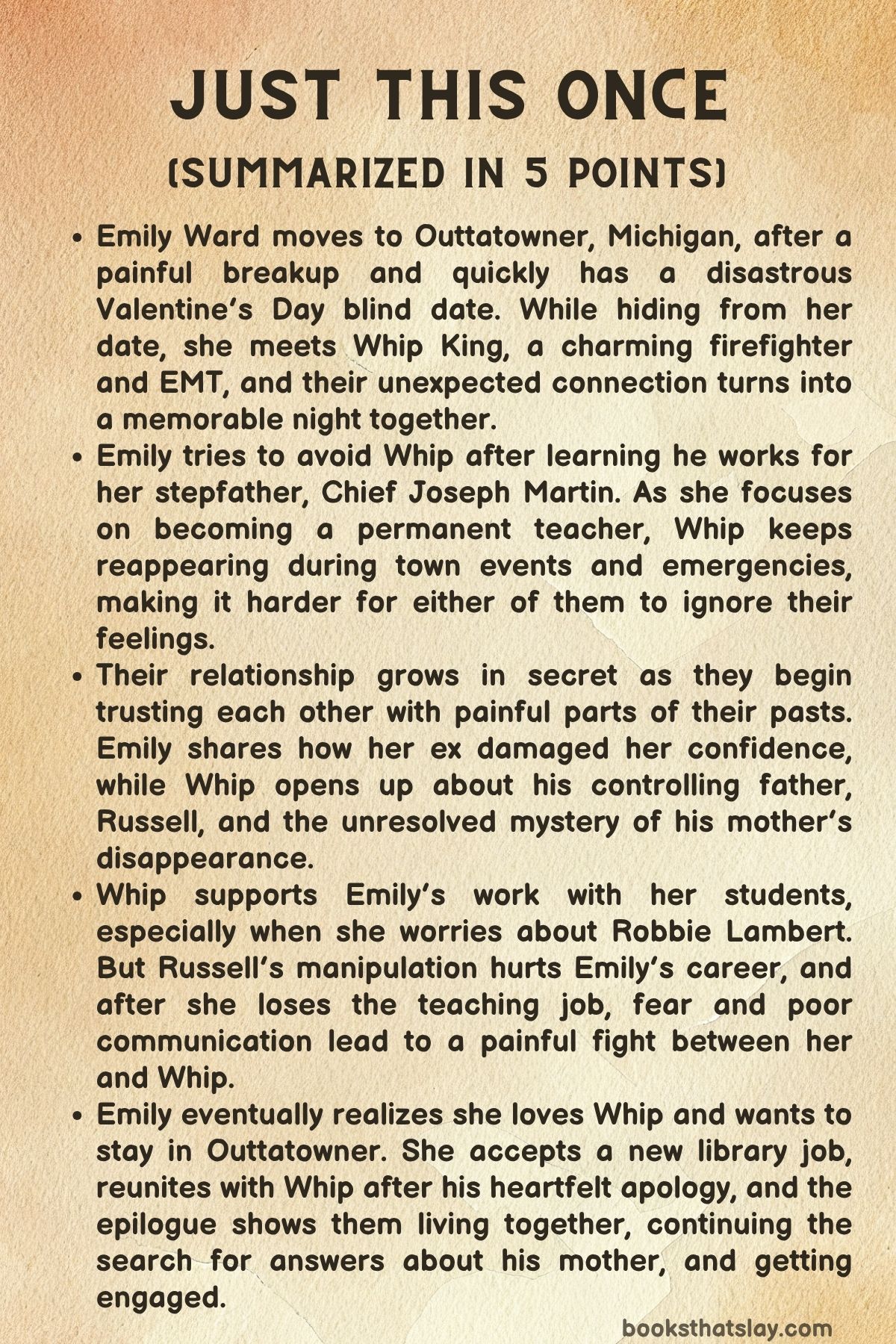
Summary
Emily Ward arrives in Outtatowner, Michigan, carrying the weight of a painful breakup and the hope that a new town might help her feel like herself again. She has left Virginia behind after being hurt by her ex, Craig, whose cheating and criticism left her doubting her worth.
Outtatowner is supposed to be a reset, but her fresh start begins in the most awkward way possible: on Valentine’s Day, her mother arranges a blind date for her with Dickie Johnson.
Dickie is exactly the kind of man Emily does not need. He is pushy, rude, and far too pleased with himself.
He talks endlessly about real estate, ignores Emily’s discomfort, and then tries to pull her into a health supplement sales scheme. Emily escapes the date and hides downtown, embarrassed, cold, and desperate for a moment of peace.
She slips into a general store, buys discounted Valentine’s candy, and ends up sitting on the floor, secretly eating chocolate while trying to recover from the disaster.
That is where Whip King finds her. He is a local firefighter and EMT, handsome, warm, and amused by her situation without making her feel small.
Their first conversation is playful and easy. They share chocolate, trade jokes, and quickly build a spark that feels natural in a way Emily has not felt in a long time.
Whip offers her a Valentine’s Day redo, and Emily, deciding to be bold for once, accepts.
Whip takes her to the Grudge Holder, a bar known for the long-running rivalry between the King and Sullivan families. In the lively bar, surrounded by local history and tension she does not yet fully understand, Emily lets herself relax.
She and Whip drink, dance, and talk. The night feels simple and exciting, far removed from the disappointment that began it.
By the end of the evening, Emily makes an impulsive choice and asks to go home with him.
They spend the night together, and for Emily it is more than a casual mistake. Whip is attentive, kind, and confident without being cruel.
But the next morning, the mood shifts when Emily realizes he is a firefighter who works under her stepfather, Chief Joseph Martin. Worried about gossip, family complications, and the effect any relationship might have on Whip’s job or her own reputation, she panics.
Instead of explaining herself, she leaves awkwardly and avoids him.
For the next two months, Emily focuses on her work as a long-term substitute teacher at Outtatowner Junior High. She wants the job to become permanent and pours her energy into her students.
Teaching gives her purpose, and she begins to feel connected to the town through the children in her classroom. One student, Robbie Lambert, worries her in particular.
His clothes and worn shoes suggest that things may be difficult at home, and Emily struggles with how to help him without embarrassing him or crossing professional boundaries.
The school year also brings frightening moments. When another student, Michael, has a serious seizure in class, Emily has to stay calm and protect the rest of her students while help arrives.
Whip responds to the emergency with his team. Emily sees him in his professional role for the first time, and the sight changes something in her.
He is calm, capable, and focused, a man who knows how to take charge when people are scared. Whip recognizes her, but he does not expose their connection while working, which shows Emily a level of respect she had not expected.
Even though Emily tries to keep her distance, Outtatowner is too small for clean avoidance. She sees Whip at the Grudge Holder and later at an emergency services awards banquet.
There, Whip learns that Emily is Chief Martin’s daughter, which helps him understand why she ran. They argue about her leaving, about the risk of being involved, and about the attraction neither of them can ignore.
Emily is afraid of damaging her chance at a permanent teaching position, while Whip is hurt that she disappeared without trusting him enough to talk.
At the same time, Emily becomes more involved in town life. She joins the Bluebird Book Club, a group of influential local women who know everyone and seem to guide much of the community’s social energy.
Through them, she helps organize events for the Outtatowner Education Foundation. These include a Mother’s Day meal event, trivia night at Abel King’s brewery, and a summer carnival.
Emily’s work on these events helps her build friendships and gives her a stronger place in the town, even as her future remains uncertain.
When Emily gives Robbie new shoes, she gets in trouble for singling him out, even though her intentions are good. Whip quietly finds a better solution.
He arranges for the fire department to donate items to every student, allowing Robbie to receive what he needs without being embarrassed. This act matters deeply to Emily.
It shows that Whip understands her heart and that he can help without making the situation about himself.
Emily and Whip begin secretly seeing each other again. What starts as physical attraction becomes emotional closeness.
They spend nights together at his house, and their conversations grow more honest. Emily tells him about Craig and the way her past relationship made her feel unwanted and not enough.
Whip shares his own pain, including the damage caused by his father, Russell King, a controlling man who uses power and manipulation to keep his family in line. Whip also carries the hurt of being abandoned by his mother, Maryann, whose disappearance has shaped his family for years.
The mystery around Maryann begins to trouble Whip more when his aunt Bug finds a box containing Maryann’s belongings, including her driver’s license. Whip and his brothers start to suspect that the story they were told about their mother may not be complete.
This discovery adds pressure to Whip’s life, forcing him to question the family history he thought he understood.
Russell King soon becomes a direct threat to Whip and Emily’s happiness. He tries to pressure Whip into influencing Emily’s mother over an issue involving the historical society.
Whip refuses to be used. Russell responds by going after Emily’s career, interfering in ways that contribute to her losing the permanent teaching job she wanted so badly.
For Emily, the loss is devastating. She has worked hard, cared deeply for her students, and begun to imagine Outtatowner as home.
Losing the job makes her feel unsteady again, as if the life she was building could disappear.
At the summer carnival, Emily and Whip are caught kissing by Chief Martin. The moment forces their relationship into the open.
Emily speaks with her father afterward, and instead of reacting with anger, he recognizes that she is an adult who has the right to make her own choices. Whip also talks with Chief Martin, who assures him that his lieutenant promotion was earned on merit and not affected by his connection to Emily.
Chief Martin gives them his blessing, removing one of Emily’s biggest fears.
Still, Emily’s career uncertainty creates distance between them. She receives a job offer across the state near Ann Arbor, and the possibility of leaving Outtatowner becomes real.
Fear and poor communication lead to a painful fight between Emily and Whip. During the argument, Whip admits that he loves her.
The confession is powerful, but it comes at a moment when both of them are scared, hurt, and unsure how to move forward.
Emily eventually realizes that she loves Whip too. More than that, she understands that Outtatowner has become home.
She does not want to keep running every time life becomes complicated. With Bug’s help, a new opportunity appears: Emily is offered the position of head librarian of the Children’s Department at the public library.
The job fits her love for children, books, and community. It gives her a way to stay without giving up the purpose she found through helping young people.
Whip, believing he may still lose her, makes a grand but sincere gesture. He organizes people around town to paint storefront windows with scenes welcoming Emily home.
The display shows her that she is wanted not only by him, but by the community she has slowly joined. When Emily and Whip meet, he apologizes and tells her he loves her.
He makes it clear that he will follow her, wait for her, or try long distance if that is what she needs. Emily tells him she is staying and that she loves him too.
By autumn, Emily has transformed the library’s Children’s Department into a safe, cheerful, active place for local kids. She and Whip are living together and building a steady life filled with love, trust, and shared purpose.
They continue looking into the truth about his mother’s disappearance, but they no longer face the future alone. One evening at home, in the life they have chosen together, Whip proposes.
Emily says yes, closing the story with the promise of a lasting future in the town where she finally found belonging.
Characters
Emily Ward
Emily Ward is the emotional center of Just This Once, and her character is shaped by the tension between wanting a fresh start and being afraid to trust that happiness can last. When she arrives in Outtatowner, Michigan, she is still carrying the pain of her breakup with Craig, whose betrayal damaged her confidence and left her questioning her own worth.
Her disastrous blind date with Dickie Johnson shows how vulnerable and displaced she feels at the beginning of the story, but it also reveals her instinct for self-protection. Emily may be wounded, but she is not passive.
She escapes an uncomfortable situation, makes her own choices, and slowly begins building a life that belongs to her rather than one defined by someone else’s rejection.
As a teacher, Emily is compassionate, observant, and deeply invested in the well-being of children. Her concern for Robbie Lambert shows that she notices the quiet struggles others may overlook, and her reaction to Michael’s seizure proves that she cares about her students beyond ordinary professional duty.
She wants the permanent teaching position not simply because she needs work, but because she wants purpose, belonging, and stability. However, her kindness also creates conflict, especially when her attempt to help Robbie leads to trouble.
This reveals one of Emily’s defining qualities: she acts from the heart, sometimes before considering how the world around her may complicate good intentions.
Emily’s relationship with Whip forces her to confront her fear of vulnerability. She is drawn to him quickly because he makes her feel seen, desired, and comfortable, yet she panics when she realizes his connection to her stepfather and the fire department.
Her decision to avoid him shows that she is afraid of risking her new life before it has fully taken shape. Over time, though, Emily grows into someone more willing to claim what she wants.
By choosing to stay in Outtatowner and accept the library position, she proves that her future is not limited to the job she lost or the pain she survived. Her arc is about reclaiming confidence, accepting love, and realizing that home can be something she actively chooses.
Whip King
Whip King is one of the most emotionally layered characters in the story because his charm, confidence, and competence hide deep wounds from his past. On the surface, he appears easygoing, flirtatious, and heroic, especially when Emily first meets him in the general store and later sees him working as a firefighter and EMT.
He is calm under pressure, capable in emergencies, and respected by those around him. However, beneath that steady public image is a man who has spent much of his life dealing with rejection, family control, and unanswered questions about his mother.
Whip’s relationship with Emily reveals his tenderness and his fear in equal measure. He is not interested in her only as a temporary romance; he notices her needs, supports her work, and helps her protect Robbie’s dignity by arranging a department-wide donation rather than allowing one student to feel singled out.
This act shows his emotional intelligence and his understanding of quiet kindness. He knows how to help without making someone feel exposed.
At the same time, Whip struggles with insecurity because he has been shaped by a father who uses control as a weapon and by a mother whose disappearance left lasting pain.
His conflict with Russell King is central to his development. Russell tries to manipulate Whip, expecting obedience and using family pressure to get what he wants.
Whip’s refusal marks a major moment of strength because he chooses integrity over fear. The discovery of Maryann’s belongings also pushes him toward a deeper reckoning with his family history.
His love for Emily becomes part of this growth, not because she fixes him, but because she gives him a relationship where honesty, loyalty, and emotional safety are possible. By the end, Whip’s proposal shows that he is no longer simply surviving the damage of his past.
He is actively building a future based on love, trust, and chosen family.
Dickie Johnson
Dickie Johnson functions as an early contrast to Whip and helps establish what Emily is trying to escape in her new life. He is pushy, self-absorbed, and inappropriate, turning what should be a simple Valentine’s Day blind date into an uncomfortable experience centered entirely on his own interests.
His endless talk about real estate and his attempt to recruit Emily into selling health supplements show that he does not truly see her as a person. Instead, he treats the date as an opportunity to promote himself and his schemes.
Dickie’s importance lies less in emotional depth and more in what he reveals about Emily’s situation. At the start of the story, Emily is still trying to be polite, still trying to adjust, and still vulnerable after her breakup.
Dickie’s behavior forces her to choose herself in a small but meaningful way. Her decision to leave the date and hide from him becomes a turning point that leads her directly to Whip.
In this way, Dickie represents the wrong kind of attention: loud, selfish, and invasive. His presence makes Whip’s warmth and attentiveness stand out even more clearly.
Chief Joseph Martin
Chief Joseph Martin is an authority figure, a father figure, and a moral checkpoint in the story. As Emily’s stepfather and Whip’s superior, he creates one of the main complications in Emily and Whip’s relationship, even when he is not actively trying to interfere.
Emily’s fear after discovering Whip works under him shows how much she worries about consequences, reputation, and the fragile life she is trying to build in Outtatowner. Chief Martin’s position gives emotional weight to the romance because the relationship is not happening in isolation; it affects family, work, and community.
Despite the tension his role creates, Chief Martin is ultimately portrayed as fair and grounded. When he catches Emily and Whip kissing, the situation could easily become controlling or judgmental, but his later conversations show that he respects Emily’s adulthood.
He accepts that she can make her own decisions, even if those decisions involve someone from his department. His conversation with Whip is equally important because he confirms that Whip’s promotion was earned on merit.
This reassures Whip and separates professional respect from personal complications.
Chief Martin’s character represents responsible authority. He does not exist merely to block the romance; instead, he helps both Emily and Whip move past fear.
His acceptance gives Emily room to stop treating love as something forbidden, and his approval gives Whip confirmation that he is valued for his own work rather than because of favoritism or family connections. He is a stabilizing presence in a story filled with emotional uncertainty.
Robbie Lambert
Robbie Lambert is a quiet but significant character because he brings out Emily’s protective instincts and reveals the social awareness at the heart of her teaching. His worn clothes and shoes suggest that he may be struggling at home, and Emily’s attention to these details shows that she is the kind of educator who sees more than grades and classroom behavior.
Robbie does not need to be loud or central to the plot to matter; his presence gives the story emotional realism by showing how children can carry hardship silently.
Through Robbie, the story explores dignity and care. Emily wants to help him, but the consequences of giving him shoes show that good intentions can become complicated within institutions.
Whip’s solution, arranging donations for every student, protects Robbie from embarrassment while still meeting his need. This makes Robbie important to both Emily and Whip’s development.
For Emily, he represents the reason she wants to teach and the kind of child she wants to protect. For Whip, helping Robbie becomes a way to show love for Emily while also serving the wider community.
Robbie also helps deepen the story’s idea of home. Outtatowner is not just a romantic setting for Emily; it becomes a place where she can care for children, form connections, and eventually transform the library into a safe space.
Robbie’s role points toward Emily’s eventual future in the Children’s Department, where her gift for noticing and nurturing children can continue even after she loses the teaching job.
Michael
Michael’s role is brief but important because his seizure allows the story to show Emily and Whip under pressure. For Emily, the emergency reveals her concern and fear as a teacher responsible for her students’ safety.
She is not detached from the children in her care; she reacts with genuine worry and seriousness. This moment reinforces that Emily’s commitment to teaching is emotional as well as professional.
For Whip, Michael’s seizure becomes a defining professional moment. Emily sees him not as the charming man from Valentine’s Day, but as a calm, capable EMT who knows how to respond in a crisis.
His composure gives her a new understanding of him and complicates her attempt to avoid him. Michael therefore serves as a bridge between Emily’s personal and professional worlds.
Through him, the story allows Emily to witness Whip’s competence, compassion, and steadiness in a way that flirting alone could never reveal.
Craig
Craig is Emily’s former partner, and although he is not physically central to the present action, his influence shapes much of Emily’s emotional journey. His cheating wounded Emily deeply and made her feel inadequate, leaving her with doubts that follow her to Michigan.
Craig represents the old life Emily is trying to leave behind: a life where love made her feel replaceable rather than cherished. The damage he caused explains why Emily is cautious with Whip even when her feelings are obvious.
Craig’s importance comes from the emotional shadow he casts. Emily’s fear of being hurt again does not come from nowhere; it is rooted in betrayal and humiliation.
Because Craig made her question herself, Whip’s genuine affection feels both healing and frightening. Emily has to learn that Whip is not Craig and that a new relationship does not have to repeat the pain of the old one.
In this sense, Craig functions as a symbol of emotional insecurity, while Emily’s eventual choice to love Whip shows that she has begun to move beyond the version of herself Craig left behind.
Russell King
Russell King is one of the strongest antagonistic forces in the story because his power comes through manipulation rather than open violence. As Whip’s father, he has shaped much of Whip’s pain, teaching him that family can be controlling, conditional, and emotionally unsafe.
Russell’s influence explains why Whip struggles with old wounds and why his relationship with Emily carries such emotional stakes. Whip is not only falling in love; he is also learning to resist the patterns of control that have defined his family life.
Russell’s attempt to use Whip to influence Emily’s mother over a historical society issue reveals his selfishness and entitlement. He expects people around him to serve his interests, and when Whip refuses, Russell retaliates by interfering with Emily’s career.
This makes him especially cruel because he targets something meaningful to Emily in order to punish Whip. His actions show that he understands people’s vulnerabilities and is willing to exploit them.
As a character, Russell represents the destructive side of legacy and family power. The King name carries history in Outtatowner, but Russell uses that history as leverage rather than responsibility.
His behavior stands in direct contrast to Whip’s growing integrity. Where Russell manipulates, Whip protects.
Where Russell controls, Whip learns to love freely. Russell’s role is essential because he forces Whip to choose what kind of man he wants to become.
Maryann King
Maryann King is an absent character whose presence is felt through mystery, grief, and unanswered questions. As Whip’s mother, her disappearance left a wound that shaped him and his brothers.
For much of Whip’s life, her absence seems to have been explained in a way that left him feeling abandoned, but the discovery of her belongings suggests that the truth may be more complicated. This makes Maryann both a personal figure and part of a larger family mystery.
Her belongings, especially the driver’s license, become symbols of hidden truth. They challenge the story Whip was given and open the possibility that his pain has been built on incomplete or manipulated information.
Maryann’s role is important because she represents the past refusing to stay buried. Even though she is not actively present, she influences Whip’s emotional development by forcing him to question what he knows about his family.
Maryann also deepens the contrast between abandonment and chosen love. Whip’s fear of losing Emily is intensified by the loss of his mother, whether that loss came through abandonment, disappearance, or something darker.
By continuing to investigate Maryann’s disappearance in the epilogue, Whip and Emily show that love does not erase the past, but it can give someone the strength to face it.
Bug
Bug is a catalyst for truth and change within the King family storyline. As Whip’s aunt, she has a close enough connection to the family to uncover meaningful pieces of the past, and her discovery of Maryann’s belongings pushes Whip and his brothers into questioning the story they have been told.
Bug’s role may seem practical at first, but it carries emotional weight because she helps reopen a mystery that directly affects Whip’s identity.
Bug also plays an important role in Emily’s future. By helping Emily receive the job as head librarian of the Children’s Department, she becomes part of Emily’s transition from disappointment to renewed purpose.
Emily loses the teaching position, but Bug helps open another path that still allows her to care for children and belong in Outtatowner. This makes Bug a quietly powerful figure in the book, because she helps uncover the past while also supporting the future.
Her character represents the importance of community networks, especially the kind of influence that operates behind the scenes. Bug is not defined by dramatic speeches or public power, but by meaningful action.
She helps people find what they need, whether that is a clue, an opportunity, or a way forward.
Emily’s Mother
Emily’s mother is important because she is tied to both Emily’s new beginning and the social life of Outtatowner. By setting Emily up on the blind date with Dickie Johnson, she unintentionally starts the chain of events that leads Emily to Whip.
The date itself is a disaster, but it places Emily in the right emotional and physical space for a more meaningful encounter. This makes Emily’s mother indirectly responsible for one of the story’s most important turning points.
She is also connected to the historical society issue that Russell King tries to manipulate through Whip. This places her within the town’s network of influence and conflict, showing that Outtatowner is a place where family, history, and community politics are closely intertwined.
Though she is not as central as Emily or Whip, her role helps create the conditions that test the couple’s relationship.
As Emily’s mother, she represents both care and complication. Her actions suggest that she wants Emily to move on and find happiness, but her involvement also reflects the way family can unintentionally pressure someone who is trying to rebuild.
Her presence adds another layer to Emily’s struggle to become independent while still remaining connected to family.
Abel King
Abel King contributes to the wider King family presence in Outtatowner and represents the more communal, welcoming side of the family name. His brewery becomes one of the locations connected to the fundraising efforts for the Outtatowner Education Foundation, especially the trivia night.
This places him within the town’s social and charitable life, contrasting with Russell King’s more manipulative use of influence.
Although Abel is not as emotionally central as Whip or Russell, his role helps show that the King family is not defined by one person. The family contains conflict, history, rivalry, and community ties.
Abel’s brewery provides a gathering place, and his involvement in town events reinforces the story’s emphasis on local relationships. He helps build the sense that Outtatowner is a living community where businesses, families, and social causes overlap.
Themes
Healing After Emotional Betrayal
Emily’s move to Outtatowner is not just a change of place; it is her attempt to rebuild the confidence that was damaged by Craig’s betrayal. Her past relationship left her feeling replaceable, inadequate, and unsure of her own judgment, which explains why she hesitates whenever her feelings for Whip become serious.
Her fear is not simply about romance going wrong again, but about losing the fragile sense of control she has worked hard to regain. The disastrous blind date at the beginning highlights how vulnerable she still feels, while her growing bond with Whip slowly teaches her that trust can be rebuilt through patience, honesty, and emotional safety.
In Just This Once, healing is shown as uneven rather than instant. Emily still runs, avoids difficult conversations, and assumes the worst when she feels threatened.
Yet her choice to stay, accept love, and build a new life proves that recovery is not about forgetting pain, but about refusing to let past hurt decide the future.
Found Family and Community Belonging
Outtatowner becomes more than a setting because it gives Emily the kind of support system she did not know she needed. At first, she arrives as an outsider trying to prove herself through work and independence, but the town gradually makes room for her through friendship, humor, shared traditions, and collective care.
The Bluebird Book Club, the school events, the fundraisers, the fire department, and even the public library all show how community can become a source of identity. Emily’s connection to Robbie also reflects this theme because her concern for him goes beyond professional duty; it shows her desire to protect children who may feel unseen.
Whip’s public gesture with the painted storefront windows confirms that belonging is not only private affection but also communal acceptance. The town welcomes Emily not because she is perfect, but because she participates, cares, and chooses to stay.
Her final role at the library completes this movement from newcomer to someone who helps create safety and joy for others.
Love as Courage and Choice
Emily and Whip’s relationship is built on strong attraction, but the deeper theme is the courage required to choose love despite risk. Both characters have reasons to protect themselves.
Emily fears repeating the humiliation and emotional damage of her previous relationship, while Whip carries the wounds of abandonment, family control, and uncertainty about his mother. Their secrecy shows how fear can make love feel dangerous, especially when careers, family expectations, and town gossip are involved.
Yet their relationship grows because they repeatedly see the best in each other during moments of pressure. Whip supports Emily’s care for Robbie without embarrassing the child, and Emily sees Whip not only as charming but as dependable, generous, and emotionally sincere.
Their conflict near the end matters because love cannot survive only through chemistry; it needs honesty, apology, and clear commitment. Whip’s willingness to follow, wait, or try long distance proves that love becomes meaningful when it is chosen freely, not when circumstances are easy.
Breaking Free from Control and Fear
Control appears in different forms throughout the story, especially through Russell King’s influence over Whip and the indirect damage he causes to Emily’s career. Russell represents a kind of power that depends on manipulation, pressure, and emotional intimidation.
Whip’s refusal to obey him marks an important shift because it shows him rejecting the family patterns that have shaped much of his life. Emily also faces control in a more internal way.
Her fear of judgment, failure, and heartbreak often pushes her to run before she can be rejected. Both characters must learn that freedom requires more than leaving painful situations; it requires making choices without letting fear speak louder than truth.
The mystery surrounding Whip’s mother adds another layer, suggesting that buried family history can continue shaping people until it is confronted. By the end, Emily and Whip are not free because every problem has disappeared.
They are free because they stop allowing fear, secrecy, and other people’s control to define their future.