Killing Me Softly Summary, Characters and Themes
Killing Me Softly by Sandie Jones is a psychological thriller about guilt, marriage, and the lies people tell to protect themselves. At its center is Freya Adams, a woman whose life begins to fall apart after one reckless night changes everything.
What starts as jealousy at a dinner party grows into a chain of deception, suspicion, and revenge. The story follows Freya and her husband Charlie as they try to escape the consequences of a hit-and-run, only to find that the past keeps closing in. Dark, tense, and full of shifting loyalties, the book explores how fear can turn ordinary lives into something dangerous.
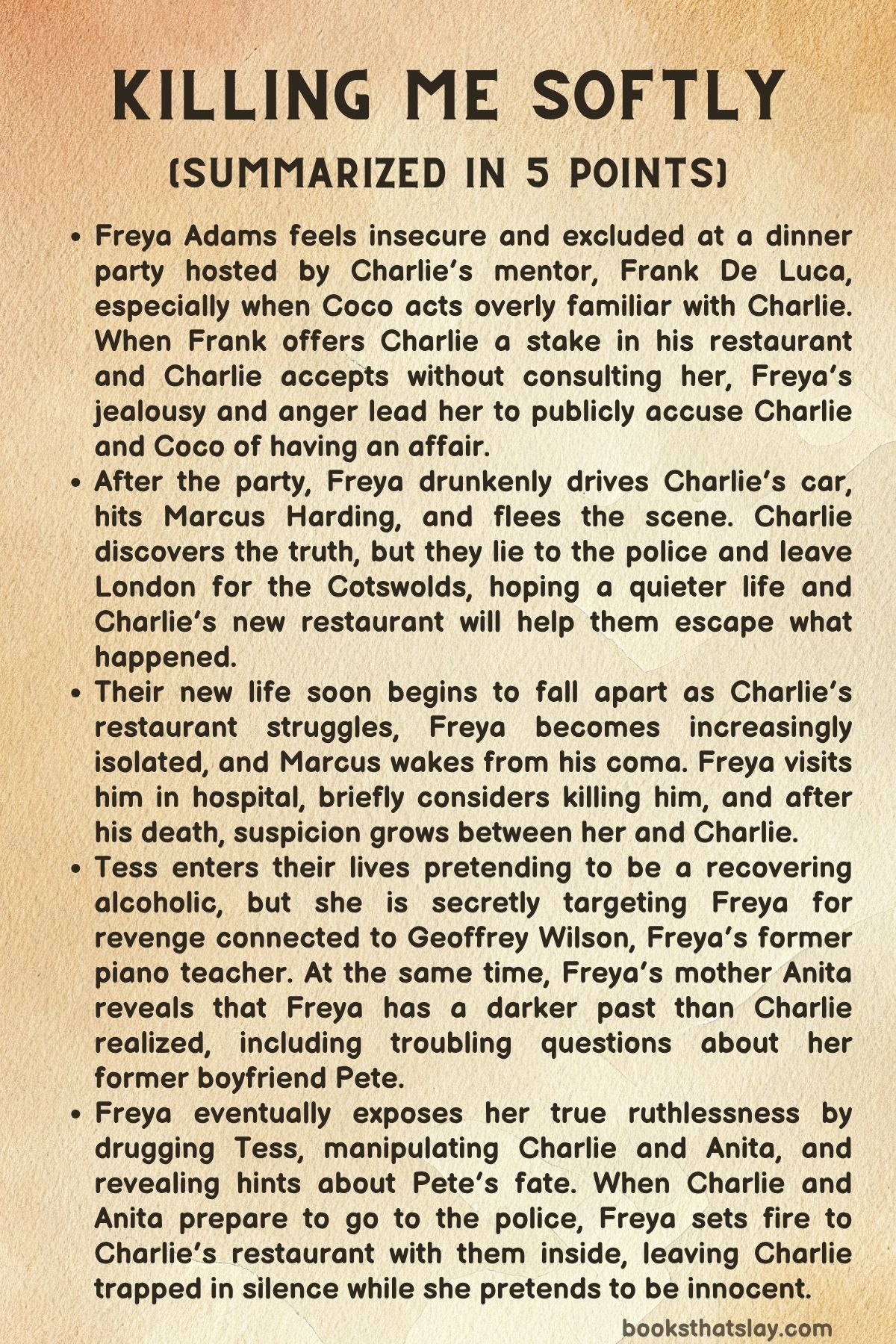
Summary
Freya Adams enters Frank De Luca’s grand Regent’s Park home feeling uncomfortable before the evening has even begun. Frank is a celebrated chef and Charlie’s former mentor, and his wife Coco carries herself with the confidence of someone used to wealth and attention.
Freya notices almost immediately that Coco seems too familiar with Charlie. Her possessive manner unsettles Freya, who already feels out of place among the rich guests and polished surroundings.
The evening becomes worse when Frank announces that Charlie is being offered a ten-percent share in Indigo, his restaurant. Charlie accepts at once, thrilled by the opportunity.
Freya is stunned and hurt that he did not talk to her first. To her, the decision is not simply professional.
It will affect their marriage, their finances, and their future. Charlie’s quick acceptance makes her feel pushed aside.
Freya and Charlie argue privately in the bathroom. Their anger briefly gives way to passion, and for a moment it seems they might recover from the tension of the evening.
But Freya soon notices signs that Charlie has been to Frank and Coco’s house before, even though he acted as if the visit was new to him. Her suspicions deepen when she overhears Charlie and Coco speaking in secret.
Already drunk and angry, she convinces herself that the two are having an affair.
Freya loses control and accuses Charlie and Coco in front of everyone, including Frank, the other guests, and Coco’s young daughter, Luciana. Charlie denies the accusation, but Freya is humiliated and furious.
She storms out of the house. The evening ends in chaos, but the real damage has only begun.
The next morning, police arrive at Freya and Charlie’s home. Charlie’s car has been involved in a hit-and-run.
A man named Marcus Harding has been left critically injured. Freya lies to the officers, claiming that she and Charlie returned home together by taxi and that the car must have been stolen.
After the police leave, Charlie appears with a head wound, and the truth comes out between them.
After Freya’s public accusation, Frank punched Charlie and threw him out. Freya, drunk and enraged, drove away in Charlie’s car.
On the way home, she hit Marcus and fled the scene. Charlie knows what happened, but he chooses to protect her.
Together, they hold on to the lie. They leave London, move to the Cotswolds, give up drinking, and try to start again.
Charlie opens a restaurant called the Fork, and they attempt to build a quieter, cleaner life far from the wreckage of that night.
Months pass, but the new life does not bring peace. Charlie’s restaurant struggles financially.
Freya feels lonely and trapped. Their marriage is strained by guilt, secrecy, and mistrust.
Marcus remains in a coma, a silent threat hanging over them. Both Freya and Charlie know that if he wakes and remembers what happened, their carefully built lie may collapse.
Freya and Charlie attend an alcohol-support meeting, where they meet Tess, a woman who presents herself as another recovering alcoholic. Tess seems sympathetic and understanding, and she slowly becomes involved in both their lives.
Freya welcomes the attention because she is isolated, while Charlie later reconnects with Tess in London. Tess quietly begins gathering information from each of them and encouraging the cracks already forming in their marriage.
When Marcus wakes from his coma and starts communicating, Freya is terrified. She visits him in hospital, hoping to learn what he remembers.
Her fear turns dark, and she briefly considers killing him to protect herself. Soon after, Marcus dies.
His death removes one immediate danger, but it does not free Freya. Instead, the atmosphere around her grows more unstable.
She becomes increasingly suspicious of Charlie, and Charlie begins to see sides of Freya that disturb him.
At the same time, Freya becomes involved in what appears to be a charity case. She is drawn into the story of a sick child named Harry and a mother named Maria who supposedly needs help.
Freya believes she is doing something meaningful, but the situation proves false. Maria does not exist, and charity money has been stolen.
The deception leaves Freya shaken and angry, and she begins to suspect that Charlie and Tess may be working together against her.
Charlie is also under pressure from Freya’s mother, Anita. Anita has long known that something is wrong with her daughter.
She suspects the truth about Marcus and begins warning Charlie that Freya is not the person he thinks she is. Anita tells him that Freya has always been dangerous and manipulative.
She also reveals a troubling detail about Freya’s former boyfriend, Pete. Freya had claimed Pete left for Australia, but Anita says that could not be true because Freya had his passport.
Charlie begins to fear that Pete did not leave at all, and that Freya may have been responsible for his disappearance.
The story also reveals that Tess has not entered Freya’s life by chance. Tess is connected to Geoffrey Wilson, Freya’s former piano teacher.
Years earlier, Freya accused Geoffrey of assault, and the accusation ruined his life. Tess believes Freya destroyed him and has been targeting her as revenge.
Her friendship with Freya and her connection with Charlie are part of a calculated plan to expose Freya and make her suffer.
Freya eventually discovers who Tess really is. When she confronts her, the mask between them drops.
Freya responds with cold calculation. She drugs Tess with wine and pills, intending to make Tess’s death look like suicide.
By this point, Freya is no longer simply a frightened woman trying to escape one mistake. She has become someone willing to remove anyone who threatens her.
Charlie and Anita decide they must go to the police. They believe Freya must be exposed not only for Marcus’s hit-and-run but also for what may have happened to Pete and Tess.
Before they can act, Freya confronts them. She gives away enough to show her lack of remorse.
When Pete is mentioned, she suggests that his fate depends “on the tide,” implying something terrible happened to him and that the sea may be hiding the evidence.
Freya also tries to manipulate Charlie with a fake pregnancy, but he has already seen through it. He reveals that he turned off the water supply and checked the pregnancy test she used, proving she lied.
The moment strips away another layer of Freya’s control. Charlie now understands that much of their marriage has been built on deception, fear, and emotional manipulation.
Cornered, Freya runs. But instead of disappearing quietly, she chooses destruction.
She sets fire to Charlie’s restaurant while Charlie and Anita are inside. An explosion follows, leaving the outcome uncertain and terrifying.
In the hospital afterward, Charlie is conscious but unable to speak. He hears police discussing Tess Phillips’s death and wanting to question Anita.
Freya is downstairs, playing the role of the anxious wife and daughter. Charlie understands the horror of his position.
He knows the truth about Freya, but he cannot yet tell anyone. She may still control the story.
She may still escape justice. The book ends with that chilling uncertainty, leaving Charlie trapped in silence while Freya performs innocence for the world.
Characters
Freya Adams
Freya Adams is the central and most disturbing character in Killing Me Softly, because she begins as someone who appears insecure, wounded, and emotionally neglected, but gradually reveals herself to be far more dangerous than she first seems. At the dinner party, her discomfort feels understandable: she is surrounded by wealth, status, and people who seem to know more about her husband’s life than she does.
Her jealousy of Coco and anger at Charlie’s decision to accept Frank’s offer without consulting her make her seem like a hurt wife who has been pushed too far. However, the story slowly shows that Freya’s emotions are not simply the result of insecurity.
She is impulsive, possessive, and capable of turning fear into cruelty. Her drunk driving after the dinner party and her decision to flee after hitting Marcus reveal her instinct for self-preservation, while her later lies show that guilt does not truly reform her.
As the book develops, Freya becomes increasingly manipulative. She is not only afraid of being exposed; she is also determined to control the people around her.
Her visits to Marcus in hospital show the depth of her moral collapse, especially because she briefly considers harming a helpless man to protect herself. Her relationship with Charlie becomes a battlefield of suspicion, lies, and emotional blackmail.
The fake pregnancy is especially revealing because it shows how she uses intimacy and vulnerability as tools. By pretending to be pregnant, she tries to trap Charlie emotionally and prevent him from acting against her.
Freya’s past also reshapes how the reader understands her. Anita’s revelations about Pete and Geoffrey Wilson suggest that Freya has a long history of destroying lives when she feels threatened or rejected.
By the end, Freya is not merely a flawed or frightened woman; she is a calculating survivor whose charm and victimhood disguise a frightening absence of conscience.
Charlie Adams
Charlie Adams is a morally conflicted character whose weakness allows much of the tragedy to unfold. At first, he appears to be an ambitious husband trying to build a better future.
His connection to Frank and the opportunity at Indigo suggest that he wants professional success and validation from a powerful mentor. However, his failure to discuss the restaurant stake with Freya shows a lack of emotional honesty in the marriage.
He wants to make major decisions quickly and avoid confrontation, which creates resentment and mistrust. His secrecy about having been to Frank and Coco’s house before also makes him seem unreliable, even before the deeper crimes emerge.
Charlie’s greatest weakness is his willingness to protect Freya after the hit-and-run. Although he knows what she has done, he chooses to lie with her, which binds him to her crime and traps him inside her world.
This decision may come from love, shock, fear, or guilt, but it marks the moment when he sacrifices his moral independence. Later, Charlie becomes more sympathetic because he seems genuinely frightened by Freya and increasingly aware that she is capable of terrible things.
His suspicions about Pete, his conversations with Anita, and his discovery of the fake pregnancy show that he is finally trying to see the truth clearly. Even so, his earlier passivity has consequences.
By the final scenes, Charlie becomes almost tragically powerless: he survives, but he cannot speak, while Freya performs innocence around him. His character shows how denial, fear, and misplaced loyalty can make a person complicit in evil.
Frank De Luca
Frank De Luca represents power, status, and masculine authority in the book. As Charlie’s famous chef-mentor, he is someone Charlie admires and wants to impress.
His grand home, successful career, and public generosity make him seem like a figure of influence, but his behavior also reveals aggression and pride. By announcing Charlie’s ten-percent stake in Indigo during dinner, Frank turns a private career decision into a public performance.
He controls the room and forces Charlie into a position where refusal would be difficult. This suggests that Frank enjoys power not only in business but also socially.
Frank’s reaction to Freya’s accusation is also important. When Freya publicly claims that Charlie and Coco are having an affair, Frank’s anger turns physical, and he punches Charlie before throwing him out.
This moment shows that Frank’s polished world is fragile beneath the surface. He values control, reputation, and possession, and when these are threatened, he responds violently.
Frank is not explored as deeply as Freya or Charlie, but he plays a crucial role in triggering the disaster. His dinner party becomes the setting where jealousy, ambition, secrecy, and humiliation explode.
Coco De Luca
Coco De Luca is presented through Freya’s suspicious and jealous perspective, which makes her feel threatening from the beginning. She behaves possessively toward Charlie, and her closeness with him makes Freya feel excluded and humiliated.
Coco belongs to the wealthy, polished world that Freya finds intimidating, and this makes her more than just a romantic rival in Freya’s mind. She represents everything Freya fears she cannot compete with: beauty, status, confidence, and access to Charlie’s professional life.
However, Coco’s role is also shaped by misunderstanding and projection. Freya assumes that Coco and Charlie are having an affair, but the deeper issue is that Freya cannot tolerate uncertainty.
Coco becomes the object of Freya’s insecurity, even though the truth of the situation is more complicated than Freya’s drunken accusation suggests. Coco’s presence at the dinner party helps expose the fragility of Freya and Charlie’s marriage.
She may not be the main cause of the tragedy, but she becomes the spark that ignites Freya’s jealousy and sends the story toward violence and deception.
Luciana
Luciana is Coco’s young daughter, and although she is a minor character, her presence at the dinner party matters because she highlights the ugliness of the adult conflict around her. Freya’s public accusation happens in front of Luciana, which makes the scene more uncomfortable and damaging.
The fact that a child witnesses this humiliation shows how reckless and uncontrolled Freya has become. Luciana represents innocence caught inside the selfish behavior of adults.
Her role also sharpens the contrast between appearance and reality. The De Luca home appears grand, elegant, and socially superior, but Luciana’s presence reminds the reader that the consequences of adult secrets are not limited to the adults themselves.
She is not responsible for the conflict, yet she is exposed to it. In this way, Luciana functions as a quiet symbol of collateral damage.
Marcus Harding
Marcus Harding is one of the most tragic figures in the story because he becomes the victim of Freya’s crime and Charlie’s silence. He is not harmed because of anything he has done to the main characters; he is simply struck by Freya during her drunken escape from the dinner party.
His suffering exposes the moral emptiness of Freya and Charlie’s decision to protect themselves. While they move away and try to rebuild their lives, Marcus remains in a coma, physically carrying the consequences of their lie.
Marcus’s later awakening creates fear rather than compassion in Freya. To an innocent person, his recovery would be a hopeful event, but to Freya it is a threat.
This reaction reveals how completely self-interest has replaced conscience in her mind. His eventual death deepens the darkness of the book because it removes the person who might have exposed the truth, while also making the crime feel even more irreversible.
Marcus is important not because he is active in the plot, but because his suffering becomes the moral center of the story. He represents the human cost of Freya and Charlie’s deception.
Tess Phillips
Tess Phillips is one of the most manipulative and strategic characters in Killing Me Softly. She enters the story pretending to be a recovering alcoholic, which allows her to gain access to Freya and Charlie at a vulnerable point in their lives.
Her false identity is powerful because she appears to offer understanding and emotional support, but she is actually gathering information and deepening the cracks in their marriage. She plays both sides carefully, reconnecting with Charlie while also befriending Freya and encouraging her suspicions.
Tess is not simply a random deceiver; she has a personal motive rooted in the past. Her connection to Geoffrey Wilson gives her revenge plot emotional force.
She believes Freya destroyed Geoffrey’s life through an accusation, and she targets Freya as punishment. This makes Tess both a villain and a kind of avenger.
Her actions are cruel and dishonest, but they are driven by a belief that Freya deserves exposure. Tess’s tragedy lies in underestimating Freya.
She thinks she is manipulating a guilty woman, but she does not fully grasp how dangerous Freya can be when cornered. Her death shows that even a careful manipulator can become a victim when facing someone with fewer moral limits.
Anita
Anita, Freya’s mother, is a crucial character because she helps reveal the truth about Freya’s past. At first, her suspicions about Marcus make her seem like an interfering or watchful parent, but she gradually becomes one of the few people willing to confront what Freya really is.
Her conversation with Charlie changes the direction of the story because it gives him a new way to understand his wife. Anita’s claim that Freya has always been dangerous and manipulative suggests that Freya’s behavior is not a sudden breakdown caused by stress, alcohol, or marital problems.
It is part of a deeper pattern.
Anita’s role is emotionally complicated because she is not only exposing Freya; she is exposing her own daughter. This makes her position painful and morally serious.
She appears to carry the burden of knowing or suspecting terrible things for a long time. Her warning about Pete and the passport helps Charlie understand that Freya may have been hiding far worse crimes than the hit-and-run.
By choosing to act with Charlie, Anita becomes a threat to Freya. This places her directly in danger and leads to the final act of violence at the restaurant.
Anita represents the voice of buried truth finally rising to the surface.
Pete
Pete is an absent but highly important character because his mysterious fate reveals the darkness of Freya’s past. Freya claims that he left for Australia, but Anita’s revelation that Freya had his passport destroys that explanation.
Pete’s absence becomes more frightening than his presence would have been, because it suggests that Freya may have eliminated him and then built a lie around his disappearance. He becomes part of the pattern that Charlie begins to recognize: people who threaten Freya, reject her, or expose her may not simply leave her life safely.
Pete’s character matters because he changes the scale of Freya’s danger. Before the truth about him emerges, Freya might be seen as someone who committed one terrible act and became trapped by it.
Pete’s story suggests something much worse. It implies that Freya may have been capable of violence long before Marcus, Tess, or the fire at the Fork.
His fate, hinted at through Freya’s chilling reference to the tide, makes him one of the most haunting figures in the story despite his limited direct presence.
Geoffrey Wilson
Geoffrey Wilson is another absent character whose ruined life has major consequences for the plot. As Freya’s former piano teacher, he is connected to one of the most serious accusations in her past.
Tess’s motive is tied to him, because she believes Freya destroyed him by accusing him of assault. Whether the full truth of that past event is known or not, Geoffrey’s life becomes evidence of the destructive power Freya may have had even before her marriage to Charlie.
Geoffrey is important because he widens the moral history of the story. His fate suggests that Freya’s manipulation may not be limited to physical violence; she may also be capable of destroying reputations, relationships, and futures through accusation and deception.
Through Geoffrey, the book explores how one person’s lie, if it was a lie, can echo across years and create new cycles of revenge. Tess’s actions are born from this old wound, which means Geoffrey’s ruined life indirectly drives much of the later conflict.
Harry
Harry is the sick child connected to the charity case that draws Freya into another layer of deception. His role is emotionally important because illness and vulnerability are used to create sympathy and trust.
Freya becomes involved in the charity situation believing that she is helping someone in need, and this briefly places her in a position that appears compassionate. However, the discovery that the case has been manipulated and that money has been stolen adds to the atmosphere of fraud and mistrust surrounding the characters.
Harry’s presence also reflects one of the story’s larger ideas: vulnerability can be exploited. Whether through illness, addiction, marriage, grief, or guilt, people in the book use weakness as a way to gain access to others.
Harry himself is not the manipulator; rather, the idea of his suffering is used by others. This makes him a symbol of innocence being turned into a tool for deception.
Maria
Maria is the supposed mother in the charity case involving Harry, but she is later revealed to be fake. Her role adds another layer of uncertainty to Freya’s world.
Just as Freya lies, Tess lies, and Charlie hides the truth, the Maria deception shows that false identities and invented stories are everywhere. The fake charity case increases Freya’s paranoia and makes her suspect that Charlie and Tess may be working together against her.
Maria’s importance lies less in her personal depth and more in what she contributes to the atmosphere of the story. She represents the way appearances can be manufactured to manipulate sympathy.
The false mother figure also mirrors distorted family relationships elsewhere in the book, especially between Freya and Anita. Through Maria, the story reinforces the idea that trust has become almost impossible because every emotional appeal may be part of a trap.
Themes
Guilt and the Cost of Concealment
Guilt controls the lives of Freya and Charlie after the hit-and-run, even when they try to escape it by moving away and starting again. Their decision to lie to the police does not protect their marriage; it poisons it.
The move to the Cotswolds, the promise to stop drinking, and the attempt to build a quieter life all become acts of avoidance rather than healing. In Killing Me Softly, guilt is shown as something that cannot be buried simply because the people involved agree to remain silent.
Marcus’s survival, his later ability to communicate, and the possibility that he may reveal the truth turn the past into a constant threat. Freya’s guilt is mixed with fear and self-preservation, while Charlie’s guilt becomes moral pressure.
Their shared secret binds them together, but it also destroys trust between them. The longer they hide the truth, the more serious their choices become, until concealment leads to further manipulation, violence, and death.
Marriage, Trust, and Betrayal
Freya and Charlie’s marriage is already fragile before the crime occurs, and the hit-and-run only exposes how weak their trust has become. Freya feels excluded when Charlie accepts Frank’s offer without consulting her, while Charlie’s secrecy about his earlier connection to the house makes her feel deceived.
Her public accusation of an affair shows how quickly insecurity can turn into humiliation and rage. After the accident, their relationship becomes less like a partnership and more like a tense agreement built around fear.
They protect each other at first, but that protection is not rooted in love as much as mutual danger. Charlie’s later connection with Tess deepens Freya’s suspicion, while Freya’s lies about pregnancy and her past make Charlie question everything he knows about her.
The marriage becomes a battlefield where truth is used only when it is useful. Betrayal is not limited to infidelity; it appears in secrecy, emotional manipulation, cowardice, and the refusal to be honest when honesty is most needed.
Manipulation and False Identity
Many characters survive by controlling what others believe, and the result is a world where appearances are rarely reliable. Freya presents herself as a worried wife, a victim of circumstances, and later a woman trying to repair her life, but her actions reveal a far colder and more dangerous nature.
Tess also uses false identity as a weapon, entering Freya and Charlie’s lives under the cover of recovery and friendship while secretly pursuing revenge. The fake charity case involving Maria and Harry expands this theme by showing how easily sympathy can be exploited.
People believe what they are emotionally prepared to believe: Freya believes Charlie may betray her, Charlie believes Freya may still be worth protecting, and Tess believes revenge can correct past harm. Manipulation works because it feeds on fear, guilt, loneliness, and pride.
The novel repeatedly shows that false identity is not only about fake names or invented stories; it is also about performing innocence, vulnerability, devotion, or concern in order to control another person’s choices.
Power, Class, and Social Insecurity
The dinner at Frank and Coco’s home establishes a world of status, wealth, and influence that immediately unsettles Freya. The grand house, the famous chef, the restaurant opportunity, and Coco’s confidence all make Freya feel small and excluded.
Charlie’s acceptance of the stake in Indigo intensifies this insecurity because it suggests he is being drawn into a world where she has little control. Her discomfort is not only jealousy; it is also fear of being replaced socially and emotionally.
Frank’s power over Charlie’s career creates an imbalance, while Coco’s possessiveness makes Freya feel judged and threatened. Later, Charlie’s failed restaurant shows the pressure behind ambition and the shame attached to financial failure.
Status becomes something characters chase, protect, resent, or weaponize. Freya’s anger grows partly from feeling powerless in rooms where other people seem richer, smoother, and more important.
The story presents class insecurity as emotionally dangerous because it can turn private fear into public humiliation, suspicion, and destructive decisions.