No Man’s Land Summary, Characters and Themes
No Man’s Land by Richard Morgan is a dark supernatural adventure set in a Britain transformed by the return of the Forest, a dangerous realm haunted by the Huldu, Fae-like beings who steal children and replace them with changelings. At its center is Duncan Silver, a hardened woodsman who survives by entering this hostile world to bring stolen children home.
The story mixes folklore, warlike tension, political conspiracy, and personal sacrifice. Duncan is not a simple hero; he is scarred, guilty, practical, and willing to do brutal things when children’s lives are at stake. The book builds a harsh world where bargains matter, iron is survival, and freedom always has a price.
Summary
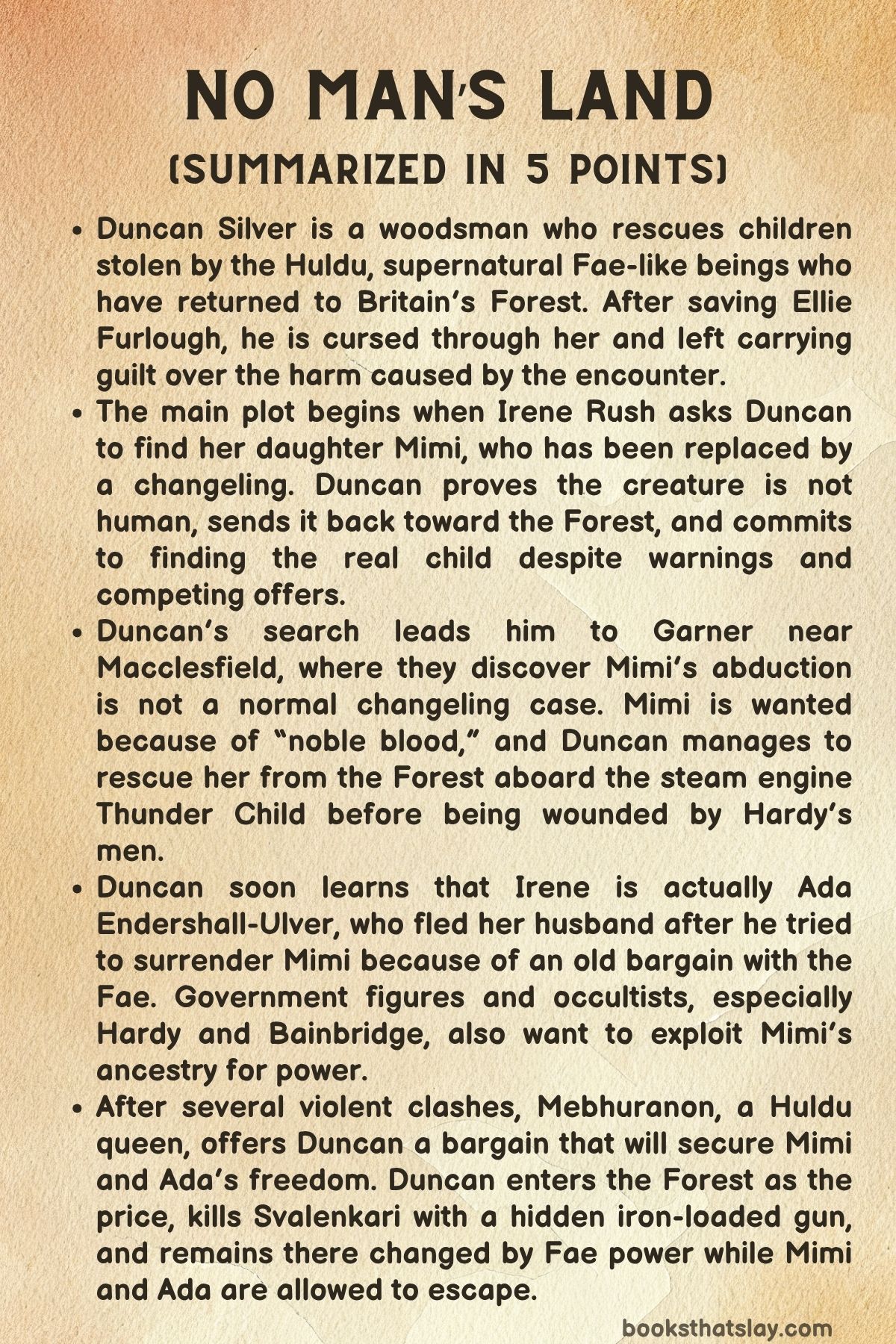
Duncan Silver lives by crossing into the returned supernatural Forest, a place that has reshaped Britain and filled it with fear. The Forest is not only a wilderness but a borderland where old powers have returned.
The Huldu, strange Fae-like beings who dwell there, steal human children and leave changelings in their place. Duncan has made a dangerous profession out of rescuing those children.
He knows the old rules, carries iron weapons, and understands that pity can get a person killed.
The story opens with Duncan rescuing a little girl named Ellie Furlough. He manages to take her from the Huldu, but the escape is not clean.
On the way back, Duncan is confronted by Huldu pursuers. Their leader reaches into Duncan’s memories and calls him by an old name, suggesting that Duncan’s past is tied to the Forest in ways even he does not fully control.
Duncan answers with iron-loaded ammunition, wounding the creature badly. Before the Huldu die, they curse Ellie.
Duncan gets the child home, but the curse leaves him burdened with guilt. His work saves lives, yet it also leaves damage behind.
The main story begins when Duncan is called to help Irene Rush, a frightened mother who believes that her daughter Mimi has been replaced. Duncan examines the child-like thing in Irene’s house and uses iron filings to prove the truth.
The creature that looks like Mimi burns under the iron and reveals its Fae nature. Mimi has indeed been taken, but the case is difficult from the start.
Irene and her maid Susan have recently moved from Dowgreave near Macclesfield, which means Duncan cannot be certain where the abduction happened or where the real Mimi has been taken.
Duncan removes the changeling and releases it toward the Forest, following the grim customs of his trade. He then commits himself to finding Mimi.
Soon after, Colonel Martin Hardy of the Forestry Commission offers him a well-paid government job, but Duncan refuses. He has already made a promise to Irene, and for all his roughness, Duncan treats such promises seriously.
Before heading out, he prepares carefully. He collects weapons and supplies from Crumley and Kegg, including iron shot, a trench knife, and new iron-filing bombs designed to hurt or scatter Huldu attackers.
He also visits Wolfbane Sally, a witch who understands curses and old powers. Duncan asks about Ellie’s condition, but Sally tells him the curse is not easy to undo.
Still, she agrees to consider the matter again if Duncan survives his journey.
Duncan travels toward Macclesfield and contacts Garner, an older woodsman with knowledge of the area. Garner warns him that the local Huldu have become unusually aggressive.
Together, they investigate Irene’s old home and begin to understand that Mimi’s abduction is not a common changeling case. The signs point to a larger purpose.
The Huldu do not want Mimi simply because she is a human child. They believe she has noble blood, a quality that makes her valuable to them.
The search takes Duncan and Garner into the Forest, where they face hostile creatures and the constant threat of Huldu patrols. The Forest is alive with danger, and every path carries risk.
Duncan’s skill keeps him moving, but Mimi’s importance makes the pursuit fiercer than usual. Eventually he finds her in an abandoned railway setting.
To escape, he uses the steam engine Thunder Child, turning the rescue into a desperate flight. Huldu attackers come after them, and the rescue becomes chaotic and violent.
Duncan manages to get Mimi close to safety near Maltby, but his victory is cut short when Hardy’s men shoot him. Badly wounded, Duncan is left to face the fact that human enemies may be as dangerous as the Fae.
Duncan survives and slowly learns that the case has drawn in powerful human interests. Government forces, occult organizations, and ambitious men are all connected to Mimi’s fate.
Niamh, Duncan’s lover and assistant, is arrested by Hardy’s people. Duncan does not accept this.
With the help of Crammond, Arthur, and others, he raids a police station and frees Niamh, as well as Garner. The rescue shows that Duncan’s fight is no longer only against the Huldu.
He is now resisting the authorities who want to control the Forest and exploit its powers.
At the same time, Susan reveals the truth about Irene Rush. Irene is really Ada Endershall-Ulver, the wife of Sir Michael Endershall.
Ada has been living under false names because she fled with Mimi and Susan to protect the child. Sir Michael had tried to surrender Mimi because of an old bargain connected to the Fae.
Ada refused to let her daughter be handed over and kept moving from place to place in the hope of staying hidden. Her deception was not meant to trick Duncan but to keep Mimi alive.
Duncan learns more from Bainbridge, an occultist whose knowledge makes the situation clearer and more dangerous. Mimi is descended from a Huldu noblewoman who entered a human bloodline centuries earlier.
This ancestry explains why the Huldu want her so badly. To them, Mimi is not an ordinary stolen child but a living link to noble Fae blood.
Hardy and Bainbridge also see value in her. They want to use Mimi’s ancestry, along with information about Huldu breeding sites, for political and military advantage.
Their plans reveal a cold human hunger for power that mirrors the cruelty of the Forest.
Duncan and his allies spy on one of Bainbridge’s gatherings, trying to understand the full extent of the conspiracy. The operation collapses into violence when Huldu archers attack.
The battle is brutal. Nimble Shanks Annie, Arthur, and Hardy are killed.
The deaths strip away any illusion that the conflict can be controlled by official plans or clever schemes. The Huldu are not tools, and the Forest does not obey human ambition.
During the bloodshed, Mebhuranon, a powerful Huldu queen, intervenes and stops the killing. She becomes central to the final bargain.
Mebhuranon tells Duncan that the only way to secure Mimi and Ada’s freedom is for him to bargain with himself. Duncan understands that saving Mimi will require more than skill, weapons, or courage.
It will require a personal sacrifice.
At Capstone Park, Ada and Mimi are reunited. Plans are made to send them to America, far from Britain and the reach of the powers hunting them.
Duncan also asks Mebhuranon to cure Niamh’s illness. Mebhuranon does so, giving Duncan one more reason to accept the bargain.
He has saved Mimi and helped Niamh, but the cost has not yet been paid.
At dawn, Duncan willingly enters the Forest. He gives himself up as the price of Mimi’s safety.
He is taken before Svalenkari, the Huldu lord who wants him dead. Svalenkari brutalizes him, believing Duncan has finally been brought helpless before him.
But Duncan has prepared one last trick. His iron-loaded McCulloch gun has been hidden inside the oak where the confrontation takes place.
When the oak splits open and reveals the weapon, Duncan seizes his chance and kills Svalenkari.
Mebhuranon honors the agreement. Mimi is free, and Ada is allowed to leave Britain with her daughter.
Niamh has been cured. Duncan, however, remains in the Forest.
He has been changed by Fae blood and power, and his future is no longer human in any simple sense. As the trees come alive around him, Duncan becomes part of the strange world he has spent his life fighting and entering.
His sacrifice secures freedom for Mimi and Ada, but it also binds him to the Forest, leaving him transformed by the same forces he once survived only through iron, caution, and will.
Characters
The characters in No Man’s Land are shaped by a world where human fear, old bargains, supernatural power, and political ambition collide. Each major figure reveals a different side of the conflict between Britain and the returned Forest, while the smaller characters help build the book’s atmosphere of danger, loyalty, betrayal, and uneasy magic.
Duncan Silver
Duncan Silver is the central figure of the book and the character through whom the supernatural danger of the Forest becomes deeply personal. He is a woodsman by trade, but his work is far more than an occupation: he enters a hostile, enchanted landscape to retrieve children stolen by the Huldu.
This makes him both a rescuer and a survivor, someone hardened by repeated exposure to terror yet still guided by a stubborn moral code. Duncan is practical, violent when necessary, and deeply familiar with the rules of the Forest, especially the usefulness of iron against the Fae.
However, he is not presented as a simple heroic adventurer. He carries guilt, especially over Ellie Furlough’s curse, and this guilt gives him emotional depth.
His bravery is mixed with trauma, and his competence is constantly shadowed by the knowledge that even successful rescues can leave permanent damage behind.
Duncan’s strongest quality is his refusal to abandon children once he has promised to help them. His decision to reject Colonel Hardy’s profitable offer because he has already committed himself to finding Mimi shows that his loyalty is not for sale.
He may be rough, secretive, and dangerous, but he still follows a personal code that separates him from the more corrupt forces around him. As the book progresses, Duncan becomes caught between human institutions, occult ambition, and Fae politics, yet he keeps returning to the same essential purpose: protecting Mimi and those connected to her.
His final bargain with Mebhuranon shows the full extent of his self-sacrifice. By entering the Forest willingly and risking himself before Svalenkari, Duncan becomes more than a rescuer; he becomes a man who accepts transformation and exile as the price of another person’s freedom.
His ending is powerful because it does not simply reward him with safety. Instead, it leaves him changed, bound to the supernatural world he has spent his life fighting.
Mimi Rush
Mimi Rush is the child at the center of the book’s main conflict, but she is more than a helpless victim. Her importance comes from the hidden truth of her ancestry, since she carries noble Huldu blood through an old human line.
This makes her valuable to the Fae and dangerous to those humans who want to exploit that connection. At first, Mimi appears mainly as an abducted child whose absence exposes the horror of changeling replacement.
However, as the story develops, she becomes a symbol of inheritance, innocence, and the terrible consequences of bargains made before she was born. She has not chosen her bloodline or the political significance placed upon her, yet adults, governments, occultists, and supernatural rulers all try to claim power over her future.
Mimi’s role is emotionally important because she represents the kind of life Duncan is trying to protect. Her vulnerability gives urgency to the rescue mission, but her noble blood also complicates the idea of rescue itself.
Saving her is not just a matter of bringing a lost child home; it means freeing her from systems of ownership that exist in both the human and Fae worlds. The fact that Duncan ultimately bargains for her freedom shows that Mimi’s safety requires more than force.
It requires sacrifice, negotiation, and the breaking of inherited control. By the end of the book, Mimi’s escape to a new life suggests hope, but that hope is costly.
Her survival depends on Duncan’s willingness to give up his own freedom.
Irene Rush / Ada Endershall-Ulver
Irene Rush, later revealed to be Ada Endershall-Ulver, is one of the book’s most important human characters because her identity is built around concealment, fear, and maternal desperation. When she first approaches Duncan, she seems to be a frightened mother whose daughter has been replaced by a changeling.
This first impression is true, but incomplete. Her real history reveals that she has been living under assumed names to escape the consequences of her husband’s connection to an old Fae-related bargain.
Ada’s deception is not presented as simple dishonesty; it is a survival strategy. She hides because the world around her gives her very few safe options.
Ada’s greatest defining trait is her determination to protect Mimi. She flees her former life, changes identities, and trusts dangerous people because remaining passive would mean losing her daughter.
Her character shows how ordinary human life has been invaded by ancient supernatural debts and aristocratic corruption. As Sir Michael’s wife, she is connected to privilege, but that privilege does not protect her.
Instead, it traps her inside obligations made by others. Ada’s fear is therefore both personal and social.
She is afraid of the Huldu, but she is also afraid of the human men and institutions willing to treat Mimi as property. Her reunion with Mimi is one of the emotional resolutions of the book, and her planned escape to America suggests that survival sometimes requires leaving behind not only a place, but an entire inherited world of power, class, and obligation.
Niamh
Niamh is Duncan’s lover and assistant, and her role brings emotional intimacy into a book otherwise dominated by violence, danger, and suspicion. She is not merely a romantic attachment; she is part of Duncan’s working life and understands the risks surrounding him.
Her relationship with Duncan shows a softer, more vulnerable side of him, because through Niamh the reader sees what Duncan still has to lose beyond his work and reputation. Her arrest by Hardy’s people becomes a major turning point because it forces Duncan and his allies into direct action against human authority, showing that the danger in the book does not come only from the Forest.
Niamh’s illness also gives her character symbolic weight. She represents human fragility in a world where supernatural power can wound, cure, corrupt, or transform.
Duncan’s request for Mebhuranon to cure her shows the depth of his love and loyalty. It is significant that Duncan uses part of his bargaining power not only to secure Mimi’s freedom, but also to save Niamh.
This choice reveals that Duncan’s sense of responsibility is personal as well as heroic. Niamh’s cure gives the ending a measure of mercy, even though Duncan himself pays a severe price.
Through her, the book shows that love can survive inside brutality, but it rarely remains untouched by sacrifice.
Colonel Martin Hardy
Colonel Martin Hardy is one of the major human antagonists in the book, and he represents the militarized, political response to the supernatural world. Unlike Duncan, who enters the Forest to rescue stolen children, Hardy sees the Forest and the Huldu as resources to be studied, controlled, and exploited.
His offer of lucrative work to Duncan initially makes him seem like a powerful official with practical aims, but his later actions reveal a much darker ambition. He is willing to use people, withhold truths, and cooperate with occult forces if doing so gives the government or himself greater power.
Hardy’s character is important because he proves that human institutions can be just as threatening as supernatural beings. His men shoot and badly wound Duncan after Mimi’s rescue, and his organization imprisons Niamh and Garner.
These actions show that Hardy treats individuals as disposable when they interfere with his plans. He is not driven by wild cruelty in the same way a monster might be; instead, his danger comes from discipline, authority, and the belief that political or military goals justify personal suffering.
His death during the Huldu attack is fitting because it shows the limits of his control. Hardy believes the supernatural can be managed as a strategic asset, but the violence of the Forest ultimately overwhelms him.
Bainbridge
Bainbridge is an occultist whose knowledge makes him dangerous. He understands more about Mimi’s ancestry than most characters and recognizes the value of her Huldu noble blood.
This knowledge could have been used to protect her, but Bainbridge instead becomes part of a plan to exploit her lineage and the Huldu breeding sites for power. His role shows how scholarship and occult expertise can become morally corrupt when separated from compassion.
He is not merely interested in truth; he is interested in usefulness, control, and advantage.
Bainbridge functions as a bridge between hidden supernatural history and modern political ambition. Through him, the book reveals that Mimi’s abduction is tied to centuries of interwoven human and Fae bloodlines.
However, Bainbridge’s understanding does not make him wise in a moral sense. He sees patterns, bloodlines, and opportunities, but not the full humanity of the child at the center of the conflict.
His gathering becomes a deadly scene when Huldu archers attack, showing that the forces he wishes to manipulate are far beyond safe control. Bainbridge’s character deepens the book’s warning against treating ancient magic as a tool for human ambition.
Mebhuranon
Mebhuranon is one of the most powerful Huldu figures in the book and one of its most morally complex supernatural characters. As a queenly presence, she carries authority, mystery, and danger.
She intervenes during the deadly battle and stops the slaughter, proving that she possesses power greater than the violence unfolding around her. Unlike many of the Huldu Duncan encounters, Mebhuranon is not defined only by hostility.
She is capable of bargaining, honoring agreements, and granting mercy, though her mercy operates according to Fae logic rather than ordinary human kindness.
Her relationship with Duncan is especially important because she offers him a path to secure Mimi and Ada’s freedom, but that path demands sacrifice. Mebhuranon does not simply rescue everyone or solve the conflict without cost.
Instead, she requires Duncan to bargain with himself, which means he must become the price of the freedom he seeks. Her cure of Niamh’s illness shows that she can heal as well as command, yet her help remains bound to exchange and consequence.
Mebhuranon embodies the ancient, formal, and dangerous nature of Fae power. She is not safely benevolent, but she is not purely evil either.
Her honor at the end, when she keeps her agreement after Duncan kills Svalenkari, makes her one of the most compelling figures in No Man’s Land.
Svalenkari
Svalenkari is the Huldu lord who wants Duncan dead, and he serves as a direct embodiment of Fae vengeance and aristocratic cruelty. His hatred of Duncan is tied to the earlier confrontation in which Duncan shoots a Huldu leader with iron-loaded ammunition.
Svalenkari’s desire to brutalize Duncan makes him a deeply threatening figure, not only because of his physical and supernatural power, but because he represents the memory of old violence returning to claim payment. He is personal danger made flesh.
In the final confrontation, Svalenkari appears to have every advantage. Duncan is in the Forest, exposed to Fae power, and seemingly trapped within the terms of the bargain.
Yet Duncan’s hidden McCulloch gun changes the balance. This moment reveals the difference between Svalenkari’s arrogance and Duncan’s survival intelligence.
Svalenkari relies on dominance, ceremony, and cruelty, while Duncan relies on preparation, iron, and an understanding of how to fight when outmatched. Svalenkari’s death is not just a victory over one enemy; it is a refusal to let Fae power define the ending completely.
Through him, the book gives its final conflict a personal and mythic intensity.
Ellie Furlough
Ellie Furlough appears early in the book, but her importance lasts far beyond the prologue. She is the little girl Duncan rescues from the Forest, and her rescue establishes both his skill and the terrible cost of his work.
Although Duncan succeeds in bringing her back, the Huldu curse her before the escape is complete. Ellie therefore becomes a reminder that survival in this world is not the same as full safety.
Even when a child is physically rescued, supernatural harm can remain.
Ellie’s role is crucial to Duncan’s emotional burden. Her curse haunts him and creates a sense of guilt that shapes his later choices.
He seeks help from Wolfbane Sally because he wants to undo the damage, but he learns that the curse cannot easily be lifted. This deepens the tragedy of Duncan’s work: he can fight, track, shoot, and bargain, but he cannot always heal what has been broken.
Ellie’s character represents innocence touched by forces beyond her understanding, and her suffering helps explain why Duncan takes Mimi’s case so seriously. He knows from Ellie that failure can exist even inside apparent success.
The Changeling
The changeling that replaces Mimi is a disturbing figure because it turns the home into a place of doubt and horror. It looks like the missing child, but Duncan’s use of iron filings exposes its Fae nature.
The changeling’s body reacts to iron, revealing that the appearance of normal childhood has been used as a disguise. This moment is one of the clearest examples of the book’s fear of substitution: the terror that a loved one can be replaced by something almost identical but fundamentally alien.
The changeling is not developed as a deeply individual personality, but it is symbolically important. It represents Fae intrusion into family life and the way supernatural violence disguises itself under ordinary domestic surfaces.
Irene’s fear becomes believable because the changeling makes her own child’s face uncertain to her. Duncan’s handling of the changeling also shows his experience and emotional restraint.
He does not treat the situation as a mystery for long; he understands what it is and acts decisively. The changeling’s release back toward the Forest reinforces the sense that human and Fae worlds are connected through uneasy crossings rather than clean separations.
Garner
Garner is an older woodsman near Macclesfield, and he functions as both a guide and a warning. Like Duncan, he understands the Forest from experience rather than theory.
His warning that the local Huldu have become unusually violent helps prepare the reader for the fact that Mimi’s case is not ordinary. Garner’s knowledge is practical, grounded, and earned, making him an important contrast to officials and occultists who approach the Forest through ambition or abstract knowledge.
Garner also expands the sense of a wider community of woodsmen. Duncan is not the only person risking himself in this dangerous profession, and Garner’s presence suggests that survival depends on shared knowledge and trust.
His arrest by Hardy’s people shows that even experienced men can become victims when government power turns against them. His rescue from the police station strengthens the theme of loyalty among Duncan’s allies.
Garner may not dominate the book, but he adds credibility and depth to the world, showing how older experience can be valuable in a landscape where ordinary rules have collapsed.
Susan
Susan is Ada’s maid and one of the most important witnesses to the truth of Mimi’s background. At first, she seems like a supporting domestic figure, but her revelation of Irene’s real identity changes the reader’s understanding of the entire case.
By explaining that Irene is actually Ada Endershall-Ulver and that she fled from Sir Michael, Susan helps uncover the hidden social and supernatural history behind Mimi’s abduction. Her knowledge makes her vital to the plot’s movement from a missing-child case into a larger conspiracy involving old bargains and noble blood.
Susan’s loyalty is her defining trait. She stays with Ada and Mimi through repeated moves, false names, and danger.
This loyalty matters because it is quiet and practical rather than dramatic. She does not possess Duncan’s weapons, Hardy’s authority, or Bainbridge’s occult knowledge, but she helps protect the truth and supports Ada’s attempt to escape.
Susan represents the kind of human faithfulness that holds families together when powerful institutions fail them. Her presence also reinforces Ada’s isolation, because without Susan, Ada would have almost no trustworthy support.
Sir Michael Endershall
Sir Michael Endershall is a morally corrupt figure whose actions reveal the cruelty hidden beneath aristocratic privilege and old obligation. As Ada’s husband and Mimi’s father, he should be a protector, but instead he attempts to hand over Mimi because of an old Fae-related bargain.
His betrayal is especially disturbing because it comes from within the family. The danger to Mimi is not only outside the home in the Forest; it also comes from the father who is supposed to defend her.
Sir Michael’s character represents inherited corruption. He is tied to old arrangements that treat children and bloodlines as objects of exchange.
His willingness to sacrifice Mimi shows how class, lineage, and supernatural obligation can combine into a system where personal love is replaced by duty to power. Even when he is not physically present for much of the action, his influence drives Ada’s flight and Mimi’s danger.
He is one of the clearest examples of human betrayal in the book, proving that monstrosity is not limited to the Huldu.
Wolfbane Sally
Wolfbane Sally is the witch Duncan consults about Ellie’s curse, and she brings a different kind of supernatural knowledge into the book. Unlike Bainbridge, whose occult learning is tied to exploitation and power, Sally’s knowledge feels older, earthier, and more personal.
She understands curses, limits, and the difficult nature of healing. Her inability to easily lift Ellie’s curse does not make her weak; instead, it shows that magic in the book has rules and consequences that even skilled practitioners cannot simply erase.
Sally’s role is important because she forces Duncan to confront the limits of action. He is used to solving problems through courage, iron, and violence, but Ellie’s condition is not something he can shoot or cut his way through.
Sally’s promise to revisit the matter if Duncan returns safely gives her connection to him a practical tenderness. She is not sentimental, but she is not indifferent either.
Through Sally, the book suggests that knowledge of the supernatural requires humility. Some wounds can be treated, some bargains can be made, and some curses remain frighteningly difficult to undo.
Crumley
Crumley is one of the suppliers who helps Duncan prepare for his mission, and his importance lies in the practical world of tools, weapons, and survival. In a book filled with Fae power and occult politics, Crumley represents the human craft needed to resist supernatural threats.
He helps provide Duncan with essential equipment, including iron-based weaponry and other supplies that become crucial in the Forest. His role reminds the reader that Duncan’s success depends not only on courage but also on preparation.
Crumley’s presence also adds texture to the world outside the Forest. There is an entire network of people who understand, profit from, or support the dangerous work of woodsmen.
Crumley may not enter the deepest emotional conflicts of the book, but he contributes to the realism of Duncan’s profession. The fight against the Huldu is not improvised; it depends on ammunition, knives, devices, and the expertise of people who know what kind of world they are living in.
Kegg
Kegg works alongside Crumley in helping Duncan obtain the equipment he needs, and his role reinforces the importance of practical invention in the struggle against the Huldu. The newly developed iron-filing bombs are especially important because they show human adaptation to supernatural danger.
Kegg’s contribution suggests that people are not merely helpless before the returned Forest. They study its weaknesses, develop tools, and create ways to survive.
Although Kegg is a supporting character, he helps ground the book’s supernatural conflict in material reality. The Huldu may be ancient and terrifying, but Duncan’s world also includes workshops, weapons, supplies, and experimental devices.
Kegg’s role is therefore part of the book’s blend of folklore and technology. He represents the ordinary human ingenuity that allows characters like Duncan to challenge beings who would otherwise seem untouchable.
Crammond
Crammond is one of Duncan’s allies during the effort to rescue Niamh and Garner, and his importance comes from his willingness to act against corrupt authority. When Hardy’s people arrest and hold Duncan’s companions, Crammond becomes part of the group that raids the police station.
This places him firmly on the side of personal loyalty rather than institutional obedience. In a world where official power is compromised, Crammond’s choice to help Duncan matters.
Crammond’s role also helps show that Duncan is not completely isolated. Though Duncan often appears as a hardened, self-reliant figure, he survives because others are willing to stand with him.
Crammond’s participation in dangerous action proves that resistance to Hardy’s schemes is collective, not merely individual. He may not receive as much attention as Duncan or Niamh, but he strengthens the book’s theme that courage often appears in groups of ordinary people making risky choices at the right moment.
Arthur
Arthur is another of Duncan’s allies and one of the characters whose death gives the later conflict its tragic weight. He joins the dangerous effort against Hardy’s forces and becomes involved in the events surrounding Bainbridge’s gathering.
Arthur’s presence shows loyalty, courage, and a willingness to confront threats larger than himself. Like several of Duncan’s companions, he is drawn into a conflict where human politics and Fae violence collide with devastating results.
Arthur’s death during the Huldu attack is significant because it prevents the battle from feeling like a simple adventure. The cost of resisting Hardy and exposing the conspiracy is real.
Arthur’s loss also emphasizes the uncontrollable nature of the forces at play. Once the Huldu attack, even brave and capable people can be killed quickly.
His character helps the book maintain moral seriousness: heroism exists, but it does not guarantee survival.
Nimble Shanks Annie
Nimble Shanks Annie is a vivid supporting character whose name alone suggests agility, toughness, and a life lived close to danger. Her death in the battle involving the Huldu archers makes her one of the casualties of the escalating conflict.
Although she is not as central as Duncan, Ada, or Mimi, her presence adds to the sense that Duncan’s world contains a wider circle of fighters, helpers, and survivors who operate on the margins of official society.
Annie’s death matters because it shows that the struggle is not limited to the main characters. The violence unleashed by Hardy’s schemes and Bainbridge’s ambitions consumes people who are connected to the conflict in practical, loyal, or opportunistic ways.
Annie’s fate contributes to the grim atmosphere of the book, where even memorable and capable figures can be lost suddenly. She helps broaden the human cost of the story.
Themes
Guilt and Moral Responsibility
Duncan’s work as a rescuer is shaped by more than duty; it is driven by the weight of past failure and the need to answer for harm he could not prevent. In No Man’s Land, the curse placed on Ellie becomes a lasting wound in his conscience, reminding him that even successful rescues can carry terrible costs.
His guilt does not weaken him into passivity. Instead, it pushes him to keep entering danger, even when the odds are poor and the reward is uncertain.
Duncan’s decision to search for Mimi despite better-paid work shows that he measures responsibility through promises, not profit. His guilt also gives him a harsh understanding of consequences.
He knows that children caught between human and Fae worlds are not symbols or bargaining tools; they are vulnerable lives that adults have failed to protect. This theme presents responsibility as painful, personal, and ongoing, demanding action even when redemption is never guaranteed.
Power, Exploitation, and Political Ambition
The struggle over Mimi reveals how quickly powerful people turn human suffering into a resource. Hardy, Bainbridge, and others do not see Mimi mainly as a child in danger; they see her ancestry as something that can be studied, controlled, and used.
Their plans expose a world where military, political, and occult interests treat the supernatural as another route to authority. The Forest is not only a place of fear, but also a place that tempts ambitious men with the promise of influence.
This makes the conflict larger than one rescue mission. Duncan’s enemies are not only the Huldu but also humans who are willing to bargain away innocence for advantage.
The theme criticizes the cold logic of institutions that justify cruelty in the name of national strength or private gain. Mimi’s value to them lies in bloodline and usefulness, while Duncan’s fight insists that her value lies in her humanity.
Identity, Bloodline, and Inheritance
Mimi’s hidden ancestry places her at the center of a conflict she is too young to understand, showing how identity can be imposed by forces outside a person’s control. Her noble Fae blood makes her desirable to the Huldu and useful to human schemers, but neither side truly respects her as an individual.
Ada’s concealed identity also reflects the danger of inheritance, since her past and marriage bind her to old bargains she tries to escape. Names, family lines, and secret histories become burdens that shape the present.
Duncan himself is also affected by a buried identity when the Huldu leader recognizes him through memory and an old name. This suggests that the past is never fully gone; it waits to claim people when they least expect it.
The theme shows inheritance as both power and trap, something that can define a person in the eyes of others while threatening their freedom to choose their own future.
Sacrifice and the Cost of Protection
Protection in the story demands more than courage; it requires loss. Duncan repeatedly risks his body, safety, relationships, and future because rescuing Mimi cannot be achieved through simple heroism.
The final bargain makes this theme clear: Mimi and Ada can only be freed if Duncan gives himself up to the Forest. His sacrifice is not presented as clean or triumphant.
He is wounded, changed, and separated from the ordinary human world, which makes the price of protection deeply personal. Ada’s flight with Mimi also reflects sacrifice, as she abandons status, comfort, and identity to keep her daughter safe.
Niamh’s danger further shows how those close to Duncan are drawn into the cost of his choices. The theme argues that genuine protection is not about control or possession, but about accepting pain so another person can live freely.
Duncan’s ending leaves him powerful, but not untouched, proving that survival and victory can still carry permanent loss.