Small Great Things Summary, Characters and Themes
Small Great Things by Jodi Picoult is a courtroom and social drama about race, privilege, justice, and moral responsibility in contemporary America. The novel follows Ruth Jefferson, a skilled Black labor and delivery nurse whose life is overturned after a white supremacist couple refuses to let her care for their newborn son.
When the baby later dies under Ruth’s watch, she becomes the target of a criminal case that forces hidden prejudice into the open. Through Ruth, her lawyer Kennedy, and the baby’s father Turk, the story examines how racism shapes ordinary choices, institutions, families, and the justice system.
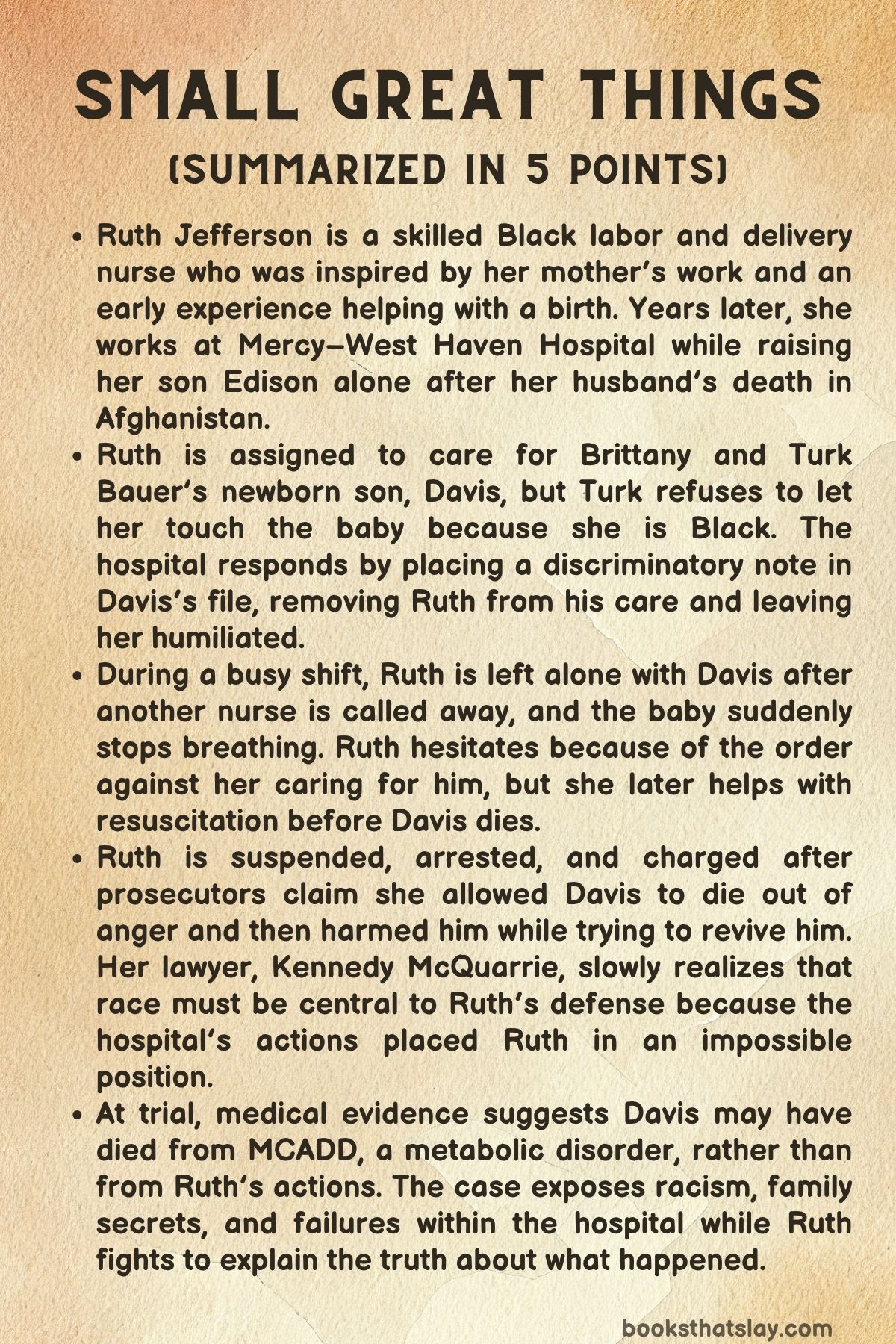
Summary
Ruth Jefferson’s life is shaped early by the quiet labor and dignity of her mother, who works as a domestic servant for the wealthy Hallowell family in Manhattan. As a child, Ruth sees two very different worlds: the privileged comfort of the Hallowells and the harder, more careful life her own family must lead.
One winter day during a blizzard, Ruth and her sister accompany their mother to work. While they are there, Mina Hallowell goes into premature labor.
Ruth’s mother helps deliver the baby before paramedics arrive, and Ruth witnesses both the terror and wonder of birth at close range. That moment stays with her and eventually guides her toward a career in nursing.
Years later, Ruth has become an experienced labor and delivery nurse at Mercy–West Haven Hospital. She is respected for her skill and discipline, and she has spent many years doing her work well.
Her personal life has also demanded strength. Her husband, Wesley, died while serving in Afghanistan, leaving Ruth to raise their son, Edison, on her own.
Edison is a teenager now, bright but under pressure, and Ruth works hard to give him opportunities and stability. She believes in doing everything right, keeping her head down, and proving her worth through excellence.
Her careful life is disrupted when she is assigned to care for Brittany Bauer, who has just given birth to a baby boy named Davis. Ruth examines the newborn, notices a faint heart murmur, bathes him, and helps with feeding.
At first, she is simply doing the job she has done countless times before. But Brittany’s husband, Turk Bauer, reacts with anger when he sees Ruth touching his child.
Turk is a white supremacist with racist beliefs and symbols, including a Confederate flag tattoo. He does not want a Black nurse caring for his son.
Ruth’s supervisor, Marie, tries to manage the conflict, but instead of defending Ruth’s right to do her job, the hospital accommodates Turk’s demand. A note is placed in Davis’s file stating that no African American personnel should care for the baby.
Ruth is taken off the case. The order humiliates her deeply.
It tells her that her training, years of service, and professional judgment matter less than the prejudice of a patient’s family. Still, Ruth tries to continue working as she always has, even though the insult follows her.
On her day off, Ruth talks with her sister Adisa, who is more direct about racism and less willing to excuse it. Adisa pushes Ruth to see the hospital’s action for what it is, not as a small workplace slight but as a racist decision with real consequences.
Ruth is used to absorbing such injuries in silence. She has built her life around control and respectability, but the incident unsettles her because it exposes how little protection her professionalism gives her.
Soon after, Ruth agrees to cover a shift because another nurse is sick. The hospital is busy, and a storm adds more strain.
Davis is brought to the nursery for a circumcision. Corinne, the nurse assigned to him after Ruth’s removal, is suddenly called away for an emergency C-section.
With the unit understaffed and pressure mounting, Corinne asks Ruth to watch Davis briefly.
While Ruth is alone with the baby, Davis stops breathing and begins to turn blue. Ruth starts to stimulate him, responding instinctively as a nurse.
Then she remembers the order forbidding her from caring for him. In that moment, she is caught between two impossible choices: obey a discriminatory instruction and risk the baby’s life, or help him and risk punishment for violating the order.
Fear and confusion make her hesitate. She briefly stops acting.
When Marie enters and sees the baby in distress, she orders Ruth to assist. A code is called, and Ruth performs chest compressions as the medical team tries to revive Davis.
Brittany and Turk arrive and witness the frantic effort to save their son. Despite the team’s work, Davis dies at 10:04.
His death devastates his parents, and their grief quickly turns into accusation. Ruth, terrified and ashamed of her hesitation, lies afterward and says she did nothing until Marie ordered her to help.
That lie becomes dangerous. Hospital risk management questions her, she is suspended, and then she is arrested.
Prosecutor Odette Lawton charges Ruth with murder and negligent homicide, arguing that Ruth allowed Davis to die because she was angry about being removed from his care and then harmed him during resuscitation.
Ruth is assigned a public defender named Kennedy McQuarrie. Kennedy is white, educated, and well-meaning, but at first she believes the best defense is to keep race out of the courtroom.
She thinks jurors will respond better to medical facts than to arguments about racism. Ruth disagrees because race is central to everything that happened.
The hospital’s order existed because Ruth was Black. Turk’s accusation was shaped by his racism.
Ruth’s hesitation came from being forced into an unjust position. Kennedy does not fully understand this at first, but as she spends more time with Ruth and sees the details of her life, her view begins to change.
The case becomes public and emotionally charged. Ruth is no longer just a nurse accused of a crime; she becomes a symbol in a larger conflict about race, blame, and justice.
Turk’s background comes under scrutiny. His hatred is shown as part personal wound, part learned ideology.
After childhood trauma connected to his brother’s death, he moves deeper into white supremacist circles and violence. His beliefs affect his marriage, his identity, and his response to Davis’s death.
To Turk, Ruth is not an individual nurse but someone onto whom he can project rage and prejudice.
Kennedy builds the defense around medical evidence as well as the circumstances Ruth faced. Experts suggest that Davis may have had MCADD, a metabolic disorder that can become life-threatening when a baby has not eaten.
Because Davis had been fasting before circumcision, the condition could have contributed to his sudden collapse. This evidence weakens the prosecution’s claim that Ruth caused the death through hatred or misconduct.
The murder charge is dismissed, but the negligent homicide charge remains, leaving Ruth’s future uncertain.
Ruth decides she must testify, even though doing so carries risk. On the stand, she admits that she lied after Davis died.
She explains her hesitation honestly: she wanted to help the baby, but she was also afraid of disobeying an order that had already marked her as unacceptable because of her race. Her testimony reveals the cruel trap created by the hospital.
She was expected to be responsible, obedient, invisible, and heroic all at once, even when the rules placed on her were unjust.
The trial also affects Ruth’s son, Edison. He struggles with the public attacks on his mother and the racism surrounding the case.
In anger and fear, he spray-paints racist graffiti at the hospital to make it look as though Turk did it. Kennedy represents him, and Odette eventually drops the matter.
Edison’s actions show how the case harms not only Ruth but also her family, forcing a teenager to confront hatred aimed at his mother.
Another revelation complicates the Bauers’ sense of identity. Kennedy discovers that Davis carried sickle-cell trait, which leads to the truth that Brittany’s biological mother is Black.
Wallace Mercy brings Brittany’s mother to the courthouse, creating a public confrontation. For a family built on white supremacist beliefs, this discovery exposes the false certainty behind their racism and challenges the identity Turk and Brittany have defended so fiercely.
By the end of the trial, Kennedy no longer avoids the issue of race. In her closing argument, she speaks directly about racism, privilege, and the impossible position Ruth was placed in.
She asks the jury to see that the case is not only about a tragic medical emergency but also about the choices made by a hospital that chose prejudice over fairness. Ruth receives growing public support as the jury deliberates.
The story reaches its final stage with the verdict still pending in the provided account. By then, the trial has exposed many truths: Turk’s hatred, the hospital’s failure, Ruth’s lie, the medical uncertainty surrounding Davis’s death, and the deep racial pressures that shaped every decision.
Small Great Things presents Ruth’s case as a test of whether justice can recognize not only what happened in a hospital room, but also the social forces that made that moment so dangerous.
Characters
In Small Great Things, the characters are shaped by race, grief, fear, guilt, professional duty, and the consequences of prejudice. Each character contributes to the central conflict by revealing how personal choices and social systems can place people in painful, unfair, or morally difficult positions.
Ruth Jefferson
Ruth Jefferson is the central character of the book and one of its most emotionally complex figures. She is an experienced labor and delivery nurse whose skill, discipline, and compassion define her professional life.
Her decision to become a nurse is rooted in an early childhood experience, when she watched her mother help deliver Mina Hallowell’s premature baby during a blizzard. That moment gives Ruth a sense of purpose and shapes her belief that nursing is not just a job but a calling.
As an adult, Ruth is hardworking, controlled, and deeply committed to excellence, partly because she understands that as a Black woman in a predominantly white professional environment, she is often judged more harshly than others.
Ruth’s character is also shaped by loss and responsibility. After her husband Wesley dies in Afghanistan, she raises her son Edison alone.
Her role as a mother is central to her identity, and she wants Edison to have security, dignity, and opportunity. However, Ruth also tries to protect him from the full weight of racism, even though the events surrounding Davis Bauer’s death force both mother and son to confront it directly.
Ruth’s pain is not only caused by Turk Bauer’s racism but also by the hospital’s willingness to accommodate his prejudice instead of defending her. This makes her humiliation more profound because it comes from both an openly racist family and an institution that should have protected her.
Ruth’s hesitation when Davis stops breathing is the most morally difficult moment in her character arc. She is trapped between her professional instinct to save a baby and the discriminatory order telling her not to touch him.
Her hesitation does not make her cruel; instead, it reveals the impossible pressure placed on her. She knows that if she acts, she may be accused of violating orders, but if she does not act, the child may die.
Her later lie shows fear, shame, and self-protection, but her decision to testify shows courage. By admitting the truth, Ruth reclaims her voice and forces the court to see that her actions cannot be separated from the racism that created the crisis.
Turk Bauer
Turk Bauer is one of the most openly hateful characters in the book, but he is also written with enough background to show how hatred is formed and sustained. He is a white supremacist whose beliefs are visible through his Confederate flag tattoo, his contempt for Black people, and his immediate rejection of Ruth as a nurse for his newborn son.
His racism is not casual or accidental; it is central to his identity and worldview. He sees Ruth not as a skilled medical professional but through the lens of racial hatred, and his demand that she be removed from his son’s care sets the tragedy in motion.
Turk’s character is shaped by grief, anger, and radicalization. The death of his brother becomes a formative wound, and instead of healing from that pain, he channels it into hatred.
White supremacist ideology gives him a false sense of belonging, power, and explanation for his suffering. This does not excuse his actions, but it helps explain why he clings so fiercely to racist beliefs.
Turk’s grief over Davis’s death is real, but it is distorted by the racism he already carries. He needs someone to blame, and Ruth becomes the target because his prejudice makes it easy for him to imagine her as guilty.
During the trial, Turk’s violent history and racist background expose the danger of his beliefs. He is not simply an angry father; he is a man whose hatred has already shaped his behavior and relationships.
Yet his character also shows the complexity of grief. He truly loves his child, but his love is poisoned by a worldview that dehumanizes others.
His accusation against Ruth reveals how racism can turn tragedy into persecution and how personal loss can be used to justify cruelty.
Kennedy McQuarrie
Kennedy McQuarrie is Ruth’s public defender and one of the most important characters in the legal and moral development of the story. At first, Kennedy believes that the best defense strategy is to avoid making the case about race.
Her initial approach reveals her own limited understanding of racism. She sees herself as fair-minded and well-intentioned, but she does not yet understand how deeply race shapes Ruth’s life, the hospital’s actions, the police response, and the public reaction to the case.
Kennedy’s early discomfort with discussing race shows how privilege can make people avoid truths that others are forced to live with every day.
As Kennedy spends more time with Ruth, her character begins to change. She starts to recognize that Ruth’s case cannot be separated from racism because racism is the reason Ruth was removed from Davis’s care in the first place.
Kennedy’s growth comes from listening, making mistakes, and gradually understanding that neutrality can protect injustice when the situation itself is unequal. Her relationship with Ruth is not always easy because Ruth has to explain painful realities that Kennedy has never had to face.
This tension makes Kennedy’s transformation more believable and meaningful.
Kennedy’s closing argument marks a major turning point in her character arc. By finally speaking openly about racism, she moves beyond a safe legal strategy and acknowledges the deeper truth of the case.
Her development shows the importance of confronting discomfort rather than hiding behind politeness or technical arguments. Kennedy becomes a stronger advocate because she learns that defending Ruth requires more than proving medical doubt; it requires naming the racial injustice that placed Ruth in an impossible position.
Brittany Bauer
Brittany Bauer is Davis’s mother and Turk’s wife, and her character is shaped by grief, dependence, and buried racial history. At first, she appears mainly as a young mother devastated by the death of her newborn child.
Her pain is genuine, and the loss of Davis leaves her emotionally shattered. However, Brittany’s position beside Turk also makes her part of the racist conflict that leads to Ruth’s removal from the baby’s care.
Even when Turk is the more aggressive figure, Brittany benefits from and participates in the racial boundaries he enforces.
Brittany’s character becomes more complicated when her biological background is revealed. The discovery that her biological mother is Black disrupts the racial identity she has lived with and exposes the hypocrisy of the Bauers’ beliefs.
This revelation is especially powerful because Brittany has aligned herself with white supremacist ideas while unknowingly having Black ancestry. The public confrontation involving her biological mother forces Brittany to face a truth that challenges the foundation of her family’s worldview.
Brittany is not portrayed as simply evil, but she is also not innocent. Her grief makes her sympathetic in one sense, yet her silence and complicity connect her to the injustice Ruth faces.
Her character shows how racism is sustained not only by violent leaders like Turk but also by people who accept, support, or fail to challenge those beliefs. Brittany’s tragedy is both personal and moral: she loses her child, but she also becomes a symbol of the ignorance and contradiction at the heart of racial hatred.
Davis Bauer
Davis Bauer is an infant, but his role in the book is central because his death becomes the event around which every major conflict gathers. He is not a developed character in the traditional sense because he is a newborn, yet his presence carries enormous emotional and symbolic weight.
To Ruth, he is a patient who deserves care. To Turk and Brittany, he is a beloved child.
To the hospital, he becomes a source of legal risk. To the court, he becomes the center of competing narratives about guilt, negligence, racism, and medical uncertainty.
Davis’s medical condition is especially important because the evidence of MCADD changes the meaning of his death. The disorder suggests that his collapse may have been caused by a metabolic crisis, especially because he had been fasting before circumcision.
This medical evidence challenges the accusation that Ruth caused his death through anger or neglect. Davis’s death is therefore not only a personal tragedy but also a test of how quickly society assigns blame when race is involved.
Davis also represents innocence caught inside adult prejudice. He has no understanding of race, hatred, or hospital policy, yet the racism of his father directly affects the care he receives.
His death exposes the danger of allowing prejudice to interfere with professional responsibility. In this way, Davis becomes the most vulnerable figure in the story, and his brief life reveals the devastating consequences of choices made by the adults around him.
Edison Jefferson
Edison Jefferson is Ruth’s teenage son, and his character shows how racism affects not only the person directly accused but also the family surrounding that person. Edison is young, intelligent, and emotionally vulnerable.
He has already lost his father, and when Ruth is arrested, his sense of safety is shaken again. Watching his mother become the target of public anger and racial suspicion forces him to confront the harsh realities she has tried to shield him from.
Edison’s decision to spray-paint racist graffiti at the hospital is wrong, but it comes from fear, anger, and desperation rather than simple malice. He wants to defend his mother and shift blame toward Turk, but his action shows how powerless he feels.
The graffiti incident reveals the pressure placed on a child who is trying to make sense of injustice without having the maturity or resources to respond wisely. His mistake also shows how trauma can push young people into impulsive choices.
Through Edison, the book explores the emotional cost of racism across generations. Ruth wants him to believe in fairness, achievement, and dignity, but the case teaches him that respectability does not always protect Black people from suspicion or mistreatment.
Edison’s character adds emotional depth to Ruth’s struggle because her fight is not only about her freedom; it is also about what kind of world her son will inherit.
Marie
Marie is Ruth’s supervisor at the hospital, and her character represents institutional failure. When Turk objects to Ruth caring for Davis because Ruth is Black, Marie chooses to manage the situation by placing a note in the baby’s file rather than directly defending Ruth.
This decision may appear administrative on the surface, but it gives official power to Turk’s racism. Marie’s actions show how institutions can participate in discrimination while presenting their choices as practical or neutral.
Marie is important because she is not portrayed as an obvious white supremacist like Turk. Her harm comes from compromise, avoidance, and self-protection.
She wants to calm the situation and protect the hospital, but by doing so, she humiliates Ruth and creates the conditions that later trap her. Marie’s order places Ruth in an impossible position when Davis stops breathing.
Ruth’s hesitation cannot be understood without recognizing that Marie helped create the conflict between professional duty and obedience to a racist instruction.
Marie’s character shows that racism does not survive only through open hatred. It also survives through policies, silence, and decisions made by people who value comfort and liability over justice.
Her role in the book is crucial because she demonstrates how authority figures can make discrimination appear official, even when they do not describe it that way.
Corinne
Corinne is the nurse assigned to Davis after Ruth is removed from his care. Her character is significant because she becomes part of the chain of events that leaves Ruth alone with Davis.
When the unit becomes busy and Corinne is pulled away for an emergency C-section, she asks Ruth to watch the baby. This request places Ruth back near a patient she has been formally forbidden to care for, creating the immediate situation that leads to Ruth’s moral crisis.
Corinne’s role shows how ordinary workplace chaos can collide with discriminatory policy. She may not intend to put Ruth in danger, but her request ignores the seriousness of the order that has already humiliated and restricted Ruth.
Corinne’s action reveals the contradiction at the heart of the hospital’s decision: Ruth is considered unacceptable when a racist parent complains, but still useful when the hospital needs help.
Although Corinne is not as central as Ruth, Turk, or Kennedy, she helps reveal the practical absurdity of the hospital’s position. The hospital wants Ruth to be both excluded and available, both distrusted and relied upon.
Corinne’s brief but important role exposes how unfair systems often depend on the very people they mistreat.
Odette Lawton
Odette Lawton is the prosecutor, and her character represents the legal system’s power to shape a story around accusation. She charges Ruth with murder and negligent homicide, presenting Ruth as someone who allowed Davis to die out of anger and then harmed him during resuscitation.
Odette’s role is important because she gives official legal force to the suspicion already directed at Ruth. Through her, the courtroom becomes a place where Ruth’s actions are judged without enough attention to the discriminatory order that shaped them.
Odette is not simply a villain; she is a skilled legal professional doing her job within the framework of prosecution. However, her case against Ruth shows how the law can appear objective while still being influenced by racial assumptions.
By focusing on Ruth’s hesitation and lie, Odette builds a damaging narrative. Yet that narrative becomes incomplete because it does not fully account for Ruth’s impossible position or the medical evidence surrounding Davis’s death.
Her decision to drop Edison’s case later shows that she is capable of discretion and judgment. Still, her primary function in the story is to challenge Ruth and force the defense to confront both the facts and the racial context.
Odette’s character reveals how truth in a courtroom is often shaped by the story each side chooses to tell.
Adisa
Adisa is Ruth’s sister, and her character provides a sharp contrast to Ruth’s more restrained approach to racism. Adisa is direct, outspoken, and less willing to soften the truth.
When Ruth discusses the hospital incident with her, Adisa urges Ruth to recognize the racism behind it. This matters because Ruth often tries to survive by maintaining professionalism and control, while Adisa pushes her to name the injustice clearly.
Adisa’s role is important because she gives voice to anger that Ruth often suppresses. She understands that the hospital’s decision is not just an unfortunate workplace problem but a racist act with serious consequences.
Her perspective helps the reader see how Ruth’s pain is not exaggerated or imagined. Adisa validates Ruth’s humiliation and challenges the idea that endurance should be mistaken for acceptance.
As a sister, Adisa also represents family truth. She may be blunt, but her bluntness comes from loyalty and experience.
Her character helps reveal the emotional burden Ruth carries and the different ways Black women respond to racism. While Ruth tries to navigate respectability and professionalism, Adisa insists that survival also requires honesty about injustice.
Wallace Mercy
Wallace Mercy plays a key role in uncovering the truth about Brittany’s background. By bringing Brittany’s biological mother to the courthouse, he helps expose a hidden racial reality that directly challenges the Bauers’ white supremacist identity.
His action creates a public confrontation that is dramatic, uncomfortable, and symbolically powerful.
Wallace’s importance lies in how he disrupts the false certainty of racial categories. Turk and Brittany’s worldview depends on rigid ideas of whiteness and racial superiority.
The revelation connected to Brittany’s biological mother undermines those ideas and shows how fragile and hypocritical racist identity can be. Wallace’s role in bringing this truth forward makes him an agent of exposure.
Although he is not one of the emotional centers of the book, Wallace helps shift the courtroom atmosphere by revealing information that changes how Brittany and Turk are seen. His character shows that truth can be powerful not only in medical evidence or legal argument but also in personal history.
Ruth’s Mother
Ruth’s mother is a foundational figure in Ruth’s life, even though she is not at the center of the trial. She works as a domestic servant for the wealthy Hallowell family in Manhattan, and through her, Ruth first witnesses both class inequality and quiet strength.
During the blizzard, Ruth sees her mother help deliver Mina Hallowell’s premature baby before paramedics arrive. This moment becomes one of the defining experiences of Ruth’s childhood.
Her character represents dignity, competence, and sacrifice. She works in a world where she serves wealthy white people, yet she possesses skill and calm under pressure.
Ruth’s admiration for her mother helps shape her own desire to become a nurse. The delivery scene teaches Ruth that care can be powerful, lifesaving, and meaningful.
Ruth’s mother also represents the generational background of Ruth’s struggle. Ruth grows up understanding that Black women often have to work hard in spaces where they are not fully respected.
Her mother’s life helps explain Ruth’s discipline and ambition, as well as her desire to be judged by her skill rather than her race.
Wesley Jefferson
Wesley Jefferson, Ruth’s late husband, influences the book through his absence. His death in Afghanistan leaves Ruth widowed and makes her the sole parent responsible for Edison.
Although he is not physically present in the main events, his loss shapes Ruth’s emotional life and her sense of responsibility. Ruth’s strength as a mother is partly defined by the fact that she has had to rebuild her family after losing him.
Wesley represents love, sacrifice, and the private grief Ruth carries before the public crisis begins. His death also adds to Edison’s vulnerability.
Edison is not only watching his mother face arrest and trial; he is doing so without his father’s support. This makes Ruth’s fear for her son even more intense.
As a character, Wesley deepens the reader’s understanding of Ruth. She is not simply a nurse accused of a crime; she is a widow, a mother, and a woman who has already endured deep loss.
His presence in her backstory adds emotional weight to everything she risks during the trial.
Mina Hallowell
Mina Hallowell is important because her premature labor creates the childhood moment that inspires Ruth to become a nurse. As a member of the wealthy Hallowell family, Mina belongs to a world very different from Ruth’s.
Ruth encounters that world through her mother’s domestic work, and the birth scene becomes a moment where social class, race, dependence, and care intersect.
Mina’s role is brief but meaningful. Her vulnerability during childbirth allows Ruth to see her mother’s strength in a new way.
In that emergency, Ruth’s mother is not just a servant; she is the person capable of protecting life when others cannot. This changes how Ruth understands care and competence.
Through Mina, the book shows how formative experiences can shape a person’s future. Ruth’s professional identity begins with witnessing a birth in a wealthy household where her mother’s labor is both necessary and undervalued.
Mina therefore helps set Ruth on the path that eventually leads her to Mercy–West Haven Hospital.
Themes
Racism and Institutional Power
In Small Great Things, racism is shown not only through open hatred but also through rules, silence, and professional systems that protect unfair treatment. Turk’s prejudice is direct and violent, but the hospital’s response exposes a deeper problem: instead of defending Ruth’s dignity and authority as a nurse, the institution accommodates his racist demand.
The note placed in Davis’s file turns discrimination into official instruction, forcing Ruth into a position where her skill, experience, and humanity are treated as less important than a racist parent’s comfort. This makes the later crisis even more painful because Ruth is not simply deciding whether to act; she is trapped by a workplace order that has already marked her as untrustworthy because she is Black.
The theme shows how racism can become powerful when people in authority avoid conflict, protect reputation, or pretend neutrality. The hospital does not need to use hateful language to harm Ruth.
Its failure to challenge racism becomes a form of participation in it.
Moral Conflict and Personal Responsibility
Ruth’s hesitation during Davis’s medical emergency creates a difficult moral conflict because her choice is shaped by fear, humiliation, and professional obedience. She knows how to help the baby, yet she has also been clearly told not to touch him.
Her pause is not presented as simple cruelty or neglect, but as the result of being placed in an impossible situation by others. The tragedy forces readers to consider how responsibility should be understood when a person’s decision is made under pressure created by injustice.
Ruth later lies about what happened, which adds another layer to the theme. Her lie comes from fear of punishment, but it also damages her credibility and gives others more power over the story.
The theme does not excuse every choice she makes; instead, it shows that moral decisions are often shaped by systems, fear, and survival. Ruth’s situation asks whether justice can truly judge one moment without also judging the conditions that created it.
Justice, Truth, and the Courtroom
The trial becomes a struggle over whose version of the truth will be believed. The prosecution tries to present Ruth as angry, reckless, and responsible for Davis’s death, while the defense gradually reveals medical facts, hospital decisions, and racial bias that complicate that accusation.
The courtroom is supposed to be a place where truth is clarified, but it also becomes a stage where prejudice, public opinion, and emotional storytelling influence how events are understood. Kennedy’s early reluctance to discuss race shows how legal strategy can avoid uncomfortable truths in the name of appearing objective.
However, as she learns more about Ruth’s life, she realizes that leaving race out would make the defense incomplete. The medical evidence surrounding Davis’s condition is important because it challenges the simple blame placed on Ruth, but the trial is not only about medicine.
It is about whether the legal system can recognize how racism shaped the crisis before the emergency even happened.
Identity, Privilege, and Self-Discovery
Several characters are forced to confront parts of themselves they would rather ignore. Ruth has spent much of her life working hard to succeed in spaces where she is often expected to stay quiet, controlled, and grateful.
The accusation against her makes it impossible for her to separate her professional identity from the racism she experiences. Kennedy’s journey is also central to this theme because she begins with confidence in her own fairness, yet slowly recognizes how her privilege has allowed her to overlook realities that Ruth cannot escape.
Turk’s identity is built around white supremacy, anger, and grief, but the revelation about Brittany’s ancestry exposes the weakness and contradiction in the racial beliefs he clings to. Edison’s actions show how a young person can be damaged by watching injustice attack someone he loves.
Through these characters, identity is shown as something shaped by family, history, fear, and social position. Self-discovery becomes painful because it requires admitting uncomfortable truths.