Starside by Alex Aster Summary, Characters and Themes
Starside by Alex Aster is a fantasy novel about revenge, survival, and the cost of chasing power. The story follows Aris, a blacksmith’s apprentice from a destroyed village, as she enters a brutal contest that offers mortals a rare chance to cross into Starside and claim magic.
But Aris is not seeking riches, glory, or eternal life. She wants justice against the gods who ruined her life. Through dangerous trials, uneasy alliances, and painful betrayals, Starside builds a world where magic is beautiful but cruel, and where love can become as dangerous as any weapon.
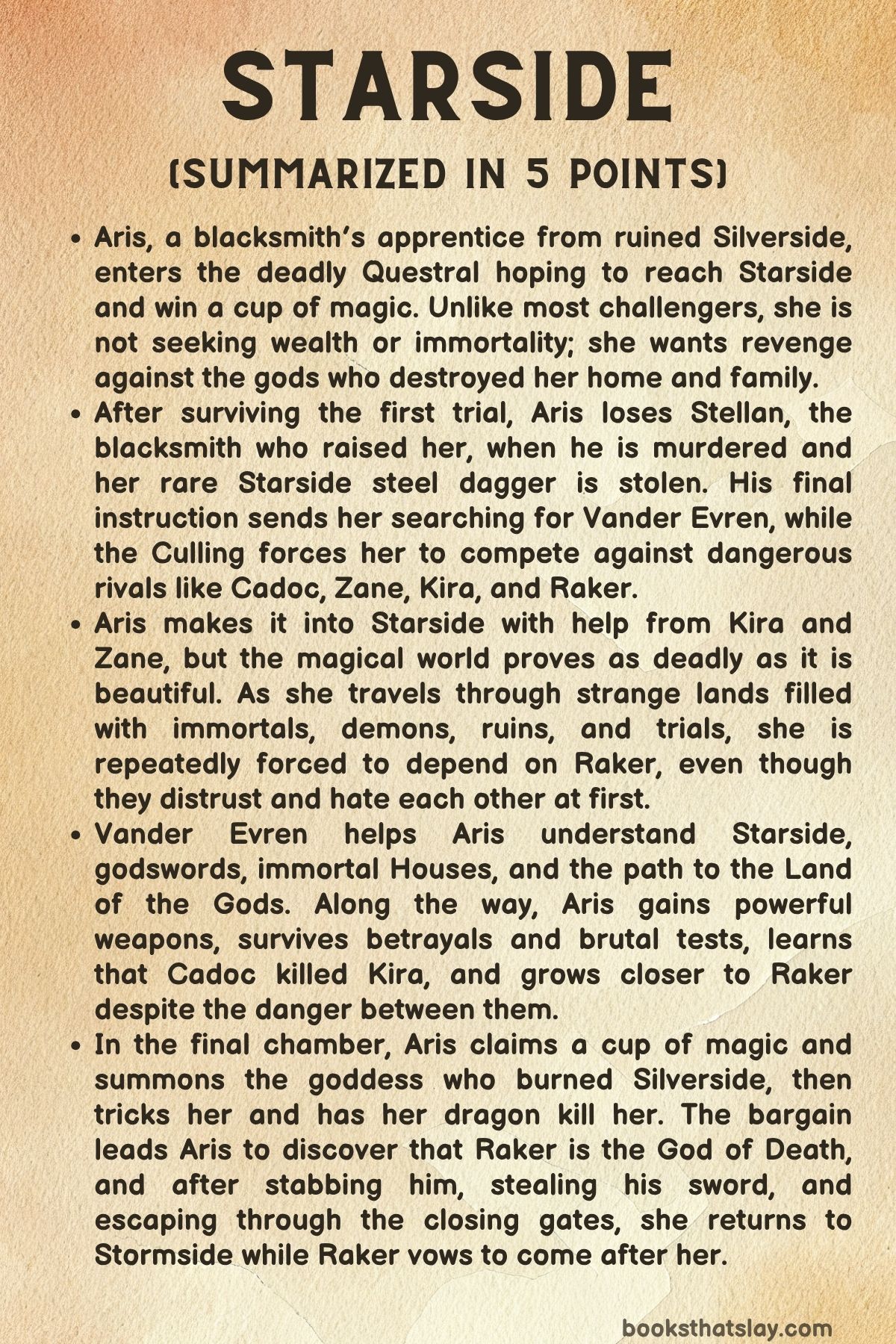
Summary
Aris is a blacksmith’s apprentice from Silverside, a village destroyed years earlier by a goddess. The attack killed her family and left her with one driving purpose: to reach Starside and kill the gods responsible for mortal suffering.
She has been raised and trained by Stellan, the blacksmith who became her guardian after the destruction of her home. From him, she receives both survival skills and a hidden dagger made from rare Starside steel, a weapon strong enough to matter in a world shaped by immortals and divine power.
Every fifty years, mortals are given one chance to enter the Questral, a deadly event that can lead them into Starside. The prize is a cup of magic, but the path to it is filled with violence.
Hundreds of challengers fight to reach a black stone platform before time runs out. Guards, rival volunteers, and the chaos of the crowd make survival uncertain from the first moments.
Aris fights her way forward, hiding the dagger and refusing to be stopped. She faces Pagnus Ender and reaches the platform, where she sees some of the strongest and most dangerous contenders, including Cadoc Bolter, Zane Sterling, Kira of Brambleside, Valen, and Harlan Raker, the feared head of the king’s guard.
When Aris accepts the Culling, she makes her true goal clear. She is not going to Starside for wealth, status, or immortality.
She is going there to kill gods. Stellan is furious and frightened by her choice, especially because he survived the previous Questral and knows more than he is willing to say.
He refuses to give her the full truth. That night, an attacker comes for him, steals the Starside steel dagger, and leaves him dying.
Aris cannot save him. Before he dies, Stellan gives her one final instruction: find Vander Evren.
The Culling continues on the road to the king’s castle. The challengers fight for horses, then attend a royal feast before being sent into another violent race through the king’s grounds.
Aris survives a thorn maze by following Raker, even though she distrusts him. She also claims Stellaris, an ancient sword with great power.
As the trials continue, she learns that Cadoc stole Stellan’s dagger and murdered him. This makes her mission even more personal.
With help from Kira and Zane, Aris survives the final stages and becomes one of the fifty chosen to cross into Starside.
Starside is more beautiful and more dangerous than Aris expected. Its lands are filled with magic, strange creatures, immortal houses, and rules that mortals barely understand.
Aris, Kira, and Zane travel together at first, looking for maps and any advantage that can help them move faster. Their alliance gives Aris a brief sense of support, but Starside quickly takes its toll.
Kira is badly injured and must be sent back in a magical boat. Before leaving, she makes Aris promise to help her sick sister.
Zane continues for a while, but Aris is eventually separated from him and forced onto a harsher path.
Aris then finds herself traveling with Raker. Their partnership begins with hostility.
He is dangerous, secretive, and tied to the same royal power structure Aris hates. Still, he repeatedly saves her life.
He pulls her from drowning, protects her from deadly creatures, shields her from immortals, and helps her survive attacks from demons and other threats. Aris resents needing him, and he keeps parts of himself hidden, but the journey changes them both.
As they move through rivers, forests, mist, ruins, deserts, magical cities, and lands ruled by immortal houses, Aris begins to understand how little she truly knows about Starside.
Eventually, Aris reaches Vander Evren, the immortal bloodbane Stellan told her to find. Vander knew Stellan and helps Aris recover.
He teaches her more about godswords, the immortal Houses, and the path that leads toward the Land of the Gods. His knowledge gives Aris a clearer sense of what she is facing, but it also confirms that her goal is almost impossible.
Killing gods is not only dangerous; it requires weapons, timing, and a willingness to lose almost everything.
At Heartfall, Aris works to secure invitations from immortal heirs so she can use portals and move closer to the end of the quest. The politics of the immortal world are treacherous, and every favor carries risk.
Raker becomes more protective of her, and the attraction between them grows stronger even as mistrust remains. Their connection is shaped by anger, need, and shared survival.
They endure betrayals, attacks, and a desert trial that forces them to relive their worst memories. Through these trials, Aris’s hatred begins to sit beside more complicated feelings, especially for Raker.
Near the end of the journey, Cadoc returns and reveals another cruel truth: he killed Kira and took her sword. Aris fights him on the back of his dragon above the City on Fire.
Their duel is brutal, and Cadoc knocks her into the flames below. She survives only because Este and other magical women rescue her.
Afterward, Aris gains a silver dragon of her own and receives a starlight sword from the Astral Queen. With these new weapons and allies, she continues toward the Land of the Gods, more determined than ever to finish what she started.
Aris reunites with Zane, who has already won a cup of magic and intends to use it to save his mountain. His success shows one version of what the Questral can mean: hope, rescue, and restoration.
But Aris’s purpose is darker. She enters the final chamber alone and claims her own cup.
Instead of asking for comfort or reward, she summons the goddess who destroyed Silverside, the God of Travels.
The goddess admits that she burned Aris’s village because of a prophecy. She offers Aris a bargain: she can bring back Aris’s family if Aris swears not to kill her.
Aris agrees, but only long enough to turn the bargain against the goddess. She has her dragon eat the goddess, choosing revenge over the promise of restoration.
The goddess’s bargain then points Aris toward the God of Death, and the truth is revealed: Raker is that god.
Aris summons him. The revelation breaks open everything between them.
She admits that she loves him, but her mission still rules her actions. She stabs him, though he survives.
Then she steals his sword and flees toward the gates with both weapons. Her dragon helps her escape through the closing passage between Starside and Stormside, while Raker remains trapped on the Starside side.
He tells her the gates will not keep him from her. Aris returns to Stormside with the weapons she needs and the weight of what she has done, answering him with the promise that she will see him in fifty years.
Characters
Aris
Aris is the central force of Starside, and her character is built around grief, rage, survival, and an almost impossible hunger for justice. She begins as a blacksmith’s apprentice from the ruined village of Silverside, but her identity is shaped far more deeply by the violence she survived as a child.
The destruction of her village and the death of her family leave her with a purpose that is much larger than winning magic or gaining immortality. Unlike many challengers who enter the Questral for power, wealth, or escape, Aris enters with a deadly and personal mission: to kill the gods.
This makes her one of the most determined characters in the book, because every danger she faces is tied to a larger emotional wound that she refuses to ignore.
Aris is brave, but her bravery is not simple fearlessness. She is often afraid, wounded, uncertain, and overwhelmed, yet she keeps moving because stopping would mean betraying the people she lost.
Her skill as a fighter comes from training, hardship, and instinct rather than privilege. The dagger made from Starside steel and later the sword Stellaris represent more than weapons; they show how Aris carries both her past and her future into battle.
She is resourceful enough to survive the Questral, clever enough to adapt to Starside’s strange rules, and stubborn enough to challenge beings far more powerful than herself.
Her emotional complexity becomes clearer as the story develops. Aris is not only angry; she is also loyal, protective, and capable of deep love.
Her bond with Kira shows her compassion, especially when she promises to help Kira’s sick sister. Her connection with Zane shows that she can form trust even in a competition built on danger.
Her relationship with Raker is the most complicated part of her emotional journey, because it forces her to face the conflict between love and revenge. She grows close to him, depends on him, and eventually admits that she loves him, yet she still chooses her larger mission when she stabs him and takes his sword.
By the end of the novel, Aris becomes a character defined by painful choices. She defeats the goddess who destroyed Silverside not by accepting mercy, but by using the goddess’s own bargain against her.
This moment shows Aris’s intelligence, ruthlessness, and refusal to be controlled by divine power. However, her victory does not give her peace.
Instead, it leaves her separated from Raker and still caught in the consequences of her revenge. Aris is heroic because she fights against impossible forces, but she is also dangerous because her grief has taught her to sacrifice almost anything for justice.
Harlan Raker
Harlan Raker is one of the most mysterious and morally layered figures in the book. At first, he appears to be the terrifying head of the king’s guard, a deadly opponent whose strength and reputation make him seem almost impossible to defeat.
His early presence creates fear because he seems controlled, brutal, and unreadable. He is not introduced as someone gentle or trustworthy, and this makes his later development much more powerful.
The more time Aris spends with him, the more the story reveals that Raker is not merely a guard or rival but someone carrying secrets that change the meaning of his actions.
Raker’s relationship with Aris begins through hostility, suspicion, and survival. He saves her repeatedly from drowning, creatures, immortals, demons, and the dangers of Starside, but his protection never feels simple.
He is guarded, sharp, and often difficult to understand. His actions suggest care before he is willing to openly admit it.
This creates tension because Aris has every reason not to trust him, yet he becomes one of the people most responsible for keeping her alive. Their partnership grows out of necessity, but it gradually becomes emotional, intimate, and dangerous.
Raker’s protectiveness is one of his defining traits. He is powerful and experienced, but his strength is complicated by secrecy.
He knows more about Starside than he reveals, and this makes him both a guide and a threat. His attraction to Aris grows despite their mistrust, and their bond becomes one of the emotional centers of the story.
He understands violence, loss, and survival in ways that make him similar to Aris, but he also belongs to a world of power that she is trying to destroy. This makes their love feel intense because it is built in the middle of betrayal, danger, and opposing purposes.
The revelation that Raker is the God of Death transforms his entire character. What once seemed like mystery becomes divine concealment.
His survival after Aris stabs him shows that he is not easily destroyed, but the emotional wound matters as much as the physical one. Aris’s betrayal hurts because their bond was real, even though both of them were hiding truths.
Raker’s final vow that the gates will not keep him from her shows that he remains determined, possessive, and emotionally tied to Aris. He is both lover and enemy, protector and god, making him one of the most conflicted characters in Starside.
Stellan
Stellan is one of the most important emotional anchors in the story, even though his time in the plot is limited. As the blacksmith who raised and trained Aris after the destruction of Silverside, he becomes a father-like figure to her.
His role is not only practical but deeply emotional. He teaches her skill, discipline, and survival, helping shape her into someone capable of entering the Questral.
Without Stellan, Aris would not have the same strength, training, or sense of purpose.
Stellan’s past as a survivor of the previous Questral gives him a mysterious weight. He clearly knows more than he is willing to tell Aris, and his refusal to reveal everything creates tension between love and protection.
He wants to keep Aris safe, but his silence also leaves her unprepared for some of the dangers ahead. This makes him a flawed guardian.
He cares deeply for her, yet he underestimates the depth of her determination and the fact that she will seek the truth with or without his permission.
His death is one of the most important turning points in the book. When Cadoc attacks him and steals the Starside steel dagger, Stellan’s murder turns Aris’s mission even more personal.
She was already driven by the death of her family and the destruction of her village, but losing Stellan gives her grief a new and immediate focus. His final instruction to find Vander Evren becomes a guidepost for Aris’s journey, showing that even in death, Stellan continues to direct and protect her.
Stellan represents memory, training, sacrifice, and unfinished truth. He is not simply a mentor; he is the person who helped Aris survive after her world was destroyed.
His influence lives through her fighting skills, her knowledge of metal and weapons, and her refusal to be powerless. His murder also reveals the cruelty of the competition and the danger of trusting appearances.
Through Stellan, the story shows how love can prepare someone for survival, even when it cannot protect them from loss.
Kira of Brambleside
Kira is one of the most sympathetic challengers in the story because her motivation is rooted in love rather than greed. She enters the deadly competition not simply to gain power for herself, but because she wants to help her sick sister.
This gives her character a gentler and more human purpose in a world filled with violence, ambition, and betrayal. Her presence reminds the reader that many mortals are desperate because the world has denied them ordinary ways to save the people they love.
Kira’s friendship with Aris is important because it shows Aris’s capacity for trust and tenderness. In a competition where other challengers can become enemies at any moment, Kira becomes someone Aris cares about.
Their bond is not built on convenience alone; it is built through shared danger and emotional honesty. When Kira is badly injured and sent away in a magical boat, her request that Aris help her sister becomes a moral responsibility that Aris carries forward.
Kira also represents innocence caught inside a brutal system. She is brave enough to enter the Culling and skilled enough to survive for a time, but she is not protected from the cruelty of stronger and more ruthless competitors.
Her later death at Cadoc’s hands is especially painful because it confirms how merciless the quest has become. Cadoc does not only kill her; he takes her sword, turning her loss into another sign of his selfishness and brutality.
Through Kira, the story explores sacrifice, friendship, and the cost of hope. She may not reach the end of the journey, but her impact continues after she is gone.
Her sister’s illness gives Aris another reason to think beyond her own revenge. Kira’s death also deepens the reader’s understanding of Cadoc as a villain and strengthens Aris’s anger against those who treat others as tools.
Kira is gentle compared to many other characters, but that gentleness makes her fate even more tragic.
Zane Sterling
Zane Sterling is a powerful rival who becomes an important ally to Aris. At first, he appears as one of the impressive challengers on the black stone platform, someone strong enough to survive where many others fail.
His presence suggests confidence, ability, and ambition. However, as the story develops, Zane becomes more than a competitor.
He proves that not every strong challenger is cruel, and not every alliance in the Culling is false.
Zane’s role in helping Aris survive shows his loyalty and practical courage. Alongside Kira, he helps Aris become one of the final fifty to enter Starside.
This makes him part of the small circle of people who affect her journey in a meaningful way. He is not as emotionally central as Raker or as tragic as Kira, but he provides balance.
He is brave, capable, and driven by a purpose that is not purely selfish.
His motivation to save his mountain gives depth to his character. Like Aris and Kira, Zane is not simply chasing glory.
He wants magic because his home needs saving, which makes him another example of how mortal desperation fuels the Questral. His success in winning a cup of magic near the end shows that he has the strength and determination to complete the journey on his own terms.
This also separates him from Aris, because while Zane seeks restoration, Aris seeks revenge against divine power itself.
Zane’s reunion with Aris near the end of the story is meaningful because it shows how far both characters have come. He has achieved his goal, while Aris is still moving toward a darker and more dangerous confrontation.
Zane’s character brings honor and steadiness to the story. He is a reminder that ambition can be noble when it is tied to love for one’s people and homeland.
Cadoc Bolter
Cadoc Bolter is one of the clearest antagonistic figures in the book, and his character is defined by ambition, cruelty, and betrayal. From the beginning, he stands out as a powerful rival, but his true nature becomes darker as the story unfolds.
He is not merely dangerous because he is skilled; he is dangerous because he has no moral boundary strong enough to stop him from taking what he wants. His theft of Stellan’s dagger and murder of Stellan reveal him as a deeply ruthless character.
Cadoc’s actions are especially cruel because they attack Aris at the heart of her personal life. By killing Stellan, he does more than remove a man from the story; he destroys one of Aris’s last living connections to safety, family, and training.
This turns Cadoc into more than a competitor. He becomes a personal enemy whose violence directly intensifies Aris’s grief and rage.
The stolen dagger also symbolizes his willingness to claim power that does not belong to him.
His later killing of Kira further establishes him as merciless. Kira’s death shows that Cadoc does not see others as people with dreams, families, or pain.
He sees them as obstacles or resources. Taking her sword after killing her makes his cruelty feel even more complete because he turns her life and death into part of his own advancement.
This makes him a strong contrast to characters like Aris, Zane, and Kira, whose motivations are tied to love, survival, or justice.
Cadoc’s duel with Aris on the back of his dragon is one of the most dramatic expressions of their conflict. He represents selfish hunger for victory, while Aris represents vengeance sharpened by loss.
When he knocks her into the flames, his violence reaches its most terrifying form, but Aris’s survival shows that his cruelty cannot fully defeat her. Cadoc is important because he embodies the worst possibilities of the Questral: a person who enters danger and becomes monstrous in pursuit of power.
Vander Evren
Vander Evren is a crucial source of knowledge and recovery for Aris. As an immortal bloodbane who knew Stellan, he connects Aris to hidden truths about the world she has entered.
His importance comes not from physical action alone but from what he understands. When Aris reaches him, he helps her recover and gives her information about godswords, immortal Houses, and the path to the Land of the Gods.
In a world where ignorance can be deadly, Vander’s guidance becomes essential.
Vander also extends Stellan’s influence beyond death. Because Stellan’s final instruction is for Aris to find him, Vander becomes part of the trust Stellan leaves behind.
This gives him emotional significance before Aris even fully understands who he is. He is a bridge between the mortal world Aris came from and the immortal world she must learn to navigate.
His connection to Stellan suggests a deeper history behind the Questral and the dangers of Starside.
His character represents wisdom, secrecy, and survival within immortal society. As a bloodbane, Vander belongs to a world filled with power and danger, yet he chooses to help Aris rather than exploit her.
This makes him different from many immortal figures who appear threatening or self-interested. He does not remove the danger from Aris’s path, but he gives her the knowledge she needs to keep moving through it.
Vander’s role also helps expand the story’s mythology. Through him, Aris learns that her quest is much larger and more complex than simply crossing into a magical land.
The existence of godswords, Houses, portals, and divine territories shows her that killing gods is not just a matter of courage. It requires knowledge, strategy, and the ability to move through systems of immortal power.
Vander strengthens Aris not by fighting for her, but by preparing her to understand the world she is trying to challenge.
Pagnus Ender
Pagnus Ender appears as one of the early obstacles Aris must overcome on her way to the black stone platform. His role may be smaller than that of the major rivals, but he is still important because he helps establish the brutality of the Questral from the very beginning.
The event is not a fair contest of dreams; it is a violent struggle where challengers must fight through guards, rivals, and chaos before they are even allowed into the Culling.
Pagnus represents the immediate danger of mortal competition. Before Aris faces immortal houses, gods, dragons, and magical trials, she must first survive people like him.
This matters because it shows that the mortal world is already cruel before Starside enters the story. Ambition, desperation, and violence exist on both sides of the gates.
Pagnus is part of the first test of whether Aris has the strength to move forward.
His encounter with Aris also helps reveal her toughness. She is not a sheltered heroine stepping into danger for the first time.
She is already capable of fighting, adapting, and surviving under pressure. By pushing through enemies like Pagnus, Aris proves that her training with Stellan has prepared her for real violence.
His presence therefore helps highlight her readiness for the larger dangers ahead.
Although Pagnus does not carry the emotional weight of characters like Stellan, Kira, or Raker, he serves an important structural purpose in the story. He shows that the path to magic is soaked in conflict from the first step.
His role reminds the reader that even before the gods become Aris’s enemies, the world of mortals is filled with people willing to harm others for a chance at power.
Valen
Valen is introduced among the powerful rivals who stand out during the early stages of the Questral. Even with limited detail, his presence helps create the atmosphere of danger surrounding the competition.
He is part of the group that makes it clear Aris is not entering a simple race, but a deadly contest filled with skilled and threatening challengers. His inclusion among names like Cadoc, Zane, Kira, and Raker suggests that he has enough strength or reputation to be noticed.
Valen’s character functions as part of the wider field of competition. He helps show the scale of the event and the variety of people drawn to it.
Every challenger comes with a different reason for risking death, and Valen’s presence adds to the sense that Aris is surrounded by unknown threats. This uncertainty is important because it keeps the early part of the story tense.
Aris cannot know which rivals might become allies, enemies, or obstacles.
His role also emphasizes Aris’s courage. She enters a contest where many others may be stronger, wealthier, more experienced, or more prepared.
Characters like Valen make Aris’s survival feel more impressive because she is not competing against ordinary people. She is facing individuals who have also fought hard to reach the platform and who may be just as desperate to win.
Valen may not have the same emotional development as the major characters, but he contributes to the dangerous world of the story. He represents the many challengers whose lives and ambitions surround Aris’s journey.
Through characters like him, the book creates the feeling that the Questral is vast, violent, and filled with people whose stories could become deadly at any moment.
Este
Este is important because she appears at a moment when Aris is almost destroyed. After Cadoc knocks Aris into the flames above the City on Fire, Este and other magical women rescue her.
This act makes Este a figure of intervention, survival, and unexpected aid. In a story where betrayal is common and danger is constant, Este’s rescue shows that help can come from surprising places.
Her role also highlights Aris’s vulnerability. Aris is strong, but she is not invincible.
There are moments when her own skill is not enough to save her, and Este’s intervention allows her journey to continue. This makes Este important even if she does not dominate the story.
Without her rescue, Aris’s quest might have ended before she reached the final chamber.
Este also represents the presence of powerful women within the magical world. Her connection with other magical women suggests a wider network of strength and influence beyond the main competition.
This broadens the world of the story by showing that power does not belong only to gods, kings, guards, or male warriors. There are other forces capable of shaping Aris’s fate.
Through Este, the story emphasizes that survival is sometimes communal. Aris often appears isolated because of her grief and mission, but she survives partly because others choose to help her.
Este’s action becomes one of the moments that allows Aris to continue toward her confrontation with the goddess. She may be a supporting character, but her impact is decisive.
The Astral Queen
The Astral Queen is a powerful and majestic figure connected to the magical grandeur of Starside. Her importance comes through the gift she gives Aris: a starlight sword.
This moment marks Aris’s movement closer to divine conflict and shows that her journey has reached a level far beyond ordinary mortal combat. A sword from the Astral Queen is not simply a weapon; it is a symbol of recognition and power.
Her presence adds to the mythic quality of the story. By the time Aris encounters figures like the Astral Queen, the world has expanded from ruined villages and mortal contests into a realm of queens, gods, dragons, immortal houses, and ancient weapons.
The Astral Queen helps deepen the sense that Aris is moving through a place where beauty and danger exist together. She belongs to that higher, more mysterious order of power.
The gift of the starlight sword also strengthens Aris’s role as a god-killer. Aris cannot challenge divine beings with ordinary tools alone.
She needs weapons connected to the magical and immortal forces of the world. By giving her such a sword, the Astral Queen indirectly helps Aris continue her mission.
This makes her part of the chain of characters who equip Aris physically, emotionally, or intellectually.
The Astral Queen’s role is not defined by personal intimacy with Aris, but by symbolic importance. She represents authority, magic, and celestial power.
Her gift signals that Aris’s quest has become larger than revenge alone. Aris is now carrying weapons and power that place her directly in the path of gods.
The God of Travels
The God of Travels is one of the most important antagonistic divine figures in the story because she is responsible for the destruction of Silverside and the death of Aris’s family. Her crime is the original wound that shapes Aris’s life.
Because of her, Aris grows up with grief, rage, and a mission that leads her into the Questral. Even before she appears directly, her presence hangs over the entire story as the force Aris wants to punish.
When Aris finally summons her, the goddess reveals that she burned Silverside because of a prophecy. This explanation makes her cruel in a cold and self-preserving way.
She destroys innocent lives not out of immediate anger, but because she fears what may come. Her willingness to murder a village because of prophecy shows the arrogance of divine power.
She treats mortal lives as disposable pieces in a larger game of fate and control.
Her bargain with Aris is one of the most emotionally dangerous moments in the book. She offers Aris the possibility of bringing back her family if Aris promises not to kill her.
This offer strikes at Aris’s deepest wound. It tempts her not with wealth or immortality, but with the one thing she has wanted since childhood.
The goddess understands grief well enough to use it as a weapon.
Aris’s decision to agree and then have her dragon eat the goddess reveals the depth of Aris’s cunning and rage. The God of Travels believes she can manipulate Aris through longing, but Aris turns the bargain against her.
This death is not only revenge; it is Aris’s rejection of divine control. The goddess represents the destructive selfishness of gods, while Aris’s victory over her proves that mortal grief can become a force powerful enough to challenge divinity.
The Silver Dragon
The silver dragon becomes one of Aris’s most powerful allies near the end of the story. Its arrival marks a major shift in Aris’s strength and status.
Earlier in the journey, she survives through training, weapons, alliances, and stubborn endurance. With the silver dragon, she gains a magical companion capable of changing the scale of her power.
The dragon makes her more than a mortal challenger; it makes her someone who can face divine forces with a creature of immense strength beside her.
The dragon is important not only as a source of power but also as an extension of Aris’s will. When Aris uses the dragon against the God of Travels, the creature becomes part of her revenge.
It carries out the action that destroys the goddess, making it central to one of the most important victories in the story. This moment shows how far Aris has come from the ruined village of Silverside.
She began as a girl shaped by loss, and she becomes someone commanding a dragon against a god.
The silver dragon also helps Aris escape through the closing gates. This makes it a symbol of survival and freedom.
Without the dragon, Aris may not have been able to return to Stormside with the weapons she stole. Its role in the ending is therefore essential, because it helps her separate herself from Raker and complete her immediate escape.
As a character-like presence, the dragon represents magic, loyalty, and transformation. It does not need long speeches to matter.
Its actions change the direction of the plot and strengthen Aris’s identity as someone who has moved beyond ordinary human limits. The silver dragon shows that Aris’s journey has given her not only scars and enemies, but also extraordinary power.
The King
The king is an important background figure because his castle, guards, feast, grounds, and gates shape the mortal side of the Culling. Even if he is not the emotional center of the story, his authority helps structure the deadly event.
The challengers are forced through royal spaces before entering Starside, and this makes the king part of the system that turns mortal desperation into spectacle.
His world is marked by power, ceremony, and violence. The royal feast contrasts sharply with the danger surrounding the challengers.
It shows how authority can decorate brutality with tradition. The Culling is not treated as random chaos; it is organized, watched, and controlled by people with power.
The king’s role therefore reflects the political side of the story’s cruelty.
The king also matters because Raker serves as the head of his guard. This connection gives Raker an official place in the mortal power structure before his deeper identity is revealed.
Through the king’s guard and the race through the royal grounds, the story shows that the challengers must survive not only each other but also the institutions that control access to magic.
As a character, the king represents distant authority more than personal intimacy. He is part of the system Aris must pass through, not someone who guides or loves her.
His presence helps show that the world outside Starside is already unequal and dangerous. Mortals are made to fight for a chance at magic while rulers and guards control the path.
Kira’s Sister
Kira’s sister never needs to dominate the action to matter deeply. Her illness is the reason Kira enters the Culling, which means she shapes Kira’s motivation from a distance.
She represents the loved ones left behind by the challengers, the people whose lives depend on whether someone survives the quest. Through her, the story shows that the Questral is not only about those who enter it, but also about the families and communities waiting outside it.
Her importance lies in what she reveals about Kira. Kira is willing to risk death because her sister needs help, and this makes Kira’s courage deeply emotional.
The sick sister becomes a symbol of mortal helplessness in a world where magic exists but is difficult and deadly to obtain. If healing or salvation were easily available, Kira would not need to enter such a brutal contest.
When Kira asks Aris to help her sister, the sister becomes part of Aris’s moral burden. Aris is already carrying the memory of her family and Stellan’s final instruction, but Kira’s promise adds another responsibility.
This matters because it pushes Aris beyond revenge alone. She must remember the needs of the living as well as the dead.
Kira’s sister represents innocence, vulnerability, and the human cost of a world controlled by power. Her illness gives emotional meaning to Kira’s journey and makes Kira’s death even more tragic.
Even though she remains outside the main action, she helps show why the stakes of the Culling are so personal for many challengers.
Themes
Revenge and Moral Compromise
Aris begins with a clear and personal mission: the gods destroyed her village, killed her family, and left her with a life shaped by grief. Her desire to kill them is not presented as simple anger, but as the result of years of loss, training, and unanswered questions.
In Starside, revenge gives Aris direction, but it also tests the limits of her conscience. She enters the quest knowing that survival will require violence, deception, and emotional hardness.
As she moves closer to the gods, her purpose becomes more complicated because the enemy is not only powerful but manipulative. The goddess offers her the one thing revenge could never give her: the possibility of seeing her family again.
Aris’s choice to accept the bargain and then destroy the goddess shows how deeply revenge has changed her. She is clever and determined, but she also becomes willing to use betrayal as a weapon.
The theme asks whether justice can remain pure when it is driven by pain, and whether revenge heals grief or only gives it a sharper form.
Survival in a World Built on Cruelty
The quest is designed to strip people down to instinct. From the first challenge to the final race, Aris faces a world where mercy is rare and weakness is punished quickly.
Survival is not only about physical strength; it depends on judgment, timing, alliances, and the ability to keep moving after loss. The Questral turns desperation into entertainment, forcing mortals to fight one another for access to magic that should not belong only to the powerful.
Once Aris reaches the magical realm, the danger becomes even greater because beauty often hides violence. Rivers, forests, deserts, cities, creatures, immortals, and gods all test her endurance in different ways.
This theme shows that survival can demand constant adaptation. Aris must learn when to fight, when to flee, when to trust, and when to hide her fear.
The harshness of the world also exposes the unfairness at its center: mortals risk everything for a small chance at power, while immortals and gods treat their suffering as part of an old system that benefits them.
Trust, Betrayal, and Unlikely Bonds
Aris’s journey is shaped by people she cannot fully trust but often has to depend on. Her connection with Stellan begins as one of love, training, and protection, yet even he keeps secrets that leave her unprepared.
Cadoc’s betrayal is more direct and cruel, since he steals from her, kills someone she loves, and later destroys another bond by killing Kira. These acts teach Aris that trust can be dangerous, especially in a competition where everyone wants power.
At the same time, she cannot survive alone. Kira and Zane help her when the quest is still forming around alliances, and their friendship gives Aris reasons to care beyond her own revenge.
Her relationship with Raker is the most difficult example of this theme. Their bond grows through hostility, rescue, attraction, and shared danger, but it is always shadowed by hidden truths.
When his identity is revealed, love and betrayal become almost impossible to separate. The theme shows that trust is not simple faith in another person; it is a risk taken despite fear, uncertainty, and the possibility of pain.
Power, Sacrifice, and the Cost of Magic
Magic is presented as something deeply desired, but never harmless. Mortals enter the quest because a cup of magic can change lives, save communities, cure sickness, or offer escape from ordinary suffering.
Zane’s wish to save his mountain and Kira’s concern for her sister show that the hunger for magic is not always selfish. For many, it is tied to responsibility and love.
Yet the system surrounding that magic is brutal. Hundreds risk death for a prize controlled by forces far above them, and the path to power demands sacrifice at every stage.
Aris gains weapons, allies, knowledge, and eventually her own cup, but each gain comes with loss. Stellan dies, Kira is killed, trust is broken, and love becomes part of the price she pays.
The theme questions whether power can truly be won without being corrupted by the process of winning it. Magic promises freedom, but it also traps people inside bargains, prophecies, debts, and violence.
By the end, Aris has more power than before, but she is also more burdened, more isolated, and tied to consequences that remain unresolved.