Sweetbitter Song Summary, Characters and Themes
Sweetbitter Song by Rosie Hewlett retells the world of the Odyssey from the side of Melantho, a slave girl usually remembered only through betrayal and punishment. This version gives her a full life, shaped by fear, friendship, desire, loss, and the struggle for control over her own fate.
At its center is Melantho’s bond with Penelope, beginning in childhood and growing into a secret love that survives war, power, and separation. The book challenges the heroic stories told about kings and warriors by asking what those legends cost the women and servants trapped beneath them.
Summary
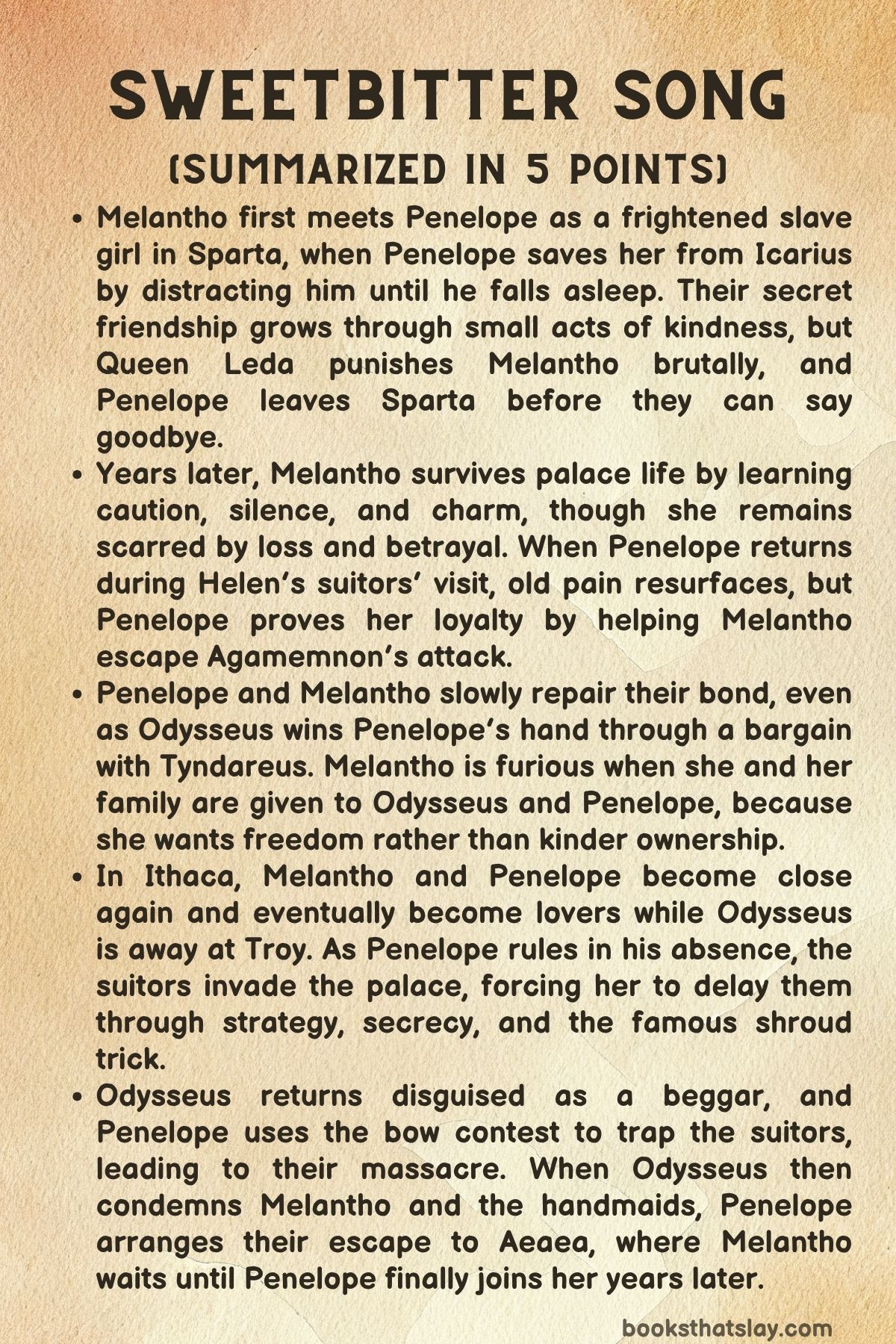
Melantho is only nine years old when she is first summoned from the slave quarters of King Tyndareus’s palace in Sparta to the rooms of Icarius, Penelope’s father. She does not understand why her mother reacts with such terror, but her mother knows enough about noble men to fear what may happen.
Melantho enters Icarius’s chamber expecting punishment or service, and instead finds herself in a dangerous situation she is too young to name. Before Icarius can harm her, his daughter Penelope steps in.
At ten years old, Penelope is already quick, clever, and observant. She distracts her father by challenging him to a board game, feeds his pride, encourages him to drink, and waits until he falls asleep.
Then she quietly returns Melantho to safety.
That night forms the beginning of a bond between the two girls. Soon afterward, Melantho sees Penelope being tormented by Clytemnestra in the gymnasium.
Remembering how Penelope saved her, Melantho lies and says Icarius has called for Penelope, giving her a way to escape. Penelope repays this loyalty by having Melantho assigned to her as a handmaid.
Their friendship grows quickly. Penelope shares honeyed figs with Melantho, talks to her as an equal, teaches her, and gives her attention that no one else in the palace offers.
For Melantho, who has known mostly labor, fear, and obedience, Penelope becomes a source of warmth and wonder.
Their closeness is dangerous because the world around them is built on rank. Penelope is a princess, while Melantho is property.
Even their affection must remain hidden or be explained away. Before Penelope is expected to leave Sparta, Melantho takes her secretly to the Eurotas River so they can swim together.
The moment is one of freedom, but it is discovered. Queen Leda forces Penelope to deny that Melantho is her friend and orders Melantho whipped.
Penelope refuses to carry out the punishment, so Clytemnestra does it instead. Melantho is beaten so badly that she nearly dies from fever.
When she finally wakes, Penelope has gone without saying goodbye. To Melantho, the loss feels like betrayal.
Years pass, and Melantho is forced to grow harder. Her mother is sold when Leda cuts down the number of kitchen slaves, leaving Melantho with another wound she cannot heal.
As she becomes older, she learns how to survive in the palace by watching, staying silent, and using the attention her beauty brings. She grows close to a serving boy named Callias and also draws the interest of Prince Castor.
None of this gives her safety or freedom, but it teaches her how power moves through the palace and how little protection a slave girl truly has.
When suitors arrive in Sparta to compete for Helen’s hand, Penelope returns. Melantho is filled with anger at seeing her again, yet she cannot deny that she is still drawn to her.
The old hurt remains between them: the whipping, the denial, the silence after Penelope left. During this tense visit, Agamemnon attacks Melantho.
She fights back and wounds him with a shard from a broken jug. The act could cost her life, but Penelope, disguised as a slave, helps protect her.
Odysseus also witnesses enough of the scene to pressure Agamemnon into silence. For the first time in years, Penelope becomes part of Melantho’s survival again.
Penelope and Melantho slowly begin to face what happened between them. Penelope admits that Melantho really was her friend and that she regretted the way things ended.
This does not erase Melantho’s pain, but it opens a path back toward trust. Around them, the nobles are busy arranging Helen’s future.
Tyndareus fears that choosing one husband for Helen will anger the rejected men and lead to violence. Odysseus uses Penelope’s advice to solve the problem: Helen will appear to choose her husband, and all the rejected suitors will swear an oath to defend the marriage.
As payment for helping, Odysseus asks to marry Penelope. Tyndareus agrees and also gives Melantho and her family to Odysseus and Penelope.
Melantho is furious. Penelope may care for her, and Odysseus may be less brutal than many noble men, but Melantho still remains enslaved.
She wants freedom, not kinder ownership. Being gifted from one household to another reminds her that her life can be moved, traded, or claimed without her consent.
When she arrives in Ithaca, she keeps her distance from Penelope at first. Yet the bond between them is difficult to break.
Penelope is isolated in her new home, and Melantho is one of the few people who truly knows her. Gradually, they return to each other.
After Odysseus leaves for Troy, Penelope gives birth to Telemachus and must govern Ithaca while waiting for a husband who may never come back. In his absence, Penelope and Melantho become lovers.
Their relationship becomes both refuge and risk. Around them, Penelope’s handmaids form a close and loyal circle, creating a hidden world of women inside the palace.
They serve, plan, protect, and comfort one another while the larger world remains ruled by men, war, and inheritance.
As years pass and news from Troy grows uncertain, suitors begin to occupy the palace. They demand that Penelope choose a new husband, since Odysseus is believed dead or lost.
Their presence becomes more threatening over time. They eat through the household’s resources, insult the servants, pressure Penelope, and endanger the women around her.
To delay them, Penelope promises to choose a husband once she finishes weaving a shroud for Laertes. Each day she works at the loom, and each night she secretly unpicks what she has woven.
This deception buys time, but it cannot last forever.
The danger in the palace increases. Penelope knows she must find a way to remove the suitors before they fully seize control.
She makes plans involving pirates and Odysseus’s great bow, hoping to turn the suitors’ greed and pride against them. Before the plan can unfold completely, Odysseus returns to Ithaca disguised as a beggar.
Penelope recognizes him, though he does not openly reveal himself. His return does not bring simple rescue.
It brings new danger, because Odysseus has come back as a man shaped by war, vengeance, and suspicion.
Penelope sets the bow contest, telling the suitors that she will marry the man who can string Odysseus’s bow and shoot through the axes. The contest traps the suitors in the hall with Odysseus, Telemachus, and their allies.
Melantho’s brother Melanthius tries to help the suitors by arming them, but Penelope’s own plan is already moving. The pirates she arranged arrive, and the suitors are killed.
The slaughter restores Odysseus’s control of the palace, but it also reveals how ruthless he has become.
After the suitors are dead, Odysseus turns his violence toward those he sees as traitors. He mutilates and kills Melanthius.
Then he orders Melantho and the handmaids hanged, accusing them of betrayal. Penelope acts quickly to save them.
She draws Odysseus away and delays him, while Telemachus secretly frees the women. Penelope has already prepared a ship so they can escape.
Melantho leaves Ithaca with the handmaids and sails to Aeaea, the island where Circe shelters women who have been cast out, harmed, or lost.
Penelope cannot go with Melantho immediately. She stays behind to protect Telemachus and to manage Odysseus, knowing that leaving too soon would endanger everyone.
Her choice hurts Melantho, but this time it is not a simple abandonment. Penelope promises she will come later.
Melantho reaches Aeaea and builds a life among women who understand exile and survival. She waits, holding on to love across years of absence.
Fourteen years after Odysseus’s death, Penelope finally comes to Aeaea. She has survived the duties, lies, and dangers that kept her in Ithaca.
Melantho has also survived, carrying both the pain of their separation and the hope of reunion. When they meet again, their love is no longer hidden inside another man’s palace or controlled by royal households.
Their reunion gives Melantho the ending she was denied by the old myths: not punishment, silence, or shame, but freedom, memory, and the chance to be loved as herself.
Characters
Melantho
Melantho is the central emotional force of Sweetbitter Song, and her character is shaped by survival, longing, anger, and love. As a child slave in Sparta, she begins the book powerless, unable to understand the danger that surrounds her but deeply affected by the fear of the adults around her.
Her early encounter with Icarius reveals how vulnerable she is in a world where enslaved girls are treated as property rather than people. Penelope’s intervention saves her, and that moment becomes the beginning of a bond that changes Melantho’s life.
Her childhood innocence is repeatedly damaged by violence, separation, and betrayal, especially when Queen Leda forces Penelope to deny their friendship and Melantho is punished for a love she barely knows how to name. This makes Melantho a character whose deepest wounds come not only from cruelty, but from the loss of trust.
As she grows older, Melantho becomes sharper, more guarded, and more strategic. She learns that beauty, silence, and flirtation can become tools of survival, even though they cannot truly protect her from the power of nobles such as Agamemnon.
Her reaction to Agamemnon’s attack shows both her fear and her refusal to remain helpless. She is not simply a victim in the book; she is someone who fights back when pushed beyond endurance.
Her anger toward Penelope is also important because it is not shallow resentment. It comes from years of abandonment, pain, and the belief that Penelope chose safety over her.
Yet Melantho’s anger exists alongside love, which makes her emotionally complex. She wants to reject Penelope, but she is still drawn to the girl who once saved her.
In Ithaca, Melantho’s character deepens further as she becomes part of Penelope’s private world and eventually her lover. Her relationship with Penelope gives her tenderness, belonging, and emotional recognition, but it never fully removes the danger created by her enslaved status.
Even when she is loved, she is still not free in the eyes of society. This tension defines much of her character.
She longs for freedom, not simply comfort. Her final escape to Aeaea represents the survival of women who have been marked as disposable by powerful men.
By waiting for Penelope, Melantho shows loyalty, endurance, and hope, but her ending is not passive. She survives, remembers, and builds a life beyond the palace that tried to destroy her.
Penelope
Penelope is one of the most intelligent and emotionally layered characters in the book. As a child, she is already observant enough to understand the danger Melantho faces in Icarius’s chamber, and she uses wit rather than force to protect her.
This early scene establishes her defining strength: Penelope survives through intelligence, patience, and careful performance. She is not physically powerful in the way Sparta values, but she understands people’s weaknesses and uses that understanding to create small openings for safety.
Her kindness to Melantho is genuine, yet her position as a noble girl also means she benefits from the same social order that harms Melantho. This contradiction follows her throughout the story.
Penelope’s childhood friendship with Melantho reveals her desire for connection outside the cold expectations of palace life. She gives Melantho food, teaches her, speaks with her, and makes her a gown, all of which show that she sees Melantho as a person rather than a servant.
However, when Leda forces her to deny the friendship, Penelope’s failure leaves a lasting wound. Her refusal to whip Melantho shows moral resistance, but it does not prevent Melantho from being punished.
This makes Penelope sympathetic but not innocent. She is loving, but she is also constrained by fear, rank, and family pressure.
Her later regret shows that she understands the cost of her silence.
As an adult, Penelope becomes a master of delay, disguise, and political intelligence. She helps Odysseus solve the crisis of Helen’s suitors, and later she governs Ithaca while Odysseus is away.
Her famous weaving strategy reflects her ability to turn domestic expectations into political resistance. She appears obedient while quietly undermining the men who try to control her.
Her love for Melantho makes her more human and more vulnerable, because it gives her a private truth that the public world cannot accept. At the end of the book, Penelope’s decision to stay behind while sending Melantho and the handmaids away is painful but strategic.
She chooses to protect Telemachus and manage Odysseus from within the palace, proving that her courage often takes the form of endurance rather than escape.
Icarius
Icarius is a disturbing figure because he represents the casual abuse of patriarchal power. His summoning of nine-year-old Melantho to his rooms immediately places him in a position of threat, even before Melantho fully understands what is happening.
The terror of Melantho’s mother makes his intentions clear, and his behavior reveals the danger that enslaved girls face in noble households. Icarius does not need to be openly violent in that moment to be frightening; his power itself creates the threat.
He embodies a world where men of rank expect access to the bodies and lives of those beneath them.
His relationship with Penelope also exposes the emotional cruelty of the household. Penelope understands him well enough to distract him through a board game and wine, which suggests that she has learned to manage his weaknesses from a very young age.
Icarius therefore helps shape Penelope into someone who survives by reading men carefully and manipulating situations quietly. He is not developed as a loving father figure; instead, he functions as one of the first examples of male authority as danger.
His presence at the beginning of the story sets the tone for the wider world Melantho must survive.
Melantho’s Mother
Melantho’s mother is a tragic figure whose fear and helplessness reveal the brutal realities of slavery. Her terror when Melantho is summoned by Icarius shows that she understands the dangers of the palace far better than her daughter does.
She cannot openly protect Melantho because she has no real power, and this makes her fear especially painful. Her character represents the grief of mothers who must watch their children become vulnerable to the same system that has trapped them.
When she is later sold away after Leda reduces the number of kitchen slaves, her removal devastates Melantho. This separation is one of the key emotional wounds in Melantho’s life because it proves that enslaved families can be broken apart casually, as if their bonds have no value.
Melantho’s mother does not need a long presence in the book to be important. She represents love without protection, fear without escape, and the constant instability of enslaved life.
Clytemnestra
Clytemnestra is forceful, cruel, and shaped by the harsh values of the Spartan palace. Her bullying of Penelope in the gymnasium shows that she understands strength in terms of domination.
She targets Penelope’s vulnerability and difference, making her a figure of family cruelty rather than sisterly protection. In childhood, Clytemnestra appears as someone who has absorbed the violence of her surroundings and learned to express it against those weaker or less favored than herself.
Her role in whipping Melantho is especially revealing. Penelope refuses to carry out Leda’s punishment, but Clytemnestra does it, turning royal cruelty into physical violence.
This act makes her an instrument of the palace’s brutality. At the same time, Clytemnestra is not merely random in her cruelty.
She belongs to a world where power is displayed through punishment, and she performs that power with frightening ease. Her character adds sharpness to the Spartan setting by showing how women, too, can enforce oppressive systems when their own security depends on strength and obedience.
Queen Leda
Queen Leda is a cold and authoritarian presence in the book. She values order, hierarchy, and reputation above tenderness, and her treatment of Melantho and Penelope shows how ruthlessly she protects social boundaries.
When she discovers the girls have gone to the river together, she does not see friendship or innocence. She sees a violation of rank.
By forcing Penelope to deny the friendship and ordering Melantho to be whipped, Leda teaches both girls that affection across class lines will be punished.
Leda’s cruelty is not impulsive; it is political and disciplinary. She understands that the palace depends on everyone knowing their place, and she uses humiliation and violence to restore that order.
Her decision to sell Melantho’s mother further shows her lack of emotional concern for the enslaved people around her. Leda is important because she represents the female face of aristocratic power.
She may not act like the predatory men in the story, but she upholds the same world that allows them to harm others.
Callias
Callias offers Melantho a form of companionship within the servant world. As a serving boy, he belongs closer to Melantho’s social position than the nobles do, and this makes their closeness feel safer and more ordinary than her relationships with people of power.
His presence suggests that Melantho’s life is not made only of suffering and fear; she also experiences connection, attraction, and moments of youthful intimacy among those who understand the risks of palace service.
At the same time, Callias’s role also highlights the limits of safety for enslaved and serving people. Bonds among servants can provide comfort, but they cannot fully protect anyone from the decisions of nobles.
His relationship with Melantho helps show her growing awareness of desire and social performance. Through him, the book presents a quieter part of Melantho’s development: her attempt to build a self within a world that constantly tries to define her as property.
Castor
Castor represents the dangerous attention of noble men, even when that attention may seem flattering on the surface. As a prince, his interest in Melantho cannot be separated from power.
For Melantho, being noticed by someone like Castor may offer temporary status or advantage, but it also places her in danger. His presence shows how beauty becomes complicated for Melantho as she grows older.
It can give her influence, but it also makes her visible to men who have far more freedom than she does.
Castor is also part of the Spartan royal world that surrounds Melantho and Penelope. He reflects the privilege and entitlement of that world, even if he is not presented with the same level of direct brutality as characters like Agamemnon.
His importance lies in how he helps define the environment Melantho must navigate: a court where attention from the powerful is never simple and never fully safe.
Helen
Helen is central to the political world of the book, even when the emotional focus rests more heavily on Melantho and Penelope. Her suitors’ arrival creates the crisis that brings Penelope back into Melantho’s life and sets major events into motion.
Helen’s marriage becomes a matter not only of personal choice but of diplomacy, pride, and male competition. Through Helen, the book shows how noble women can be treated as prizes whose marriages determine alliances and wars.
Although Helen appears to be given the appearance of choice, that choice is carefully managed by the men around her and by Odysseus’s plan. This makes her position more complicated than simple privilege.
She is admired and desired, but that desire turns her into a political problem. Helen’s character therefore reflects another version of female captivity.
Unlike Melantho, she has rank and beauty that make her famous, but those same qualities make her life subject to public negotiation.
Agamemnon
Agamemnon is one of the clearest embodiments of violent male entitlement in the book. His attack on Melantho reveals his arrogance and his belief that status protects him from consequence.
He treats Melantho as someone available to be used, and his behavior exposes the danger faced by enslaved women in spaces controlled by powerful men. Melantho’s act of wounding him is therefore significant because it interrupts the assumption that he can harm her without resistance.
His silence afterward, pressured by Penelope and Odysseus’s involvement, does not come from remorse. It comes from calculation and the need to protect himself.
This makes Agamemnon morally ugly in a very specific way: he is not only violent, but also politically aware enough to hide his violence when necessary. He represents the kind of power that depends on reputation while committing harm in private.
His presence sharpens the book’s criticism of heroic male culture by showing the brutality beneath noble status.
Odysseus
Odysseus is intelligent, strategic, and deeply unsettling. He recognizes Penelope’s cleverness and values it, which makes their marriage different from a simple arrangement of convenience.
He is capable of admiration, wit, and political insight, especially in the way he handles the problem of Helen’s suitors. However, his intelligence is also tied to manipulation.
Odysseus often sees people as pieces on a board, and this makes him dangerous even when he is useful.
His relationship with Penelope is complex because he both respects and limits her. He benefits from her mind, but he still belongs to a world where husbands own authority over wives, households, and enslaved people.
His acceptance of Melantho and her family as gifts shows that he participates in the same system Melantho longs to escape. Later, when he returns to Ithaca and orders the deaths of Melantho and the handmaids, his cruelty becomes unmistakable.
His sense of justice is shaped by possession and vengeance, not compassion. In Sweetbitter Song, Odysseus is not only the clever returning hero; he is also a man whose heroism is inseparable from violence.
Tyndareus
Tyndareus is a king concerned with order, diplomacy, and reputation. His problem with Helen’s suitors reveals the instability of royal power, because even a king must manage the pride of powerful men.
He needs a solution that prevents conflict while preserving the appearance of honor. This makes him a practical political figure rather than a deeply emotional one.
He is willing to accept Odysseus’s plan because it protects his household and avoids immediate disaster.
His gifting of Melantho and her family to Odysseus and Penelope shows the moral blindness of his position. To him, enslaved people are transferable property used to complete alliances and marriages.
For Melantho, this is enraging because it confirms that even when her life changes, her lack of freedom remains the same. Tyndareus therefore represents the polished, official face of the system that destroys private lives while calling itself order.
Telemachus
Telemachus is important because he stands between the world of his father and the world of his mother. As Penelope’s son, he is someone she must protect, and her decision to remain in Ithaca after Melantho’s escape is tied to his safety.
His existence complicates Penelope’s choices because she cannot act only for herself or for Melantho. She must also think about the survival and future of her child.
His role in secretly freeing Melantho and the handmaids shows that he is not simply a copy of Odysseus. At a crucial moment, he chooses mercy and loyalty to Penelope’s hidden plan over obedience to his father’s violence.
This makes him a hopeful figure, though not a simple one. He is still the son of a powerful household, but his actions suggest the possibility of a different kind of manhood, one shaped by compassion rather than domination.
Melanthius
Melanthius is a painful character because he is Melantho’s brother, yet his choices place him in opposition to her survival. His attempt to arm the suitors during the slaughter marks him as a traitor in Odysseus’s eyes, but his character should also be understood through the desperation of enslaved life.
Like Melantho, he lives within a system that gives him little control. Unlike Melantho, he makes choices that align him with dangerous men, perhaps because he believes that proximity to male power may offer protection or advantage.
His brutal mutilation and death at Odysseus’s hands reveal the savagery beneath the language of justice. Melanthius may betray the household, but the punishment inflicted on him is excessive and horrifying.
His fate also deepens Melantho’s tragedy because the violence of the palace reaches her family again. Through Melanthius, the book shows how oppressed people can be driven into morally compromised positions and then destroyed by the very powers they try to navigate.
Laertes
Laertes is mostly important through the symbol of his shroud. Even though he is not an active force in the main emotional conflict, his name becomes part of Penelope’s strategy for survival.
By claiming to weave his funeral shroud, Penelope uses social duty and respect for family obligation as a shield against the suitors. Laertes therefore represents the old patriarchal order, but also the expectations that Penelope cleverly turns to her advantage.
His character’s importance lies less in direct action and more in what he allows Penelope to perform. The shroud becomes a tool of delay, secrecy, and resistance.
Through Laertes, the book shows how women can use the rituals demanded by patriarchal society to quietly undermine the men who try to control them.
Circe
Circe represents refuge, female power, and the possibility of life beyond the violent households of men. Her island of Aeaea becomes a sanctuary for lost women, which gives the ending emotional and symbolic force.
Unlike the palaces of Sparta and Ithaca, Aeaea offers shelter rather than ownership. For Melantho and the handmaids, Circe’s protection makes survival possible after Odysseus condemns them.
Circe’s importance is also thematic. She stands for a different kind of power, one not built on marriage, kingship, or male approval.
Her presence expands the world of the book beyond suffering and revenge. She gives the women a place where they can exist outside the roles forced on them as servants, wives, lovers, or traitors.
In this way, Circe becomes a figure of alternative freedom.
Themes
Power, Ownership, and the Denial of Freedom
In Sweetbitter Song, slavery is shown not only as physical ownership but also as a system that controls memory, family, movement, safety, and even love. Melantho’s life is shaped by the fact that other people can decide where she sleeps, whom she serves, whether her mother stays with her, and whether her body is protected or used.
Her anger at being “gifted” to Odysseus and Penelope is especially important because it proves that kindness from an owner does not erase the cruelty of ownership itself. Even when she is treated with affection, she is still not free.
The nobles around her often view slaves as useful objects, while Melantho constantly asserts her inner self through defiance, desire, loyalty, and survival. Her longing for freedom is not abstract; it is tied to the right to belong to herself.
The theme becomes sharper because freedom is repeatedly offered as safety, yet Melantho understands that safety without choice is still another kind of prison.
Female Friendship, Love, and Loyalty
The relationship between Melantho and Penelope begins as an unlikely bond between two girls divided by rank, power, and expectation. Penelope’s early protection of Melantho creates a connection built on tenderness, secrecy, and trust, but that trust is damaged when Penelope is forced to deny their friendship.
Their later relationship carries both love and pain because affection alone cannot remove the imbalance between a princess and an enslaved girl. As adults, they must face the fact that their bond has always existed inside a world designed to separate them.
Their love becomes a form of resistance because it gives both women emotional truth in a palace ruled by marriage, inheritance, and male authority. The handmaids’ loyalty also widens this theme beyond one relationship.
Women protect one another through silence, planning, and sacrifice when open power is denied to them. Love is shown as powerful, but never simple, because it must survive betrayal, fear, duty, and unequal freedom.
Survival Through Silence, Performance, and Strategy
Melantho learns early that survival depends on reading danger before it fully appears. In a world where speaking openly can lead to punishment, she uses silence, beauty, flirtation, and obedience as shields.
These acts are not signs of weakness; they are tools developed by someone who has very little formal power. Penelope survives in a different but related way.
She performs the role expected of a loyal wife while secretly controlling events around her. Her delay tactics, hidden plans, and careful management of the suitors reveal intelligence shaped by pressure.
Both women understand that direct confrontation is often impossible, so they rely on patience, disguise, timing, and emotional control. The theme shows that survival is not always heroic in a public sense.
Sometimes it means pretending, waiting, hiding fear, or allowing others to underestimate you. The story gives value to these quiet forms of resistance, especially for women whose lives are restricted by class, gender, and violence.
Betrayal, Forgiveness, and the Cost of Love
Betrayal in the story is rarely simple because it often grows out of fear, power, and impossible choices. Penelope’s denial of her friendship with Melantho wounds Melantho deeply because it turns private affection into public abandonment.
That moment shapes Melantho’s anger for years, making their reunion painful as well as tender. Yet the story does not treat forgiveness as immediate or easy.
Penelope must admit the truth of what Melantho meant to her, while Melantho must decide whether love can exist after humiliation and loss. Later, Penelope’s decision to stay behind while Melantho escapes creates another painful separation, but this time it is tied to protection rather than rejection.
The repeated pattern of parting and return shows that love can demand endurance, but it can also leave scars. Forgiveness becomes meaningful because it does not erase the past.
Instead, it allows both women to carry the past honestly while still choosing each other.