That’s What Friends Are For Summary, Characters and Themes
That’s What Friends Are For by Wade Rouse is a warm, funny, and generous novel about four older gay men who have built a family together in Palm Springs. Teddy, Ron, Barry, and Sid live in a pink mid-century house they call Zsa Zsa, where their routines are full of jokes, brunches, drag performances, old wounds, and fierce loyalty.
Beneath the comedy, each man is facing fear, loneliness, regret, or change. The book celebrates friendship as a form of survival, showing how chosen family can offer forgiveness, courage, care, and a second chance at joy.
Summary
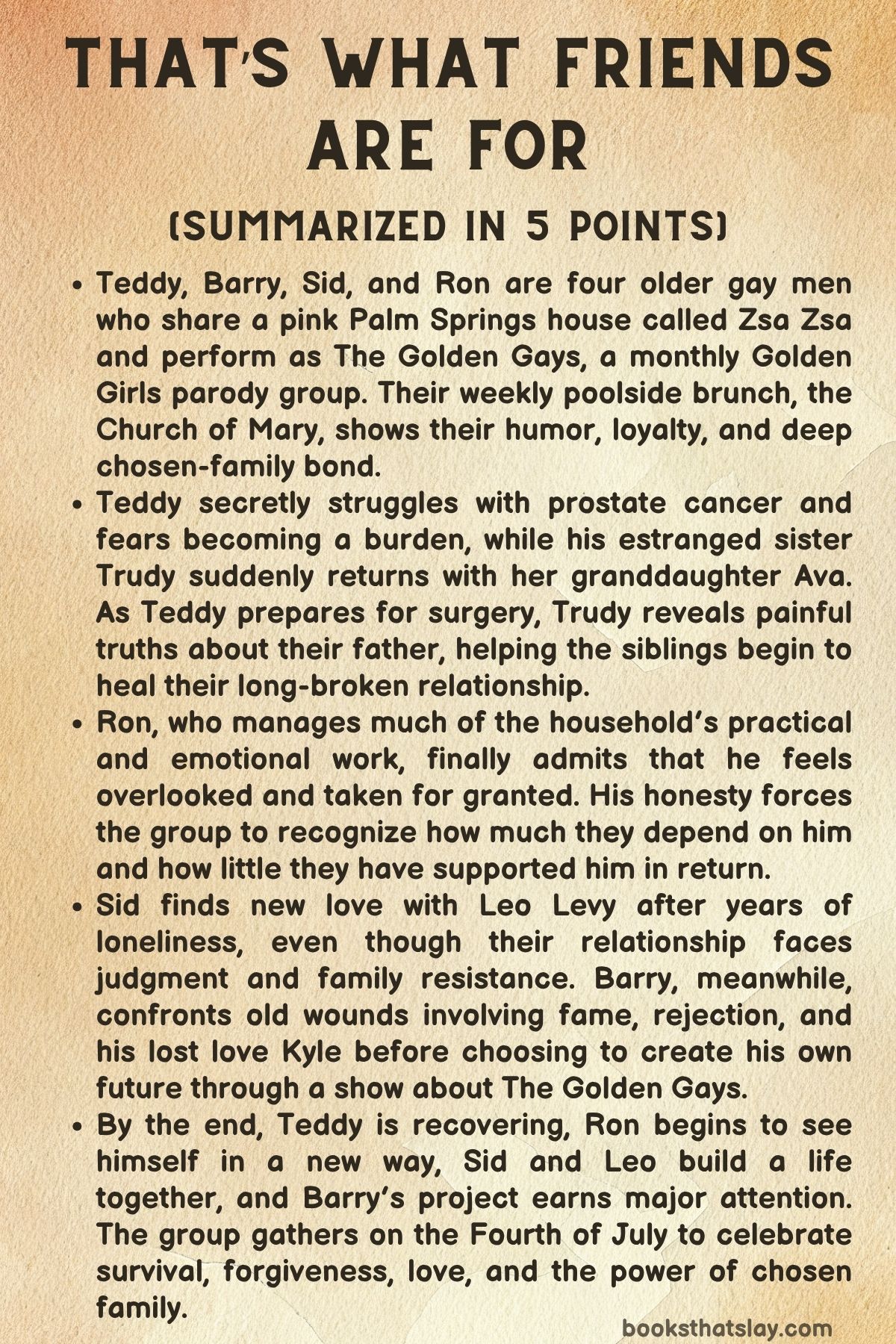
That’s What Friends Are For centers on Teddy, Barry, Sid, and Ron, four older gay men who live together in Palm Springs in a pink mid-century house they have named Zsa Zsa. Their home is loud, stylish, dramatic, and full of history, much like the men themselves.
Together, they perform a monthly Golden Girls parody called The Golden Gays, with Teddy playing Dorothy, Ron playing Rose, Barry playing Blanche, and Sid playing Sophia. Their friendship has become the main structure of their lives.
They tease each other, argue, share meals, dress up, perform, and return again and again to the rituals that make them feel safe.
One of their most important rituals is a weekly poolside brunch called the Church of Mary. It is a mix of food, gossip, jokes, camp, and care.
On the surface, their lives seem bright and comic, but each man is carrying pain that he has not fully shared. Teddy, the sharp-tongued owner of a vintage shop called Dorian Gay, is hiding the biggest secret: he has prostate cancer.
He fears that he may be dying, but he keeps the news from the others because he does not want pity, panic, or the feeling that he has become a burden.
Teddy’s fear grows when his estranged sister, Trudy, calls him after decades of silence. He wants nothing to do with her.
Their family history is filled with hurt, rejection, and silence, and Teddy has spent much of his adult life trying to protect himself from it. At the same time, his doctor tells him that his cancer is serious but treatable.
Surgery is recommended, yet Teddy hesitates. He worries about the cost, the recovery, the loss of independence, and the emotional weight of letting others care for him.
His illness forces him to face not only his body’s weakness but also his fear of being loved when he is vulnerable.
Ron, the steady caretaker of the group, has his own breaking point approaching. He is the one who cooks, cleans, organizes, manages bills, maintains the house, and smooths over emotional conflicts.
Because he does these things so well, the others rarely notice how much they depend on him. Ron begins to feel invisible and unappreciated.
His role as the reliable one has become a trap. He loves his friends, but he is tired of being treated like the household’s unpaid nurse, parent, and manager.
Sid is dealing with loneliness. He came out late in life, after a marriage and family life that no longer fit who he truly was.
Although he has found belonging with the men at Zsa Zsa, he still carries the ache of lost time and damaged family ties. At the senior center track, he meets Leo Levy.
Their first encounter is awkward, and Sid embarrasses himself, but Leo is interested in him anyway. Slowly, the two men begin a gentle romance.
For Sid, the relationship offers hope that love has not passed him by. Still, their age difference creates trouble when Leo’s parents react with discomfort, especially because Sid is older than they are.
Barry, meanwhile, is still chasing the recognition he believes he was denied long ago. He was once cast as Coco in the original Golden Girls pilot, only to be cut from the show before it became a classic.
That loss has shaped his whole life. He also remains haunted by Kyle, his first love, who went on to become a famous actor.
Barry keeps pursuing fame, beauty, and younger men, but much of this pursuit is really an attempt to prove that he still matters. When he attends Nostalgia Con and runs into Kyle again, the meeting reopens old wounds.
Barry is reminded of both the career he lost and the love that never became what he hoped it would be.
Trudy soon arrives in Palm Springs with her teenage granddaughter, Ava. Teddy is furious at first and wants to shut them out, but Ron allows them to stay.
Ava becomes an unexpected bridge between Teddy and his past. She spends time with him at Dorian Gay and sees through his defenses more quickly than most people do.
She pushes him to take his illness seriously and makes it harder for him to pretend that nothing is wrong. Her presence softens him, even when he resists it.
While Teddy struggles with Trudy’s arrival, Ron spends time with her and begins to see another side of her. He takes her around Palm Springs and helps her change not just her appearance but also her understanding of Teddy’s life.
Trudy has arrived with judgments and old habits, but she is also carrying a terrible secret. Eventually, she tells Teddy the truth about their father.
Their father abused and controlled her, forced her into a dangerous back-alley abortion, and kept her trapped in the family home. Her cruelty toward Teddy was partly an effort to push him away from the danger in that house and stop him from returning.
This confession changes Teddy’s view of their shared past. The sister he believed had rejected him was also a victim, and her harshness came from fear, pain, and a damaged attempt at protection.
Teddy breaks down. He allows himself to grieve not only what happened to him but also what happened to Trudy.
He forgives her, and the two begin the slow process of becoming family again. Their reunion does not erase the past, but it opens a door that had been closed for decades.
As Teddy finally decides to have surgery, the other men are forced to tell the truth about their own lives. Ron confronts the group and tells them how tired he is of being taken for granted.
His anger is not just about chores; it is about being unseen. The others must recognize that love requires attention, gratitude, and shared responsibility.
Sid admits how serious his relationship with Leo has become, even though others may not understand it. Barry, after being offered a major role in Kyle’s new movie, Billy’s Back, briefly thinks his long-delayed breakthrough has arrived.
But Kyle later attacks and humiliates him, proving that Barry has been giving Kyle too much power over his self-worth.
Instead of letting Kyle define him again, Barry chooses a different path. He begins writing his own project about The Golden Gays.
Rather than waiting for someone else to validate him, he uses the life he has actually lived: the friendship, the performances, the jokes, the pain, and the beauty of surviving as an older gay man with a chosen family. The project is eventually picked up by Netflix, giving Barry the career breakthrough he has wanted for forty years.
More importantly, it comes from his own voice rather than from Kyle’s approval.
Near the end of That’s What Friends Are For, Teddy is recovering from prostate surgery. Ron cares for him, but their dynamic has shifted because Teddy has finally allowed himself to need help, and Ron has begun to demand respect for the care he gives.
Ron also cuts off his famous hair, a symbolic change that lets him see himself in a new way. Sid faces another public attack from the woman who had called him a groomer at Drag Queen Reading Hour, but this time he fights back.
His courage turns him into a local hero. Leo moves into Zsa Zsa, and Leo’s parents eventually make peace with Sid and the relationship.
Barry’s show gains attention, and The Golden Gays prepare for their television premiere. Trudy moves closer to the family she has only just begun to reclaim, while Ava plans college visits and more time in Palm Springs.
The household expands, not just in numbers but in trust. Each character has been changed by truth: Teddy by illness and forgiveness, Ron by finally speaking up, Sid by late-life love, Barry by choosing himself, and Trudy by revealing the pain that shaped her.
The novel closes on the Fourth of July with everyone gathered for Church of Mary. They swim, eat, laugh, watch fireworks, and light sparklers.
The scene is joyful because it has been earned. These people have faced illness, shame, rejection, aging, family trauma, and old regret, but they have survived by staying near one another.
That’s What Friends Are For ends as a celebration of chosen family: not perfect, not painless, but loyal, funny, forgiving, and strong enough to carry each person through the hardest parts of life.
Characters
Teddy
Teddy is one of the central emotional figures in That’s What Friends Are For, and his character is shaped by fear, pride, humor, illness, and a deep need for love that he often hides behind sarcasm. As Dorothy in The Golden Gays, he carries a sharp, commanding presence, and that performance reflects the way he often tries to control the world around him.
Beneath his wit, however, Teddy is terrified. His prostate cancer forces him to confront his mortality, but instead of immediately leaning on his chosen family, he keeps his illness secret because he does not want to be pitied, burden anyone, or lose the independence that has helped him survive.
Teddy’s emotional conflict becomes even more layered when Trudy reappears after decades of estrangement. His anger toward her is not shallow; it comes from years of abandonment, pain, and unanswered questions.
At first, he sees her return as an invasion of the peaceful life he has built in Palm Springs, but her arrival also forces him to face the wounds of his childhood. When Trudy reveals the truth about their father’s abuse and explains why she pushed him away, Teddy’s bitterness begins to transform into grief, understanding, and forgiveness.
His journey is not simply about surviving cancer, but about allowing himself to receive care, reconnect with family, and accept that vulnerability can be a form of strength.
Ron
Ron is the caretaker of the household, and his character represents the emotional labor that often goes unnoticed inside families, even chosen ones. He cooks, cleans, organizes, manages practical details, handles finances, supports everyone emotionally, and keeps the home functioning, yet the others often treat his effort as something automatic.
His resentment grows because he is surrounded by people he loves, but he does not always feel seen by them. Ron’s crisis is quieter than Teddy’s illness or Barry’s career disappointments, but it is deeply important because it shows how even love can become unbalanced when one person is expected to hold everything together.
Ron’s growth comes from finally naming his exhaustion and forcing the others to recognize his needs. His relationship with Trudy also reveals his gentleness and emotional intelligence.
He helps her soften, not by judging her, but by giving her space to become more open and honest. By the end of the story, Ron’s decision to cut off his famous hair becomes a symbolic act of renewal.
He is no longer only the dependable caretaker who exists for everyone else. He begins to see himself as someone who deserves care, attention, beauty, and change.
Sid
Sid is a tender, lonely, and quietly brave character whose arc centers on late-life self-discovery and the hunger for companionship. Having come out later in life, he carries the pain of losing parts of his old family life and the ache of feeling that he arrived at his truth too late.
His humor as Sophia in The Golden Gays gives him a sharp and entertaining public identity, but privately, he longs to be wanted, understood, and chosen. His early awkwardness with Leo shows both his insecurity and his desire to keep trying despite embarrassment.
Sid’s romance with Leo is one of the most touching parts of the book because it gives him a chance to experience love without hiding. The relationship challenges assumptions about age, desire, and belonging, especially when Leo’s parents struggle with the fact that Sid is older than they are.
Sid’s courage becomes even more visible when he stands up after being attacked and judged during Drag Queen Reading Hour. By fighting back, he refuses to let shame or public cruelty define him.
His journey shows that it is never too late to claim joy, romance, pride, and dignity.
Barry
Barry is dramatic, wounded, ambitious, and deeply vulnerable beneath his glamorous surface. As Blanche in The Golden Gays, he embraces charm, flirtation, and theatrical confidence, but those qualities also mask decades of disappointment.
Barry is haunted by being cut from the original Golden Girls pilot and by losing Kyle, his first love. These losses have shaped his identity so strongly that he keeps chasing fame and younger men as if success or desirability might finally repair the damage of the past.
Barry’s encounter with Kyle at Nostalgia Con forces him to confront the illusion he has carried for years. Kyle represents the life, love, and career Barry believes he was denied, but Kyle’s later cruelty exposes how dangerous it is for Barry to let another person define his worth.
Barry’s true breakthrough comes when he stops waiting for validation from the people who once rejected him and begins creating his own story about The Golden Gays. His eventual success is meaningful because it is not simply fame arriving late; it is Barry finally taking ownership of his voice, his pain, and his chosen family.
Trudy
Trudy is one of the most emotionally complicated characters in the story because she first appears as a source of disruption and old pain, but later becomes a figure of trauma, survival, and possible reconciliation. Teddy initially sees her as the sister who abandoned and hurt him, and her arrival in Palm Springs reopens wounds he had tried to bury.
Her sternness, guarded behavior, and difficult attitude make her seem harsh at first, but the book gradually reveals that much of her life has been shaped by fear and control.
Trudy’s confession about their father changes the reader’s understanding of her entirely. She was abused, trapped, and forced into a devastating situation, and her cruelty toward Teddy was partly an attempt to keep him away from danger.
This does not erase the pain she caused, but it gives her actions tragic context. Her relationship with Ron helps her soften, and her relationship with Teddy begins to heal once the truth is spoken.
Trudy’s arc shows how family damage can echo across decades, but it also suggests that honesty can open the door to forgiveness, even very late in life.
Ava
Ava brings youth, honesty, and emotional freshness into the older characters’ world. As Trudy’s teenage granddaughter, she arrives as an outsider, but she quickly becomes connected to Teddy, especially through her time with him at Dorian Gay.
Unlike the adults, Ava is not weighed down by decades of silence, resentment, or performance. This allows her to speak with a directness that the others often avoid.
She pushes Teddy to take his illness seriously, and her concern helps him recognize that his life still matters to people beyond himself.
Ava also represents the future of the family that is slowly being rebuilt. Her bond with Teddy helps soften his anger toward Trudy, and her plans for college visits and time in Palm Springs suggest that the family connection will continue beyond the immediate crisis.
She is not just a young supporting character; she is a bridge between generations. Through Ava, the story shows that healing does not only belong to the people who were directly wounded in the past.
It can also reshape the lives of those who inherit that family history.
Leo Levy
Leo Levy is a warm and important presence in Sid’s life, offering him affection, patience, and the possibility of romance without shame. He meets Sid at the senior center track, and even after Sid embarrasses himself, Leo continues to pursue him with kindness.
This matters because Sid is someone who has known rejection, loneliness, and the difficulty of coming into his identity late in life. Leo’s steady interest helps Sid believe that he is still desirable and worthy of love.
Leo’s character also challenges the idea that older queer love must be treated as unusual or secondary. His relationship with Sid is tender, serious, and transformative.
The tension with Leo’s parents adds conflict, but it also allows the story to explore how love can unsettle expectations within families. When Leo moves into Zsa Zsa and his parents eventually reconcile with Sid, Leo becomes part of the chosen family at the heart of the book.
His role is not only romantic; he helps Sid move from loneliness into belonging.
Kyle
Kyle functions as both a person from Barry’s past and a symbol of everything Barry believes he lost. As Barry’s first love and a now-famous actor, Kyle carries the glamour, success, and emotional unfinished business that Barry has been chasing for decades.
Their reunion at Nostalgia Con initially seems like it might offer closure or even a second chance, but Kyle’s later behavior reveals the cruelty and imbalance beneath Barry’s old attachment.
Kyle’s importance lies in the way he forces Barry to confront his dependence on outside approval. For years, Barry has allowed memories of Kyle and his lost Hollywood opportunity to shape his sense of failure.
When Kyle attacks and humiliates him, Barry finally sees that the fantasy he preserved is not the truth he needs. Kyle becomes the final push that moves Barry away from longing for old validation and toward creating his own work.
In that sense, Kyle is less a love interest than a catalyst for Barry’s independence.
Ava’s Grandmother Trudy and Teddy’s Father
Teddy and Trudy’s father is not present in the active household life of the story, but his influence is devastating and central to the family trauma. He represents the hidden violence and control that shaped Trudy’s life and indirectly shaped Teddy’s estrangement from his sister.
Through Trudy’s confession, he becomes the source of a painful history that explains decades of silence, cruelty, and separation.
His role in the book is important because he shows how abuse can distort family relationships long after the abuser is gone. Teddy believed Trudy rejected him out of coldness, but the truth reveals that fear, coercion, and survival were involved.
The father’s shadow makes Teddy and Trudy’s reconciliation more powerful because they are not only repairing a sibling bond; they are also breaking the silence that allowed his harm to define them for so long.
Leo’s Parents
Leo’s parents represent the social and generational discomfort that can surround unconventional relationships, especially when age and queer identity intersect. Their initial struggle with Sid and Leo’s romance is not simply about dislike; it reflects confusion, protectiveness, and difficulty accepting a relationship that does not fit their expectations.
Because Sid is older than they are, their discomfort becomes both personal and symbolic.
Their eventual reconciliation with Sid is meaningful because it shows that acceptance can grow when people are willing to move beyond first reactions. They help expand the story’s idea of family, showing that chosen family and biological family do not always have to remain separate or opposed.
By accepting Sid, they also affirm Leo’s right to love honestly and freely.
Themes
Chosen Family as Survival
In That’s What Friends Are For, Teddy, Ron, Sid, and Barry build a home that functions as protection, comfort, and emotional rescue. Their pink Palm Springs house is more than a shared address; it becomes a place where aging, illness, loneliness, regret, and fear can be faced with humor and care.
Their brunch ritual shows how friendship can take on the role of religion, family, and therapy at once. The jokes and performances may look playful, but beneath them is a serious structure of loyalty.
These men have survived rejection, grief, shame, and loss, and their bond gives them a way to keep living with dignity. The ending strengthens this theme by showing their circle expanding to include Trudy, Ava, and Leo.
Family is not presented only as blood relation, but as the people who stay, feed one another, forgive one another, and celebrate survival together.
Aging, Illness, and the Fear of Becoming a Burden
Teddy’s prostate cancer gives the story one of its most emotional conflicts because his fear is not only death, but dependence. He hides his illness because he does not want to disturb the balance of the house or become someone the others must manage.
His hesitation about surgery shows how illness can create shame, especially for older people who already worry about losing control over their bodies and choices. The theme also appears through Ron, who quietly carries the burden of care before anyone names it.
His cooking, cleaning, organizing, and emotional support are treated as natural until he finally demands to be seen. The story suggests that aging does not reduce a person’s need for respect, romance, attention, or independence.
It also shows that accepting care is not weakness. Teddy’s recovery becomes meaningful because it allows the group to practice love honestly instead of hiding pain behind jokes.
Forgiveness and the Pain Hidden Inside Families
Teddy and Trudy’s reunion explores how family wounds can last for decades when truth is buried under anger. At first, Teddy sees Trudy only as the sister who rejected him, while Trudy appears harsh, judgmental, and unwanted in his carefully built life.
Her confession changes the emotional meaning of their past. The cruelty Teddy remembers was shaped by fear, abuse, control, and a desperate attempt to protect him from their father.
This does not erase the hurt he experienced, but it allows him to understand that Trudy was also a victim. Forgiveness here is not simple or sentimental.
It arrives after shock, grief, and a painful rethinking of memory. Their repaired bond shows that healing sometimes depends on hearing the story that was never allowed to be spoken.
The theme makes clear that families can harm deeply, but truth can create a path toward tenderness.
Self-Worth Beyond Fame, Youth, and Approval
Barry’s storyline examines the damage caused by chasing validation from people and dreams that once rejected him. His past as an actor, his lost role, and his memories of Kyle leave him trapped in an old version of failure.
He keeps seeking attention from younger men and from the entertainment world because he believes recognition will prove that his life mattered. Nostalgia Con forces him to face how much power he has given Kyle and the past.
When Kyle humiliates him, Barry finally begins to separate his worth from someone else’s approval. His decision to create a project about The Golden Gays is important because he stops waiting to be chosen and starts telling his own story.
The breakthrough that follows is not just professional success; it is emotional recovery. The theme shows that dignity comes from claiming one’s voice, not from being accepted by those who once caused pain.