The Adjunct Summary, Characters and Themes
The Adjunct by Maria Adelmann is a sharp academic novel about poverty, ambition, memory, and power inside higher education. The book follows Sam, an exhausted adjunct lecturer trying to survive a semester of low pay, unstable housing, medical crises, and professional humiliation.
Around her daily struggle sits an older wound: her relationship with Tom Sternberg, a former professor whose influence still shapes her sense of failure. As Sam reads his new novel and confronts rumors about their past, the story examines how institutions protect status, how stories get rewritten by those with power, and how easily a person can disappear while still working constantly.
Summary
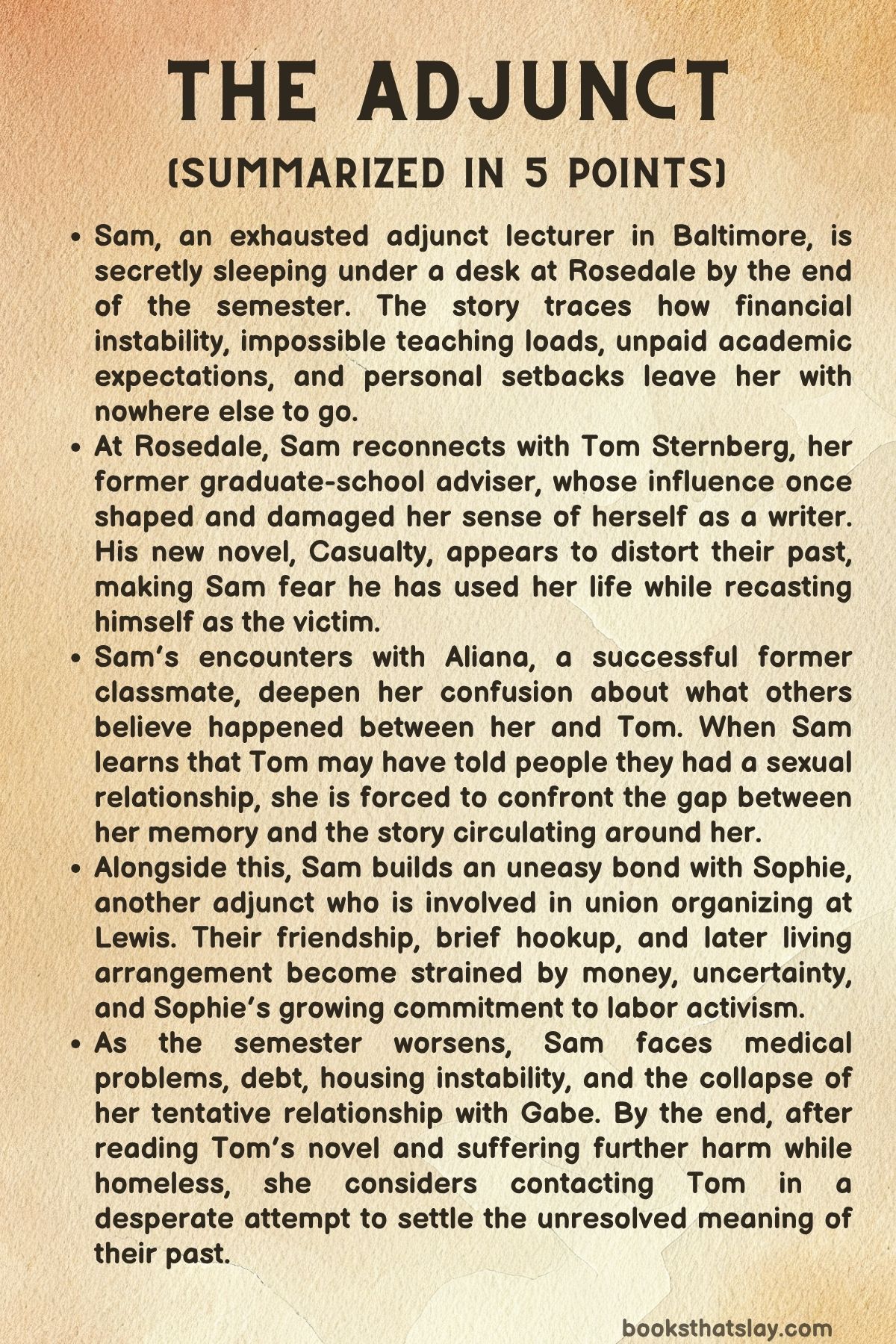
Sam is an adjunct lecturer in Baltimore, working far more than she can manage for far less money than she needs. At the end of the semester, she is sleeping secretly beneath a desk in the literature building at Rosedale, a wealthy college where she has been hired at the last minute.
From this low point, the story looks back at the fall semester and shows how a hardworking teacher with degrees, experience, and ambition can still be pushed into homelessness by academic precarity.
At the beginning of the semester, Sam is already overwhelmed. She has been given two courses at Rosedale while also teaching three at Lewis, a public college.
Five classes leave her with almost no time to prepare, grade, apply for jobs, or revise an article that might help her career. She is behind on rent, has no reliable laptop, and lives with the constant fear that one small expense will ruin her.
Her life is full of calculations: how to get to campus, how to answer students, how to keep her landlord and roommate calm, how to eat, how to seem professional while everything underneath is falling apart.
Rosedale brings an unexpected shock when Sam sees Tom Sternberg, her former graduate-school professor and adviser. Years earlier, Sam had admired Tom with a mixture of intellectual devotion, desire, and need.
She entered his creative-writing track, wanted his approval, and became attached to him in ways that embarrassed her even at the time. While house-sitting for him, she discovered private sexual objects that made her feel closer to his hidden life and also more humiliated by her own fixation.
Tom eventually steered her away from fiction and toward criticism, leaving her with the lasting belief that she was not talented enough to become a novelist.
Now Tom has returned to prominence with his long-awaited second novel, Casualty. Its plot seems to echo his history with Sam, but in a changed and self-serving form.
Sam learns that the book presents a professor whose career is damaged by a former student’s accusation. The more she hears, the more she worries that Tom has used her life as raw material while changing the facts to protect himself and make himself the victim.
This discovery unsettles her because she has spent years trying to understand what happened between them, and now Tom appears to have turned that confusion into art and reputation.
Sam also reconnects with Aliana, a former classmate whose career has gone much better than hers. Aliana has published a novel, secured academic success, and moves through literary spaces with confidence.
Her presence reminds Sam of the future she wanted but did not get. When Aliana suggests that people believe Sam and Tom had a sexual relationship, Sam is stunned.
She insists they never actually had sex. The rumor horrifies her because it gives Tom a story he can control and gives everyone else a simple explanation for something that was never simple.
Outside Rosedale, Sam’s friendship with Sophie becomes one of the few sources of companionship in her life. Sophie is another adjunct at Lewis, also stretched thin by multiple jobs and poor pay.
Unlike Sam, Sophie channels her anger into organizing. She is involved in efforts to unionize adjuncts and is willing to take risks that Sam finds both admirable and frightening.
Together they scavenge leftover food, complain about academic exploitation, and bond over the humiliations of their work. After drinking, they hook up, but Sam is unsure how to read the encounter.
Sophie treats it more casually, which leaves Sam uncertain about whether she has found intimacy, shelter, or another unstable attachment.
Sam’s material problems continue to worsen. Her car is towed and later broken into, turning transportation into another source of debt and stress.
A toothache grows so painful that she ends up needing emergency care and then a costly root canal. She also gets a UTI, adding another private physical crisis to a semester already defined by exhaustion.
Each medical problem shows how fragile her life is: pain becomes expensive, and expense becomes another threat to housing, work, and dignity. She borrows an old laptop from Gabe, a kind visiting professor at Rosedale, and their connection slowly becomes romantic.
Gabe offers Sam care at moments when she badly needs it. He helps her during medical emergencies and tries to be present with a steadiness she is not used to receiving.
Yet Sam cannot fully accept what he gives. She is distracted by Tom, by money, by shame, and by the feeling that any relationship can become a debt.
Gabe senses that she is physically and emotionally distant. Though he wants to matter to her, he begins to feel like a temporary convenience rather than a chosen partner.
Tom’s public reading intensifies Sam’s fear that she has become part of his career narrative. Aliana and others seem nervous about her presence, as if they are waiting for her to react or cause trouble.
Later, a journalist contacts Sam about Tom’s earlier departure from SHU. The journalist asks about an old exit interview in which Sam had answered uncertainly when asked whether Tom’s conduct affected her education.
Sam realizes that her unclear answer may have helped trigger consequences for Tom, even though she never meant to make a formal complaint. This revelation complicates her memory.
She did not accuse him in the way the rumor suggests, but she also cannot deny that something in their relationship harmed her.
At Thanksgiving, Gabe brings Sam to a faculty gathering hosted by Dr. Brighton. The event places Sam inside the polished world of stable academics, a world that feeds on the labor of adjuncts while treating them as marginal.
There she sees Tom and Aliana together, which sharpens her jealousy, anger, and sense of displacement. Sam confronts Aliana, who tells her that Tom claimed he and Sam had sex.
Sam denies it again, but denial does not restore control. The rumor has already moved through the world without her permission.
Afterward, Gabe tells Sam he feels unwanted and replaceable, effectively ending their relationship.
As the semester nears its end, Sophie’s union work becomes more dramatic and risky. Sam moves in with Sophie after her living situation with Brianna becomes impossible, but the arrangement soon strains under money problems, emotional confusion, and Sophie’s political intensity.
A fight between them leaves Sam with nowhere to go. With no stable home, no partner, and no clear professional future, she begins sleeping in the Rosedale adjunct office, hidden inside the institution that depends on her labor but offers her no real security.
In the final stretch, Sam reads Casualty and sees how completely Tom has rewritten their shared history. His version turns him into the wounded party and reshapes her into a figure that serves his plot.
At the same time, Sam’s own life becomes more dangerous. She is robbed or attacked while homeless and wanders through Baltimore in a state of fear, pain, and disorientation.
Her body, work, memories, and relationships all seem to have been used up.
By the end, Sam decides to contact Tom. In her distressed logic, she imagines that sleeping with him now might prove something, correct the false story, or finally resolve the uncertainty of the past.
The decision is troubling because it shows how deeply Tom’s version of events has trapped her. The Adjunct ends with Sam still caught between what happened, what was said to have happened, and what powerful people can make others believe.
Characters
Sam
Sam is the central character of The Adjunct, and her role in the book is shaped by exhaustion, poverty, intellectual ambition, humiliation, and emotional disorientation. She is an overworked adjunct lecturer trying to survive within an academic system that depends on her labor while offering her almost no stability, protection, or dignity.
Her situation is physically and emotionally precarious from the beginning, as she is behind on rent, teaching too many classes, applying for jobs, trying to revise academic work, and eventually sleeping under a desk in a literature building. This instability is not just background hardship; it defines the way she moves through the story.
Sam is constantly trying to appear functional while her life is quietly collapsing, and this creates a strong tension between her professional identity and her private desperation.
Sam’s relationship with academia is deeply conflicted. She wants recognition, legitimacy, and intellectual belonging, but the institutions around her repeatedly make her feel replaceable.
Her position as an adjunct leaves her without security, and yet she continues to measure herself through the standards of the academic world. This makes her both critical of academia and painfully dependent on it.
She understands its unfairness, but she also cannot fully detach from the hope that it might eventually reward her. Her financial struggles, health problems, housing insecurity, and dependence on borrowed resources show how vulnerable she is, but her vulnerability is made worse by the fact that she is expected to keep teaching, grading, writing, and performing professionalism as if nothing is wrong.
One of Sam’s most important emotional conflicts comes from her history with Tom Sternberg. Years earlier, she admired him intensely and attached great meaning to his approval.
He was her teacher, adviser, and literary authority figure, and his influence shaped the way she understood her own talent. When he pushed her away from fiction and toward criticism, Sam internalized the idea that she was not good enough to become a novelist.
This wound remains active throughout the book because Tom’s presence at Rosedale forces her to face the past again. Her memories of house-sitting, discovering his private sexual objects, and feeling humiliated by her own attraction reveal how blurred the emotional and professional boundaries were between them, even though she insists they never had sex.
Sam is also morally and psychologically complicated because she does not always understand her own motives. She is often passive until a crisis forces her into action, and she sometimes drifts into relationships or situations without clearly deciding what she wants.
Her connection with Sophie is marked by friendship, need, attraction, uncertainty, and dependency. Her relationship with Gabe is similarly unstable because Gabe offers care and steadiness, but Sam cannot fully receive it.
She is too consumed by shame, physical pain, financial pressure, and unresolved anger toward Tom to be emotionally available. This does not make her cruel in a simple way, but it does show how survival can narrow a person’s capacity for tenderness.
By the end of the book, Sam becomes a figure of both damage and agency. Her decision to contact Tom after reading his novel is disturbing because it suggests that she is still trapped inside the logic he created.
She imagines that sleeping with him now might prove, correct, or resolve something about the past, but this desire shows how deeply his version of events has invaded her sense of reality. Sam’s tragedy lies in the fact that she wants control over her own story, yet she keeps being pulled into stories written by institutions, men, poverty, and professional failure.
She is not simply a victim, because she thinks, chooses, resists, and judges; however, the book presents her choices as constrained by systems and relationships that have already done serious harm.
Tom Sternberg
Tom Sternberg is one of the most troubling and influential characters in the story because his power is both professional and narrative. As Sam’s former graduate-school professor and adviser, he once held authority over her creative future, her academic confidence, and her sense of artistic possibility.
He is not merely an old teacher from her past; he represents the kind of charismatic academic figure whose approval can shape a student’s identity. Sam’s earlier admiration for him gives him emotional power over her long after their formal teacher-student relationship has ended.
Tom’s behavior is significant because he seems to control not only institutional spaces but also the story of what happened between him and Sam. His second novel, Casualty, appears to transform their past into fiction while changing essential facts.
This makes him a character connected to appropriation and self-protection. He takes material from a vulnerable former student’s experience and reshapes it in a way that appears to center his own injury.
By presenting a professor damaged by an accusation from a former student, Tom turns himself into the wronged figure and pushes Sam into the shadow of a distorted role. This is one of the most important forms of power he exercises in the book: he does not simply remember the past differently; he publishes a version of it.
Tom is also morally evasive. The suggestion that he told people he and Sam had sex, even though Sam denies it, makes his character especially disturbing.
If he spread that version of events, then he not only misrepresented their relationship but also exposed Sam to gossip and judgment. His conduct shows how reputation works unequally in academic circles.
Tom’s version circulates with authority because he is established, male, published, and professionally recognized, while Sam is precarious, financially desperate, and unsure how to defend herself. The imbalance between them is not only about what happened in the past but also about who gets believed in the present.
At the same time, Tom’s character is not presented as a simple villain without complexity. His departure from SHU and the journalist’s questions suggest that he may have faced consequences connected to Sam’s old exit interview.
This complicates the moral landscape because Sam did not intend to make a formal complaint, and yet her uncertain answers may have contributed to institutional action against him. Still, this complication does not erase Tom’s responsibility.
Instead, it shows how murky and painful power-based relationships can become when institutions respond imperfectly, rumors spread, and personal memory is converted into professional narrative.
Tom’s importance in the book lies in the way he becomes a symbol of authorship, authority, and distortion. He has the power to tell a story publicly, while Sam struggles to understand and reclaim her own private truth.
His novel becomes an extension of his character: polished, self-justifying, and dangerous because it transforms real emotional damage into literary material. Through Tom, the story examines how a powerful person can wound someone not only through direct actions but also through interpretation, gossip, silence, and art.
Aliana
Aliana is a successful former classmate whose presence intensifies Sam’s feelings of failure, exposure, and professional inadequacy. She represents the version of literary and academic success that Sam has not achieved.
Aliana has a flourishing career, a published novel, and a confidence that contrasts sharply with Sam’s financial instability and professional uncertainty. Because they come from a shared academic past, Aliana functions as a painful mirror for Sam.
She shows what Sam hoped she might become, while also reminding her of how far she feels she has fallen.
Aliana’s role in the book is especially important because she is connected to the circulation of rumors about Sam and Tom. When she suggests that people know Sam had a sexual relationship with Tom, she destabilizes Sam’s understanding of her own past.
Sam insists that no such relationship happened, so Aliana’s claim reveals that Sam’s reputation may have been shaped by a false version of events for years. Aliana is therefore not just a successful peer; she becomes a messenger of the social narrative that has been built around Sam without Sam’s consent.
Aliana’s relationship with Tom also complicates her character. She appears close to him in the present, and this closeness makes her seem aligned with his version of events.
At the Thanksgiving gathering, when Sam confronts her, Aliana insists that Tom told people he and Sam had sex. This moment is crucial because Aliana is not simply inventing the rumor; she is repeating what she says Tom claimed.
However, her willingness to accept and circulate that version shows how easily academic communities absorb gossip when it comes from powerful figures. Her character demonstrates how complicity can operate through conversation, assumption, and professional loyalty.
Aliana is not necessarily cruel in an obvious or theatrical way, but she is socially powerful in a way Sam is not. Her success gives her confidence, and her closeness to Tom gives her access to the dominant version of the past.
This makes her threatening to Sam because she belongs to the circle that Sam feels excluded from. Aliana’s presence sharpens the book’s interest in class, prestige, gender, and literary ambition.
She shows that success in academia and publishing is not only about talent but also about networks, reputation, and who controls the story.
Sophie
Sophie is another adjunct lecturer, and she functions as both a companion and a contrast to Sam. Like Sam, she is overworked and economically strained, but she responds to adjunct precarity in a more outwardly political way.
Her union organizing gives her character a sense of purpose that Sam often lacks. Sophie sees the exploitation of adjunct labor not only as a personal problem but as a collective injustice that demands action.
Through her, the book presents one possible response to academic exploitation: solidarity, organization, and confrontation.
Sophie’s friendship with Sam is built on shared hardship. They scavenge leftover food, complain about academic life, and understand the humiliations of being underpaid and undervalued.
This shared experience gives their bond warmth and urgency. Sophie is one of the few people who seems to understand the material reality of Sam’s life without romanticizing it.
She knows what it means to work too much, have too little money, and still be expected to perform intellectual professionalism. In this sense, Sophie offers Sam a form of recognition that Rosedale and Lewis do not.
However, Sophie’s relationship with Sam is also unstable. Their brief hookup introduces emotional ambiguity, especially because Sam is unsure what it means while Sophie treats it more casually.
This difference reveals a mismatch between them. Sam often seeks meaning, reassurance, or rescue in relationships, while Sophie appears more focused on survival and activism.
When Sam moves in with Sophie, the arrangement is practical but strained. Money, attraction, resentment, and emotional uncertainty all press against the relationship, making their living situation fragile from the beginning.
Sophie’s escalating union work makes her admirable but also difficult to live with. Her commitment to collective action gives her strength, yet it also contributes to the collapse of her arrangement with Sam.
She is not simply a heroic organizer or a careless friend; she is a person under pressure, trying to transform anger into political action. Her character helps show that exploitation does not automatically create perfect solidarity among people who suffer from it.
Shared hardship can create intimacy, but it can also create conflict when people have different needs, limits, and ways of coping.
Gabe
Gabe is a visiting professor at Rosedale and one of the few characters who tries to care for Sam in a steady and practical way. He lends her an old laptop, helps her during medical emergencies, and becomes involved with her romantically.
Compared with Tom, Gabe appears kinder, less manipulative, and more emotionally available. He notices Sam’s vulnerability and tries to respond with generosity rather than exploitation.
His presence offers a possible alternative to the damaging academic male authority represented by Tom.
Even so, Gabe’s relationship with Sam reveals how difficult it is for her to accept care. Sam is physically and emotionally distant, not necessarily because Gabe has done something wrong, but because she is overwhelmed by pain, poverty, shame, and unresolved trauma.
Gabe wants to matter to her, but Sam cannot fully make room for him. This creates a quiet imbalance in their relationship.
He gives help, attention, and concern, while she remains partly elsewhere, caught in the emotional gravity of Tom and the pressures of her collapsing life.
Gabe is important because he eventually recognizes that he feels unwanted and replaceable. His confrontation with Sam after the Thanksgiving gathering shows that he is not merely a convenient caretaker.
He has emotional needs of his own, and he understands that Sam is not truly present with him. This moment prevents him from becoming a flatly idealized character.
Although he is kind, he is not endlessly self-sacrificing. He can see when a relationship is hurting him, and he has enough self-respect to name it.
In the larger structure of the story, Gabe represents the possibility of ordinary care, but also the limits of care when someone is deeply trapped in another unresolved wound. He cannot save Sam from her financial precarity, her professional despair, or her obsession with Tom’s rewritten version of the past.
His failure to rescue her is not a failure of kindness; it shows that personal support cannot fully repair structural exploitation or psychological damage. Gabe’s role is therefore tender but limited, and his departure leaves Sam even more exposed.
Brianna
Brianna is Sam’s roommate, and although she is not as central as Sam, Tom, Sophie, or Gabe, she plays an important role in showing the pressure of Sam’s domestic life. Sam’s home is supposed to be a place of rest, but her arrangement with Brianna becomes increasingly difficult.
This matters because Sam has almost no stable space in the book. Her work life is unstable, her finances are unstable, her body is in pain, and eventually even her housing becomes insecure.
Brianna’s character helps reveal how poverty and stress can damage ordinary relationships. The problem between Brianna and Sam is not presented as a grand betrayal but as the kind of accumulating strain that happens when people live close to financial and emotional limits.
As Sam falls further behind and becomes harder to live with, the roommate situation deteriorates. Brianna becomes part of the chain of pressures that push Sam out of any normal domestic structure and toward homelessness.
Brianna also helps mark Sam’s movement from precarious stability to open crisis. When Sam can no longer remain in that living arrangement and later moves in with Sophie, the change seems practical at first but ultimately leads to another unstable situation.
Brianna’s role therefore shows how little margin Sam has. A conflict at home is not just uncomfortable; it becomes part of a larger collapse because Sam lacks money, family support, or secure employment to cushion the impact.
Dr. Brighton
Dr. Brighton is significant because of the faculty gathering at Thanksgiving, where several of the book’s social tensions become visible at once. As the host of the gathering, Dr. Brighton represents the more secure and established world of academia.
This world is very different from Sam’s life of adjunct overwork, debt, illness, and housing insecurity. The gathering places Sam inside a professional social space where she is physically present but emotionally and socially out of place.
Dr. Brighton’s importance is less about personal development and more about what the character’s environment reveals. The faculty gathering exposes the hierarchy between secure academics and precarious instructors.
It also becomes the setting where Sam sees Tom and Aliana together, confronts Aliana, and experiences the final weakening of her relationship with Gabe. In this way, Dr. Brighton’s home becomes a stage for Sam’s humiliation, jealousy, anger, and alienation.
Through Dr. Brighton, the book shows how academic privilege often appears ordinary to those who possess it. A faculty gathering may seem like a normal social event, but for Sam it becomes charged with class anxiety, professional insecurity, and emotional threat.
Dr. Brighton’s role highlights the distance between the comfortable rituals of established academic life and the hidden suffering of the adjuncts who help keep that same world functioning.
Themes
Economic Precarity and Academic Exploitation
In The Adjunct, Sam’s professional life is shaped by constant exhaustion, debt, and instability. Her teaching load is heavy, yet her position gives her little security, respect, or financial safety.
She moves between institutions, takes on more work than she can realistically manage, and still cannot meet basic needs such as rent, medical care, transportation, and reliable technology. The contrast between wealthy Rosedale and public Lewis exposes how academic labor depends on people like Sam while refusing to protect them.
She is expected to be passionate, available, polished, and intellectually productive, even when she is physically unwell and economically trapped. Her secret sleeping in the literature building becomes a powerful sign of how completely the system has failed her.
Academia presents itself as a space of ideas and prestige, but Sam’s experience shows the hidden cost behind that image: underpaid workers, temporary contracts, emotional burnout, and the slow loss of dignity.
Power, Memory, and Control of the Story
Sam’s past with Tom reveals how power can shape not only events but also the way those events are remembered and repeated. Tom was once her adviser, mentor, and gatekeeper, which gave him influence over her confidence, career path, and sense of artistic worth.
Even without a sexual relationship, the emotional charge between them left Sam humiliated, confused, and dependent on his approval. Years later, his novel appears to reshape their history in a way that protects him and reduces her to a distorted figure.
This creates a painful conflict between what Sam knows happened and what others believe happened. The theme becomes less about proving one clear fact and more about who has the authority to define reality.
Tom has literary status, institutional connections, and public sympathy, while Sam has uncertainty, shame, and fragmented memories. Her struggle is a struggle to reclaim her own version of the past.
Isolation, Desire, and Failed Intimacy
Sam repeatedly reaches toward connection, but her relationships are marked by imbalance, confusion, and emotional distance. With Sophie, friendship, attraction, housing, and political frustration become difficult to separate.
Their brief hookup does not create clarity; instead, it adds another layer of awkwardness to a relationship already strained by money and different expectations. With Gabe, Sam receives genuine care, especially during medical emergencies, but she cannot fully accept his tenderness or respond to his need for emotional presence.
Her attachment to Tom remains even more damaging because it mixes desire with humiliation, resentment, and the need for validation. These relationships show how poverty and unresolved trauma make intimacy harder.
Sam is not simply lonely because people are absent; she is lonely because she cannot feel secure with the people who are present. Her body, mind, and circumstances keep pushing her into forms of closeness that either fail or hurt her further.
Identity, Shame, and Professional Failure
Sam’s sense of self is tied to the academic and literary success she has not achieved. She once imagined herself as a novelist, but Tom’s judgment redirected her away from fiction and left her believing she lacked the talent to create.
Seeing Aliana succeed intensifies Sam’s shame because Aliana represents the life Sam wanted: publication, recognition, confidence, and professional movement. Sam’s own work remains unfinished or delayed, while her job applications, article revisions, and teaching duties pile up around her.
Her failure is not presented as laziness or lack of intelligence; it is shown as the result of pressure, exhaustion, poor support, and internalized doubt. Still, Sam experiences it personally, as if every setback confirms her inadequacy.
The theme is powerful because it shows how institutions turn structural failure into private shame. Sam absorbs the damage as a flaw in herself, even when the conditions around her are clearly unsustainable.