The Beheading Game Summary, Characters and Themes
The Beheading Game by Rebecca Lehmann is a dark historical reimagining of Anne Boleyn’s final hours and what might have happened after them. The book begins where history ends: with Anne’s execution at the Tower of London.
Instead of remaining dead, she wakes inside her coffin, still conscious though her head has been cut from her body. From that strange and violent beginning, the story becomes a tale of revenge, survival, motherhood, and power. The Beheading Game turns Tudor history into a sharp, strange, and fierce story about a queen who refuses to stay buried.
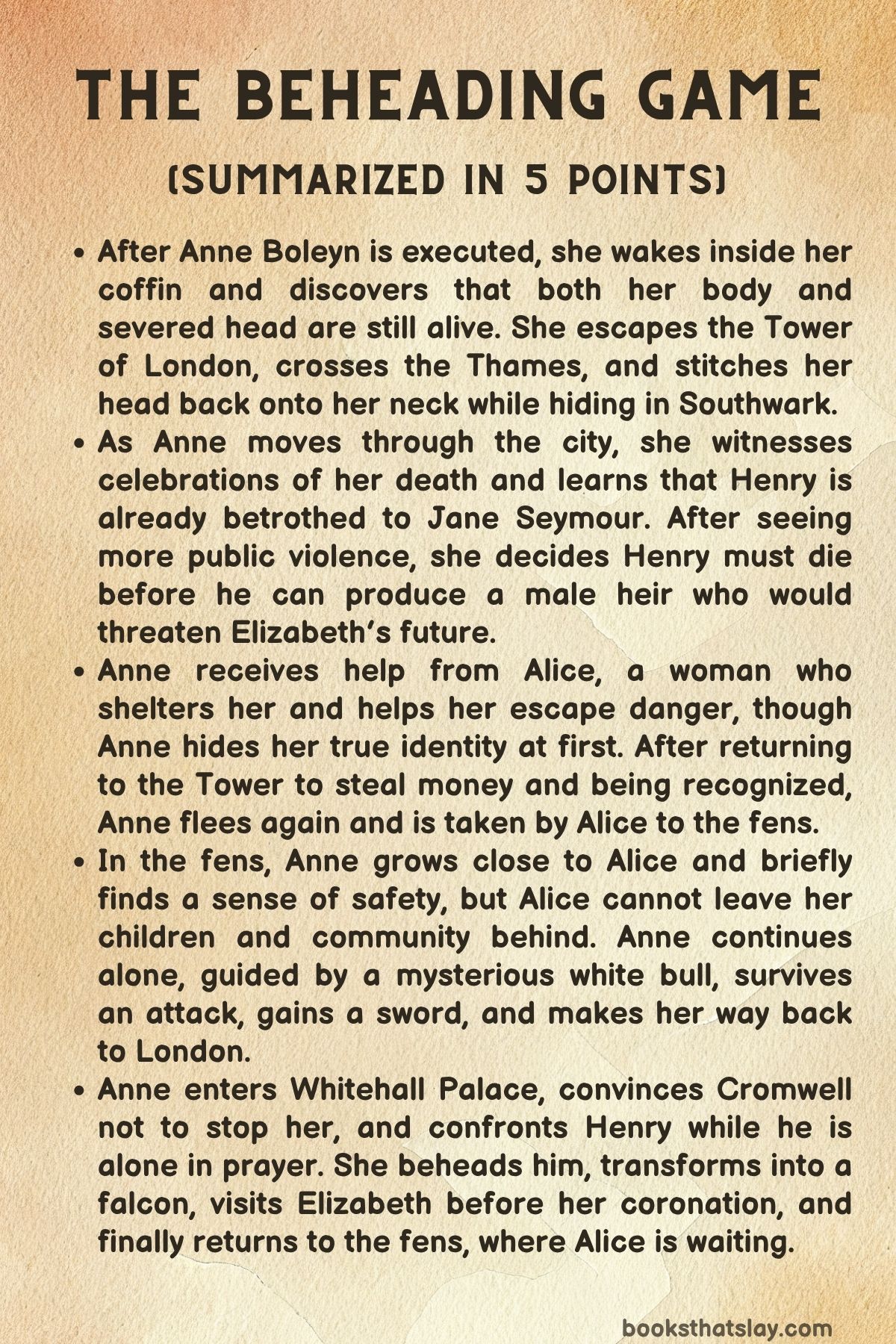
Summary
Anne Boleyn wakes in total darkness after her execution at the Tower of London. At first she cannot understand where she is, but she soon realizes she has been placed inside an arrow chest that is being used as her coffin.
Her body is wrapped for burial, and her head has been cut from her neck. Yet both parts of her are still alive.
She is not dead, even though England believes she has been killed. Trapped in the chapel where she was buried, Anne frees herself from the linens and escapes into the night.
She carries her severed head under her arm and makes her way out of the Tower. The world outside is cold, dangerous, and unfamiliar to her in this new form.
She steals a small boat and drifts across the Thames to Southwark. By dawn, she reaches the riverbank.
Anne knows that if she is to move through the city and complete any purpose, she must first repair herself. She breaks into a tavern, steals a sewing basket and a kerchief, and hides outside.
There, using stolen thread and needle, she stitches her head back onto her neck.
The act is painful and grotesque, but Anne forces herself through it. She cleans herself as best she can, steals drink, removes her bloodied gown, and covers the wound around her neck with a silk swaddling cloth that once belonged to her daughter, Elizabeth.
That cloth becomes more than a covering. It reminds Anne of the child she has left behind and of the danger Elizabeth now faces.
Anne may have been accused, condemned, and killed, but her daughter still lives in a world ruled by Henry.
As Anne moves through Southwark, she sees people celebrating her death. The public has accepted the story that she was a traitor and a fallen queen.
She also learns that Henry has already become betrothed to Jane Seymour. This news strikes her with fresh force.
Henry has erased her quickly, and if Jane gives him a son, Elizabeth’s future may be destroyed. Anne watches a bearbaiting spectacle, where a wounded bear is forced into violence until it kills animals and a man before being killed itself.
The cruelty of the scene hardens Anne’s thinking. She decides that Henry must die before he can produce a male heir who would threaten Elizabeth’s claim.
In Southwark, Anne meets a young blacksmith named John. By the river, she lets him touch her, using his desire and trust to her advantage.
When he falls asleep, she steals his money. John later follows her and threatens her, but a woman named Alice intervenes with a knife and drives him away.
Alice takes Anne into a brothel and gives her shelter. Anne does not tell her the truth at first.
Instead, she claims to be a noblewoman fleeing a murderous husband and trying to rescue her daughter. Alice, practical and cautious, agrees to help Anne cross London Bridge in exchange for payment.
As Anne and Alice cross the bridge, Anne sees the tarred heads of the five men executed before her. Among them is her brother George.
The sight wounds her deeply. Their deaths were part of the same machinery that destroyed her, and seeing them displayed as warnings reminds her of Henry’s power and cruelty.
Anne and Alice continue across the bridge, but Anne weakens and faints. Her body is still not fully restored, and her new life is fragile.
Rather than going straight to Henry, Anne realizes she needs money and resources. She decides to return to the Tower mint.
Entering the Tower again forces her to confront the place of her imprisonment and death. She visits the rooms where she spent her final days and overhears Thomas Wyatt and Kingston.
She steals coins and jewels, but her presence is discovered. Kingston recognizes her and cries out that she is Anne Boleyn.
Anne flees before the Tower guards can seize her. She leaps into the Thames and escapes again, with Alice helping her reach safety.
Anne understands that the guards may now search for her, so she pays Alice to hide her in the fens. Away from London, Anne enters a world very different from the royal court.
Alice brings her to her home, where Anne meets Alice’s children, her community, and a man named George. The fens offer hardship, but they also offer a kind of life Anne has never truly known.
There are ordinary people, ordinary needs, and a rhythm of survival that does not depend on court favor. Anne slowly becomes attached to Alice and the people around her.
Over time, Alice learns the truth. Anne is not simply a noblewoman fleeing her husband.
She is Anne Boleyn, the executed queen, somehow alive again. This truth changes their relationship, but it does not destroy it.
Anne and Alice grow closer and eventually kiss. For Anne, Alice represents warmth, courage, and a possible life outside the brutal ambitions of kings.
Yet Alice has children, a home, and responsibilities she will not abandon. She cares for Anne, but she cannot leave everything behind.
Alice helps arrange for Anne to continue her journey, and Anne must go on alone.
After leaving the fens, Anne is guided through the woods by a mysterious white bull she names Zeus. The animal seems more than ordinary, and Anne follows it as though it has been sent to guide her.
During her travels, she encounters men who give her shelter, but danger follows her there as well. One of the men attacks her.
Anne fights back, kills him, and escapes on the bull. Her journey becomes more determined after this.
She later obtains a sword from a shrine and turns back toward London, ready to face Henry.
Anne enters London in disguise and makes her way into Whitehall Palace. There she meets Thomas Cromwell, the man who helped engineer her fall.
Their meeting is tense. Anne knows Cromwell helped destroy her, but she also knows he understands power.
She argues that Henry’s death would open a path for Elizabeth to become queen. Cromwell refuses to help her directly, but he does not stop her.
He promises that if Anne succeeds, he will support Elizabeth. This is not forgiveness between them, but a political bargain shaped by their knowledge of Henry and the future of England.
Anne hides inside Henry’s chambers and chapel, waiting for the chance to strike. When Henry finally comes alone to pray, she confronts him.
Henry is terrified and tries to plead with her. He attempts to charm her, reason with her, and bend her will as he once did in life.
But Anne has passed beyond the reach of his words. She has seen what he made of her, what he did to those around her, and what he may still do to Elizabeth.
Anne raises the sword and beheads him.
After Henry’s death, Anne begins to transform into the white falcon that once served as her emblem. Guards approach, but she escapes before they can capture her.
No longer bound by the form of a condemned queen, she flies out of the palace. Her revenge is complete, but her deepest purpose remains Elizabeth.
Anne goes to Hatfield, where her daughter lives.
In Elizabeth’s room, Anne returns to human form. She embraces her child and gives her the love and reassurance she was denied the chance to offer in life.
She tells Elizabeth a story about a princess who becomes queen. It is both a comfort and a promise.
Anne cannot remain with her daughter, but she has changed the course of Elizabeth’s future. At dawn, Cromwell arrives to take Elizabeth to be crowned.
Anne transforms back into a falcon and flies away.
In the end, Anne returns to the fens, where Alice waits for her. After vengeance, fear, blood, and flight, Anne finds her way back not to a throne, but to a place where she was briefly seen as more than a queen, a victim, or a ghost.
The Beheading Game ends with Anne no longer trapped by the death Henry gave her. She has reclaimed her body, protected her daughter, and chosen a life beyond the court that tried to erase her.
Characters
Anne Boleyn
Anne Boleyn is the central figure of The Beheading Game, and she is presented as a woman who refuses to remain defeated even after execution. Her survival after death immediately makes her both supernatural and deeply human, because the horror of her severed body does not erase her intelligence, pride, fear, anger, or love.
Anne’s first actions after waking inside the coffin show her extraordinary willpower. She frees herself, carries her own head, escapes the chapel, crosses the Thames, and stitches herself back together.
These actions make her appear almost monstrous at first, but the book quickly reveals that her resurrection is not just a frightening miracle; it is also a second chance for resistance.
Anne is driven by several powerful emotions at once. She is furious at Henry for destroying her, replacing her, and threatening Elizabeth’s future, but her anger is not shallow revenge alone.
Her rage is tied to motherhood, political awareness, and a clear understanding of how dangerous Henry’s desire for a male heir is. When she sees people celebrating her death and learns that Henry has already turned toward Jane Seymour, she understands that her own execution is part of a larger pattern of cruelty and power.
Her decision to kill Henry comes from the belief that Elizabeth can only be safe if Henry is removed.
Anne’s character is also morally complicated. She steals, lies, manipulates people, and eventually kills, yet the book does not reduce her to villainy.
These actions come from desperation and from the brutal world she has been forced to survive in. Her encounter with John shows this complexity clearly.
She uses him for comfort and then steals from him, which makes her selfish and vulnerable at the same time. Her later relationship with Alice reveals a softer and more intimate side of her.
With Alice, Anne is not only a fallen queen or a resurrected body; she is a lonely woman who wants shelter, tenderness, and recognition.
Anne’s transformation into the white falcon completes her symbolic journey. The falcon represents her royal identity, her freedom, and her refusal to be contained by the violence done to her.
By the end of the story, Anne becomes something larger than a wronged queen. She becomes a figure of rebellion, maternal devotion, survival, and myth.
Her final return to the fens and to Alice suggests that her freedom is not found only in revenge or political victory, but also in choosing a life beyond Henry’s control.
Alice
Alice is one of the most important characters in the book because she gives Anne both practical help and emotional refuge. When she first appears, Alice protects Anne from John with a knife, immediately showing that she is brave, sharp, and used to defending herself in a dangerous world.
She is not a passive helper. She understands risk, money, survival, and violence, and she makes decisions based on the needs of herself and her children.
Her willingness to shelter Anne begins as a practical arrangement, but it gradually becomes something deeper.
Alice represents a world very different from Anne’s courtly life. She belongs to the margins of society, moving through brothels, riverbanks, hidden routes, and the fens.
Through Alice, Anne enters a community shaped by hardship but also by loyalty and resilience. Alice’s home in the fens gives Anne something she has not had since her imprisonment: a place where she can rest, observe ordinary life, and be seen without the full weight of the crown.
Alice’s children and community also remind Anne of forms of love and responsibility outside royal politics.
The emotional bond between Alice and Anne is one of the most tender parts of the story. Alice becomes the person who can know Anne’s impossible truth and still remain with her.
Their closeness, including their kiss, reveals Anne’s desire for intimacy after betrayal and death. Alice does not simply admire Anne as a queen; she responds to her as a person.
At the same time, Alice has her own limits. She refuses to abandon her children and home, which makes her love grounded rather than romanticized.
Alice’s strength comes from loyalty, but also from knowing where loyalty must end. She helps Anne continue her journey, yet she does not surrender her own life to Anne’s mission.
This makes her a fully independent character. By waiting for Anne at the end, Alice becomes a symbol of chosen home.
She offers Anne not a throne, but a place of belonging.
Henry VIII
Henry VIII is the main source of violence and political danger in the story. Even before he appears directly, his power shapes everything that happens.
Anne’s execution, the deaths of the men accused with her, the public celebration of her fall, and the immediate movement toward Jane Seymour all show the reach of his authority. Henry is not only a husband who betrayed Anne; he is a ruler whose personal desires determine who lives, who dies, and whose future is protected.
Henry’s character is built through fear, absence, and consequence. Much of the story follows Anne moving through the damage he has caused.
The severed heads on London Bridge, the atmosphere of danger around the Tower, and Anne’s terror for Elizabeth all point back to him. He represents a form of kingship where marriage, inheritance, and execution are tied together.
His desire for a male heir makes Elizabeth vulnerable, and that vulnerability becomes the emotional center of Anne’s mission.
When Anne finally confronts Henry, his weakness becomes visible. He begs and tries to persuade her, suggesting that his power depends not only on force but also on manipulation.
In this moment, the mighty king becomes a frightened man. This reversal is important because Anne, who was once condemned by his authority, becomes the one who judges him.
His beheading mirrors Anne’s own execution, but it also overturns the system that allowed him to treat her body and life as disposable.
Henry functions as both character and symbol. As a character, he is selfish, fearful, and dangerous.
As a symbol, he represents patriarchal power, royal cruelty, and the political erasure of women. His death is not presented as a simple act of revenge alone; it is also the removal of a threat to Elizabeth and the breaking of the force that tried to silence Anne permanently.
Elizabeth
Elizabeth is physically present only near the end, but she influences the entire book. She is Anne’s daughter, Anne’s emotional anchor, and the reason Anne’s revenge becomes a political mission.
Anne’s love for Elizabeth gives purpose to her resurrection. Without Elizabeth, Anne’s return from death might have remained only a personal act of survival; because of Elizabeth, it becomes an effort to change the future.
Elizabeth represents innocence, inheritance, and possibility. She is endangered not because of anything she has done, but because of the politics of succession and Henry’s obsession with producing a male heir.
Anne understands that Elizabeth’s life and status can be destroyed by the same forces that destroyed her. This makes Elizabeth both vulnerable and powerful.
She is a child, but she is also the future queen Anne wants to protect.
The scene between Anne and Elizabeth is deeply important because it brings Anne’s violent journey back to tenderness. After blood, theft, flight, and murder, Anne enters her daughter’s room not as a warrior but as a mother.
She embraces Elizabeth and tells her a story about a princess who becomes queen. This moment transforms the political outcome into something intimate.
Anne does not only want Elizabeth crowned; she wants Elizabeth to feel loved, remembered, and destined for greatness.
Elizabeth’s role is also symbolic. She represents the future that survives after male violence fails.
Her coming coronation suggests that Anne’s suffering has not erased her legacy. Through Elizabeth, the story imagines history being rewritten so that the daughter, rather than the desired son, inherits power.
Elizabeth is therefore the living answer to Henry’s cruelty and Anne’s final gift to the world.
Thomas Cromwell
Thomas Cromwell is a politically cautious and morally ambiguous character. When Anne finds him at Whitehall, she tries to convince him that Henry’s death would allow Elizabeth to become queen.
Cromwell does not openly become Anne’s ally in violence, but he also does not stop her. This makes him a character of calculation rather than emotion.
He understands power, consequence, and opportunity.
Cromwell’s refusal to help directly shows his instinct for survival. He will not risk himself openly unless the outcome is clear, but he is intelligent enough to recognize what Anne’s return might mean.
His promise to support Elizabeth if Anne succeeds reveals that he is willing to shift his loyalty toward the future. He is not moved by love in the way Anne is, but he can recognize a political opening.
Cromwell’s character adds realism to the story’s supernatural events. Anne may have risen from the dead, but power still moves through careful negotiation, silence, and strategy.
Cromwell’s agreement not to interfere is as important as direct assistance would be. His role shows that political change often depends not only on bold action but also on the quiet cooperation of those who understand how institutions work.
By arriving at dawn to take Elizabeth to be crowned, Cromwell confirms that he has accepted the new order created by Anne’s act. He remains pragmatic to the end.
He is not portrayed as purely noble, but he is useful, intelligent, and capable of recognizing when history has turned.
John
John is a young blacksmith Anne meets soon after her escape, and he represents both temporary comfort and immediate danger. At first, he seems like someone who can offer Anne human contact after the horror of waking in her coffin and wandering through London wounded and alone.
Anne allows him to touch her by the river, which shows her need for physical warmth and reassurance after being violently separated from her own body and former life.
However, John’s role quickly changes. When Anne steals his money and he follows her, he becomes threatening.
His anger is understandable on one level because Anne has robbed him, but the encounter also reveals how unsafe Anne’s world has become. Even ordinary people can become dangerous when power, money, and gendered vulnerability collide.
John is not as politically important as Henry or Cromwell, but he shows the smaller forms of threat Anne faces while moving through the city.
John also reveals Anne’s survival instincts. She does not treat him with honesty or kindness because she cannot afford to.
Her encounter with him shows that resurrection has not made her morally pure; it has made her desperate. She uses what she can, takes what she needs, and keeps moving.
Through John, the book shows that Anne’s journey is not graceful or clean. It is messy, bodily, fearful, and morally strained.
Jane Seymour
Jane Seymour appears mainly as a sign of Henry’s betrayal and Anne’s replacement. Anne learns that Henry has already become betrothed to Jane, and this knowledge intensifies her anger.
Jane does not need to act directly in the story to matter. Her importance comes from what she represents: the speed with which Anne has been discarded and the way women at court are positioned against one another by Henry’s desire for an heir.
Jane’s presence deepens Anne’s sense of humiliation and urgency. Anne has barely been executed, yet Henry has already moved forward.
This makes Anne’s death seem politically convenient rather than tragic to those in power. Jane becomes part of the machinery that threatens Elizabeth, because her marriage to Henry could produce the male child who would push Anne’s daughter further aside.
At the same time, Jane should not be read only as a villain. The book positions her more as a symbol of replacement within a dangerous system than as the main cause of Anne’s suffering.
Like Anne, Jane exists inside a court where women’s value is tied to marriage, fertility, and royal ambition. Her role reminds the reader that Henry’s cruelty does not end with Anne; it continues through the women who come after her.
Thomas Wyatt
Thomas Wyatt appears when Anne returns to the Tower and overhears him with Kingston. His presence is significant because he belongs to the world Anne has lost: the courtly, poetic, dangerous world where admiration, desire, politics, and suspicion are closely connected.
Wyatt’s appearance helps bring Anne back into contact with the people and places tied to her fall.
Wyatt also represents survival under Tudor power. Unlike the men whose heads Anne sees displayed on London Bridge, Wyatt remains alive.
This contrast is important. Some people close to Anne were destroyed, while others survived by luck, caution, status, or political usefulness.
His presence reminds Anne of the unevenness of Henry’s justice and the cruelty of a system where association with the queen could become fatal.
Although Wyatt is not central to Anne’s later mission, he contributes to the atmosphere of the Tower scenes. He helps show that Anne’s former world continues to function after her death, even though she has been erased from it.
His presence makes her return feel ghostly and unsettling, as if she is moving through a life that has already replaced her.
Kingston
Kingston is important because he recognizes Anne when she returns to the Tower. His recognition turns her from a hidden fugitive into a discovered impossibility.
When he shouts that she is Anne Boleyn, the danger of her resurrection becomes public. This moment forces Anne to flee again and confirms that her old identity can no longer protect her; it can only expose her.
Kingston represents the authority of the Tower and the machinery of imprisonment and execution. He is connected to the place where Anne was held, condemned, and supposedly ended.
His recognition is frightening because it brings the power of the state back into pursuit of her. Anne may have escaped death, but she has not escaped the institutions that killed her.
His role also intensifies the supernatural tension of the story. Kingston sees someone who should be dead, and his reaction gives weight to the impossible nature of Anne’s return.
Anne’s resurrection is not treated as a private fantasy; other people can witness it, fear it, and respond to it. Kingston therefore helps move the story from secret survival into open danger.
George Boleyn
George Boleyn, Anne’s brother, is one of the executed men whose tarred heads Anne sees on London Bridge. Though he does not act in the present events of the story, his presence is emotionally devastating.
His displayed head reminds Anne that her fall did not destroy only her own life. It consumed the men accused with her, including her own family.
George represents the personal cost of political accusation. His death deepens Anne’s grief and guilt, because the violence surrounding her execution extends beyond her body.
Seeing his head forces Anne to confront the full horror of what Henry’s court has done. It also strengthens the book’s repeated focus on severed heads as symbols of state power, spectacle, and humiliation.
George’s role is especially powerful because he mirrors Anne’s own condition. Anne carries and reattaches her severed head, while George’s head remains displayed and silenced.
Anne has been granted an impossible chance to act after execution, but George has not. This contrast makes her survival feel even heavier.
She lives not only for herself and Elizabeth, but also in the shadow of those who cannot return.
George from the Fens
George from the fens is part of Alice’s world, and his presence helps show that Alice has a life beyond Anne. He belongs to the community that shelters Anne after her escape from the Tower, and he contributes to the grounded, ordinary environment that contrasts with the violence of London and the court.
Through characters like him, the fens become more than a hiding place. They become a social world with relationships, obligations, and tensions of its own.
This George also helps reveal Anne’s position as an outsider. In the fens, she is no longer surrounded by courtiers or enemies who know her as queen.
She is among people whose lives are shaped by work, family, and survival rather than royal ceremony. His presence emphasizes the distance between Anne’s former identity and the life Alice inhabits.
Although he is not as central as Anne or Alice, George from the fens supports one of the story’s major contrasts: courtly power against communal survival. The fens offer Anne a glimpse of a life outside monarchy, but they also remind her that Alice cannot simply leave everything behind.
George is part of the network of people and responsibilities that keep Alice rooted.
Zeus, the White Bull
Zeus, the mysterious white bull, is one of the most symbolic figures in the story. Anne names him Zeus, and he becomes her guide after she leaves Alice and moves through the woods.
His appearance gives the journey a mythic quality. He is not simply an animal; he feels like a supernatural companion, a force that helps Anne move from wounded fugitive toward avenging figure.
The white bull contrasts with Anne’s later transformation into a white falcon. Both animals are associated with power, mystery, and movement, but they represent different stages of Anne’s journey.
Zeus carries Anne through danger when she is still vulnerable and earthbound. The falcon represents the freedom she gains after completing her mission.
Zeus therefore belongs to the middle stage of her transformation, when she is becoming something more than human but has not yet fully changed.
Zeus also gives Anne a form of companionship when she is alone. After losing the safety of Alice’s home, Anne needs guidance through a world that is physically and morally dangerous.
The bull’s presence suggests that nature, myth, or fate itself may be assisting her. In a story full of human betrayal, Zeus offers a strange, silent loyalty.
Themes
Female Rage and Revenge
Anger becomes a force of survival rather than a flaw. Anne’s return from death gives physical form to the rage created by betrayal, public humiliation, and political violence.
Her anger is not shown as sudden or irrational; it grows from the knowledge that her body was used, judged, punished, and discarded by men who wanted power. The celebrations of her execution make the injustice even sharper because the public treats her death as entertainment while Henry quickly moves on to another marriage.
Her decision to kill him comes from personal revenge, but it also becomes political. She understands that Henry’s continued rule threatens Elizabeth’s future and keeps the same violent system alive.
The revenge in The Beheading Game is therefore not only about punishing one man. It is about answering a world that has turned female suffering into spectacle.
Anne’s violence mirrors the violence already done to her, but it also reverses the power structure that once made her helpless.
Motherhood and Protection
Anne’s love for Elizabeth gives her resurrection a purpose beyond escape. Even after death, her strongest attachment is not to the crown, wealth, or reputation, but to her daughter’s safety.
Elizabeth is physically absent for much of the story, yet she shapes Anne’s choices at every stage. The swaddling cloth that Anne uses to hide her wound becomes a powerful reminder that motherhood is tied to both tenderness and pain.
Anne’s body carries the mark of execution, while the cloth connects her to the child she could not fully protect in life. Her fear that Henry will produce a male heir makes her mission urgent because she knows Elizabeth’s claim and life may be erased.
Motherhood here is not passive or sentimental. It becomes fierce, strategic, and dangerous.
Anne’s final visit to Elizabeth gives emotional meaning to everything she has endured, because her revenge is completed only when her daughter is given the future denied to her.
Power, Violence, and Public Spectacle
Violence is repeatedly shown as something society watches, enjoys, and uses to maintain control. Anne’s execution is not treated as a private punishment but as a public event meant to shame her and warn others.
After she escapes, she sees that people are celebrating her death, which shows how easily political violence becomes popular entertainment. The bearbaiting scene strengthens this idea.
The wounded bear is forced to fight for the crowd’s pleasure until blood and death become part of the show. Anne recognizes herself in that trapped animal: wounded, watched, and expected to die for others’ satisfaction.
This moment helps her understand that Henry’s power depends not only on laws and armies but on making brutality seem normal. Public display turns suffering into order.
By beheading Henry in a private religious space, Anne breaks this pattern. She removes the ruler who turned bodies into warnings and makes violence answer back to the person who commanded it.
Identity, Transformation, and Freedom
Anne’s identity is unstable throughout the story because she exists between life and death, queen and fugitive, woman and symbol. Her severed head makes this conflict literal.
She is still herself, yet her body has been divided by the punishment meant to end her. As she moves through taverns, brothels, the fens, and palaces, she must constantly change how others see her in order to survive.
These disguises show that identity is partly something imposed by society and partly something Anne reclaims. Her transformation into the white falcon completes this movement.
The falcon is connected to her royal image, but it also becomes a sign of escape from the human systems that trapped her. As a woman, she was judged, married, accused, and executed.
As a falcon, she moves beyond those limits. The ending suggests that freedom does not mean returning to the old life.
It means becoming something that can no longer be owned, silenced, or contained.