Wait With Me Summary, Characters and Themes
Wait With Me by Amy Daws is a contemporary romantic comedy about Kate Smith, a romance author who finds an unlikely cure for writer’s block inside a Tire Depot waiting room. Writing under the pen name Mercedes Lee Loveletter, Kate is funny, impulsive, and secretly stuck in both her career and personal life.
Her daily visits to the tire shop bring her face-to-face with Miles Hudson, a guarded mechanic with his own emotional baggage. What begins as a strange writing routine turns into a playful, messy, and passionate romance about honesty, trust, creative identity, and finding love in the most unexpected place.
Summary
Kate Smith is a successful erotic romance author, though most of the world knows her by her pen name, Mercedes Lee Loveletter. Her career has given her recognition and financial stability, but when the story begins, she is struggling with a severe case of writer’s block.
Her creativity has stalled, and her personal life is not helping. She is still living in a townhouse with her immature ex-boyfriend, Dryston, a situation that makes her feel trapped, uncomfortable, and unable to fully move forward.
The home that should give her peace only reminds her of a relationship that did not support who she truly is.
Kate’s creative block changes unexpectedly when she visits a Tire Depot and discovers its Customer Comfort Center. The waiting room is surprisingly luxurious, with comfortable seating, free coffee, and baked goods made by Betty, a warm and friendly employee.
Something about the atmosphere works for Kate. The smell of tires, the buzz of customers, and the routine of the place help her write again.
Instead of treating it as a one-time visit, she begins sneaking into the waiting room every day with her laptop. She settles in, drinks coffee, eats treats, and finally gets words on the page.
To avoid being caught, Kate tells Betty that she works for corporate. The lie allows her to keep using the space, but it also raises the risk of exposure.
Her best friend Lynsey points out that Kate is basically loitering, but Kate insists the waiting room has become her creative refuge. Her friends Dean and Hannah add to the chaos by pranking her with a fake refreshment invoice and an embarrassing pizza delivery sent directly to the waiting room.
Kate’s secret routine becomes increasingly ridiculous, but she is willing to put up with the awkwardness because she is writing again.
At Tire Depot, Kate meets Miles Hudson, a handsome mechanic who notices that she keeps appearing at the shop without any clear reason. Their first real encounter happens when she crashes into him in the alley and nearly damages her laptop.
Miles is curious about her, and Kate introduces herself as Mercedes instead of Kate. He can tell something is off about her presence there, and he eventually realizes she is not there for car service.
Kate tries to keep him quiet by bribing him with leftover pizza, and Miles allows the strange situation to continue.
Their connection grows when Kate faints after drinking too much coffee and not eating enough real food. Miles takes care of her and brings her to a pizza restaurant.
During that meal, Kate finally admits that she has been using Tire Depot as her writing spot. She tells him the truth about her daily visits, though she does not fully explain what kind of books she writes.
Miles is amused, intrigued, and increasingly drawn to her. Kate, in turn, becomes more aware of her attraction to him, especially after watching him work in the garage.
Miles is attracted to Kate too, but he is cautious. He is still healing from a toxic long-term relationship with his ex, Jocelyn, and he does not want to repeat old mistakes.
He tries to keep things light and limited to Tire Depot, framing their connection as casual and contained. Even so, their chemistry keeps building.
Kate’s humor, confidence, and odd honesty interest him, while his steadiness and quiet care make her feel seen in a way she has not felt for a long time.
One night at a bar, Miles sees Kate with Dean and becomes jealous. Kate explains that Dean is only a friend, and the tension between her and Miles shifts into a more honest conversation.
Over drinks, Kate admits that her own writing excites her and finally reveals that she writes erotic romance. She also shares that Dryston was ashamed of her career and made her feel judged for the work that brought her success.
Miles responds in a way Kate does not expect. Instead of mocking her or pulling away, he calls his sister to prove that his family would not judge her.
The gesture touches Kate because it shows acceptance, something she has badly needed.
Moved by his response, Kate kisses Miles. The kiss is intense and confirms the attraction between them, but Miles pulls back.
He tells her he is not in a place where he can like someone. His rejection hurts Kate deeply, especially after she allowed herself to be vulnerable.
Embarrassed and disappointed, she tries to stay away from Tire Depot. She even buys a tire-scented candle in an attempt to recreate the waiting room atmosphere at home, but it does not work.
Without the strange comfort of Tire Depot and without the emotional pull of Miles, her writing stalls again.
With encouragement from Lynsey and Dean, Kate returns to Tire Depot. The awkwardness between her and Miles slowly eases, and they agree to be friends.
Their friendship gives them a safer way to rebuild trust. Kate begins sharing more of herself with him, including the origin of her pen name, Mercedes Lee Loveletter.
She explains how she once accidentally attended a BDSM-themed bed-and-breakfast with Dryston and later turned the strange experience into a bestselling book. Miles is fascinated rather than judgmental, and his interest makes Kate feel understood.
As Kate works on a new mechanic romance, she asks Miles to help with “research.” Their time together becomes more personal and more physically charged. Miles takes her on his motorcycle, then on a camping trip, and the boundary between friendship and desire begins to fade.
They begin a casual friends-with-benefits arrangement, telling themselves that it can stay simple. In reality, both of them are developing stronger feelings.
Kate is inspired by Miles, not only as material for her book but as someone who makes her feel alive, accepted, and desired. Miles is also falling for her, though he is afraid to admit how much she matters.
The relationship faces a major problem when Dryston returns to the townhouse and Miles discovers that Mercedes is actually Kate. He also learns that she still technically lives with her ex.
From Miles’s perspective, this feels like a serious omission. Because of his past with Jocelyn, he reacts strongly and assumes he may be walking into another painful relationship full of hidden complications.
Kate is hurt by his reaction because she had planned to tell him the truth herself. She feels judged at the exact moment when she hoped he would understand.
Their fight creates distance between them. Kate struggles with her writing again and tries to move forward with support from Lynsey and Dean.
Miles, meanwhile, has to face the truth about his own fear. He realizes he has been unfairly comparing Kate to Jocelyn and letting old betrayal shape his response.
Kate’s situation with Dryston is awkward and unfinished, but it is not the same as deceitful betrayal. Miles begins to understand that his fear has caused him to hurt someone who was trying to be honest in her own time.
Eventually, Miles decides he does not want a casual arrangement with Kate. He wants all of her: Kate Smith, Mercedes Lee Loveletter, the author, the awkward Tire Depot visitor, and the woman who has brought joy and chaos back into his life.
Kate comes back to Tire Depot asking for more “happy ending” research, and the two finally reconcile. They admit their feelings and choose each other more openly.
Miles accepts her career, her pen name, her past, and the unusual path that brought them together.
Three months later, Kate is in a much better place. She is happy, writing again, and building a committed relationship with Miles.
Their life together includes playful reminders of how they began, including homemade pizza and licorice. Kate completes her mechanic romantic comedy, clearly inspired by Miles and by the strange, funny, romantic experience of finding love at Tire Depot.
By the end, Wait With Me becomes a story about a woman reclaiming her voice, a man learning to trust again, and two people discovering that love can arrive in a place as ordinary as a tire shop waiting room.
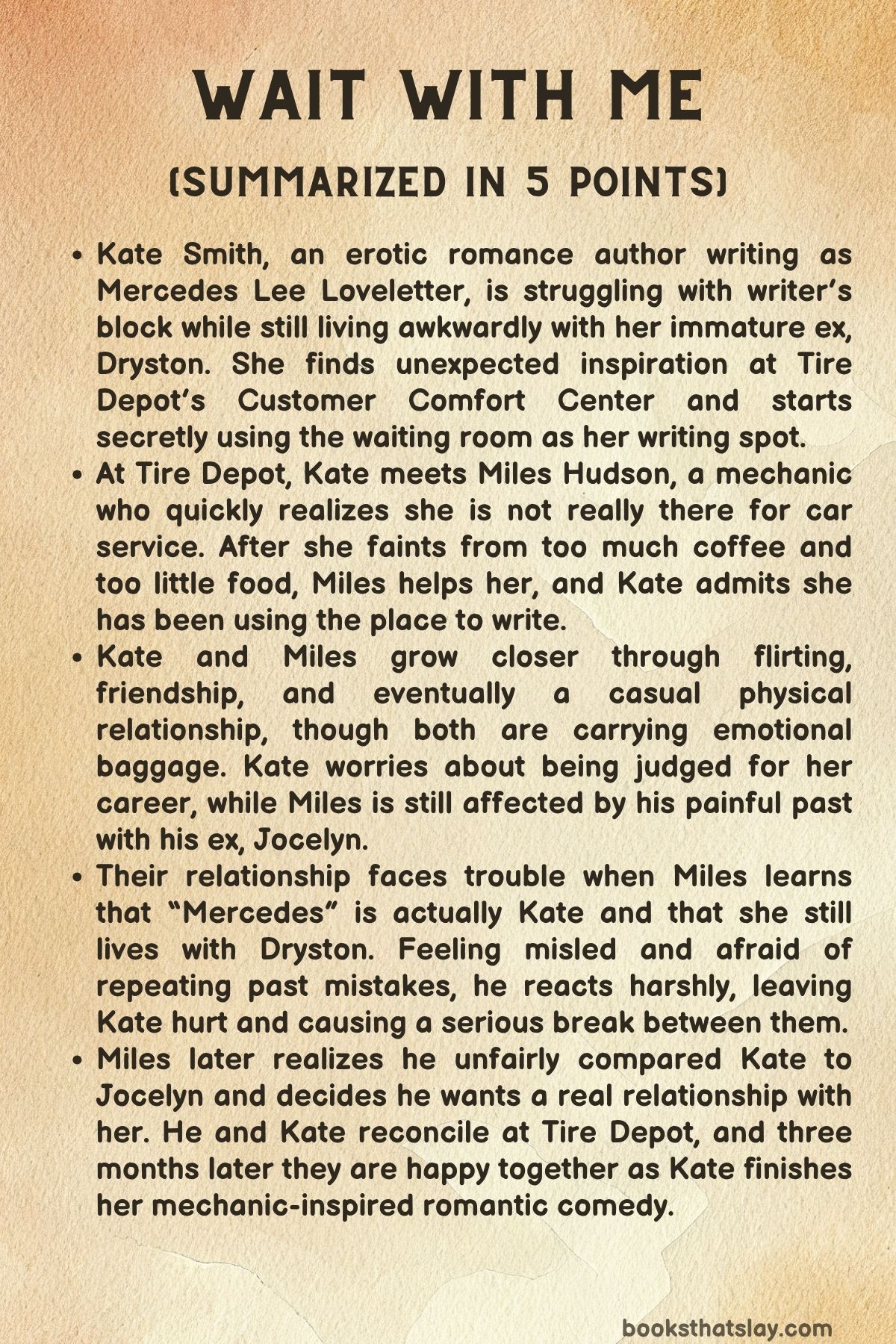
Characters
Kate Smith / Mercedes Lee Loveletter
Kate Smith is the central character of Wait With Me, and her personality is built around a lively contrast between confidence and insecurity. Professionally, she is already successful as an erotic romance author under the pen name Mercedes Lee Loveletter, which shows that she has imagination, boldness, humor, and the courage to write openly about desire.
At the same time, her writing slump reveals how fragile her creative confidence can become when her personal life is unsettled. Her awkward living arrangement with Dryston keeps her emotionally stuck, and her inability to write at home suggests that she needs more than silence or comfort to create; she needs a place where she feels free from judgment.
Kate’s decision to sneak into Tire Depot every day shows both her desperation and her comic impulsiveness. She knows she is not supposed to use the Customer Comfort Center as her private writing office, but she convinces herself that the place is harmless because it restores her creativity.
This makes her funny and flawed rather than simply dishonest. Her lie to Betty about working for corporate is not malicious, but it does show her tendency to avoid uncomfortable truths until they grow into larger problems.
She often uses charm, humor, and quick thinking to escape embarrassment, but those same qualities sometimes keep her from being fully honest with the people around her.
Her pen name, Mercedes Lee Loveletter, represents more than a professional identity. It is the side of Kate that feels daring, sensual, and creatively powerful.
However, Kate’s past with Dryston has taught her that not everyone accepts that part of her. Because her ex was ashamed of her career, she carries a fear that Miles might also judge her once he learns what she writes.
This fear makes her cautious even when she is clearly attracted to him. Her vulnerability appears most strongly when Miles accepts her career without mockery.
That moment matters because Kate is not simply looking for romance; she is looking for someone who can respect the full version of her.
Kate’s relationship with Miles helps her grow from avoidance toward honesty. At first, she hides behind the name Mercedes, hides the truth about why she is at Tire Depot, and hides the complications of her life with Dryston.
These secrets create conflict, especially when Miles discovers the truth before she can explain it herself. Still, Kate is not a manipulative character.
She is someone who has been embarrassed, judged, and creatively blocked, and she is trying to protect the one place and one person that make her feel alive again. By the end of the story, Kate becomes more emotionally settled.
Her creativity returns, her relationship with Miles becomes honest and committed, and she no longer has to separate Kate the woman from Mercedes the author.
Miles Hudson
Miles Hudson is the romantic hero of the book, and his character is shaped by the tension between attraction and fear. On the surface, he is confident, physically attractive, hardworking, and observant.
As a mechanic at Tire Depot, he notices Kate’s unusual behavior quickly, which shows that he is more perceptive than she expects. He is amused by her presence, curious about her secrets, and drawn to her energy.
His first interactions with her have a playful quality, especially when he allows himself to be bribed with leftover pizza, but beneath that humor is a man who is careful about emotional involvement.
Miles’s hesitation comes from his painful history with Jocelyn. His past relationship has made him suspicious of complicated romantic situations and afraid of being pulled into another emotionally damaging bond.
This is why he tries to label his connection with Kate as casual or limited to Tire Depot. He wants the excitement of being near her without the risk of truly needing her.
His jealousy over Dean, his intense reaction to Kate’s secrets, and his attempt to pull away after kissing her all show that his feelings are stronger than he wants to admit. He is not indifferent; he is defensive.
One of Miles’s most important qualities is that he is capable of acceptance, even when he struggles with trust. When Kate reveals that she writes erotic romance, he does not shame her.
Instead, he goes out of his way to prove that his family would not judge her either. This response separates him from Dryston and shows why Kate begins to feel emotionally safe with him.
Miles may be cautious, but he is not cruel. His instinct, when he is not blinded by fear, is to protect and affirm the people he cares about.
Miles’s flaw is that he allows his past with Jocelyn to shape his judgment of Kate. When he discovers that Mercedes is actually Kate and that she still technically lives with Dryston, he reacts as though Kate has repeated Jocelyn’s betrayal.
This is unfair because Kate’s situation is awkward and imperfect, but not the same as deliberate emotional dishonesty. His growth comes from recognizing that difference.
By choosing Kate fully, he moves beyond fear and accepts the uncertainty that comes with love. In the end, Miles becomes not just Kate’s inspiration for a mechanic romance, but also the person who helps her feel seen, desired, and respected.
Dryston
Dryston is Kate’s ex and one of the main sources of emotional discomfort in her life. He is described as immature, and his continued presence in the townhouse keeps Kate tied to a past she has not fully escaped.
Even though he is not the central romantic obstacle in the same way Miles’s fears are, Dryston represents the kind of relationship that limited Kate. His immaturity makes the living arrangement awkward, but his deeper significance lies in the shame he made Kate feel about her career.
Dryston’s inability to accept Kate’s work as an erotic romance author reveals a narrow and unsupportive side of his character. Instead of celebrating her success, he made her feel embarrassed about the very thing that gave her independence and identity.
This has lasting effects on Kate because it causes her to hesitate before telling Miles what kind of books she writes. Dryston therefore functions as a reminder of how damaging it can be when someone claims closeness to a person but rejects an essential part of them.
His return to the townhouse creates major conflict because it exposes the unresolved messiness of Kate’s personal life. Miles’s reaction to Dryston is shaped by Miles’s own past, but Dryston’s presence still makes Kate seem more secretive than she intends to be.
In this way, Dryston is not merely an ex-boyfriend; he is the unfinished business Kate has to move beyond. He represents emotional clutter, old shame, and the lingering consequences of a relationship that did not truly support her.
Jocelyn
Jocelyn is Miles’s ex and an important unseen influence on his behavior. Even though she is not as active in the present action as Kate or Miles, her impact is strong because she shaped Miles’s fear of relationships.
She represents betrayal, toxicity, and emotional damage in Miles’s past. Because of her, Miles approaches Kate with suspicion even when Kate has not earned that suspicion.
Jocelyn’s role in the story is mainly psychological. She explains why Miles tries to keep things casual, why he pulls away after moments of intimacy, and why he reacts so harshly when he learns that Kate has not told him everything.
His fear of repeating the same kind of relationship drama causes him to misread Kate’s situation. Jocelyn therefore becomes a shadow over Miles’s present, influencing his choices even when she is not physically there.
As a character, Jocelyn helps reveal Miles’s weakness. He is not afraid of love because he lacks feeling; he is afraid because he has felt too much for someone who hurt him.
Her presence in his backstory makes his guarded nature more understandable, but it does not excuse the unfairness of his reaction to Kate. By moving beyond Jocelyn’s influence, Miles proves that he is ready to judge Kate by her own actions rather than by the wounds someone else left behind.
Lynsey
Lynsey is Kate’s best friend and one of the clearest voices of reason in Wait With Me. She understands Kate well enough to recognize both her creativity and her absurdity.
When Kate insists that Tire Depot has become her writing sanctuary, Lynsey points out the obvious truth: Kate is basically loitering. This makes Lynsey practical, honest, and grounded.
She does not simply encourage every strange idea Kate has, but she also does not abandon her when Kate’s life becomes chaotic.
Lynsey’s friendship is important because she gives Kate emotional support without feeding her delusions. She sees that Kate is in a difficult creative and personal place, but she also pushes her to recognize when she is avoiding reality.
Her warnings about Tire Depot show concern rather than judgment. Lynsey understands that Kate’s writing matters deeply to her, but she also knows that Kate’s habit of sneaking, hiding, and improvising can create trouble.
Lynsey also helps Kate recover when things become painful with Miles. After Kate is hurt and embarrassed, Lynsey remains part of the support system that encourages her to return to herself.
She represents loyal friendship, practical advice, and emotional steadiness. In a story filled with romantic tension and comic situations, Lynsey helps keep Kate connected to reality.
Dean
Dean is Kate’s close friend, and his character brings humor, mischief, and emotional support into the story. Along with Hannah, he pranks Kate with a fake refreshment invoice and an embarrassing pizza delivery, which shows that his friendship with her is playful and teasing.
He is the kind of friend who knows Kate well enough to joke with her about her ridiculous situation at Tire Depot, but his humor does not erase his loyalty.
Dean also becomes important because Miles mistakes his closeness with Kate for something romantic. This moment reveals more about Miles than about Dean, but Dean’s presence helps create jealousy and forces Kate to clarify her relationships.
Dean is not a romantic rival in the true sense. Instead, he represents the comfortable, trusted friendships Kate already has in her life.
His presence shows that Kate is loved and supported outside of romance.
As a friend, Dean helps Kate move through her emotional confusion. He encourages her when she struggles with Miles and with her writing, and his playful personality gives the story warmth.
He is not simply comic relief; he is part of the chosen-family structure around Kate. Through Dean, the story shows that friendship can be just as important as romance in helping a character regain confidence.
Hannah
Hannah is part of Kate’s friend group and contributes to the playful, teasing energy around Kate’s Tire Depot secret. Her involvement in the fake invoice and pizza prank shows that she shares Dean’s mischievous sense of humor.
She understands the absurdity of Kate’s situation and participates in making it even more embarrassing, but the prank comes from familiarity rather than cruelty.
Hannah’s role may be smaller than Lynsey’s or Dean’s, but she still helps define Kate’s social world. Her presence shows that Kate is not isolated, even when she feels creatively stuck or romantically confused.
Kate has people around her who know her quirks, laugh at her strange choices, and still support her. Hannah helps create that atmosphere of affectionate chaos.
As a supporting character, Hannah adds lightness to the story. She reminds the reader that Kate’s situation at Tire Depot is not only romantic and emotional, but also deeply comedic.
Through Hannah, the book keeps a playful tone even while dealing with insecurity, shame, and trust.
Betty
Betty is the friendly presence at Tire Depot who unknowingly helps create Kate’s writing sanctuary. Her baked goods, kindness, and role in the Customer Comfort Center make the waiting room feel welcoming rather than sterile.
For Kate, Betty becomes part of the environment that restores her creativity. Even though Betty does not fully know the truth at first, her warmth contributes to the comfort Kate desperately needs.
Betty also matters because Kate lies to her about working for corporate. This lie shows Kate’s fear of being exposed and her willingness to bend the truth to protect her new routine.
Betty’s trust makes Kate’s deception more uncomfortable, because Betty is not an antagonist. She is simply kind, and Kate takes advantage of that kindness in a small but meaningful way.
As a character, Betty represents hospitality and everyday generosity. She is not central to the romance, but she helps make Tire Depot feel like a place of unexpected transformation.
Without Betty’s welcoming presence, the waiting room would not have the same emotional importance for Kate. Betty helps turn an ordinary business into the unlikely space where Kate finds her voice again.
Themes
Creativity, Inspiration, and the Need for the Right Space
Kate’s writing block shows how creativity is not only about talent, discipline, or professional success, but also about emotional comfort and environment. In Wait With Me, her ability to write returns in an unexpected place: the Customer Comfort Center at Tire Depot.
This unusual setting becomes more than a waiting room because it gives her distance from the awkwardness of living with Dryston and the pressure of producing new work. The free coffee, Betty’s baked goods, the background noise, and the routine of secretly arriving each day create a space where her imagination can breathe again.
Her dependence on Tire Depot also shows how fragile creative confidence can be. When she tries to stay away, even a tire-scented candle cannot replace the real atmosphere because what she needs is not just a smell, but a feeling of escape, possibility, and renewed identity.
The theme suggests that inspiration can come from ordinary places when they offer freedom from judgment and emotional pressure.
Identity, Honesty, and Self-Acceptance
Kate’s use of the name Mercedes Lee Loveletter reflects the distance between who she is privately and the public identity she has built as a successful erotic romance author. Her pen name gives her confidence, fame, and creative freedom, but it also becomes a shield when she meets Miles.
By introducing herself as Mercedes instead of Kate, she avoids immediate vulnerability and controls how much of herself he can see. This becomes complicated because Miles is drawn to her honesty, humor, and boldness, yet he later feels betrayed when he discovers the parts she held back.
Kate’s struggle is not simply about using a false name; it is about wanting to be accepted without shame. Her ex made her feel judged for her career, so Miles’s acceptance of her writing becomes deeply meaningful.
The theme develops through Kate’s gradual movement toward owning both sides of herself: the woman behind the laptop and the author who writes openly about desire.
Love, Fear, and Emotional Risk
Miles and Kate’s relationship grows through attraction, humor, friendship, and physical closeness, but fear repeatedly interrupts their connection. Miles is not emotionally free when he meets her because Jocelyn’s betrayal has left him suspicious of complicated relationships and hidden truths.
His desire for a “casual” arrangement is less about not caring and more about protecting himself from another painful disappointment. Kate also carries emotional wounds, especially from being with someone who made her feel embarrassed about her work and identity.
Their romantic tension is therefore shaped by both longing and caution. The first rupture after their kiss shows Miles retreating from feelings he cannot control, while the later conflict over Kate’s real name and living situation shows how past pain can distort present judgment.
Their reconciliation matters because it is not based only on attraction. It comes when Miles recognizes that Kate is not Jocelyn and when Kate allows herself to believe that love does not require hiding important parts of herself.
Friendship, Support, and Found Family
Kate’s friendships with Lynsey, Dean, Hannah, and even Betty create a strong support system around her personal and creative struggles. Lynsey challenges Kate when she is being reckless, especially about sneaking into Tire Depot, but her warnings come from care rather than judgment.
Dean and Hannah’s pranks add humor, yet they also show how familiar and comfortable Kate’s chosen circle is. These friendships keep her grounded when her emotions become intense, especially after conflicts with Miles and during moments when her writing suffers again.
Betty’s kindness in the waiting room also matters because her baked goods and friendly presence help turn a public business space into a place where Kate feels welcomed, even before the truth is known. This theme shows that romance is not the only emotional bond shaping Kate’s growth.
Her friends help her take risks, recover from embarrassment, face disappointment, and return to herself. Their support makes her final happiness feel fuller because it is rooted in community as well as love.