Want to Know a Secret? Summary, Characters and Themes
Want to Know a Secret? by Freida McFadden is a fast-moving domestic thriller about image, jealousy, friendship, and the ugly truths hidden behind polished suburban lives. The story follows April Masterson, a popular baking YouTuber whose cheerful online brand depends on secrets, sweetness, and perfection.
But her own life is far from perfect. Anonymous messages begin to expose private mistakes, her friendships turn hostile, her marriage collapses, and she becomes trapped in a web of suspicion. What begins as suburban drama soon turns into a darker story about manipulation, murder, and the dangerous cost of keeping secrets buried.
Summary
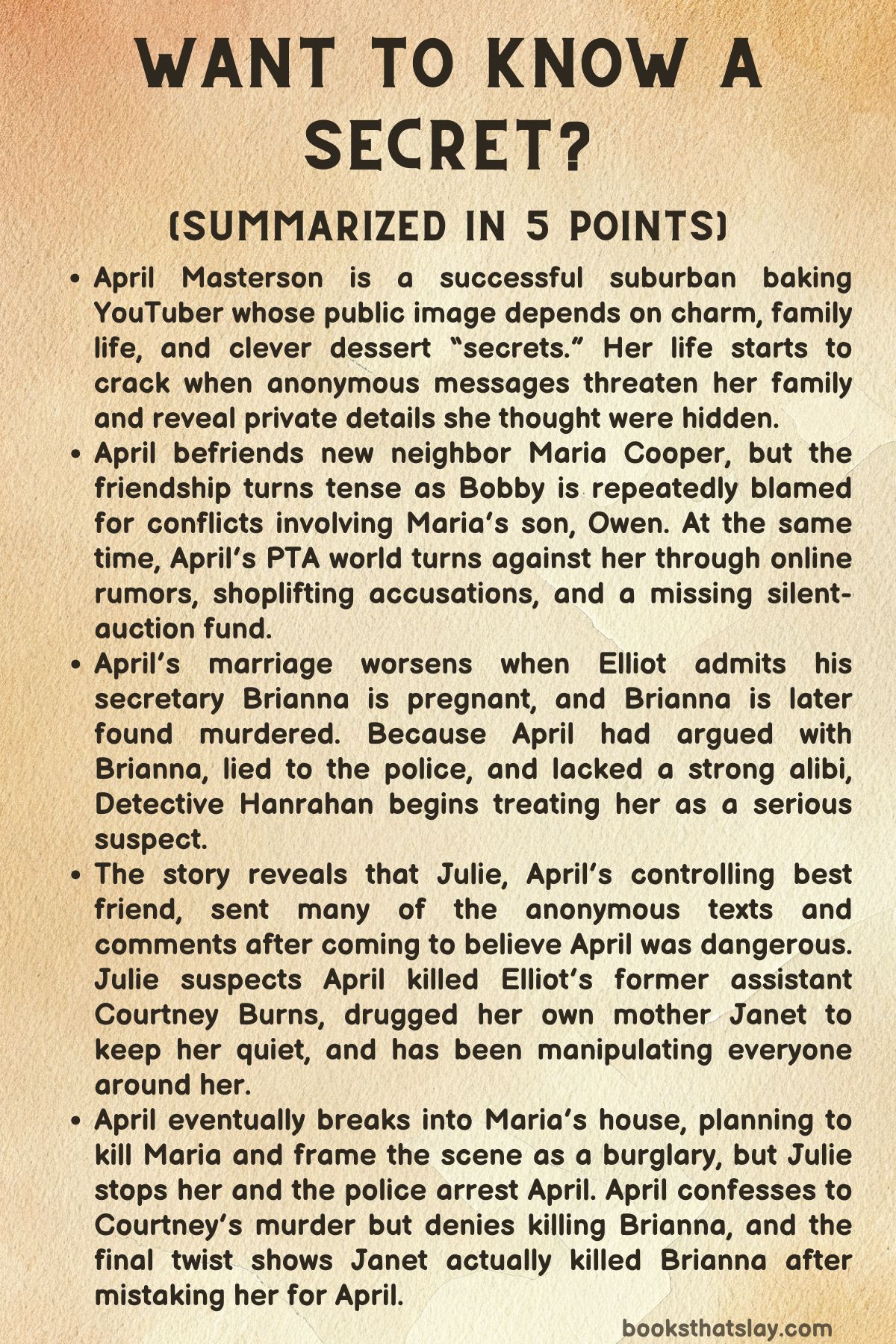
April Masterson appears to have the kind of life other people admire. She is a successful suburban baking YouTuber, a mother, a wife, and a familiar presence in her community.
Her show is built around dessert tips and clever kitchen secrets, and she presents herself as warm, polished, and in control. But that careful image begins to crack when she receives an anonymous text claiming that her son, Bobby, is not where she thinks he is.
April panics, terrified that something has happened to him. Bobby is soon found safe at the home of the new neighbors, the Coopers, where he has been playing with their son, Owen.
Although nothing bad has happened, the message leaves April shaken. It also marks the beginning of a campaign of threats, accusations, and humiliation that slowly destroys her sense of security.
April soon meets Maria Cooper, Owen’s mother. Maria is new to the neighborhood, confident, stylish, and easy to talk to.
April quickly feels drawn to her and begins to see her as a possible friend. Maria’s husband, Sean, also catches April’s attention.
He is attractive, helpful, and more attentive than April’s own husband, Elliot, who has grown distant. As Bobby and Owen spend more time together, April becomes more involved with the Cooper family.
April introduces Maria to her social circle, including Julie Bressler, the PTA president and April’s closest friend. Julie is powerful, judgmental, and used to controlling the women around her.
At first, Maria seems like a welcome addition to the group, but her behavior soon begins to unsettle April. Maria proves she can be cruel and strategic when she humiliates a young mistress by planting jewelry in the woman’s purse at Helena’s, the store Maria manages.
April sees that Maria is capable of using other people’s weaknesses against them.
Soon after, April starts receiving cruel online comments and threatening texts. The messages reveal private details about her life, including the fact that she dropped out of culinary school.
They also mention her kiss with Mark Tanner, the soccer coach, and hint at trouble in her marriage. April realizes that whoever is targeting her knows things that only someone close to her could know.
Her relationships begin to fall apart. April’s bond with Julie becomes strained, especially as Julie grows closer to Maria.
Bobby and Owen also start having problems. When Julie’s son, Leo, is hurt during soccer, Bobby is blamed.
Later, during a school carnival, Leo falls from a bouncy-house slide, and Bobby is blamed again. April insists Owen is lying and trying to frame Bobby, but Julie refuses to believe her.
Instead of supporting April, Julie sides with Maria and the other parents.
April’s public reputation suffers as well. Someone sabotages her bake sale by spreading a rumor online that she has been vomiting while baking.
This strikes directly at April’s YouTube brand and her identity as a baker. She begins to suspect Maria, especially because Maria has become cold and unfriendly toward her.
Her suspicions deepen when Maria frames her for shoplifting at Helena’s. April feels cornered and increasingly convinced that Maria is trying to ruin her life.
Then April faces another accusation. Money from the PTA silent auction goes missing, and Julie threatens to report April to the police unless the money is returned.
April denies responsibility, but the accusation adds to the pressure building around her. At the same time, her marriage reaches a breaking point.
Elliot admits that his secretary, Brianna, is pregnant with his baby. This mirrors an earlier scandal involving another assistant, Courtney Burns, and makes April’s life feel even more out of control.
The situation turns deadly when Brianna is found murdered. Detective Riley Hanrahan questions April and Elliot.
April becomes a serious suspect because she had fought with Brianna, lied about where she had been, and cannot provide a reliable alibi. April insists she is innocent and becomes more certain that Maria is behind the threats, the framing, and possibly the murder.
She believes Maria has been using a burner phone to torment her and make her look guilty.
The story then shifts to Julie’s point of view, revealing that April has been wrong about some of her assumptions. Julie admits that she sent many of the anonymous texts and online comments.
She used a burner phone she had found after discovering her husband’s affair. Julie’s anger toward April had been building for years.
She had long believed April was dangerous, and she suspected that April had murdered Courtney Burns, Elliot’s former assistant.
Julie’s suspicion came partly from April’s mother, Janet, who had once suggested that she had provided April with an alibi for Courtney’s death. Julie also discovered that Janet was being heavily medicated in a nursing home, and she believed April had arranged this with the help of a corrupt doctor to keep Janet quiet.
Julie’s resentment grew when she saw April kissing Mark Tanner and took a photo of it. She later used the photo to torment April.
Julie also threw a rock through April’s window and sent messages designed to make April paranoid and unstable.
Although Julie has been cruel, she is not the only person hiding the truth. April eventually breaks into Maria’s house, convinced that Maria has the burner phone and proof of the campaign against her.
Once inside, April’s own narration reveals the darkest secrets of all. She admits that she killed Courtney Burns by forcing her to overdose after Elliot tried to leave her.
She also admits that she had her mother drugged and placed in a nursing home when Janet threatened to expose her. April further reveals that she caused the death of elderly Mrs. Kirkland by pushing her down the stairs.
She also admits that she stole the PTA money.
April’s suspicions about Maria are partly based on fear, but her plan is not innocent. She intends to kill Maria and make it look like a burglary.
She believes this will remove the person she thinks is ruining her life and help her regain control. But Julie sees April inside Maria’s bedroom holding a knife.
Realizing what April is about to do, Julie rushes over. She sends April a text to distract her, then strikes her with a vase.
The police arrive and arrest April.
After her arrest, April is jailed and confesses to killing Courtney. However, she continues to insist that she did not kill Brianna.
This claim seems doubtful at first, given everything else she has admitted. But the final reveal proves that April is telling the truth about Brianna’s death.
Janet, April’s mother, had escaped from the nursing home. Confused and full of anger, she stole a nurse’s white SUV and followed a young blonde woman whom she believed was April.
In reality, the woman was Brianna. Janet attacked her with a shovel and killed her, believing she had killed her own daughter.
The truth adds one final twist to the story: April is guilty of several terrible crimes, but not of the murder that first brought the police closest to her.
Characters
April Masterson
April Masterson is the central and most disturbing character in Want to Know a Secret because she is presented first as a successful, polished suburban mother and baking YouTuber, but gradually emerges as a manipulative and dangerous person hiding behind domestic perfection. Her public identity is built on sweetness, helpfulness, family, and control, which makes her private cruelty feel even more unsettling.
April’s obsession with maintaining her image shapes almost everything she does. She wants to be admired as a wife, mother, friend, and online personality, and whenever that image is threatened, she reacts with fear, rage, and calculation rather than honesty.
Her character shows how appearances can become a weapon, because she uses charm, victimhood, and social status to make others doubt the truth about her.
April is also deeply possessive, especially when it comes to Elliot and the life she believes belongs to her. Her crimes against Courtney, Janet, Mrs. Kirkland, and Maria reveal that she does not simply panic under pressure; she is capable of planning harm when someone becomes inconvenient.
What makes April especially frightening is that she often convinces herself she is justified. She sees other people as threats to her marriage, reputation, and comfort, not as human beings with their own lives.
Even when she is genuinely being tormented by Julie’s messages, her paranoia is mixed with guilt, because the accusations circling around her are connected to real crimes. April’s role in the book is therefore not only that of a villain but also of a carefully constructed mask slowly cracking until the violence underneath is exposed.
Julie Bressler
Julie Bressler is one of the most complicated figures in the story because she is both an antagonist to April and, in a strange way, one of the people trying to expose the truth. As April’s controlling best friend and PTA president, Julie represents the social pressure of suburban life: reputation, popularity, influence, and judgment.
At first, she seems petty, domineering, and jealous, especially in the way she manages friendships and sides against April when conflicts arise. However, her later perspective reveals that her behavior comes from suspicion, fear, and a long-held belief that April is far more dangerous than she appears.
Julie’s moral position is not simple. She sends anonymous texts, posts cruel comments, throws a rock through April’s window, and deliberately pushes April into paranoia.
These actions are harmful and manipulative, yet they come from Julie’s belief that normal methods will not reveal April’s guilt. Julie is driven by anger over April’s past behavior, fear for others, and disgust at what she believes April has done to Courtney and Janet.
Her character adds tension because she is not purely heroic; she is willing to torment April psychologically, but she also becomes the person who prevents April from murdering Maria. Julie’s importance lies in how she exposes the danger of obsession on both sides.
She is right about April, but her methods show how the pursuit of justice can become morally messy when it is fueled by revenge.
Maria Cooper
Maria Cooper functions as both a real person and a projection of April’s growing paranoia. When she first enters the story as April’s new neighbor, she appears friendly, stylish, confident, and appealing.
April is drawn to her because Maria seems like a refreshing alternative to Julie’s controlling friendship. Maria’s presence also unsettles the existing social order, because she quickly becomes involved in the neighborhood, the PTA circle, and April’s personal life.
Her confidence makes her attractive to April at first, but later that same confidence makes April see her as threatening.
Maria is not innocent in every situation. She can be sharp, calculating, and socially ruthless, especially when she humiliates Carrie’s husband’s mistress by planting jewelry in her purse.
That moment shows that Maria is capable of manipulation and punishment when she believes someone deserves it. However, April’s belief that Maria is behind every anonymous message and act of sabotage is ultimately misplaced.
Maria becomes the convenient enemy April needs in order to avoid facing her own guilt and the real source of the threats. In the book, Maria’s character is important because she exposes April’s tendency to turn suspicion into certainty.
April does not simply dislike Maria; she constructs Maria as a villain so that she can justify invading her home and planning her death.
Sean Cooper
Sean Cooper is Maria’s attractive and helpful husband, and his role is significant because he intensifies April’s fascination with the Cooper family. He represents temptation, comparison, and the kind of domestic ideal April thinks she deserves.
April’s interest in him is not developed only as attraction; it also reveals her dissatisfaction with Elliot and her desire to feel admired and wanted. Sean’s presence makes the Cooper household seem even more appealing from April’s point of view, which helps explain why Maria’s later coldness feels like such a personal betrayal to her.
Sean is not as central as April, Julie, or Maria, but he matters because he becomes part of the emotional atmosphere that destabilizes April. His politeness and helpfulness allow April to imagine meanings that may not fully exist, and this makes him another piece in her fantasy of being desired and valued.
He also helps make Maria seem more threatening, because April sees Maria as someone who has the husband, confidence, and control that April wants to preserve in her own life. Sean’s character therefore works less through direct action and more through what he represents inside April’s unraveling mind.
Bobby Masterson
Bobby Masterson is April and Elliot’s son, and his role highlights the vulnerability of children caught inside adult lies, rivalries, and manipulations. At the beginning, the anonymous message about Bobby not being where April thinks he is immediately strikes at April’s deepest fear as a mother.
Even though Bobby is safe, that moment begins the chain of panic and suspicion that drives much of the story. Bobby’s friendship with Owen initially seems ordinary and innocent, but it later becomes another battlefield for the adults around them.
Bobby is also important because April uses motherhood as part of her public identity. She wants to be seen as a protective and devoted mother, yet the chaos around Bobby reveals the instability of the home he lives in.
When Bobby is blamed for hurting Leo and later for the carnival incident, April’s reaction is shaped by both maternal protectiveness and her own paranoia. She insists that Owen is lying and framing him, but her response is also tied to her larger belief that Maria is attacking her.
Bobby’s character shows how children in the story are often used as extensions of adult conflict rather than being allowed to remain separate from it.
Owen Cooper
Owen Cooper is Maria and Sean’s son, and he serves as Bobby’s friend, rival, and possible accuser. His connection with Bobby first creates a bridge between April and Maria, making the families seem naturally connected.
However, once Bobby and Owen begin clashing, that bridge becomes a source of tension. Owen’s role is especially important because April becomes convinced that he is lying and helping frame Bobby.
Whether Owen fully understands the adult dynamics around him or not, his presence becomes central to April’s suspicion of the Cooper family.
Owen also reflects how easily children can become part of a larger social drama. The conflict between Owen and Bobby does not remain a simple childhood disagreement; it is absorbed into the adult world of gossip, blame, reputation, and revenge.
April’s reaction to Owen says more about her own state of mind than about him. She sees him not merely as a child but as evidence that Maria is working against her.
In this way, Owen’s character helps reveal April’s inability to separate ordinary conflict from conspiracy.
Elliot Masterson
Elliot Masterson is April’s husband, and his weakness, dishonesty, and repeated infidelity help create the conditions for April’s violence and desperation. He is not portrayed as a strong moral center.
Instead, he is evasive, selfish, and willing to betray his marriage while leaving others to deal with the consequences. His affair with Brianna and the earlier scandal involving Courtney show a pattern of behavior that damages the women around him and repeatedly threatens April’s carefully maintained image of a perfect marriage.
At the same time, Elliot is not responsible for April’s crimes. His betrayal may explain some of her rage, but it does not excuse her choices.
His character is important because he reveals one of April’s deepest fears: abandonment. When Elliot’s actions threaten to expose the emptiness of their marriage, April responds not by accepting reality but by trying to erase the people who disrupt her life.
Elliot’s cowardice and infidelity make him morally flawed, but April’s reaction to his betrayal shows the far darker side of her personality. He functions as both a source of conflict and a mirror reflecting how much of April’s identity depends on keeping control over her marriage.
Brianna
Brianna is Elliot’s secretary and the woman whose pregnancy threatens to destroy April’s marriage and reputation. Although she is not given the same depth as April or Julie, her role is crucial because her death becomes the central crime that places April under suspicion.
Brianna represents a repeated pattern in Elliot’s life: a younger woman connected to him through work becomes entangled in his marriage. For April, Brianna is not simply a person; she becomes a symbol of humiliation, replacement, and public exposure.
Brianna’s murder also creates one of the story’s most important misdirections. Because April has already shown anger toward her, lied about her whereabouts, and lacks a solid alibi, it seems believable that April may have killed her.
The final revelation that Janet killed Brianna by mistake changes Brianna’s role from apparent victim of April’s jealousy to victim of a separate but connected tragedy. Brianna’s character shows how innocent or partially innocent people can be destroyed by the violent consequences of other people’s secrets.
Courtney Burns
Courtney Burns is one of the most important absent characters in the novel because her death reveals the truth about April’s past. She was Elliot’s former assistant and became part of an earlier scandal that April tried to bury.
Although Courtney is dead before the main events unfold, her presence haunts the story. Julie’s suspicion that April murdered Courtney becomes one of the main reasons Julie begins tormenting April, and Janet’s knowledge of what happened makes her dangerous to April.
Courtney represents the original crime that exposes April’s true nature. April’s admission that she forced Courtney to overdose reveals that her violence did not begin with Maria or Brianna.
Courtney’s death proves that April’s polished persona has been hiding something monstrous for years. As a character, Courtney matters because she is the buried truth beneath the suburban surface.
Even in absence, she drives the plot, shapes Julie’s investigation, and helps reveal that April’s fear of exposure is based on real guilt.
Janet
Janet, April’s mother, is one of the most tragic and unsettling characters in the story. She knows enough about April’s past to threaten the false life April has built, and because of that, April arranges for her to be heavily medicated and confined in a nursing home.
Janet’s situation shows the full cruelty of April’s self-protection. April does not only harm rivals or strangers; she is willing to silence her own mother when Janet becomes inconvenient.
Janet’s final role is deeply ironic and horrifying. After escaping the nursing home, she follows a young blonde woman whom she mistakes for April and kills her with a shovel.
This reveals that April was telling the truth when she said she did not kill Brianna, but it does not make April innocent. Instead, Janet’s act shows how April’s earlier cruelty continues to create destruction.
Janet has been damaged, drugged, isolated, and pushed into confusion, and the result is another death. Her character adds tragedy because she is both a victim of April and the person responsible for Brianna’s murder.
Mark Tanner
Mark Tanner is the soccer coach whom April kisses, and his role is important because he becomes another secret that Julie uses against her. Mark represents April’s hypocrisy and emotional instability.
April is furious over Elliot’s betrayals, yet she also crosses a boundary outside her marriage. Her kiss with Mark does not make her equal to Elliot in wrongdoing, but it does show that the perfect wife image she performs is false.
Mark’s importance lies less in his own personality and more in the consequences of his involvement with April. Julie photographs the kiss and uses it as part of her campaign to frighten and expose April.
Through Mark, the story shows how even a private moment can become a weapon in a community built on reputation and surveillance. He also adds to the sense that April’s life is full of secrets waiting to be uncovered.
Detective Riley Hanrahan
Detective Riley Hanrahan represents law, suspicion, and the outside world entering the closed suburban environment. Once Brianna is murdered, Riley questions April and Elliot, forcing the private tensions of their marriage into the open.
Riley’s presence shifts the story from neighborhood drama into criminal investigation. April can manipulate friends and neighbors, but a detective introduces a more formal kind of scrutiny.
Riley is important because April’s usual strategies become less reliable under investigation. Her lies about her whereabouts, her fight with Brianna, and her lack of an alibi make her look guilty.
Riley’s questioning also increases April’s fear that everything she has hidden may finally collapse. Although Riley does not uncover every truth alone, the character helps tighten the pressure around April and moves the story toward exposure.
Leo Bressler
Leo Bressler is Julie’s son, and his role is tied to the conflict between Bobby, Owen, April, and Julie. When Leo gets hurt during soccer and later falls from the bouncy-house slide at the carnival, the incidents become major turning points in the breakdown of April’s social position.
Bobby is blamed, and April’s insistence that Owen is lying deepens the divide between her and Julie.
Leo’s character also shows how quickly adult suspicion can attach itself to children’s accidents. His injuries become part of a larger pattern of blame, loyalty, and social judgment.
For Julie, protecting Leo strengthens her hostility toward April and Bobby. For April, the accusations against Bobby become further proof that others are conspiring against her.
Leo is therefore important not because he drives the plot intentionally, but because what happens to him becomes fuel for the adults’ conflict.
Carrie
Carrie is part of the suburban social circle and becomes important through the humiliation of her husband’s young mistress. Her situation reveals the cruel, performative morality within the community.
The women around her may appear supportive, but their support can take the form of punishment, spectacle, and social shaming. Carrie’s pain over her husband’s affair becomes an opportunity for Maria to demonstrate her own ruthlessness.
Carrie’s character also reflects one of the story’s recurring themes: betrayal inside marriage. Her husband’s behavior echoes Elliot’s affairs, creating a broader pattern of men damaging their families while women are left to manage the emotional and social consequences.
Carrie is not as central as April or Julie, but her presence strengthens the book’s portrait of suburbia as a place where private scandals are constantly being watched, judged, and weaponized.
Helena
Helena is connected to the store where Maria works, and the store itself becomes an important setting for social humiliation and accusation. Through Helena’s, Maria is able to frame Carrie’s husband’s mistress by planting jewelry in her purse, and later April is framed for shoplifting there.
Helena’s role is therefore tied less to personal development and more to the way public spaces become stages for private revenge.
As a character, Helena helps represent the respectable surface of the community. A store should be ordinary and controlled, but in the story it becomes a place where reputations can be damaged instantly.
The incidents connected to Helena’s show how easily evidence can be planted and how quickly appearances can replace truth. Her presence supports the novel’s larger concern with image, suspicion, and social punishment.
Mrs. Kirkland
Mrs. Kirkland is one of April’s hidden victims, and her importance becomes clear when April admits that she “nudged” the elderly woman down the stairs. Mrs. Kirkland’s role is brief but chilling because it expands the reader’s understanding of April’s violence.
April’s crimes are not limited to romantic jealousy or immediate threats. She is willing to harm a vulnerable elderly woman when it serves her purposes.
Mrs. Kirkland’s character matters because she shows the casualness of April’s cruelty. The word “nudged” makes the act sound small, but the reality is horrifying.
April’s way of describing it reveals her ability to minimize violence and make herself feel detached from what she has done. Mrs. Kirkland therefore becomes a symbol of the people April has harmed quietly, away from public attention, while continuing to present herself as sweet and respectable.
Themes
Secrets as Tools of Power
In Want to Know a Secret, secrets are not private burdens; they become weapons used to control, threaten, punish, and survive. April builds her public image around “secrets” in baking, but her real life is shaped by far darker hidden truths.
The contrast between her cheerful online persona and her concealed violence shows how secrecy can protect a false identity. Julie also uses secrets as a form of power, sending anonymous messages and exposing private facts to weaken April’s confidence and reputation.
What makes the theme especially strong is that secrecy does not belong to only one villain. Almost every major relationship is damaged by hidden information: Elliot hides his affair, Janet hides what she knows, Julie hides her revenge, and April hides her crimes.
The novel suggests that secrets grow more dangerous when they are used to avoid responsibility. Instead of disappearing, buried truths return in distorted, destructive ways, often harming people who were not originally involved.
The Fragility of Image and Reputation
April’s life depends on the appearance of perfection. Her success as a baking YouTuber, her role as a suburban mother, and her position in the PTA circle all require others to believe that she is polished, generous, and trustworthy.
The threats against her are effective because they attack this image piece by piece. Comments about her past, her marriage, her parenting, and her baking do not physically harm her at first, but they damage the social identity she has carefully built.
This theme shows how reputation in close communities can be both powerful and unstable. A rumor, accusation, or public embarrassment can quickly turn admiration into suspicion.
April’s panic comes not only from fear of being exposed but from fear of losing control over how others see her. The novel presents suburban respectability as a fragile performance, where friendliness and status often hide competition, resentment, and judgment beneath the surface.
Obsession, Paranoia, and Loss of Control
April’s growing fear changes how she sees everyone around her. Once the anonymous messages begin, she starts reading ordinary events as signs of a larger plot against her.
Maria’s coldness, Owen’s behavior, Julie’s betrayal, and the accusations at school all feed April’s belief that someone is carefully destroying her life. This paranoia is partly understandable because someone is truly tormenting her, but it also reveals her deeper instability.
Her need to control every person and every situation becomes impossible to maintain. The more threatened she feels, the more reckless and dangerous she becomes.
This theme is important because the story does not present paranoia as simple fear; it shows how fear can combine with guilt. April is haunted because she knows she has committed terrible acts before.
Her suspicion of others reflects her own capacity for deception and violence. In the end, her obsession with identifying the enemy exposes the fact that she herself is the greatest danger.
Motherhood, Protection, and Moral Corruption
Motherhood appears throughout the story as both love and excuse. April’s fear for Bobby begins the chain of threats, and her protective instincts initially make her seem sympathetic.
She believes others are targeting her son, and her anger toward Owen grows from her desire to defend Bobby. Yet the novel gradually complicates this idea by showing that protection can become possessive and morally corrupt.
April does not simply want to protect her family; she wants to preserve the life she believes she deserves, even if that means harming others. Janet’s actions also distort motherhood.
Her confused violence comes from a broken desire to confront or punish April, but it destroys Brianna instead. These mother-child relationships are filled with fear, control, resentment, and damage.
The theme suggests that love without moral limits can become dangerous. When family loyalty is used to justify lies, silence, or violence, it stops being protection and becomes another form of harm.