Judge Stone Summary, Characters and Themes
Judge Stone, by Viola Davis and James Patterson, is a legal drama about power, conscience, race, faith, and the cost of doing what the law does not always make easy.
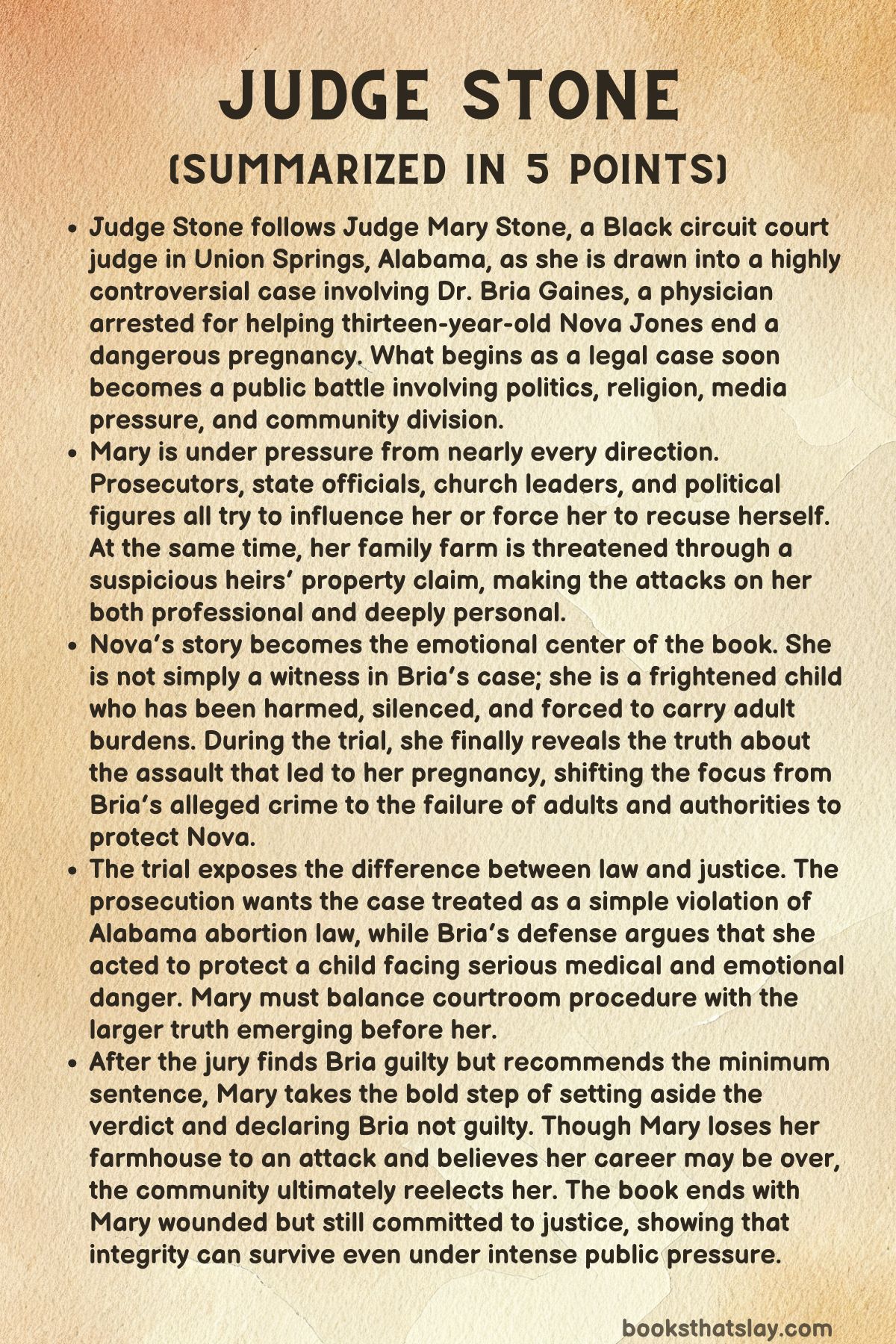
The story centers on Judge Mary Stone, a Black circuit court judge in Alabama whose courtroom becomes the center of a national storm after a local doctor is charged for helping a pregnant thirteen-year-old girl. Around Mary’s rulings, the novel builds a conflict between justice and politics, public morality and private pain, and community loyalty and violent intimidation. It is both a courtroom story and a portrait of a woman fighting to keep her integrity intact.
Summary
Judge Stone begins in Union Springs, Alabama, where Dr. Bria Gaines opens her clinic late at night for an appointment that must remain secret. Cocheta Bass, the school nurse, brings Nova Jones, a frightened thirteen-year-old girl who is pregnant and desperate for help.
Bria knows that Alabama law could punish her severely if she performs an abortion. She also knows that Nova is a child, terrified of her mother’s reaction, and in danger from a pregnancy that could harm her body and future. Bria chooses to help Nova because she believes that protecting the girl is more important than protecting herself.
At the same time, Judge Mary Stone begins another difficult day on her family farm. She is blunt, disciplined, funny in a dry way, and deeply tied to the land her family has held for generations. Her morning routine with animals and chores hides the pressure waiting for her at the courthouse.
Mary is preparing to sentence Ferrell Gray, a man convicted of murdering an elderly couple. The jury has recommended death, and Mary must decide whether to impose that sentence or choose life in prison without parole. Before the hearing, Gray sends her a hateful letter filled with threats and racist abuse.
In court, Gray tries to use his own threats to force Mary off the case. Mary refuses to let him manipulate the system. She sentences him to life without parole, saying that even his life remains sacred. This decision shows the kind of judge she is: firm, morally serious, and unwilling to turn punishment into revenge.
Outside the courthouse, Mary’s life is rooted in a weekly Saturday breakfast on her farm, a tradition started by her parents. Her sisters Nellie and Jordan help feed neighbors, church members, unhoused guests, and struggling families. Among those who come is Starla Jones, Nova’s mother, with her many children.
Mary notices that Nova carries more responsibility than a girl her age should. Nova watches younger siblings, manages their needs, and tries to disappear into the background. When Nova looks sick and withdrawn, Mary senses something is wrong, but she does not yet know the full truth.
Soon after, Nova collapses at home and is taken away by ambulance. Bria is arrested at her clinic in front of patients and cameras. The private medical decision she made in the middle of the night becomes a public scandal, and Union Springs begins to split into opposing camps.
The case quickly lands in Mary’s orbit. District Attorney Robert Reeves is eager to prosecute Bria and seems just as eager to pressure Mary. He suggests that Mary should step aside, but Mary refuses. She knows that if she leaves the case simply because it is difficult, she would be abandoning her duty.
Pressure comes from every direction. Reverend Curtis Erskine visits Mary and urges her to “do the right thing,” clearly meaning that religion should guide the case. Mary refuses to discuss a pending matter and warns him about the danger of mixing church influence with the courts.
The governor and the attorney general also try to push Mary into recusing herself. They claim that Union Springs cannot handle the security and media attention. When they think Mary is no longer listening, they insult her with racist and sexist contempt. Mary hears them, and their words confirm that their concern is not justice but control.
Mary’s personal life also comes under attack. A lawyer named Arch Pearce sends notice that someone is claiming an interest in her family farm through heirs’ property. Mary recognizes the threat immediately. The land is more than property to her; it is history, inheritance, labor, and proof that her family endured.
As the abortion case grows larger, Bria changes lawyers. Her first lawyer is not ready for the fight ahead, so Benjamin Meyers, an experienced attorney from Atlanta, takes over. Bria is reluctant at first, but she eventually understands that the case could destroy her career, freedom, and reputation if she is not defended properly.
Nova is brought to the courthouse by Starla and is treated by the prosecution as an important witness. She is hungry, scared, and overwhelmed. The prosecutors want her testimony to support their case against Bria, but Nova’s concern is whether the doctor who helped her will be okay.
Mary sees how the State is using Nova. She also sees that prosecutors are trying to create conflicts that could force Mary off the case. Mary remains alert to these tactics and refuses to surrender control of her courtroom.
The town becomes more hostile. Bria is harassed, her clinic suffers, and supporters and opponents flood Union Springs. Ben is assaulted outside a restaurant by a former patient who calls Bria a killer. Cocheta Bass, who had helped Nova reach Bria, is found dead under suspicious circumstances after being followed at night.
Mary goes to Cocheta’s home and sees signs that the death was staged as a warning. A red letter K is found nearby, suggesting white supremacist intimidation. The case has now moved beyond legal argument into organized fear.
A public rally led by Mason Phelps brings armed men, Confederate imagery, and chaos into town. Mary tries to open the courthouse as a shelter when the crowd turns dangerous. Gunshots are fired, people are injured, and Union Springs feels less like a community than a battlefield.
Mary is also targeted in the press. A story about her friendship with Loucilla Payne is published in a way meant to embarrass or distract her. Mary realizes that delay is making the situation worse, so she orders the lawyers into court and sets the case for trial sooner than expected.
As trial approaches, Bria seeks comfort at Victory Baptist, but Reverend Erskine preaches against abortion in a way that feels aimed directly at her. Instead of finding spiritual refuge, Bria is shamed and rejected.
Mary’s own past is forced back into the open when Erskine confronts her. He knows that Mary had an abortion years earlier. Mary reveals that she had been assaulted as a teenager and that when she once turned to him for guidance, he condemned her instead of helping her. The confrontation explains much of Mary’s distance from the church and her fierce protectiveness toward vulnerable people.
Jury selection is difficult because many potential jurors know Bria or have been treated by her. Mary worries that the trial’s location may hurt Bria’s chances, but the case moves forward. She sequesters the jury to protect them from the media, protests, and intimidation outside.
The trial begins with the State presenting Bria’s action as a clear violation of Alabama law. Reeves argues that Bria performed an illegal abortion and that the facts are simple. Ben, however, focuses on Nova’s age, the risks of adolescent pregnancy, and the moral and medical emergency Bria faced.
When the emergency room doctor testifies, Ben draws out the danger pregnancy posed to a girl Nova’s age. The courtroom is disrupted when someone throws a brick through a window, another sign that intimidation is shaping the case.
The prosecution tries to use Cocheta’s written statement, but Mary excludes it because Cocheta is dead and cannot be cross-examined. Mary’s ruling frustrates the State, but it protects the fairness of the trial.
Nova then takes the stand. The prosecutors expect her to repeat a story about a party and an older boy, but Nova cannot keep telling that lie. She breaks down and says the party never happened. Mary clears the courtroom to protect her and restore order.
Nova reveals that two white boys assaulted her, threatened her siblings, and had a K mark connected to the intimidation surrounding the case. Her testimony changes everything. What had been framed as an abortion prosecution now exposes a hidden crime against a child.
Nova identifies a boy in the gallery as one of those involved. He tries to flee, and Mary orders the courtroom locked down. The moment confirms that the State never truly investigated what happened to Nova because it was more focused on punishing Bria.
After court, Mary herself is attacked. She returns to the farm and finds a red K painted on her door and a tripwire around the house. Her rooster triggers the device, and an explosion destroys the farmhouse built by her family. Mary survives, but the loss devastates her.
In the hospital, her sisters try to steady her. Jordan focuses on what survived: Mary, the barn, the animals, and Tornado, the pregnant mare. Nellie is furious. Mary, who has spent her life appearing strong, finally admits that she is exhausted.
Even after the bombing, Mary returns to court in borrowed clothes, injured and grieving. The prosecution again pushes her to recuse herself, then tries to use her old abortion record against her. Mary refuses to be blackmailed and makes clear that her private pain will not be used to control her judicial duty.
Bria testifies in her own defense. She explains that she came to Union Springs to serve people who lacked care and that she believed Nova’s pregnancy posed a serious health risk. Under cross-examination, she admits she did not report suspected abuse to police, but she explains that she feared doing so would force Nova to continue the pregnancy.
The defense presents expert testimony about the risks of pregnancy for very young adolescents. The State tries to frame the case as only a matter of the law, while Ben argues that the law cannot be separated from the child at the center of the case.
After closing arguments, the jury deliberates for two days. They return a guilty verdict but recommend the minimum sentence. Mary understands that the verdict is a compromise, likely reached by jurors who believed Bria should not be punished harshly but could not agree to acquit her.
Reeves immediately asks that Bria be taken into custody. Instead, Mary uses her authority to set aside the verdict. She enters a judgment of acquittal, declares Bria not guilty, and tells her she is free.
After the trial, Mary lives in a trailer on the farm because her house is gone. Her campaign appears doomed, the Saturday breakfasts have stopped, and attack ads flood the airwaves. Nova visits her with pansies, offering quiet comfort. Their hug says what words cannot: both have survived, but both are changed.
Mary later recuses herself from Mason Phelps’s case because she is personally connected to the bombing. She even asks him directly whether he planted the explosive, then leaves the courtroom knowing another judge must handle the matter.
On election night, Mary expects to lose. She sits alone in the trailer, avoiding the results. Nellie and Jordan arrive and tell her she is winning. Record turnout has lifted her ahead, and her opponent concedes.
At the watch party, the community cheers Mary’s arrival. Bria appears and thanks her before leaving for Chicago. Mary gives an acceptance speech promising to keep fighting for justice in Alabama. The ending does not erase the damage, but it shows that Mary’s courage has reached people who still believe justice can survive pressure, violence, and fear.
Characters
Judge Mary Stone
Mary Stone is the central moral force of the book, a judge whose authority comes not only from her position but from her deep sense of duty. She is sharp, funny, stubborn, and sometimes impatient, but her harsh edges are tied to a lifelong awareness that the legal system can be both a tool of protection and a weapon against the vulnerable. Judge Stone places her in situations where neutrality is not simple, because she must apply the law while also seeing the people the law can harm.
Her connection to the family farm is essential to her identity. The land represents ancestry, sacrifice, Black survival, and the dignity of owning something that history repeatedly tried to take away. When the farm is legally threatened and later violently attacked, Mary is wounded at a level far deeper than property loss. The burning of the farmhouse becomes an assault on her memory, family, and place in the world.
Mary’s personal history also shapes her view of justice. Her past assault and abortion are not used to make her weak; instead, they explain her fierce refusal to let powerful people shame women and girls into silence. She knows what it means to be judged by people who claim moral authority but offer no compassion. This makes her especially sensitive to Nova and Bria, though she works hard to keep her courtroom fair.
Her greatest strength is also her greatest burden: she will not step away when pressure rises. Governors, prosecutors, pastors, mobs, and extremists all try to move her, but Mary believes that abandoning the case would be a failure of office and conscience. By the end of the story, she is damaged but not defeated, and her reelection confirms that courage can still matter in a community under strain.
Dr. Bria Gaines
Bria Gaines is the doctor whose decision begins the central conflict. She is not written as reckless or political at first; she is a physician facing a terrified child in a medical and moral emergency. Her choice to help Nova comes from professional judgment and human compassion, even though she knows the legal consequences could destroy her.
In Judge Stone, Bria’s character represents the collision between medical care and criminal law. She understands Nova’s physical risk, fear, and lack of power. To Bria, refusing to help would mean abandoning a child to a dangerous pregnancy and a household where the truth cannot safely come out. The law views her action as a crime, but the story frames her decision as an act of protection.
Bria’s arrest strips her of privacy and dignity. Her patients leave, her clinic collapses, and people who once trusted her turn against her. She is forced to watch her life’s work become a public symbol in a political fight. Even then, she remains focused on Nova and the reason she acted in the first place.
Her testimony shows both courage and vulnerability. She admits difficult facts, including that she did not report suspected abuse, but she explains the fear behind that choice. Bria is not presented as flawless; she is presented as a doctor who made a decision under terrible pressure. Her acquittal by Mary restores her legal freedom, but it does not fully restore the life she had before.
Nova Jones
Nova Jones is the most vulnerable figure in the story, and much of the book’s emotional force comes from the way adults fail her before a few finally try to protect her. She is only thirteen, yet she is expected to care for younger siblings, manage household needs, and endure adult responsibilities without adult power. Her childhood has been consumed by labor, fear, and silence.
Nova’s pregnancy is first treated by others as a legal fact or a moral scandal, but the story slowly reveals that it is evidence of violence committed against her. Her fear of telling the truth is believable because she has been threatened, shamed, and trained to think of herself as responsible for keeping the family together. The false story about a party is not simple dishonesty; it is a survival strategy created by terror.
Her courtroom testimony marks a major turning point. When she refuses to keep repeating the lie, she takes back a small piece of control. The act is frightening, messy, and painful, but it exposes the truth that prosecutors ignored. Nova’s voice forces the trial to become about the child herself rather than only about the charge against Bria.
By the end, Nova remains wounded, but her visit to Mary with pansies suggests quiet resilience. She does not become magically healed, and the story does not pretend that truth-telling removes trauma. Instead, Nova represents the possibility that being believed can be the beginning of recovery.
Benjamin Meyers
Benjamin Meyers is Bria’s defense attorney and one of the few characters who understands how large the case truly is. He enters the story as an outsider from Atlanta, polished and experienced, but he is not merely a legal technician. He sees that Bria needs a defense strong enough to face not only prosecutors but also public rage, political ambition, and media spectacle.
Ben’s strength lies in his ability to shift attention back to what the State would rather avoid. He focuses on Nova’s age, the medical risk, the weak investigation, and the prosecution’s refusal to ask how Nova became pregnant. His courtroom strategy is careful without being cruel, especially when he questions Nova. He knows that winning cannot require destroying the child Bria tried to help.
He also shows physical and emotional bravery. When Bria is confronted outside the restaurant, Ben places himself between her and danger and is assaulted for it. This moment demonstrates that his defense of Bria is not abstract. He is willing to absorb some of the hostility directed at her.
Ben’s role is important because he gives Bria the defense she deserves, but he does not replace her agency. He advises, prepares, and argues, yet Bria ultimately chooses to testify and face the court herself. Ben functions as both advocate and protector, helping the truth reach the jury even when the verdict initially fails to reflect it.
Robert Reeves
Robert Reeves is the district attorney and a major representative of institutional arrogance in the book. He is ambitious, combative, and often more interested in winning than in understanding the human reality beneath a case. From his first interactions with Mary, he shows resentment toward her authority and tries to push her into positions that serve the prosecution.
Reeves treats the case against Bria as legally simple because that version benefits him. He wants the court to focus on the fact that an abortion occurred, not on Nova’s age, health, fear, or assault. His approach narrows justice into a technical weapon, where the broader truth becomes inconvenient.
His behavior toward Mary reveals his discomfort with a judge he cannot control. He challenges her, pressures her, and reacts angrily when her rulings do not favor him. He also works alongside more powerful state officials who want the case shaped into a political victory.
Reeves is not the most violent antagonist, but he is dangerous because he gives official form to injustice. He shows how harm can be done through procedure, argument, and selective attention. His failure is not only that he prosecutes Bria; it is that he refuses to see Nova fully until the truth becomes impossible to ignore.
Eleanor Lindquist
Eleanor Lindquist enters as a skilled prosecutor from the attorney general’s office, brought in to strengthen the State’s case. She is controlled, strategic, and polished, which makes her a different kind of threat from Reeves. Where Reeves is openly abrasive, Lindquist often applies pressure with professional calm.
Her handling of Nova shows how legal skill can become morally troubling. She tries to shape the child into a useful witness, guiding her toward the version of events the State wants. Even when Nova is clearly frightened, Lindquist’s focus remains on preserving the case.
Lindquist also participates in attempts to remove Mary from the trial. Her use of Mary’s private medical history is one of the story’s clearest examples of institutional cruelty. The act is not only invasive but designed to humiliate Mary and make her past appear like evidence of bias.
Yet Lindquist is not careless. She understands the law, the courtroom, and the pressure points of a case. That intelligence makes her choices more serious. She is a character who shows that competence without compassion can become a polished form of harm.
Cocheta Bass
Cocheta Bass is the school nurse who first acts when Nova needs help. Her decision to bring Nova to Bria reveals both compassion and courage. Like Bria, she recognizes that Nova is a child in danger, and she chooses action over indifference.
Cocheta’s life is marked by exhaustion and responsibility. She works multiple jobs and supports her son’s education, which makes her involvement in the case even more costly. She is not a person with power or protection. Once the case becomes public, she is exposed to the same forces that punish anyone who helps Nova.
Her agreement to testify for the State complicates her character, but it does not erase her earlier compassion. It suggests fear, pressure, and the survival calculations of a woman with limited options. The legal system does not simply ask her for truth; it corners her.
Her death turns the case darker and shows that the threat surrounding the trial is real. Cocheta becomes a warning to others, but she also remains part of the moral foundation of the story. Without her first act of care, Nova might never have reached help.
Starla Jones
Starla Jones is Nova’s mother, and she is one of the more difficult characters because her failures are serious but not entirely simple. She is harsh with Nova, dismisses her pain, and expects her daughter to shoulder responsibilities far beyond her age. Her reaction to Nova’s pregnancy is shaped by denial, judgment, and a limited understanding of what her daughter has endured.
Starla’s household is chaotic and strained. She has many children and relies on Nova as if Nova were another adult. This dependence blinds her to her daughter’s suffering. Starla sees Nova’s strength as proof that she can endure more, when in fact it is evidence that she has already endured too much.
Her comments about Nova being able to carry the pregnancy reveal a damaging cycle. Starla became a mother young, and instead of seeing that as a warning, she treats it as a precedent. She confuses survival with acceptability.
Still, the book gives her moments that suggest she is not incapable of love. When Nova is terrified at court, Starla takes her hand. This does not undo her neglect, but it shows that she is a flawed mother rather than a one-note villain. Her tragedy is that she recognizes Nova’s pain too late.
Nellie Stone
Nellie Stone, Mary’s sister, is practical, protective, and often blunt. She helps sustain the family’s Saturday breakfast tradition and is deeply tied to the farm and community. Her relationship with Mary is built on love, argument, shared memory, and the honesty that only family can offer.
Nellie often sees danger before Mary fully admits it. She warns Mary that the Bria Gaines case could destroy her and recognizes that the farm dispute may be connected to the pressure around the trial. Her fears are not weakness; they come from understanding how power operates against Black families in Alabama.
After the bombing, Nellie’s anger is fierce and clarifying. She does not soften the attack or rush Mary toward gratitude. She knows someone tried to kill her sister and destroy their family history, and she responds with the rage that such violence deserves.
Nellie’s role is to keep Mary connected to family truth. While Mary must perform composure as a judge, Nellie reminds her that she is also a sister, daughter, landowner, and human being who has the right to grieve.
Jordan Stone
Jordan Stone is Mary’s other sister, and she brings a quieter but equally important strength. She shares in the labor of the farm, the Saturday breakfasts, and the family’s fight to protect their land. Her steadiness gives the Stone family a sense of balance during the story’s escalating crises.
Jordan often approaches disaster by naming what remains. After the farmhouse is destroyed, she tries to help Mary see that she survived, the animals survived, and the farm itself is not entirely gone. This does not mean Jordan minimizes the loss. Instead, she tries to create a path through grief by identifying what can still be held.
She is also capable of courage in public. Her quiet confrontation with Mason Phelps shows that she is not passive. She may not carry Mary’s judicial authority or Nellie’s blunt fire, but she has her own moral backbone.
Jordan represents continuity. She helps preserve the family’s rituals and emotional center when outside forces try to scatter them. Through her, the book shows that resistance is not always loud; sometimes it is the steady refusal to abandon one another.
Reverend Curtis Erskine
Reverend Curtis Erskine is a religious leader whose influence reaches beyond the church into the moral politics of Union Springs. He presents himself as a guide to righteousness, but his interactions with Mary and Bria reveal a severe lack of compassion when people most need care.
His visit to Mary’s chambers is an attempt to influence a sitting judge under the language of faith. Mary recognizes the danger immediately. Erskine is not simply offering spiritual advice; he is trying to make religious authority shape a legal proceeding.
His treatment of Bria at church is equally damaging. Instead of giving comfort to a woman under immense strain, he allows the church to become another place of judgment. Bria enters seeking strength and leaves rejected.
His past failure toward Mary is one of his defining actions. When Mary was young and traumatized, he condemned rather than comforted her. This history explains why Mary distrusts his moral certainty. Erskine represents faith stripped of mercy, and the story uses him to question religious power that punishes the wounded.
Mason Phelps
Mason Phelps is the public face of white supremacist intimidation in the story. He brings rallies, symbols, and aggression into Union Springs at a time when the town is already tense. His presence turns conflict into spectacle and encourages people who want fear to replace law.
Phelps understands the power of public performance. The Confederate imagery, armed men, and inflammatory march are meant to provoke and dominate. He does not need to personally commit every act of violence to be responsible for creating the atmosphere in which violence becomes likely.
His connection to the K symbol and the bombing threat makes him part of the story’s larger pattern of racial terror. The attacks on Cocheta, Bria, Nova, and Mary are not isolated events. They are connected by the desire to silence people who challenge control.
When Mary later recuses herself from his case, her decision shows that even righteous anger must yield to judicial ethics. Phelps may represent hatred, but Mary refuses to let hatred make her abandon the rules she has sworn to uphold.
Sheriff Mick Owens
Sheriff Mick Owens is a complicated figure because he stands between law enforcement duty and the failures of local power. He arrests Bria and Cocheta, manages courthouse security, and later responds to the violence around the trial. Yet his actions often feel inadequate against the scale of the danger.
His relationship with Mary is tense. At times, he seems to respect her, but he also blames her for moving too slowly and suggests that her handling of the case has worsened the town’s unrest. Mary rejects this because it shifts responsibility away from the people causing the violence.
Mick’s failure to solve Cocheta’s death quickly and his inability to identify the person who throws the brick through the courtroom window deepen doubts about whether law enforcement can protect those under threat. The story does not make him purely corrupt, but it does show the limits of his courage and effectiveness.
He represents a local system that reacts to crises but often fails to prevent them. His presence raises an important question in the book: what good is law enforcement if the most vulnerable people remain unsafe?
Loucilla Payne
Loucilla Payne is Mary’s best friend and one of the few people with whom Mary can speak honestly. She offers perspective, humor, warning, and emotional grounding. Unlike many others, she does not try to control Mary. She tries to help Mary see the full size of what she is facing.
Loucilla understands that the Bria Gaines case is not just a local prosecution. She compares it to major courtroom battles and recognizes that the trial will draw national attention, danger, and political pressure. Her warnings are accurate, but they are rooted in care rather than fear.
The public exposure of her friendship with Mary is meant to shame and distract them. Loucilla’s response mixes humor with hurt, showing how invasive political attacks can wound private relationships. Even friendship becomes something opponents try to weaponize.
Her importance lies in the emotional space she provides. Mary is surrounded by people demanding rulings, loyalty, obedience, or silence. Loucilla gives her conversation, truth, and companionship, which help Mary remain human beneath the robe.
Themes
Justice Under Pressure
Justice in the story is never shown as clean, easy, or protected from outside influence. Courtrooms are supposed to be spaces of order, but Mary’s courtroom is surrounded by protest, political pressure, racial hostility, media attention, and threats of violence. The law is present, yet it is constantly being pushed by people who want it to serve power rather than truth.
Mary’s work shows that justice depends on the courage of individuals inside the system. She cannot stop every threat, prevent every attack, or control every public reaction. What she can do is rule carefully, protect due process, reject improper evidence, and refuse to step aside when powerful people want a more convenient judge.
The Bria Gaines trial reveals how narrow legal arguments can hide larger moral failures. The State wants the case to be only about whether Bria performed an abortion. The broader question is why a pregnant thirteen-year-old was treated as evidence before she was treated as a harmed child.
Judge Stone argues that justice requires more than applying rules mechanically. It requires attention to context, power, vulnerability, and truth. Mary’s judgment of acquittal is controversial because it challenges the jury’s verdict, but it also shows her belief that courts must not become instruments of injustice simply because the law has been written that way.
The Control of Women’s Bodies
The story places women’s bodies at the center of legal, religious, political, and social conflict. Nova’s pregnancy becomes something adults argue over before they fully understand what happened to her. Bria’s medical decision becomes a criminal charge. Mary’s private medical past becomes a weapon used to attack her authority. In each case, a woman or girl is treated as something to be judged, exposed, or controlled.
Nova’s situation is the clearest and most painful example. She is a child who has already been harmed, yet the public debate around her pregnancy threatens to erase her personhood. Prosecutors want her testimony, activists want a symbol, and adults around her often fail to ask what she needs. Her body becomes a battlefield for beliefs she is too young and too frightened to fight.
Bria’s role as a doctor challenges that control. She acts because she sees Nova not as an argument but as a patient. Her prosecution shows how medical judgment can be punished when law is shaped by ideology. The story does not present her decision as casual; it presents it as urgent, risky, and rooted in care.
Mary’s past adds another layer. The attempt to use her abortion record against her shows that even decades-old private pain can be dragged into public view when women refuse to obey power. The theme is not only about abortion law; it is about who gets to decide what women’s bodies mean.
Race, Land, and Inherited Power
Race shapes the story’s setting, conflicts, and threats. Mary works in a courthouse marked by Alabama’s history of exclusion, and she knows that her presence as a Black woman judge carries historical weight. Her authority challenges people who are used to seeing power held by others, and much of the hostility directed at her cannot be separated from racism.
The threat to Mary’s farm expands this theme beyond the courtroom. The land is heirs’ property, legally vulnerable because of the way Black family ownership has often been recorded, ignored, or exploited. Arch Pearce’s claim is not just a property dispute. It reflects a long history of taking land from Black families through legal complexity, intimidation, and unequal access to records.
The red K, the rally, the Confederate symbols, Cocheta’s death, and the bombing of Mary’s house all connect present events to older forms of racial terror. The story shows that racism does not only appear as insult or prejudice. It also appears through legal pressure, public spectacle, property attacks, and threats designed to make people retreat.
Mary’s refusal to give up the farm or the case becomes a form of resistance. She stands in a line of people who built, worked, defended, and preserved what others tried to take. The theme shows that justice is tied not only to verdicts but also to memory, ownership, and belonging.
Public Morality and Private Harm
Many characters claim to know what is moral, but the story repeatedly asks whether their morality helps anyone who is suffering. Reverend Erskine condemns abortion, but he fails Mary when she is young and fails Bria when she seeks comfort. Protesters claim to defend life, but some of them harass, threaten, and endanger living people. Prosecutors claim to uphold the law, but they ignore the child who was assaulted.
This contrast between public morality and private harm is one of the story’s sharpest critiques. The loudest moral voices often show the least tenderness toward Nova. They speak in slogans, charges, sermons, and threats, while Nova needs safety, belief, and care. The people who actually help her, Cocheta and Bria, are the ones punished.
Mary’s role exposes the emptiness of moral performance. She is not interested in speeches about righteousness that avoid responsibility. Her courtroom demands facts, procedure, and accountability. Yet her own life also shows that private pain can make a person more just, not less. Her past does not corrupt her judgment; it deepens her understanding of what shame and silence can do.
The story suggests that morality without compassion becomes cruelty. Real ethical action is not measured by how loudly someone condemns others, but by whether they protect the vulnerable when protection is costly. In that sense, the quiet choices made by Bria, Cocheta, Nova, and Mary carry more moral weight than the public voices trying to judge them.