Bloodsinger Summary, Characters and Themes | Juliette Cross
Bloodsinger by Juliette Cross is a dark fantasy romance set in an alternate ancient Rome ruled by dragon-blooded power, cruelty, and fear. The story follows Lela, an enslaved Dacian woman with dangerous blood magic, and Trajan Tiberius, a Roman tribune secretly working against a tyrannical emperor.
Their connection begins in violence and danger, but grows into trust, loyalty, and love. The book blends mythology, rebellion, political intrigue, dragon lore, and romance, creating a story about survival, freedom, and the cost of standing against a brutal empire. It’s the 2nd book of the Fire That Binds series.
Summary
Bloodsinger begins with an ancient myth about Euryale, sister of Medusa, who receives a terrible and powerful gift from Minerva. If she tastes a man’s blood, that man must obey her commands.
Euryale first uses this ability against a cruel king who has enslaved and abused his people. By tasting his blood, she bends him to her will, destroys him, and frees the village under his control.
From that moment, her power becomes a weapon against men who rule through violence and oppression.
Centuries later, that same kind of magic lives in Lela, a Dacian woman enslaved in Rome by Consul Valerius. Lela is treated not as a person but as a possession.
Valerius keeps her displayed in jeweled bridles and muzzles because he fears what she can do. She once bit him, tasted his blood, and nearly forced him to kill himself.
Since then, he has controlled her through humiliation, confinement, and constant threat.
At one of Valerius’s parties, Tribune Trajan Tiberius sees Lela being shown off like an exotic prize. He immediately understands that the beauty of the bridle is only another form of cruelty.
Trajan belongs to Rome’s powerful dragon-blooded elite, yet he despises the corruption around him. Secretly, he is involved in a rebellion against Emperor Igniculus, a ruler whose hunger for absolute control has poisoned the empire.
Alongside his grandfather and other conspirators, Trajan dreams of a Rome without slavery, tyranny, and endless terror.
Lela’s suffering has driven her close to despair. Inside Valerius’s house, she seeks moments of escape in a temple of Diana, where she harms herself in private as a way to endure what has been done to her.
Trajan finds her there and sees the depth of her pain. He also witnesses signs of the strange power in her blood.
His concern unsettles Lela because she has learned to expect only ownership or violence from powerful men.
Lela later seeks help from Euphemia, a medicine woman who is connected to the hidden resistance. Lela asks for poison, wanting an end to her torment.
Euphemia refuses to give it to her. Instead, she speaks of a future filled with death, travel, and freedom.
Around the same time, Lela receives a secret message from Fausta, a noblewoman who seems to know more than she should. The message urges Lela to think of justice, courage, and liberation.
When Valerius summons Lela again, she finally chooses action over endurance. She frees herself from the bridle, wounds him, tastes his blood, and commands him to kneel.
Then she kills him. Trajan arrives soon after in his dragon half-form, having intended to kill Valerius himself, and finds Lela standing over the body.
He knows that if she remains, Emperor Igniculus will use her death as a public warning. Trajan persuades her to leave with him and carries her to his own house.
Rome quickly turns against Lela. Caesar declares her a murderer and offers a reward for her capture.
Trajan hides her while the city searches for her. Valerius’s death also changes the political balance in Rome.
Instead of Valerius’s brutal ally Quintus gaining more power, Trajan’s grandfather rises into the role of consul. For Lela, Quintus is not just another cruel Roman.
He is the man responsible for the destruction of her village, making him a living symbol of everything stolen from her.
As Lela stays hidden with Trajan, she learns more about his rebellion and his hatred of Igniculus. She also begins to see that Trajan’s desire for freedom is real, not merely a nobleman’s game.
Trajan, in turn, realizes that Lela is his destined mate. This truth frightens him because he never wants her to feel claimed, trapped, or owned again.
His love must be offered without control, and that matters deeply in a world where Lela’s body and choices have been denied for so long.
Trajan and Lela take a dangerous step by visiting Alaric, the imprisoned Visigoth king. Igniculus plans to execute him after Lupercalia, but Trajan believes Alaric and his army may be essential to overthrowing Caesar.
With Lela’s blood magic, they get past the guards and speak with him. Alaric is strong, proud, and dangerous, but he may also be a powerful ally against Rome’s emperor.
Meanwhile, Fausta’s true role comes into focus. She is a smuggler who helps slaves and bastard-born dragons escape Rome.
She agrees to help Lela flee the city, but Caesar’s forces discover her actions. Fausta is killed, and her body is burned as a message.
Lela answers this cruelty with vengeance, killing the men responsible. Her power grows stronger as she stops seeing herself only as someone hunted and begins acting as someone who can strike back.
At the palace, Igniculus becomes more openly tyrannical. He murders Consul Kato, dissolves the senate, and pressures Trajan’s grandfather to support his rule.
The emperor’s fear and rage increase when he hears about the bloodsinger and Fausta’s death. Lela is nearly taken near the palace, but Trajan rescues her.
With Rome becoming too dangerous, Trajan, Lela, and his grandfather escape by ship.
Trajan brings Lela first to a family refuge and then to Britannia. There, Lela is reunited with her sister Malina, who escaped their destroyed village years earlier.
Malina has built a new life with Julian, Trajan’s former general and trusted ally. The reunion gives Lela a glimpse of the family and future she thought had been lost forever.
In Britannia, she and Trajan also confess their love for each other. Their bond becomes emotional as well as physical, rooted in trust, choice, and shared purpose.
Yet Lela cannot remain safely away while Alaric is still imprisoned. She insists on returning to Rome to help free him, knowing his survival may matter to the coming war.
Trajan goes with her. Together, they break Alaric out of Mamertine Prison and make for the ship Mercury, hoping to escape before Caesar’s forces can stop them.
Their flight turns into a violent battle when Quintus recognizes Lela. He attacks with other dragons, and the fight moves above the river.
Lela nearly drowns, but Trajan saves her. When Quintus comes for her, Lela’s magic reaches a new level.
She uses her blood power to pull his blood from his body, weakening him before Trajan tears off his head. In the same battle, Alaric reveals his own terrifying strength as a golden dragon and destroys several attackers, proving that he is far more powerful than most Romans understood.
The survivors escape Rome. The ending returns to Britannia, where Trajan and Lela live for a short time among Malina, Julian, Trajan’s sisters, and his grandfather.
Their peace is temporary because war with Igniculus is still coming. They prepare to meet Alaric and plan the fight against Caesar, no longer acting only as fugitives but as part of a rising resistance.
The epilogue shifts to Anya, another of Lela’s sisters. She finds Alaric and learns that Lela is alive and bonded to Trajan.
Rather than leaving, Anya bargains to remain with Alaric’s fighters until Lela returns. Her choice suggests that the family’s story is not finished and that the struggle against Rome will continue.
Bloodsinger closes with freedom won for the moment, love chosen freely, and a larger war waiting just beyond the horizon.
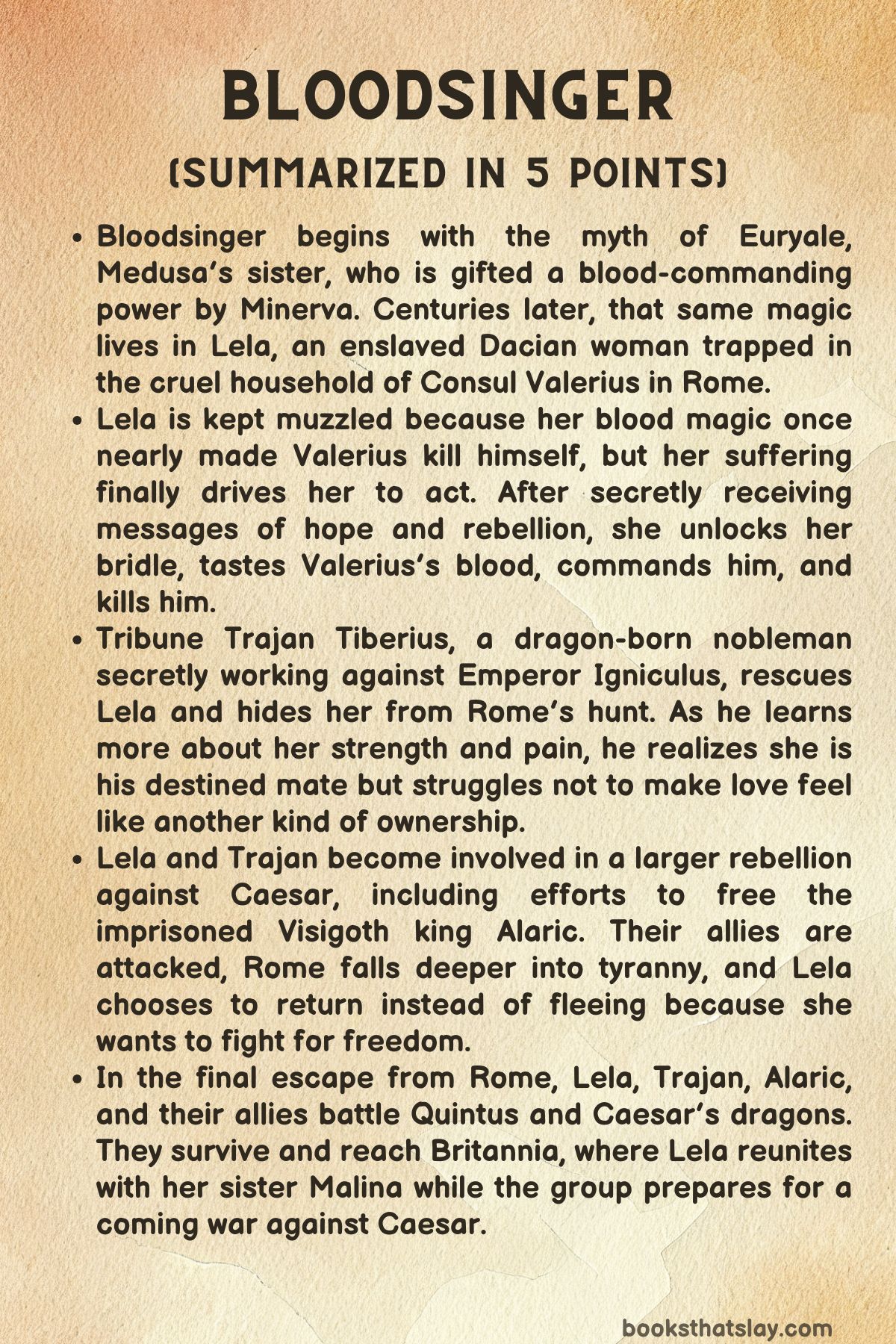
Characters
Bloodsinger presents its characters through a world shaped by slavery, dragon power, blood magic, rebellion, revenge, and chosen love. Each major figure reveals a different side of power: some use it to dominate, some use it to protect, some fear it, and some reclaim it after being broken by cruelty.
Lela
Lela is the emotional center of the book and one of its most powerful figures because her strength grows out of suffering rather than comfort. As a Dacian woman enslaved by Valerius, she begins the story trapped in a life where even her voice and body are controlled through the ornate bridles he forces her to wear.
Her blood magic makes her dangerous to men who abuse power, but the tragedy of her condition is that this gift does not initially free her; instead, it makes Valerius even more determined to cage and humiliate her. Lela’s self-harm in the temple of Diana shows the depth of her despair and the way she has been driven inward by captivity.
She is not presented as weak, but as someone who has been forced to survive unbearable conditions with very few choices.
Her killing of Valerius is a turning point because it is both an act of revenge and an act of self-reclamation. When she removes the bridle, tastes his blood, commands him, and kills him, she takes back the power he tried to make monstrous.
Lela’s magic is frightening, but the story frames it as a response to injustice rather than simple violence. Her power becomes a way of punishing those who enslave, torture, and destroy others.
Even after she escapes Rome, she does not choose safety alone. Her decision to return for Alaric proves that freedom, for her, cannot be complete if others remain trapped under Caesar’s cruelty.
Lela’s relationship with Trajan is also important because it forces her to learn the difference between possession and love. After living under Valerius’s ownership, she has every reason to fear control disguised as protection.
Trajan’s hesitation to claim her as his destined mate reflects his awareness of that wound, while Lela’s gradual trust in him shows her slow movement from survival into emotional freedom. By the end of the book, she is not simply rescued or healed by love.
She becomes a woman who chooses love, chooses war against tyranny, and chooses to use her terrifying gift in defense of the oppressed.
Trajan Tiberius
Trajan is one of the central heroic figures in the book, defined by a conflict between duty, rebellion, desire, and moral restraint. As a Roman tribune and dragon shifter, he belongs to the ruling world that has enslaved and brutalized people like Lela, yet he is deeply disgusted by Rome’s corruption.
His reaction to seeing Lela displayed like property immediately separates him from men such as Valerius and Quintus. He recognizes the horror of what has been done to her, and his anger is not only personal but political.
Trajan’s hatred of Caesar and his involvement in the conspiracy show that he wants more than private revenge; he wants to help create a different Rome.
His dragon nature gives him physical power, but his most important quality is his restraint. When he realizes Lela is his destined mate, he does not rush to claim her because he understands that claiming can resemble ownership if it is forced on someone who has been enslaved.
This makes him a thoughtful romantic lead rather than merely a protective warrior. He wants to shield Lela from danger, but he also has to learn that she is not someone to be hidden away from the fight.
His love becomes strongest when he respects her agency.
Trajan’s courage is shown repeatedly through action. He hides Lela, rescues her, helps free Alaric, battles other dragons, and risks his position for the rebellion.
Yet his character is not only built around combat. He represents the possibility that someone born inside a corrupt empire can reject its values.
His journey is about using inherited privilege and supernatural strength against the system that produced him. By the end, his bond with Lela strengthens both his personal purpose and his political mission.
Valerius
Valerius is one of the clearest embodiments of cruelty and ownership in the story. As Lela’s enslaver, he treats her not as a person but as a dangerous possession to be displayed, restrained, and humiliated.
The bridles he forces on her are especially symbolic because they represent his desire to silence her, control her, and turn her pain into spectacle. His fear of her blood magic does not lead him to recognize her humanity; instead, it makes him more vicious and controlling.
Valerius’s evil is not only personal but social. His parties and his public treatment of Lela reveal a Roman elite that is comfortable watching suffering as entertainment.
He survives through status, violence, and the protection of a corrupt political order. His death matters because it is not just the fall of one abusive man.
It creates a political opening and disrupts the network of power around Caesar. Through Valerius, the book shows how private abuse and public tyranny are connected.
His relationship with Lela is built on domination, but it also exposes his weakness. He is terrified of the very power he tries to suppress.
When Lela finally uses her blood magic against him, the reversal is complete: the man who forced obedience from others is compelled to kneel. His death is brutal, but it carries symbolic justice because he is destroyed by the woman he tried to reduce to an object.
Emperor Igniculus
Emperor Igniculus is the central tyrant behind the larger conflict. While Valerius represents private ownership and cruelty, Igniculus represents institutional oppression on a national scale.
He rules through fear, spectacle, violence, and political manipulation. His plan to execute Alaric after Lupercalia shows his need to turn punishment into public theater, using death as a warning to enemies and subjects alike.
Igniculus’s murder of Consul Kato and dissolution of the senate reveal the full extent of his authoritarian ambition. He does not simply want influence over Rome; he wants absolute rule.
His actions push the empire from corruption into open tyranny. This makes him the force that unites many of the rebel characters, including Trajan, his grandfather, Lela, Fausta, and those trying to help enslaved people escape.
As a character, Igniculus is less emotionally intimate than Valerius, but his presence shapes the entire book. He is the reason rebellion becomes necessary rather than optional.
His fear of the “bloodsinger” also shows that oppressive systems are often terrified of those they cannot fully control. Lela’s existence threatens him because her magic can break the chain of command on which tyranny depends.
Euryale
Euryale serves as the mythic foundation of the story. As Medusa’s sister and the first figure associated with the blood-commanding gift, she connects Lela’s power to an ancient line of female vengeance and divine intervention.
Her gift from Minerva gives her the ability to command a man after tasting his blood, and she uses it to destroy a cruel king and liberate an enslaved village. This opening myth frames blood magic not as evil in itself, but as a weapon against male brutality and unjust rule.
Her role is important because she gives historical and symbolic weight to Lela’s abilities. Lela is not an isolated monster or accident; she is part of a larger legacy of women who punish cruelty and free the oppressed.
Euryale’s actions also establish one of the book’s central moral questions: when violence is used against tyrants, can it become justice? The story’s answer, through Euryale and later Lela, suggests that power becomes righteous when it is used to break chains rather than create them.
Euryale also broadens the book’s world by linking Roman politics to older myth. Her presence makes Lela’s journey feel fated, not in a way that removes Lela’s choice, but in a way that gives her suffering and strength a mythic echo.
She stands at the beginning as a model of wrath turned toward liberation.
Minerva
Minerva functions as the divine source of Euryale’s blood magic and therefore indirectly shapes the entire story. By giving Euryale the power to command men through blood, she introduces a form of justice that bypasses ordinary political authority.
This is significant because the human systems in the book, especially Rome’s imperial structure, are shown to be corrupt and violent. Divine power enters where law has failed.
Minerva’s gift is not gentle, but it is purposeful. It gives a wronged woman the means to confront a cruel king and free enslaved people.
In that sense, Minerva represents wisdom joined with retribution. Her role suggests that justice sometimes requires a force strong enough to terrify the powerful.
She is not developed as a personal character in the same way as Lela or Trajan, but her decision creates the magical and moral framework of the story.
Consul Valerius’s Cruel King Parallel
The unnamed cruel king in Euryale’s myth acts as an early mirror for later tyrants such as Valerius, Quintus, and Igniculus. Though he appears only in the mythic beginning, his role is important because he establishes the pattern of powerful men enslaving villages and abusing authority.
His destruction by Euryale foreshadows the fate of men who believe their rank protects them from justice.
He is less a psychologically complex character and more a symbolic figure of ancient tyranny. His presence shows that the violence of Rome is not new; oppression has existed for centuries, and so has resistance.
By placing him at the beginning, the story makes Lela’s later revenge part of a repeating struggle between domination and liberation.
Quintus
Quintus is one of the most hateful antagonistic figures because his violence is tied directly to Lela’s past. He is not just another brutal Roman ally of Valerius; he is the man who destroyed Lela’s village.
That history makes him a living reminder of everything Lela lost before her enslavement. His pursuit of power after Valerius’s death and his loyalty to Caesar’s violent order reveal him as someone who thrives in systems built on conquest and cruelty.
His attack during the escape from Rome turns the political conflict into a deeply personal confrontation. When he recognizes Lela, the past catches up with the present.
Lela’s use of strengthened blood magic against him is one of the most significant acts of revenge in the story. By drawing his blood from his body before Trajan kills him, she does not merely survive him; she helps destroy the man who helped shatter her former life.
Quintus also acts as a contrast to Trajan. Both are powerful dragon figures connected to Rome, but they represent opposite moral paths.
Quintus uses strength to dominate, while Trajan uses strength to protect and rebel. Through Quintus, the book shows what dragon power becomes when it serves empire, pride, and cruelty.
Euphemia
Euphemia is a medicine woman, secret rebel ally, and spiritual guide figure in the story. When Lela comes to her seeking poison, Euphemia refuses to help her die, which makes her role both compassionate and challenging.
She recognizes Lela’s suffering, but she also sees that Lela’s story is not finished. Her prophecy of journey, death, and freedom gives Lela’s future a sense of mystery and destiny.
Euphemia’s importance lies in her ability to see beyond immediate despair. She does not rescue Lela physically, but she helps interrupt Lela’s movement toward self-destruction.
Her refusal is an act of faith in Lela’s survival. As someone connected to medicine and rebellion, she represents healing that is not passive.
She belongs to the underground world of people quietly resisting Rome’s violence.
Her presence also strengthens the book’s theme that freedom is built by networks of courage, not by one hero alone. Euphemia is not a warrior in the same way Trajan or Alaric is, but her resistance matters.
She keeps hope alive when Lela cannot yet see it for herself.
Fausta
Fausta is one of the most courageous supporting characters, and her role as a noblewoman-smuggler makes her especially interesting. On the surface, she appears to belong to Rome’s privileged class, but secretly she helps slaves and bastard-born dragons escape.
This double life makes her a character of hidden defiance. She uses her status not to protect herself alone but to undermine the system that benefits people like her.
Her secret message to Lela about justice, courage, and freedom shows that she understands Lela’s situation before many others do. Fausta does not merely pity the enslaved; she acts.
Her willingness to help Lela flee reveals both practical bravery and moral conviction. She is part of the same resistance as Trajan, but her work operates through smuggling, secrecy, and sacrifice.
Fausta’s death is one of the most painful events in the book because it shows the cost of resistance. Caesar’s forces kill her and burn her body, turning her into another victim of imperial terror.
Yet her death also intensifies Lela’s resolve. Fausta’s life and death prove that rebellion is dangerous, but also necessary.
She becomes a symbol of quiet heroism punished by a brutal state.
Alaric
Alaric, the imprisoned Visigoth king, is both a political prisoner and a powerful future ally. His captivity in Rome shows Caesar’s desire to display conquered enemies and turn them into symbols of imperial dominance.
Yet Alaric is never truly reduced by imprisonment. Even when confined, he carries the dignity and danger of a ruler whose people may become essential to the rebellion.
His meeting with Lela and Trajan is important because it expands the conflict beyond Rome’s internal politics. Freeing Alaric is not only an act of mercy; it is a strategic move in the coming war against Caesar.
He represents forces outside Rome that may help break the empire’s tyranny. His eventual revelation as a powerful golden dragon makes him even more significant, transforming him from captive king into a majestic and terrifying force of liberation.
Alaric’s interaction with Anya in the epilogue also suggests that his role will continue beyond the immediate story. He becomes connected not only to Trajan and Lela’s rebellion but also to Lela’s family.
His character combines royal authority, supernatural power, and restrained menace. He is dangerous, but his danger is aimed at the tyrannical world that imprisoned him.
Trajan’s Grandfather
Trajan’s grandfather is a major political figure because he represents the older Roman order that still has some sense of honor and responsibility. After Valerius’s death, he becomes consul instead of Quintus, creating an important shift in power.
His rise gives the rebellion a brief political advantage and shows that not every Roman authority figure is loyal to Caesar’s corruption.
He is also important because he connects Trajan’s private rebellion to a broader political movement. Trajan is not acting alone; his grandfather is part of the conspiracy against Igniculus.
This gives the resistance legitimacy and structure. He understands the danger of Caesar’s ambition, especially after the murder of Kato and the dissolution of the senate, and he is forced into the dangerous position of surviving inside a collapsing political system.
On a personal level, he helps provide Trajan with family grounding. His escape with Trajan and Lela shows his willingness to risk status and safety for the cause.
By the end, his presence in Britannia suggests that the rebellion is becoming more organized and intergenerational. He stands for a Rome that might have been more honorable, even as the actual Rome falls deeper into tyranny.
Consul Kato
Consul Kato plays a brief but meaningful role because his murder marks a turning point in Caesar’s rule. He represents the remaining structure of Roman political authority, and when Igniculus kills him, the emperor symbolically destroys the limits placed on his own power.
Kato’s death is therefore less about his personal development and more about what his murder reveals.
Through Kato, the book shows that tyranny does not always begin with open chaos. It often begins with the removal of institutions, rivals, and voices that could restrain absolute rule.
His death makes Caesar’s intentions undeniable. The senate is dissolved, political balance collapses, and rebellion becomes even more urgent.
Malina
Malina is Lela’s sister and a vital figure in Lela’s emotional restoration. Her survival proves that Lela’s past has not been completely erased by slavery, violence, and separation.
When Lela reunites with her in Britannia, the moment gives Lela something that revenge alone cannot provide: family, memory, and belonging. Malina represents the life Lela thought she had lost forever.
Her escape from their village years earlier with Julian also gives her a parallel survival story. Like Lela, she has endured the consequences of Roman violence, though in a different way.
Her presence in Britannia helps turn that refuge into more than a hiding place. It becomes a space where broken family bonds can begin to heal.
Malina’s role also deepens Lela’s motivation. Lela is not fighting only for abstract justice; she is fighting for people like her sisters, her lost village, and everyone torn apart by empire.
Malina’s survival gives emotional weight to the future Lela wants to protect.
Julian
Julian is Trajan’s former general, ally, and the man who helped Malina escape. His character connects the military world of Rome to the refuge in Britannia.
As someone tied to Trajan’s past, he helps show that Trajan’s resistance did not appear suddenly. There are older loyalties, alliances, and acts of defiance beneath the surface of the story.
His protection of Malina suggests courage and compassion, especially because helping someone escape Roman violence would have carried serious danger. Julian’s role is quieter than Trajan’s or Alaric’s, but he is part of the network of people who make survival possible.
Like Euphemia and Fausta, he shows that rebellion depends on those who shelter, guide, and protect others away from public view.
Julian also helps make Britannia feel like a meaningful counterpoint to Rome. In Rome, power is associated with spectacle, control, and fear.
Around Julian, Malina, and Trajan’s family, power begins to look more like loyalty, refuge, and preparation for a just war.
Anya
Anya appears most strongly in the epilogue, but her role is important because she extends the story beyond Lela and Trajan’s immediate escape. As another of Lela’s sisters, she continues the family thread that runs through Lela’s emotional journey.
Her discovery that Lela is alive and bonded to Trajan gives her hope and also connects her to the larger rebellion.
Her bargain to stay with Alaric’s fighters shows that she is bold, determined, and unwilling to remain passive. She does not simply wait to be reunited with Lela.
Instead, she places herself near power, danger, and future action. This makes her feel like a character with her own unfolding path rather than merely a surviving relative.
Anya also helps prepare the reader for the next stage of conflict. Through her, the world of the story expands again, linking Lela’s family to Alaric’s forces.
Her presence suggests that the sisters may all have roles to play in the coming struggle against Caesar.
Diana
Diana functions less as an active character and more as a sacred presence connected to Lela’s suffering and need for refuge. The temple of Diana inside Valerius’s house becomes one of the few places where Lela can withdraw from public humiliation.
It is there that Trajan sees the depth of her pain and witnesses signs of her magic. This makes Diana’s temple a place of exposure, vulnerability, and hidden truth.
Because Diana is associated with women, wilderness, protection, and independence, her presence matters symbolically. Lela is trapped inside a house of ownership, but the temple offers a spiritual contrast to Valerius’s control.
Even though Diana does not intervene directly, the sacred space around her helps frame Lela as more than an enslaved woman. It places her suffering within a larger world of divine feminine power and survival.
Themes
Freedom and Self-Ownership
In Bloodsinger, freedom is not treated as a distant dream but as a right that has been violently stolen. Lela’s body, voice, movement, and choices are controlled by Valerius, and the ornate bridle becomes a strong symbol of slavery disguised as luxury.
Her magic gives her power, but it does not immediately give her freedom, because fear, trauma, and Roman law still trap her. The story shows that true freedom is not only escape from chains; it is the recovery of personal will.
Lela’s decision to kill Valerius is not presented as simple revenge, but as the first moment when she refuses to remain an object owned by another person. Trajan’s role strengthens this theme because he recognizes that rescuing Lela is not enough if he replaces one form of control with another.
His fear of claiming her as a mate shows the story’s concern with consent and agency. Freedom becomes meaningful only when Lela can choose where to go, whom to love, and what cause to fight for.
Power, Corruption, and Tyranny
Rome is shown as a society where power has been stripped of justice and turned into a tool for domination. Valerius uses his rank to own, humiliate, and display Lela, while Caesar uses fear, public punishment, political murder, and military force to silence resistance.
The corruption is not limited to one cruel man; it spreads through parties, palaces, prisons, laws, and the senate itself. This creates a world where cruelty is protected by status, and goodness must often survive in secret.
Trajan’s rebellion challenges the idea that authority deserves obedience simply because it holds power. His disgust toward Valerius and Caesar comes from understanding that Rome’s greatness has become rotten when it depends on slavery and terror.
Lela’s blood magic also complicates the theme because it gives her the ability to command others, yet she uses it against oppressors rather than for selfish rule. The story contrasts power used to enslave with power used to resist tyranny.
Trauma, Survival, and Healing
Lela’s suffering is not treated as something she can easily overcome once she is rescued. Her self-harm, fear, silence, and distrust reveal the lasting damage caused by captivity and abuse.
The story gives weight to the fact that survival often continues long after the immediate danger has passed. Lela’s healing does not happen through one romantic confession or one act of revenge.
It grows through safety, choice, connection, and the gradual return of hope. Trajan helps because he sees her pain without reducing her to it.
He does not treat her only as a victim or as a weapon; he gives her room to decide her own path. Her reunion with Malina also deepens this theme because healing is tied not only to love but to restored family and identity.
At the same time, Lela’s trauma becomes part of her strength without being glorified. She survives cruelty, but the story does not pretend that cruelty leaves no scars.
Love, Trust, and Chosen Loyalty
The relationship between Lela and Trajan develops through trust rather than possession, which is important in a story shaped by slavery and control. Trajan is physically powerful and politically important, but the emotional force of the romance depends on his restraint.
He protects Lela without demanding ownership of her life. This matters because Lela has already been treated as property, and any love that ignores her freedom would only repeat the violence she escaped.
Their bond grows through shared risk, honesty, and respect for each other’s choices. Lela’s decision to return to Rome shows that love does not make her passive or dependent; instead, it gives her a stronger ground from which to act.
Trajan’s loyalty to her also connects with his loyalty to a larger cause, because both are rooted in the belief that people should not be ruled by fear. Love becomes more than romance.
It becomes a form of trust that helps both characters choose courage over safety.