Blood Bound Summary, Characters and Themes | Ellis Hunter
Blood Bound by Ellis Hunter is a fantasy romance about two young women forced into a death match by an ancient magical contract, only to discover that the real enemy is the system that demands their sacrifice.
Astrid, a witch princess, has been raised to die for her kingdom, while Skylar, a street performer, is dragged into royal politics after learning she is Vatra’s true firstborn heir. Between dragons, forbidden magic, political lies, and a failing magical source, the story follows enemies who become allies, then something far more dangerous to the powers controlling them. It’s the 1st book of the Cursed Covenant series.
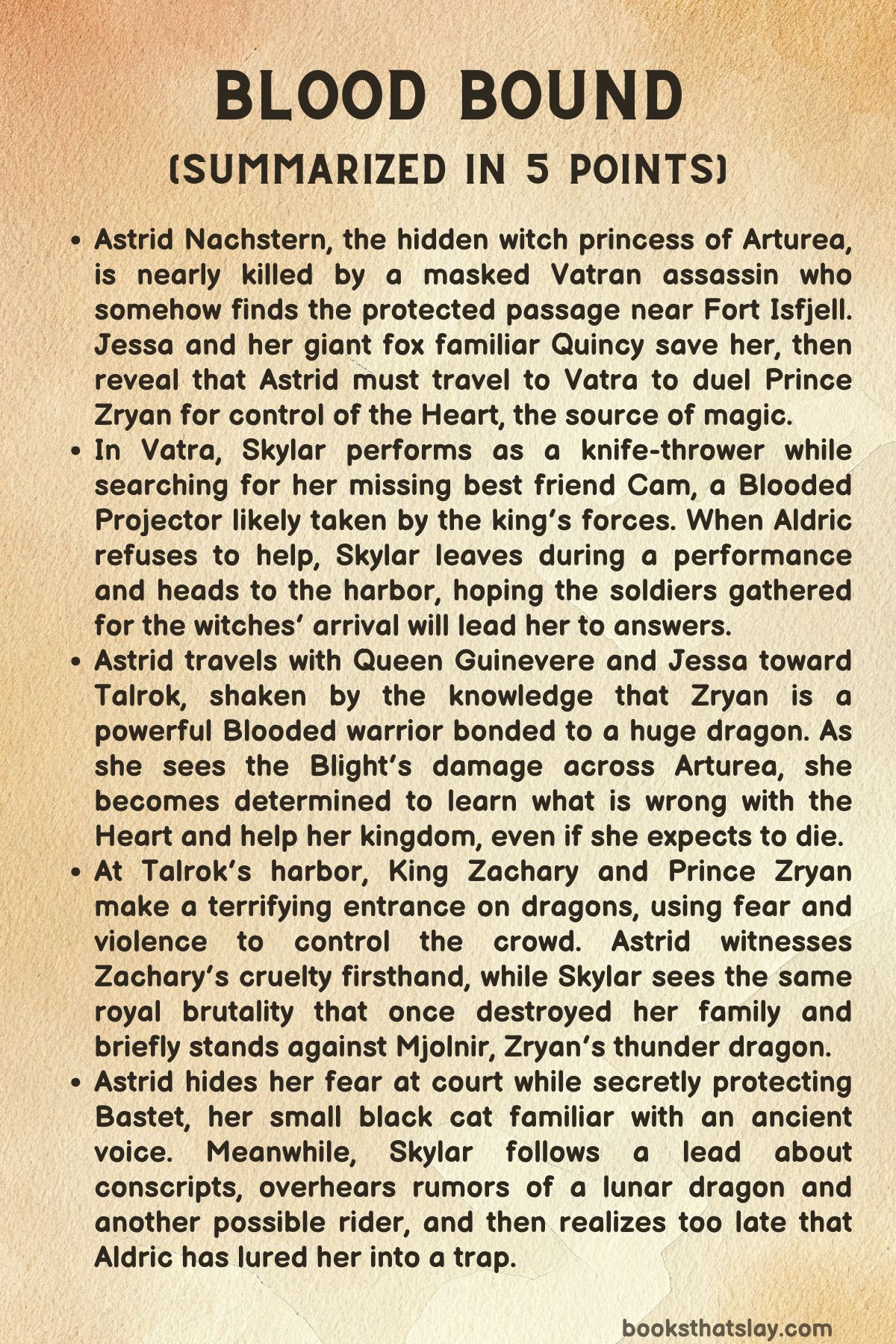
Summary
Astrid, the witch princess of Arturea, begins the story already marked by fear, duty, and near-certain death. While moving through the snowy forests near Fort Isfjell, she is ambushed by a Vatran assassin and nearly killed.
Her training is not enough to save her because she is injured, without her potion vials, and unable to battle-cast because of a deep magical block tied to past trauma. Jessa, her loyal guard and closest friend, arrives with her giant fox familiar, Quincy, and rescues her before the assassin can finish the job.
The attack proves that Vatra has discovered a hidden passage into Arturea, making Astrid’s journey even more urgent. She must travel to Talrok, the Stone City, for the Blood Binding and later the deadly duel required by the Covenant.
That Covenant forces Arturea’s heir and Vatra’s heir to fight to the death for guardianship of the Heart, the magical source that sustains both worlds. Astrid expects to die because her supposed opponent, Prince Zryan, is a powerful dragon rider, while she cannot reliably use the kind of magic needed to survive.
Far from Astrid’s royal world, Skylar lives as a dagger-throwing street performer in Talrok under the stage name Blade. She performs with Aldric’s troupe, but her real concern is her missing best friend, Cam.
Skylar fears Cam has been taken because he is Blooded, one of the magically gifted people hunted or conscripted by Vatra’s forces. When Aldric dismisses her fears and refuses to help, Skylar chooses to search for Cam herself, even if it means defying the troupe and walking straight into danger.
As Astrid arrives in Talrok, the city greets the witches with fear, hatred, and unrest. King Zachary and Prince Zryan arrive on dragons, displaying the monarchy’s terrifying control over the people.
The king’s brutality is made public when he uses his dragon and soldiers to punish rebels and citizens, while Queen Guinevere of Arturea responds to threats against Astrid with her own frightening power. Astrid sees Talrok as beautiful but deadly, a place where she may soon meet her end.
Skylar, meanwhile, witnesses the royal dragons and the monarchy’s violence from the crowd. The sight triggers memories of her mother’s murder by the Dreki and strengthens her hatred for Vatra’s rulers.
Her search for Cam leads her into a trap arranged by Aldric, who has sold her out. She is captured, drugged, and dragged into the palace, where her identity is revealed in front of the royal court.
Queen Guinevere presents Skylar as King Zachary’s firstborn child. The revelation changes everything because the Covenant requires the true Vatran heir to face Astrid.
Zachary denies Skylar and orders her killed, but Mjolnir, Zryan’s thunder dragon, destroys the guard sent to execute her. The ancient Covenant then confirms Skylar’s bloodline, naming her Vatra’s true firstborn heir and making her Astrid’s new opponent.
Skylar is trapped inside a destiny she never wanted. She does not care about a throne, the Covenant, or royal legitimacy; she wants Cam.
Still, the court makes clear that she has only two choices: fight Astrid or die. The Blood Binding ties Astrid and Skylar together so that neither can be assassinated before the duel without killing the other too.
Astrid first sees Skylar’s arrival as a terrible mercy. Skylar has no dragon, no royal training, and no preparation, which means Astrid may finally have a chance to live and save Arturea from the Blight.
Yet Astrid is disturbed by the cruelty of hoping an innocent girl dies in her place. Her duty to her kingdom clashes with her conscience almost immediately.
Both women begin investigating the truth behind their suffering. Astrid searches for information about the Heart and the Blight, only to find that important records have been removed or hidden.
Skylar tries to break into Zachary’s office to find information about Cam and the conscripts. Their separate goals lead them into an uneasy alliance, with Astrid offering magic and potions while Skylar offers stealth, climbing, and lock-picking skills.
At the same time, Skylar is trained for her role as heir. Zryan and Axel prepare her for a dragon trial on Isla Draka, where she may either bond a dragon or die.
Skylar’s strength, sarcasm, and survival instincts impress those around her, but she remains emotionally focused on Cam. She sees every royal lesson as another obstacle between her and the truth.
Astrid’s relationship with Zryan grows more complicated as she repeatedly encounters him during her investigations. He is dangerous, loyal to Vatra on the surface, and connected to the family threatening her people, but he also shows restraint, humor, and unexpected care.
Their attraction grows in secret, even though Astrid knows his sister has become her opponent and he has every reason to want Astrid dead. Zryan’s rare Teleportation magic and his bond with Mjolnir make him even more powerful than Astrid first imagined.
Skylar’s dragon trial takes a shocking turn when she strays into forbidden territory and is attacked by dragons guarding a hidden cave. Under the assault, a condemned power erupts from within her.
She is revealed to be an Exhauster, someone able to drain life and power from the world around her. In Vatran society, Exhausters are feared, hunted, and marked for death.
This revelation connects Skylar to her murdered mother and deepens her hatred for Zachary, who confirms his role in her mother’s death. But instead of killing Skylar, the monarchy keeps her alive because the duel still requires her.
Soon after, Skylar senses life inside a fossilized fire dragon egg in Arach’s Temple. Rather than drain it, she pushes energy into the wards holding it trapped.
The egg hatches, and Kaida, the last fire dragon, emerges for Skylar. This event transforms Skylar from unwanted bastard heir into a possible prophetic figure, though it also makes the coming duel even more dangerous for Astrid.
At a Masked Ball, both women move closer to truth and disaster. Skylar learns that the conscripted Blooded Champions are taken to the Heart, giving her the first real lead on Cam.
Astrid finds a brief moment of peace in a magical winter setting and shares an intimate encounter with Zryan. During that encounter, she learns that her Gift allows her to amplify other people’s magic, though doing so can endanger Bastet, her secret familiar.
The ball turns tragic when assassins attack. Jessa and Quincy are killed while protecting Astrid, and Astrid is devastated by the loss of the person who had been her closest companion and anchor.
Skylar saves Astrid during the attack by using her Exhauster power defensively. Astrid, in turn, realizes she can strengthen Skylar’s power through their strange connection.
After Jessa’s death, Astrid and Skylar’s alliance becomes more personal. They are no longer only enemies forced together by circumstance.
Skylar checks on Astrid, brings her tea, and quietly protects her, while Astrid begins to understand Skylar’s grief and courage more deeply. Yet the duel still approaches, and their growing trust makes the coming fight more unbearable.
Their investigation reveals that the Heart may not be what either kingdom claims. Astrid discovers clues suggesting Vatra is also suffering from the Blight and that Zachary has hidden the failure of his supposed solution.
Skylar asks Astrid to locate Cam using his ring. The spell points not to any place on the map but upward to the Stars, forcing Astrid to realize Cam is dead.
Cam’s death shatters Skylar. Her reason for enduring the palace, training, humiliation, and danger is gone, leaving only rage and a need for revenge.
Still, she continues helping Astrid. Together, they track carriages connected to the warrens and uncover a path that may lead to the hidden Heart.
The night before the duel, Skylar attends the Mourning Feast so Astrid does not have to face it alone. Their farewell is quiet and painful because both know one of them is expected to die the next day.
Astrid spends one last private night with Zryan, who admits that he chooses her, even though there is still no answer that saves both Astrid and Skylar under the Covenant.
In the duel cage, Skylar attacks with cold, frightening force, using her Exhauster power and shutting down her tenderness so she can survive. Astrid fights with potions, strategy, Bastet, and everything she has left.
Astrid eventually wins and stands over Skylar with the chance to kill her. Killing Skylar would save Arturea and fulfill everything expected of her, but she cannot do it.
Skylar, too, reveals that she never truly meant to kill Astrid. She pushed Astrid to win because she believed Astrid deserved to live.
When Astrid refuses the killing blow and returns Skylar’s hairpin, the Covenant reacts in a way no one expected. A mate mark appears, binding them together, and the cage breaks apart.
The ancient condition that only “two become one” can open the cage is fulfilled not by death, but by their bond. Both heirs survive, destroying the logic of the duel and enraging Zachary and Ottilie.
The court erupts into violence. Astrid finally casts the shield spell that failed her in the past, saving herself from fire and reclaiming the magic tied to her deepest trauma.
Skylar and Astrid fight together, their powers strengthening each other through the mate bond. Mjolnir arrives and reveals that Zryan has been arrested by his own parents.
Astrid explains that Zryan is the rebel leader working against Zachary from within. The group realizes he has been taken to the Heart, the place they have been trying to find all along.
Astrid, Skylar, Bastet, Kaida, and Mjolnir travel toward the hidden complex near Sarkan’s Pass and find Zryan chained and wounded. Their rescue becomes a trap set by Queen Ottilie.
Ottilie reveals that her true power is not Discernment but Nullification, allowing her to suppress others’ magic. Axel’s betrayal is also exposed, though his loyalty proves conflicted and painful.
The greatest revelation follows: there is no functioning Heart. The source that both kingdoms have fought over is gone or destroyed.
Vatra has been covering up the collapse by draining magic from Blooded Champions, including conscripts like Cam. The Blight in both lands is tied to this hidden failure.
Skylar’s mother’s hairpin is revealed to be a witch wand connected to older secrets about magic, the lost Heart, and the worlds beyond Vatra and Arturea. When Ottilie orders Axel to take it, Axel uses his emotional power on Skylar but then releases her control at the critical moment.
Skylar kills Axel with the wand to save the others. His death is both a betrayal’s consequence and a tragic sacrifice, because he cared for her even while helping the queen.
Mjolnir breaks into the chamber, Zryan joins the fight, and Ottilie flees on her solar dragon. During the aerial battle, a lunar dragon rider appears and captures Skylar, using a matching wand to open a tear in the sky.
Skylar is taken into another world. Through the mate bond, she sends Astrid two words: wand and unlock.
Astrid uses her unlocking spell with the wand and crosses into a lush moonlit jungle realm with Bastet. Skylar and Zryan are gone, the bond is weakened by static, and Bastet is injured.
As Astrid tries to steady herself, figures approach from every direction, killing plant life wherever they walk. She realizes they are Exhausters, dozens of them, and the book ends with Astrid stranded in another world, separated from Skylar and surrounded by the very power Vatra tried to erase.
Characters
Astrid
Astrid is the witch princess of Arturea, and her role in the book is shaped by fear, duty, intelligence, and a deep sense of responsibility. She begins as someone who believes her death is almost certain, not because she lacks courage, but because the systems around her have convinced her that sacrifice is her purpose.
Her inability to battle-cast after her father’s death gives her a constant sense of weakness, especially when she compares herself to dragon riders and warriors. Yet the book steadily proves that Astrid’s strength does not lie in brute force alone.
She is a brewer, a strategist, a reader, an investigator, and someone who survives by thinking under pressure. Her potions become an extension of her mind, allowing her to fight creatively even when traditional magic fails her.
In Blood Bound, Astrid’s emotional journey is as important as her political one. She moves from accepting death as destiny to questioning the entire structure that demands it.
Her grief over Jessa’s death is one of her defining moments because it strips away the illusion that sacrifice is noble when it is forced by cruel rulers and broken traditions. Jessa’s loss leaves Astrid shaken, but it also sharpens her refusal to let more people die for lies.
Astrid’s relationship with Skylar changes her moral understanding. At first, Skylar represents survival: an untrained opponent who might allow Astrid to live and save Arturea.
Over time, Skylar becomes a person Astrid respects, protects, and eventually cannot kill. That refusal is the moment Astrid truly breaks from the role assigned to her.
Her bond with Zryan also reveals her capacity to see beyond inherited hatred. She does not excuse Vatra’s violence, but she begins to recognize individuals trapped inside the same brutal order.
Astrid’s successful casting of Forsvare after the duel is a major turning point. The spell once represented trauma and failure, but when she finally casts it, she reclaims a part of herself that fear had locked away.
By the end, Astrid is no longer simply a princess trying to save her kingdom. She is a young woman prepared to challenge the history, magic, and political lies that shaped her world.
Skylar
Skylar is one of the most dynamic figures in the book, beginning as a street performer whose life is defined by survival, anger, and loyalty to Cam. She has no interest in crowns or ancient contracts, and that refusal makes her different from nearly everyone else pulled into royal politics.
Her identity is repeatedly taken from her and rewritten by others. She is first a performer called Blade, then a missing king’s daughter, then the true Vatran heir, then an Exhauster, then a fire dragon rider, and finally Astrid’s mate.
Across Blood Bound, Skylar resists each label because every revelation comes with a new form of control. Her rage is not childish rebellion; it is the logical response of someone whose mother was murdered, whose best friend was taken, and whose body is turned into a tool of the state.
Skylar’s loyalty to Cam gives her early story its emotional core. Everything she does, even when reckless, comes from the need to find him.
When she learns he is dead, the loss destroys the purpose that kept her moving. Her grief makes her more dangerous because it removes the one hope she had been protecting.
Her Exhauster power is central to her character because it embodies both fear and misunderstanding. Vatra treats that power as monstrous, yet Skylar repeatedly uses it to survive, protect, and expose the truth.
The hatching of Kaida is one of Skylar’s most important moments because it shows she is not only a destroyer. She can give life, free what has been trapped, and connect to ancient magic in ways the royal family cannot control.
Skylar’s bond with Astrid grows from necessity into trust. She begins by seeing Astrid as another royal figure in her way, but she gradually recognizes that Astrid is also trapped.
Her decision not to kill Astrid, and her earlier choice to save her, show that Skylar’s cruelty is often a mask. Beneath it is someone capable of fierce devotion, moral courage, and painful self-sacrifice.
By the end, Skylar stands as a threat to every false story Vatra has told. She is the heir they tried to erase, the power they tried to exterminate, and the person whose existence may unlock the truth behind worlds.
Zryan
Zryan first appears as the enemy Astrid fears most: a prince with a thunder dragon, royal training, deadly magic, and every reason to want her dead. He is introduced through power, intimidation, and distance, which makes Astrid’s terror of him understandable.
As the story develops, Zryan becomes far more complex than the role of rival prince allows. He is sharp, controlled, observant, and often amused by danger, but he is not blindly loyal to his parents.
His Teleportation marks him as extraordinarily powerful, but it also isolates him. The rarity of his ability sets him apart even within a royal family already defined by dragon bonds and magical dominance.
Zryan’s relationship with Astrid is built through tension, secrecy, and reluctant trust. He catches her in places she should not be, sees through many of her lies, and still chooses not to harm her when he could.
Their romance matters because it does not erase the political violence around them. Zryan loves Astrid while also knowing that saving her under the Covenant could mean losing Skylar.
That contradiction makes him both romantic and tragic. He wants to choose Astrid, protect Skylar, and fight his parents, but the world he was born into gives him no clean path.
The revelation that he is the rebel leader reframes his earlier behavior. His restraint, secret movements, and tension with the throne become signs of resistance rather than uncertainty.
Zryan is a character caught between inherited power and chosen rebellion. He knows the palace, understands its cruelty, and uses his position to work against it from within.
His bond with Mjolnir also reveals something important about him. The dragon’s loyalty is not merely a symbol of royal strength; it becomes evidence that Zryan’s true allegiance is more honorable than his family’s rule.
Jessa
Jessa is Astrid’s guard, best friend, protector, and emotional anchor. Her role in the book is built on loyalty, but it is not passive loyalty.
She scolds Astrid, challenges her, trains her, heals her, and refuses to let her drift too far into hopelessness. Jessa knows Astrid’s weaknesses and fears, yet she never treats her as useless.
Jessa’s relationship with Quincy, her giant fox familiar, also shows the depth of her steadiness and courage. Together, they represent safety for Astrid in a world that rarely allows her to feel safe.
Her personal history with the Blight gives her more than a professional reason to care about Arturea’s survival. She has lost family to the devastation, so her commitment to Astrid’s mission is tied to grief as well as duty.
Jessa’s death is one of the book’s most painful turning points because it removes the person who has protected Astrid most consistently. Unlike public sacrifices praised by kingdoms, her death feels senseless and cruel.
That senselessness is exactly why it matters. Through Jessa, the story shows the human cost of political games, magical contracts, and royal secrecy.
Even after her death, Jessa continues to shape Astrid’s choices. Astrid’s grief becomes part of her refusal to keep accepting systems that demand innocent lives.
Jessa is not simply a guard who dies to motivate the heroine. She is a full emotional presence whose love, anger, humor, and loyalty help define what Astrid is fighting to protect.
Bastet
Bastet is Astrid’s familiar, a tiny black cat with a grand personality, a sarcastic voice, and a deep bond with his witch. His small size contrasts sharply with his confidence, and that contrast gives him both comic energy and emotional weight.
Astrid hides Bastet for months because she fears he will be used against her or forced into the duel cage. That secrecy shows how much she loves him and how dangerous the Covenant is for anyone connected to an heir.
Bastet is not only a source of humor. He is Astrid’s magical partner, conscience, critic, and comfort.
He often objects to Astrid’s reckless plans, but his complaints come from love. He understands the cost of her choices, especially when her Gift risks drawing too much from him.
The discovery that Astrid can amplify magic also makes Bastet more vulnerable. Their bond is powerful, but it carries danger because her need to survive can accidentally harm him.
Bastet’s courage becomes especially clear after Jessa and Quincy die. He carries grief alongside Astrid and continues fighting even when exhausted and injured.
His presence keeps Astrid emotionally connected when she is close to breaking. He reminds the reader that familiar bonds are not accessories to magic; they are relationships built on trust, risk, and shared pain.
Queen Guinevere
Queen Guinevere is Astrid’s mother and the ruler of Arturea, and she is defined by desperation as much as authority. She loves Astrid, but her love is shaped by the impossible position of a queen trying to save a dying land.
Her harshness toward Astrid after the assassination attempt comes from fear. She sees her daughter’s recklessness not only as personal danger but as a threat to Arturea’s last chance of survival.
Guinevere is willing to expose Skylar and use her as a political solution because she believes there is no other way to save her people. This makes her morally complicated rather than simply cruel.
She understands that the Covenant is brutal, yet she still works within it when breaking it seems impossible. Her choices show how oppression can force even loving people into terrible calculations.
Guinevere’s use of nightmare magic and her willingness to punish enemies also reveal that Arturea is not innocent just because it is suffering. The book does not let her side remain pure.
As a mother, she wants Astrid alive. As a queen, she needs Arturea saved.
Those two desires usually align, but the cost falls on Skylar. That is where Guinevere’s character becomes most uncomfortable, because her love for one daughter-like figure depends on the death of another young woman.
King Zachary
King Zachary is the face of Vatran tyranny. He rules through fear, public violence, dragon power, and political denial.
His cruelty is displayed from his first major appearances, especially when he orders deaths in front of crowds and treats executions as demonstrations of control. To him, terror is a governing tool.
Zachary’s rejection of Skylar exposes both his cowardice and his obsession with legitimacy. He wants the benefits of royal bloodlines and ancient power, but only when they support the version of rule he prefers.
His involvement in the death of Skylar’s mother makes his villainy personal. For Skylar, he is not an abstract tyrant; he is the man behind the loss that shaped her entire life.
Zachary also represents the lie at the center of Vatra’s power. He denies the Blight, hides the collapse of the Heart, and allows Blooded people to be harvested while maintaining the image of royal strength.
His relationship with Zryan is also important because it helps explain Zryan’s rebellion. Zachary’s world leaves no room for conscience, and Zryan’s resistance becomes a rejection of his father’s entire model of kingship.
Zachary is dangerous because he believes power justifies itself. His downfall begins when the people he tried to control refuse to remain trapped in the roles he assigned them.
Queen Ottilie
Queen Ottilie is one of the book’s most chilling figures because her danger lies in concealment. For much of the story, she appears as a controlled royal presence whose full power is unclear.
The revelation that she is a Nullifier changes the reader’s understanding of her. She has hidden her true Gift from her family, court, and country, making deception central to her identity.
Ottilie’s ability to suppress other magic makes her terrifying in a world where power often determines survival. Against her, Astrid, Skylar, and Zryan are not only outmatched but temporarily stripped of the abilities that define them.
Her role in hiding the truth about the Heart makes her more than a personal villain. She is an architect of systemic violence.
Ottilie understands that the Heart is gone, that the magical system is failing, and that Blooded people are being consumed to keep a lie alive. Rather than reveal the truth, she protects the system that benefits her rule.
Her cruelty is cold, strategic, and almost amused. She does not need Zachary’s public brutality because her control works through secrets, traps, and suppression.
The fact that she waits for Astrid, Skylar, and Zryan at the hidden complex shows how far ahead she has been planning. Ottilie is dangerous because she knows the truth and chooses power anyway.
Axel
Axel is Skylar’s guard, trainer, possible love interest, and eventual betrayer. His character is built around tension between duty and feeling.
At first, he is harsh and controlling, responsible for keeping Skylar confined and preparing her for a life she never wanted. He represents the palace’s power over her body and choices.
Yet Axel also shows moments of genuine care. Returning Skylar’s mother’s hairpin is a significant act because he understands its emotional importance.
His emotional magic complicates every interaction he has. The ability to calm, influence, or dull another person’s feelings makes his care difficult to fully trust, especially for someone like Skylar, who already fears being controlled.
Axel’s betrayal at the Heart is painful because it does not erase the tenderness that came before it. He acts against Zryan and the others because of suspicion and loyalty to the throne, but he also seems unable to fully condemn Skylar.
His final moments are especially complex. By releasing Skylar’s emotions, he allows her to act freely, even though that choice leads to his death.
Axel dies as both betrayer and protector. That contradiction makes him tragic because he is not innocent, but he is not empty of love or remorse either.
Kaida
Kaida is the last fire dragon, and her hatching transforms Skylar’s place in the story. She begins as an impossible creature trapped inside what everyone believes is a fossilized egg.
Skylar’s decision to free rather than drain the life within the egg is crucial. It proves that her Exhauster power does not have to be only destructive.
Kaida’s bond with Skylar rewrites the meaning of both characters. Skylar, feared as a life-draining threat, becomes the person chosen by fire and new life.
Because Kaida is still young, she is not immediately a weapon in the way Mjolnir or Bruma are. Her importance is symbolic, emotional, and prophetic before it is military.
Her hunger, simple thoughts, and closeness to Skylar also soften the story’s heavier political stakes. Through Kaida, Skylar receives a form of trust that is not based on fear, bloodline, or usefulness.
Kaida represents a future the old rulers cannot understand. She is proof that what was thought dead can return, and that power can choose someone the monarchy tried to reject.
Mjolnir
Mjolnir is Zryan’s thunder dragon, but his significance extends beyond being a royal mount. From his first appearance, he is overwhelming, intelligent, and impossible to ignore.
He terrifies Astrid and Skylar alike, representing the power that makes Vatra seem unbeatable. Yet his behavior quickly becomes more complicated than simple obedience to the throne.
Mjolnir protects Skylar when Zachary orders her killed, suggesting that he recognizes her legitimacy or importance before the court fully understands it. That intervention saves her life and changes the course of the Covenant.
His bond with Zryan reveals deep loyalty, but not loyalty to Zachary’s rule. When Zryan is arrested, Mjolnir becomes the one who brings the truth to Skylar and Astrid.
Mjolnir’s arrival in the arena also shifts the surviving heirs from near defeat to action. He is not merely a force of destruction; he becomes a rescuer and guide.
As a dragon, Mjolnir carries ancient authority that human rulers cannot fully command. His choices challenge the monarchy’s claim that dragons belong neatly to royal power.
Cam
Cam is Skylar’s missing best friend and emotional foundation. Though he is absent for most of the book, his presence shapes nearly every major choice Skylar makes.
For Skylar, Cam is family. He represents the life she had before the palace, the troupe, and the revelation of her bloodline.
Her search for him keeps her grounded when royal politics tries to rename and reshape her. She endures training, captivity, and danger because she believes finding him is still possible.
Cam’s death is devastating because it removes the hope that has driven Skylar from the beginning. The locating spell’s answer forces her to face that the monarchy’s cruelty has already taken the person she most wanted to save.
His death also exposes the horror of the Champion system. Cam is not only a personal loss; he becomes evidence of the way Vatra consumes Blooded lives to maintain a lie.
Even after death, Cam continues to influence Skylar. His memory softens her, haunts her, and reminds her of who she was before rage became her armor.
Aldric
Aldric is the leader of the performance troupe and one of the earliest examples of betrayal in the book. He presents himself as a practical survivor, but his choices show greed, cowardice, and exploitation.
He controls the troupe’s image as an Illusionist, which fits his larger role as someone who hides truth behind performance. He treats Skylar’s talent as useful but not her fears as worthy of respect.
When Skylar worries about Cam, Aldric dismisses her because helping would endanger profit. His willingness to bring the troupe to Talrok despite the danger shows how little he values the people under his control.
His betrayal of Skylar is especially cruel because he uses her desperation against her. By selling her out, he helps deliver her into the royal machinery that will try to claim her life.
Aldric’s older hidden appearance hints at a longer history of manipulation. He is not the central villain, but he introduces a pattern that repeats across the story: powerful people treating Skylar as property to be traded.
Themes
Sacrifice Without Consent
The Covenant turns sacrifice into law, ritual, and public spectacle, but the book repeatedly questions whether sacrifice has any nobility when the people involved are denied real choice. Astrid is raised to believe her death may be necessary for Arturea, while Skylar is dragged into the same fate without warning, training, or consent.
Their duel is presented by rulers as ancient duty, yet it functions as a cage built to make young women pay for failures created by older powers. The Mourning Feast makes this cruelty especially clear because it beautifies death before it happens, asking the heirs to participate in their own erasure.
Jessa’s death deepens this theme because it cannot be dressed up as destiny. She dies protecting Astrid, but the loss feels wasteful rather than heroic, exposing the emotional fraud behind systems that glorify sacrifice.
By refusing to kill each other, Astrid and Skylar reject the idea that survival must require obedience to inherited violence. Their choice does not deny duty; it redefines it. True responsibility becomes the refusal to keep feeding innocent lives to a broken order.
Power, Fear, and Control
Power in Blood Bound is rarely neutral. Dragons, royal blood, Blooded magic, nightmare Gifts, Nullification, and Exhauster abilities all carry political meaning because the ruling class decides which powers are honored and which are condemned.
Vatra celebrates dragon riders and royal magic while hunting Exhausters and conscripting Blooded people for hidden use. That division is not based on morality; it is based on usefulness to the throne.
Skylar’s Exhauster power is feared as monstrous because it drains life, yet the monarchy secretly drains Blooded Champions to keep its false Heart system alive. The hypocrisy is severe: the state condemns in an individual what it practices on a massive scale.
Ottilie’s Nullification shows another form of control. Her power does not simply defeat others; it silences them at the source, stripping away the abilities they rely on to protect themselves.
Astrid’s amplifying Gift offers a contrast because it works through connection. It can be dangerous, but it also becomes a shared force when used with trust.
The book’s treatment of power asks who gets to name magic as sacred, useful, forbidden, or evil. Again and again, the answer is political rather than ethical.
Love as Defiance
Love in the story is not limited to romance; it appears as friendship, familiar bonds, chosen family, grief, loyalty, and protection. These bonds become dangerous because they interfere with the roles the Covenant and the monarchy demand.
Astrid is supposed to see Skylar as an obstacle to Arturea’s survival, while Skylar is supposed to see Astrid as the royal enemy standing between her and life. Instead, they begin protecting each other, grieving together, and recognizing the shared cruelty of their situation.
Their mate bond matters because it turns the Covenant’s logic against itself. The cage was built for death, but it opens when they choose unity over murder.
Zryan’s love for Astrid is also defiant because it grows across enemy lines and against his family’s political interests. His role as rebel leader confirms that love and loyalty can push a person to reject inherited power.
Jessa’s devotion to Astrid, Bastet’s bond with Astrid, and Skylar’s loyalty to Cam all show that love gives characters reasons to resist control. It does not make them safe, but it makes obedience impossible.
In this world, caring for someone becomes a political act when the ruling system depends on isolation, fear, and forced violence.
Buried Truth and Broken History
The search for the Heart becomes a search through lies. At first, the Heart appears to be a sacred magical source worth fighting and dying for, but every missing record, hidden route, and guarded secret suggests that the official story is incomplete.
Astrid’s research matters because knowledge itself has been controlled. The absence of books is as revealing as the information she finds.
Vatra’s rulers maintain power by hiding the collapse of the Heart and pretending the system still functions. The Blight spreading through both lands proves that denial has consequences beyond politics; it damages bodies, farms, homes, ecosystems, and futures.
The revelation that Blooded Champions are being drained exposes how false history becomes active violence. People are not only lied to; they are consumed to keep the lie alive.
Skylar’s wand, her mother’s hidden identity, the lunar dragon rider, and the other world of Exhausters suggest that the history taught by Vatra and Arturea is only a controlled fragment of something much larger.
The ending expands the theme by moving Astrid into a world filled with the very people Vatra tried to erase. What was buried is not gone. It has been waiting beyond the borders of the story’s known world.