Big Girl Blitz Summary, Characters and Themes
Big Girl Blitz by Danielle Allen is a contemporary romance about Jazmyn Payne, a divorced English teacher returning to a hometown that never felt safe to her. Haunted by childhood bullying and still learning how to take up space without apology, Jazz arrives in Chance, Virginia, expecting a summer with her beloved Aunt Addy.
Instead, she faces illness, grief, unexpected desire, and the challenge of being seen publicly. Through Jazz’s bond with Addy and her growing relationship with football player Lamar Anderson, Big Girl Blitz becomes a story about confidence, loss, pleasure, love, and choosing a larger life. It’s the 3rd book of the Curve series.
Summary
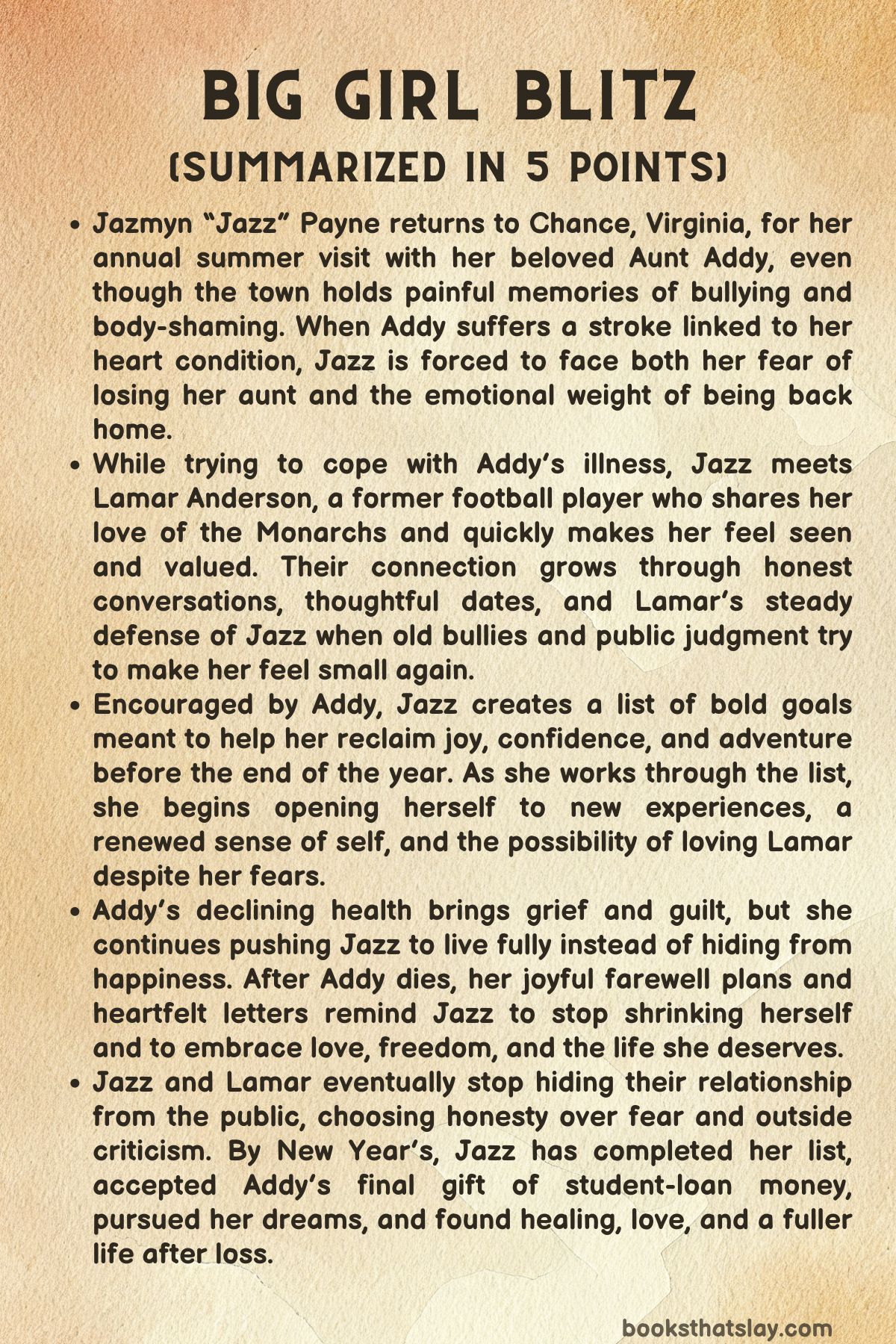
Jazmyn Payne returns to Chance, Virginia, for what is supposed to be her usual summer visit with her aunt, Addison Payne, known to everyone close to her as Addy. Jazz is an English teacher from Maryland, divorced from her ex-husband Tyson, and still cautious about romance, sex, and trust.
She loves Addy deeply, but she does not love Chance. The town carries painful memories for her.
As a fat girl growing up there, she was teased, judged, and made to feel like her body invited cruelty. Even as an adult, she arrives expecting old wounds to reopen.
On the drive, Jazz talks to her best friends Aaliyah and Nina, who know her history and tease her about the long dry spell she has had since her marriage ended. Their conversation is funny and familiar, but Jazz’s mood changes when she receives a call from Monica, Addy’s nurse.
Addy has suffered a stroke connected to her congestive heart failure and has been moved to a rehabilitation center. The news terrifies Jazz.
Her aunt has always been her refuge, the one person in Chance who made her feel loved without condition.
When Jazz sees Addy, she is shaken by how weak her aunt looks. Addy, however, refuses to let illness turn her into someone joyless.
She demands earrings, lipstick, flowers, family photos, and personal touches for her room. She wants the rehabilitation center to feel less cold and more like a place where she can still be herself.
Jazz tries to stay upbeat for Addy, but fear weighs on her. She is not ready to imagine life without the woman who gave her so much safety and confidence.
One evening, overwhelmed by worry, Jazz goes to a sports bar to distract herself. There she meets Lamar Anderson, a handsome former football player with a warm manner and an easy confidence.
They bond over the Monarchs, a football team they both love, and their conversation quickly grows beyond sports. They talk about food, books, ambitions, and life.
For the first time in a long while, Jazz feels relaxed with a man.
The night is nearly ruined when Olivia and Morgan, two women who bullied Jazz when they were younger, show up and call her by the cruel nickname “Jummy.” Jazz leaves the table in embarrassment, but she refuses to let them take the entire night from her. She returns and sees Lamar reject the women’s attention.
Later, when they insult Jazz again in the parking lot, Lamar defends her. His support matters, not because Jazz needs saving, but because he sees the insult clearly and refuses to excuse it.
He asks to see her again, and Jazz is surprised by how much she wants to say yes.
Addy encourages Jazz to stop hiding from life. With her aunt’s push, Jazz begins a list of things she wants to do before the end of the year.
The list includes exploring a new city, dyeing her hair, getting a belly piercing, getting a tattoo, attending a Monarchs game, writing her book, learning to swim, going vegetarian for a month, paying off her student loans, and dating again. It is not just a list of activities.
It becomes a promise that Jazz will stop postponing joy.
Lamar becomes part of that promise. He takes Jazz around Spring Hill and introduces her to places that help her see the area differently.
He buys her a meaningful book, and she learns about his plans for life beyond playing football. Lamar has a business idea focused on helping young professional football players manage their careers, contracts, finances, and public images.
Jazz listens closely and gives him thoughtful feedback. Their connection grows through honest conversation, shared humor, and mutual respect.
Their attraction becomes harder to ignore. On another date, they visit a botanical garden, where their chemistry leads to a passionate encounter.
Jazz then meets Lamar’s mother, a moment that signals Lamar is not treating her like a temporary distraction. Still, Jazz is nervous.
She has been hurt before, and she is also dealing with Addy’s worsening health. Wanting Lamar while Addy is dying fills her with guilt, as though desire and grief cannot exist together.
Addy refuses to let Jazz think that way. She urges her niece to live fully, even in sadness, and to understand that joy is not a betrayal.
As the summer continues, Jazz decides to stay and help care for Addy. The two women spend meaningful time together, completing parts of their lists and making room for laughter even as Addy’s body weakens.
Addy gets a tattoo and makes social plans, insisting on choice, beauty, and humor until the end. Through Addy, Jazz sees what it means to claim life without waiting for perfect circumstances.
Meanwhile, Lamar’s football career changes. He is activated from the Monarchs’ practice squad and begins to stand out as a defensive player.
His nickname, “Hollywood,” starts to fit his rising fame. The more attention he receives, the more complicated his relationship with Jazz becomes.
Photos and rumors about them appear online. Strangers make cruel comments about Jazz’s body and compare her to Milan, Lamar’s glamorous ex.
Jazz hates being judged by people who do not know her. She also fears that public criticism of their relationship could hurt Lamar’s career.
Because of that fear, Jazz asks Lamar to say publicly that they are only friends. The request hurts because both of them know it is not true.
Their relationship has become intimate, emotional, and serious. Lamar wants to claim her openly, but Jazz is still learning how to stand firm under public attention.
The old shame from Chance mixes with the new pressure of the internet, and she struggles to believe that love can survive being watched.
Addy’s death changes everything. She dies at home surrounded by people who love her.
The loss devastates Jazz, but Addy leaves behind instructions that reflect exactly who she was. She does not want a gloomy funeral.
She wants a joyful farewell party. She also leaves letters that challenge Jazz to stop making herself smaller for other people’s comfort.
Addy’s final guidance is clear: Jazz must choose love, freedom, pleasure, and happiness, even while grieving.
Jazz mourns deeply, supported by Lamar, Aaliyah, and Nina. Their presence helps her move through the early pain of losing Addy.
After the memorial, Milan tries to create the impression that she and Lamar still have a possible future. Lamar shuts that down and makes it clear that Jazz is the woman he wants.
His choice matters because he refuses to let public assumptions, his ex, or the expectations around his fame decide his life.
Jazz then attends a Monarchs game, completing one of the most important items on her list. She carries Addy with her in a literal and emotional way, scattering some of her ashes on the field.
Lamar plays brilliantly, and Jazz watches with pride. The moment brings together love, grief, football, memory, and release.
Jazz is no longer only the girl who was mocked in Chance or the divorced woman afraid to start again. She is someone actively choosing her own life.
After that, Jazz and Lamar stop hiding. They post their relationship publicly and tell each other they love one another.
Jazz still has grief to carry, but she is no longer letting pain define the size of her future. Lamar’s love does not erase her insecurities, yet it supports the confidence Addy always wanted her to have.
He sees Jazz clearly, desires her openly, and respects the mind and heart that make her who she is.
By New Year’s, Jazz has completed her list. She has tried new things, pursued her book, changed her look, opened herself to adventure, and loved Lamar without pretending they are less than they are.
She continues to mourn Addy, but she also lives in a way that honors her aunt’s lessons. Addy’s final letter brings one more gift: she left Jazz money to pay off her student loans, freeing her from a burden that had followed her for years.
The story ends on New Year’s Eve with Jazz surrounded by Lamar, Aaliyah, Nina, and their partners. She has lost the person who made Chance bearable, but she has also gained a stronger sense of herself.
Big Girl Blitz closes with Jazz grateful for the love she has found, the healing she has begun, and the fuller life she now has the courage to keep choosing.
Characters
In Big Girl Blitz by Danielle Allen, the characters are shaped by love, grief, body image, healing, friendship, and the courage to live more openly. The book uses its characters to show how past wounds can follow a person into adulthood, but also how support, romance, and self-acceptance can help someone rebuild a fuller life.
Jazmyn “Jazz” Payne
Jazmyn Payne is the emotional center of Big Girl Blitz, and her journey is rooted in pain, self-protection, and gradual transformation. As a divorced English teacher from Maryland, Jazz begins the book carrying the weight of several past hurts: the bullying she endured as a fat girl in Chance, the emotional damage left by her failed marriage to Tyson, and her fear of being judged whenever she returns to the town that once made her feel small.
Her hatred of Chance is not simply dislike for a place; it is connected to humiliation, rejection, and the feeling that people still see her through the cruel lens of her childhood. This makes her a deeply vulnerable character, even when she tries to appear composed and independent.
Jazz’s relationship with Aunt Addy reveals her softer and more dependent side. Addy is her safe place, and when Addy becomes seriously ill, Jazz is forced to confront the possibility of losing the person who has always made her feel loved without condition.
Jazz’s grief begins before Addy’s death because she watches Addy weaken and understands that their time together is limited. At the same time, Jazz feels guilty for wanting happiness, romance, and pleasure while Addy is dying.
This guilt shows how deeply loyal she is, but it also reveals one of her main internal conflicts: she often believes that loving herself or choosing joy might somehow betray the people she loves.
Jazz’s romance with Lamar becomes a major part of her healing because he sees her with admiration rather than judgment. Through Lamar, Jazz begins to experience desire, attention, and emotional safety after a long period of avoiding sex and dating.
However, she is not instantly confident. When public attention and online cruelty begin to target her, Jazz’s old wounds return.
The comparisons to Milan and the insults about her appearance make her fear that being with Lamar could hurt his image or career. Her request for Lamar to say they are just friends shows how deeply she has internalized the belief that she is a problem to be hidden rather than a woman worthy of being claimed openly.
By the end of the story, Jazz becomes more willing to live the way Addy wanted her to live. Completing her list is not just about doing activities; it symbolizes her decision to stop postponing her own happiness.
She embraces love, pursues her book, tries new experiences, and allows herself to grieve without giving up on life. Jazz’s development is powerful because she does not magically stop hurting.
Instead, she learns to carry grief, insecurity, love, and hope at the same time. Her growth comes from accepting that she does not have to shrink herself to be loved.
Aunt Addison “Addy” Payne
Aunt Addy is one of the warmest and most influential figures in the book. She is Jazz’s emotional anchor, the person who gives her unconditional love and a sense of belonging when Chance feels hostile and judgmental.
Even after suffering a stroke connected to congestive heart failure, Addy remains funny, stubborn, stylish, and full of personality. Her insistence on earrings, lipstick, flowers, and family photos shows that she refuses to let illness erase her identity.
She wants her rehabilitation room to feel like home because she is determined to preserve dignity, beauty, and joy even while her body is failing.
Addy’s role goes beyond comfort. She is also a guide who pushes Jazz toward life.
She understands that Jazz has been surviving rather than fully living, and she encourages her niece to create a list of bold, joyful, and freeing experiences. Addy does not want Jazz to let fear, shame, or grief control her future.
Her advice is especially meaningful because Addy herself is close to death, yet she remains focused on helping Jazz live more fully. This gives Addy a life-affirming presence in the story; she is dying, but she becomes one of the strongest forces of renewal.
Addy’s own list and her desire to complete meaningful experiences show that she is not simply a symbol of illness or loss. She still wants fun, connection, beauty, and excitement.
Her tattoo and social plans reveal a playful, courageous spirit. She teaches Jazz that age, illness, and grief do not cancel a person’s right to pleasure and self-expression.
Addy’s farewell instructions also reflect this same philosophy. By planning a joyful celebration instead of a traditional sad funeral, she makes her final act one of love and emotional direction.
Even after her death, Addy continues shaping Jazz’s choices through her letters and the financial gift that helps pay off Jazz’s student loans. Her love is practical, emotional, and spiritual.
She gives Jazz permission to stop hiding, to accept love, and to build a future without feeling guilty. Addy is the heart of the book’s message about living boldly before time runs out.
Lamar Anderson
Lamar Anderson is a romantic lead whose strength comes not only from his physical presence as a former football player and rising professional athlete, but also from his emotional attentiveness. When he first meets Jazz at the sports bar, he connects with her through shared interests rather than superficial charm.
Their conversations about football, food, books, and life show that he values her mind and personality. This matters because Jazz is used to being reduced to her body by people who mocked her, judged her, or underestimated her.
Lamar’s behavior toward Olivia and Morgan helps establish his integrity. He rejects their attention and defends Jazz when they insult her, making it clear that he is not interested in public approval at Jazz’s expense.
His attraction to Jazz is direct and respectful, and he does not treat her as someone he needs to hide. This becomes especially important later, when Jazz fears that being publicly connected to him will damage his image.
Lamar’s willingness to claim her openly shows that his love is not dependent on outside validation.
Lamar is also ambitious and thoughtful. His business plan for helping young football players manage careers, contracts, and money reveals that he thinks beyond athletic fame.
He understands the instability of sports careers and wants to build something meaningful from his experience. Jazz’s feedback on his plan strengthens their bond because their relationship is not only romantic or physical; it is also intellectual and supportive.
They help each other imagine better futures.
As Lamar becomes activated from the Monarchs’ practice squad and gains attention as “Hollywood,” he enters a world of fame, rumors, and public scrutiny. This creates pressure in his relationship with Jazz, especially when online comments and Milan’s presence threaten Jazz’s confidence.
Lamar’s most important quality in this part of the book is consistency. He does not allow public attention to make him ashamed of Jazz.
Instead, he stands firm, rejects false narratives about Milan, and chooses emotional honesty. Lamar represents the kind of love that helps Jazz see herself differently: not as someone lucky to be chosen, but as someone fully deserving of devotion.
Aaliyah
Aaliyah is one of Jazz’s closest friends and part of the support system that helps Jazz survive grief, insecurity, and transition. From the beginning, Aaliyah is included in Jazz’s conversations about dating, sex, and life after divorce, which shows that their friendship is intimate and honest.
Jazz can discuss her fears and frustrations with Aaliyah because their bond allows vulnerability without judgment.
Aaliyah’s importance lies in her steadiness. She is not the central force of transformation in the same way Addy is, but she helps create the emotional safety Jazz needs.
When Jazz is dealing with Addy’s illness and later Addy’s death, Aaliyah remains present. Her support reminds the reader that healing does not happen through romance alone.
Friendship is also essential to Jazz’s ability to keep going.
Aaliyah also represents the life Jazz has outside Chance and outside her childhood trauma. While Chance makes Jazz feel judged and trapped in an old version of herself, Aaliyah belongs to the adult world where Jazz is known more fully.
This contrast matters because Aaliyah helps Jazz remember that she is not only the bullied girl from the past. She is also a friend, a teacher, a woman rebuilding her confidence, and someone worthy of joy.
Nina
Nina, like Aaliyah, is part of Jazz’s trusted circle. She helps show that Jazz has friendships built on honesty, humor, and emotional closeness.
Nina’s presence in conversations about Jazz’s romantic and sexual life suggests that she is someone Jazz trusts with personal subjects. This kind of friendship gives Jazz room to admit loneliness, hesitation, and desire without feeling ashamed.
Nina’s role becomes especially important during Jazz’s grief. After Addy dies, Nina helps support Jazz along with Aaliyah and Lamar.
Her presence reinforces the book’s larger idea that loss should not isolate a person completely. Jazz’s grief is deep, but she is not abandoned in it.
Nina helps create a community around Jazz at a time when she could easily retreat into pain.
Nina also contributes to the ending’s sense of chosen family and renewal. By New Year’s Eve, Jazz is surrounded by Lamar, Aaliyah, Nina, and their partners.
Nina’s presence in that final stage of the story shows that Jazz’s fuller life includes more than romantic love. It includes friendship, celebration, and people who remain with her as she continues grieving and growing.
Aunt Addy’s Loved Ones
The loved ones who gather around Addy near the end of her life help create a sense of community, care, and emotional closure. Their presence at Addy’s home when she dies shows that Addy is not alone and that her life has touched many people.
Although they are not developed as deeply as Jazz, Addy, or Lamar, they serve an important purpose by surrounding Addy with warmth and dignity in her final moments.
These characters also help emphasize the kind of legacy Addy leaves behind. She is loved not only by Jazz but by a wider circle of people who respect her spirit.
Their involvement in her farewell makes her death feel communal rather than isolated. Addy’s joyful memorial instructions also depend on this community, because she wants the people who love her to celebrate her life instead of only mourning her absence.
Tyson
Tyson is Jazz’s ex-husband, and even though he is not physically central in the main events, his influence is important because he represents part of Jazz’s emotional past. Jazz’s divorce from Tyson has contributed to her long break from dating and sex.
This suggests that the marriage left her wounded, cautious, or disconnected from her own desires. Tyson’s role is therefore connected to Jazz’s fear of trying again.
He functions as a reminder that Jazz’s hesitation about Lamar does not come only from childhood bullying. Her adult romantic history has also shaped her.
The end of her marriage made her more guarded, and her relationship with Lamar forces her to consider whether she is ready to trust someone again. Tyson’s importance lies less in who he is as an active character and more in what his absence has done to Jazz’s emotional life.
Through Tyson, the book shows that healing after divorce can involve more than moving on from one person. Jazz must rebuild her confidence, reconnect with her body, and decide whether she believes love can be safe again.
Tyson belongs to the past, but the effects of that past are part of what Jazz must overcome.
Monica
Monica is the nurse who calls Jazz to tell her about Addy’s stroke and move to the rehabilitation center. Her role is brief but significant because she delivers the news that changes the direction of Jazz’s summer.
Before Monica’s call, Jazz is expecting her yearly visit with Addy. After the call, she is forced into fear, caregiving, and the emotional reality of Addy’s declining health.
Monica represents the medical world that enters Jazz and Addy’s relationship. Through her, the seriousness of Addy’s condition becomes unavoidable.
She helps move the story from routine summer visit to crisis. Although Monica is not deeply explored as a character, her function is important because she becomes the messenger of vulnerability and change.
Olivia
Olivia is one of Jazz’s old bullies, and she represents the cruelty of Chance’s past. When she appears at the sports bar and calls Jazz by the cruel nickname “Jummy,” she brings Jazz’s childhood humiliation into the present.
This moment shows how trauma can return suddenly, especially when the people who caused it still refuse to acknowledge the harm they did.
Olivia’s behavior reveals her lack of growth. Instead of seeing Jazz as an adult woman with dignity, she tries to reduce her to the same mocked identity from years earlier.
Her cruelty is especially painful because it happens just as Jazz is beginning to enjoy herself with Lamar. Olivia’s presence threatens to pull Jazz back into shame at the exact moment Jazz is experiencing connection and possibility.
However, Olivia also becomes a contrast that highlights Jazz’s growth. Jazz initially retreats, but she returns determined not to let Olivia ruin her night.
This is an important moment because Jazz does not fully defeat her insecurity, but she does resist it. Olivia’s cruelty gives Jazz an opportunity to choose herself, and that choice becomes part of her larger journey toward confidence.
Morgan
Morgan, like Olivia, represents the bullying and judgment Jazz associates with Chance. Her presence reinforces the idea that Jazz’s fear of returning home is based on real experiences, not exaggeration.
Morgan participates in the same cruel social behavior that made Jazz feel unsafe and unwanted in her hometown.
Morgan’s role is important because she shows how group cruelty works. Olivia and Morgan together create a social threat that is larger than one person’s insult.
Their shared mocking suggests that Jazz’s past pain came from a culture of judgment, not just isolated meanness. They embody the town’s worst influence on Jazz: the pressure to feel ashamed of her body and her presence.
Like Olivia, Morgan also helps reveal Lamar’s character. When Lamar refuses to entertain their cruelty and defends Jazz, Morgan’s behavior becomes a test of whether Lamar will choose popularity, beauty standards, and easy attention over respect and loyalty.
His rejection of that cruelty strengthens the reader’s understanding of his feelings for Jazz.
Milan
Milan is Lamar’s glamorous ex, and she functions as both a public comparison and a source of insecurity for Jazz. Even before Milan acts directly, the online comments comparing Jazz unfavorably to her deepen Jazz’s fear that she is not the kind of woman people expect Lamar to love.
Milan represents the polished, socially approved image that Jazz believes she cannot compete with.
Milan’s role becomes more active when she tries to imply publicly that she and Lamar may still have a future. This creates tension not only because it threatens Jazz’s relationship, but because it plays into the public narrative Jazz already fears.
Milan’s presence challenges Lamar to make his loyalty clear, and he does so by shutting down the rumors and openly claiming Jazz.
As a character, Milan is less about emotional depth and more about pressure. She represents image, status, and the public expectations surrounding Lamar’s career.
Her presence forces the central romance to move from private affection to public truth. Because of Milan, Lamar and Jazz must stop hiding behind ambiguity and decide what they are willing to claim.
Themes
Self-Acceptance and Reclaiming Identity
Jazz’s journey in Big Girl Blitz is shaped by her effort to stop seeing herself through the cruel opinions of the people who hurt her. Chance represents a place where her body was mocked, her confidence was damaged, and her younger self learned to expect judgment before acceptance.
When Olivia and Morgan use the old nickname against her, the pain is not only about that single insult; it brings back years of shame that Jazz has carried into adulthood. Her growth begins when she refuses to let those voices control her choices.
Lamar’s admiration helps, but the real change comes from Jazz learning to believe she deserves joy without needing outside approval. Her list becomes a practical way of claiming space in her own life.
Each new experience challenges the fear that she must hide, shrink, or apologize for who she is. By choosing visibility, pleasure, love, and confidence, Jazz begins to define herself on her own terms.
Love as Safety, Courage, and Choice
The romance between Jazz and Lamar is not presented as an escape from pain but as a relationship that asks Jazz to be honest about what she wants. Lamar makes her feel desired, heard, and protected, yet the relationship also forces her to confront her fear of being seen.
Public attention around Lamar’s career makes Jazz anxious because it exposes her to the same kind of judgment she has feared for years. Her request to be called “just friends” shows how deeply shame and self-protection still shape her decisions.
Lamar’s love becomes meaningful because he does not treat her as someone to hide or defend only in private. He chooses her openly, even when rumors, comparisons, and public opinions threaten their peace.
Jazz’s eventual willingness to love him without hiding marks a major emotional shift. Love becomes an act of courage because she must believe she is worthy of being claimed, celebrated, and respected.
Grief and the Demand to Keep Living
Addy’s illness and death create the emotional center of Jazz’s transformation. Jazz wants to devote herself fully to caregiving, but she also feels guilty whenever happiness enters her life during Addy’s decline.
This conflict captures a realistic part of grief: the fear that joy might look like betrayal. Addy challenges that belief by encouraging Jazz to keep living, dating, laughing, and trying new things even while loss is approaching.
Her instructions for a joyful farewell party show that she refuses to let death erase personality, humor, or love. After Addy dies, Jazz’s grief remains present, but it does not freeze her life.
The ashes, letters, memories, and final gift all become ways for Addy to continue guiding her. The story treats mourning as something that can exist beside growth.
Jazz does not “move on” from Addy; she carries her forward by becoming braver, freer, and more open to happiness.
Friendship, Family, and Chosen Support
Jazz survives painful change because she is surrounded by people who remind her she is not alone. Addy gives her the deepest form of family support, offering comfort, honesty, humor, and direction even as her health fails.
Aaliyah and Nina provide another kind of care: the steady friendship that allows Jazz to speak freely about fear, desire, grief, and insecurity. Their presence matters because Jazz’s old hometown memories are filled with rejection, but her present life contains people who know and value her fully.
Lamar also becomes part of this support system, not by replacing anyone, but by standing beside Jazz when public judgment and private sorrow become difficult to bear. The story shows that healing is rarely a solitary act.
Jazz becomes stronger through relationships that encourage truth rather than performance. These bonds help her challenge the old belief that she must face shame, grief, or love by herself.