Crown Me Dead Summary, Characters and Themes
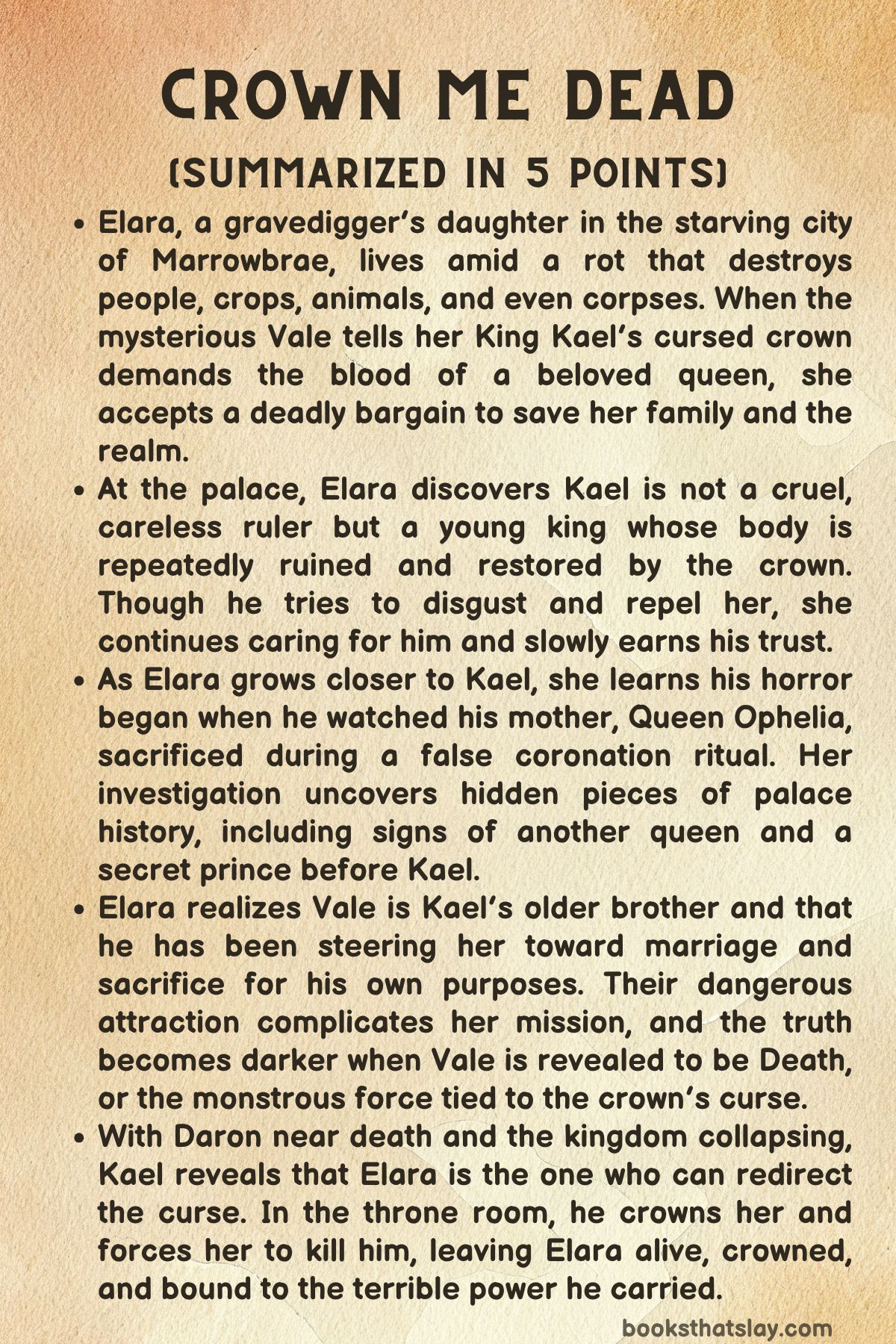
Crown Me Dead by Liv Zander is a dark fantasy romance about sacrifice, power, decay, and the terrible cost of survival. Set in the starving city of Marrowbrae, the story follows Elara, a gravedigger’s daughter whose family is being destroyed by a strange rot spreading through the kingdom.
When she is offered a chance to save her loved ones by entering the palace and becoming the doomed queen of King Kael, she accepts a fate that seems already written. But inside the palace, Elara discovers that the curse, the king, and the man guiding her are far more dangerous than she first believed. It’s the 1st book of the Heartstring Duet.
Summary
Elara lives in Marrowbrae, a city slowly dying from a terrible rot. The disease does not spare anyone or anything.
It eats through crops, animals, living bodies, and even corpses. Hunger is everywhere, sickness is common, and death has become part of daily life.
As the daughter of a gravedigger, Elara has grown used to handling the dead, though that does not make her life any easier. She works beside her mother and helps care for her younger brother, Daron, whose fingers are already being consumed by the rot.
Her father is gravely ill, and the family survives on very little while preparing bodies no one truly has the strength to mourn.
After one grim day of work, Elara is approached by Vale, a clean, well-fed stranger who looks completely out of place in Marrowbrae. He tells her that the crown must be fed, a phrase that sounds strange and threatening.
At first, Elara does not understand what he wants from her, but her family’s situation soon becomes even more desperate. Thieves rob their graveyard home, taking what little security they still had.
Her father worsens, Daron’s condition grows more frightening, and Elara is forced to listen when Vale returns with an explanation.
Vale tells her that King Kael’s crown is cursed. The crown gives kings unnatural strength, power, and survival, but it demands a terrible payment.
Every so often, a beloved queen must be killed in a ritual to satisfy the curse. King Kael has refused to marry because he will not take a wife only to murder her.
He believes the curse can be broken, and because of his refusal, the kingdom is rotting around him. Vale offers Elara a brutal bargain: go to the palace, win the king’s love, marry him, and die in the ritual.
In return, her family will be cared for, and the kingdom will be saved.
Elara accepts, not because she wants glory or power, but because she sees no other way to save Daron and her mother. At the palace, she becomes King Kael’s caretaker.
What she finds there is not the luxury she expected. The palace is also touched by rot.
Servants are sick, rooms are decaying, and the king himself is not the careless tyrant people imagine. Kael is a young man trapped in a ruined body, kept alive by the crown while the rot destroys and repairs him over and over.
He is ashamed of his appearance and furious at the world’s suffering, but he is also too broken to know how to stop it.
Kael tries to drive Elara away. He shows her his wounds, his decay, and the horrors of his body.
He splashes her with pus and maggots, wanting to disgust her so badly that she leaves. Elara is horrified, but she comes back.
She cleans him, tends his injuries, and refuses to be chased out. Her task is to make him love her, yet the more time she spends with him, the more she sees that he is not a monster in the simple way people believe.
He is only twenty-nine, lonely, tortured, and crushed by guilt because his refusal to sacrifice a queen has allowed so many people to die.
Vale continues pressing Elara from the outside. He wants her to endure Kael’s ugliness, gain his trust, seduce him, and become queen quickly.
Elara follows the plan because her family’s survival depends on it, but her feelings become increasingly conflicted. Kael begins to soften with her.
She gets him to drink. She helps clean his wounds.
She takes him into the gardens and later to a salt spring, giving him small moments of relief from the prison of his body. These acts of care create a bond between them, one built on pain, need, and reluctant trust.
As Kael opens up, Elara learns more about his childhood and the trauma that shaped him. His mother, Queen Ophelia, was sacrificed when he was a child.
Kael witnessed his father, King Merrick, being forced to cut Ophelia’s throat during what was called a coronation. That memory has haunted him ever since.
It is the reason he refuses to marry. He cannot bear to repeat what was done to his mother, even though his choice has allowed the curse to spread through the kingdom.
Elara begins investigating the palace and its history. She notices details that do not fit.
Ophelia was allergic to roses, yet there is a greenhouse filled with roses supposedly given in honor of Kael’s birth. The story feels false.
As Elara searches deeper, she finds signs that there may have been another queen named Maeryn and possibly another prince before Kael. The official history of the royal family has been edited, hidden, or deliberately distorted.
Eventually, Elara confronts Vale and learns that he is not merely a palace steward. He is Kael’s older brother, a hidden prince whose own mother was sacrificed.
His place in the royal bloodline has been erased, and he has been manipulating events from behind the scenes. He wants Elara to become Kael’s queen and die, but his motives are not as noble as saving the kingdom.
He has his own plans for the curse, the crown, and the royal line.
While Elara tries to understand Vale’s role, her personal losses deepen. Her father dies, leaving her grief-stricken.
Kael comforts her, showing tenderness that makes her mission even harder. He also offers to bring her mother and Daron to the palace, which gives Elara hope but also increases the pressure on her.
When they arrive, Daron is close to death. Seeing him so ill convinces Elara that she must push Kael toward marriage and the ritual before it is too late.
At the same time, Elara’s connection with Vale grows darker and more dangerous. Their attraction becomes physical, complicating everything she believes about duty, desire, and survival.
Vale tells her the origin of the curse: long ago, an ancient king tricked Death in a chess bargain. Because of that bargain, Death was forced to create the crown from a string of his own heart.
The crown’s power is therefore tied to Death himself, and the ritual sacrifices have kept that terrible magic alive through generations of kings.
Elara later finds a letter suggesting that Kael has been working on a secret plan involving heritage, translation, and the curse. When Kael discovers she has seen it, he reacts with fear and anger.
The letter hints that the truth is more complicated than Vale has allowed her to know. Kael finally warns Elara that Vale has no heart and tells her to lure him into moonlight if she wants to see what he really is.
Elara does as Kael says, and Vale’s human form falls away. She sees the truth: Vale is Death himself, or at least the monstrous being at the center of the curse.
Kael then reveals what he has been hiding. The royal bloodline is already compromised, and he cannot break the curse in the way he once hoped.
But Elara can change its direction. She is not simply meant to be a sacrificed queen.
She can take the crown and the curse into herself, altering the old pattern of kings killing beloved wives to keep their power.
The final confrontation happens in the throne room. Vale storms in, furious and determined to stop Kael’s plan.
Kael places the crown on Elara’s head and forces the ritual knife into her hand. He begs her to kill him.
Elara is horrified, but she understands enough to act. Instead of dying as the next queen sacrificed to the crown, she cuts Kael’s throat.
Kael dies, ending his suffering and breaking the role he was trapped in. Vale is stunned because the ritual has not gone the way he intended.
Elara remains alive, crowned, and bound to the curse. She has saved herself from becoming only another dead queen, but she has also inherited something terrible.
The story ends with her standing in Kael’s place, no longer just a gravedigger’s daughter sent to die, but the bearer of the crown and the curse that has ruined the kingdom for generations.
Characters
Elara
Elara is the central character in Crown Me Dead, and her role is shaped by poverty, duty, grief, and a brutal moral bargain. As a gravedigger’s daughter, she begins the book surrounded by death long before she becomes directly tied to the crown’s curse.
Her life in Marrowbrae has taught her endurance rather than innocence, and this makes her different from the kind of heroine who enters palace life with wonder or ambition. Elara understands suffering in physical, practical terms: rotting bodies, starvation, illness, and the slow collapse of a family trying to survive.
Because of this, her decision to accept Vale’s bargain is not presented as simple bravery or foolishness. It comes from desperation, love for her family, and the crushing awareness that doing nothing will also lead to death.
Elara’s strength lies in her ability to face horror without turning away. When she becomes Kael’s caretaker, she is confronted with the grotesque reality of his cursed body, yet she returns to him even after he tries to repel her through disgust and humiliation.
This does not mean she is fearless; rather, she is willing to act despite fear. Her compassion is practical and physical.
She cleans wounds, brings water, helps Kael move, and slowly treats him as a person instead of a monster. This makes her emotionally powerful because she does not romanticize suffering, but she also does not let suffering erase a person’s humanity.
At the same time, Elara is not morally untouched. Her mission requires manipulation, seduction, and a willingness to become part of a ritual built on death.
Her growing connection to Kael complicates her original purpose because she begins by intending to make him love her so that he can sacrifice her, but she gradually sees the lonely, ashamed man beneath the decay. Her involvement with Vale deepens this conflict further, showing that she is vulnerable to desire, pressure, confusion, and the need to believe that someone else has answers.
Elara’s emotional journey is therefore not only about survival but also about learning who can be trusted, what sacrifice truly means, and whether love can exist inside manipulation.
By the end of the book, Elara becomes the figure who changes the direction of the curse, but not in a clean or triumphant way. Killing Kael is both an act of obedience to his final plea and an act of transformation that binds her to the very power she once planned to die beneath.
Her crowning is not a simple victory. It marks the loss of innocence, the burden of rule, and the beginning of a darker destiny.
Elara’s character is compelling because she is neither a passive sacrifice nor a flawless savior. She is a young woman forced to make impossible choices in a world where love, death, hunger, and power are inseparable.
King Kael
King Kael is one of the most tragic and morally complex figures in the book. At first, he appears to be the cause of the kingdom’s suffering because his refusal to marry and sacrifice a beloved queen allows the rot to spread through Marrowbrae.
From the outside, this makes him look selfish, cowardly, or tyrannical. However, the truth of his condition reveals a far more painful character.
Kael is not a careless ruler enjoying luxury while his people starve. He is a young man trapped in a rotting body, repeatedly destroyed and kept alive by the crown’s curse, forced to endure both physical agony and the knowledge that his people are dying because he refuses to continue the cycle of ritual murder.
Kael’s horror is both bodily and psychological. His decayed flesh, wounds, pus, maggots, and constant suffering make him almost impossible to look at, but his deepest wound comes from childhood trauma.
Watching his mother, Queen Ophelia, die in a ritual disguised as coronation shattered his understanding of kingship, family, and love. For Kael, the crown does not symbolize glory; it symbolizes inherited violence.
This explains why he refuses to marry. His refusal is not merely rebellion against tradition but a desperate attempt to prevent another woman from becoming what his mother became.
In this sense, Kael’s apparent failure as king is also his attempt to remain human.
His relationship with Elara reveals the buried parts of his personality. He first tries to drive her away because he expects disgust, betrayal, and fear.
His cruelty toward her is defensive, born from shame and the belief that no one should have to touch or care for what he has become. Yet Elara’s persistence gradually allows him to show tenderness, grief, and trust.
When he opens up about his mother and accepts small acts of care, the book shows that Kael’s monstrosity is not moral but imposed upon him. He is monstrous in appearance, but emotionally he remains painfully human.
Kael’s final choice is one of the defining moments of his character. By placing the crown on Elara’s head and begging her to kill him, he chooses an ending that is both sacrificial and strategic.
He understands that he cannot break the curse in the way he once hoped, but he can help redirect it. His death is not an escape from responsibility; it is his last attempt to stop Death’s control and give Elara a chance to alter the kingdom’s fate.
Kael’s tragedy lies in the fact that he spends his reign trying not to become like the kings before him, yet he can only resist the curse through his own destruction.
Vale
Vale begins as a clean, well-fed stranger who appears to bring Elara the terrible truth about the crown, but he gradually becomes one of the most dangerous and deceptive figures in the story. His first power over Elara is not physical force but knowledge.
He knows the secret of the crown, the hunger of the curse, and the desperation of her family. By offering her a bargain that could save Daron, her mother, and the starving realm, he presents manipulation as necessity.
This makes Vale especially unsettling because he does not need to lie about everything. He uses partial truths to control people, allowing his victims to believe they are choosing freely when their choices have already been narrowed by suffering.
As the hidden older brother figure, Vale represents buried history and stolen inheritance. His connection to an earlier sacrificed queen suggests that the royal family’s past is more corrupt and complicated than the official version allows.
He is not merely a palace servant or political schemer; he is a living reminder that the curse has erased people, rewritten family lines, and turned queens into fuel for male power. His resentment and ambition are therefore understandable on one level, but the way he uses Elara shows how thoroughly he has embraced the logic of the curse.
He treats sacrifice as a tool, and he is willing to turn Elara into another woman consumed by the crown.
Vale’s attraction to Elara makes him more complex but not less dangerous. Their physical involvement blurs the line between desire and manipulation, especially because Vale is guiding her toward a fate that requires her death.
He can appear intimate, seductive, and emotionally charged, yet his tenderness is never fully separate from his agenda. This gives him a predatory quality because he understands Elara’s loneliness, fear, and desperation, then uses those emotions to keep her moving toward his plan.
His appeal lies in his mystery and confidence, but his danger lies in the fact that he makes control feel like protection.
The revelation that Vale is Death, or the monstrous force behind the curse, transforms his character from political manipulator into mythic antagonist. Once his human disguise falls away, the book reframes his earlier actions as part of a much older pattern of hunger, bargaining, and domination.
He is not simply trying to influence the throne; he is trying to preserve a system in which love becomes payment and queens become offerings. Vale’s lack of a heart is both literal and symbolic.
It explains his inhuman nature while also reflecting his inability to love without possession, bargain without exploitation, or desire without destruction.
Daron
Daron is Elara’s younger brother and one of the emotional anchors of the book. Though he does not control the plot in the way Elara, Kael, or Vale do, his illness drives many of Elara’s most important decisions.
The rot consuming his fingers makes the kingdom’s curse painfully personal. For Elara, the suffering of Marrowbrae is not an abstract political problem.
It is visible in her brother’s body, in his approaching death, and in the helplessness of a family that cannot protect its youngest member. Daron therefore represents innocence caught inside a system built by kings, curses, and ancient bargains.
His role also intensifies the moral pressure on Elara. Her agreement to go to the palace and become part of the crown’s ritual is not motivated by ambition.
It is motivated by the possibility of saving Daron. This makes him central to understanding Elara’s desperation.
Every time his condition worsens, the bargain becomes harder for her to resist, and the idea of sacrifice becomes more urgent. Daron’s suffering narrows Elara’s choices until death begins to look like a form of love.
Daron also represents the future that may be lost if the curse continues. He is young, vulnerable, and dependent on others, which makes the rot’s cruelty even sharper.
His presence in the palace later in the story adds urgency because the royal setting does not magically separate Elara’s family from suffering. Even surrounded by power, Daron remains near death.
Through him, the book shows that curses and political failures are ultimately measured in bodies, families, and children who should have had more time.
Elara’s Mother
Elara’s mother is a figure of endurance, grief, and working-class survival. As part of the graveyard household, she lives close to death and decay, not as a symbol but as a daily reality.
Her work preparing corpses places her among the people who must handle the consequences of the kingdom’s collapse while having no power to change its cause. She represents the kind of ordinary person most harmed by the crown’s curse: someone who labors, suffers, and watches her family deteriorate while those in power hide behind palace walls and buried secrets.
Her relationship with Elara is important because it shapes Elara’s sense of responsibility. Elara does not leave home because she wants escape or status; she leaves because her family is breaking under hunger, illness, and loss.
Her mother’s presence gives emotional weight to the bargain because Elara is not sacrificing herself for an abstract kingdom alone. She is trying to preserve the remaining pieces of her family.
The mother’s hardship also shows the generational nature of suffering. She has already lost stability, is losing her husband, and may lose her son, yet she continues to endure.
When Elara brings her mother to the palace, the contrast between palace and graveyard becomes less comforting than it should be. The palace is also rotting, and safety remains uncertain.
This prevents the story from turning royal space into a simple rescue. Elara’s mother remains a reminder that the curse follows everyone, rich or poor, because the entire realm has been poisoned by the crown’s hunger.
Elara’s Father
Elara’s father is physically absent from much of the action because of illness, but his condition strongly influences the emotional atmosphere of the book. As a sick gravedigger, he embodies the collapse of both family and livelihood.
The man whose work is tied to burying the dead is himself being overtaken by the same world of rot and decay. His illness adds to the sense that death has entered every corner of Elara’s life, not only through strangers’ corpses but through the people she loves.
His death is a turning point for Elara because it deepens her grief while also increasing the emotional cost of her mission. Until then, she is acting to prevent total loss.
After his death, she is also carrying the pain of what could not be saved. Kael’s comfort during this moment becomes significant because it allows Elara to see him not only as the cursed king she must manipulate but as someone capable of tenderness.
In this way, Elara’s father indirectly helps shift the emotional connection between Elara and Kael.
As a character, Elara’s father represents the powerless victims of royal history. He does not choose the curse, benefit from the crown, or participate in palace deception.
Yet he dies because of a system maintained by rulers, rituals, and Death’s bargain. His importance lies in how quietly devastating his role is.
He shows that the curse does not only create dramatic sacrifices in throne rooms; it also creates slow deaths in poor homes.
Queen Ophelia
Queen Ophelia is one of the most haunting figures in the book because her death shapes Kael’s entire life and reign. She is remembered primarily through sacrifice, but that sacrifice is not a noble tradition when seen through Kael’s eyes.
It is a traumatic act of violence carried out under the pressure of the crown’s demand. As Kael’s mother, Ophelia represents love destroyed by monarchy.
Her death teaches Kael that queens are not protected by kingship; they are consumed by it.
Ophelia’s character also exposes the false beauty of royal ritual. A coronation should symbolize continuity, legitimacy, and public glory, but in her case it becomes a disguised execution.
This contrast makes her death especially disturbing. The ceremony hides murder beneath tradition, turning the language of rule into a mask for sacrifice.
Through Ophelia, the book criticizes inherited systems that call violence duty and demand that women’s bodies pay for male power.
The detail that Ophelia was allergic to roses while the palace history claims a rose-filled greenhouse was connected to Kael’s birth reveals how memory has been distorted. This inconsistency allows Elara to understand that the official story cannot be trusted.
Ophelia is therefore not only important as Kael’s mother but also as a clue to the hidden history of the palace. Her erased or altered truth helps Elara uncover the deeper corruption behind the crown.
King Merrick
King Merrick is a tragic and disturbing figure because he stands at the intersection of love, obedience, and royal violence. As Kael’s father, he is remembered most powerfully through the ritual in which he is forced to slit Queen Ophelia’s throat.
This act defines him less as a simple villain and more as a man trapped inside a monstrous inheritance. However, the fact that he carries out the sacrifice still makes him part of the system that destroys the women it claims to honor.
Merrick’s role is important because he shows how the crown corrupts kings by making murder appear necessary. Whether he loved Ophelia or not, the ritual demands that he place the survival of the realm and the continuation of power above the life of his queen.
This creates a terrible model for Kael, who grows up understanding kingship through the image of his father killing his mother. Merrick’s obedience becomes Kael’s trauma.
As a former king, Merrick also represents the old pattern that Kael refuses to repeat. His actions show what tradition expects from a ruler: marry, love, sacrifice, continue.
Kael’s refusal gains meaning because Merrick did what the curse required and still left behind horror. Merrick therefore functions as both a warning and a wound.
He shows that following the rules of a cursed system does not make a ruler righteous; it only keeps the system alive.
Queen Maeryn
Queen Maeryn is a hidden figure whose importance lies in what her possible erasure reveals about the palace’s past. She appears as part of the buried history that Elara begins to uncover, suggesting that the royal bloodline and the story of succession are not as clean as they seem.
If Ophelia’s story was altered, Maeryn’s existence points to an even deeper pattern of concealment, sacrifice, and forgotten women whose lives were consumed by the crown.
Maeryn’s role is especially significant because she suggests that the curse has not only killed queens but also rewritten history around them. A sacrificed queen can be mourned, mythologized, or erased depending on what best protects the throne.
This makes Maeryn a symbol of the women who came before Elara and Ophelia, women whose suffering may have been necessary to maintain royal power but inconvenient to remember honestly.
Although she is not as directly present as Elara or Ophelia, Maeryn expands the scale of the story. She shows that the curse is not a single tragedy but a repeating structure.
Her shadow over the narrative helps Elara understand that she is not facing one isolated ritual. She is standing at the edge of a long history in which women have been selected, loved, killed, and forgotten.
Themes
Sacrifice and the Cost of Survival
Crown Me Dead presents sacrifice as something far more painful than a noble gesture. Elara’s choice to go to the palace is not driven by glory, romance, or ambition, but by poverty, disease, and fear for her family.
Her body becomes part of a bargain made by people with more power than her, showing how survival often demands the most from those who have the least. Kael’s refusal to marry and kill a queen also comes from sacrifice, but his sacrifice creates suffering across the kingdom.
He tries to save one unknown woman from death, yet the rot spreads through homes, streets, fields, and bodies because of that refusal. This creates a difficult moral conflict: saving one person may condemn thousands, while saving thousands may require murdering one innocent person.
The theme becomes even more complex when Elara kills Kael instead of dying herself. Sacrifice is shown not as clean or heroic, but as a brutal exchange where every choice leaves guilt behind.
Power, Corruption, and Inherited Burdens
Power in the story is presented as something poisonous, especially when it is passed down without consent. The crown gives kings unnatural survival, but that survival is not freedom.
Kael is not powerful in the traditional sense; he is trapped inside a ruined body, forced to live through pain while the kingdom decays around him. His position makes him responsible for suffering he did not create, showing how inherited power can become inherited punishment.
The curse began with an old king’s attempt to cheat Death, but later generations continue paying for that selfish act. This theme also appears through hidden royal history.
The erased queens, lost bloodlines, and secret prince reveal that monarchy depends not only on ceremony and authority, but also on silence, violence, and controlled memory. Vale’s manipulation further shows how power often works through deception rather than open force.
The crown may sit on one head, but its damage spreads through every life connected to it.
Appearance, Humanity, and Compassion
Kael’s decaying body forces the story to question how easily people connect beauty with goodness and ugliness with evil. Elara first enters the palace expecting a cruel king who has allowed his people to suffer, but she finds a young man whose body has been destroyed by the very curse that keeps him alive.
His wounds, smell, rot, and shame are horrifying, yet they do not erase his humanity. His attempts to disgust Elara are also a form of self-defense.
He wants to make himself impossible to love because love has become dangerous under the rules of the crown. Elara’s care for him becomes important because it is physical, patient, and practical.
She cleans wounds, brings water, helps him move, and stays when he expects rejection. Compassion here is not sentimental.
It requires facing pain directly and refusing to reduce a person to their damage. The story suggests that true care begins when horror does not cancel empathy.
Manipulation, Desire, and Loss of Choice
Many of Elara’s choices are shaped by people who understand her desperation and use it against her. Vale offers her a bargain, but the offer is built on hunger, illness, grief, and fear.
She technically accepts, yet her consent is pressured by circumstances so extreme that refusal barely feels possible. This theme becomes stronger as Vale guides her behavior, tells her how to seduce Kael, and hides his true identity.
Desire becomes dangerous because it is mixed with lies. Elara’s attraction to Vale complicates her mission, but it also exposes how manipulation can feel intimate while still being controlling.
Kael also withholds information, though his secrecy comes from shame and a plan to change the curse’s path. By the end, Elara is forced into an impossible moment where action matters more than full understanding.
Her crowning does not feel like simple victory. It marks the point where she survives, gains power, and loses the ordinary freedom she was trying to protect.