Cleo Dang Would Rather Be Dead Summary, Characters and Themes
Cleo Dang Would Rather Be Dead by Mai Nguyen is a novel about grief, motherhood, and the painful work of surviving after unbearable loss. It follows Cleo Dang after the death of her newborn daughter, Daisy, a tragedy that leaves her unable to recognize herself, her marriage, or the world around her.
The book looks closely at bereavement without softening its ugliness: jealousy, anger, numbness, guilt, and the strange pull of death. At the same time, it shows how love can remain after loss, and how a life can be rebuilt without pretending the wound has disappeared.
Summary
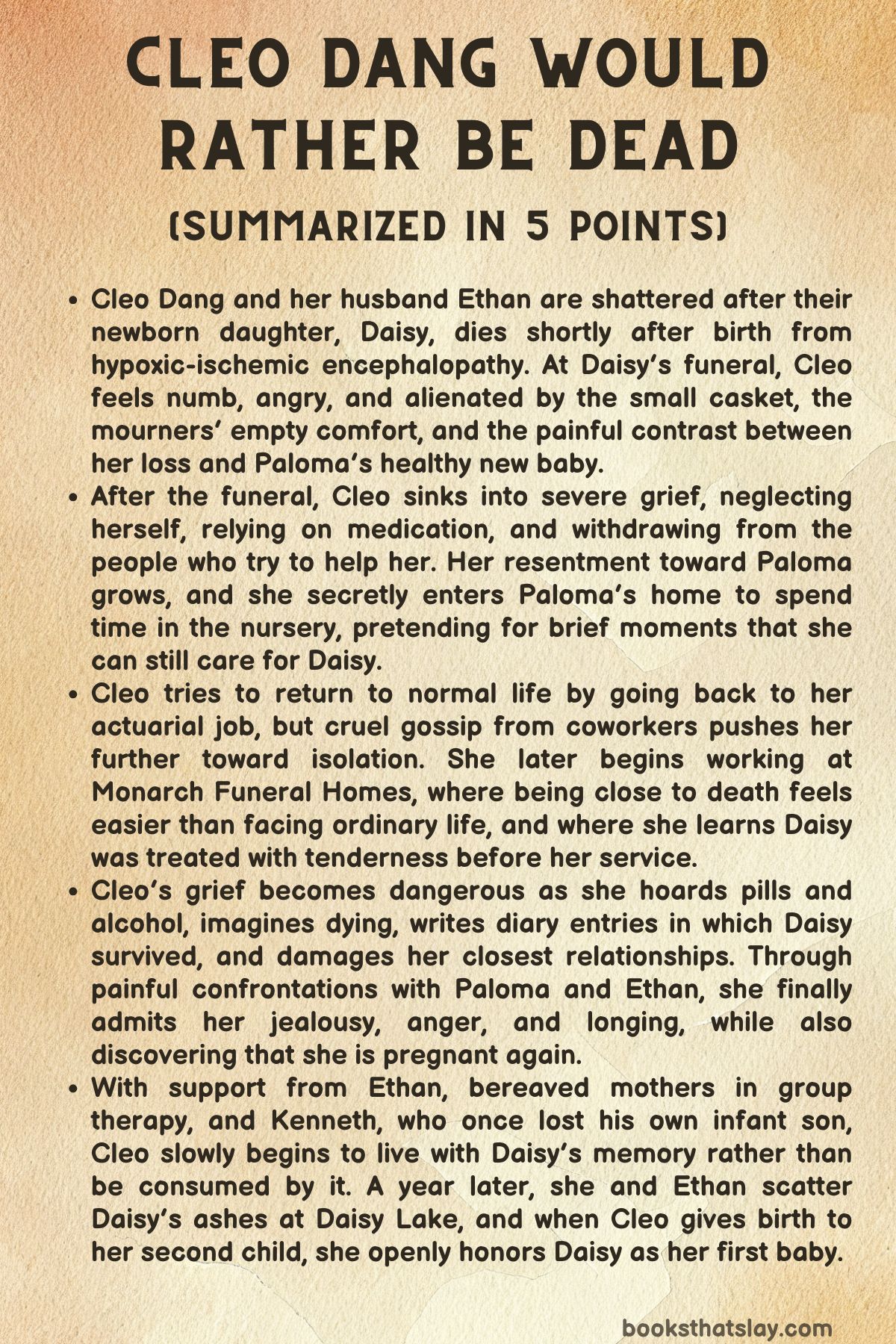
Cleo Dang’s life changes forever when her newborn daughter, Daisy, dies shortly after birth from hypoxic-ischemic encephalopathy. Instead of bringing Daisy home, Cleo and her husband Ethan must bury her.
At the funeral, Cleo feels detached from everything around her. Daisy’s casket is impossibly small, and the rituals meant to offer comfort only make the situation feel more unreal.
People offer condolences that sound empty to her, and she struggles to accept that this ceremony is for her child. Her best friend Paloma has organized much of the service, and Cleo recognizes the kindness behind it.
Still, gratitude sits beside bitterness. Paloma gave birth to a healthy baby only hours after Daisy was born, and Cleo cannot stop comparing their lives.
Paloma has the exhaustion, milk, crying baby, and sleepless nights Cleo had expected for herself. Cleo has silence.
After the funeral, Cleo retreats from ordinary life. She stays in bed, avoids bathing, ignores food, and depends on medication to get through the hours.
Flowers and meals arrive from people who want to help, but to Cleo they feel like reminders that everyone else believes grief can be managed with gestures. Ethan responds differently.
He goes back to work and runs with an intensity that seems almost punishing. Cleo’s parents and Paloma try to help her return to some form of routine, but Cleo feels unreachable even to herself.
Paloma bathes her, feeds her, and pushes her toward counseling, yet Cleo cannot bear being close to someone whose baby survived.
Her grief turns into secret, troubling behavior. Cleo enters Paloma’s house without permission, drawn to the nursery Paloma now uses with her own child.
She cleans it, reads Paloma’s diary, and holds a plush dumpling toy as though it were Daisy. In those private moments, Cleo pretends she is caring for her daughter.
The fantasy brings comfort, but it also deepens her separation from reality. She knows she is violating Paloma’s trust, but the need to feel like Daisy’s mother is stronger than her shame.
Trying to prove that she can function, Cleo returns early to her job as an actuary. The office is not a refuge.
Her coworkers are uncomfortable around her, and some speak cruelly behind her back. They judge the way she grieves, gossip about her lack of visible tears, and even suggest she may have faked her pregnancy.
Cleo’s anger finally spills over when she damages a coworker’s computer. Instead of finding stability at work, she is sent back on leave, more isolated than before.
Cleo then finds an unexpected place for herself at Monarch Funeral Homes after meeting Kenneth Timmerman, the funeral director. At first, the work appeals to her because it keeps her occupied and surrounds her with death rather than the ordinary signs of life she finds unbearable.
She helps with services, body transfers, paperwork, and the preparation of the deceased. The funeral home does not frighten her.
In a strange way, it feels honest. Death is not hidden there, and no one expects her to act fine.
She gets to know Rachel and Ana, who work at Monarch, and she begins to feel useful in a way she has not felt since Daisy died.
Her connection to Monarch becomes more meaningful when she learns how the staff cared for Daisy before the funeral. They treated her gently and even played lullabies for her.
This matters deeply to Cleo. Daisy’s life was brief, but the knowledge that someone handled her with tenderness gives Cleo a form of comfort she did not know she needed.
It confirms that Daisy was not just a loss or a medical tragedy. She was a baby, and she was loved.
Even so, Cleo’s grief remains dangerous and unpredictable. She hoards pills and alcohol, thinks constantly about death, and imagines ways she might stop living without directly acting on it.
She becomes obsessed with the afterlife and with the possibility of being reunited with Daisy. She writes diary entries in which Daisy survived, creating a version of life where she is still a mother in the daily, physical sense.
These writings let her escape, but they also worry Ethan when he discovers them.
Cleo’s relationships suffer under the pressure of her pain. She fights with Ethan, Paloma, and her parents.
Her loved ones want to reach her, but they often say the wrong thing or fail to understand the depth of her anger. At a baby shower for Sadie and Fatima, Cleo tries to behave normally, but the sight of Sadie’s baby moving inside her body breaks something in her.
She cannot keep pretending that other people’s pregnancies and babies do not hurt her. The event exposes how raw her grief still is and how far she feels from the life she imagined.
Her friendship with Paloma nearly breaks after Paloma accuses her of “playing the victim.” The words cut Cleo deeply because they suggest that her grief is a choice or an act. Later, when Paloma discovers Cleo has been entering her home, the truth comes out.
Cleo admits the jealousy, resentment, and longing she has been hiding. She confesses how painful it is to see Paloma live the life Cleo lost.
The confrontation is painful, but it also becomes a turning point. Paloma apologizes and acknowledges Daisy more fully, giving Cleo something she has desperately needed: recognition of her daughter as real and irreplaceable.
Around this time, Cleo discovers she is pregnant again. The news is not simple joy.
It is tangled with fear, guilt, hope, and the memory of Daisy. A new pregnancy cannot erase the first child, and Cleo knows that another baby will not replace Daisy.
Still, the pregnancy forces her to think about whether she wants to live and what kind of future might still be possible.
Cleo and Ethan also begin to reconnect. When Ethan finds her fictional diary about Daisy surviving, he is hurt and angry at first.
The entries reveal how far Cleo has gone into fantasy, and they frighten him. But instead of walking away, Ethan takes her to Daisy Lake, a place he found while searching for Daisy’s name.
There, they begin to imagine a way to honor their daughter without remaining frozen at the moment of her death. They decide to scatter Daisy’s ashes in the lake.
For Cleo, this is not about letting Daisy go in the sense of forgetting her. It is about carrying Daisy differently, allowing her memory to move with them rather than keeping her only in a place of pain.
Cleo begins group therapy with other bereaved mothers. At first, she resists the process, but the group gives her something ordinary sympathy could not: people who understand the strange, ugly, honest sides of losing a child.
They challenge her fantasies and her self-destructive habits, but they also make room for her anger and sorrow. Among them, Cleo is not shocking or unnatural.
She is a grieving mother trying to survive.
Slowly, Cleo starts rebuilding. She throws away substances she had been using to numb herself, eats again, and allows others back into her life.
She leaves her insurance job, recognizing that it no longer fits the person she has become. Monarch Funeral Homes remains important to her because it gives her purpose and a place where loss is treated with care rather than discomfort.
Kenneth eventually shares his own story: his infant son Teddy died decades earlier of SIDS, and that loss led him to open the funeral home. His life shows Cleo that a dead child can remain present and loved across decades, without requiring the parent to die too.
A year after Daisy’s birth, Cleo and Ethan scatter Daisy’s ashes in Daisy Lake. The act is painful, but it is also an expression of love.
They are not abandoning Daisy. They are making space for her in a wider life.
Cleo continues to carry her daughter, but no longer only through fantasy, rage, or despair.
Later, when Cleo goes into labor with her second child, she openly tells the nurse that Daisy was her first child. This moment shows how far she has come.
She no longer hides Daisy to make others comfortable, and she does not treat the new baby as a replacement. Surrounded by Ethan, Paloma, and Daisy’s memory, Cleo gives birth.
When she hears the baby cry, the sound marks not an erasure of grief but the beginning of another life alongside it. Cleo Dang Would Rather Be Dead ends with Cleo still shaped by loss, but also able to welcome love, motherhood, and survival again.
Characters
The characters in Cleo Dang Would Rather Be Dead are shaped by grief, motherhood, guilt, love, resentment, and the difficult process of learning how to continue living after an unbearable loss. Each character contributes to Cleo’s emotional journey, either by reflecting her pain, challenging her isolation, or helping her understand that Daisy’s death does not erase Daisy’s place in her life.
Cleo Dang
Cleo Dang is the emotional center of the book, and her character is defined by the devastating death of her newborn daughter, Daisy. At the beginning, Cleo is almost completely consumed by grief.
Her numbness at the funeral, her horror at Daisy’s tiny casket, and her irritation toward mourners’ empty condolences show how alienated she feels from ordinary rituals of comfort. She is not simply sad; she is shattered in a way that makes normal life feel absurd and even offensive.
Her grief affects every part of her existence, including her body, her marriage, her friendships, her work, and her sense of identity. She cannot easily accept that she is a mother without a living child, and this contradiction becomes one of the deepest sources of her suffering.
Cleo is also a deeply complicated character because her grief often expresses itself in ways that are disturbing, secretive, or self-destructive. She stays in bed, neglects herself, depends on medication, hoards pills and alcohol, and imagines death as a form of escape.
Her private acts, such as entering Paloma’s house, cleaning the nursery, reading Paloma’s diary, and pretending to mother Daisy through a plush toy, reveal how desperate she is to inhabit the life that was taken from her. These actions are not healthy, but they are emotionally understandable because Cleo is trying to create a space where Daisy still exists.
Her fictional diary entries, in which Daisy survives, show that Cleo is not only mourning a baby but also mourning an entire imagined future.
At the same time, Cleo is not portrayed as only a victim of tragedy. She is angry, jealous, resentful, and sometimes cruel, especially toward Paloma, whose living baby represents everything Cleo lost.
Her resentment is painful because it is directed at someone who loves her, yet it also makes her grief feel honest. Cleo’s jealousy does not mean she lacks love; it means her pain has distorted her ability to receive love from others.
Her conflict with Paloma becomes one of the most important emotional turning points because Cleo is finally forced to admit the full truth of her resentment, longing, and brokenness. This honesty begins to loosen the secrecy that has kept her trapped.
Cleo’s work at Monarch Funeral Homes becomes an unexpected path toward healing. At first, she is drawn to the funeral home because death feels more bearable than ordinary life.
Being surrounded by funerals and bodies allows her to avoid the cheerful world of babies, coworkers, and polite sympathy. However, the work gradually becomes meaningful because it teaches her that care can still be given after death.
Learning that Daisy was treated tenderly by the funeral home staff helps Cleo see that her daughter mattered to others too. Through this work, Cleo begins to transform her relationship with death from obsession into service.
By the end, Cleo’s growth is not shown as a simple recovery. She does not stop grieving Daisy, and the book does not suggest that a second child replaces the first.
Instead, Cleo learns to live with grief as something permanent but not entirely destructive. Her decision to scatter Daisy’s ashes with Ethan, begin group therapy, discard substances, reconnect with loved ones, resign from insurance, and openly name Daisy as her first child shows that she is reclaiming life without denying loss.
Cleo’s final strength lies in her ability to carry Daisy forward, not as a fantasy, but as a real and beloved part of her motherhood.
Ethan
Ethan, Cleo’s husband, is a grieving father whose pain is quieter and more controlled than Cleo’s, but no less real. After Daisy’s death, Ethan responds by returning to work and running obsessively, suggesting that he tries to survive by creating structure, movement, and distance from the emotional chaos at home.
His grief is practical and contained, while Cleo’s grief is consuming and visible. This difference creates tension between them because each seems unable to fully understand the other’s way of mourning.
Ethan’s return to routine may feel like abandonment to Cleo, but it is also his attempt to keep himself from collapsing.
Ethan’s relationship with Cleo is strained because Daisy’s death changes the emotional language of their marriage. They are connected by the same loss, yet they often seem isolated from each other.
Cleo withdraws into secrecy, substances, fantasies, and resentment, while Ethan struggles to reach her without knowing how to confront the depth of her despair. His anger when he discovers her fictional diary is significant because it reveals his own pain and fear.
He is not simply judging Cleo; he is devastated by the realization that she has created an imagined version of their life that excludes the painful truth they both share.
Despite this conflict, Ethan becomes an important figure in Cleo’s healing because he eventually chooses compassion over anger. His decision to take Cleo to Daisy Lake shows that he has also been searching for a way to keep Daisy present.
The lake becomes a place where grief can be honored rather than avoided. Ethan’s gesture proves that he has not forgotten Daisy and has not moved on in a careless way.
Instead, he has been carrying his daughter privately, just as Cleo has been carrying her in a more visible and destructive form.
Ethan’s character represents the difficulty of shared grief within a marriage. He shows that two people can lose the same child and still experience that loss in very different ways.
His journey is quieter than Cleo’s, but it is essential because he helps transform Daisy’s memory into something Cleo and Ethan can hold together. By the end, Ethan’s presence during the birth of their second child reinforces his role as a partner who has endured loss, remained connected, and helped Cleo step into a future where Daisy is remembered rather than erased.
Daisy
Daisy is physically absent for most of the story, but she is one of the most powerful presences in the book. Her death shortly after birth shapes every relationship, conflict, and emotional turning point.
Although she does not live long enough to develop in the ordinary sense, Daisy is not treated as a symbol alone. She is Cleo and Ethan’s first child, a real baby whose brief life permanently changes the people around her.
The horror of her tiny casket, the tenderness shown to her body, and the later scattering of her ashes all emphasize that Daisy’s existence matters deeply.
Daisy represents the future Cleo imagined and lost. For Cleo, Daisy is not only a baby who died but also the daughter she expected to feed, hold, comfort, raise, and know.
This is why Cleo’s grief is so intense and disorienting. She is mourning both Daisy’s brief life and the years of motherhood that will never unfold.
Cleo’s pretend diary entries, her attachment to the plush dumpling toy, and her inability to bear Paloma’s living child all show how Daisy remains alive in Cleo’s imagination even after death. Daisy’s absence creates a painful gap between reality and longing.
At the same time, Daisy’s role changes as Cleo begins to heal. At first, Daisy is tied to Cleo’s fantasies, death wishes, and refusal to accept reality.
Later, Daisy becomes part of a more honest form of remembrance. The decision to scatter her ashes in Daisy Lake is not an act of forgetting, but a recognition that love does not require Cleo to remain trapped in the moment of loss.
Daisy becomes a continuing presence rather than an impossible fantasy. This shift allows Cleo to speak of Daisy openly as her first child when she later gives birth again.
Daisy’s importance lies in the way the story insists that a brief life can still have lasting meaning. She is not replaced by Cleo’s second child, and she is not reduced to a tragedy that must be overcome.
Instead, Daisy remains part of Cleo and Ethan’s family. Her character shows that love for a dead child can continue, not as denial, but as memory, identity, and enduring motherhood.
Paloma
Paloma is Cleo’s best friend and one of the most emotionally complicated supporting characters because she stands at the painful intersection of love and resentment. She cares deeply for Cleo and tries to help her in practical, intimate ways.
She arranges Daisy’s funeral, bathes Cleo, feeds her, and urges her toward counseling. These actions show Paloma’s loyalty and willingness to enter Cleo’s suffering rather than simply offer distant sympathy.
She is not a shallow friend; she is present when many people would withdraw.
However, Paloma is also the person Cleo finds hardest to face because Paloma has a healthy baby born almost at the same time Daisy dies. This cruel contrast makes Paloma a living reminder of the life Cleo expected.
Paloma’s sleeplessness, milk, nursery, and living child become unbearable symbols of what Cleo has lost. Cleo’s resentment toward Paloma is not reasonable in a moral sense, but it is emotionally believable.
Paloma has done nothing wrong, yet her happiness wounds Cleo simply by existing beside Cleo’s grief.
Paloma’s own limitations appear when she tells Cleo to stop “playing the victim.” This moment is painful because it shows that even someone loving and devoted can become impatient with grief she cannot fully understand. Paloma wants Cleo to survive, but she sometimes fails to grasp the depth and irrationality of bereavement.
Her frustration does not erase her care, but it reveals the strain that grief places on friendship. The friendship nearly breaks because both women are trapped in different forms of motherhood: Paloma in the overwhelming reality of a living child, and Cleo in the unbearable absence of a dead one.
Paloma’s discovery of Cleo in her house becomes a turning point because secrecy finally gives way to truth. When Cleo admits her jealousy, resentment, and longing, Paloma is forced to confront the full extent of her friend’s suffering.
Her apology and acknowledgment of Daisy are crucial because Cleo needs more than help with food or hygiene; she needs Daisy to be recognized. Paloma’s character shows that friendship after tragedy requires more than kindness.
It requires the courage to hear ugly emotions, repair harm, and make room for grief that does not behave politely.
Kenneth Timmerman
Kenneth Timmerman, the funeral director at Monarch Funeral Homes, becomes an unexpected guide for Cleo. At first, he appears mainly as the person who gives her access to funeral work, but his importance grows as Cleo begins to understand the emotional purpose behind his profession.
Kenneth is calm, experienced, and familiar with death in a way that does not feel cold. His presence contrasts sharply with the awkward mourners and cruel coworkers Cleo encounters elsewhere.
He does not try to force comfort onto Cleo; instead, he offers her a place where death is acknowledged directly.
Kenneth’s funeral home becomes a refuge because it allows Cleo to be near death without being treated as strange for thinking about it. In ordinary spaces, Cleo’s grief makes others uncomfortable.
At Monarch, death is part of daily work, and this gives Cleo room to exist without pretending. Kenneth’s role is important because he helps create an environment where care continues after life ends.
Through him and the staff, Cleo learns that preparing the dead is not merely a technical task but an act of dignity.
The later revelation that Kenneth lost his infant son Teddy to SIDS gives his character greater depth. His connection to infant loss means that his tenderness is not abstract professionalism; it is rooted in personal grief.
Teddy’s death led him to open the funeral home, which shows that Kenneth has transformed his sorrow into service. This does not mean he has stopped grieving.
Rather, he has found a way to let grief shape his life without destroying it.
Kenneth becomes a model for Cleo because he proves that a parent can continue loving a dead child across decades. His story helps Cleo understand that Daisy can remain present without requiring Cleo to remain trapped in despair.
Kenneth’s character represents mature grief, not because he is untouched by pain, but because he has learned to live in relationship with it. His influence helps Cleo imagine a future where mourning and living can exist together.
Rachel
Rachel, one of Cleo’s coworkers at Monarch Funeral Homes, contributes to the sense of safety and belonging Cleo finds there. Unlike Cleo’s actuarial coworkers, who gossip and judge, Rachel is part of a workplace where death is handled with steadiness and care.
Her presence helps show why Monarch becomes meaningful for Cleo. Rachel is not presented as someone who tries to fix Cleo with empty encouragement.
Instead, she participates in a work environment where grief is treated as real, physical, and worthy of attention.
Rachel’s importance lies partly in the contrast she creates with the outside world. At Cleo’s old job, people respond to her loss with suspicion, discomfort, and cruelty.
At Monarch, Rachel and the others treat death as something that deserves respect. This difference helps Cleo feel valued rather than alienated.
Rachel’s role may not be as central as Kenneth’s, but she helps form the supportive community that allows Cleo to reenter life through work.
Rachel also represents the quiet compassion of people who care for the dead and the grieving without needing emotional recognition. The funeral home staff’s tenderness toward Daisy, including the detail that lullabies were played for her, changes Cleo’s understanding of what happened after Daisy died.
Rachel is part of that larger culture of care. Through characters like Rachel, the story shows that small acts of respect can matter profoundly to grieving families, even when those acts occur out of sight.
Ana
Ana, another coworker at Monarch Funeral Homes, helps deepen the funeral home’s role as an emotionally restorative space for Cleo. Like Rachel, Ana is part of a world where death is neither hidden nor treated as an embarrassment.
Her presence contributes to the calm, practical, and compassionate atmosphere that Cleo needs. Ana helps Cleo experience work not as a place of judgment, but as a place where difficult realities can be faced directly.
Ana’s character is important because she helps normalize Cleo’s proximity to death in a healthier way. Before Monarch, Cleo’s obsession with death is private, frightening, and tied to self-destruction.
At the funeral home, death is still painful, but it is also approached through responsibility, ritual, and care. Ana’s role in this setting helps Cleo move from passive fantasies of dying toward active acts of service.
This shift is central to Cleo’s gradual healing.
Ana also helps represent the collective tenderness of the funeral home staff. The staff’s treatment of Daisy becomes one of the most moving revelations for Cleo because it proves that Daisy was not simply handled as a body or a task.
She was treated as a baby. Ana’s presence within that community reinforces the idea that care can continue after death, and this idea becomes essential to Cleo’s ability to remember Daisy without being consumed by the violence of her loss.
Cleo’s Parents
Cleo’s parents represent family love that is sincere but limited in its ability to reach her. They try to pull Cleo back into life after Daisy’s death, but their efforts cannot fully penetrate the depth of her grief.
Their role reflects a common reality of bereavement: loved ones may want desperately to help, yet still not know how to meet the grieving person where they are. Cleo’s parents are not uncaring, but they are often outside the private center of her pain.
Their importance also lies in the way they show Cleo’s isolation within her own family. Even when people are physically present, Cleo remains emotionally unreachable for much of the story.
Her parents’ attempts to intervene highlight how grief can create distance between the sufferer and those who love them. They may represent stability, concern, and family obligation, but Cleo’s loss is so profound that ordinary forms of support feel inadequate.
Cleo’s parents also help show that grief affects more than the immediate parents of the child. Daisy’s death ripples outward, touching grandparents, friends, coworkers, and community members.
However, the story keeps Cleo’s experience at the center, which means her parents are mainly seen through their struggle to understand and support her. Their character function is important because they remind readers that love does not always come with the right language, and that even well-meaning support can feel distant when someone is drowning in grief.
Sadie
Sadie is a supporting character whose pregnancy becomes emotionally significant for Cleo. At Sadie and Fatima’s baby shower, Cleo tries to behave as though she can participate normally in a celebration of new life, but the experience overwhelms her.
When Cleo sees Sadie’s baby kick, the reality of living pregnancy becomes unbearable. Sadie’s body represents the continuity of life that Cleo has been violently separated from.
Sadie is not cruel or antagonistic; her importance comes from what she unintentionally symbolizes. Her pregnancy exposes the gap between social expectation and private grief.
A baby shower is supposed to be joyful, but for Cleo it becomes a site of emotional injury. Sadie’s presence forces Cleo to confront how impossible it is for her to simply return to ordinary celebrations involving babies and motherhood.
Through Sadie, the story shows that grief can make innocent moments feel devastating. Sadie does not need to say or do anything harmful in order to hurt Cleo.
Her pregnant body, her baby’s movement, and the atmosphere of celebration are enough. This makes Sadie an important figure in the portrayal of grief because she reveals how the world continues to produce joy even when Cleo’s own world has collapsed.
Fatima
Fatima appears alongside Sadie in the context of the baby shower, and her character helps shape one of the scenes that exposes Cleo’s inability to perform happiness. Like Sadie, Fatima is connected to a social world where pregnancy and babies are celebrated openly.
Her presence contributes to the emotional pressure Cleo feels while trying to act normal. The gathering becomes a test of Cleo’s ability to reenter life before she is ready.
Fatima’s role is subtle but meaningful because she helps create the contrast between public celebration and private devastation. For the people at the shower, the event likely represents hope, family, and anticipation.
For Cleo, it becomes a reminder of Daisy’s absence. Fatima therefore belongs to the group of characters who are not directly responsible for Cleo’s pain but still intensify it by representing ordinary happiness.
Fatima also helps show how grief can isolate a person even in social spaces. Cleo is physically present at the shower, but emotionally she is elsewhere, caught between politeness and collapse.
Fatima’s presence within that scene reinforces the idea that Cleo’s suffering is not confined to funerals, bedrooms, or therapy rooms. It follows her into celebrations, friendships, and public rituals of joy.
Teddy
Teddy, Kenneth’s infant son who died decades earlier of SIDS, is another child whose brief life continues to shape the living. Although Teddy is not present in the action of the story, his death explains much about Kenneth’s life and work.
Like Daisy, Teddy remains loved and remembered despite his short life. His importance lies in showing Cleo that infant loss does not disappear with time, but it can become part of a life that still contains purpose.
Teddy’s role also creates a connection between Kenneth and Cleo. Before Kenneth reveals his loss, Cleo may see him mainly as a funeral director who understands death professionally.
After the revelation, she recognizes him as a bereaved parent who understands child loss personally. Teddy’s death gives Kenneth’s compassion a deeper meaning.
His work at Monarch is not only a career but also a response to grief.
Through Teddy, Cleo sees a possible future version of bereavement. Kenneth has lived for decades after his son’s death without forgetting him.
This helps Cleo understand that continuing to live does not betray Daisy. Teddy’s character therefore expands the story’s treatment of parental grief by showing that a dead child can remain central to a parent’s heart long after the first shock of loss has passed.
Themes
Grief as a Disordered and Unpredictable Force
Cleo’s grief in Cleo Dang Would Rather Be Dead does not follow a clean path from pain to healing. It appears as numbness, anger, jealousy, exhaustion, denial, and even a strange attraction to death.
Daisy’s loss leaves Cleo unable to perform ordinary acts of living, such as bathing, eating, working, or speaking honestly to the people around her. Her grief also changes the way she sees others.
Paloma’s living child becomes a painful reminder of the future Cleo expected, while Ethan’s return to routine feels like abandonment rather than survival. The narrative shows that grief can make love look like resentment and care feel like intrusion.
Cleo’s secret visits to Paloma’s nursery and her fictional diary entries reveal a mind trying to create a version of reality where Daisy still exists physically. Rather than judging these actions simply as irrational, the story presents them as signs of unbearable longing.
Healing begins only when Cleo is allowed to admit the uglier parts of grief without being reduced to them.
Motherhood Beyond Physical Presence
Motherhood in the story is not limited to raising a living child. Cleo’s relationship with Daisy continues after death through memory, ritual, language, imagination, and the choices she makes to keep her daughter acknowledged.
The world around Cleo often fails to understand this, treating Daisy’s death as an event to be mourned briefly before life resumes. Cleo, however, experiences motherhood as something that has already changed her permanently.
Her pain comes partly from being a mother without the visible proof of motherhood that others recognize. This is why Paloma’s baby, Sadie’s pregnancy, and even casual comments from coworkers hurt so deeply.
They expose the gap between Cleo’s inner identity and the way others see her. By the end, Cleo’s ability to tell the nurse that Daisy was her first child marks a powerful shift.
She no longer hides Daisy to make others comfortable. The story suggests that a child’s brief life can still create a lasting bond, and that acknowledging that bond is essential to survival.
The Failure and Necessity of Human Support
The people around Cleo often want to help, but their help is imperfect, awkward, or painful. Flowers, food, funeral rituals, forced encouragement, and careless words all show how society struggles to respond to infant loss.
Paloma’s care is sincere, but her own new motherhood makes her presence both comforting and unbearable. Ethan grieves differently, turning toward work and running, which makes Cleo feel isolated even within her marriage.
Her parents try to pull her back into life, but their efforts cannot reach the depth of her despair. The story does not suggest that love automatically fixes grief.
Instead, it shows that support becomes meaningful only when it makes room for truth. Paloma’s apology matters because she finally acknowledges Daisy and Cleo’s resentment without demanding politeness.
Ethan’s gesture at Daisy Lake matters because he finds a way to remember their daughter with Cleo rather than apart from her. Group therapy also becomes important because Cleo meets people who do not need her grief translated.
Support works when it listens before correcting.
Death, Work, and the Search for Meaning
Cleo’s work at Monarch Funeral Homes begins as an escape from ordinary life, but it gradually becomes a place where death can be faced with care rather than terror. Her former workplace represents social cruelty, gossip, and the demand to behave normally after devastation.
Monarch, by contrast, is surrounded by death but offers tenderness, order, and respect. The staff’s treatment of Daisy before the funeral helps Cleo understand that her daughter was not simply handled as a body but cared for as a person.
This knowledge gives dignity to a loss that had felt brutally empty. Kenneth’s story about Teddy deepens this theme by showing that grief can become part of a life’s purpose without disappearing.
His funeral home exists because of love that survived death. Through Monarch, Cleo learns that death does not have to erase responsibility, compassion, or connection.
The work gives her a way to be near loss without being destroyed by it. Meaning does not replace Daisy, but it helps Cleo keep living with her memory.