City of Iron and Ivy Summary, Characters and Themes
City of Iron and Ivy by Thomas Kent West is a dark Victorian fantasy about family ruin, social pressure, hidden violence, and botanical magic turned monstrous. Set in an alternate 1888 London, the novel follows Elswyth Elderwood as she refuses to accept the official story of her sister Persephone’s death.
What begins as a private search for answers becomes a dangerous investigation into murder, royal scandal, scientific obsession, and corrupted floromancy. The book blends gothic mystery with court politics and body horror, creating a world where flowers carry messages, gardens hide crimes, and survival often depends on courage, wit, and the willingness to fight back.
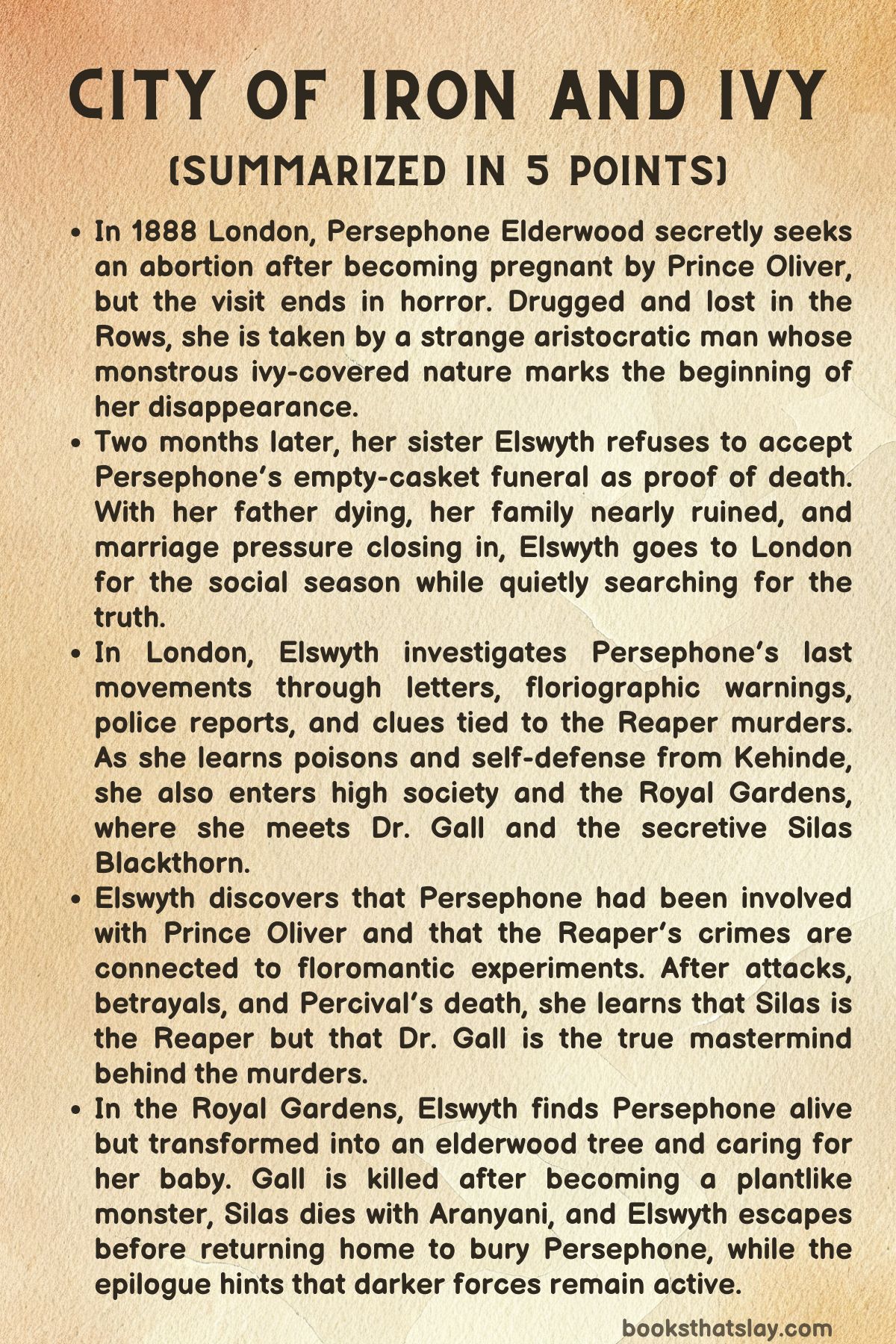
Summary
City of Iron and Ivy opens in 1888 London with Persephone Elderwood in desperate trouble. She has discovered that she is pregnant by Prince Oliver, a secret that could destroy her place in society and bring disgrace upon her family.
With no safe public option available to her, she travels in secret to the Rows, a poor and dangerous part of the city, to visit Lady Sheers, a hedge witch known for helping women in difficult situations. Lady Sheers gives Persephone a potion meant to end the pregnancy, but the treatment leaves her drugged, bleeding, frightened, and unable to think clearly.
Persephone leaves before she has recovered. Her hired coach is gone, and she is forced to wander the slums alone.
In her weakened state, she accepts help from a mysterious aristocratic man in a black carriage. At first, he seems like a rescuer.
Then he gives her a grape that paralyzes her. As she loses control of her body, he reveals that his face is monstrous and overgrown with vines.
Ivy forces its way into her mouth, and Persephone vanishes into a nightmare no one understands.
Two months later, Elswyth Elderwood attends Persephone’s funeral at Elderwood House. The casket is empty, and Elswyth cannot accept that her sister is truly dead.
Her father, Ambrose, insists that the matter is settled, but Elswyth senses lies and avoidance around every explanation. Her grandmother, whose body has been damaged by floromantic warping, urges her to find the man responsible and kill him.
Soon afterward, Elswyth learns that Ambrose is dying from internal warping and that the Elderwood family is almost ruined. Her dream of attending Oxford is no longer financially possible unless she secures a wealthy marriage.
To escape the possibility of being married off to her unpleasant cousin Ficus, Elswyth goes to London for the social season. She stays with her eccentric uncle, Percival Devereux, and his steward, Kehinde Ogunlana.
London offers her both danger and opportunity. On the surface, she must learn how to behave properly in society under the instruction of Madame Vivian Rose.
Beneath that polite education, she begins looking into Persephone’s disappearance.
Elswyth searches through Persephone’s old letters and belongings. She finds a strange dried bouquet whose flowers seem to carry a warning through floriography, the language of flowers.
She also learns about the Reaper, a serial killer who has been murdering women in the Rows and leaving flowers growing from their bodies. The details are too close to Persephone’s fate for Elswyth to ignore.
With Kehinde’s help, she visits the Rows, questions people, and eventually finds Persephone’s ruined gown through a scarred street girl named Gillie. Kehinde proves to be far more than a steward.
He is skilled in combat and begins teaching Elswyth how to defend herself, including lessons in poison and survival.
At the same time, Elswyth enters fashionable society. She visits the Royal Gardens, where Dr. Gall, a botanist and physician, takes an interest in her and offers her a place as his assistant.
This gives her access to scientific and floromantic spaces that may hold answers. She also meets Silas Blackthorn, a dangerous and magnetic outsider connected to the gardens, to Prince Oliver, and to secrets no one wants exposed.
Elswyth is wary of him, but she is also drawn to him. His knowledge, confidence, and strange sadness make him difficult to dismiss.
As Elswyth investigates, she uncovers evidence that Persephone and Prince Oliver had an affair. Oliver had sent Persephone to Lady Sheers when her pregnancy became a problem.
This discovery shifts the case from a family tragedy into a royal scandal. Elswyth begins to understand how many powerful people might want the truth buried.
Her position in society becomes more fragile with each new clue.
The social season becomes increasingly hostile. Captain Burr is murdered with asphodel, and Elswyth is pulled closer to suspicion and danger.
At Syon House, she is framed for causing a rash outbreak, making her look reckless and unfit for respectable company. Queen Viscaria publicly humiliates her, damaging her already uncertain reputation.
Yet Elswyth refuses to stop. Even as society tries to shame her into obedience, she keeps searching for Persephone and for the Reaper.
The Reaper’s violence grows more personal. A mandrake-like creature spies on Elswyth, suggesting that someone is watching her through unnatural means.
An assassin attacks her and nearly kills her. Elswyth survives only by fighting back, and she is badly wounded before killing him in self-defense.
The experience changes her. She is no longer only a clever young woman chasing clues.
She has become someone capable of meeting violence with violence when survival demands it.
Dr. Gall eventually proposes marriage to Elswyth. His offer would give her security, restore her path to Oxford, and protect her from a worse match.
Elswyth accepts after Silas refuses to marry her, though her feelings remain conflicted. On her wedding day, Mrs. Rose helps her finally decode Persephone’s bouquet.
The message tells her to “look within.” This leads Elswyth to discover Oliver’s letter and return to Lady Sheers in search of the missing truth.
There, the Reaper attacks. To Elswyth’s horror, he is revealed to be Silas Blackthorn.
He abducts Mrs. Rose and escapes through the sewers, leaving Elswyth shaken and betrayed. The man she had trusted, desired, and tried to understand is tied directly to the murders.
Elswyth, Percival, and Kehinde push deeper into the truth behind the Reaper. The cost becomes devastating when another mandrake kills Percival.
Elswyth follows Silas into the Royal Gardens, where the full horror is revealed. Persephone is alive, but not free.
She has been fused into an elderwood tree and is nursing her baby, Prince Oliver’s son. Her body has become part of a floromantic experiment.
The Reaper killings were never random acts of madness. Dr. Gall has been using murdered women to harvest wombs and floromantic power for experiments meant to resurrect Silas’s dead wife, Aranyani.
Silas has helped Gall because of grief. His love for Aranyani made him vulnerable to Gall’s promises and blind to the cruelty of the work.
But when Gall threatens Elswyth, Silas turns against him. The final confrontation breaks open in the Royal Gardens.
Gall mutates into a plantlike monster, the experiments spiral out of control, and fire spreads through the gardens. Elswyth fights through terror, grief, and betrayal, and she kills Gall, ending his immediate threat.
Silas remains behind with Aranyani as the building collapses. Elswyth escapes, but not untouched.
She has lost Percival, lost the sister she once hoped to save whole, and seen the corruption beneath London’s polished surface. Afterward, she returns home and gives Persephone a proper burial.
She inherits what remains of her family’s damaged life and prepares to leave England with Kehinde, carrying Percival’s ashes to Africa.
The epilogue shows that the danger has not fully ended. Queen Viscaria is assassinated by a woman connected to the same dark forces surrounding Aranyani.
The ending closes Elswyth’s search for Persephone, but it leaves the larger world unsettled. The forces that fed on grief, power, bodies, and magic are still moving, and London’s iron order remains vulnerable to the ivy growing beneath it.
Characters
Elswyth Elderwood
Elswyth Elderwood is the central force of City of Iron and Ivy, and her character is shaped by grief, anger, intelligence, and a growing refusal to accept the limits placed on her. At the beginning of the book, she is trapped between family expectations and personal ambition.
Her desire to attend Oxford shows that she wants a life built on learning and independence, but her family’s financial collapse and her father’s illness threaten to reduce her future to marriage and obedience. Persephone’s disappearance becomes the emotional wound that drives Elswyth forward, but her investigation is not only about solving a mystery.
It is also about reclaiming power in a world that repeatedly tries to silence young women, especially women whose reputations can be damaged more easily than their actual bodies can be protected.
Elswyth’s development is especially important because she begins as someone underestimated by nearly everyone around her. Society views her as a young woman to be trained, displayed, married, and controlled, but the story gradually reveals her courage, sharpness, and moral endurance.
Her visits to the Rows, her study of poisons, her work in the Royal Gardens, and her willingness to confront dangerous men all show that she is learning how to survive in a brutal world. She is not fearless in a simple heroic sense; she is often afraid, wounded, confused, and emotionally torn.
What makes her powerful is that she continues acting even when fear is reasonable.
Her relationships also reveal the complexity of her character. With Persephone, Elswyth carries both sisterly love and survivor’s guilt.
With Kehinde, she finds a mentor who respects her strength instead of treating her as fragile. With Silas, she experiences attraction, suspicion, betrayal, and heartbreak, showing that her emotional vulnerability does not cancel her intelligence.
With Dr. Gall, she is briefly tempted by the safety he offers, which makes her decision to resist him more meaningful. By the end of the book, Elswyth has become someone who understands that survival requires both tenderness and violence.
Her final escape and later decision to travel with Kehinde suggest that she is no longer willing to let inheritance, family ruin, or social judgment define her future.
Persephone Elderwood
Persephone Elderwood is one of the most tragic figures in the book because much of the plot is built around what happens to her body, her reputation, and her hidden choices. Her pregnancy by Prince Oliver places her in a dangerous position, not because she has done something uniquely immoral, but because society gives men freedom while punishing women for the consequences of desire.
Her secret journey to the Rows shows desperation, shame, and fear. She is trying to solve a crisis alone because the world around her offers no safe or honorable path.
Her visit to Lady Sheers is therefore not merely a plot event; it reveals how abandoned she is by the social structures that should protect her.
Persephone’s suffering becomes even more horrifying because she is turned from a missing woman into a living experiment. When she is later discovered fused into an elderwood tree and nursing her child, her character embodies the book’s deepest fears about womanhood being consumed, harvested, and transformed by male ambition.
She is alive, but her life has been stolen from her. She is a mother, but motherhood has been twisted into captivity.
Her body becomes both sacred and violated, natural and monstrous, maternal and imprisoned. This makes her one of the most emotionally disturbing characters in the story.
Even though Persephone is absent for much of the action, her presence shapes almost every major decision Elswyth makes. She represents the truth hidden beneath polite society, the cost of royal carelessness, and the cruelty of scientific obsession.
Her final proper burial matters because it restores dignity to someone whose body and story were repeatedly used by others. Persephone’s character is therefore not only a victim; she is the emotional center around which the book’s themes of grief, exploitation, sisterhood, and justice revolve.
Silas Blackthorn
Silas Blackthorn is one of the most morally conflicted characters in the story. He first appears as a dangerous and charming outsider, a figure who attracts Elswyth because he seems to understand the darker truths beneath London’s polished surfaces.
His connection to the Royal Gardens, Prince Oliver, and the hidden violence surrounding the Reaper murders makes him both fascinating and suspicious. He carries the atmosphere of a romantic antihero, but the book gradually reveals that his mystery is not harmless.
His secrets are tied to real violence, deception, and death.
Silas’s deepest motivation is grief. His devotion to Aranyani explains much of his corruption, but it does not excuse it.
He helps Dr. Gall because he wants to recover the woman he lost, and this makes him a character driven by love that has become diseased. His love is powerful, but it has turned selfish and destructive because he allows innocent women to suffer for the possibility of restoring one dead person.
This makes him tragic, but not innocent. The reveal that he is the Reaper forces the reader to reconsider his charm, because the same man who shows tenderness and attraction toward Elswyth is also responsible for terror and murder.
His relationship with Elswyth is one of the most emotionally complicated parts of the book. Silas is drawn to her courage and intelligence, and his decision to turn against Gall when Elswyth is threatened shows that some moral feeling remains inside him.
However, his affection for her cannot erase the horror of what he has done. He is not a simple villain because he is capable of love, regret, and sacrifice, but he is also not a true hero because his grief led him into monstrous choices.
His ending beside Aranyani as the building collapses feels like the natural conclusion of a man who could not separate love from obsession.
Dr. Gall
Dr. Gall is the main villain of the book and represents the cold cruelty of ambition disguised as science. At first, he appears respectable: a botanist, physician, and possible husband who offers Elswyth security, Oxford, and social protection.
This makes him dangerous because his evil is hidden beneath manners, education, and usefulness. Unlike more openly threatening characters, Dr. Gall understands how to use respectability as a shield.
He moves through society as a learned man while secretly committing horrific acts against vulnerable women.
His experiments reveal his complete moral emptiness. He uses the Reaper murders to harvest wombs and floromantic power, treating women’s bodies as materials rather than human lives.
His desire to resurrect Aranyani may seem connected to love or scientific wonder, but his actions prove that he values control more than compassion. He is willing to exploit Persephone, manipulate Silas, deceive Elswyth, and destroy others in pursuit of his goal.
His obsession with resurrection is really an obsession with mastery: mastery over death, nature, women, and the boundaries of the human body.
Dr. Gall’s final mutation into a plantlike monster makes visible what he has been internally all along. His body becomes a reflection of his corrupted science and unnatural hunger for power.
In contrast to Elswyth, who learns from plants, poisons, and violence in order to survive, Gall uses knowledge to dominate and consume. His death at Elswyth’s hands is important because it reverses the power structure he depends on.
The young woman he tried to possess through marriage and control becomes the person who destroys him.
Prince Oliver
Prince Oliver is a character whose weakness and privilege cause immense harm. His affair with Persephone exposes the hypocrisy of the upper classes, especially the way powerful men can create scandal and then distance themselves from its consequences.
He does not appear as the most violent figure in the book, but his irresponsibility sets Persephone’s tragedy in motion. By sending her to Lady Sheers for an abortion, he treats her crisis as a problem to be managed rather than a life he has helped endanger.
Oliver’s importance lies in the gap between his social position and his moral courage. As a prince, he has status, protection, and influence, but he fails to use any of these to protect Persephone.
His privilege allows him to remain insulated while she is forced into secrecy, risk, and humiliation. In this way, he represents a softer but still devastating form of cruelty: the cruelty of cowardice.
He may not be the mastermind, but his choices create the conditions that allow others to prey on Persephone.
His son also complicates his role in the story. The child is a living reminder of Oliver’s actions and of Persephone’s suffering.
Through Oliver, the book criticizes aristocratic entitlement and the gendered injustice of reputation. He is not monstrous in the same way as Gall, but his negligence shows that social power does not need to be openly violent to destroy lives.
Kehinde Ogunlana
Kehinde Ogunlana is one of the strongest supporting characters in the book because he offers Elswyth the guidance, protection, and practical education that polite society refuses to give her. As Percival’s steward, he initially appears to occupy a service role, but the story quickly reveals that he has his own strength, discipline, intelligence, and history.
His combat skill and knowledge of poisons make him a crucial ally, but his value is not limited to physical protection. He helps Elswyth understand danger clearly and prepares her to act rather than remain dependent.
Kehinde’s relationship with Elswyth is built on respect. He does not treat her as a helpless young lady whose only future is marriage.
Instead, he teaches her how to defend herself, how to think tactically, and how to survive in places where social training is useless. This makes him a counterpoint to characters like Madame Rose and Dr. Gall.
While others try to shape Elswyth for society or control her future, Kehinde helps her become more capable on her own terms.
His planned journey with Elswyth to Africa at the end gives his character a sense of emotional and narrative importance beyond the London mystery. He represents movement, survival, and a wider world beyond the suffocating structures of English aristocracy.
Carrying Percival’s ashes with Elswyth also connects him to grief, loyalty, and chosen family. Kehinde is therefore both protector and liberator, helping Elswyth move from reaction to agency.
Percival Devereux
Percival Devereux is Elswyth’s eccentric uncle and one of the warmer figures in the story. He offers her shelter in London when her family’s circumstances force her into the social season, and his household becomes a space where oddness and intelligence can exist more freely than at Elderwood House.
His eccentricity gives him charm, but it also suggests that he stands somewhat outside the rigid expectations of conventional society. This makes him a valuable figure for Elswyth, who herself is struggling against those expectations.
Percival’s importance grows because he becomes part of Elswyth’s chosen circle of trust. He may not be the central investigator, but his support gives her room to pursue the truth.
His connection to Kehinde also reflects his openness to relationships and loyalties that do not fit neatly into aristocratic norms. In a book filled with men who exploit, dismiss, or manipulate women, Percival’s kindness matters.
His death at the hands of a mandrake is emotionally significant because it shows the cost of seeking the truth. The danger surrounding Elswyth is not abstract; it takes people she loves.
Percival’s death also marks a point of no return, deepening Elswyth’s grief while strengthening her determination. His ashes at the end symbolize memory, loyalty, and the burden of carrying the dead into whatever future remains.
Ambrose Elderwood
Ambrose Elderwood is Elswyth and Persephone’s father, and his character reflects the decline of the Elderwood family. He dismisses Elswyth’s suspicions about Persephone’s death, showing either emotional denial, patriarchal blindness, or a desire to preserve appearances.
His inability or unwillingness to take Elswyth seriously forces her to become the investigator her family refuses to be. In this sense, Ambrose represents the failure of paternal protection.
His illness from internal warping also makes him a symbol of family decay. The Elderwood name may still carry social meaning, but beneath that surface the family is physically, financially, and morally collapsing.
Ambrose’s dying condition mirrors the ruined estate and the shrinking options available to Elswyth. Because he cannot secure her future, she is pushed toward marriage as a financial solution, even when that marriage might destroy her independence.
Ambrose is not presented as a grand villain, but his weakness has consequences. His failure to believe Elswyth and his inability to protect Persephone leave both daughters vulnerable in different ways.
He embodies a fading patriarchal order: still powerful enough to restrict women, but too damaged to save them.
Elswyth’s Grandmother
Elswyth’s grandmother is a disturbing and prophetic figure, ravaged by floromantic warping and yet able to see the seriousness of Persephone’s fate more clearly than Ambrose does. Her physical condition makes her a living warning about the dangers of floromancy and the way nature can deform the human body when power goes wrong.
She belongs to the gothic atmosphere of the book, where family houses, bloodlines, and bodies all carry signs of hidden rot.
Her command that Elswyth find the man responsible and kill him is extreme, but it gives voice to the rage that polite society suppresses. Unlike Ambrose, she does not soften Persephone’s disappearance with denial.
She recognizes that violence has been done and that justice may require violence in return. Her words help push Elswyth from mourning into action.
The grandmother’s role is brief but powerful because she connects family memory, bodily horror, and vengeance. She shows that the older generation is not united in passivity.
Although warped and diminished, she gives Elswyth permission to be ruthless in a world where gentleness alone would leave her defenseless.
Lady Sheers
Lady Sheers is a hedge witch whose role in the story sits in a morally gray space. Persephone goes to her in a moment of fear and desperation, seeking a potion to end her pregnancy.
Lady Sheers is connected to hidden female knowledge, bodily secrecy, and the dangerous services women must seek when respectable society gives them no safe choices. Her presence reveals the underground systems that exist beneath official morality.
At the same time, Lady Sheers is not presented as purely comforting or safe. The potion leaves Persephone drugged, bleeding, and disoriented, and Persephone’s early departure places her directly in danger.
Lady Sheers becomes part of the chain of events that leads to Persephone’s abduction, even if she is not the ultimate predator. Her character shows how limited and risky women’s options are when their bodies become sites of scandal.
Her later encounter with Elswyth is important because it brings the hidden truth closer to the surface. Lady Sheers belongs to the shadow-world of the Rows, where knowledge exists outside royal gardens, medical institutions, and aristocratic homes.
Through her, the book contrasts folk practice with institutional science, showing that both can be dangerous, but only one is protected by status.
Madame Vivian Rose
Madame Vivian Rose is initially associated with etiquette, social training, and the performance of femininity. She teaches Elswyth how to move through society, which might make her seem like an agent of restriction.
However, her character becomes more layered as the story progresses. She understands the language of appearances, but she also understands coded meanings, especially through floriography.
This makes her a guide to both social survival and hidden communication.
Mrs. Rose’s role in decoding Persephone’s bouquet is crucial because it helps Elswyth discover the instruction to “look within.” This moment transforms Madame Rose from a figure of manners into a figure of revelation. She helps uncover Persephone’s voice from beyond disappearance and presumed death.
Her knowledge of flowers is not decorative; it becomes investigative and emotionally powerful.
Her abduction by Silas raises the stakes and shows that even women who know how society works are still vulnerable to the violence beneath it. Madame Rose represents the intelligence hidden inside traditionally feminine arts.
Etiquette, flowers, and coded language may look ornamental to men like Gall, but in the hands of women, they become tools of resistance.
Queen Viscaria
Queen Viscaria represents the cruelty of public power and social judgment. Her humiliation of Elswyth shows how authority can be used not only through law or violence, but through spectacle.
As queen, she has the ability to define reputation, and reputation is one of the most dangerous weapons in the world of the book. Her treatment of Elswyth reinforces the social order that punishes women for suspicion, scandal, or simply failing to perform correctly.
Her name and presence also connect her to the book’s botanical atmosphere, where beauty and danger often exist together. She is regal, but not nurturing; powerful, but not just.
Her role reminds readers that the corruption of the world is not limited to hidden laboratories and sewer tunnels. It also exists in courts, ceremonies, and polite gatherings.
Her assassination in the epilogue suggests that the forces unleashed during the story extend beyond Elswyth’s personal battle. Queen Viscaria’s death widens the scope of danger and implies that the conflict surrounding floromancy, Aranyani, and hidden violence is not finished.
She is therefore both a symbol of oppressive authority and a sign that even the powerful are not safe.
Ficus
Ficus is Elswyth’s repulsive cousin and represents the ugly practical reality of marriage as a financial trap. He does not need to be deeply developed to serve an important function in the book.
His presence shows what Elswyth might be forced into if she cannot secure another future. The threat of marrying him makes the loss of Oxford and the family’s financial ruin feel immediate and personal.
As a character, Ficus embodies the way women’s futures can be negotiated through family convenience rather than personal choice. He is not merely unpleasant; he is the symbol of a life Elswyth finds intolerable.
His role helps explain why she goes to London for the season and why marriage becomes such a pressing issue throughout the story.
Ficus also contrasts with Elswyth’s intellectual ambition. While she dreams of Oxford, he represents confinement, disgust, and surrender.
Through him, the book makes clear that Elswyth’s search for a husband is not romantic freedom but survival under pressure.
Gillie
Gillie is the scarred street girl who helps Elswyth find Persephone’s ruined gown, and her character brings the suffering of the Rows into sharper focus. She belongs to the part of London that aristocratic society would rather ignore.
Her scars and streetwise presence suggest a life shaped by danger, poverty, and early exposure to violence. Unlike the women of drawing rooms and royal events, Gillie cannot rely on reputation to protect her; she survives through knowledge, caution, and usefulness.
Her role in finding the gown is important because she helps connect Persephone’s aristocratic tragedy to the physical reality of the slums. Persephone’s disappearance is not just a family mystery; it is tied to a place where vulnerable women can vanish, be harmed, and be forgotten.
Gillie becomes a bridge between Elswyth’s world and the Rows.
Although she is a supporting character, Gillie adds moral texture to the story. She reminds readers that Elswyth’s investigation passes through lives already marked by hardship.
Her presence helps prevent the Rows from being merely a gothic setting; it becomes a human space filled with people who have their own wounds and survival strategies.
Captain Burr
Captain Burr is significant because his murder with asphodel shows how the violence of the Reaper plot reaches into public and social spaces. His death is one of the events that turns Elswyth’s London season into a field of danger rather than opportunity.
The use of a flower-associated method also strengthens the book’s pattern of beauty becoming lethal.
As a character, Captain Burr functions less as an emotionally developed figure and more as a sign of escalation. His murder proves that the killer’s methods are not confined to the Rows and that the world Elswyth is moving through is far more dangerous than it appears.
Social events, which should help her secure a future, become scenes of death, suspicion, and fear.
His death also contributes to the atmosphere of uncertainty around Elswyth. As disasters gather near her, she becomes easier to frame, isolate, and discredit.
Captain Burr’s role therefore supports the larger pattern of manipulation that surrounds her investigation.
Aranyani
Aranyani is central to the motives of both Silas and Dr. Gall, even though she exists largely as a lost or altered figure. She is the dead wife Silas cannot release and the being Gall wants to resurrect through terrible experiments.
Because of this, she becomes less a conventional character and more a haunting presence at the center of the book’s obsession with death, love, and unnatural restoration.
Her importance lies in the way others respond to her absence. Silas’s grief for her becomes the emotional weakness that Gall exploits.
Gall’s desire to bring her back becomes the justification for murder and bodily violation. Aranyani therefore reveals how love, when mixed with possession and scientific arrogance, can become monstrous.
The men around her claim to act in the name of restoration, but their actions create more death.
The epilogue’s connection between Aranyani and the woman who assassinates Queen Viscaria suggests that Aranyani’s influence or associated forces may extend beyond the final fire. She remains mysterious, dangerous, and unresolved.
Her character gives the ending a sense of lingering supernatural threat, suggesting that Gall’s death may not have ended the deeper darkness.
Themes
The Control of Women’s Bodies
City of Iron and Ivy presents a world where women’s bodies are treated as objects to be managed, hidden, punished, or used for power. Persephone’s pregnancy becomes a crisis not because of her own needs, but because it threatens royal reputation, family status, and social order.
Her visit to Lady Sheers shows how women are pushed into danger when respectable society denies them safety, choice, and protection. The Reaper murders make this theme even darker, as Gall turns women’s bodies into materials for his experiments.
His crimes expose the extreme end of a culture that already sees women as useful only when they serve male ambition, inheritance, desire, or scientific progress. Elswyth’s own future is also controlled by marriage expectations, money, and reputation.
Her intelligence and Oxford dreams matter less to society than her ability to marry well. Through these experiences, the story shows that bodily freedom and social freedom are closely connected.
Grief and the Damage It Can Cause
Grief drives many characters, but the story shows that sorrow becomes dangerous when it turns into obsession. Elswyth’s grief over Persephone pushes her to search for the truth, and in her case, grief becomes a force of courage and loyalty.
She refuses to accept the easy explanation given by her family and society, because love makes her question what others ignore. Silas, however, represents grief that has become destructive.
His longing for Aranyani leads him into Gall’s experiments and the Reaper murders, even though each crime demands more suffering from innocent women. Gall also uses grief as an excuse for cruelty, hiding monstrous ambition behind the language of restoration and love.
The contrast between Elswyth and Silas is important: both suffer loss, but Elswyth seeks justice while Silas helps create more victims. The story suggests that grief does not excuse harm; it reveals the moral choices people make after loss.
Class, Reputation, and Social Hypocrisy
Victorian society in the story is obsessed with manners, marriage, bloodline, and public appearance, but beneath that polished surface there is corruption, violence, and neglect. Elswyth enters London society because her family’s financial ruin leaves her few options, proving that reputation is often tied to survival rather than personal pride.
The wealthy protect themselves through silence, while the poor women of the Rows are left exposed to danger. Persephone’s disappearance is not treated with the urgency it deserves because scandal matters more than truth.
The Reaper’s victims are easy for society to overlook because they come from spaces already dismissed as dirty, immoral, or disposable. Social events, etiquette lessons, and royal humiliations show a world where cruelty can hide behind politeness.
The contrast between glittering gardens and suffering streets reveals the hypocrisy of a society that calls itself civilized while allowing its most vulnerable people to be hunted, shamed, and forgotten.
Knowledge, Power, and Moral Responsibility
Knowledge in the story is never neutral; it can heal, protect, exploit, or destroy depending on who uses it and why. Elswyth’s education, investigation, and training help her survive in a world designed to limit her.
Her learning gives her the ability to read hidden messages, understand poisons, question evidence, and defend herself. In contrast, Gall’s scientific knowledge becomes monstrous because it is separated from compassion.
His skill as a botanist and physician should make him a healer, but he uses it to harvest bodies and force nature into serving his private obsession. The Royal Gardens become a symbol of this corrupted knowledge: beautiful on the surface, but filled with secrets, experiments, and violence.
Kehinde’s practical knowledge also matters because it teaches Elswyth that survival requires more than social polish. The story argues that intelligence alone is not admirable.
Knowledge becomes meaningful only when guided by responsibility, empathy, and respect for human life.