Crown Me Yours Summary, Characters and Themes
Crown Me Yours by Liv Zander is a dark fantasy romance about a reluctant queen, a cursed kingdom, and Death himself. Elara begins as a common gravedigger, far from power, but after killing King Kael during a coronation rite, she inherits both the throne and a terrible curse.
The crown fastened to her skull marks her as ruler, yet it also ties her to a dying realm filled with rot, plague, hunger, and fear. Her only path to saving her people leads to Vale, Death in human form, whose hatred, loneliness, and hidden longing become central to the kingdom’s fate. It’s the 2nd book of the Heartstring Duet and the sequel to Crown Me Dead.
Summary
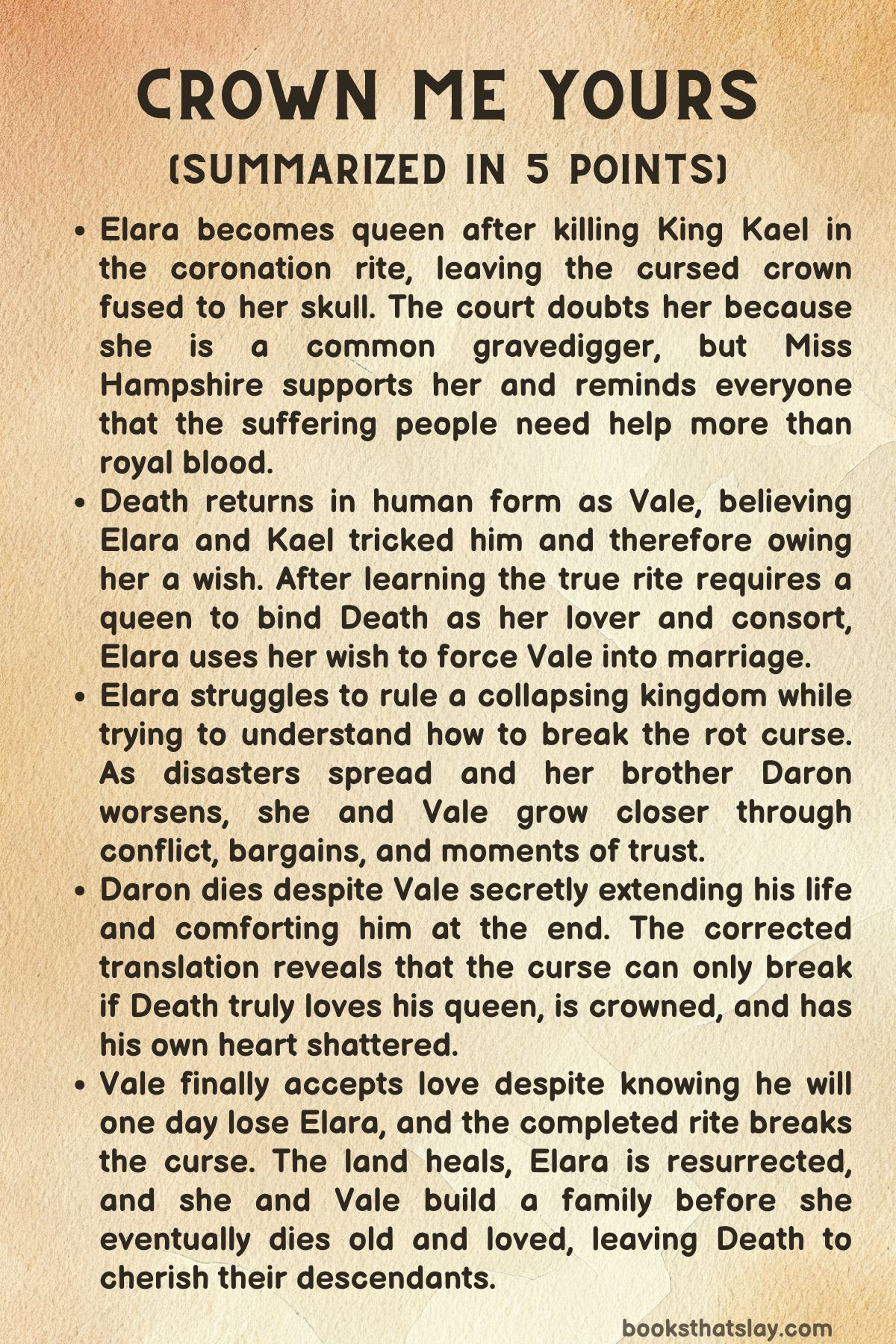
Elara’s reign begins with death, mud, and suspicion. After killing King Kael in the coronation rite, she helps bury him beside her mother, carrying the weight of a crown that has fused itself to her skull.
The act has made her queen, but not in a way the court, priests, or nobles can easily accept. She is a gravedigger, a common woman, and now the ruler of a kingdom already collapsing under famine, plague, and a spreading rot curse.
The powerful people around her are unsettled by the idea that someone of her birth could rule, but Miss Hampshire speaks in her defense. She argues that the people starving in villages and dying from sickness care far more about survival than royal blood.
Elara has no clear idea how Kael expected her to end the curse. She only knows the kingdom is failing and her own brother, Daron, is growing worse from the rot.
The crown has given her power, but it has also trapped her inside a duty she barely understands. Her grief and fear sharpen when Death returns to her in his human guise, Vale.
He believes Elara and Kael tricked him during the rite, and because of that belief, he owes her a wish. Elara first tries to use the wish to remove the curse, but Vale tells her he cannot undo a binding older than himself in that simple way.
She thinks about wishing Daron well, or saving her mother, but realizes any such help would only delay death rather than defeat the curse.
A secret messenger named Corvin Hale reaches Elara with the truth Kael uncovered before his death. The old curse had been deliberately mistranslated to keep power in the hands of kings.
The original rite was never meant for a king at all. It required a queen to bind Death to herself as lover and consort, share his bed, crown him, and spill his blood over the crown.
Elara realizes that her path forward depends on forcing Vale into the ritual. Since Vale believes he owes her a wish, she demands marriage.
Vale is furious, but he is bound by the terms of the wish. Their wedding is tense, strange, and filled with dread.
Elara’s mother, Miss Hampshire, and a terrified priest witness the ceremony. Elara does not marry Vale out of romance, but out of desperation.
Her kingdom is dying, her brother is fading, and she has no other weapon strong enough to fight an ancient curse. Vale, meanwhile, resents being bound to her and resists the role the rite demands of him.
Their marriage begins as a battle of wills, with duty and anger standing between them.
As queen, Elara must learn to rule while the kingdom falls apart around her. A dam breaks, rotting corpses threaten towns, and desperate people gather at the gates.
Instead of hiding behind royal custom, she begins making practical decisions with Miss Hampshire’s help. She sees the scale of suffering beyond palace walls and understands that saving the kingdom cannot be only a mystical task.
It is also political, human, and immediate. Food, bodies, water, shelter, fear, and order all demand her attention.
At the same time, Elara continues searching for the true meaning of the curse. She forces a priest to retranslate the old language and confronts the lies that have protected royal authority for generations.
The more she learns, the clearer it becomes that Kael’s version of the rite was incomplete. Death cannot simply be used as a tool.
The curse requires something deeper and more painful than a forced marriage or spilled blood.
Elara and Vale’s relationship changes slowly through conflict, bargains, and moments of closeness neither fully trusts. Vale is not only a godlike figure; he is also lonely, proud, wounded, and afraid of being known.
Elara demands to see his true form, and he finally reveals himself as a being divided between flesh and bone, beauty and horror, life’s shape and death’s certainty. Instead of turning away, Elara touches him.
Her acceptance unsettles him. She sees the broken heart inside him, not as a weakness to mock, but as proof that even Death can suffer.
Vale begins to fall in love with her, though the feeling frightens him. He is eternal, and love to him means eventual loss.
Everyone he loves must die. Rather than accept that vulnerability, he damages one of his healing heartstrings, trying to protect himself from the growing bond between them.
Elara, however, continues pushing toward the truth of the rite, because she has no time to let him hide from himself.
For a brief while, Daron seems to improve, giving Elara hope that the curse might be weakening or that Vale’s power might save him. That hope breaks when Vale tells her Daron is dying.
He admits he has already stretched Daron’s life as far as he can. In terror and grief, Elara acts too soon.
She slashes Vale’s throat and places the crown on him, trying to force the ritual to completion before her brother dies. But the rite is not ready.
It is not enough. Daron dies before Elara can reach him.
Daron’s death devastates her. At his funeral, she learns something that changes how she sees Vale.
He had sat with Daron at the end, held his hand, and told him not to be afraid. Vale could not save him, but he did not abandon him.
This act does not erase Elara’s grief, yet it reveals that Death is capable of mercy. It also shows that Vale’s feelings for her and her family have grown beyond bargain or obligation.
The corrected translation finally reveals the full truth. The curse can only be broken when Death loves his queen, beds her, is crowned, and suffers the shattering of his own heart.
Blood alone cannot end it. A forced rite cannot end it.
Death must choose love, knowing it will wound him. Elara and Vale finally speak honestly about what stands between them.
Vale admits that love terrifies him because he must outlive everyone. To love mortals is to accept grief again and again.
Elara argues that avoiding grief is not the same as living. Refusing love may prevent pain, but it also prevents joy, family, loyalty, and meaning.
Vale eventually chooses Elara and the kingdom, fully aware of what that choice will cost him. In the throne room, Elara places the crown on Death’s head.
Vale reveals his true form and confesses his love for her. Then he cuts her throat.
As Elara dies, the crown melts and releases the missing piece of his broken heart. His heart becomes whole, and the curse finally breaks.
The rot ends. The land begins to heal.
Instead of leaving Elara dead, Vale resurrects her, bringing her back into a world no longer ruled by decay.
After the curse is broken, Elara and Vale build a life together as queen and Death. Their bond, once born from anger and necessity, becomes a real marriage.
Elara becomes pregnant, and Vale faces the fear that comes with loving a mortal family. Their children, including Maren, Rowan, and Edmund, give him new reasons to remain present instead of living only in dread of future loss.
The kingdom heals, their family grows, and Vale becomes not just Death, but a husband and father.
Years pass, and Elara grows old surrounded by love. Vale cannot stop time, and he cannot keep her mortal life from ending, but he no longer sees that truth as a reason to reject love.
When Elara finally dies, he carries her soul gently into rest. Generations later, Death continues watching over their descendants.
He no longer sees mortals only as lives that will end. Through Elara, he learns to see them as continuations of love, memory, and the present.
Crown Me Yours ends as a story about sacrifice, mortality, devotion, and the courage required to love what cannot last forever.
Characters
Elara
Elara is the central figure of Crown Me Yours, and her character is defined by an extraordinary movement from powerlessness to authority. At the beginning of the book, she is a common gravedigger, someone associated with death, poverty, and the suffering of ordinary people rather than royal privilege.
This background makes her rise to queenship shocking to the court and the priests, but it also makes her uniquely suited to understand the kingdom’s pain. Unlike rulers who think in terms of inheritance, ceremony, or political image, Elara understands hunger, sickness, grief, and survival.
Her position as queen is therefore not merely a change in status; it becomes a test of whether someone from the lowest part of society can rule with more humanity and courage than those born into power.
Elara’s strength comes from her refusal to accept helplessness. After killing King Kael and becoming bound to the cursed crown, she does not fully understand what she has inherited, yet she continues searching for a way to save the kingdom and her family.
Her brother Daron’s illness gives her mission a deeply personal urgency, but her concern gradually expands beyond her own household. She has to confront broken dams, rotting corpses, frightened citizens, suspicious priests, and a court that doubts her legitimacy.
Through these pressures, Elara proves that leadership is not about noble blood but about action, endurance, and moral responsibility. She is inexperienced, but she is not passive.
Even when she is afraid, she makes decisions.
Her relationship with Vale reveals another important side of her character. Elara is bold, strategic, and emotionally perceptive.
When she learns that Death owes her a wish, she does not waste the opportunity on a temporary solution. Instead, she uses the wish to force a marriage that might break the curse, even though it places her in direct conflict with a furious immortal being.
This decision shows both desperation and intelligence. Elara is willing to bargain with Death because she understands that ordinary solutions cannot solve an ancient curse.
However, she is not simply manipulative. As she spends more time with Vale, she begins to see his loneliness, fear, and wounded heart.
Her ability to touch his true form without disgust becomes one of the clearest signs of her emotional courage.
Elara is also a character shaped by grief. Daron’s death breaks through her determination and exposes the limits of her control.
Her attempt to complete the ritual too early by slashing Vale’s throat shows how panic and love can make her reckless. She wants to save her brother so badly that she acts before the truth is fully understood.
Yet this mistake does not make her weak; it makes her human. Her grief becomes part of her wisdom.
Later, when she argues that Vale cannot avoid love simply to avoid future loss, she speaks from the truth of someone who has suffered deeply and still chooses life. By the end of the story, Elara becomes a queen not only because she wears a crown, but because she embodies sacrifice, compassion, and the willingness to love despite pain.
Vale
Vale, the human guise of Death, is one of the most emotionally complex figures in the book. As Death, he is ancient, powerful, and feared, but the story presents him not as a simple villain or distant supernatural force.
Instead, Vale is a being burdened by eternity. His power isolates him because every mortal connection contains the certainty of loss.
This makes him defensive, angry, and deeply suspicious when he believes Elara and Kael have tricked him. His fury after being bound to marry Elara comes from more than pride; it comes from fear of being forced into intimacy, vulnerability, and emotional dependence.
Vale’s true form reflects his inner conflict. He is half-flesh and half-skeletal god, a visual embodiment of life and death existing together.
When Elara asks to see him as he truly is, he expects fear or rejection. Her acceptance unsettles him because it challenges the way he sees himself.
Vale has long believed that his nature makes him unlovable or too dangerous to be loved. Elara’s touch does not erase his pain, but it begins to heal something in him.
His broken heart becomes one of the most important symbols of his character, showing that even Death can be wounded by love, loneliness, and fear.
His relationship with Daron reveals Vale’s hidden tenderness. Although he cannot save Daron permanently, he stretches the boy’s life as far as he can.
More importantly, he sits with Daron at the end, holds his hand, and comforts him so that he does not die afraid. This moment is crucial because it shows that Vale is not emotionless.
He understands fear at the edge of death, and he is capable of mercy. His compassion is quiet, but it is real.
It also changes how the reader understands him: he is not merely the force that takes life, but also a presence that can guide souls gently when life ends.
Vale’s greatest struggle is his fear of love. When he realizes he is falling for Elara, he damages one of his own healing heartstrings because he cannot bear the vulnerability that love brings.
This act shows the depth of his terror. For an immortal, love is not only joy; it is a future wound waiting to happen.
His eventual choice to love Elara and help break the curse is therefore a profound act of courage. He accepts that he will one day lose her, but he chooses the fullness of love over the emptiness of emotional safety.
By the end of the book, Vale becomes a devoted husband, father, and guardian of his descendants, proving that Death can learn to honor life not by possessing it forever, but by cherishing it while it lasts.
King Kael
King Kael is a character whose presence continues to shape the story even after his death. Although he is buried early in the book, his discoveries and choices create the path that Elara must follow.
Kael’s role is complicated because he is both part of the old royal system and someone who uncovered the truth that system tried to hide. His research into the curse reveals that the traditional understanding of the coronation rite was built on mistranslation and manipulation.
The curse was preserved in a way that kept power passing through kings, which suggests that Kael belonged to a monarchy built on deception, but also that he may have been trying to expose or undo that deception.
Kael’s death places Elara in a position she never expected. By dying in the coronation rite and leaving the crown fused to her skull, he becomes the bridge between the old order and the new one.
His role is therefore more symbolic than active. He represents the failure of inherited power, but also the possibility that someone within that system recognized the need for change.
The fact that Elara, a common gravedigger, becomes queen after him shows that the kingdom’s salvation cannot come from bloodline alone. Kael’s importance lies in the knowledge he leaves behind and the disruption his death creates.
There is also a tragic quality to Kael because he seems to have understood only part of what needed to happen. He discovered that the curse involved a queen binding Death as lover and consort, but the deeper emotional requirement, Death’s love and the shattering of his heart, becomes clear only later.
This makes Kael a figure of incomplete knowledge. He sets the solution in motion, but he cannot complete it himself.
His legacy depends on Elara’s courage, Vale’s transformation, and the corrected truth of the ancient language. In this way, Kael functions as a catalyst, a dead king whose hidden discovery allows a living queen to remake the future.
Daron
Daron is one of the emotional anchors of the story. As Elara’s brother, he gives her struggle a personal and intimate urgency.
The rot curse is not abstract to Elara because it is destroying someone she loves. Daron’s worsening illness constantly reminds her that every delay has consequences.
Through him, the book shows the cruelty of the curse on a human scale. It is not only a political or magical problem; it is a disease that steals breath, time, and family.
Daron’s importance comes partly from his vulnerability. He does not drive the plot through power or strategy, but through the love others have for him.
Elara’s desperation to save him shapes many of her decisions, including her attempt to force the ritual forward before the conditions are complete. His illness reveals both the nobility and the danger in Elara’s love.
She is willing to challenge priests, bargain with Death, and risk everything for him, but her fear of losing him also pushes her into rash action. Daron therefore becomes a mirror for Elara’s deepest emotional weakness: the terror of being unable to save someone she loves.
His death is one of the most important turning points in the book. It proves that neither Elara’s determination nor Vale’s power can prevent every loss.
Vale can stretch Daron’s time, but he cannot undo the binding of the curse or grant a permanent escape from mortality. Daron’s passing forces Elara to confront the difference between saving the kingdom and saving one beloved person.
It also deepens her understanding of grief, which later allows her to speak honestly to Vale about love and loss.
Daron also helps reveal Vale’s compassion. The fact that Vale sits with him, holds his hand, and tells him not to be afraid gives Daron’s death a quiet dignity.
Daron is not simply a victim of the curse; he becomes the person through whom Elara and Vale both learn something essential. Elara learns that love cannot always prevent death, and Vale shows that Death can be gentle.
Daron’s life is brief, but his influence is lasting.
Elara’s Mother
Elara’s mother represents family, grief, and the ordinary human world that Elara comes from. Her presence at King Kael’s burial and later at Elara’s marriage to Vale keeps the story grounded in personal ties rather than only royal or supernatural conflict.
She is connected to the life Elara had before the crown, a life marked by labor, loss, and survival. Through her, Elara remains emotionally tied to her origins even after becoming queen.
As a mother, she also reflects the cost of the kingdom’s suffering on families. The rot curse threatens her son, and Elara’s sudden rise to power places her daughter in danger.
She is not presented as a political force in the same way Miss Hampshire is, but her role is still important because she represents the people who must endure the consequences of rulers, rituals, and curses. Her presence reminds the reader that Elara is not an isolated heroine.
She comes from a family that has already suffered and continues to suffer.
Her attendance at Elara and Vale’s tense chapel wedding also matters symbolically. The marriage is not romantic in its beginning; it is a forced bargain made under pressure.
Having Elara’s mother present makes the scene feel more human and painful. A mother watching her daughter marry Death emphasizes the emotional weight of Elara’s choice.
It also shows that Elara’s path to queenship and sacrifice is witnessed by someone who knows her not as a monarch, but as a daughter.
Elara’s mother helps deepen the story’s contrast between royal ceremony and human feeling. The court may worry about legitimacy, priests may fear broken traditions, and Vale may resist being bound, but a mother’s concern is simpler and more personal.
She embodies the private grief behind public crisis. Through her, the book keeps returning to the idea that kingdoms are not only saved through rituals and crowns, but through love for the people who suffer within them.
Miss Hampshire
Miss Hampshire is one of the most practical and politically clear-sighted characters in the book. She defends Elara when the court and priests are unsettled by the idea of a common gravedigger becoming queen.
Her argument is direct and grounded: starving, plague-ridden people care more about survival than bloodlines. This makes her an important voice of reason in a world still trapped by hierarchy and ritual.
She understands that legitimacy must come from service, not ancestry.
Her support helps Elara survive the early instability of her reign. Elara has courage, but she lacks experience in ruling.
Miss Hampshire provides practical help as disasters strike, including the broken dam, the threat of rotting corpses, and the suffering crowds at the gates. She helps turn Elara’s compassion into governance.
Her role shows that good leadership often depends not only on the ruler’s heart, but also on wise advisers who understand logistics, public need, and political reality.
Miss Hampshire also serves as a contrast to the priests and courtiers who cling to old structures. Where they see scandal in Elara’s background, Miss Hampshire sees necessity.
Where they fear the disruption of tradition, she recognizes that tradition has already failed the people. Her loyalty to Elara is not blind sentiment; it is based on an understanding that the kingdom needs a ruler willing to act.
This makes her one of the story’s most grounded moral figures.
Her character also reinforces one of the central themes of Crown Me Yours: power is meaningful only when it answers suffering. Miss Hampshire does not romanticize queenship or treat the crown as a symbol of glory.
She sees rule as responsibility. Through her, the book challenges the idea that nobility is inherited and suggests instead that true nobility appears in those who protect the vulnerable, speak honestly, and help repair what broken systems have ignored.
Corvin Hale
Corvin Hale is a messenger figure whose importance lies in bringing hidden truth to Elara. His arrival gives her access to King Kael’s discovery about the curse and changes the direction of the story.
Before Corvin reaches her, Elara knows that she must break the rot curse, but she does not understand the true nature of the rite. Corvin’s message reveals that the curse was mistranslated and that the original binding involves a queen and Death, not merely a kingly line of power.
Corvin represents the danger and power of suppressed knowledge. The fact that he must reach Elara secretly suggests that truth has been controlled by those who benefit from the old system.
His role exposes how language, translation, and religious authority have been used to preserve power. The curse is not only magical; it is political.
By delivering the corrected understanding, Corvin helps Elara see that the kingdom has been trapped by deliberate distortion as much as by supernatural rot.
Although Corvin does not dominate the emotional center of the story, his function is essential. He gives Elara the information that allows her to transform Vale’s mistaken belief into a binding wish for marriage.
Without Corvin’s message, Elara might have used her wish in a temporary or ineffective way. His arrival therefore becomes a turning point between confusion and strategy.
He does not break the curse himself, but he gives Elara the knowledge needed to begin forcing the true ritual into motion.
Corvin’s character also reminds the reader that revolutions often depend on messengers, scholars, and truth-bearers as much as on rulers and warriors. His courage is quieter than Elara’s, but it matters.
He carries the hidden knowledge of the dead king into the hands of the new queen, helping shift the kingdom from a false tradition toward a painful but necessary truth.
The Priest
The priest represents religious fear, institutional obedience, and the fragility of authority when old beliefs are challenged. In the chapel wedding between Elara and Vale, he is frightened, which is understandable because he is being forced to participate in a union between a mortal queen and Death himself.
His fear gives the scene a tense and unsettling atmosphere. He is not a heroic spiritual guide; he is a man caught between ritual duty and terror.
The priest also reflects the larger failure of the religious institution surrounding the crown. The priests are unsettled by Elara’s rise because she does not fit their expectations of monarchy.
More importantly, the priestly handling of the curse has depended on mistranslation or incomplete translation. Whether through ignorance, fear, or corruption, the institution has helped preserve a false version of the rite.
This makes the priest a representative of systems that maintain power by controlling sacred language.
When Elara forces a priest to retranslate the old language, the balance of authority shifts. The priest is no longer the unquestioned interpreter of divine or ancient truth.
Elara demands accuracy because lives depend on it. This moment shows her growing strength as queen.
She refuses to let religious authority hide behind tradition when the kingdom is dying. The priest’s role therefore helps reveal one of the book’s central conflicts: truth versus controlled interpretation.
At the same time, the priest should not be seen only as malicious. His fear suggests weakness more than pure evil.
He belongs to a system that is afraid of what the truth might require. Through him, the story shows how ordinary people inside institutions can become tools of harmful traditions.
His character matters because he embodies the danger of obedience without courage and ritual without understanding.
Maren
Maren, one of Elara and Vale’s children, represents the future made possible by sacrifice. Her existence shows that the broken curse does not simply end suffering in the present; it opens a path for new life.
As the child of a mortal queen and Death, Maren also symbolizes the union of two forces that once seemed impossible to reconcile. Her life proves that love between Elara and Vale becomes creative rather than destructive.
Maren’s role is not defined by conflict in the same way Elara’s and Vale’s roles are. Instead, she belongs to the healed world that follows the curse’s end.
She represents continuity, inheritance, and hope. Through her, the story moves beyond survival into legacy.
Elara and Vale’s love does not remain a private victory; it becomes a family, a lineage, and a restored relationship with the future.
Maren also helps show Vale’s transformation. Earlier, Vale fears mortal attachment because it always ends in loss.
As a father, he must face that fear again and again. Loving Maren means accepting tenderness without control over time.
His devotion to his children shows that he has learned to live in the present rather than seeing every loved one only as a future grief. Maren therefore helps reveal the emotional completion of Vale’s character arc.
Rowan
Rowan, another child of Elara and Vale, continues the theme of life after devastation. Like Maren, Rowan belongs to the restored realm and represents the ordinary joys that become possible once the curse is broken.
The presence of children in the later part of the story changes the emotional tone from desperate struggle to lasting renewal. Rowan’s existence shows that the kingdom’s healing is not temporary; it extends into family, generations, and daily life.
Rowan also serves as part of Vale’s education in love. For Death, fatherhood is a profound challenge because children are mortal, vulnerable, and constantly changing.
To love Rowan is to accept time rather than resist it. Vale’s devotion as a father shows that he has moved beyond the belief that love is only a source of eventual pain.
Rowan helps demonstrate that love is also growth, presence, memory, and meaning.
As part of Elara and Vale’s family, Rowan symbolizes the merging of two worlds: the mortal and the eternal. The child’s place in the story suggests that the future is not haunted by the curse in the same way the past was.
Instead of inheriting rot, fear, and false ritual, Rowan inherits a healed realm and a family built from sacrifice. This makes Rowan important as a sign of generational repair.
Edmund
Edmund, one of Elara and Vale’s children, adds to the story’s vision of legacy. His presence helps show that Elara and Vale’s union is not only a solution to a curse, but the beginning of a continuing family line.
Edmund belongs to the world after healing, where love has replaced the old cycle of fear, mistranslation, and royal control. Through him, the book emphasizes that the ending is not merely about survival but about renewal.
Edmund also contributes to Vale’s final transformation. For an immortal father, every child carries both joy and the certainty of eventual loss.
Earlier in the story, Vale tries to protect himself from grief by resisting love. As a father to Edmund, he chooses the opposite.
He accepts the vulnerability of attachment and finds meaning in caring for a mortal child. Edmund therefore becomes part of the emotional proof that Vale has changed.
His role also strengthens Elara’s legacy. Elara begins as a gravedigger and becomes a queen who saves the realm.
Through Edmund and his siblings, her courage continues beyond her own lifetime. Her life does not vanish when she dies old and loved; it continues through the descendants Vale watches over.
Edmund is part of that continuation, a sign that Elara’s sacrifice created not only a healed kingdom, but a living future.
The Descendants
The descendants of Elara and Vale represent the long-term meaning of the story’s ending. Generations later, Death still watches over them, but his way of seeing them has changed.
Earlier, Vale viewed mortal lives through the lens of eventual loss. After loving Elara and building a family with her, he learns to see descendants not only as people he will someday lose, but as an endless continuation of life, love, and the present moment.
These descendants are important because they complete the book’s meditation on mortality. The story does not defeat death by making everyone immortal.
Instead, it transforms Death’s relationship to life. The descendants show that mortal existence matters precisely because it continues through memory, family, and renewal.
Each generation becomes a reminder that love does not end simply because individual lives do.
They also preserve Elara’s legacy. Her courage breaks the curse, heals the realm, and changes Death himself.
The generations that follow are living evidence of what she made possible. The descendants turn the ending into something larger than romance or royal victory.
They show that one woman’s refusal to surrender to rot, fear, and false tradition reshaped the future for countless lives after her.
Themes
Power, Legitimacy, and the Burden of Rule
Elara’s rise to power challenges every belief the court holds about who deserves to rule. In Crown Me Yours, authority is not shown as something proven by noble blood, ceremony, or priestly approval, but by the willingness to protect people when power becomes dangerous and uncertain.
Elara enters queenship as a common gravedigger, someone the elite see as unfit, yet her background gives her a clearer understanding of the kingdom’s suffering than the royal class possesses. The starving citizens, the plague-ridden families, the broken dam, and the growing unrest at the gates all force her to see rule as service rather than privilege.
Her legitimacy is tested not through grand speeches but through practical choices, emotional endurance, and the courage to question traditions that have preserved suffering. The mistranslated curse also exposes how power can be manipulated through religion, language, and inherited systems.
Elara’s rule becomes meaningful because she refuses to protect the throne at the cost of the people.
Love as a Choice Made Despite Loss
Love in the story is not presented as safety, escape, or simple happiness. It becomes a conscious choice made in full awareness of pain.
Vale fears love because his immortality guarantees that every attachment will end in grief, and his damaged heart shows how deeply he has tried to protect himself from that truth. Elara’s argument that avoiding grief means refusing life gives the theme its emotional force.
Their relationship develops through anger, bargains, fear, tenderness, and honesty, making love feel earned rather than effortless. Vale does not become human to love Elara; instead, he learns to accept the cost of loving as Death.
His final choice to break the curse depends not only on desire, but on his willingness to suffer the shattering of his own heart. The ending deepens this idea by showing that love remains valuable even when it is temporary.
Elara grows old and dies, but Vale’s love does not become meaningless because it ends. It changes how he sees life itself.
Sacrifice, Grief, and the Price of Healing
Healing in the story never comes without sacrifice. The kingdom’s rot is not broken by a simple wish, a royal command, or a convenient ritual.
It demands emotional truth, bodily suffering, and the acceptance of loss. Elara’s desperation to save Daron shows how grief can drive people toward violent and imperfect choices.
Her attempt to complete the rite too early comes from love, but it cannot undo death or bypass the deeper requirement of the curse. Daron’s death becomes one of the most painful moments because it proves that even queens and gods cannot always save the people they love.
Yet the story does not treat grief as empty destruction. Vale sitting with Daron at the end gives grief a gentler meaning, showing compassion where Elara expected only coldness.
The curse breaks only when Death himself suffers heartbreak, making emotional pain central to renewal. The restored land is therefore not a reward without cost, but the result of endured grief, chosen sacrifice, and love strong enough to face suffering.
Defying Tradition and Reclaiming Truth
The curse survives for so long because truth has been hidden beneath mistranslation, fear, and systems designed to preserve male power. The old rite is deliberately misunderstood so that kings remain central, while the true solution depends on a queen claiming authority over Death himself.
This makes the recovery of language an act of rebellion. Elara’s insistence on forcing the priest to retranslate the old words shows her refusal to accept inherited explanations simply because they come from powerful institutions.
The priests and court represent a society that depends on tradition even when tradition is killing people. Elara, by contrast, treats truth as something that must be tested, corrected, and acted upon.
Her relationship with Vale also challenges what the kingdom assumes about Death. He is not only an ending, a terror, or a punishment; he is capable of fear, tenderness, love, and change.
By correcting the curse and crowning Death as consort, Elara replaces a false history with a living truth that finally frees the realm.