Dark Is When the Devil Comes Summary, Characters and Themes
Dark Is When the Devil Comes by Daisy Pearce is a dark psychological thriller about family damage, survival, and the terrible secrets hidden in isolated places. The story follows Hazel Maddon, a woman already broken by divorce and loneliness, who returns to her childhood home hoping to begin again.
Instead, a chance meeting leads her into the hands of a disturbed man with a history of violence and delusion. As Hazel fights to stay alive, the novel also explores her fractured bond with her sister Cathy, the long reach of childhood trauma, and the thin line between real horror and the monsters the mind creates.
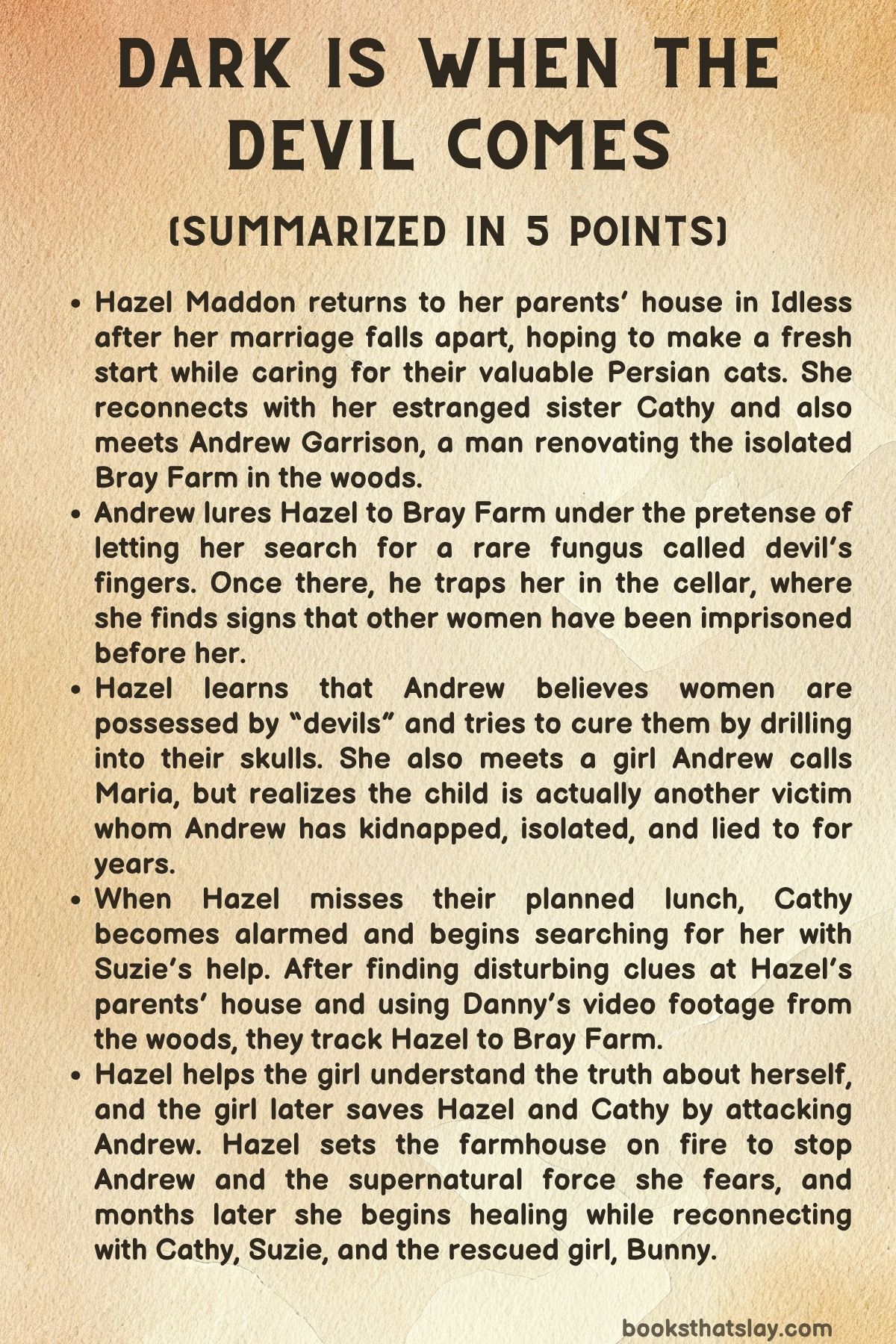
Summary
Hazel Maddon comes back to Idless after the end of her marriage to Joe. Her return is not triumphant or hopeful at first.
She is hungover, ashamed, and emotionally worn down, staying in her parents’ house while they are away on a long cruise. The house is filled with reminders of family distance and old tensions, and Hazel’s main responsibility is to look after her parents’ valuable Persian cats.
When her divorce papers arrive, the finality of her failed marriage forces her to face how much of her life has fallen apart.
Wanting to make some kind of new start, Hazel reaches out to her older sister Cathy. The two sisters have not spoken in five years, and the silence between them carries a heavy history.
Cathy has her own troubles. She is raising her sons, Danny and Scout, and struggling with money, exhaustion, and the pressure of daily survival.
Even so, Hazel’s call affects her. Beneath the hurt and resentment, there is still love between the sisters, and they agree to meet for lunch.
For Hazel, this feels like the beginning of a repair she badly needs.
While Hazel tries to move through the day, she reconnects with Suzie, an old school friend, and then meets Andrew Garrison. Andrew is renovating Bray Farm, a remote property deep in the woods.
Hazel is an amateur mycologist, and she is especially interested in finding a rare fungus known as devil’s fingers. When she learns that Bray Farm may be a good place to search, Andrew gives her permission to look around the land.
He appears helpful and open, and Hazel has little reason at first to think he is dangerous.
Andrew later offers Hazel a ride and takes her further into the forest. As they travel, he tells her about his past.
He says his parents died in a car crash years earlier and that his little sister Maria vanished after the accident. The story gives him an air of tragedy, and Hazel listens with curiosity and sympathy.
When they reach Bray Farm, the place feels isolated and uneasy, but Hazel still follows him inside. Then she hears a thud from the cellar.
Thinking Andrew may need help, she goes down to check on him. Too late, she realizes she has walked into a trap.
Andrew locks Hazel in the cellar. The place soon reveals that she is not the first woman to be held there.
Hazel finds signs of earlier prisoners and begins to understand the scale of Andrew’s madness. He believes women are infected by evil forces, and he claims he can cure them.
His method is horrifying: he drills into their skulls, convinced he is removing devils from inside them. Hazel’s situation becomes a fight not only against captivity, but against a man whose delusions have already destroyed lives.
While trapped, Hazel also begins to experience something strange and terrifying within herself. As a child, she had a teratoma removed from her back, and she has long associated that buried part of her past with the idea of another sister, a monstrous double attached to her body and memory.
In the cellar, under fear and pressure, this presence seems to return. Hazel sees and hears things she cannot fully explain.
Whether the presence is supernatural, psychological, or both, it becomes part of the terror pressing in on her.
A young girl also begins speaking to Hazel through the cellar door. Andrew calls the girl Maria, but Hazel gradually realizes that this child is not his missing sister.
The real Maria disappeared years ago. This girl is another victim, abducted and raised by Andrew in isolation.
He has lied to her for years, shaping her understanding of herself and the world. She has been taught to believe she is Maria and to obey Andrew.
Hazel recognizes that the girl is both a captive and a tool Andrew uses to maintain his twisted version of reality.
Outside Bray Farm, Cathy becomes worried when Hazel fails to appear for their lunch. Given their long estrangement, she might have assumed Hazel had simply changed her mind, but something feels wrong.
Cathy turns to Suzie, and together they begin looking for Hazel. At Hazel’s parents’ house, they find disturbing signs.
The cats have been locked inside a suitcase, Hazel’s room is in disarray, and it seems clear that someone has been there. These discoveries convince Cathy that Hazel has not simply vanished by choice.
The police do not take Cathy’s fears seriously enough. Rather than accepting their dismissal, Cathy and Suzie continue searching on their own.
They gather clues piece by piece. Security footage shows a strange black shape following Hazel, adding an unsettling element to the mystery.
Cathy also receives signs from Hazel, including a pharmacy receipt marked with a request for medication. These clues are strange but meaningful, and Cathy refuses to ignore them.
Danny’s video footage from the woods becomes important. It helps Cathy and Suzie identify a hidden house with a distinctive weather vane.
This detail points them toward Bray Farm. Their search becomes more urgent as they begin to understand that Hazel may be trapped somewhere nearby and that the man connected to the remote property may be involved.
Cathy’s fear is sharpened by guilt: after years of distance, she has only just begun to reconnect with Hazel, and now she may lose her before they can truly repair anything.
In the cellar, Hazel uses every bit of patience and intelligence she has. She understands that brute force alone will not save her.
She needs to manipulate Andrew, find weaknesses in his routines, and reach the girl he calls Maria. Hazel manages to hide her phone and later tricks Andrew into leaving with it, hoping its location might help Cathy trace her.
This small act becomes one of her few chances to send help toward the right place.
Hazel also tries to reach the girl emotionally. She knows the child’s identity has been stolen and replaced by Andrew’s lie.
To weaken his control, Hazel persuades the girl to look at herself in a mirror. This moment matters because it forces the girl to question what Andrew has told her.
She begins to see that she is not Maria, not Andrew’s sister, and not the person he has forced her to become. Hazel gives her a way to doubt him, and that doubt becomes the beginning of her freedom.
Andrew eventually takes Hazel upstairs and begins the horrific process he believes will cure her. He starts drilling into her head, convinced he is releasing the evil inside her.
Hazel is on the edge of death when the power cuts out. At the same time, Cathy and Suzie reach the farmhouse.
Their arrival brings the confrontation into the open. Andrew faces them, still dangerous and unstable, but the balance has started to shift.
The girl, guided by what Hazel has taught her, attacks Andrew with a heavy object. Her action saves Cathy and Hazel, and it marks her break from the man who controlled her life.
Even after Andrew is injured, Hazel senses that the danger is not over. The strange “other sister” presence that has haunted her seems to be attaching itself to the girl.
Hazel fears that if it spreads, it will continue harming people. Whether this force is literal or tied to trauma, Hazel believes she must stop it at the source.
She sends Cathy, Suzie, and the girl away, then pours petrol through the farmhouse. With Andrew still inside, she sets the place on fire.
Cathy cannot leave Hazel behind. She returns to the burning house and drags her out, saving her life.
This act becomes a powerful answer to the years of silence between them. Their relationship has been damaged, but not destroyed.
Cathy’s return proves that their bond still exists, and Hazel survives because her sister refuses to abandon her.
Months later, Hazel is recovering from what happened. The truth about the girl is uncovered.
Her real name is Bunny, and she is the daughter of Astrid Miller, one of Andrew’s victims. Police excavate the grove near Bray Farm and find six skeletons.
Among them are Andrew’s real sister Maria and Bunny’s mother, Astrid. The discoveries confirm the terrible history hidden beneath Andrew’s lies and show how many lives he ended before Hazel escaped.
Hazel begins rebuilding her life with a clearer sense of what matters. She reconnects with Cathy and Suzie, and the old isolation around her starts to loosen.
Bunny’s future becomes important to her, and Hazel considers becoming her guardian. The choice suggests that Hazel’s survival is not only about escaping death, but also about choosing responsibility, connection, and care after horror.
The story closes with Hazel preparing to return to the woods with Cathy, Suzie, and Bunny to scatter Astrid’s ashes. This return is not a simple victory.
The woods still hold grief, memory, and fear. Yet Hazel is no longer alone there.
By facing the place again with the people who saved her and the child who survived Andrew’s lies, she begins to turn a site of terror into a place where the dead can be acknowledged and the living can continue.
Characters
Hazel Maddon
Hazel Maddon is the central character of Dark Is When the Devil Comes, and her journey carries the emotional, psychological, and supernatural weight of the book. At the beginning, she is broken by the collapse of her marriage to Joe and returns to her parents’ house in Idless feeling defeated, lonely, and directionless.
Her depression, hangover, and the arrival of her divorce papers show that she is not simply starting over in a practical sense, but trying to rebuild a self that has been damaged by rejection, disappointment, and isolation. Hazel’s interest in mycology also gives her a distinctive identity.
Her search for the rare devil’s fingers fungus is not just a hobby; it becomes the reason she enters Andrew’s world and the forest, showing how her curiosity and desire for renewal place her directly in danger.
Hazel is also a deeply vulnerable but resourceful character. Once trapped in Andrew’s cellar, she experiences terror, confusion, physical suffering, and psychological manipulation, yet she does not become passive.
She studies Andrew, observes the cellar, listens to the girl behind the door, and uses whatever small opportunities she has to resist. Her ability to think while frightened makes her survival believable and powerful.
She also shows emotional intelligence when she realizes that the girl Andrew calls Maria is not his real sister, but another victim who has been lied to and shaped by captivity. Hazel’s connection with the girl becomes one of the most important parts of her character because it shows that even while imprisoned, she is still capable of compassion and moral courage.
Hazel’s supernatural experiences add another layer to her character. The monstrous presence linked to the teratoma removed from her back as a child suggests that Hazel’s fear is not only external but also internal.
She is haunted by something that feels like a lost or deformed part of herself, which she imagines as her “other sister.” This makes Hazel’s struggle more than a fight against Andrew; it is also a fight against trauma, bodily horror, guilt, and the fear that darkness can live inside a person. By the end of the story, Hazel’s decision to burn the farmhouse shows both sacrifice and control.
She chooses destruction not out of cruelty, but because she believes she must stop Andrew and prevent the supernatural evil from spreading. Her survival, her reconnection with Cathy and Suzie, and her possible role in Bunny’s future show that she emerges changed but not destroyed.
Cathy
Cathy is Hazel’s older sister, and she represents family loyalty, responsibility, and persistence. At first, her relationship with Hazel is strained because they have not spoken for five years.
This estrangement gives Cathy’s role emotional depth, as she is not simply a supportive sister from the beginning. She is someone who has been hurt, separated, and burdened by her own struggles, especially financial pressure and the responsibility of raising Danny and Scout.
When Hazel reaches out to her, Cathy is moved because the call opens the possibility of repairing a relationship that has been silent for too long.
Cathy’s importance grows when Hazel disappears. Unlike the police, who dismiss her concerns, Cathy trusts her instincts and refuses to ignore the signs that something is wrong.
Her worry becomes action when she searches Hazel’s parents’ house, notices the disturbing state of the cats, finds evidence of intrusion, and follows every clue available to her. This makes Cathy one of the most determined characters in the book.
She is not trained as an investigator, but her love for Hazel makes her observant, brave, and relentless.
Cathy also acts as a contrast to Hazel. While Hazel is trapped inside the farmhouse fighting Andrew directly, Cathy fights from the outside, piecing together clues and pushing past disbelief.
Her partnership with Suzie shows that she is willing to accept help and work with others when the situation becomes dangerous. Cathy’s final return to drag Hazel from the burning house is one of her strongest moments.
It shows that despite years of distance between the sisters, her love is active and life-saving. By the end, Cathy becomes part of Hazel’s recovery and helps restore the family bond that had been broken.
Suzie
Suzie is Hazel’s old school friend, and her role in the book is both practical and emotional. When Hazel first runs into her, Suzie represents a connection to Hazel’s past and to ordinary life before the horror fully begins.
However, Suzie becomes much more than a familiar face. She proves herself to be loyal, brave, and willing to enter danger for Hazel’s sake.
Her involvement in the search shows that friendship in the story is not shallow or nostalgic; it becomes a force of action and rescue.
Suzie is especially important because she supports Cathy when the police fail to take Hazel’s disappearance seriously. She helps investigate, looks at evidence, and follows clues even when the situation becomes increasingly strange and frightening.
This makes her a grounded character in a story filled with psychological and supernatural terror. Suzie does not need to fully understand every dark element surrounding Hazel to know that Hazel needs help.
Her willingness to believe Cathy and act with her gives the rescue effort strength.
Suzie also adds balance to the emotional structure of the story. Cathy’s search is driven by sisterly guilt and fear, while Suzie’s search is driven by friendship and concern.
Together, they show that Hazel is not as alone as she feels at the beginning. Suzie’s presence in the later recovery period also suggests that Hazel’s future will not be built only on survival, but on restored human connections.
She is a supporting character, but her loyalty makes her essential to the book’s sense of hope.
Andrew Garrison
Andrew Garrison is the main human antagonist, and he is one of the most disturbing characters in the book because his violence is wrapped in delusion. When Hazel first meets him, he appears helpful and perhaps even intriguing.
He is renovating Bray Farm, gives Hazel permission to search for fungus, and offers her a ride. This calm and ordinary surface makes his later cruelty more horrifying, because he uses politeness and trust as tools of capture.
His ability to seem harmless is part of his danger.
Andrew’s obsession with “curing” women by drilling into their skulls reveals a mind shaped by control, madness, and misogynistic violence. He does not see his victims as full people.
Instead, he imagines them as sick bodies containing devils that he alone can remove. This belief allows him to present his brutality to himself as a mission rather than a crime.
That self-justification makes him especially frightening because he is not merely impulsive; he has built a whole false moral system around his abuse.
Andrew’s past also explains, though does not excuse, some of his damaged psychology. The loss of his parents and the disappearance of his real sister Maria seem to have left him trapped in grief and obsession.
However, instead of mourning honestly, he recreates Maria through another abducted child, Bunny, and forces her into a false identity. This shows that Andrew’s need for control extends beyond murder.
He tries to rewrite reality itself, forcing others to live inside his fantasy. His end inside the burning farmhouse is fitting because the place that holds his crimes, delusions, and buried victims becomes the place of his destruction.
Bunny
Bunny is one of the most tragic and important characters in the book. For much of the story, she is known as the girl Andrew calls Maria, but this false name is part of her imprisonment.
She has been abducted, isolated, and raised inside Andrew’s lies, made to believe she is someone she is not. Her character shows the long-term damage of captivity, especially when a child is deprived not only of freedom but of identity.
Andrew’s control over her is psychological as much as physical, because he shapes what she believes about herself and the world.
Bunny’s relationship with Hazel is central to her awakening. Hazel gradually understands that the girl is another victim, not Andrew’s real sister, and tries to help her see the truth.
The mirror becomes important because it gives Bunny a direct confrontation with herself. In that moment, she begins to separate her own identity from the role Andrew forced onto her.
This makes Bunny’s development quiet but powerful. She does not instantly become free in an emotional sense, but she begins the painful process of realizing that her life has been stolen and renamed.
Bunny’s attack on Andrew is a major turning point. By using the heavy object Hazel had taught her about, she acts against the man who controlled her and saves Cathy and Hazel.
This moment gives her agency after years of being manipulated. However, Bunny’s ending is also unsettling because Hazel realizes that the supernatural “other sister” has begun attaching itself to her.
This makes Bunny both a rescued child and a possible vessel for future darkness. Her real identity as Astrid Miller’s daughter adds further sadness, because she is connected to one of Andrew’s victims and to the hidden history of the grove.
Still, the possibility that Hazel may become her guardian suggests that Bunny may be able to build a life beyond Andrew’s lies.
Maria Garrison
Maria Garrison is Andrew’s real sister, though she is absent for most of the story and exists mainly through memory, deception, and discovery. Her disappearance after the crash that killed her parents becomes the emotional wound around which Andrew’s madness seems to form.
Maria’s absence is powerful because it creates a gap Andrew tries to fill in a horrifying way. Instead of accepting her loss, he replaces her with Bunny and traps Bunny inside Maria’s name.
Maria is important because she represents the original truth that Andrew has buried. His claim over Bunny depends on erasing the difference between the living child and the missing sister.
When the truth finally emerges, Maria is no longer just a tragic memory but one of Andrew’s victims, found among the skeletons in the grove. This discovery shows the full extent of Andrew’s corruption.
The sister he claims to mourn was not preserved by his love; she was swallowed into the same violence that consumed the other victims.
Maria’s character also deepens the book’s themes of sisterhood. Hazel has Cathy, Hazel imagines an “other sister,” Andrew loses Maria, and Bunny is forced to become Maria.
Through these connections, Maria becomes more than a missing girl. She becomes a symbol of grief twisted into possession, and of how love becomes monstrous when it refuses truth, freedom, and personhood.
Astrid Miller
Astrid Miller is one of Andrew’s victims and Bunny’s mother. Although she is not physically present in the main events, her importance grows as the truth about Bunny is revealed.
Astrid represents the stolen lives behind Andrew’s crimes. She is not merely part of the evidence found later; she is a mother whose child was taken and whose death left Bunny without her real family, history, and name.
Astrid’s role gives emotional weight to the ending. When Hazel, Cathy, Suzie, and Bunny prepare to return to the woods to scatter Astrid’s ashes, the act becomes a form of recognition and mourning.
It restores dignity to someone Andrew tried to erase. Astrid’s presence in the story reminds the reader that every skeleton found in the grove belonged to a person with a life, relationships, and a future taken from them.
Through Bunny, Astrid’s memory also continues, making her part of the possibility of healing after horror.
Joe
Joe is Hazel’s ex-husband, and although he does not dominate the action, his role is important in shaping Hazel’s emotional state at the beginning. The collapse of Hazel’s marriage to Joe sends her back to her parents’ house feeling rejected and displaced.
The divorce papers deepen her sense that one part of her life has ended permanently. Joe therefore functions less as an active character and more as a source of emotional damage that Hazel must move beyond.
Joe’s absence is also meaningful. He represents a life Hazel thought she had but can no longer rely on.
Because of him, Hazel begins the story in a vulnerable condition, looking for a fresh start while feeling fragile and alone. This makes her more susceptible to the false safety Andrew offers.
However, Hazel’s later courage shows that her identity is not defined by the failed marriage. Joe may mark the beginning of her crisis, but he does not control the outcome of her story.
Hazel and Cathy’s Parents
Hazel and Cathy’s parents are mostly absent from the main action because they leave for a long cruise, but their absence creates the circumstances that allow the story to unfold. By leaving Hazel in charge of their valuable Persian cats, they give her a reason to remain at the house in Idless.
Their home becomes Hazel’s temporary refuge after her marriage fails, but it also becomes a place where signs of danger are discovered after she disappears.
Their role also reflects the emotional distance and fragmentation within the family. Hazel returns to her parents’ house, but the people who own it are not there to support her.
This leaves her isolated at the exact moment when she needs connection. Later, when Cathy searches the house and finds the cats trapped inside a suitcase and Hazel’s room disturbed, the parents’ home becomes evidence of violation.
Their absence therefore makes the house feel both familiar and unsafe, a place connected to family but unable to protect Hazel.
Danny
Danny is Cathy’s son, and he plays a small but significant role in the rescue plot. As a child character, he represents the ordinary family life Cathy is trying to maintain while dealing with worry, financial stress, and fear for Hazel.
His presence reminds the reader that Cathy is not free from responsibility when she begins searching for her sister. She is a mother as well as a sibling, which makes her courage more striking.
Danny’s video footage from the woods becomes an important clue because it helps Cathy and Suzie identify the hidden house with the distinctive weather vane. In this way, Danny contributes directly to Hazel’s rescue, even though he is not part of the final confrontation in the farmhouse.
His role shows how small details and accidental observations can become crucial in a story where the official investigation fails. Danny also helps connect the domestic world of Cathy’s family with the dangerous world hidden in the woods.
Scout
Scout is Cathy’s other son, and his role is quieter than Danny’s, but he still matters to the emotional background of the story. He helps show the life Cathy is carrying while she becomes involved in Hazel’s disappearance.
Cathy is not simply a sister searching for Hazel; she is also a mother trying to protect and provide for her children. Scout’s presence strengthens the sense that Cathy’s decisions have real personal stakes.
Scout also contributes to the theme of vulnerable children in the book. While Bunny is the clearest example of a child harmed by adult cruelty, Scout and Danny represent the safer family world that Bunny has been denied.
Through them, the story contrasts ordinary childhood with the stolen childhood Andrew creates for Bunny. Scout may not drive the plot directly, but his presence helps deepen Cathy’s character and reinforces the importance of family, protection, and care.
Themes
Trauma and the Struggle to Reclaim the Self
Hazel’s experience shows how trauma can make a person feel divided from their own body, memory, and sense of control. Before her abduction, she is already emotionally weakened by divorce, isolation, alcohol, and estrangement from Cathy.
Andrew’s imprisonment deepens this fracture by reducing her to an object he believes he can “fix.” His violence is not only physical but psychological, because he tries to replace Hazel’s understanding of herself with his own cruel explanation of sickness and cure. The supernatural presence connected to Hazel’s childhood surgery gives this theme a darker shape, turning buried pain into something visible and frightening.
Yet Hazel does not remain passive. She observes, plans, manipulates Andrew, protects Bunny, and finally makes a terrible choice to stop the evil from spreading.
Her recovery at the end suggests that trauma may leave marks, but it does not have to erase identity. Survival becomes an act of reclaiming the self from those who tried to define, damage, or possess it.
Sisterhood, Estrangement, and Repair
The broken bond between Hazel and Cathy gives Dark Is When the Devil Comes much of its emotional force. Their silence has lasted for years, and Hazel’s call at the beginning is more than a casual attempt to reconnect; it is a fragile step toward admitting that she needs family again.
Cathy’s response shows that love can survive resentment, distance, and disappointment. When Hazel disappears, Cathy refuses to accept easy explanations, even when the police dismiss her fears.
Her search becomes an act of loyalty, proving that sisterhood is not defined by constant closeness but by the willingness to show up when it matters. The false “Maria” relationship created by Andrew offers a disturbing contrast.
He uses the language of family to control Bunny, trapping her inside a lie. By helping Bunny see the truth, Hazel breaks that false bond and makes room for real care.
The ending restores sisterhood not as something perfect, but as something chosen again after pain.
Control, Delusion, and Male Violence
Andrew’s violence is rooted in a terrifying need to control women’s bodies, thoughts, and identities. He believes he is curing them, but his belief is only a mask for domination.
By calling women sick and claiming that evil lives inside them, he gives himself permission to imprison, experiment on, and murder them. His delusion is especially dangerous because it is organized and purposeful; he is not simply chaotic, but methodical in how he traps Hazel and hides his crimes.
The cellar becomes a symbol of the way abusers isolate victims, cut them off from help, and force them into a world ruled by the abuser’s logic. Bunny’s captivity shows how control can extend beyond the body into memory and identity.
Andrew does not only keep her hidden; he teaches her a false version of who she is. The resistance against him comes through truth, connection, and refusal.
Hazel, Cathy, Suzie, and Bunny each weaken his power by rejecting the reality he tries to impose.
Female Courage and Collective Survival
The rescue is not driven by one heroic figure alone, but by women acting with courage in different ways. Hazel survives by thinking carefully under extreme fear, reading Andrew’s weaknesses, and finding ways to send signals beyond the farmhouse.
Cathy shows courage through persistence, refusing to be silenced by police indifference or uncertainty. Suzie adds practical support and loyalty, becoming part of a search that depends on trust as much as evidence.
Bunny’s courage is especially moving because she has been raised inside Andrew’s lies, yet she still responds to Hazel’s guidance and acts at the crucial moment. Their survival depends on cooperation rather than isolation.
Each woman sees part of the truth, and together they form the resistance that Andrew cannot fully control. This theme also challenges the idea that fear and vulnerability are the opposite of strength.
Hazel is terrified, injured, and haunted, but she still protects others. Courage here means acting despite damage, not pretending damage does not exist.