Dear Monica Lewinsky Summary, Characters and Themes
Dear Monica Lewinsky by Julia Langbein is a sharp, strange, and darkly funny novel about shame, memory, power, and the stories women are forced to carry alone. The book follows Jean Dornan, a middle-aged court interpreter whose ordinary life is disturbed when she hears from David Harwell, the former professor who changed the course of her youth.
Moving between Jean’s present and a formative summer in France, the novel examines how admiration can become manipulation, how silence can shape a life, and how one woman, guided by a surreal vision of Monica Lewinsky as a saint of the shamed, finally claims the truth of her own past.
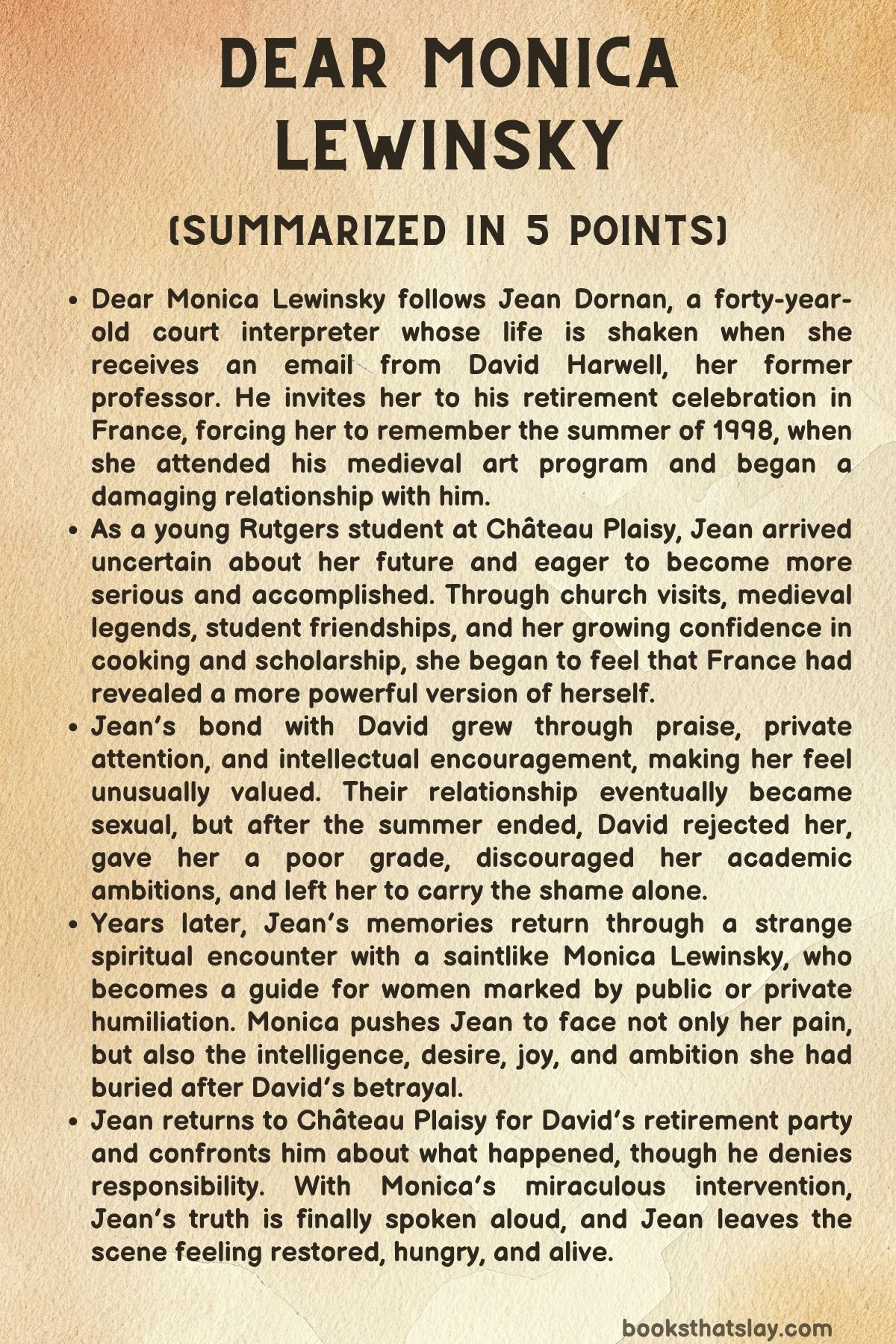
Summary
Dear Monica Lewinsky begins with an unusual act of reimagining. Monica Lewinsky, known publicly through the scandal that made her a target of national ridicule, is transformed into a kind of modern saint.
In this imagined sacred role, she becomes a protector of women who have been humiliated, silenced, or made to feel responsible for the desires and abuses of powerful men. This opening sets the tone for the rest of the novel, which treats shame not as a private weakness but as something created and enforced by public judgment, institutional power, and personal betrayal.
The central figure is Jean Dornan, a forty-year-old court interpreter living in Hoboken. Her life seems controlled and routine, but an email from David Harwell unsettles everything.
David is a former professor of hers, and he is inviting her to a retirement celebration at Château Plaisy in France. The château is not just any place from Jean’s past.
Twenty years earlier, when she was a Rutgers undergraduate, she spent a summer there in a medieval art program. That summer was supposed to make her feel serious, intelligent, and directed.
Instead, it became the place where her confidence was built, exploited, and then crushed.
The email sends Jean into an emotional collapse. She begins looking through old notebooks, photographs, and memories from 1998.
Back then, she was unsure of herself and uncertain about her future. She had no clear academic path and carried a deep desire to become someone more impressive than the person she believed herself to be.
France seemed like a chance to begin again. At Château Plaisy, she joined a group of students and professors studying Romanesque churches, medieval sculpture, architecture, and sacred stories.
The place was full of history, ritual, beauty, and hierarchy, and Jean wanted badly to belong to it.
At first, Jean feels out of place. She is assigned to document church apertures, but she does not really understand what she is meant to observe or record.
Other students seem more confident, more polished, or more prepared. The professors, especially David Harwell and James Neary, appear to belong naturally to this world of old stones, academic language, and cultural authority.
Jean watches, listens, and tries to learn the rules of the program. The group visits churches, studies their forms and symbols, eats together, drinks together, and absorbs stories of saints, martyrs, bodies, suffering, and devotion.
Gradually, Jean begins to find a role for herself. One unexpected source of power is cooking.
In college, cooking had embarrassed her because it made her smell like food, marking her as practical and ordinary rather than intellectual. At the château, however, her ability in the kitchen becomes a gift.
After two students produce a bad dinner, Jean takes charge of a Sunday meal and impresses the group. Her competence is natural and confident in a way her academic work is not yet.
People admire her food, and David praises her. That praise matters deeply to her.
It makes her feel that France has revealed something true and valuable in her.
David’s attention soon becomes the center of Jean’s summer. He gives her books, encourages her thoughts, laughs at her jokes, and treats her as if she is unusually perceptive.
To a young woman longing for direction, his approval feels transformative. He appears to see intelligence and promise in her before she can fully see them in herself.
Their connection grows through private conversations, glances, and moments that make Jean feel chosen. Although the relationship is unequal from the beginning, Jean experiences it at first as recognition.
During this time, Jean also forms relationships with the other students. Yoni becomes a lively friend, someone who adds humor and energy to her days.
Sigrid becomes another important presence, especially through running and shared physical effort. Jean observes Judith’s eating disorder and becomes aware of the different ways women suffer, control themselves, and try to be seen.
These friendships and observations widen Jean’s understanding of the people around her, but David remains the strongest force in her emotional life.
As the summer continues, Jean becomes more confident intellectually. She begins to understand the churches and the questions the program is asking.
During one visit, she makes a real contribution by challenging the assumption that later architectural styles are automatically superior to earlier ones. This moment matters because Jean is not merely repeating what others have said.
She is thinking for herself. Yet even this growth becomes tied to David’s approval.
Her confidence is real, but it is also dangerously dependent on the man whose attention has made her feel important.
Near the end of the program, the emotional tension between Jean and David turns physical. After a drunken final celebration, they kiss and then have sex in the château library.
Patrick discovers them on the floor, making the private act instantly vulnerable to exposure. For Jean, the encounter is not casual.
It feels like the culmination of everything that has been building all summer: admiration, desire, intellectual awakening, and the fantasy that David truly values her. But the next morning, David behaves with cold formality.
As everyone prepares to leave France, he distances himself, treating what happened as something to be contained rather than acknowledged.
Back at Rutgers, Jean expects some version of the intimacy to continue. Instead, David calls her to his office and shuts it down.
He offers a vague apology for their “friendship,” as though the problem were mutual emotional confusion rather than his misuse of authority. He gives her a poor grade on her paper, discourages her from pursuing medieval history, and tells her not to take his classes.
Jean does not protest. She absorbs the humiliation silently.
The man who had encouraged her now denies her the future she had begun to imagine.
The consequences shape the next twenty years of Jean’s life. She gives up the academic path that had briefly seemed possible.
She drinks too much, drifts through young adulthood, and carries a sense of failure she cannot fully name. She eventually turns to cooking, where her skill once again gives her purpose, but even that path does not remain stable.
By the time she is a court interpreter, she has built a life, but it is a life marked by avoidance. She has not fully faced what happened with David, nor has she allowed herself to remember the parts of that summer that were joyful, ambitious, sensual, and alive.
In 2019, David’s email breaks open the past. Jean falls apart at work and begins hearing the voice of Saint Monica.
She enters a church and experiences a surreal vision of Monica Lewinsky enthroned in a miraculous Ritz-Carlton bathroom. This vision is comic, bizarre, and serious all at once.
Monica becomes Jean’s guide through shame. She does not simply comfort Jean; she pushes her to look directly at what she has buried.
Jean must revisit not only the pain of David’s rejection but also the young woman she once was: hungry, funny, intelligent, desiring, and full of possibility.
At first, Jean resists the idea of returning to France. Going back to Château Plaisy means returning to the place where she was both awakened and wounded.
But the vision of Monica shows her how distorted her story has become when filtered through shame. Jean sees a grotesque version of her life turned into a saint’s legend, a narrative in which her suffering is made meaningful only by erasing her anger and complexity.
This false version pushes Jean toward action. She realizes that silence has protected David and trapped her.
The truth must be spoken, not as confession but as correction.
Jean travels to Château Plaisy for David’s retirement celebration. There she reunites with Sigrid, who had made sure Jean was invited.
The return to the château brings the past into the present with painful force. Jean confronts David about what happened between them and about the unfair grade that helped derail her academic future.
David denies the relationship. His denial repeats the old injury: once again, he tries to control the story by refusing to acknowledge her reality.
Then the novel’s saintly, supernatural logic takes over. Monica intervenes.
The retirement tributes, which should have honored David, transform into speeches that tell Jean’s real story. David is trapped in his chair and forced to listen.
The public ceremony meant to celebrate his career becomes a reckoning. His power depends on speech, prestige, and authority, but now those tools fail him.
He eventually loses the ability to speak, while Jean’s story takes the place of the flattering version he expected to hear.
Jean does not remain to enjoy the spectacle for long. Her victory is not simply about David’s punishment.
It is about returning to herself. She leaves the formal event and goes to the kitchen, where she reunites with Jojo and Victoire.
There, among food, labor, bodies, and knives, she reconnects with the part of herself that had once felt powerful at the château. She joyfully helps butcher rabbits, an act that is earthy, physical, and free from academic performance.
It brings her back to appetite and skill, to the life of the body, to the practical knowledge she once treated as lesser but now recognizes as real strength.
The novel closes with Jean walking outside with her knife, feeling alive and hungry. Her gratitude to Monica is not only gratitude for revenge.
It is gratitude for being guided out of silence and back into possession of her own story. Dear Monica Lewinsky ends by showing that shame loses force when it is named, shared, and returned to the people who created it.
Jean cannot undo the past, but she can refuse the version of herself that David’s rejection left behind. In speaking the truth, she recovers not innocence but appetite, anger, humor, and self-respect.
Characters
Jean Dornan
Jean Dornan is the central figure in Dear Monica Lewinsky, and her character is shaped by memory, shame, intelligence, hunger, and the painful difficulty of reclaiming a self that was once publicly or privately diminished. At forty, Jean appears outwardly functional as a court interpreter in Hoboken, but David Harwell’s email exposes how unresolved the past remains inside her.
Her panic is not simply nostalgia or embarrassment; it is the return of a wound she has spent years trying to bury. As a young undergraduate in France, Jean is uncertain, awkward, and eager to become someone serious.
She arrives at Château Plaisy hoping that intellectual purpose will give her a new identity, yet she initially feels unprepared and out of place. Her assignment on church apertures reflects this insecurity because she does not fully understand what she is supposed to be doing, and this confusion mirrors her larger uncertainty about who she is.
Jean’s growth during the summer is genuine but fragile. She begins to discover intellectual confidence, especially when she challenges the assumption that later architectural styles are automatically superior.
This moment matters because it shows that Jean is not merely a passive student drawn into David’s orbit; she has perception, originality, and the ability to contribute meaningfully. At the same time, her confidence becomes dangerously tied to David’s approval.
His praise makes her feel chosen, visible, and transformed, which is why his later rejection carries such force. Jean’s skill in cooking also reveals another side of her identity.
What once embarrassed her becomes a source of authority and pleasure at the château. Through food, she experiences competence, sensuality, and communal power.
Cooking becomes a language through which she can command attention without apology.
Jean is also a character whose deepest conflict lies in the gap between what happened to her and what she allowed herself to admit. After David distances himself, gives her a poor grade, discourages her academic future, and asks her not to take his classes, she absorbs the humiliation silently.
This silence alters the direction of her life. She abandons the scholarly path that had begun to open before her, drifts, drinks, and moves into cooking before eventually leaving even that behind.
Her later encounter with the visionary Monica forces her to return not only to pain but also to the vitality she had lost. By the end of the story, Jean’s return to France is an act of witness.
She does not merely confront David; she reclaims the truth of her own experience. Her final movement toward the kitchen, the rabbits, the knife, and her renewed hunger suggests that she is no longer defined only by shame.
She becomes alive again because she can finally recognize herself as more than the person David dismissed.
Monica Lewinsky / Saint Monica
Monica Lewinsky is transformed in the book from a public figure associated with scandal into a miraculous, saint-like presence who hears the prayers of women burdened by humiliation. This version of Monica is not treated as a conventional realistic character but as a symbolic and spiritual force.
She represents the possibility that shame can be answered, witnessed, and even reversed. The mock-saintly framing gives her an unusual power: she becomes both comic and holy, absurd and deeply serious.
Her presence suggests that women who have been reduced to scandal, gossip, or sexual embarrassment deserve not mockery but reverence.
As Saint Monica, she functions as Jean’s guide through memory. She does not simply comfort Jean; she pushes her to look directly at the past.
This makes her role more demanding than sentimental. Monica forces Jean to revisit the joy, ambition, desire, and intelligence that existed alongside the trauma.
In doing so, she helps Jean understand that the summer in France cannot be reduced to disgrace. Jean had been alive, curious, talented, and hungry before David’s rejection narrowed the meaning of that experience.
Monica’s intervention restores complexity to Jean’s past.
Monica also becomes an agent of justice. When David denies the truth, she alters the retirement celebration so that Jean’s story is publicly spoken.
This reversal is important because David once controlled the narrative through authority, distance, and silence. Monica’s miracle takes that control away from him.
By making him listen and then depriving him of speech, she symbolically corrects the imbalance between the powerful man who can deny and the younger woman who was expected to disappear quietly. Her character therefore represents witness, comic vengeance, female solidarity, and the sacred importance of telling the truth.
David Harwell
David Harwell is one of the most morally troubling characters in Dear Monica Lewinsky because he combines charm, intelligence, authority, and cowardice. As Jean’s former professor, he holds institutional and emotional power over her.
During the summer in France, he presents himself as encouraging, witty, and attentive. He gives Jean books, laughs at her jokes, praises her cooking, and makes her feel unusually seen.
These gestures are not meaningless; they are precisely what make him so powerful in Jean’s imagination. He appears to recognize her potential at a time when she is uncertain of herself.
Yet David’s attention is compromised by the unequal structure of the relationship. Jean is a young student trying to find intellectual direction, while David is an established professor whose approval can shape her academic future.
His closeness to her blurs the boundary between mentorship and desire. The sexual encounter in the château library is therefore not just a private romantic moment; it is part of a larger misuse of authority.
His behavior afterward reveals the weakness beneath his charm. Rather than acknowledge what happened or take responsibility, he retreats into formality, distance, and institutional control.
David’s later treatment of Jean is especially damaging because he rewrites the relationship as something vague and regrettable while punishing her academically and professionally. The poor grade, the discouragement from medieval history, and the request that she avoid his classes all show how easily he can protect himself at her expense.
His denial years later confirms that he has preserved his own reputation by refusing Jean’s reality. When Monica’s intervention renders him speechless, the punishment fits the character.
David’s power has depended on speaking, grading, defining, denying, and controlling the official version of events. Losing his voice becomes a symbolic exposure of the moral emptiness behind his authority.
James Neary
James Neary functions as part of the academic world that Jean enters at Château Plaisy. As one of the professors, he helps establish the intellectual atmosphere of the summer program, a setting filled with churches, Romanesque architecture, medieval legends, scholarly conversation, and hierarchy.
While he is less central than David, his presence matters because he represents the institutional environment in which Jean hopes to become serious and purposeful.
James also helps define the contrast between ordinary academic authority and David’s more intimate, dangerous form of influence. Jean’s life is not transformed by James in the same personal way, but he belongs to the world whose approval she seeks.
Through characters like him, the story shows how academic spaces can appear elevated and disciplined while still containing private vulnerabilities, exclusions, and abuses of power. James is important less for dramatic action than for the atmosphere of scholarship he helps create around Jean’s formative summer.
Yoni
Yoni is one of Jean’s livelier companions during the summer in France and serves as an important social counterweight to the intensity of her relationship with David. His friendship with Jean gives the château experience warmth, humor, and human connection outside the professor-student hierarchy.
While David makes Jean feel chosen in a charged and unequal way, Yoni helps show that Jean is capable of ordinary friendship, wit, and belonging.
Yoni’s role also emphasizes Jean’s youth. Around him and the other students, Jean is not yet the damaged adult who will later look back on the summer with pain.
She is part of a group, discovering herself through conversation, observation, awkwardness, and shared experience. His presence helps preserve the summer as something more than a single traumatic event.
Through Yoni, the story remembers the social texture of that time: the friendships, jokes, meals, and student dynamics that made France feel alive before it became a source of shame.
Sigrid
Sigrid is significant because she remains connected to Jean’s past while also helping make Jean’s return possible. During the summer, she is associated with discipline and physical movement, especially through running with Jean.
This connection suggests a form of companionship based on endurance, routine, and shared presence. Sigrid is not as emotionally central as Monica or as destructive as David, but she represents a steadier kind of relationship.
Her later role is especially important because she ensures that Jean is invited to David’s retirement celebration. This action makes Sigrid a quiet catalyst in the story’s final movement toward confrontation.
Whether she fully understands what Jean endured or not, her involvement helps bring Jean back to the place where the original wound occurred. Sigrid therefore becomes part of the structure of return.
She links past and present, student life and adult reckoning, private memory and public exposure.
Judith
Judith is a disturbing and vulnerable presence among the students, particularly through Jean’s observation of her eating disorder. Her character brings another form of bodily suffering into the story.
In a setting where food, appetite, scholarship, desire, and shame are all important, Judith’s troubled relationship with eating becomes thematically meaningful. She reflects the ways young women can struggle silently with control, visibility, and self-punishment.
Judith also helps sharpen Jean’s own relationship to hunger. Jean’s appetite, cooking, and pleasure in food are central to her vitality, even when she is ashamed of smelling like food in college.
Judith’s eating disorder stands in contrast to Jean’s eventual rediscovery of hunger as life force. Through Judith, the story shows that the château is not simply a romantic intellectual paradise.
It is also a place where private suffering exists beneath the surface of communal meals and academic performance.
Caitlin
Caitlin appears as one of the students in the summer program and contributes to the group atmosphere at Château Plaisy. Though she does not occupy the emotional center of Jean’s memory, her presence helps create the social world Jean enters: a temporary community of young people studying, eating, traveling, and trying to define themselves under the eyes of professors.
Characters like Caitlin are important because Jean’s transformation does not happen in isolation. It happens within a group where comparison, belonging, insecurity, and observation shape her sense of herself.
Caitlin also helps represent the ordinary student experience against which Jean’s private relationship with David becomes more secretive and consequential. The group setting makes David’s special attention feel even more powerful to Jean because it separates her from the others.
Caitlin’s role is therefore part of the background pressure of the summer: the collective student world from which Jean is gradually singled out.
Patrick
Patrick has a brief but crucial role because he discovers Jean and David after their sexual encounter in the château library. His presence turns a private act into something witnessed, which intensifies the shame and exposure surrounding the event.
Patrick does not need to be a major speaker or central emotional figure to matter; his act of seeing becomes part of Jean’s memory of humiliation.
Patrick’s role also foreshadows the importance of public knowledge and hidden truth. At the time, his discovery does not lead to justice or accountability.
Instead, Jean is the one who absorbs the shame, while David later retreats into denial and authority. Patrick’s witnessing therefore becomes painful because it exposes Jean without protecting her.
In the larger structure of the story, this moment contrasts with Monica’s later intervention, where public speech finally serves Jean rather than humiliating her.
Sam
Sam is one of the students whose failed attempt at dinner allows Jean’s cooking ability to emerge powerfully. After Sam and Brice produce a terrible meal, Jean takes over a Sunday dinner and impresses the group.
Sam’s role may seem minor, but this moment is important because it creates one of Jean’s first major experiences of mastery at the château. Through Sam’s failure, Jean discovers that something she had once considered embarrassing can become a source of admiration and strength.
Sam also belongs to the communal life of the summer program. His presence helps establish the château as a place where students are not only studying churches and medieval art but also sharing domestic responsibilities, making mistakes, and forming a temporary household.
In that environment, Jean’s talent becomes visible not through academic performance alone but through practical skill, sensual confidence, and care for others.
Brice
Brice, like Sam, is connected to the failed dinner that leads to Jean’s culinary triumph. His role helps set up one of the key turning points in Jean’s self-perception.
When the meal goes badly, Jean steps into authority naturally, and the group responds with admiration. Brice’s inadequacy in the kitchen therefore indirectly reveals Jean’s competence.
Brice also contributes to the student ensemble at Château Plaisy. He is part of the youthful, temporary world that surrounds Jean before the summer becomes dominated in her memory by David’s attention and rejection.
His character helps show the ordinary messiness of the program: young people experimenting with responsibility, failing at tasks, and creating the conditions for Jean to discover unexpected power.
Jojo
Jojo is one of the caretakers at Château Plaisy and represents a world of practical knowledge, physical labor, and grounded vitality. Unlike the professors, Jojo is not associated with academic judgment or intellectual hierarchy.
Instead, Jojo belongs to the material life of the château: kitchens, food, animals, maintenance, and the bodily realities that sustain the elegant setting of the summer program.
Jojo’s importance becomes especially clear near the end, when Jean leaves the spectacle of David’s public reckoning and returns to the kitchen. Reuniting with Jojo helps Jean reconnect with the part of herself that finds joy in work, appetite, and skill.
The act of helping butcher rabbits is deliberately physical and vivid. It suggests that Jean’s recovery is not only emotional or intellectual; it is embodied.
Through Jojo, the story honors forms of knowledge that exist outside the academic world David represents.
Victoire
Victoire, like Jojo, is one of the caretakers of Château Plaisy and is closely linked to the practical, domestic, and bodily life of the place. Her name itself suggests victory, which becomes meaningful in the final movement of the story.
Jean’s reunion with Victoire in the kitchen marks a return not to shame but to vitality. The kitchen becomes the opposite of David’s retirement ceremony: instead of denial, performance, and institutional praise, it offers action, hunger, and honest physical presence.
Victoire helps Jean reclaim a form of power that David could not give and therefore could not take away. The academic world wounded Jean by making her dependent on approval, but the kitchen restores her through competence and appetite.
Victoire’s presence at the end strengthens the sense that Jean’s liberation is not found in becoming the perfect scholar David once seemed to invite her to be. It is found in recovering her own force, her own desire, and her own ability to stand in the world without apology.
Themes
Shame and Public Judgment
Dear Monica Lewinsky treats shame as something that grows when powerful people control the story and force the wounded person into silence. Jean’s memory of her relationship with David is not only painful because of the sexual encounter itself, but because he later decides what it meant, how it should be forgotten, and what place she should occupy afterward.
His denial, his poor grade, and his cold dismissal make her feel foolish, exposed, and disposable. The connection to Monica Lewinsky expands Jean’s private humiliation into a wider pattern of women being reduced to scandal while men protect their reputations.
Shame becomes a social punishment, not just a personal feeling. Jean has spent years carrying an event that others either ignored or rewrote, and this silence shapes her career, confidence, and sense of self.
The story shows that shame loses power only when the hidden version of events is brought into the open and the person who was made to feel small finally becomes the speaker.
Power, Desire, and Exploitation
Jean’s relationship with David is marked by an imbalance that makes his attention both thrilling and dangerous. As her professor, mentor, and intellectual guide, David has the authority to make her feel gifted, chosen, and capable.
Jean’s desire for him is tied to her desire to be taken seriously, so his praise seems to confirm her worth. This is what makes the betrayal so damaging.
David benefits from Jean’s admiration while avoiding responsibility for the emotional and professional consequences of his actions. After the sexual encounter, he reclaims his institutional power by distancing himself, lowering her grade, and discouraging her academic future.
The story does not present desire as simple victimhood; Jean experiences excitement, hunger, pride, and pleasure. Yet it shows how unequal power can distort desire, especially when one person can later define the event as meaningless.
David’s real cruelty lies in using his authority to erase Jean’s reality once it becomes inconvenient.
Reclaiming Voice and Truth
Jean’s journey is centered on recovering the truth she was trained to swallow. For years, she accepts David’s version of events through silence, even though that silence damages her.
Her life after France is shaped by unfinished speech: she never properly protests the grade, never exposes the hypocrisy, and never names the harm done to her. Monica’s visionary presence pushes Jean to revisit the past not as a passive victim but as someone whose memories have value.
The final confrontation matters because Jean stops treating David’s comfort as more important than her own reality. Even when he denies her, the story insists that truth does not disappear just because power refuses to recognize it.
The magical transformation of the retirement speeches gives public form to what Jean could not say alone. Her recovery is not about changing the past but about refusing to let David’s denial remain the official record.
Speaking becomes an act of survival and self-respect.
Identity, Hunger, and Self-Recovery
Jean’s sense of self is repeatedly tied to hunger: intellectual hunger, sexual hunger, bodily hunger, and the hunger to be seen. In France, she discovers parts of herself that had been hidden by insecurity.
She learns to think more sharply, cook with authority, make others laugh, and participate in serious conversations. Yet because so much of this awakening is connected to David’s approval, his rejection makes her abandon not only him but also the confident self that had begun to appear.
Her later life suggests a long retreat from appetite, ambition, and pleasure. Monica’s guidance forces Jean to remember that the summer was not only a wound; it also contained proof of her intelligence, humor, skill, and vitality.
By returning to the kitchen and helping prepare food, Jean reconnects with a form of power that belongs fully to her. The ending’s image of Jean alive, hungry, and holding a knife suggests that self-recovery means accepting desire without shame and strength without apology.