Drifting Dawn Summary, Characters and Themes
Drifting Dawn by Samantha Young is a romantic suspense novel about lost love, grief, family duty, and the courage it takes to trust again. Set around the close-knit Scottish island community of Leth Sholas, the book follows Taran Macbeth and Quinn McQuarrie, former childhood sweethearts whose future was destroyed by betrayal, pain, and impossible choices.
Years later, Taran’s return home after her mother’s illness brings her face-to-face with Quinn, the man she has never stopped loving and never fully forgiven. As danger circles Taran and old wounds reopen, Drifting Dawn becomes a story about second chances, survival, and rebuilding a future from the wreckage of the past. It’s the 2nd book of the Scottish Isles series.
Summary
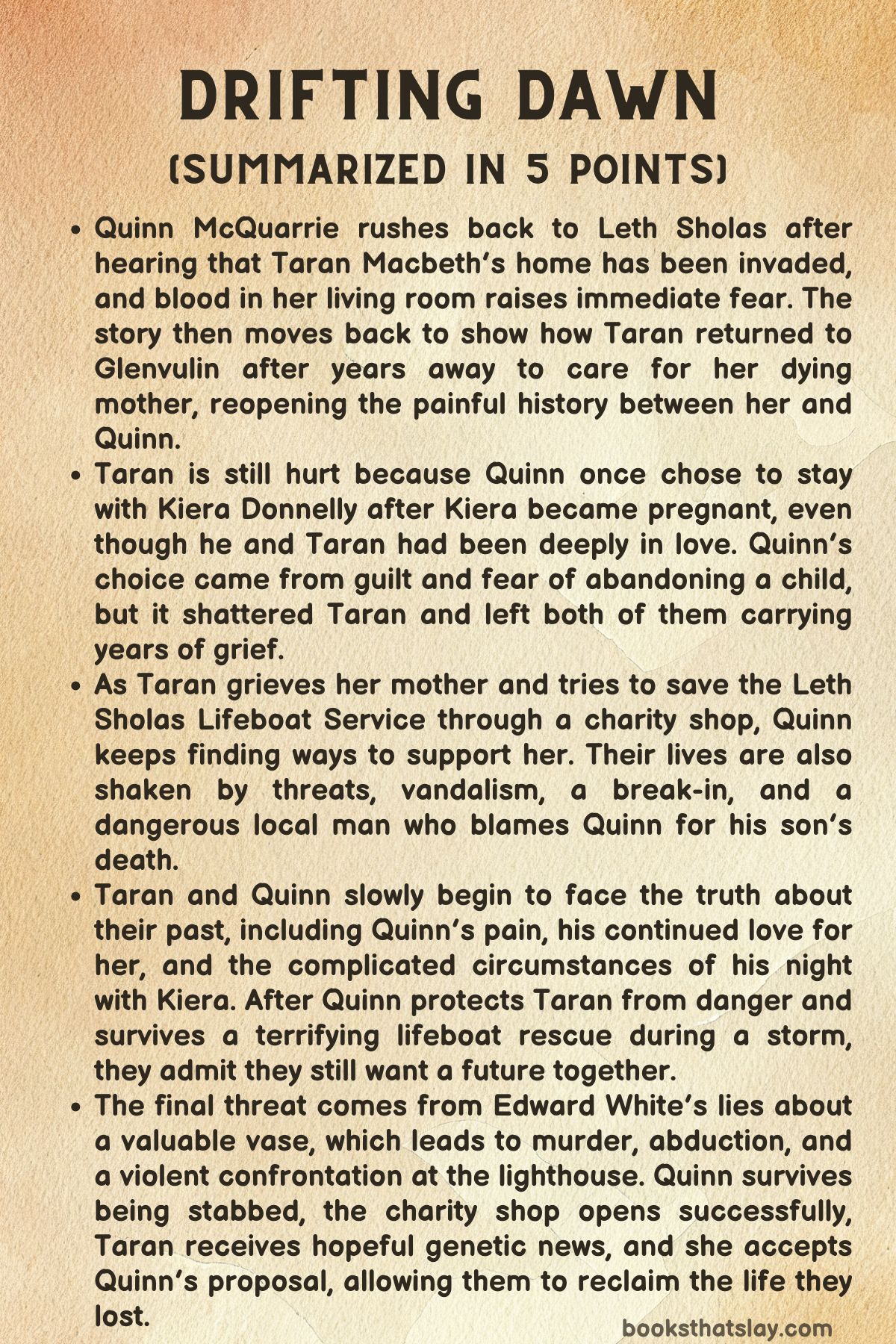
Drifting Dawn opens with Quinn McQuarrie rushing back to Leth Sholas by ferry after learning that Taran Macbeth’s home has been broken into. He is frantic, afraid that something terrible has happened to the woman he has loved for most of his life.
When he reaches the house and sees blood in the living room, the moment is terrifying enough to pull the story back into the history that brought Taran and Quinn to this point.
A year earlier, Taran had returned to Glenvulin after nearly nineteen years away. Her mother, Isla, was dying, and Taran came home to be with her during her final days.
Coming back meant facing not only grief, but also Quinn, the boy she had loved since childhood and the man who had once broken her heart. Taran and Quinn had grown up together, moved from friendship into young love, and planned a future that seemed certain until Taran left for university in Glasgow.
Their separation changed everything.
While Taran was away, Quinn made a mistake that shattered both their lives. During a drunken night, he slept with Kiera Donnelly, who became pregnant.
Quinn had been abandoned by his own father, and the idea of doing the same to his child terrified him. Feeling trapped by responsibility and guilt, he decided to try to make a family with Kiera.
To Taran, this felt like the worst kind of betrayal. Quinn’s choice destroyed her trust, and she left carrying anger, heartbreak, and the belief that Quinn had chosen someone else over her.
In the present, Taran is grieving the death of her mother and trying to rebuild her life. She takes over Macbeth’s Pages & Perks, the family bookshop and café, and begins sorting through Isla’s belongings.
Among her mother’s antiques is a vase that catches the attention of Edward White, an antiques dealer whose manner makes Taran uneasy. Edward claims the vase is almost worthless, but his behavior suggests otherwise.
Taran suspects he is lying and that the vase may be far more valuable than he wants her to know.
At the same time, Taran becomes involved in helping the Leth Sholas Lifeboat Service. The service is badly underfunded, and she comes up with the idea of opening a charity shop to raise money.
Quinn, who volunteers with the lifeboat crew, supports the plan. He also takes on the construction work for the new shop, partly because he believes in the cause and partly because it gives him a reason to stay near Taran.
Quinn is still deeply in love with her, even though she keeps him at a careful distance.
Quinn’s personal life is also changing. His daughter, Heather, comes to stay with him and arrives angry, guarded, and difficult to reach.
Quinn struggles to understand her mood, but he eventually opens up to her instead of hiding behind silence. Heather admits that she is frightened about losing her girlfriend, Hazel.
This honesty helps father and daughter grow closer. As their relationship improves, Heather begins to see how much Quinn still loves Taran.
She encourages him to stop hiding from the truth and to tell Taran how he feels.
Taran and Quinn are repeatedly brought together by friends, family, and island life. Their community is small, and avoiding each other is nearly impossible.
During Highland Games events, danger begins to appear around them. A car nearly hits Taran and Quinn, Cammie’s car is vandalized with a threatening message, and Taran’s house is broken into.
Quinn fears that Eoghan McCall may be responsible. Eoghan is a bitter local man who blames Quinn for the death of his son during a past lifeboat rescue.
His grief has hardened into resentment, and Quinn believes he may be trying to punish him through Taran.
Eoghan later admits that he was behind the reckless driving and the vandalism, but he denies the more serious attacks. His confession answers some questions while leaving others unresolved.
Someone else may still be targeting Taran, and Quinn becomes increasingly protective of her. Taran resists needing him, but every threat forces her to confront the truth that Quinn still makes her feel safe, even when trusting him feels dangerous.
As the pressure around them grows, Taran and Quinn finally begin to speak honestly about the past. Quinn explains that he never stopped loving her.
He also tells her that the night with Kiera was not as simple as Taran had believed. Both he and Kiera were extremely drunk, and the situation was clouded by a lack of clear consent.
Quinn has carried shame, guilt, and regret for years, but he also felt bound by the responsibility of becoming a father. Taran begins to see that Quinn’s choice did not come from a lack of love for her.
It came from fear, duty, and his own childhood wound.
This does not erase Taran’s pain, but it changes how she understands it. For years, she saw Quinn only as the person who betrayed and abandoned her.
Now she sees that he also suffered. Their old love has never fully died, and their renewed honesty makes it harder for either of them to pretend they are indifferent.
After an attempted abduction in Oban, Quinn protects Taran, and the fear of losing each other pushes them closer. They sleep together, but their reunion is not simple.
Taran wants him, loves him, and still fears being hurt by him again.
Their bond is tested further when a violent storm forces Quinn and the lifeboat crew out on a dangerous rescue mission. A fishing boat is in trouble, and the crew answers the call despite the brutal conditions.
The rescue nearly ends in disaster when the lifeboat capsizes. Quinn survives and comes home, but the terror Taran feels while waiting for him shakes her.
She realizes how deeply she still loves him and how unbearable it would be to lose him. Instead of accepting that truth, she panics and tries to pull away through a text message.
Quinn refuses to let her retreat into fear. He finds her at the lighthouse, where they finally face what has been between them all along.
Taran admits that she is scared, but Quinn makes it clear that he wants a real chance with her, not a half-life built around regret. They decide to try again.
Their relationship resumes with greater honesty and maturity than they had as teenagers. Taran also becomes more connected to Quinn’s family life.
She supports him as he takes Heather to university, and her bond with Heather and Quinn’s loved ones begins to deepen.
The central danger returns through the antique vase. Edward White comes back, this time with another man named Pollock.
Pollock reveals that the vase is genuinely valuable and demands it. The situation turns violent when Pollock kills Edward and attacks London.
He then abducts Taran at gunpoint, forcing her to take him to where he believes the vase is hidden. Taran stays as calm as she can and thinks quickly.
Instead of leading him toward other people, she directs him to the lighthouse, hoping to isolate him and buy time.
Quinn and Ramsay arrive, and the confrontation becomes deadly. Pollock attacks Quinn and stabs him during the fight.
The struggle ends when Pollock falls to his death, removing the immediate threat but leaving Quinn badly injured. Once again, Taran is forced to face the possibility of losing him.
Quinn survives, and his survival becomes another turning point. The danger that has followed them is finally over, and the future they once lost begins to feel possible again.
Afterward, life on Leth Sholas moves toward healing. The charity shop opens successfully, giving the lifeboat service the support Taran had hoped to create.
Taran also receives good news from genetic testing, lifting another fear that had been weighing on her. The community, Quinn’s family, and Taran’s renewed sense of home all come together in the closing moments.
Quinn proposes in front of Heather and Angus, offering Taran not just romance but the life they were denied years earlier. This time, there are no secrets standing between them and no past mistake left unspoken.
Taran accepts. By the end of Drifting Dawn, Taran and Quinn have survived grief, danger, guilt, and years of separation.
Their love is no longer the innocent promise of youth, but something stronger, shaped by truth, forgiveness, and the choice to begin again.
Characters
Taran Macbeth
Taran Macbeth is the emotional center of Drifting Dawn, a character shaped by grief, betrayal, independence, and a deep fear of being hurt again. Her return to Glenvulin is not simply a physical homecoming but an emotional confrontation with everything she tried to leave behind.
The death of her mother, Isla, places Taran in a vulnerable position, forcing her to manage loss while also taking responsibility for Macbeth’s Pages & Perks and the remnants of her mother’s life. She is practical and capable, but beneath that strength is a woman who has spent years protecting herself from the pain Quinn caused when he chose to build a life with Kiera after she became pregnant.
Taran’s hurt is complicated because it is rooted not only in jealousy or heartbreak, but in the collapse of a future she once believed in completely. Quinn was her childhood love, and losing him meant losing the person who had once represented safety, trust, and belonging.
This makes her guarded in the present. She does not immediately soften toward him because her anger has been part of her emotional survival.
However, Taran is not cruel or closed-minded. As she learns more about Quinn’s suffering, his confusion, and the circumstances surrounding the night with Kiera, she begins to understand that the past was not as simple as she had believed.
Her courage is shown most clearly through her actions. She throws herself into saving the Leth Sholas Lifeboat Service, showing that she is not someone who retreats from community or responsibility even while personally wounded.
Her suspicion of Edward White also reveals her intelligence and instinct; she notices dishonesty and refuses to be easily manipulated. Later, when Pollock abducts her, Taran’s bravery becomes even more visible.
Instead of panicking, she thinks strategically and leads him to the lighthouse to protect others and buy time. By the end of the book, Taran’s journey is one of healing.
She does not forget the pain of the past, but she learns that love can be rebuilt when honesty, accountability, and courage are present.
Quinn McQuarrie
Quinn McQuarrie is one of the most emotionally conflicted characters in the book, a man defined by love, guilt, responsibility, and regret. His love for Taran has never disappeared, but his choices in the past created a wound that neither of them could easily escape.
When Kiera became pregnant, Quinn chose to try to build a family with her because he was terrified of becoming like his own father, who had abandoned him. This decision reveals one of Quinn’s defining traits: he is deeply afraid of failing the people who depend on him.
However, that same fear led him to hurt Taran profoundly.
Quinn’s character is not presented as simply heroic or simply guilty. He is a man who made a devastating choice under emotional pressure, and he has lived with the consequences for years.
His work with the lifeboat service shows his bravery and commitment to others, but his emotional life is more fragile. He wants to protect people physically, yet he struggles to express the depth of his own pain and love.
His relationship with Taran is therefore built on the difficult process of learning to speak honestly instead of hiding behind duty or silence.
His relationship with Heather adds another important layer to his character. Quinn is not a perfect father, but he is a loving one who wants to understand his daughter.
When he opens up to her emotionally, he allows their relationship to deepen. This shows growth because Quinn begins to realize that protection is not only about responsibility; it is also about emotional honesty.
His near-death experience during the storm rescue reinforces his courage but also exposes how much Taran still loves him. By the end, Quinn becomes a man who is no longer only trying to make up for the past.
He is actively choosing a future with openness, devotion, and hope.
Heather
Heather is an important character because she brings out Quinn’s softer and more vulnerable side. At first, she behaves with anger and emotional distance, but her behavior comes from fear rather than simple rebellion.
She is dealing with her own anxieties, especially her fear of losing Hazel, and this makes her guarded. Her tension with Quinn reflects the difficulty that can exist between parents and children when emotions are left unspoken.
As Heather begins to communicate more honestly, her relationship with Quinn improves. She becomes more than just Quinn’s daughter; she becomes a voice of emotional clarity.
Her encouragement for Quinn to tell Taran the truth shows that she understands the importance of honesty even when adults around her struggle with it. Heather’s presence also helps Taran become part of Quinn’s family life again, which is essential to the healing of the central relationship.
Through Heather, the story shows that love is not only romantic but also familial, and that younger characters can sometimes see emotional truths more clearly than the adults who are trapped by regret.
Kiera Donnelly
Kiera Donnelly is a significant figure because her pregnancy changes the course of Taran and Quinn’s lives. She is central to the past conflict, even though her role is more connected to consequence than present action.
The night she and Quinn slept together creates a situation that forces Quinn into a decision shaped by guilt, responsibility, and fear. Kiera therefore represents the painful complexity of choices made in vulnerable or impaired circumstances.
Her presence in the story is not simply that of an obstacle between Taran and Quinn. Instead, she is part of the moral complication surrounding Quinn’s past.
The revelation that both Quinn and Kiera were too drunk for clear consent adds emotional seriousness to the situation and changes how Taran understands what happened. Kiera’s role reminds the reader that the past cannot always be divided neatly into villain and victim.
Her character exists at the center of a painful event that affected several lives, especially Quinn, Taran, and Heather.
Isla Macbeth
Isla Macbeth is important even though her death occurs early in the story’s emotional timeline. As Taran’s mother, she represents home, history, and inherited responsibility.
Her illness brings Taran back to Glenvulin after many years away, making her the reason Taran must face the people and places connected to her past. Isla’s death leaves Taran grieving, but it also leaves her with the shop, the antiques, and the emotional weight of family memory.
Through Isla’s belongings, especially the antiques, the story connects personal grief with danger and mystery. The valuable vase becomes part of the external conflict, but for Taran it is also tied to her mother’s legacy.
Isla’s role therefore continues after her death. She shapes Taran’s decisions, her responsibilities, and her connection to Glenvulin.
Her character represents the way loved ones can remain active forces in a story even when they are no longer physically present.
Edward White
Edward White is a deceptive and unsettling character whose greed helps set the final danger in motion. As an antiques dealer, he is expected to possess knowledge and professionalism, but he abuses that position by lying to Taran about the vase.
His attempt to undervalue it reveals that he is dishonest and opportunistic. He sees Taran’s grief and the confusion surrounding her mother’s belongings as something he can exploit.
Edward’s role in the book is important because he introduces the danger connected to the vase. He is not the most violent antagonist, but his greed opens the door to greater violence.
His death at Pollock’s hands also shows that Edward has involved himself in something more dangerous than he can control. He is a character whose corruption is smaller and more calculating than Pollock’s brutality, but it is still morally significant because it places Taran in danger.
Pollock
Pollock is the most openly violent antagonist in the story. He is driven by greed and is willing to kill, threaten, and abduct to get what he wants.
Unlike Edward White, who uses deception, Pollock uses force. His pursuit of the valuable vase turns the mystery surrounding Isla’s antiques into a life-threatening conflict.
He brings the external danger of the story to its peak.
Pollock’s attack on Taran and his murder of Edward show that he has no loyalty or restraint. He values the vase more than human life, making him a direct threat to the emotional future Taran and Quinn are trying to rebuild.
His confrontation with Quinn and Ramsay at the lighthouse is symbolically important because it places Taran’s reclaimed future in immediate danger. Pollock’s fall to his death ends the threat he represents, allowing the story to move from fear and violence toward healing and commitment.
Eoghan McCall
Eoghan McCall is a bitter and damaged character whose grief has hardened into blame. He holds Quinn responsible for the death of his son during a past lifeboat rescue, and this resentment makes him dangerous.
His actions, including the dangerous driving and vandalism, show how unresolved grief can become destructive when it is directed at the wrong person. Eoghan is not innocent, but his wrongdoing comes from pain rather than greed.
His denial of the more serious attacks helps separate him from the larger mystery surrounding Taran’s home invasion and the vase. This distinction is important because Eoghan functions as a misleading threat.
He is dangerous enough to be suspected, but he is not the true source of the final violence. His character adds emotional complexity to the lifeboat service, reminding the reader that rescue work carries consequences not only for those saved or lost, but also for the families left behind.
Ramsay
Ramsay is a supportive and dependable character who becomes especially important during the final confrontation. His arrival with Quinn at the lighthouse shows his courage and loyalty.
He is not at the center of the romantic conflict, but he plays a meaningful role in protecting Taran and helping stop Pollock. His presence reinforces the importance of community in the story.
Ramsay also represents the kind of steady support that surrounds the main characters as they face danger and emotional upheaval. In a book where many people are wounded by the past, Ramsay’s role is grounded in action and reliability.
He helps show that Taran and Quinn are not isolated in their struggles. Their community, despite its tensions and secrets, contains people willing to step forward when it matters.
London
London is a victim of Pollock’s violence and helps demonstrate the seriousness of the final threat. Pollock’s attack on London makes it clear that he is not merely trying to intimidate Taran but is willing to harm anyone who stands in the way of his goal.
London’s presence in this part of the story raises the stakes and shows that the danger surrounding the vase extends beyond Taran alone.
Although London is not developed as deeply as the central characters, the character serves an important purpose in the plot. Through London’s attack, the story emphasizes Pollock’s brutality and the urgency of stopping him.
London also becomes part of the wider pattern of harm caused by greed, deception, and violence.
Angus
Angus is important as part of Quinn’s family life and the hopeful ending of Drifting Dawn. His presence during Quinn’s proposal helps frame the ending as not only a romantic reunion but also a family moment.
Taran’s acceptance of Quinn is therefore connected to a wider sense of belonging. She is not simply returning to Quinn; she is entering a future that includes family, community, and shared emotional stability.
Angus helps soften the final movement of the story after its danger and violence. His presence reminds the reader that the future Quinn and Taran reclaim is not abstract.
It is built through everyday relationships, family bonds, and moments of public joy. In that sense, Angus contributes to the feeling of renewal that closes the book.
Cammie
Cammie is connected to the community pressure and danger surrounding Taran and Quinn. Her car being vandalized with a threat shows that the danger is spreading beyond the central couple and affecting people around them.
This makes Cammie part of the story’s atmosphere of suspicion and fear. The attack on her property also helps strengthen the belief that someone local may be targeting Quinn or Taran.
Cammie’s role reflects how closely connected the community is. In a small setting, personal conflicts do not remain private for long, and danger quickly touches friends and family.
Through Cammie, the story shows that the consequences of resentment and violence ripple outward. She also helps place Taran and Quinn within a network of people who are affected by their past, their present choices, and the threats unfolding around them.
Hazel
Hazel is important because of her connection to Heather’s emotional life. Heather’s fear of losing Hazel reveals her vulnerability and helps explain her anger and defensive behavior.
Hazel may not be central to the main conflict, but she matters because she helps bring Heather’s inner world into focus. Through Hazel, the story shows that Heather has her own fears and attachments rather than existing only as Quinn’s daughter.
Hazel’s role also allows Quinn and Heather’s relationship to grow. When Heather opens up about her fear, Quinn is given the chance to respond with understanding instead of authority or frustration.
This creates emotional progress between father and daughter. Hazel therefore influences the story indirectly, helping Heather become more honest and helping Quinn become more emotionally available.
Themes
Love, Hurt, and the Difficulty of Forgiveness
In Drifting Dawn, love is shown as something powerful but not simple, because Taran and Quinn’s bond has been shaped by years of pain, misunderstanding, guilt, and unfinished grief. Their relationship is not repaired by one apology or one emotional conversation; it requires both of them to face the truth of what happened and admit how deeply they were damaged by it.
Taran’s anger is rooted in betrayal, but beneath that anger is fear: fear of being abandoned again, fear of trusting someone who once chose another life, and fear that love may not be enough to protect her. Quinn’s pain is different but equally heavy.
His choice was driven by responsibility, shame, and his own childhood wound of being left behind by his father. The theme becomes stronger because forgiveness is not presented as forgetting.
Taran has to understand Quinn’s suffering without erasing her own. Their reunion works because both characters stop treating the past as a weapon and begin treating it as a wound that needs honesty, patience, and courage.
Grief, Inheritance, and Rebuilding Identity
Taran’s return to Glenvulin is closely tied to loss, because her mother’s illness and death force her to face both personal grief and the life she left behind. Isla’s absence is not only emotional; it also leaves Taran with responsibilities, memories, and physical objects that carry the weight of family history.
Running the bookshop and handling her mother’s antiques become ways for Taran to remain connected to her mother while also deciding who she wants to become without her. Grief in the story is not treated as a single event but as an ongoing condition that affects choices, relationships, and self-protection.
Taran’s guardedness with Quinn is partly romantic pain, but it is also intensified by the loneliness of losing her mother. At the same time, inheritance is not shown only through objects like the vase.
It appears through values, community ties, and emotional strength. By choosing to remain involved in the shop, the charity project, and the island community, Taran begins to rebuild an identity that honors her past without being trapped by it.
Responsibility, Family, and Emotional Courage
Quinn’s story strongly explores the burden of responsibility and the emotional courage needed to be a better father, partner, and son than the examples he once knew. His decision to stay with Kiera after Heather’s conception is shaped by fear of repeating his father’s abandonment.
Even though that choice hurts Taran, it comes from a desperate need to do what he believes is right. This makes Quinn a morally complicated character rather than a careless one.
His relationship with Heather develops this theme further, because he must learn that providing stability is not enough if he remains emotionally closed off. Heather’s anger reflects her own fears and insecurities, and Quinn’s willingness to speak honestly with her becomes one of his most important acts of growth.
The theme also connects to his lifeboat work, where responsibility becomes literal risk. Quinn repeatedly places himself in danger for others, but the story suggests that true responsibility is not only about sacrifice.
It also means communicating honestly, accepting vulnerability, and allowing loved ones to see fear instead of hiding behind duty.
Community, Danger, and the Need for Trust
The island setting creates a strong sense of community, but that closeness also exposes how fear, resentment, and suspicion can spread when danger enters familiar spaces. Taran’s work to support the lifeboat service shows the positive side of community: people contribute skills, labor, loyalty, and care to protect one another.
The charity shop becomes more than a practical solution to underfunding; it represents collective effort and shared responsibility. At the same time, the threats against Taran and those around her reveal how fragile safety can feel even in a place that should be home.
The attacks force characters to depend on one another, not only physically but emotionally. Quinn’s instinct to protect Taran matters, but the deeper issue is whether she can trust him without feeling that trust makes her weak.
The final confrontation connected to the vase brings this theme to its highest point, because survival depends on courage, quick thinking, and the arrival of people who refuse to let one another stand alone. Community becomes a source of rescue, healing, and renewed belonging.