Dream in the Ash Summary, Characters and Themes
Dream in the Ash by Jacquelyn Gilmore is a dark science-fiction thriller about identity, trauma, hidden power, and the cost of truth. The story follows Audrey Sarafian, a young woman released from prison after ten years for the supposed murder of her family.
Audrey has always insisted a tattooed stranger caused the fire, but no one believed her. When that man returns through her mind, her world shifts from legal nightmare to interplanetary conflict. The book mixes prison aftermath, telepathic abilities, alien politics, rebellion, addiction, captivity, and family secrets as Audrey searches for her surviving twin and tries to decide who, if anyone, can be trusted. It is the 1st book of the Other Half of the End series.
Summary
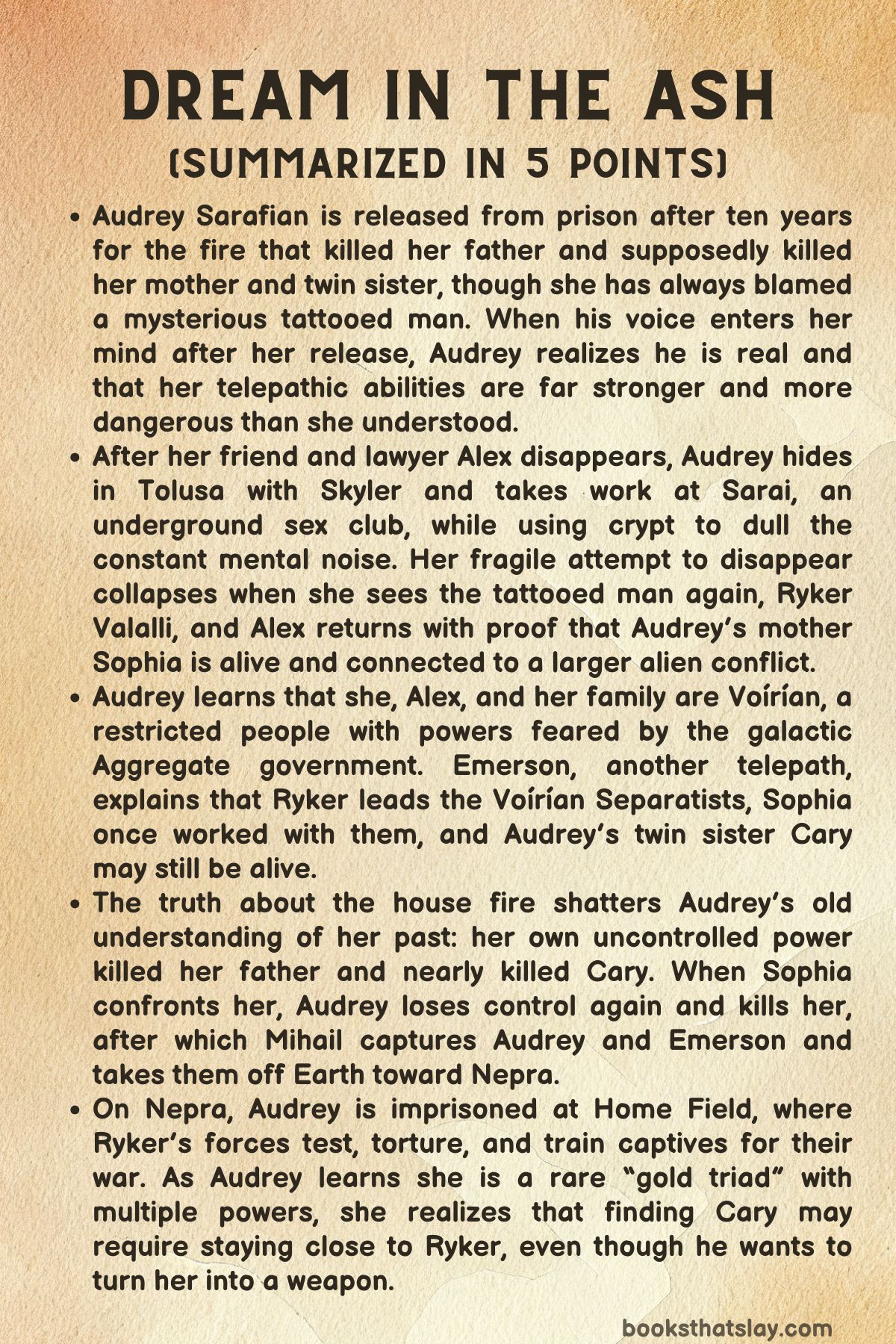
Audrey Sarafian leaves prison after ten years behind bars for a crime she has never accepted as hers. As a teenager, she was convicted of murdering her parents and her twin sister, Cary, in the fire that destroyed their home.
Audrey has always insisted that a strange tattooed man was in the backyard that night and that he was responsible, but the world dismissed her story as fantasy or denial. Her release should be the start of a second chance, yet freedom immediately feels unstable.
The same man’s voice enters her mind, proving that he is real and that Audrey’s version of the past may not be madness after all.
Audrey expects Alex, her lawyer and lifelong friend, to meet her after her release, but he does not appear. His absence leaves her exposed, frightened, and unsure where to go.
She makes her way to Tolusa, where the pressure of other people’s minds becomes almost unbearable. Audrey has always known she is different, but outside prison her abilities become harder to ignore.
She can hear thoughts, sense intentions, and feel the mental weight of crowds around her. Soon she discovers that her power is not limited to telepathy.
Under stress, she can freeze people, control their actions, and cause real physical harm without touching them.
With Alex missing and no clear support, Audrey turns to Skyler, someone she knew from prison. Skyler gives her temporary shelter and helps her find work at Sarai, an underground sex club.
Audrey’s life narrows into survival. She tries to stay hidden, earn money, avoid people who might recognize her, and quiet the constant mental noise that follows her everywhere.
To cope, she begins using crypt, a drug that dulls her abilities and gives her moments of silence. What begins as relief soon becomes dependency.
Months pass while Audrey avoids the truth about Alex, her past, and the terrifying man who keeps appearing at the edge of her mind.
At Sarai, Audrey finally sees the tattooed man again. His name is Ryker Valalli, and he is the figure from the night of the fire, the nightmares that followed, and the voice that invades her thoughts.
His presence confirms that Audrey’s childhood story was not a lie, but it also raises more questions than it answers. Soon after, Alex returns and explains that he has been searching for answers.
He reveals that Audrey’s mother, Sophia, is alive. This revelation shatters Audrey’s understanding of the fire.
If Sophia survived, then the official story of the murders was never complete.
Alex has uncovered records showing that Sophia lived under false names and was connected to terrorism that reaches far beyond Earth. He also reveals that Audrey, Alex, and Audrey’s family are not human.
Audrey is part of a people called the Voíríans, whose powers make them feared and restricted by a larger galactic authority known as the Aggregate. Audrey struggles to accept this, but the evidence around her keeps growing.
She meets Emerson, another telepath who is also tracking Sophia and the Voírían Separatists, a militant network led by Ryker. Emerson explains that Voíríans are confined to Nepra because their abilities can include telepathy, fire manipulation, telekinesis, siphoning, and other dangerous forms of power.
Audrey learns that Ryker leads the Separatists in their fight against the Aggregate and that Sophia once had ties to them. Even more shocking is the possibility that Cary, the twin sister Audrey believed dead, may still be alive.
This possibility gives Audrey a new purpose, but it also makes her vulnerable. Everyone around her seems to know more than she does.
Alex, Emerson, Sophia, Ryker, and others all hold pieces of the truth, and none of them give Audrey the whole picture. She begins to realize that her life has been shaped by secrets long before the fire.
Audrey, Emerson, and their allies follow a lead involving a forger who creates Silo identifications, hoping it will bring them closer to Sophia and the truth about Cary. Instead, events turn violent.
Mihail, a powerful Voírían connected to Ryker, confronts them. Sophia appears and finally reveals what happened the night Audrey’s family burned.
According to Sophia, Audrey’s uncontrolled power caused the fire, killed her father, and nearly killed Cary. Sophia claims she tried to stop what Audrey was becoming.
The revelation breaks something open in Audrey. Her grief, fear, anger, and power erupt at once, and she loses control.
This time, Sophia dies in front of her, burned to ash by Audrey’s own ability.
After Sophia’s death, Audrey and Emerson are captured by Mihail. Audrey learns that Cary is alive somewhere, but she is given no comfort and no clear path to her.
She is moved through off-world transport systems and taken away from Earth toward Nepra, the world tied to her people and to the conflict she never knew existed. The journey marks a complete break from the life Audrey understood.
She is no longer only an ex-prisoner trying to survive after a wrongful conviction. She is now a powerful Voírían caught between rebels, governments, family lies, and the sister she may still be able to save.
On Nepra, Audrey is taken to Home Field, a brutal Separatist facility where prisoners are interrogated, tested, trained, and sorted according to usefulness. The place is designed to break people down and remake them into tools for Ryker’s war.
Audrey meets Taryn, another prisoner, who helps her understand the danger of revealing the full extent of her abilities. Taryn warns Audrey that if Ryker’s people learn everything she can do, they will never let her go.
Audrey tries to hold back, but her powers are unstable, and the pressure around her keeps increasing.
Home Field shows Audrey the cost of Ryker’s cause. Taryn is tortured and later publicly killed as part of a cruel display meant to frighten and control the prisoners.
Audrey witnesses how easily the Separatists use pain as a lesson. Her own fear grows, but so does her anger.
When she is brought before Ryker, he recognizes what she is: a rare “gold triad,” someone capable of multiple extraordinary powers. To him, Audrey is not simply a survivor or a lost member of his people.
She is a weapon of unusual value. Ryker invades her mind, forces secrets out of her, and marks her, making it clear that he intends to shape her into something useful to him.
Audrey remains captive for weeks. She is trained violently by Kat and others while Ryker watches her progress.
Her abilities continue to expand and resist her control. She struggles with telepathy, empathy, telekinesis, and fire, while also trying to protect the one truth that matters most to her: she needs to find Cary.
The training is not meant to heal her or help her understand herself. It is meant to test how much pressure she can survive and how much destruction she can cause.
Audrey is forced to confront the fact that her power can protect her, but it can also kill people she never meant to hurt.
During her captivity, Audrey forms a complicated connection with Felix, a guard who gives her crypt and pieces of information. Felix is not fully safe, but he offers moments of relief in a place built on control.
Audrey’s dependence on crypt and her desperate need for knowledge make the bond messy and dangerous. When Audrey loses control again, Felix is killed as punishment.
His death becomes another reminder that Ryker controls not only Audrey’s body and training but also the people around her. Any mistake she makes can be turned against someone else.
Ryker uses Felix’s death to harden Audrey. He forces her to look at the consequences of her power and tells her that time is running out.
Mihail and Cary may soon become unreachable, which means Audrey cannot wait for rescue or keep resisting every path placed before her. She begins to understand that survival alone will not save her sister.
The world around her is too large, too violent, and too full of hidden agendas. The Aggregate wants control.
The Separatists want power. Ryker wants to use her.
Mihail has his own role in Cary’s fate. Alex and Emerson have helped her, but they have also kept secrets.
Sophia tried to frame the past in her own way before dying by Audrey’s hand.
By the end of Dream in the Ash, Audrey has changed from a woman running from her past into someone who sees that escape is no longer enough. Her life has been shaped by lies, imprisonment, addiction, fear, and powers she never asked for.
Cary’s survival gives her a reason to keep going, but the path to her sister leads deeper into Ryker’s world. Audrey does not trust him, and she does not believe his cause is clean.
Still, she recognizes that he may be the only person who can bring her closer to Cary and to the truth about what she is. With every safe option gone, Audrey begins moving toward Ryker’s side, not out of loyalty, but out of necessity.
Her choice is dangerous, but it is also the first time she stops waiting for others to define her fate.
Characters
The characters in Dream in the Ash are shaped by secrecy, trauma, power, and survival. Nearly every major figure carries hidden knowledge, divided loyalties, or painful motives, which makes the story less about simple heroes and villains and more about people trying to control damage, protect themselves, or use others before they are used.
Audrey Sarafian
Audrey Sarafian is the central and most emotionally burdened character in the book. At the beginning of the story, she is defined by imprisonment, grief, and disbelief, having spent ten years convicted of murdering her parents and twin sister in a fire she insists she did not cause.
Her release from prison does not bring freedom in any peaceful sense; instead, it forces her into a frightening world where the nightmare figure from her past is real and where her own mind is more dangerous than she understands. Audrey’s telepathy makes her deeply vulnerable because she cannot easily separate herself from the thoughts and emotions of others.
This constant invasion of mental noise leaves her exhausted, unstable, and desperate for silence, which partly explains her dependence on crypt and her attempt to disappear into Sarai. Her addiction is not only a weakness but also a sign of how unbearable her powers have become without guidance, safety, or truth.
As the story develops, Audrey becomes increasingly complex because she is not simply a victim of other people’s schemes. She is also someone with terrifying power and a history of losing control.
The revelation that she caused the fire that killed her father and nearly killed Cary forces her to confront the possibility that the monster she feared may also exist within herself. This does not make Audrey evil, but it does make her morally complicated.
Her abilities are connected to fear, rage, pain, and instinct, and when she is cornered, she can become devastatingly destructive. Her killing of Sophia shows how thin the line is between self-defense, revenge, panic, and uncontrollable power.
Audrey’s journey is therefore not only about finding Cary or escaping Ryker, but also about learning whether she can live with what she is.
Audrey’s emotional arc is driven by betrayal and withheld truth. Alex hides things from her, Sophia manipulates and fears her, Ryker wants to use her, and even those who help her often do so with incomplete honesty.
This makes trust almost impossible for her. By the end of the story, Audrey begins to understand that waiting to be rescued will only leave her trapped in other people’s plans.
Her movement toward Ryker’s side is not a sign of loyalty or surrender, but a dangerous strategic choice. She is beginning to claim agency in a world where everyone else has tried to define her.
Audrey becomes compelling because she is wounded, powerful, unstable, and determined, and the book leaves her standing at the edge of becoming either a weapon, a survivor, or something entirely her own.
Cary Sarafian
Cary Sarafian is one of the most important characters in the story even though her physical presence is limited for much of the book. At first, Cary exists in Audrey’s memory as the twin sister who supposedly died in the fire, which makes her a symbol of Audrey’s grief, guilt, and lost innocence.
Audrey’s belief that Cary died helps shape her entire identity after prison. Cary is not only a missing sister; she is the emotional center of Audrey’s trauma.
The possibility that Cary is alive transforms the story because it changes Audrey’s motivation from simply surviving to actively searching for the truth.
Cary’s survival also deepens the mystery surrounding Sophia, Ryker, Mihail, and the larger Voírían conflict. She becomes a hidden piece in a political and military struggle that Audrey does not fully understand.
Because Cary is trapped somewhere beyond Audrey’s reach, she represents both hope and manipulation. Many characters use the possibility of finding Cary to influence Audrey’s choices, especially Ryker, who understands that Audrey’s love for her sister may be the strongest way to control her.
Cary’s importance lies in the way she pulls Audrey forward. She is the reason Audrey cannot fully run away, even when every path ahead is dangerous.
Cary also functions as Audrey’s mirror. As Audrey’s twin, she reflects the life Audrey lost and the person Audrey might have been without prison, secrecy, and fear.
The truth that Audrey nearly killed Cary complicates their bond before they are even reunited. Audrey’s desire to save Cary is therefore mixed with guilt, love, responsibility, and the need for redemption.
Cary is not only someone Audrey wants to rescue; she is someone Audrey must face. Her character gives the story emotional urgency because finding her may also force Audrey to confront the deepest consequences of her own power.
Sophia Sarafian
Sophia Sarafian is one of the most morally complex figures in the book. As Audrey’s mother, she should represent protection, safety, and truth, but she becomes associated with fear, secrecy, and manipulation.
The revelation that she is alive completely changes Audrey’s understanding of her past. Sophia’s false identities and connection to terrorism suggest that she has lived for years inside layers of deception.
She is not simply a missing mother or a grieving widow; she is someone deeply tied to the dangerous political history surrounding the Voíríans, the Separatists, and the Aggregate.
Sophia’s actions are difficult to judge because they seem to come from both fear and control. She appears to understand Audrey’s powers better than Audrey does, and her choices on the night of the fire suggest that she saw Audrey as a danger that had to be stopped.
This makes Sophia a tragic figure because her maternal instinct is tangled with terror. She may have believed she was protecting Cary, herself, or even the world from what Audrey could become, but her secrecy and harshness also helped create the very instability she feared.
By hiding the truth, abandoning Audrey to imprisonment, and allowing others to control the narrative, Sophia becomes partly responsible for Audrey’s suffering.
Sophia’s death is one of the most significant emotional turning points in the story. Audrey burning her to ash is not only a violent act but also a symbolic collapse of the past.
Sophia carries answers Audrey desperately needs, yet she also represents the source of many lies. Her death leaves Audrey with fragments rather than closure.
Sophia’s role is powerful because she shows how love can become distorted by fear and how a parent’s attempt to control a dangerous child can become its own form of cruelty. She is neither a simple villain nor a loving mother misunderstood; she is a damaged, secretive, and dangerous woman whose choices shape Audrey’s entire life.
Alex
Alex is Audrey’s lifelong friend and lawyer, and his role is built around loyalty complicated by secrecy. At first, his failure to meet Audrey after her release feels like abandonment, especially because he is one of the few people Audrey expects to trust.
His absence increases her vulnerability and pushes her into Tolusa alone, where she is quickly overwhelmed and endangered. When he later returns, he brings information that changes everything Audrey knows about herself, her family, and her world.
This makes Alex both a rescuer and a destabilizing force.
Alex cares about Audrey, but he also withholds information from her, which makes his loyalty imperfect. He has been searching for answers and trying to understand Sophia’s survival, false identities, and dangerous connections.
However, because Audrey has spent so much of her life being lied to, Alex’s secrecy hurts even when his intentions appear protective. He represents one of the story’s central questions: whether hiding the truth can ever truly protect someone.
For Audrey, Alex’s choices are painful because they prove that even love and friendship can become another form of control when information is unevenly held.
Alex is also important because he helps move Audrey from a personal mystery into a larger cosmic and political reality. Through him, Audrey learns that she and her family are not human, and that her life is connected to forces far beyond Earth.
His role is therefore transitional. He bridges Audrey’s old life and the wider truth of the Voírían world.
Yet he is not fully able to save her. His limitations make him realistic: he may love Audrey and want answers, but he cannot undo the damage done to her or protect her from powers much larger than himself.
Ryker Valalli
Ryker Valalli is one of the most dangerous and magnetic characters in the story. He first appears as the tattooed man from Audrey’s nightmares, which makes him a figure of fear before he is fully understood.
His ability to invade Audrey’s mind establishes him immediately as someone who can violate boundaries in the most intimate way possible. Ryker’s power is not only physical or political; it is psychological.
He knows how to enter people’s minds, expose their secrets, and use what they love against them.
As the leader of the Voírían Separatists, Ryker is more than a personal antagonist. He represents a militant response to oppression, restriction, and political control.
His cause may be rooted in real suffering, especially given the confinement and regulation of Voíríans, but his methods are brutal. Home Field reveals the true nature of his leadership: interrogation, testing, punishment, spectacle, and the breaking of people into usable pieces.
Ryker sees Audrey as extraordinary because she is a gold triad, but his interest in her is not tender or purely admiring. He sees her as a weapon, a threat, and a key to power.
Ryker’s complexity comes from the fact that Audrey may need him even though he is dangerous. He holds access to information about Cary and the larger conflict, which makes him difficult to reject entirely.
This creates a tense relationship between him and Audrey. He is not trustworthy, but he is useful.
He is cruel, but he understands parts of Audrey that others have hidden from her. His presence forces Audrey into morally dangerous territory because aligning with him may be the only way to reach her sister.
Ryker is compelling because he is both captor and possible guide, enemy and path forward, making him one of the most unsettling forces in the book.
Emerson
Emerson serves as a guide into the wider Voírían and political world. When Audrey meets him, he brings structure to the chaos surrounding her identity.
He explains Voíríans, their abilities, the restrictions placed upon them, Nepra, the Separatists, and the Aggregate government. Because Audrey has been living with confusion, fear, and half-truths, Emerson’s knowledge is extremely important.
He helps Audrey understand that her powers are not random madness but part of a larger inheritance and conflict.
At the same time, Emerson is not simply an information source. He is also a character with his own mission, loyalties, and risks.
He is tracking Sophia and the Separatists, which means he enters Audrey’s life because she is connected to his goals. This makes his relationship with her useful but not entirely simple.
Audrey has reason to question everyone who offers help, and Emerson is no exception. Still, compared with figures like Ryker or Sophia, Emerson often feels more honest and stabilizing.
He gives Audrey language for what she is, and that language matters because it allows her to begin understanding herself.
Emerson’s capture alongside Audrey also makes him part of her suffering rather than merely an outside observer. Once they are taken toward Nepra, he becomes tied to the same danger that traps her.
His role helps show the scale of the conflict and the vulnerability of even those who know more than Audrey does. Emerson may understand the world better, but knowledge does not make him safe.
Through him, the story shows that truth is valuable, yet truth alone is not enough to defeat systems built on violence and control.
Mihail
Mihail is a powerful and threatening Voírían whose connection to Ryker makes him a major source of danger. He appears during a moment when Audrey and the others are following a lead, and his confrontation helps push the story into a darker and more expansive phase.
Mihail’s presence signals that Audrey is no longer dealing only with memories, rumors, or hidden files. She is now facing people who have power, organization, and direct ties to the Separatist world.
Mihail’s importance comes from his role as both captor and gatekeeper. He helps move Audrey away from Earth and toward Nepra, forcing her into the center of the conflict she has only begun to understand.
He is also connected to Cary’s fate, which makes him especially important to Audrey. His actions increase the urgency of the story because Audrey learns that Cary and Mihail may soon become unreachable.
This makes Mihail not only a threat in himself but also part of the ticking pressure that drives Audrey toward difficult choices.
Mihail is intimidating because he operates within a world where people are treated as assets, prisoners, or weapons. He does not need to be emotionally open to be effective as a character; his menace comes from power, access, and timing.
He stands between Audrey and answers, and his connection to Ryker’s world reinforces the sense that Audrey has entered a system where ordinary escape is impossible.
Skyler
Skyler offers Audrey temporary shelter during one of her most vulnerable periods. As a former prison acquaintance, Skyler belongs to the part of Audrey’s life shaped by incarceration, survival, and damaged trust.
Audrey turning to Skyler shows how few safe options she has after her release. When Alex is missing and Audrey is overwhelmed in Tolusa, Skyler becomes a practical refuge rather than an ideal one.
Skyler’s role is important because she helps create the conditions for Audrey’s descent into hiding, addiction, and avoidance. Through Skyler, Audrey enters the world of Sarai and begins working at the underground sex club.
This part of Audrey’s life is not just a change of setting; it reflects her emotional collapse. She is trying to silence her mind, numb her fear, and delay the truth.
Skyler’s presence therefore marks a stage in Audrey’s journey where survival means disappearing rather than confronting anything.
Skyler is not presented as the person who can save Audrey, but she does represent the kind of connection Audrey forms when she has almost nothing left. Her importance lies in the way she anchors Audrey’s post-prison life in a world of marginal safety, desperation, and compromise.
Skyler helps Audrey survive for a time, but that survival comes with emotional and physical costs.
Taryn
Taryn is one of the most tragic characters in the book. Audrey meets her at Home Field, where Taryn helps her understand the danger of revealing too much about her abilities.
In a place built to test, break, and sort people, Taryn’s advice is an act of protection. She understands the system better than Audrey does and tries to help her survive inside it.
This makes Taryn a brief but deeply meaningful source of guidance.
Taryn’s character also reveals the cruelty of Ryker’s world more clearly than explanations alone could. Her torture and public killing show that Home Field is not only a prison but also a theater of fear.
Violence there is used to punish individuals and control everyone watching. Taryn becomes a warning to Audrey about what happens to people who are powerless inside that system.
Her death is designed to break morale, but it also sharpens Audrey’s understanding of the enemy she faces.
Taryn’s significance lies in the contrast between her humanity and the brutality around her. She offers Audrey knowledge and caution in a place where kindness is dangerous.
Her death leaves a mark because it shows that people at Home Field are not simply background prisoners; they are lives being consumed by a cause that claims to fight oppression while reproducing its own forms of terror.
Felix
Felix is a complicated figure because he is both part of Audrey’s captivity and one of the few people who offers her moments of relief. As a guard, he belongs to the system holding her prisoner, which means his kindness can never be fully innocent or equal.
Yet he gives Audrey drugs and information, creating a bond that is uneasy, dependent, and dangerous. For Audrey, Felix becomes a source of comfort inside a place designed to strip comfort away.
Felix’s relationship with Audrey also shows how easily attachment can become another vulnerability. Audrey is desperate for relief from pain, fear, and mental pressure, and Felix offers temporary escape.
However, because Ryker’s world punishes weakness and disobedience, any connection Audrey forms can be used against her. Felix’s death as punishment makes this painfully clear.
He becomes another casualty of Audrey’s loss of control and of Ryker’s need to teach lessons through violence.
Felix is important because his death forces Audrey to confront the consequences of emotional dependence and uncontrolled power. He is not simply a romantic or sympathetic presence; he represents the danger of finding comfort in captivity.
His fate teaches Audrey that in Ryker’s world, even small acts of connection can be turned into instruments of pain.
Kat
Kat is one of the figures responsible for Audrey’s violent training during her captivity. Her role is tied to discipline, control, and the process of turning Audrey’s abilities into usable force.
Unlike characters who explain Audrey’s powers or emotionally manipulate her, Kat is connected to the physical and practical side of Audrey’s transformation. She helps show how Home Field treats power not as a personal gift but as a resource to be sharpened, tested, and exploited.
Kat’s importance comes from the way she contributes to Audrey’s forced development. Audrey must learn control, but the environment in which she is taught is cruel and coercive.
This makes her training morally disturbing. Growth usually suggests empowerment, but under Kat and Ryker’s system, growth is inseparable from violence.
Audrey becomes stronger, yet that strength is being cultivated for someone else’s purpose.
Kat represents the machinery of Ryker’s organization. She may not carry the same symbolic weight as Ryker or Sophia, but she is part of what makes the Separatist facility function.
Through her, the book shows that oppressive systems depend not only on leaders but also on people who enforce their methods every day.
Audrey’s Father
Audrey’s father is important largely through memory, loss, and revelation. At first, he is one of the victims Audrey is believed to have murdered, and his death forms part of the crime that defines her public identity.
For years, Audrey lives under the weight of being accused of killing him, along with the rest of her family. His death is therefore central to her imprisonment and trauma.
The later revelation that Audrey’s uncontrolled power killed him changes his role in the story. He becomes part of the truth Audrey must face about herself.
His death is no longer only a mystery or a wrongful accusation; it becomes evidence of the danger Audrey carried even before she understood it. This makes him a silent but powerful figure in Audrey’s emotional development.
He represents the irreversible harm caused by hidden power, family secrecy, and loss of control.
Although he does not shape the story through active choices in the present, his death shapes nearly everything that happens to Audrey. He is part of the past she cannot escape and part of the guilt she must eventually learn to understand.
Sarai
Sarai is not a character in the human sense, but it functions almost like a living force in Audrey’s story. The underground sex club becomes a place where Audrey hides from her past, her powers, and her fear.
It gives her work, anonymity, drugs, and distraction, but it does not give her healing. Sarai represents survival through numbness.
Audrey can exist there without fully confronting who she is, but that existence slowly pulls her deeper into addiction and avoidance.
Sarai is also important because it brings Audrey back into contact with Ryker. The place that seems to offer escape becomes another doorway into the nightmare she has been trying to avoid.
In this way, Sarai reflects one of the book’s larger patterns: every hiding place eventually leads Audrey back to the truth. She cannot bury her powers, her past, or her connection to the Voírían conflict forever.
As a setting with character-like influence, Sarai reveals Audrey’s vulnerability after prison. It shows how easily someone who has been isolated, traumatized, and overwhelmed can be drawn into dangerous forms of relief.
Sarai does not create Audrey’s problems, but it exposes how desperate she has become to silence them.
The Voírían Separatists
The Voírían Separatists function as a collective character because their ideology, violence, and organization shape much of Audrey’s journey. They are presented as a militant network fighting against the Aggregate government, and their existence is tied to the restriction and confinement of Voíríans on Nepra.
Their cause may come from real injustice, but their methods are ruthless. They capture, test, torture, and use people in the name of war.
The Separatists are important because they complicate the moral world of the story. They are not simply rebels fighting for freedom, nor are they only villains without cause.
They represent what can happen when oppression produces extremism, and when a movement built around liberation begins treating individuals as tools. Home Field shows the ugly reality behind their political mission.
People are sorted by usefulness, broken for information, and punished publicly to maintain control.
For Audrey, the Separatists are both a threat and a possible path to Cary. This makes them especially dangerous.
She cannot simply reject them from a distance because they hold answers she needs. Their role in the story forces Audrey into a world where survival may require cooperation with people she fears and despises.
The Aggregate
The Aggregate is another collective force that shapes the larger conflict. It represents galactic authority, political control, and the system that restricts Voíríans because of their dangerous powers.
Although the Aggregate is not explored through a single central character in the provided story, its influence is deeply important. Without the Aggregate’s control over Voíríans and confinement of them to Nepra, the Separatist movement would not have the same meaning.
The Aggregate adds political complexity to the book because it prevents the conflict from being a simple battle between good and evil. The restriction of Voíríans suggests fear, prejudice, and authoritarian control, but the danger of Voírían powers also makes the political situation difficult.
Audrey herself proves how destructive those powers can be when uncontrolled. The Aggregate therefore represents the cold logic of containment, while the Separatists represent the violent backlash against that containment.
For Audrey, the Aggregate is part of the larger system that has shaped her life without her knowledge. She is not only an individual with personal trauma; she is a rare and powerful being caught between governments, rebels, and family secrets.
The Aggregate expands the story beyond Audrey’s personal pain and places her inside a much larger struggle over power, freedom, fear, and control.
Themes
Survival, Escape, and the Cost of Avoidance
Audrey’s life is shaped by survival long before she understands the full truth of her identity. After prison, she is not free in any meaningful sense; she is hunted by memory, by other people’s fear, by the voices in her head, and by forces that know more about her than she knows about herself.
Her instinct is to disappear, and that instinct becomes both protection and prison. Tolusa gives her a hiding place, but it also becomes a place where she numbs herself through crypt, dangerous work, and emotional withdrawal.
This theme shows that escape can keep a person alive without helping them heal. Audrey avoids Alex’s disappearance, her family’s past, her powers, and the possibility that her memories are incomplete.
Yet every avoided truth returns with greater force. By the end, survival no longer means staying hidden.
It means accepting danger, facing what she has done, and choosing movement over fear.
Power, Control, and Fear of the Self
Audrey’s abilities are not presented as simple gifts; they are sources of terror, shame, and danger. Her telepathy first appears as invasion, noise, and suffering rather than strength.
As her powers expand into control, physical harm, fire, empathy, and telekinesis, the central conflict becomes not only who wants to use her, but whether she can trust herself. The tragedy of her family is tied to uncontrolled power, making Audrey’s fear deeply personal.
Sophia sees her as a threat, Ryker sees her as a weapon, and Audrey is left trying to define herself between those extremes. Dream in the Ash treats power as something that demands responsibility before it can become freedom.
Audrey’s greatest fear is not only that others will control her, but that they may be right to fear what she can become. Her growth begins when she stops denying her power and starts confronting the need to master it.
Truth, Manipulation, and Broken Trust
Nearly every relationship in Audrey’s life is marked by withheld truth. Alex loves and protects her, but he also keeps secrets until circumstances force revelation.
Sophia hides behind false identities and leaves Audrey trapped inside a version of the past that is only partly true. Emerson offers knowledge, but even his explanations place Audrey inside a larger political struggle she barely understands.
Ryker is the most openly dangerous figure, yet he sometimes gives Audrey information others concealed. This makes truth unstable and trust difficult.
Audrey cannot rely on simple categories such as friend, enemy, protector, or villain, because each person around her has used knowledge as power. The theme becomes especially painful because Audrey’s own mind can enter others, yet she remains surrounded by lies.
Her journey is not just about learning facts; it is about learning how truth can be shaped, delayed, weaponized, and used to control someone’s choices.
Identity, Belonging, and Becoming Other
Audrey begins as a woman defined by crime, prison, grief, and disbelief. She has spent years being treated as a murderer and a liar, only to discover that even her species, family history, and place in the universe have been hidden from her.
The revelation that she is Voírían changes more than her biology; it forces her to reconsider every memory, every fear, and every explanation she once accepted. Yet belonging to the Voíríans does not bring comfort.
Nepra is violent, the Separatists are brutal, and Audrey’s rare abilities make her valuable rather than safe. She belongs nowhere completely: not with ordinary humans, not with the Aggregate, not with Ryker’s people, and not with the family story she once believed.
This theme gives her identity a painful uncertainty. Audrey must build a self from fragments others tried to define for her, choosing who she will become in a world determined to name, use, and possess her.