Deathly Fates Summary, Characters and Themes
Deathly Fates by Tesia Tsai is a fantasy story about duty, grief, sacrifice, and the heavy cost of trying to protect the people we love. The book follows Kang Siying, a young ganshi priestess whose work involves guiding the dead back to their rightful resting places.
When her father’s illness pushes her into taking a dangerous assignment, she becomes bound to Meng Renshu, a dead prince who is not as lifeless as he should be. Their journey across haunted towns and war-scarred lands forces Siying to face restless spirits, royal betrayal, and the truth that love cannot always save someone from loss.
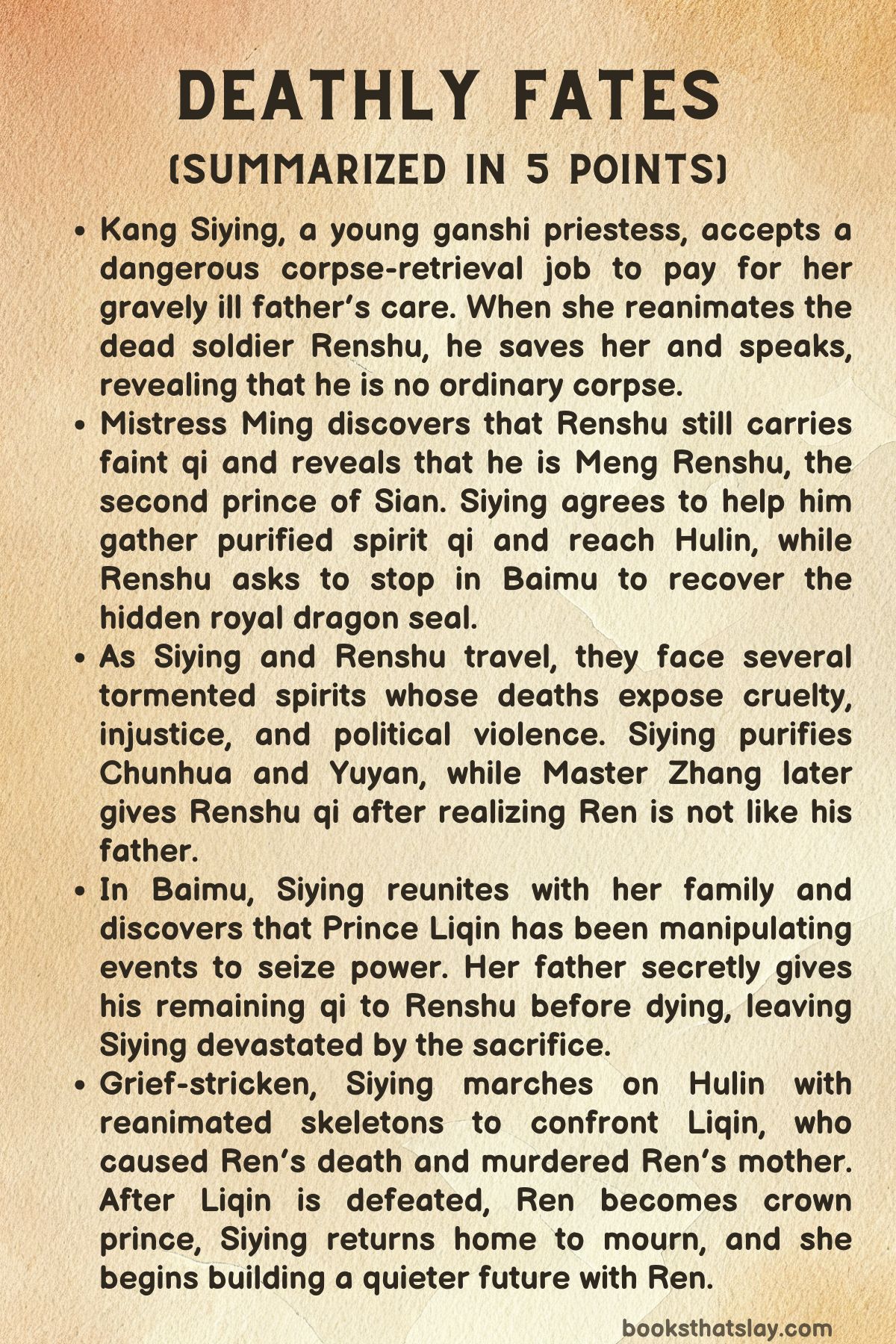
Summary
Kang Siying has spent her life doing work most people fear. As a ganshi priestess, she guides reanimated corpses home so they can be buried properly, using ritual skill, talismans, and discipline to control the dead.
It is not glamorous work, and it carries danger, but it is the trade that supports her family. Her father is gravely ill, and his treatment costs more than she can easily earn.
Because of this, when Official Yi offers her a high-paying job, she accepts it even though the task is risky. She must travel into Wen territory, find the body of a dead Sian soldier named Renshu on a battlefield, and bring him to the capital city of Hulin.
Siying expects a difficult but ordinary corpse-driving assignment. The battlefield, however, is full of signs that death has not settled quietly there.
While searching among the bodies, she finds the soldier she has been sent to retrieve, but she is attacked by a jiangshi. Forced to act quickly, she performs the reanimation ritual on Renshu’s body.
Instead of rising as a silent corpse under her control, he saves her. Even more shocking, he speaks.
This should be impossible. A corpse should not have thought, will, or voice.
Confused and wary, Siying takes Renshu to Mistress Ming, a wisewoman living in Wen. Ming examines him and discovers that faint qi still remains in him.
Siying’s talisman has briefly restored his spirit to his body, leaving him in a strange state between life and death. Ming also reveals that Renshu is not a common soldier.
He is Meng Renshu, the second prince of Sian. She once served his mother, Consort Lin, and she tells him a painful truth: his mother did not die from illness, as he had been led to believe.
She was poisoned. Ming was blamed for it and forced to flee.
Renshu’s restored existence is fragile. He will die unless he absorbs enough purified spirit qi to repair what has been broken inside him.
Siying still needs the money promised for bringing him to Hulin, and Ren offers her double if she helps him survive the journey. Their path now has two goals: reach the capital within three weeks and gather enough qi to keep him alive.
Ren also asks that they stop in Baimu first, where he has hidden something of great importance.
Their search for spirit qi leads them first to Fuzhou Forest, where the ghost of Liu Chunhua is said to haunt the trees. The story people tell is that Chunhua hanged herself after losing her baby, but the spirit Siying encounters is full of rage and pain.
Chunhua attacks with terrifying force. Siying barely survives, and Ren is badly hurt.
At first, the ghost seems like a dangerous obstacle, but Siying begins to understand that Chunhua’s anger has roots in injustice.
When Siying speaks to Chunhua’s parents, she learns that the truth is darker than the village tale. Chunhua had not simply taken her own life out of despair.
She had been murdered by her in-laws, who then made her death look like suicide. The grief over her dead daughter, Chenguang, and the cruelty done to her twisted Chunhua into a vengeful spirit.
Siying returns to the forest not only to defeat Chunhua but to free her. By reminding Chunhua of Chenguang and helping her remember love beneath rage, Siying purifies her spirit.
Ren absorbs the purified qi, gaining strength, but the amount is still not enough to save him completely.
The journey continues to Guangli, where Jing Mansion stands as a place of fear. The mansion is haunted by Yuyan, a shamaness who slaughtered the Jing family and became a powerful jiangshi.
The townspeople avoid the place, leaving the dead and their pain trapped inside. Siying and Ren enter the mansion in search of another source of spirit qi, but Yuyan is far more dangerous than they expect.
Inside Jing Mansion, Yuyan uses illusions to confuse and weaken Siying. She separates Siying from Ren and traps her in visions meant to break her resolve.
Yuyan also tries to possess Ren, drawn to the unusual state of his body and spirit. Siying must fight her way through fear, deception, and the mansion’s violent history to reach him.
Her skill as a priestess is tested not just by physical danger but by the need to see through false images and hold on to what is real.
Siying manages to purify Yuyan’s spirit and save Ren. The mansion catches fire, and the crisis finally pushes the people of Guangli to act together instead of hiding from the past.
They put out the flames and begin the work of burying the dead properly. For Siying, this becomes another reminder that spirits are not only monsters to be destroyed.
Many are people shaped by betrayal, suffering, and neglect. Her work is about release, not merely control.
As Siying and Ren travel toward Xiatang, the political wound between Sian and Wen becomes clearer. Xiatang is a town scarred by royal violence.
Siying learns that the Sian king massacred local men who had meant only to petition for Wen autonomy. They had not set out as rebels or attackers.
They wanted to be heard, but they were killed instead. The spirit of Master Zhang, Xiatang’s former leader, has remained in the town as its protector.
Master Zhang first seems noble in his devotion to Xiatang, but when he realizes Ren is the son of the Sian king, his pain turns against him. To Zhang, Ren represents the bloodline responsible for the massacre.
He attacks, driven by grief and anger that have never been answered with justice. Ren, however, proves he is not the same as his father.
When he saves a village girl named Feilin, Zhang sees that Ren is capable of compassion and courage. Regretting his attack, Zhang gives Ren some qi willingly.
Even so, Ren remains short of what he needs.
Not long after, Siying and Ren are captured by a Wen officer named Anshi. Anshi is suspicious of them, especially once she understands Ren’s identity.
Ren bargains for their freedom by offering something politically powerful: the lost royal dragon seal. He reveals that he hid the seal in Baimu.
The seal could affect claims to power, and its location makes Baimu even more important to their journey.
Baimu is also Siying’s home. Her family monastery is there, and returning means facing the father she has been trying so desperately to save.
When they arrive, they find that Ren’s older brother, Prince Liqin, is already waiting. Liqin presents himself as caring and composed, but Siying and Anshi both sense that something about him is wrong.
His kindness feels too polished, and his presence in Baimu raises too many questions.
Siying reunites with her father and her sister, Lilan. The reunion is shadowed by her father’s worsening condition.
Siying has taken risks and crossed dangerous lands because she wanted money for his care, but time has nearly run out. Then her father collapses.
Before dying, he secretly gives all his remaining qi to Ren. This final act completes Ren’s recovery, but it costs Siying her father.
She realizes that the life she was trying to save has been willingly spent to save someone else.
The loss shatters her. Siying’s grief quickly turns into rage, and she fixes that rage on Liqin.
By now, the truth of his schemes has come into focus. Liqin poisoned Ren’s mother, Consort Lin.
He arranged Ren’s death. He manipulated people and events to clear his path to power.
His gentle appearance hides a ruthless hunger for the throne. To Siying, he is not only a political traitor but the reason Ren suffered, Ming was disgraced, and her own father’s sacrifice became necessary.
In a desperate act, Siying reanimates the skeletons of the murdered Xiatang men and marches toward Hulin. She means to confront Liqin and kill him.
This choice crosses a grave line. Her work as a ganshi priestess is meant to guide the dead home, not use them as an army.
But in her grief, Siying believes justice must be taken by force. The palace becomes the stage for the final reckoning, with old crimes rising alongside the bones of those who were denied justice.
Siying corners Liqin, ready to end him. Ren intervenes before she can lose herself completely to revenge.
Liqin is defeated, but not in the way Siying first intended. Ren survives and chooses to step into the role he had once resisted.
He decides to become crown prince, not for glory, but because Sian needs someone willing to face the harm done by the royal family and change the direction of the kingdom. He also clears Mistress Ming’s name, correcting one of the lies that helped protect Liqin for years.
Because of Ren’s influence, Siying’s punishment for storming the palace is reduced, though she still must face consequences for what she did.
After the political storm passes, Siying returns home. She buries her father and mourns with Lilan.
The grief does not vanish, and the story does not pretend that sacrifice makes loss easy to bear. Siying must learn to live with the truth that she could not control death, no matter how fiercely she fought it.
Her father’s choice was his own, and loving him did not give her the power to keep him alive forever.
Months later, Siying is temporarily banned from corpse-driving, but her life continues. She teaches new pupils, passing on knowledge even while she waits to return fully to her calling.
Ren visits her in Baimu, and their bond remains quiet but strong. They have both been changed by what they endured.
Ren carries the burden of rule and the hope of becoming better than those before him. Siying carries grief, guilt, and a growing understanding of freedom.
By the end, Deathly Fates becomes a story about accepting what cannot be undone while still choosing to live. Siying cannot bring back her father, undo the massacres, or erase the pain that shaped the spirits she met.
But she can honor the dead without being ruled by them. She can remember love without trying to command fate.
And with Ren beside her, she begins to imagine a future that holds both sorrow and peace.
Characters
Deathly Fates presents its characters through grief, duty, sacrifice, and the difficult process of accepting what cannot be controlled. Each major character carries some form of loss, and the story uses their choices to show how love can become either healing or destructive depending on whether it is joined with compassion, truth, and responsibility.
Kang Siying
Kang Siying is the emotional center of the book, and her journey is shaped by responsibility, fear, grief, and love. As a young ganshi priestess, she begins as someone who is used to dealing with death in a practical and ritualistic way, but she is not emotionally free from it.
Her work guiding reanimated corpses home for burial gives her a serious, disciplined nature, yet her decision to take a dangerous job is deeply personal because she is trying to save her gravely ill father. This makes her both brave and desperate.
She is not motivated by glory or adventure, but by the urgent need to protect the person she loves most.
Siying’s strength lies in her persistence and moral courage. Even when she is frightened, injured, or overwhelmed, she continues forward because she believes she has a duty to the dead and to the living.
Her encounters with spirits such as Liu Chunhua, Yuyan, and Master Zhang force her to see that death is not only a physical condition but also a state of unresolved pain. Through these experiences, Siying becomes more than someone who performs rituals.
She becomes someone who listens, understands, and helps wounded souls find peace. Her ability to purify spirits depends not only on spiritual skill but also on empathy.
Her relationship with Renshu gradually changes her understanding of life and death. At first, she sees him partly as a job and partly as an unnatural mystery, but over time she recognizes his humanity, pain, and dignity.
Their bond grows through danger, trust, and shared vulnerability. Renshu challenges Siying’s assumptions, while Siying gives him a reason to keep fighting for life.
Their relationship is quiet but meaningful because it is built on mutual rescue, not simple romance. Each helps the other survive in ways neither fully expects.
Siying’s greatest weakness is her desire to control loss. Her father’s illness terrifies her because it represents something she cannot fix through skill or determination.
When he sacrifices his qi to save Renshu and dies, Siying’s grief becomes rage. Her decision to reanimate the skeletons of the murdered Xiatang men and march on Hulin shows how pain can twist even a righteous person toward violence.
Yet this moment also reveals the depth of her love and the intensity of her suffering. By the end, Siying learns that accepting grief does not mean forgetting love.
Her growth comes from understanding that life cannot be preserved by force, and that healing begins when she allows herself to mourn without being consumed by vengeance.
Meng Renshu
Meng Renshu is one of the most tragic and morally complex figures in the book. He is introduced as a dead soldier, but the revelation that he is actually the second prince of Sian transforms him into a character caught between death, memory, royal identity, and unfinished duty.
His condition is symbolic: he is neither fully dead nor fully alive, and this reflects his place in the political and emotional world of the story. He has been betrayed, hidden, and nearly erased, yet he continues to act with dignity and restraint.
Renshu’s nobility is shown less through his title and more through his choices. Although he is physically dependent on spirit qi and vulnerable to death, he repeatedly protects Siying and others.
He saves Siying from danger, shows concern for innocent people, and later saves Feilin even when Master Zhang sees him as the son of an enemy king. These actions separate Renshu from the cruelty associated with Sian’s rule.
He does not deny the harm done by his kingdom, but he also refuses to become a symbol of inherited violence. His character proves that birth and bloodline do not determine moral worth.
His grief is quiet but deep. Learning that his mother, Consort Lin, was poisoned and that his own death was arranged forces him to confront betrayal within his own family.
Renshu’s pain is especially powerful because he does not respond with blind rage. Unlike Siying, whose grief erupts outward after her father’s death, Renshu tries to carry his suffering with control.
This does not make him emotionless; instead, it shows how much he has been trained by royal life to hide pain and think strategically. His calmness often balances Siying’s intensity.
By the end, Renshu’s decision to become crown prince shows his acceptance of responsibility. He does not seek power for personal ambition, but because he understands that walking away would leave others vulnerable to the same corruption that destroyed his family.
His survival is not only physical but moral. He survives betrayal, death, and political manipulation, and he chooses to use his restored life to correct injustice.
His bond with Siying gives his future emotional warmth, while his choice to rule gives it purpose.
Prince Liqin
Prince Liqin is the main human antagonist of the story, and his danger comes from his ability to appear caring while secretly manipulating the people around him. He represents ambition disguised as affection.
When he appears in Baimu, he seems concerned and brotherly, but Siying and Anshi’s suspicion suggests that his kindness is carefully performed. This makes him a frightening character because his cruelty is not wild or impulsive.
It is calculated, patient, and hidden beneath royal charm.
Liqin’s crimes reveal a character who values power above family, truth, and human life. He poisons Consort Lin, arranges Renshu’s death, and manipulates events to secure his own rise.
His betrayal is especially severe because it violates the trust of his own family. In a story filled with spirits who become dangerous because of suffering, Liqin is different because he causes suffering deliberately.
He does not act from grief or confusion but from ambition. This makes him morally colder than many of the supernatural threats Siying faces.
His role also exposes the corruption within political systems. Liqin is not merely an evil brother; he is a product of a royal world where power can be gained through secrecy, murder, and control.
He understands how to use appearances, titles, and loyalty to protect himself. His ability to manipulate others shows how dangerous authority becomes when it is separated from conscience.
Through him, the story suggests that the living can be more monstrous than the dead.
Liqin’s defeat is important because it breaks the false version of history he tried to create. He depends on lies, hidden crimes, and the erasure of victims, but Siying and Renshu bring those buried truths into the open.
His downfall restores justice not only for Renshu and Consort Lin but also for everyone harmed by the chain of violence he helped create. He stands as a warning against ambition that treats people as tools.
Official Yi
Official Yi is the character who sets Siying’s journey in motion by hiring her to retrieve Renshu’s body. His role is practical, but it is also morally significant because his job offer draws Siying into a much larger web of political secrets.
To Siying, the task first appears to be a dangerous but necessary way to earn money for her father’s treatment. However, Official Yi’s involvement shows how ordinary people can be pulled into royal conflicts without understanding the full truth.
He represents the official world of orders, payments, and political distance. Unlike Siying, who must face danger directly, Official Yi functions from a position of authority and arrangement.
He does not experience the battlefield, the haunted places, or the emotional cost of the mission in the same way Siying does. This contrast helps show the gap between those who command tasks and those who suffer through them.
Although he is not developed as deeply as Siying or Renshu, Official Yi is important because he reflects the hidden machinery of power. His request seems simple on the surface, but it leads to revelations about Renshu’s identity, Consort Lin’s murder, and Liqin’s betrayal.
He is part of the structure that moves bodies, secrets, and responsibilities through the kingdom. His presence reminds the reader that political decisions often reach into the lives of vulnerable people like Siying.
Mistress Ming
Mistress Ming is a wise, protective, and truth-bearing figure in the story. As a wisewoman in Wen, she provides knowledge that Siying and Renshu cannot access on their own.
Her discovery that Renshu still has faint qi changes the direction of the plot, because it proves that he is not an ordinary reanimated corpse and that his spirit has briefly returned to his body. Ming’s wisdom gives shape to the mystery surrounding him.
Her past connection to Consort Lin makes her emotionally important as well as useful. She once served Renshu’s mother, and her revelation that Lin was poisoned exposes one of the central injustices of the story.
Ming is a survivor of false accusation, having fled after being blamed for something she did not do. This makes her another character harmed by Liqin’s corruption and the politics surrounding the royal family.
Her life has been disrupted by lies, yet she continues to preserve the truth.
Ming’s role is also maternal and restorative. She gives Renshu knowledge about his mother, his condition, and his limited time, while giving Siying a clearer path forward.
She does not remove danger from their journey, but she equips them to face it. In this way, she represents guidance rather than rescue.
Her wisdom must be acted upon by others.
By the end, Renshu clearing Ming’s name is significant because it restores dignity to someone who was unjustly punished. Her character shows that truth may be buried for years, but it does not disappear.
Ming’s survival and eventual vindication reinforce the story’s concern with justice for the wrongfully accused and forgotten.
Consort Lin
Consort Lin is physically absent from most of the story, but her influence is powerful. As Renshu’s mother, she represents love, loss, and the hidden wound at the center of the royal family.
The belief that she died of illness conceals the truth that she was poisoned, and this false history shapes Renshu’s understanding of his past. Her death is not only a personal tragedy but also a political crime.
Lin’s importance comes from what her murder reveals about the royal world. She was not simply lost to fate; she was removed through betrayal.
This makes her a symbol of innocence destroyed by ambition. Her death exposes Liqin’s willingness to sacrifice family for power and shows how dangerous the palace becomes when appearances matter more than truth.
For Renshu, learning the truth about his mother deepens his grief but also clarifies his purpose. Lin becomes part of what he must honor by surviving and eventually taking responsibility as crown prince.
Her memory gives emotional weight to his choices. He is not fighting only for his own life but also for the truth of what happened to her.
Consort Lin also connects several characters together. Through Mistress Ming, her story survives.
Through Renshu, her legacy continues. Through Liqin’s crime, her death becomes part of the larger pattern of corruption that must be exposed.
Even in absence, she shapes the moral direction of the novel.
Kang Siying’s Father
Siying’s father is one of the most emotionally important characters because his illness drives Siying’s choices from the beginning. He represents family, duty, sacrifice, and the pain of helpless love.
Siying takes the dangerous corpse-driving job because she wants money to help him, and this shows how central he is to her motivation. His condition places Siying under pressure, making her feel that failure is not an option.
His quiet sacrifice near the end reveals the depth of his love. By secretly giving all his qi to Renshu, he completes Renshu’s recovery but causes his own death.
This act is devastating for Siying because it saves someone she has come to care for while taking away the person she was trying hardest to protect. His choice creates the emotional crisis that pushes Siying into grief-fueled vengeance.
The father’s sacrifice is complex because it is both loving and painful. From his perspective, he may see his death as meaningful because it saves Renshu and perhaps helps secure a better future.
From Siying’s perspective, it feels like a loss she did not consent to and could not prevent. This difference makes the moment especially tragic.
It forces Siying to confront the truth that love cannot always control another person’s choices.
His death becomes the central turning point in Siying’s emotional development. She must learn to live with grief instead of trying to undo it through power.
By burying him and mourning with Lilan, Siying begins to accept loss in a more honest way. His character continues to shape her even after death because his sacrifice teaches her that life, love, and freedom are inseparable from letting go.
Lilan
Lilan, Siying’s sister, represents home, family continuity, and shared grief. Her presence in Baimu reminds Siying that she is not only a priestess or a corpse-driver but also a daughter and sister.
Lilan helps ground Siying’s character in ordinary human relationships, which makes Siying’s later grief feel even more personal. Through Lilan, the reader sees that Siying’s family life exists beyond her dangerous work.
Lilan’s importance becomes clearer after their father dies. She mourns with Siying, and this shared mourning gives Siying a path back from rage.
Grief can isolate people, but Lilan’s presence helps show that mourning is also something families carry together. She does not have the same outwardly dramatic role as Siying, but she provides emotional balance by representing the life Siying must return to after violence and revenge.
She also highlights the cost of Siying’s choices. Siying’s journey may be heroic, but it leaves behind a sister who must also endure fear, illness, and loss.
Lilan’s character reminds the reader that the consequences of great quests are felt at home as much as on battlefields or in palaces. Her grief is quieter, but it is not less meaningful.
By the end, Lilan helps anchor Siying’s recovery. Their shared mourning allows Siying to begin living again without pretending that the loss does not hurt.
Lilan represents the family bond that remains after death has changed everything.
Anshi
Anshi is a Wen officer who begins as an obstacle but becomes a more complicated figure as the story develops. When she captures Siying and Renshu, she appears to be an enemy acting from military duty.
However, her suspicion of Liqin and her willingness to respond to Ren’s bargain reveal that she is not blindly loyal or foolish. She is cautious, strategic, and capable of judging people beyond first appearances.
Her character reflects the political tension between Wen and Sian. As a Wen officer, she has reason to distrust Renshu, especially because he is the son of the Sian king.
Yet she is also practical enough to recognize the value of the royal dragon seal and the larger stakes involved. This makes her a character who lives in the gray area between duty and moral judgment.
She does not simply follow emotion; she weighs risk and advantage.
Anshi’s suspicion of Liqin is especially important because it supports Siying’s growing awareness that the prince’s kindness may be false. Her perspective adds credibility to the danger around Liqin.
She sees through appearances in a way that many others do not, and this makes her a valuable presence in the story’s political conflict.
Although she is not the emotional center of the novel, Anshi contributes to its themes of divided loyalty and difficult trust. She shows that people on opposing sides of a conflict are not automatically villains.
Her choices suggest that justice sometimes depends on individuals who are willing to question official narratives.
Liu Chunhua
Liu Chunhua is one of the most tragic spirits in the story, and her character shows how injustice can trap the dead in pain. She is initially believed to have hanged herself after losing her baby, but Siying later discovers that this version of events is false.
Chunhua was murdered by her in-laws, who staged her death as suicide. This revelation transforms her from a frightening ghost into a wronged woman whose rage comes from betrayal and suffering.
Chunhua’s spirit is dangerous, but the story does not treat her as simply evil. Her violence comes from unresolved grief, the loss of her child, and the cruelty committed against her.
She represents women whose suffering is hidden by social lies and family reputation. Her death was not only physical murder but also a theft of truth, because others controlled the story of what happened to her.
Siying’s purification of Chunhua is meaningful because it requires understanding rather than brute force. By reminding Chunhua of her dead daughter, Chenguang, Siying reaches the love beneath the rage.
This moment shows Siying’s growing ability to see spirits as people with histories, not just threats to be defeated. Chunhua’s pain can only be resolved when her truth is acknowledged and her love for her child is remembered.
Chunhua’s character also helps shape Siying’s moral development. Through her, Siying learns that the dead often carry the consequences of living injustice.
Chunhua’s story deepens the novel’s concern with buried truth, especially the way vulnerable people can be blamed or silenced after death.
Chenguang
Chenguang, Liu Chunhua’s dead daughter, is a small but deeply significant presence. Although she does not actively participate in the story, her memory is the key to reaching Chunhua’s wounded spirit.
Chenguang represents innocence, maternal love, and the grief that binds Chunhua to the world after death. Her loss is the emotional center of Chunhua’s tragedy.
The mention of Chenguang reveals that Chunhua’s rage is rooted in love as much as pain. Chunhua is not merely angry because she died unjustly; she is devastated because she was separated from her child.
This makes her haunting more human and heartbreaking. Chenguang’s memory allows Siying to appeal to the part of Chunhua that still loves rather than only suffers.
Chenguang’s role also shows how the dead remain connected to the living through memory. Even though she is gone, she still has the power to bring peace to her mother’s spirit.
Her presence in the story is gentle but powerful because she becomes the emotional bridge between violence and release.
Through Chenguang, the story suggests that love can survive death, but it can also become a source of torment when it is joined with injustice. Her memory helps transform Chunhua’s ending from one of rage to one of sorrowful peace.
Chunhua’s Parents
Chunhua’s parents are important because they help Siying uncover the truth about their daughter’s death. Their role is rooted in grief and memory.
Unlike the false public story that claims Chunhua hanged herself, her parents preserve the emotional reality of who she was and what she suffered. They become witnesses to a truth that others tried to bury.
Their grief gives Chunhua’s story greater depth. Through them, Siying learns that Chunhua was not simply a ghost haunting the forest but a daughter who was loved and wronged.
This matters because it restores Chunhua’s humanity. The dead are often reduced to rumors, fears, or rituals, but Chunhua’s parents remind Siying that every restless spirit once belonged to someone.
They also show the limits of ordinary people against social injustice. Even if they loved Chunhua, they could not prevent what happened to her or fully correct the false story after her death.
Their helplessness reflects a larger theme in the story: love is powerful, but it is not always enough to stop cruelty. Still, their testimony helps Siying bring Chunhua peace.
Chunhua’s parents represent the importance of remembering truthfully. Their sorrow allows Siying to see beyond the official explanation and pursue justice for a woman whose voice was stolen.
In that way, they help transform Chunhua from a feared ghost into a mourned victim.
Chunhua’s In-Laws
Chunhua’s in-laws are secondary antagonistic figures whose cruelty reveals the social violence hidden beneath family structures. They murder Chunhua and stage her death as suicide, turning her suffering into a lie.
Their actions show how reputation and control can become more important to people than compassion or justice.
They are important because they embody a quieter but deeply damaging form of evil. Unlike supernatural monsters or royal conspirators, they operate within the household.
Their crime is intimate and domestic, which makes it especially disturbing. They do not merely kill Chunhua; they attempt to control how she will be remembered after death.
Their false staging of her suicide also reflects the story’s concern with truth. By making Chunhua appear responsible for her own death, they try to erase their guilt and place shame on the victim.
This mirrors the larger pattern of powerful or cruel people rewriting events to protect themselves. In this way, Chunhua’s in-laws connect to the broader themes of hidden violence and exposed secrets.
Their role may be brief, but it is morally important. They show that injustice does not only exist in palaces or battlefields.
It can exist inside families, where victims may be silenced by those closest to them.
Yuyan
Yuyan is one of the most terrifying supernatural figures in the story because she combines spiritual power with psychological manipulation. As a shamaness who slaughtered the Jing family and became a powerful jiangshi, she represents corruption of spiritual ability.
Her powers are not used to guide, heal, or protect, but to trap, deceive, and possess.
Her use of illusions makes her especially dangerous to Siying. She does not simply attack the body; she attacks perception and trust.
By separating Siying from Renshu and trying to possess him, Yuyan threatens both their physical safety and their growing bond. Her power creates confusion, forcing Siying to rely on courage and inner clarity rather than simple ritual knowledge.
Yuyan’s character contrasts sharply with Siying. Both are connected to spiritual practices, but they represent opposite uses of that connection.
Siying’s work is meant to guide the dead toward rest, while Yuyan’s existence traps death in violence. This contrast strengthens Siying’s role as someone who must choose compassion and discipline even when surrounded by horror.
The purification of Yuyan’s spirit is important because it ends a cycle of fear surrounding Jing Mansion. Her defeat also allows the townspeople to come together, put out the fire, and bury the dead.
Through Yuyan, the story shows how unresolved evil can poison a place, but also how communal action and spiritual release can begin restoration.
The Jing Family
The Jing family functions mainly as a group of victims, but their presence gives Jing Mansion its tragic weight. Their slaughter by Yuyan turns the mansion into a place of horror and unresolved death.
They represent the innocent lives destroyed when spiritual power becomes corrupted and violent.
Although individual members of the Jing family are not deeply developed, their collective suffering matters because it shows the scale of Yuyan’s cruelty. The mansion is not merely haunted because something frightening lives there; it is haunted because people were murdered and left without proper peace.
Their deaths create an atmosphere of grief beneath the fear.
The burial of the dead after the mansion fire is significant because it restores dignity to the Jing family. In the world of the story, proper burial is not a minor detail but a necessary act of respect and closure.
The townspeople’s decision to come together for this task suggests that healing requires community responsibility.
The Jing family’s role reinforces the story’s larger concern with the dead being treated properly. Their tragedy helps show why Siying’s work matters.
Guiding and burying the dead is not only a ritual duty but a moral act that acknowledges the value of lives that violence tried to erase.
Master Zhang
Master Zhang is a tragic guardian figure whose grief and anger are tied to political violence. As Xiatang’s former leader, he protected his town after the massacre of local men who had only intended to petition for Wen autonomy.
His spirit remains connected to the town, and his protective role makes him sympathetic. He is not a mindless threat but a leader whose pain has continued beyond death.
His attack on Renshu reveals the danger of inherited blame. When Master Zhang realizes that Renshu is the Sian king’s son, he sees him through the lens of the massacre.
His rage is understandable because Sian’s violence destroyed innocent lives, but his judgment is incomplete because Renshu is not personally responsible for his father’s cruelty. This conflict forces the story to examine the difference between justice and revenge.
Master Zhang’s change after Renshu saves Feilin is one of his most important moments. Seeing Renshu protect a Wen village girl forces him to reconsider his hatred.
His regret shows that even a wounded spirit can recognize truth when confronted with compassion. By giving Renshu some qi, Master Zhang moves from vengeance toward repair.
His character deepens the political and moral complexity of the novel. He is both victim and threat, protector and attacker.
Through him, the story shows that suffering can make people righteous, but it can also make them unfair if grief hardens into hatred.
Feilin
Feilin is a village girl whose role is brief but meaningful. Her danger gives Renshu the opportunity to prove his character in Xiatang.
When Renshu saves her, he demonstrates that he is not defined by his father’s violence or by Sian’s political cruelty. This moment becomes crucial in changing Master Zhang’s view of him.
Feilin represents innocence caught between larger conflicts. She is not responsible for royal politics, massacres, or old grievances, yet her life is affected by the violence surrounding her community.
Her presence reminds the reader that ordinary people, especially children, are often the most vulnerable in conflicts created by rulers and armies.
Her rescue also becomes a moral test. Renshu’s willingness to save her shows compassion without calculation.
He does not protect her to win approval from Master Zhang; he acts because it is right. This helps separate him from the image of Sian power that Master Zhang hates.
Though Feilin is not a central character, she plays an important symbolic role. She becomes the living proof that compassion can interrupt inherited hatred.
Through her, the story allows a moment of recognition between enemies and opens the possibility of healing.
The Sian King
The Sian king is a powerful background figure whose actions shape much of the suffering in the story. His massacre of the local men in Xiatang reveals a ruler who responds to political petition with violence.
Even though he is not the central villain in the immediate plot, his cruelty creates the conditions for Master Zhang’s rage and for Wen’s distrust of Sian.
His role is important because he represents oppressive authority. The men of Xiatang intended to petition for autonomy, but instead of listening, the king uses force.
This shows a failure of leadership and compassion. His actions make political conflict personal, turning ordinary communities into sites of grief.
The Sian king also affects how others see Renshu. Because Renshu is his son, people like Master Zhang may assume that Renshu carries the same guilt or cruelty.
This creates one of the story’s central moral questions: whether a person should be judged by bloodline or by action. Renshu’s character becomes stronger because he must rise above the shadow of his father’s rule.
The king’s presence in the story shows how rulers can cause suffering far beyond the palace. His choices echo through haunted towns, grieving spirits, and divided loyalties.
He is a reminder that political violence does not end when the battle is over; it remains in memory, land, and the dead.
The Xiatang Men
The murdered men of Xiatang are a collective symbol of political injustice. They had intended to petition for Wen autonomy, but they were massacred by the Sian king’s forces.
Their deaths reveal the cruelty of a system that treats peaceful voices as threats. Although they are not developed individually, their collective fate shapes the moral atmosphere of the story.
Their importance grows when Siying reanimates their skeletons after her father’s death. In that moment, they become instruments of her grief and rage.
Siying uses their bodies to march toward Hulin and confront Liqin, connecting her personal loss with the broader history of political violence. This act is powerful but morally troubling because it shows how easily the dead can be pulled back into the conflicts of the living.
The Xiatang men also represent silenced victims whose deaths demand recognition. Their massacre is not merely background information; it becomes part of the emotional and ethical burden carried by the characters.
Master Zhang’s protective rage, Wen’s hostility, and Siying’s later vengeance are all connected to their unjust deaths.
Through them, the story shows that mass violence leaves behind more than bodies. It leaves unresolved grief, anger, and demands for justice.
Their presence reminds the reader that political cruelty is measured not only in royal decisions but in the lives of ordinary people destroyed by those decisions.
Themes
Grief and the Struggle to Let Go
Siying’s journey is shaped by her fear of loss, especially her desperate need to save her father. Her work as a ganshi priestess already places her close to death, but her personal grief makes death feel like an enemy she must defeat rather than a truth she must face.
This becomes clear when her father sacrifices his remaining qi for Ren, leaving Siying with a pain she cannot control or bargain with. Her rage after his death shows how grief can turn into violence when it has no place to rest.
By raising the skeletons of the murdered men and marching toward revenge, Siying tries to turn sorrow into action, as if punishing someone will make the loss bearable. Yet the ending moves her toward a more honest form of mourning.
She buries her father, grieves with Lilan, and slowly learns that love does not require holding on to the impossible. Deathly Fates presents grief as painful, lasting, and life-changing, but also something that can be carried without letting it destroy the living.
Justice, Revenge, and Moral Responsibility
The story repeatedly places Siying and Ren before wrongs that have been hidden, denied, or left unresolved. Chunhua’s death is falsely treated as suicide, Yuyan’s violence leaves a town haunted by fear, and Xiatang’s massacre is buried under royal power.
Each encounter forces the characters to ask what justice should look like when the dead can no longer speak for themselves. Siying’s gift gives her access to truths that others ignore, but it also tempts her to use the dead as weapons.
Her attack on the palace comes from real injustice, yet it also shows the danger of letting rage decide what justice means. Ren’s role is equally important because he must face crimes connected to his own family and future rule.
He cannot undo what was done, but he can choose responsibility over denial. The theme becomes most powerful when justice is shown not as simple punishment, but as truth, accountability, restraint, and care for those harmed by power.
Power, Corruption, and the Cost of Ambition
Royal authority in the story is often tied to secrecy, violence, and the hunger to control succession. Liqin’s ambition leads him to poison, manipulate, and betray his own family, proving that the desire for power can destroy even the bonds that should be most sacred.
The Sian king’s violence against Xiatang also shows how rulers can treat ordinary people as threats when they demand dignity or autonomy. Through these events, power is not presented as evil by itself, but as dangerous when it is separated from compassion and truth.
Ren’s survival creates a contrast with Liqin’s corruption. He has every reason to reject the throne after learning how much blood surrounds it, yet he chooses to become crown prince because he understands that refusing responsibility may leave the same broken system in place.
His decision suggests that ethical leadership requires more than birthright. It requires memory, humility, and the willingness to answer for harm caused by the state, even when that harm was committed by others.
Identity, Humanity, and Seeing Beyond Fear
Ren’s condition challenges the boundary between life and death, forcing others to decide whether he is a person, a corpse, a prince, or a threat. At first, Siying sees him through the rules of her profession: he is a body to be transported and a task to be completed.
As he speaks, protects her, suffers, and makes choices, she must recognize his humanity beyond what his body appears to be. This theme also extends to spirits like Chunhua, Yuyan, and Master Zhang, who are feared because of what they have become, yet each carries a human story of pain, injustice, or regret.
The supernatural elements therefore do more than create danger; they reveal how easily people reduce the dead, the wounded, or the frightening into monsters. Siying’s growth comes from learning to look closer before judging.
Her power matters not simply because she can command corpses or purify spirits, but because she can listen to what pain has turned them into and respond with courage rather than blind fear.