Dog Person Summary, Characters and Themes | Camille Pagán
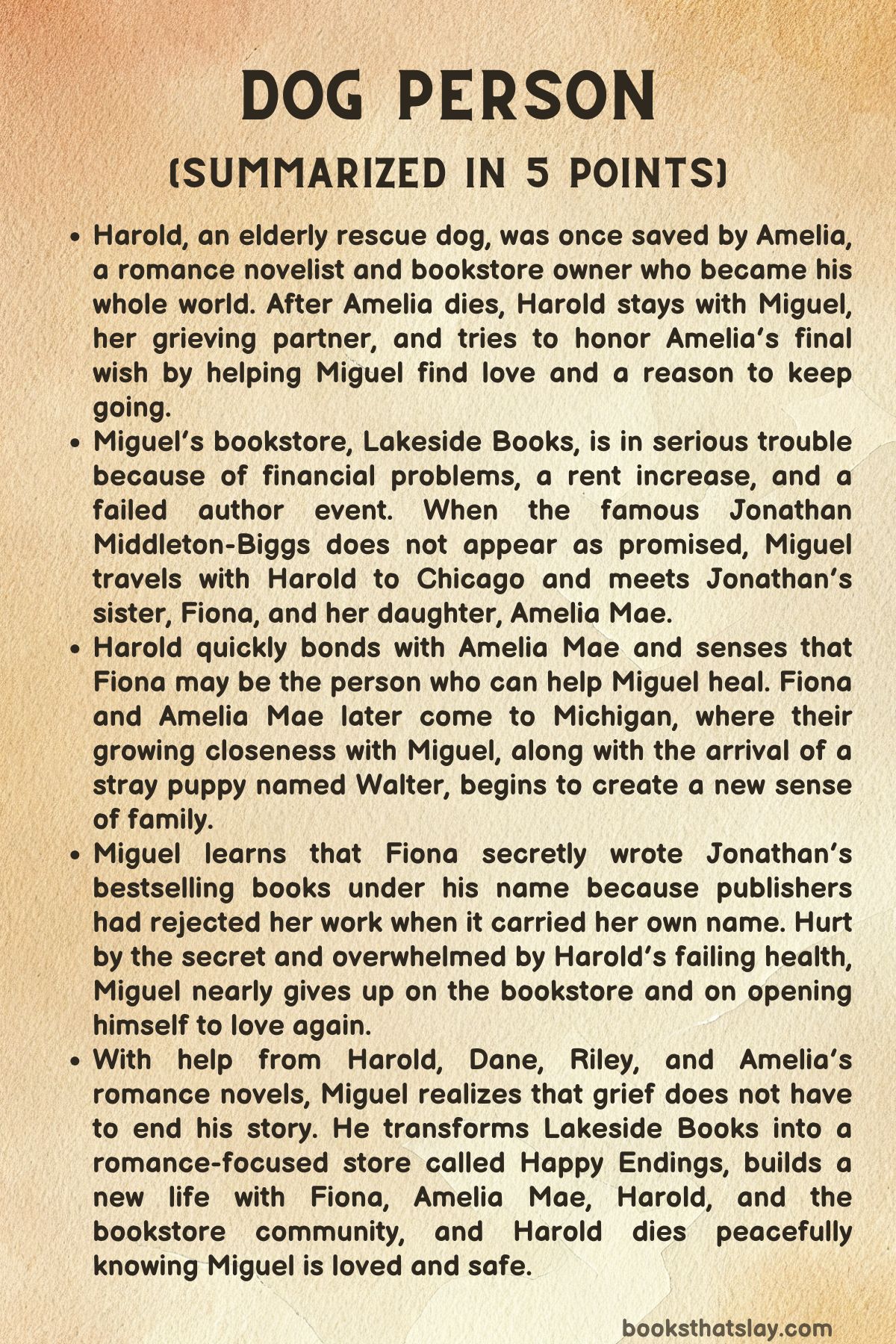
Dog Person by Camille Pagán is a warm, emotional novel about grief, second chances, and the quiet loyalty that can change a human life. Told through the presence and purpose of Harold, an aging rescue dog, the story follows Miguel, a bookstore owner struggling after the death of his partner, Amelia.
As Miguel withdraws from the world, Harold tries to honor Amelia’s final wish: help Miguel find love and connection again. Through a failing bookstore, a missing author, a mother and daughter, and a loyal dog’s final mission, Dog Person explores how loss can open the way to a new kind of family.
Summary
Harold is an elderly rescue dog who has known fear, loneliness, and uncertainty, but his life changed when Amelia adopted him. Before Amelia, Harold had lived in a shelter, anxious and alone, waiting for someone to see him as worthy of love.
Amelia became that person. She brought him home, gave him safety, affection, and a place in her life with Miguel, her partner.
Together, Amelia and Miguel ran Lakeside Books, a small bookstore that was once full of warmth, purpose, and community. Amelia was also a romance novelist, someone who believed deeply in stories about people finding each other, healing, and choosing happiness even after pain.
When Amelia dies, Harold’s world changes again. Miguel is devastated by the loss and begins to shut himself away from nearly everything.
He is still physically present, but emotionally he is stuck in grief. He barely keeps the bookstore running and depends on Harold as his main source of comfort.
Harold understands more than people realize. He remembers that before Amelia died, she asked him to take care of Miguel and help him find someone to love again.
Harold treats this as a promise. He knows Miguel is not really living, and he also knows that his own body is getting older and weaker.
Time matters. Harold wants to make sure Miguel will not be alone when he is gone.
Lakeside Books is in trouble. Miguel has pulled away from the business, leaving the staff to manage the daily work.
Riley, Dane, Brenna, and Natalie care about the store, but they can only do so much without Miguel’s energy and leadership. The store’s financial problems grow worse when Kathy, the building owner, announces a steep rent increase.
Lakeside is already fragile, and the new rent threatens its future. Miguel places his hopes on a large paid event featuring Jonathan Middleton-Biggs, his favorite author.
The event is meant to bring in money, attention, and customers. Instead, Jonathan fails to appear.
The failed event is a disaster. Customers have paid for something they did not receive, and the bookstore cannot afford the refunds.
Miguel is angry, embarrassed, and frightened about what the failure means for Lakeside. Rather than accept the loss, he decides to track Jonathan down and make him reschedule.
Dane helps Miguel, and Harold goes along. Their search takes them from Michigan to Chicago, where they visit Jonathan’s house.
At Jonathan’s home, they meet Fiona Foster, Jonathan’s sister and informal assistant, and Fiona’s young daughter, Amelia Mae. The child’s name immediately hurts Miguel because it is so close to Amelia’s.
For a moment, the similarity feels unbearable, but the confusion passes. Harold, however, reacts differently.
He is drawn to Amelia Mae right away and also senses something important about Fiona. To Harold, Fiona seems like exactly the kind of person Amelia would want Miguel to notice.
She is smart, capable, and carrying her own burdens. Harold begins to believe that Fiona may be the person who can help Miguel return to life.
Fiona explains that Jonathan has disappeared and does not want to be found. This is not what Miguel wants to hear.
He needs Jonathan to fix the damage he caused, but Jonathan has made himself unreachable. Later, Miguel learns that Jonathan is in Copenhagen after Amelia Mae secretly uses Fiona’s phone to call him.
When Miguel finally speaks with Jonathan, the author refuses to reschedule the event. He shows little concern for the harm he has done to the bookstore.
Miguel returns to Michigan without the solution he wanted, but the trip has still changed something. Harold cannot stop thinking about Fiona and Amelia Mae, and Miguel has been shaken out of his numb routine, even if only briefly.
Back home, Harold hopes Fiona and Amelia Mae will come to Lakeside. Amelia Mae makes that happen in a dangerous and impulsive way: she runs away from camp and takes a train by herself to reach the bookstore.
Fiona follows, angry and terrified, but also relieved to find her daughter safe. Though the situation begins in fear, it brings Fiona, Amelia Mae, Miguel, and Harold together again.
Fiona and Amelia Mae stay in town for a while, and Fiona starts helping Miguel think through the bookstore’s problems.
During this time, a stray puppy enters their lives. The puppy is later named Walter.
Walter gives Fiona and Amelia Mae another reason to remain close to Miguel and Lakeside. He also brings new energy into Harold’s life.
Walter is young, lively, and full of needs, while Harold is old and tired. Still, the puppy’s presence strengthens the growing bond among everyone.
Fiona, Amelia Mae, Miguel, Harold, and Walter begin to look less like strangers brought together by accident and more like the beginning of a family.
As Miguel spends more time with Fiona, he discovers the truth behind Jonathan Middleton-Biggs’s career. Fiona, not Jonathan, secretly wrote the famous novels published under her brother’s name.
She had submitted her work as herself, but publishers ignored her. Under Jonathan’s name, the books became successful.
Jonathan received the public praise, while Fiona stayed hidden behind him. His disappearance came after a breakup with Vik, but the deeper truth is that Jonathan’s fame has always rested on Fiona’s talent.
Miguel reacts badly when Fiona tells him the truth. Instead of responding with understanding, he feels betrayed and overwhelmed.
His own pain, anger, and fear make him push her away. Fiona is hurt by his reaction and leaves.
Miguel loses the connection Harold had been trying so hard to help him build.
At the same time, Harold’s health worsens. His aging body can no longer keep up with his determination.
When he collapses, Miguel takes him to the animal hospital and learns that Harold’s heart is failing. The news terrifies Miguel.
He has already lost Amelia, and now he faces losing Harold too. Harold has been his closest companion through grief, the one living link to Amelia’s love.
The thought of saying goodbye to him feels impossible. Miguel responds by retreating again.
He decides that it may be better to close the bookstore and protect himself from more pain. If he does not risk caring, he will not have to face another loss.
But the people around him do not let him disappear completely. Dane, Riley, and Harold all help pull Miguel back toward the life he still has.
Dane tells Miguel that Amelia would not have wanted his story to end in loneliness. This matters because Miguel has been treating grief as if it must be the end of everything.
He has confused loyalty to Amelia with refusing to live without her.
A blackout becomes a turning point. Harold pushes Miguel toward Amelia’s romance novels, the books Miguel has avoided.
Miguel finally reads them. As he does, he begins to understand Amelia in a new way.
Her books are not just simple love stories. They are about people who are hurt, frightened, stubborn, and changed by the decision to keep going.
They are about choosing love even when love carries the risk of pain. Miguel breaks down as he reads, but the breakdown clears something inside him.
He realizes that Amelia did not write about perfect people. She wrote about people brave enough to accept happiness after loss.
Miguel goes into Amelia’s attic office and brings her books down to the store. This act is both practical and symbolic.
He is no longer hiding Amelia away as part of a frozen past. He is bringing her work, her voice, and her belief in love into the future of Lakeside Books.
Miguel decides not to close the store. Instead, he allows the staff to help him reimagine it.
Riley, Brenna, Dane, and Natalie become co-owners, making the bookstore a shared effort rather than Miguel’s burden alone. The store is renamed Happy Endings, and it becomes focused on romance, the genre Amelia loved and the one Miguel finally understands.
Miguel also knows he has to make things right with Fiona. He apologizes for how he responded to her truth.
Fiona returns with Amelia Mae and Walter, allowing their relationship to begin again on more honest ground. Miguel’s life continues to open.
His sister Miriam moves closer after getting a job in Michigan, and she and Dane begin a relationship. The bookstore’s reopening is a success, and Miguel publicly honors Amelia while also accepting that loving her does not require him to stay alone forever.
By the end, Miguel has a new kind of family around him. Fiona and Amelia Mae have rented a nearby house.
Walter follows Harold everywhere, learning from him and loving him in the simple, devoted way dogs do. Miguel is no longer isolated.
He has Fiona, Amelia Mae, Harold, Walter, his sister, the staff, and the renewed bookstore community. Harold sees that his promise to Amelia has been fulfilled.
Miguel is loved. He is safe.
He has chosen life again.
When Harold’s health finally fails, the goodbye is painful but peaceful. Miguel and Amelia Mae are with him.
Harold sees Amelia waiting for him, and he dies knowing that he has done what he was asked to do. He rescued Miguel in the way Amelia once rescued him.
Through Harold’s loyalty, Miguel found his way back to love, family, work, and hope. Dog Person ends with sorrow, but also with comfort: Harold’s life had meaning, his promise was kept, and the people he loved are ready to keep living.
Characters
Harold
Harold is the emotional heart of Dog Person and one of the most tenderly written characters in the book. As an elderly rescue dog, he carries both the vulnerability of age and the quiet wisdom of a life shaped by love, fear, loyalty, and loss.
His past as a lonely shelter dog makes Amelia’s rescue of him deeply meaningful, because she does not simply give him a home; she gives him a purpose, a sense of safety, and a person to love completely. After Amelia’s death, Harold becomes more than Miguel’s companion.
He becomes the living connection between Miguel’s past with Amelia and the possibility of a future beyond grief.
Harold’s character is defined by devotion. He takes Amelia’s final wish seriously and sees caring for Miguel as his remaining mission.
This gives him a deeply purposeful role in the story, because his love is active rather than passive. He observes Miguel’s sadness, senses his emotional withdrawal, and worries about what will happen after his own body can no longer keep going.
Harold’s aging body adds urgency to his character arc. His failing health is not just a source of sadness; it reminds the reader that love often comes with limited time, and that the people and animals we love can push us toward healing even when they cannot stay forever.
Harold also functions as a bridge between characters. His instant bond with Amelia Mae, his affection for Fiona, and his acceptance of Walter all help create the new family Miguel is too afraid to seek for himself.
Harold understands love instinctively, without pride, resentment, or hesitation. Through him, the book shows that emotional recovery often begins before a person is ready to admit it.
By the end, Harold’s death is peaceful rather than empty, because he has fulfilled Amelia’s request. He leaves Miguel loved, supported, and no longer trapped in loneliness, making him one of the most important and emotionally complete characters in the story.
Miguel
Miguel is one of the central human figures in the book, and his journey is built around grief, emotional avoidance, and the difficult return to life after devastating loss. After Amelia dies, Miguel becomes withdrawn and stuck in sorrow.
He is physically present at Lakeside Books but emotionally absent from it, leaving much of the responsibility to the staff while he clings to Harold as his main source of comfort. His grief is understandable, but it also becomes limiting.
He begins to treat love as something that can only lead to pain, and this fear keeps him from engaging fully with the store, his friends, his family, and his own future.
Miguel’s relationship with Amelia continues to shape him even after her death. At first, he seems unable to move beyond the life they shared, and the bookstore becomes a painful reminder of what he has lost rather than a living place that can still grow.
His decision to track down Jonathan Middleton-Biggs begins as an act of desperation, because he believes the failed author event may be the final blow to the store. However, this journey also becomes the beginning of his emotional reopening.
Meeting Fiona and Amelia Mae forces Miguel into situations where he must confront discomfort, misunderstanding, attraction, tenderness, and the possibility that love did not end with Amelia.
Miguel’s flaws make him believable. He reacts poorly when he learns Fiona’s secret, and his first instinct is to retreat when Harold’s health declines.
He wants to close the bookstore not only because of financial strain but because closing it would allow him to avoid more pain. Yet his growth comes from realizing that avoidance is not the same as safety.
Through Dane’s honesty, Harold’s persistence, and Amelia’s novels, Miguel finally understands that love requires risk and that grief does not have to erase the future. His decision to keep the store open, honor Amelia, apologize to Fiona, and embrace a new family marks his transformation from a man trapped by loss into someone willing to live again.
Amelia
Amelia is physically absent for most of the story, but her presence shapes nearly every major emotional development in the book. She is Miguel’s deceased partner, Harold’s beloved rescuer, and the creative force behind the romance novels that eventually help Miguel understand what she valued about love and change.
Amelia’s importance lies in the way she continues to influence the living characters. Her love for Harold gave him a home and a purpose, while her love for Miguel left behind not only grief but also a model of emotional courage that he must learn to recognize.
Amelia’s final request to Harold reveals her understanding of Miguel’s vulnerability. She knew he might collapse inward after losing her, and she trusted Harold to help guide him toward connection.
This makes Amelia compassionate and perceptive, even in death. She does not want Miguel to remain frozen in loyalty to her memory; she wants him to find love and companionship again.
That wish shows that her love is generous rather than possessive. She wants Miguel’s life to continue, even if that means he eventually loves someone else.
Amelia’s identity as a romance novelist is also meaningful. Miguel initially fails to appreciate the emotional depth of her work, but when he finally reads her novels, he discovers that they contain the wisdom he has been avoiding.
Her stories teach him that people can change, that pain does not make love meaningless, and that happy endings are not shallow fantasies but choices people make after struggle. Amelia therefore becomes a guiding moral and emotional presence in Dog Person.
She represents the kind of love that remains powerful after death because it encourages the living to keep growing.
Fiona Foster
Fiona Foster is a complex character whose storyline explores talent, invisibility, sacrifice, and the fear of being truly seen. When Miguel first meets her, she appears to be Jonathan Middleton-Biggs’s sister and informal assistant, but her real importance is much greater.
Fiona is the true writer behind Jonathan’s successful novels, having allowed her brother’s name to become the public face of work she created. This secret gives her character a deep emotional burden.
She is talented and capable, but she has been pushed into the background by a publishing world that ignored her when she submitted work under her own identity.
Fiona’s deception is morally complicated, but it is rooted in disappointment and survival rather than cruelty. Her choice to write under Jonathan’s name reflects the unfairness she faced, and it also shows how easily women’s creative labor can be dismissed or hidden.
At the same time, the arrangement traps her. Jonathan receives recognition, while Fiona carries the pressure of maintaining the lie.
Her relationship with Miguel becomes difficult because she wants to be loved honestly but has not been honest about a major part of herself. When Miguel reacts badly to the truth, her hurt is understandable because she has already spent so long being unseen.
Fiona is also a loving and protective mother. Her relationship with Amelia Mae shows warmth, frustration, fear, and devotion.
When Amelia Mae runs away to Lakeside, Fiona’s anger is mixed with relief, showing how deeply she cares. Fiona’s bond with Miguel grows because they both understand loss, responsibility, and the difficulty of beginning again.
By returning after Miguel apologizes, Fiona shows that she is willing to risk trust despite being hurt. Her character adds emotional richness to the story because she is not simply a romantic interest; she is a woman reclaiming her voice, her authorship, and her right to be loved as herself.
Amelia Mae
Amelia Mae is Fiona’s daughter and one of the brightest sources of energy in the story. Her name initially causes Miguel pain because it so closely resembles Amelia’s, but this discomfort eventually becomes part of Miguel’s healing.
Amelia Mae is curious, impulsive, affectionate, and emotionally direct. Unlike the adults, who often hide behind grief, fear, pride, or secrecy, she acts on what she feels.
Her decision to secretly call Jonathan and later travel alone to Lakeside shows both her boldness and her lack of adult caution.
Amelia Mae plays an important role in bringing people together. Her immediate bond with Harold is especially significant because Harold recognizes her as part of the future Miguel needs.
She is not a replacement for Amelia, and the story does not treat her that way. Instead, she represents new love entering Miguel’s life in an unexpected form.
Through her, Miguel begins to experience caretaking, joy, worry, and family in a way he had closed himself off from after Amelia’s death.
Her relationship with Walter also reveals her tenderness and need for connection. The puppy gives her a reason to remain tied to Lakeside, just as Harold helps tie Miguel to Fiona and Amelia Mae.
By the end, Amelia Mae’s presence in Miguel’s life shows that healing is not only romantic. It is also familial, communal, and intergenerational.
Her goodbye to Harold is especially moving because it shows that she has become part of the circle of love Harold worked so hard to create.
Jonathan Middleton-Biggs
Jonathan Middleton-Biggs is an important offstage force whose choices create many of the story’s conflicts. At first, he appears to be Miguel’s favorite author and the person who might save Lakeside Books through a major paid event.
When he fails to appear, the consequences are immediate and serious. His absence threatens the store financially and pushes Miguel into action.
However, as more is revealed, Jonathan becomes less a glamorous literary figure and more a selfish, careless man who benefits from the labor and loyalty of others.
Jonathan’s greatest moral flaw is his willingness to accept public success for books Fiona wrote. While the publishing world’s rejection of Fiona helps explain how the arrangement began, Jonathan’s continued participation in it makes him deeply compromised.
He enjoys the reputation without carrying the full creative burden, and when his personal life falls apart after his breakup with Vik, he disappears without regard for the damage he causes. His refusal to reschedule the event shows a lack of responsibility toward Miguel, Lakeside Books, and the readers who trusted him.
Still, Jonathan is not only a villain. He is also weak, avoidant, and emotionally immature.
His disappearance suggests someone who cannot face consequences, whether in his career, his family, or his romantic life. As a character, he serves as a contrast to Miguel.
Both men are overwhelmed by pain, but Miguel eventually learns to face grief and repair harm, while Jonathan runs away. This contrast makes Jonathan useful to the story’s moral structure, because he shows what happens when avoidance becomes selfishness rather than sorrow.
Riley
Riley is one of the Lakeside Books employees who helps keep the store alive when Miguel is too consumed by grief to lead it properly. Her character represents loyalty, steadiness, and belief in the bookstore as more than a business.
While Miguel withdraws, Riley continues showing up, which makes her part of the quiet support system holding his life together before he is ready to recognize it. She is not merely an employee; she is part of the community Amelia and Miguel built.
Riley’s importance grows when the bookstore is reimagined rather than abandoned. Her willingness to become a co-owner shows that she has a real emotional and practical investment in the store’s future.
She helps transform Lakeside Books into Happy Endings, and this shift reflects the broader movement of the story from grief to renewal. Riley’s character demonstrates that healing does not happen through one person alone.
Miguel needs Harold, Fiona, and Amelia’s memory, but he also needs the people who have been standing beside him all along.
As a supporting character, Riley helps ground the story in community. She represents the everyday labor and care that keep meaningful places alive.
Her presence reminds the reader that bookstores are not only shaped by owners or famous authors, but also by workers who know the customers, understand the atmosphere, and believe in the store’s purpose. Through Riley, the book shows that shared ownership can be both practical and emotional, turning a struggling workplace into a chosen community.
Dane
Dane is one of the most important supporting characters because he gives Miguel honesty when Miguel needs it most. He helps Miguel travel to Chicago to find Jonathan, but his role extends far beyond practical assistance.
Dane sees Miguel clearly and is willing to challenge him. His friendship is compassionate but not passive.
When Miguel begins surrendering to grief and fear, Dane reminds him that Amelia would not have wanted his life to end in loneliness.
Dane’s emotional intelligence makes him a stabilizing figure. He understands that grief can become a kind of hiding place, and he refuses to let Miguel mistake isolation for loyalty.
His words help push Miguel toward the realization that continuing to live is not a betrayal of Amelia. This makes Dane one of the characters most directly responsible for Miguel’s transformation.
He does not solve Miguel’s problems, but he helps him see the truth he has been avoiding.
Dane’s eventual relationship with Miriam also adds warmth to his character arc. It connects him more deeply to Miguel’s family and to the renewed community around the bookstore.
Like many relationships in the story, this romance suggests that love can emerge quietly from loyalty, proximity, and emotional openness. Dane’s character reinforces the idea that chosen family can be just as important as romantic love, especially during periods of grief and rebuilding.
Brenna
Brenna is another member of the Lakeside Books staff who helps keep the store functioning during Miguel’s emotional absence. Her role may be quieter than some of the central characters, but she contributes to the sense that the bookstore is a living community rather than just a setting.
Brenna’s continued presence shows commitment during uncertainty. When the store faces financial trouble, failed events, and the possibility of closure, she remains part of the group trying to preserve it.
Brenna’s character helps emphasize the theme of collective renewal. Miguel initially behaves as though the store’s fate rests only on him, but the eventual transformation into Happy Endings proves that the store belongs emotionally to more people than he realized.
Brenna becoming a co-owner is significant because it changes the power dynamic of the bookstore. The staff members are no longer simply holding things together for Miguel; they are invited to shape the future themselves.
Through Brenna, the story highlights the value of dependable supporting figures. Not every character needs a dramatic personal arc to matter.
Brenna’s importance lies in her reliability, her participation in the store’s survival, and her role in the community that helps Miguel heal. She represents the people who stay, work, and believe in something even when its future is uncertain.
Natalie
Natalie is part of the Lakeside Books team and contributes to the store’s survival during its most fragile period. Like Riley and Brenna, she helps show that the bookstore has a community structure Miguel has failed to fully appreciate while lost in grief.
Her presence matters because the store’s continued existence depends not only on Miguel’s decisions but also on the care and labor of the people around him.
Natalie’s role becomes especially meaningful when the staff members become co-owners. This development shows that the future of the bookstore cannot be built on Miguel’s grief or Amelia’s memory alone.
It must become something shared, active, and forward-looking. Natalie’s inclusion in that future gives her character symbolic importance.
She is part of the movement from a store associated with loss into a renewed space centered on romance, hope, and belonging.
Although Natalie is a supporting character, she helps reinforce one of the book’s central ideas: healing is communal. Miguel does not recover because one person saves him.
He recovers because many people, including Natalie, help create an environment where he can choose life again. Her character adds to the sense that the bookstore’s happy ending belongs to a whole group, not just to Miguel.
Kathy
Kathy, the building owner, serves as a source of practical pressure in the story. Her rent increase intensifies the crisis facing Lakeside Books and forces Miguel to confront the reality that grief cannot pause the demands of the outside world.
While Miguel is emotionally stuck, bills, rent, customers, and employees still exist. Kathy’s decision makes the store’s financial problems impossible to ignore.
Kathy is not developed as emotionally as the central characters, but her function in the book is important. She represents external pressure, the kind that often arrives when people are least prepared to handle it.
Her rent increase sharpens the stakes and helps set off the chain of events that sends Miguel searching for Jonathan. Without that pressure, Miguel might have continued drifting in sorrow instead of being pushed toward action.
As a character, Kathy reminds the reader that healing does not happen in isolation from ordinary life. Grief may feel all-consuming, but the world continues to make demands.
Her role helps expose how close Miguel is to losing not only Amelia and Harold, but also the bookstore that connects him to both the past and the possibility of a future.
Walter
Walter is the stray puppy who enters the lives of Fiona, Amelia Mae, Miguel, and Harold at a crucial point in the story. His arrival brings new energy, innocence, and continuity.
Where Harold represents aging, memory, loyalty, and the nearing end of one life, Walter represents youth, renewal, and the beginning of another bond. His presence helps soften the sadness surrounding Harold’s decline without erasing it.
Walter also gives Fiona and Amelia Mae a reason to remain connected to Lakeside. His arrival strengthens the bond between the characters and helps form the new family Harold has been trying to create for Miguel.
Walter’s attachment to Harold is especially touching because it creates a sense of succession. He follows Harold around, learning from him in a way that suggests love and loyalty will continue after Harold is gone.
As a character, Walter does not replace Harold, and that is important. Instead, he represents the way love expands.
The presence of a new dog does not make the old dog’s death less painful, but it does show that affection can continue in new forms. Walter helps the ending feel hopeful even as Harold’s life comes to a close.
Miriam
Miriam is Miguel’s sister, and her decision to move closer after getting a job in Michigan adds another layer to Miguel’s renewed support system. Her presence matters because Miguel’s healing is not limited to romance or the bookstore.
Family also becomes part of the life he is rebuilding. Miriam’s move suggests that Miguel is no longer as isolated as he once was, and that his future will include more consistent connection.
Miriam’s relationship with Dane adds warmth and possibility to the story’s ending. Their connection reflects the wider emotional renewal happening around Miguel.
As he opens himself to Fiona, Amelia Mae, Walter, Harold, and the bookstore community, other characters also move toward love and companionship. Miriam and Dane’s relationship supports the idea that healing can spread outward, affecting not just one person but an entire circle of people.
Miriam’s character also helps show that Miguel does not have to carry his life alone. Her closeness gives him family support at a time when he is learning to accept help instead of withdrawing from it.
Even though she is not one of the central figures, Miriam strengthens the story’s final vision of belonging, stability, and emotional safety.
Vik
Vik is important mainly through his relationship with Jonathan. His breakup with Jonathan helps explain Jonathan’s disappearance, which then creates serious consequences for Miguel and the bookstore.
Although Vik is not deeply developed, his role reveals something significant about Jonathan’s character. Jonathan responds to romantic pain by vanishing, avoiding responsibility, and allowing others to suffer the consequences of his emotional collapse.
Vik’s presence in the story therefore helps deepen the contrast between different responses to heartbreak. Miguel loses Amelia and nearly disappears into grief, but he eventually learns to return to life and repair the damage his withdrawal has caused.
Jonathan, after losing Vik, chooses escape and neglect. Through this contrast, Vik becomes part of the book’s larger exploration of pain, avoidance, and accountability.
Even as a minor character, Vik has narrative importance because his absence helps expose Jonathan’s instability. He is connected to the reason Jonathan refuses to appear, refuses to reschedule, and fails to take responsibility for the harm he has caused.
Vik’s role may be brief, but it helps reveal the emotional weakness behind Jonathan’s public image.
Themes
Grief and the Fear of Beginning Again
In Dog Person, grief is shown as something that can turn love into a kind of emotional prison. Miguel’s sorrow after Amelia’s death does not simply make him sad; it makes him retreat from the store, from other people, and from the possibility of a future.
His bond with Harold becomes both comforting and dangerous because Harold is the last living connection to Amelia, and Miguel clings to him as though moving forward would mean betraying the past. The financial decline of the bookstore reflects Miguel’s inner state: neglected, uncertain, and unable to grow while he remains frozen in loss.
His healing begins only when he understands that remembering Amelia does not require him to stop living. Reading her novels helps him see that love always carries risk, but refusing love is also a kind of loss.
By the end, grief has not disappeared, yet it has changed shape. Miguel learns to carry Amelia’s memory while allowing Fiona, Amelia Mae, Harold, Walter, and the bookstore community to become part of his life.
Love as Responsibility
Love in the story is not presented only as affection, romance, or emotional comfort. It is shown through responsibility, loyalty, and the willingness to act for someone else’s good.
Harold’s promise to Amelia gives him a purpose beyond his own needs, and his care for Miguel becomes one of the emotional centers of the narrative. Even though Harold is aging and physically weak, he continues trying to guide Miguel toward connection because he understands that Miguel cannot survive on memory alone.
This theme also appears in the way the bookstore staff keep the business alive when Miguel is too broken to lead. Riley, Dane, Brenna, and Natalie do not abandon the store when things become difficult; they protect it because they love what it represents.
Fiona’s love is also complicated by responsibility, especially in her sacrifices for Jonathan’s career and her fierce protection of Amelia Mae. The story suggests that real love is not passive.
It requires effort, honesty, courage, and sometimes the painful choice to push someone toward the life they are afraid to claim.
Identity, Voice, and Being Seen
Fiona’s secret authorship exposes the pain of having talent ignored because the world chooses not to recognize the person behind it. Her writing succeeds only when published under Jonathan’s name, which shows how unfairly recognition can be shaped by bias, image, and expectation.
Fiona is not lacking ability; she is lacking access to belief from others. This makes her confession to Miguel especially painful because she is not only admitting a lie, but also revealing years of invisibility.
Jonathan’s fame rests on her voice, while she remains hidden in the background, managing the consequences of a success that should have belonged to her. Miguel’s reaction hurts her because it repeats the same pattern of judgment before understanding.
The theme deepens through Amelia’s posthumous presence as a writer whose work helps Miguel understand love and change. Stories become a way for hidden truths to surface.
By the end, the narrative values authentic voice over public image, showing that people need more than success; they need to be recognized truthfully.
Community, Renewal, and Chosen Family
The bookstore’s transformation shows how healing often depends on community rather than individual strength alone. Miguel cannot save the store or himself while acting from isolation, but when he allows others to help, the place becomes more alive than it was before.
The shift from a struggling bookstore to a romance-focused space reflects a larger emotional renewal. It honors Amelia’s legacy while allowing the future to look different from the past.
Riley, Dane, Brenna, and Natalie becoming co-owners is important because it changes the store from Miguel’s burden into a shared home built through trust. Fiona, Amelia Mae, Walter, Miriam, and Harold also expand Miguel’s idea of family.
These relationships are not replacements for Amelia; they are proof that life can grow around loss without erasing it. The final chapters show renewal as something practical and emotional at once: a business reopens, people return, bonds deepen, and Harold can leave knowing Miguel is no longer alone.
Community becomes the force that turns survival into belonging.