The Rules of Three Summary, Characters and Themes
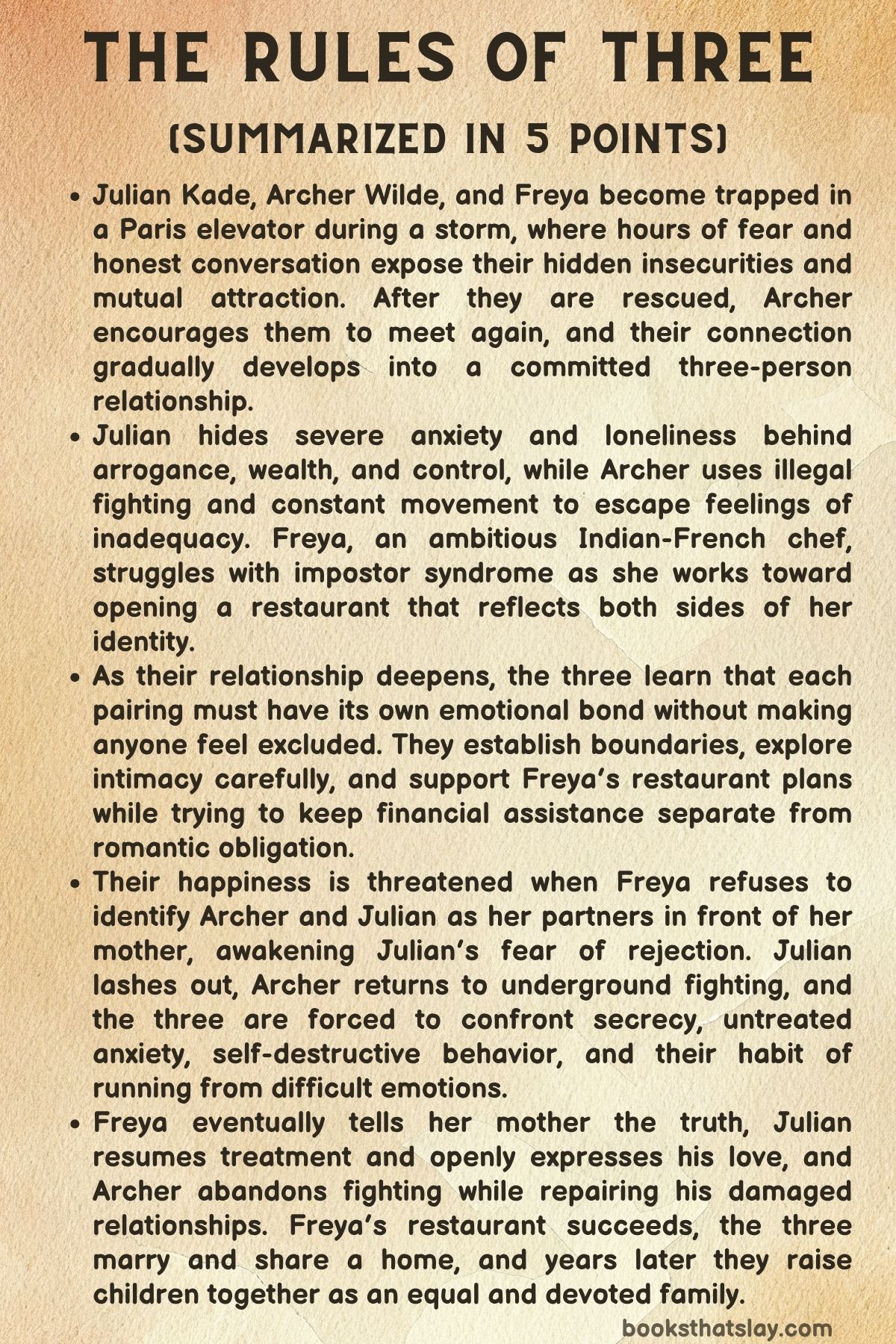
The Rules of Three by Sara Cate is a contemporary romance centered on three people whose lives change after they become trapped in a Paris elevator during a storm.
Julian Kade hides anxiety and loneliness behind wealth, control, and arrogance; Archer Wilde seeks danger because ordinary life leaves him restless; and Freya is an ambitious chef trying to unite her Indian heritage with her French culinary training. Their attraction develops into a committed three-person relationship, but lasting happiness requires more than desire. Each must confront insecurity, family expectations, professional ambition, self-destructive behavior, and the fear of being rejected once fully known.
Summary
Julian Kade expects his father, Ronan, to leave him sole control of L’Amour, the Parisian club connected to the older generation of the Salacious Players’ Club. Receiving the property would prove that Ronan trusts him and considers him worthy, even though Julian privately fears that Jack St. Claire, his father’s capable godson, deserves it more.
Instead, Ronan divides ownership among Julian, Jack, Amelia, Phoenix, Elizabeth, and Weston. They must operate the club together for a year, and if anyone abandons the arrangement, the property will pass to Matis Moreau and be sold.
Julian initially interprets the decision as another sign that his father does not believe in him. However, Jack chooses Julian as his management partner, and the group renames the club Legacy, recognizing both the achievements of their parents and their own responsibility to create something new.
More than a year later, Julian has become deeply involved in Legacy. He develops consent wristbands, themed events, virtual-reality experiences, and other ideas intended to protect guests while keeping the business relevant.
Despite his professional competence, Julian remains convinced that he must make himself indispensable or risk being discarded. His immaculate clothes, jewelry, designer accessories, and controlled manner serve as protection against anyone discovering his anxiety, loneliness, or need for affection.
Julian has stopped taking his prescribed anxiety medication because he believes he functions better without it. He seeks anonymous sexual encounters because physical access without emotional exposure allows him to experience temporary closeness while avoiding the danger of being known.
His apparent coldness also hides a generous nature. When Élodie, a dancer at Legacy, reveals that her son Étienne is ill, Julian secretly gives her money, arranges medical care, grants paid leave, and orders her not to tell anyone that he helped.
Elsewhere in Paris, Archer Wilde participates in illegal underground fights. As the heir to an aviation fortune, he does not need the winnings, but fighting gives him a sense of accomplishment that cannot be inherited from his wealthy family.
Archer has spent years drifting between cities and avoiding responsibility. His parents expected him to become a pilot and enter the family business, but he abandoned that path because he feared living according to someone else’s expectations.
After one fight, Archer returns to his apartment building bruised, bloodied, and poorly dressed. Julian encounters him in the elevator, assumes he is a dangerous outsider, and threatens to call the police.
Archer responds by mocking Julian’s suspicion and calling him “pretty boy.” Their first encounter is hostile, but the tension between them contains an attraction neither man is prepared to admit.
Freya, Amelia’s closest friend, is preparing an Indian-French fusion menu for Ronan and Daisy Kade’s anniversary celebration. She has professional training and considerable talent, but she constantly worries that one mistake will reveal her as an impostor.
Her cooking brings together French methods and the Indian flavors associated with her family. She dreams of opening a restaurant where neither side of her cultural identity must be diminished to make the other acceptable.
Ronan and Daisy enthusiastically approve her tasting menu and hire her to cater their celebration. The opportunity could become an important step toward Freya’s independent career, although she still struggles to believe that she earned it through talent rather than her connection to Amelia.
While cleaning the Kade kitchen, Freya collides with Julian and accidentally spills crème brûlée over his expensive shirt. Julian responds with immediate blame and arrogance, leaving Freya unable to understand how such an unpleasant man belongs to Amelia’s warm family.
A thunderstorm begins as Freya prepares to leave. Daisy orders Julian to help carry Freya’s supplies and accompany her, forcing the two into a tense car ride during which Freya accuses him of spreading his misery to everyone around him.
Julian threatens to have her fired, although he regrets the threat almost immediately. Back at his apartment building, he encounters Archer again and realizes that the bloodied stranger from the previous night is actually a wealthy resident.
Freya follows Julian into the elevator because she wants him to withdraw the threat against her job. Archer enters with them, and the storm causes the power to fail, leaving all three trapped between floors.
Freya initially panics, but Julian’s reaction is much more serious. He begins hyperventilating and suffers a severe panic attack, exposing the vulnerability beneath his polished appearance.
Archer calmly instructs Julian to focus on him and regulate his breathing. Freya presses her forehead against Julian’s and counts his breaths until the worst of the episode passes.
As the hours continue, the elevator becomes cold, and the three huddle together for warmth. Freya shares her food, Archer tells stories, and Julian gradually stops treating them as enemies.
Freya describes the restaurant she wants to open, including the menu, atmosphere, and cultural history she hopes to express. Archer insists that she call herself a chef rather than minimizing the identity she has worked to earn.
Archer confesses that fighting provides the only achievement he believes belongs entirely to him. He also admits that he has difficulty remaining in one place, sustaining relationships, or knowing what he wants from his life.
When Julian is asked about his dream, he admits that he does not have one. Although he possesses money, status, and a successful club, much of his life feels empty because achievement has never given him the sense of worth he expected.
Their conversation eventually turns toward attraction and sexual fantasies. Archer acknowledges that he is drawn to both Freya and Julian, Julian discusses his preference for controlled anonymous encounters, and Freya reveals that she is sexually inexperienced but curious about risk and secrecy.
By the time rescuers free them, the three have spent approximately twelve hours together. Julian immediately attempts to restore his emotional distance, insisting that the experience created no meaningful bond.
Nevertheless, he cannot allow Freya to enter Archer’s apartment alone without following them. His excuse is concern for her safety, but his real motivation is the powerful connection he already fears losing.
In the following days, Archer cannot stop thinking about both of them. He creates a group chat, sends playful invitations, and proposes that they meet for dinner.
Freya also becomes curious about Julian’s private world. During a visit to Legacy with Amelia, she observes the club’s carefully controlled environment and recognizes that Julian’s interest in power exists alongside a serious commitment to consent.
When Julian catches Freya watching, their hostility turns into unmistakable sexual tension. He does not take advantage of her uncertainty, but the interaction confirms that she desires him as strongly as she desires Archer.
At dinner, Archer and Julian learn more about Freya’s difficult professional experiences and her restaurant dream. Archer impulsively offers to finance the project, but Freya rejects the offer because she does not want affection, business, and financial obligation to become inseparable.
Julian approaches the matter more carefully by suggesting a formal investment. His proposal respects Freya’s talent and independence, although it also provides a reason to remain involved in her life.
After the restaurant empties, Archer openly addresses the attraction among them. Their answers confirm that every possible pairing contains genuine desire rather than the two men merely competing for Freya.
Freya drinks too much and falls asleep in Julian’s apartment. Archer and Julian carry her to bed, make sure she is safe, and refuse to involve her in any decision while she cannot consent.
Left alone, the men finally kiss. Their attraction is intense, but they stop before going further because they want Freya included in any development affecting the three-person relationship.
When Freya wakes and learns what happened, she does not feel betrayed or excluded. Instead, she is relieved that the bond between Archer and Julian is real and independent rather than existing only through her.
Freya still worries that accepting their financial investment could create an imbalance. Amelia supports her interest in both men but warns that Julian’s cruel appearance conceals someone who can be easily wounded.
The trio begins exploring their attraction slowly. Archer frequently acts as a bridge because he communicates his desires openly, notices emotional tension, and helps Freya understand what Julian struggles to express.
Julian becomes jealous when Freya appears more comfortable with Archer. He fears that he is an unnecessary third person who will eventually be removed once Freya and Archer recognize how much easier their lives would be without him.
Freya repeatedly reaches for Julian and assures him that she does not view the relationship as a couple plus an outsider. The three gradually understand that their relationship consists of separate connections between each pair as well as the bond they share together.
As Freya becomes more confident, she also confronts her professional dissatisfaction. Her employer insults her heritage, belittles her cooking, and treats her fusion concept as inferior, prompting Freya to quit instead of continuing to build someone else’s dream.
She accepts Archer and Julian’s investment under formal terms and chooses a property for her restaurant. The decision allows her to receive support without surrendering ownership of her vision or treating dependence as proof of weakness.
Julian’s hidden compassion also becomes visible. Freya and Archer learn what he did for Élodie and Étienne, and although Julian dismisses their admiration, they recognize that his actions consistently reveal a kinder person than his words suggest.
Archer continues fighting despite the growing seriousness of the relationship. When Freya and Julian attend one of his matches, they are horrified by how willingly he risks severe injury simply to maintain his identity as a winner.
Archer defeats his opponent, but the victory becomes meaningless when he sees the fear on his partners’ faces. Julian takes care of him afterward while also warning that neither love nor sex can become another escape from Archer’s unresolved pain.
Freya tells Archer that she loves him and cannot passively watch him destroy himself. Soon afterward, she chooses to deepen her physical relationship with both men, making the decision according to her own readiness rather than pressure.
The trio’s domestic life grows more comfortable. They cook, sleep, plan the restaurant, explore changing power dynamics, and learn that intimacy can exist in ordinary routines as much as in dramatic encounters.
Julian publicly introduces Archer to Daisy as his boyfriend. Archer, who once associated commitment with confinement, begins imagining Paris as a permanent home.
Freya is slower to name the relationship publicly. Although she loves both men, she fears the reaction of her traditional family and worries that acknowledging the triad will damage her place within it.
Julian interprets her hesitation through his own history of insecurity. Because he has begun taking public risks for the relationship, her reluctance makes him fear that she views him and Archer as temporary or shameful.
At Legacy, Freya gains greater confidence in her desires and stops seeing herself as inexperienced or unsophisticated. Archer and Julian’s attention helps her recognize that she has the right to claim pleasure without comparison or embarrassment.
Archer openly tells both partners that he loves them. Julian initially struggles to respond, and his refusal to state what his actions already reveal hurts Archer deeply.
Julian later speaks honestly with Ronan and learns that his father never expected him to compete with Jack. Ronan wanted Julian to find purpose, connection, and happiness rather than prove his value through perfect performance.
Jack also apologizes for suggesting that Julian was incapable of partnership. He tells Julian that his standards, honesty, creativity, and loyalty have made him both a strong business partner and a genuine friend.
These conversations begin changing Julian’s belief that love must be earned through superiority. However, his anxiety remains untreated because he has again stopped taking his medication and avoids discussing his worsening mental state.
The trio celebrates six months together by revisiting locations connected to their first meeting. Their happiness is interrupted when Freya’s mother arrives unexpectedly and Freya panics.
Rather than introducing Archer and Julian as her partners, Freya minimizes their relationship and presents them as friends or business associates. Julian experiences the denial as confirmation that he is unworthy of being publicly loved.
The resulting argument becomes destructive. Julian turns cold, Freya defends her fear of family rejection, and Archer attempts unsuccessfully to make them understand each other.
After Freya leaves, Archer confronts Julian about neglecting his medication and allowing anxiety to control his conclusions. Julian retaliates by attacking Archer’s deepest insecurity, accusing him of abandoning everyone who depends on him.
Archer returns Julian’s ring and leaves. Julian is left alone with the realization that his fear of abandonment has caused him to drive away both people he loves.
Amelia arrives and refuses to allow Julian to hide behind arrogance. She tells him that medication and therapy do not make him weak and that continually testing people by pushing them away will eventually destroy the love he wants to preserve.
Julian takes his medication and decides to repair the damage. He finds Freya, apologizes, and joins her search for Archer, who has returned to underground fighting.
Before searching for Archer, Freya tells her mother the truth. She explains that she loves two men who also love each other, expecting disappointment or rejection.
Her mother is surprised but focuses on Freya’s happiness and safety rather than condemning her. Freya realizes that fear and assumptions prevented her from giving her family the opportunity to respond honestly.
Archer finds Rex at the underground venue. Rex feels abandoned because Archer disappeared into his new relationship without acknowledging the friend who had supported him during years of reckless behavior.
Their resentment turns into a fight, but Archer realizes that defeating Rex would only deepen the harm between them. Before he can deliberately surrender, Freya arrives and punches Rex, triggering confusion throughout the venue.
Julian and Freya help Archer escape as the authorities approach. During the escape, Julian admits that he used cruelty to create the rejection he expected and finally tells Archer that he loves him.
The three return to their building and acknowledge their individual failures. Freya accepts responsibility for denying the relationship, Archer admits that he returned to violence rather than facing loss, and Julian accepts that he weaponized the private wounds Archer had trusted him to protect.
They choose to reunite through honesty, forgiveness, and renewed commitment. Julian returns his ring to Archer, and all three exchange direct declarations of love instead of relying on actions or implications.
Freya’s restaurant opens after six months of planning. The space brings together Indian memory, French technique, family history, and her own professional vision.
Archer and Julian remain beside her through the pressures of opening night, but they continually emphasize that the achievement belongs to Freya. Her mother, the Kades, and their friends attend, turning the restaurant into a celebration of both her talent and the family created around her.
Julian becomes more comfortable allowing Archer to take control in moments of vulnerability. Archer redirects his physical energy away from illegal fighting and begins repairing his friendship with Rex.
Archer also calls his mother and speaks honestly about his life in Paris. He begins releasing the belief that he was born merely as a replacement for his deceased brother, Preston, and accepts that his parents can love him as an individual.
Freya agrees to move into Julian’s penthouse, where Archer is already effectively living. In the elevator where they first met, Archer presents rings to both partners and proposes a lifelong commitment.
Freya and Julian accept, understanding that legal limitations do not determine the reality of their family. The elevator that once exposed their fear and loneliness becomes the place where they publicly choose their future.
One year later, the three celebrate their marriage with their families. Julian continues therapy and medication, Freya’s professional dream has become sustainable, and Archer has learned that freedom can include stability.
They choose Wilde as their shared surname because Archer was the person who first pursued the connection and continually helped hold the trio together. Julian, Freya, and Archer Wilde begin discussing children and the long future they once believed was impossible.
Five years later, they are raising their son Kiran and preparing for the birth of their second child, Evren. Archer works at a gym, Julian continues supporting the family with greater emotional openness, and Freya embraces the home they created without traditional rules.
They have chosen not to determine which man is Kiran’s biological father because both men are equally involved in parenting him. Their family rests not on biology or convention but on care, communication, responsibility, and repeated commitment.
Characters
Julian Kade
Julian is the most psychologically guarded character in The Rules of Three. His arrogance, expensive clothing, severe manner, and insistence on control are not simple signs of vanity; they are defenses designed to prevent other people from discovering how frightened and emotionally uncertain he feels.
He believes that affection is conditional and that people will remain only while he is useful, impressive, or impossible to replace. This belief shapes his obsession with developing Legacy, proving himself to Ronan, competing internally with Jack, and maintaining an appearance of complete self-possession.
His clothing is especially significant because it creates a visible identity that he can control. When his shirt is ruined, he reacts with disproportionate anger because the incident damages not only an expensive object but also the protective image through which he manages social situations.
Julian’s anxiety exposes the weakness in this carefully constructed identity. His panic attack in the elevator reveals a frightened man who cannot always command his own body, despite organizing nearly every other aspect of his life with precision.
The fact that he stops taking his medication demonstrates his shame about needing assistance. He interprets treatment as evidence that he is defective, which makes him hide his condition until avoidance and untreated anxiety begin influencing his relationships.
Julian often reacts to fear through cruelty. When he suspects that Freya and Archer might leave, he does not ask for reassurance but instead provokes conflict, withdraws affection, and says the most painful thing he can identify.
This behavior allows him to feel that he controlled the rejection, but it also creates the loneliness he claims to be protecting himself against. His argument with Archer is the clearest example, as he weaponizes Archer’s family history and then discovers that emotional self-protection can become emotional abuse.
Despite his harsh behavior, Julian is consistently compassionate when he can express care without discussing feelings. He pays for Étienne’s treatment, protects Élodie’s income, supports Freya’s restaurant, tends Archer’s injuries, and creates safety systems at Legacy.
These actions reveal that Julian does not lack empathy. His difficulty lies in allowing kindness to become visible, because public generosity invites gratitude, emotional closeness, and the possibility that others will expect continued openness from him.
His connection with Freya challenges his instinct to treat emotional distance as strength. She confronts his rudeness directly, recognizes that confidence is largely a performance, and refuses to believe that his defensive behavior represents the whole person.
Freya also helps Julian understand that he can be desired without being flawless. Her repeated decision to reach for him weakens his belief that she will inevitably choose Archer, who appears warmer and easier to love.
Archer affects Julian differently by offering him both opposition and understanding. He recognizes Julian’s loneliness quickly, responds to his panic without judgment, and is willing to surrender control without treating Julian’s desire for power as shameful.
At the same time, Archer refuses to accept cruelty as a permanent excuse. His willingness to confront Julian makes their bond important because Julian is not merely comforted; he is required to take responsibility for how his untreated fears affect others.
Julian’s relationship with Ronan reveals how thoroughly insecurity can distort love. He spends years believing his father prefers Jack, only to learn that Ronan’s real concern was whether Julian would find purpose and meaningful connection.
His reconciliation with Jack has similar importance. Once Julian stops treating partnership as a competition, he can recognize that Jack’s capability does not reduce his own value.
By the end of the novel, Julian’s growth does not consist of eliminating anxiety. He begins taking medication openly, continues therapy, accepts support, expresses love directly, and understands that vulnerability is not a failure of control.
His decision to marry Freya and Archer, build a shared household, and raise children with them represents a complete reversal of his original emotional strategy. He moves from protecting himself through distance to creating security through communication, accountability, and trust.
Freya
Freya is an ambitious chef whose personal growth involves claiming professional, cultural, sexual, and emotional authority. At the beginning, she possesses considerable talent but speaks about herself as though she must still earn permission to be taken seriously.
Her Indian-French fusion cuisine represents more than a commercial idea. It allows her to bring together parts of her identity that she has often felt pressured to separate, simplify, or defend.
Freya’s impostor syndrome causes her to interpret opportunities as favors rather than achievements. Even when Ronan and Daisy enthusiastically approve her food, she worries that her friendship with Amelia rather than her own talent secured the catering position.
Her professional experiences reinforce this insecurity. Working under chefs who belittle her heritage teaches her to endure disrespect in exchange for experience, as though suffering is necessary before she can deserve independence.
Quitting her hostile workplace becomes one of her strongest decisions. She stops building other people’s restaurants and accepts that ambition requires her to invest in her own vision rather than wait for an authority figure to validate it.
Her decision to accept financial support from Archer and Julian is equally complex. Freya does not reject help because she lacks trust in their intentions but because she fears that dependence will weaken her autonomy or make affection seem transactional.
By insisting on a formal investment, she creates a structure in which support and independence can coexist. The restaurant remains her concept, her work, and her achievement even though her partners provide capital and practical assistance.
Freya’s sexual inexperience initially contributes to her belief that she is less sophisticated than Archer and Julian. She assumes that their confidence gives them greater authority over the relationship and worries that she will be judged, compared, or treated as a temporary curiosity.
The men’s patience allows her to discover that inexperience does not require passivity. Freya gradually becomes the person who states her boundaries, determines the pace, initiates encounters, and communicates what she wants.
Her fantasies involving secrecy and public risk also connect to her broader development. Freya has spent much of her life being careful, responsible, and focused on professional achievement, so controlled rule-breaking gives her access to a side of herself that discipline once suppressed.
She becomes increasingly confident within the private relationship but struggles with public acknowledgment. Her fear of telling her family shows that self-acceptance can develop faster in protected spaces than in environments shaped by cultural expectation and family duty.
When her mother arrives unexpectedly, Freya’s panic leads her to deny the true nature of the relationship. Although she does not intend to reject Archer or Julian, her language makes them appear insignificant after they have made themselves emotionally vulnerable.
Her eventual honesty with her mother is therefore essential. She stops dividing herself into the acceptable daughter, ambitious chef, and woman who loves two men, accepting that these identities belong to the same person.
Freya’s relationship with Archer is characterized by immediate warmth and emotional comfort. He encourages her to call herself a chef, takes her ambitions seriously, and makes desire feel playful rather than intimidating.
Her connection with Julian is more confrontational. She challenges his cruelty, sees his insecurity, and pushes him to communicate instead of relying on money, control, or practical assistance to express love.
The difference between these two bonds helps the triad remain balanced. Freya does not love the men for identical reasons, and she eventually understands that equality does not require every relationship to look the same.
The restaurant’s opening confirms Freya’s professional transformation. She moves from preparing a hopeful tasting in someone else’s kitchen to commanding a space that publicly expresses her heritage, training, imagination, and authority.
By the later events of the story, Freya has become a partner, wife, chef, business owner, daughter, and mother without treating any role as a contradiction. Her journey demonstrates that accepting support does not erase independence when the person receiving it continues to make conscious, responsible choices.
Archer Wilde
Archer is outwardly adventurous, charismatic, sexually confident, and apparently free from the anxieties that control Julian and Freya. Beneath that appearance, however, he is profoundly restless and unsure whether he has any value separate from his family’s wealth and grief.
His underground fighting provides a temporary answer to that uncertainty. Victory feels personally earned because no inheritance, family name, or financial advantage can absorb the physical effort required inside the ring.
The fights are also a form of self-harm disguised as recreation. Archer repeatedly accepts serious danger because pain and adrenaline silence thoughts he does not want to confront.
His family history explains much of this behavior. Born after Preston’s death, Archer grows up fearing that he was created to replace a son his parents truly wanted and that his own identity will always be measured against an idealized absence.
Rather than risk failing to satisfy those expectations, Archer abandons college, refuses the aviation career planned for him, and moves constantly. His freedom is partly authentic, but it is also an escape from responsibility, disappointment, and the possibility of being needed.
Archer’s role in The Rules of Three is often that of the emotional connector. He initiates the group chat, arranges dinner, names the attraction, interprets Julian’s defensive statements, and encourages Freya to claim her ambitions and desires.
His comfort with attraction across gender allows him to accept the triad without insisting that one pairing must be more important. He understands early that he wants Freya and Julian together, but he also wants an independent relationship with each.
Archer’s easy communication does not mean he is emotionally healthier than his partners. He can discuss desire openly, yet he avoids deeper conflict by joking, changing locations, returning to violence, or assuming that unresolved problems will disappear.
His relationship with Freya reveals his gentleness. When she feels homesick or professionally uncertain, he listens, reassures her, and supports her without turning every moment of closeness into a sexual opportunity.
His relationship with Julian allows Archer to experience surrender and care. Although he is physically fearless and socially relaxed, Julian recognizes that Archer sometimes seeks pain because he does not know how to ask for comfort directly.
Julian’s warning that the relationship cannot become another addictive escape is crucial. Archer must decide whether he wants his partners as people with needs of their own or merely as a new source of intensity replacing underground fights.
His decision to stop fighting and help build Freya’s restaurant marks an important change. He begins using his energy to create something lasting rather than proving himself through destruction.
However, Archer initially makes the mistake of treating his new life as though it must replace everything that came before. He neglects Rex, failing to recognize that his friend may experience the sudden withdrawal as abandonment.
Their confrontation reveals that Archer’s habit of running harms more than family or romantic partners. Rex supported him during dangerous years, and Archer owes him honesty even if the friendship must change.
Archer’s return to fighting after the breakup shows how quickly old habits can reappear during emotional crisis. Believing he has lost Freya and Julian, he seeks the familiar certainty of physical pain rather than tolerating grief and uncertainty.
His decision not to defeat Rex represents growth because he finally recognizes that winning can become another form of failure. He accepts vulnerability, accountability, and the possibility of appearing weak rather than preserving an undefeated image.
Calling his mother is another major step. Archer acknowledges that independence does not require permanent estrangement and that returning emotionally is different from surrendering control of his future.
His proposal in the elevator completes his transformation from a restless man who avoids attachment into the person who openly asks for lifelong commitment. He discovers that staying does not eliminate freedom when permanence is deliberately chosen.
As a husband and father, Archer redirects his physical intensity toward a healthier profession and a stable family. His later happiness does not erase his adventurous nature; it gives that energy a purpose that no longer depends on injury, escape, or constant movement.
Amelia Kade
Amelia occupies an important position as both Freya’s closest friend and Julian’s sister. Because she understands the insecurities of both characters, she can support their relationship without ignoring the danger created by Julian’s defensive behavior.
Her friendship gives Freya access to the Kade family, but Amelia refuses to let Freya dismiss her opportunities as personal favors. She continually reminds Freya that talent, work, and vision earned the respect she receives.
Amelia also warns Freya that Julian’s coldness conceals unusual emotional sensitivity. This observation helps Freya understand that his arrogance is defensive, though Amelia never suggests that fear excuses cruelty.
Her strongest contribution occurs after the breakup. She confronts Julian directly, challenges his refusal to take medication, and explains that he cannot continually push people away as a test of whether they love him.
Amelia represents a form of family love that is compassionate without being indulgent. She sees Julian’s pain clearly but insists that he remain responsible for treating his condition and repairing the harm he causes.
Her charged interaction with Matis hints that she possesses private emotional complications beyond her supporting role. This suggestion prevents her from functioning only as an adviser and leaves open the possibility that she will face her own struggle between control and vulnerability.
Ronan Kade
Ronan serves as both Julian’s father and the architect of the Legacy experiment. His decision to divide ownership among six younger people appears disappointing to Julian, but it is designed to rebuild relationships and force each owner to discover a meaningful role.
He understands that simply giving Julian the club would reinforce his son’s dependence on paternal approval. Shared ownership requires Julian to cooperate, contribute, and recognize that partnership does not reduce individual worth.
Ronan’s relationship with Julian suffers because both men avoid direct emotional communication. Julian interprets Ronan’s faith in Jack as evidence of rejection, while Ronan assumes his hopes for Julian are understood without explanation.
Their lunch becomes significant because Ronan finally states that he never wanted Julian to defeat Jack or prove himself superior. His real wish was for his son to find purpose, companionship, and happiness.
Ronan therefore functions as a parent whose intentions are loving but whose communication has been incomplete. His eventual honesty helps Julian separate genuine paternal expectations from the much harsher standards created by his own insecurity.
Daisy Kade
Daisy is a warm and perceptive maternal presence who recognizes qualities in Julian that he tries to hide. She understands that his clothes have emotional significance and predicts that someone will eventually discover the kindness beneath his hostility.
Her acceptance of Archer as Julian’s boyfriend is immediate and enthusiastic. Rather than treating Julian’s relationship as a problem requiring explanation, she responds with affection and makes Archer feel welcomed.
Daisy also supports Freya professionally by trusting her with the anniversary celebration. Her confidence helps create the opportunity that eventually leads to Freya’s restaurant.
Although Daisy is not central to the major conflicts, she represents stable family affection. Her presence offers a contrast to Julian’s belief that he must perform perfectly before he can be loved.
Jack St. Claire
Jack initially represents everything Julian believes he is failing to become. He appears responsible, capable, trusted by Ronan, and naturally suited to leadership.
Julian’s rivalry with him is largely internal. Jack chooses Julian as his management partner and repeatedly recognizes his creativity, even though Julian interprets criticism as evidence that he is about to be replaced.
Their disagreement exposes genuine problems in Julian’s behavior. Jack becomes frustrated when Julian appears distracted or emotionally unreliable, and his harsh words strike the insecurity Julian already carries.
Jack later takes responsibility for overstating his criticism. By calling Julian a good business partner and friend, he gives him a form of validation that does not depend on family obligation.
His role demonstrates that comparison can damage relationships even when the supposed rival is not participating in the competition. Once Julian abandons the need to defeat Jack, cooperation becomes a source of strength rather than humiliation.
Rex
Rex is Archer’s closest connection to the underground fighting world. He handles bets, helps Archer survive dangerous situations, resets his injured shoulder, and shares the reckless lifestyle that Archer once treats as his primary source of belonging.
Their friendship contains loyalty but also avoidance. Fighting allows them to remain close without discussing fear, grief, responsibility, or the possibility that their lives should change.
When Archer becomes involved with Freya and Julian, he gradually disappears from Rex’s life. Archer views the change as personal growth, but Rex experiences it as proof that he was useful only while Archer needed access to fights and companionship.
The confrontation between them exposes Archer’s tendency to begin a new life without properly ending or redefining the old one. Rex’s anger is excessive when it becomes violent, but the emotional grievance beneath it is legitimate.
Their later reconciliation allows Archer to retain an important friendship while establishing healthier boundaries. Rex’s inclusion in the restaurant suggests that growth does not always require abandoning people associated with an unhealthy past.
Élodie
Élodie is a dancer at Legacy whose family crisis reveals Julian’s hidden generosity. When her son becomes ill, Julian provides money, medical assistance, paid leave, and practical protection without seeking praise.
Her gratitude creates a situation Julian finds deeply uncomfortable because it exposes the difference between his public cruelty and private compassion. She becomes evidence that his kindness is neither theoretical nor limited to the people he desires romantically.
Élodie also illustrates Julian’s preferred method of caring for others. He is comfortable solving material problems, arranging resources, and issuing protective instructions long before he is capable of openly expressing tenderness.
Étienne
Étienne is Élodie’s young son, and his illness becomes a quiet turning point in how Freya and Archer understand Julian. Although Étienne has little direct influence on the action, Julian’s concern for him reveals the instinctive compassion hidden beneath his defensive image.
His recovery also gives Julian an opportunity to see that practical generosity has genuine emotional consequences. Through Étienne, the novel demonstrates that Julian has always possessed the ability to care for a family, even before he believes he is capable of building one himself.
Preston Wilde
Preston, Archer’s deceased older brother, remains a powerful psychological presence despite dying before Archer’s birth. Archer believes that his parents had him to repair the loss and that he can never equal the child they continue mourning.
This belief shapes his rejection of the aviation business, discomfort with home, and fear of being expected to fulfill a role he did not choose. Preston becomes less an individual character than the idealized standard against which Archer imagines himself being judged.
Archer’s later conversation with his mother helps reduce this influence. He begins to accept that grief for Preston and love for him can exist at the same time without making one son a substitute for the other.
Freya’s Mother
Freya’s mother represents the family judgment Freya fears long before she knows whether that judgment will actually occur. Freya assumes that cultural tradition will make acceptance impossible and therefore hides her relationship.
When told the truth, her mother responds with surprise, questions, humor, and concern rather than rejection. Her reaction does not suggest that every family member will immediately understand, but it proves that Freya’s fear had prevented genuine conversation.
She also becomes the first guest at Freya’s restaurant, connecting professional acceptance with personal acceptance. Her support helps Freya understand that she does not need to abandon her family heritage to live honestly.
Lucien
Lucien provides practical assistance during moments of crisis, most notably when the group escapes the underground fighting venue. His readiness to help reflects the wider network surrounding the Kade family.
Although he does not receive a large independent storyline, Lucien contributes to the sense that the trio is not isolated. Their unconventional relationship develops within a community capable of offering protection, humor, and acceptance.
Matis Moreau
Matis initially appears as the person who will receive Legacy if any of the six owners abandons Ronan’s arrangement. His position creates external pressure for the younger generation to cooperate rather than retreat when conflict occurs.
He later appears through a charged interaction with Amelia, suggesting a more personal role beyond the inheritance condition. Even with limited development, Matis represents both a possible threat to the club’s continuity and a connection to future emotional complications.
Phoenix, Elizabeth, and Weston
Phoenix, Elizabeth, and Weston are members of the younger generation who receive joint ownership of Legacy. Their presence establishes that the club is a collective inheritance rather than a possession belonging only to Julian or Jack.
Although they remain in the background of the main romantic story, they contribute to the family-like structure Ronan hopes to restore. Their involvement also prevents Julian from treating Legacy solely as a private test of his worth.
Themes
Love, Vulnerability, and the Fear of Abandonment
In The Rules of Three, intimacy becomes difficult not because the central characters are incapable of love, but because each has developed a different method of escaping the risks attached to it. Julian hides behind cruelty and control, Archer runs toward movement and danger, and Freya buries herself in work while avoiding choices that might disappoint her family.
Their defenses are effective only when relationships remain shallow. The elevator removes their usual forms of escape and forces them to reveal fear, loneliness, ambition, and desire before they can rebuild their public identities.
Julian’s struggle shows that pushing someone away can become an attempt to control abandonment. By provoking rejection, he avoids the helplessness of waiting for another person to decide whether he deserves to remain loved.
Archer’s instability reflects a similar fear in a more active form. He leaves before responsibility can expose him as inadequate and seeks physical danger because injuries feel easier to understand than emotional dependence.
Freya’s avoidance is quieter but equally consequential. She accepts love privately while delaying public acknowledgment, believing that secrecy will protect both her family relationships and the triad.
The breakup demonstrates that vulnerability cannot be replaced by practical care, sexual connection, or implied devotion. Julian must say that he loves Archer, Freya must name both men as her partners, and Archer must admit that staying matters more than appearing endlessly free.
Their commitment becomes secure only when all three stop treating emotional exposure as a loss of power. Love remains risky, but they learn that avoiding the risk produces the isolation they fear more than honest attachment does.
Identity, Self-Worth, and the Burden of Expectation
Each central character begins with a damaged understanding of personal value. Julian believes he must outperform Jack and remain essential to Legacy, Archer believes inherited wealth makes his achievements meaningless, and Freya assumes that opportunity will reveal rather than resolve her inadequacy.
Their external privilege or talent does not automatically create confidence. Julian’s wealth allows him to dress perfectly and solve problems with money, yet it cannot convince him that people value his real personality.
Archer’s fortune gives him freedom to travel and avoid conventional work, but it also makes him suspicious of anything achieved without physical struggle. Underground fighting becomes attractive because victory appears impossible to inherit.
Freya’s professional skill is repeatedly undermined by impostor syndrome and cultural prejudice. She fears that fusion cooking will be treated as inauthentic, that financial assistance will make her success illegitimate, and that failure will confirm every insulting judgment she has faced.
The story challenges the assumption that worth must be earned through suffering. Freya does not become less talented because she receives investment, Archer does not become less independent because he chooses commitment, and Julian does not become weak because he requires medication and therapy.
Family expectations also shape their identities. Julian misreads Ronan’s hopes as a demand for superiority, Archer interprets his parents’ grief as proof that he is a replacement, and Freya predicts rejection before allowing her mother to respond.
Growth occurs when they stop constructing identities around imagined judgments. They begin measuring worth through choices, responsibility, creativity, honesty, and the ability to sustain relationships rather than through perfection, pain, or approval.
Ambition, Support, and Independence
Freya’s restaurant provides the clearest examination of whether accepting help compromises independence. Her hesitation is understandable because Archer and Julian possess enough wealth to change her life casually, creating the possibility of obligation within an emerging romantic relationship.
She therefore insists that affection cannot serve as payment and that financial support must be treated as a professional investment. This boundary prevents generosity from becoming ownership and allows her to remain accountable for the restaurant’s concept and operation.
Julian and Archer also find purpose through supporting Freya. Their investment is not presented merely as wealthy men rescuing an inexperienced woman, because Freya already possesses the skill, vision, training, and determination required to lead the business.
What she lacks is access to capital and a supportive professional environment. Receiving those resources allows existing ability to develop rather than manufacturing success without effort.
The restaurant changes Julian by giving his practical generosity a constructive purpose. Instead of using money only to resolve emergencies or avoid emotional conversation, he helps create an institution that reflects someone else’s identity and ambition.
It changes Archer by offering a lasting project that requires reliability. Coordinating deliveries and preparing the restaurant may appear less dramatic than fighting, but these responsibilities demand a form of endurance that cannot be demonstrated through a single victory.
Freya’s independence ultimately becomes stronger because she accepts appropriate support rather than treating isolation as proof of strength. The novel distinguishes dependence based on control from interdependence based on consent, formal boundaries, shared respect, and continued personal responsibility.
Chosen Family and Relationships Beyond Convention
The central relationship challenges the idea that love must be organized around one exclusive couple. Freya, Julian, and Archer develop three individual bonds as well as a shared partnership, and the health of the triad depends on respecting all four dimensions.
Jealousy appears when one character interprets private closeness between the other two as exclusion. Freya worries that Archer and Julian may form a stronger pair, while Julian fears that Freya and Archer would be happier without his difficulty and anxiety.
They gradually learn that affection is not a limited resource divided into equal portions. Balance does not require identical behavior, because each pairing has a distinct emotional character and meets different needs.
Consent and communication are necessary precisely because the relationship lacks a conventional script. The characters must discuss boundaries, privacy, public recognition, changing power dynamics, sexual agreements, business arrangements, and the meaning of commitment.
Family acceptance also expands the definition of belonging. Daisy welcomes Archer, Freya’s mother accepts the truth, Ronan values Julian’s happiness, and Rex eventually gains a place within Archer’s new life rather than being erased by it.
The marriage and shared surname transform chosen commitment into a public family identity. Although legal structures may not fully recognize three equal spouses, the characters refuse to treat institutional limitations as proof that their bond is less real.
Their later parenting choices extend this principle. By declining to prioritize biological paternity, they define fatherhood through presence, responsibility, and love, presenting family as something sustained through daily action rather than determined solely by convention or DNA.