Dogs, Boys, and Other Things I’ve Cried About Summary and Analysis
Dogs, Boys, and Other Things I’ve Cried About by Isabel Klee is a memoir about growing up through love, loss, bad decisions, better choices, and the strange, saving power of dogs. Isabel traces her life from her uncertain early twenties in New York City to adulthood, marriage, and a career shaped by rescue animals.
The book is as much about learning to care for wounded dogs as it is about learning when to stop trying to rescue people who will not rescue themselves. With humor, honesty, and warmth, it shows how healing often comes slowly, through patience, routine, friendship, and love that asks for nothing flashy in return.
Summary
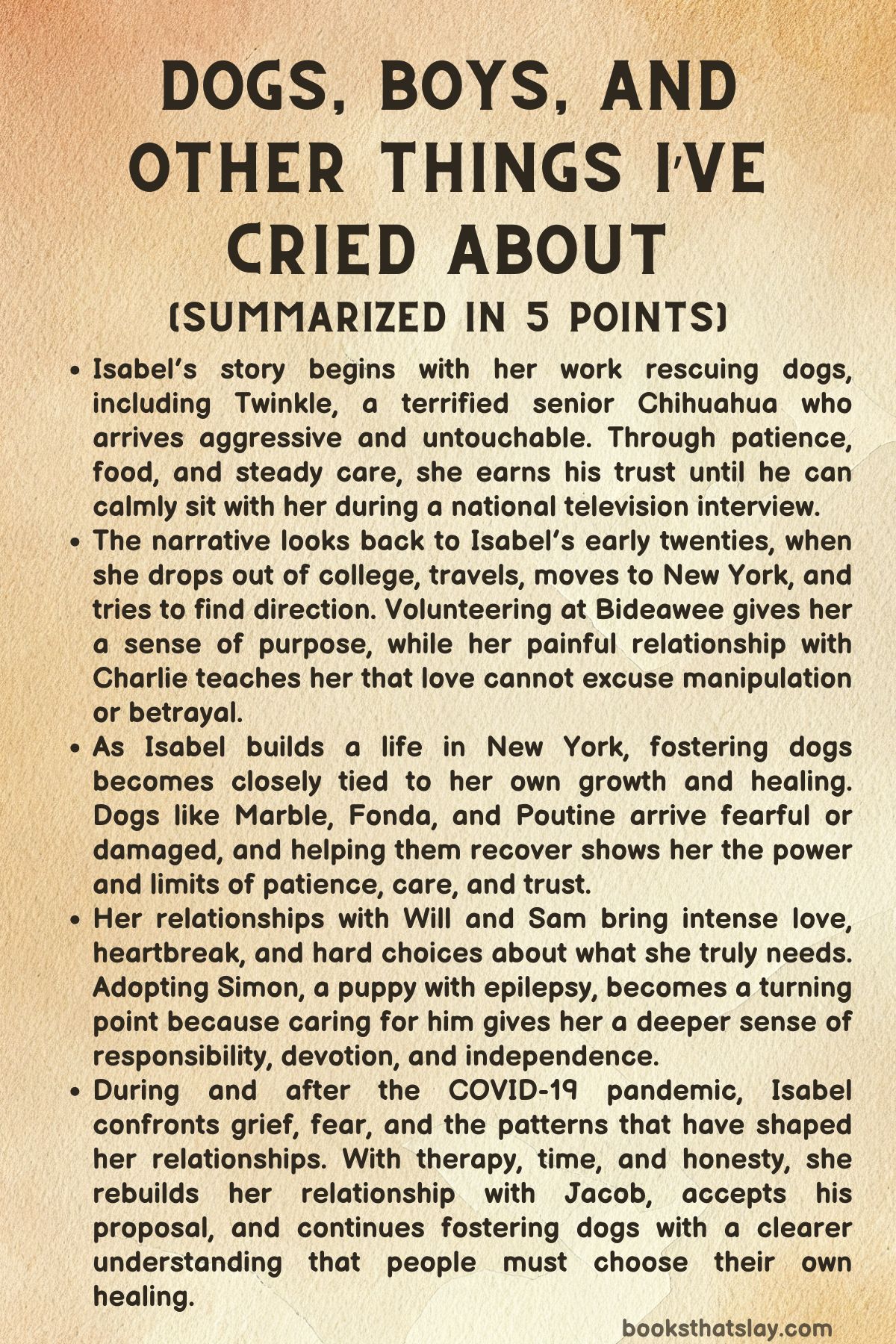
Dogs, Boys, and Other Things I’ve Cried About opens with Isabel Klee in 2024, preparing for a national television appearance about fostering dogs. In her arms is Twinkle, a senior Chihuahua who has survived a terrible situation.
He was rescued from an apartment where his owner had died, along with several other dogs. When Twinkle first comes to Isabel, he is frightened, defensive, and impossible to touch.
He reacts as if the world has only ever hurt him. Isabel does not rush him.
She gives him space, food, safety, and time. Little by little, his fear gives way to trust.
By the time he appears with her on television, he can sit calmly in her lap. His change becomes a quiet example of what the book keeps returning to: dogs can often recover when they are given patience, consistency, and care.
The story then moves back to Isabel’s early twenties. In 2013, she is unsure of who she is or what she wants.
She has dropped out of college, traveled, worked different jobs, and drifted through life without a clear sense of direction. Eventually, she moves to New York City to attend Marymount Manhattan.
The city is exciting, but it is also overwhelming. Isabel lives with her friends Phoebe and Emily in a small basement apartment on the Upper East Side.
Their lives are crowded, messy, and full of late nights, bars, hangovers, and the kind of freedom that can start to feel empty when it has no purpose behind it.
Isabel begins volunteering at Bideawee, an animal welfare organization, and the shelter becomes one of the first places in New York where she feels useful. Caring for dogs gives shape to her days.
The animals need her in clear, practical ways, and that need steadies her. At the same time, she enters her first serious relationship with Charlie, an older man who is needy, controlling, and emotionally manipulative.
Isabel mistakes intensity for love and attention for devotion, even when the relationship begins to drain her.
Her first foster dog, Marble, is difficult and anxious. He is not the easy, grateful rescue dog Isabel may have imagined.
He has fears and habits that require patience. Taking care of him teaches her that fostering is not about receiving instant affection; it is about meeting an animal where he is and helping him become ready for a safer life.
Marble is eventually adopted, and Isabel learns the painful joy of letting a foster dog go. Around the same time, Charlie cheats on her.
His betrayal forces Isabel to see the relationship more clearly, and she ends it.
After that breakup, Isabel and Phoebe move to Astoria. Compared with their earlier apartment and their chaotic nights out, Astoria feels calmer and more livable.
Isabel begins to feel more rooted. As graduation approaches, she applies for a job as an assistant to Elias, a dog photographer.
The job sounds strange, creative, and perfect for the version of herself she is beginning to understand. For her application, she completes a dog-photo assignment, then spends a rainy day shooting dogs around the city.
Her effort pays off, and she gets the job. The opportunity helps her decide that New York is not just a place where she has been drifting.
It is a place where she might build a life.
Isabel then meets Will, a recovering addict living in a halfway house. Their relationship is intense from the beginning.
Will is charming, vulnerable, and magnetic, and Isabel is drawn into the drama of loving someone who seems wounded in ways she wants to understand and soothe. The relationship brings passion, but also instability and pain.
While she is with Will, Isabel fosters Fonda, a reactive senior dog. Fonda is not simple to care for.
She needs boundaries, calm handling, and people willing to see beyond her difficult behavior. Over time, Fonda finds patient adopters who can give her the kind of home she needs.
Fonda’s story helps Isabel recognize a hard truth. A damaged dog can improve when loving people provide safety and patience, but a dishonest person cannot be fixed by someone else’s devotion.
Isabel wants to believe that love can heal Will, yet he continues to lie. Just before she is supposed to move in with him, she discovers proof that he has been cheating for years.
The evidence is devastating, but it also frees her from the illusion that he only needs more love, more understanding, or more chances. She leaves him.
After Will, Isabel moves to Bushwick with Hannah, Sarah, Mia, and their cat Caveman. The apartment becomes a place of recovery.
It is full of friendship, parties, noise, and the strange comfort of being surrounded by people while trying to rebuild yourself. Isabel is still hurting, but she is no longer alone in the same way.
She continues fostering and takes in Poutine, a neglected bully mix whose body and behavior show signs of a hard life. Poutine does not immediately know how to relax or play.
Isabel watches him slowly learn that comfort is allowed. He begins to rest, enjoy toys, and accept affection.
Eventually, he is adopted by a loving woman, another reminder that care can change the course of a dog’s life.
Work takes Isabel to Ireland, where she encounters another kind of dog world. In Connemara, she meets sheepdogs and sees the deep connection between dogs, people, land, and work.
In Dublin, she spends a brief, tender night with a man named Liam. Their encounter does not become a lasting romance, but it offers Isabel a moment of gentleness.
It reminds her that not every connection has to be destructive or permanent to matter.
Back in Brooklyn, Isabel meets Sam on a dating app. Their relationship begins with warmth and affection.
Sam loves her openly, and for a while that kind of devotion feels like safety after the chaos of Will. They fall in love and eventually move in together.
But over time, Isabel starts to feel crowded by his need for closeness. His love, though sincere, begins to feel suffocating.
She struggles to understand why being loved so fully can still make her want space.
During this relationship, Isabel sees a puppy online and feels pulled toward him. Sam is hesitant, but Isabel fosters the puppy anyway and names him Simon.
Simon soon has severe seizures and is diagnosed with epilepsy. Caring for him changes everything.
His condition is frightening and demanding. Isabel must learn his medications, watch for symptoms, respond to emergencies, and live with the anxiety of not knowing when the next seizure will come.
But Simon also becomes her anchor. He is not just another foster passing through.
He is her dog. Isabel adopts him, and the bond between them becomes one of the central relationships of her life.
Eventually, she ends things with Sam, understanding that kindness alone does not make a relationship right.
When the COVID-19 pandemic arrives, Isabel moves through a period of isolation, grief, and uncertainty. Like many people, she has to face herself without the usual distractions.
Apartments change, routines shift, and the world feels smaller and more frightening. Through it all, Simon remains with her.
He gives her a reason to get up, care for someone else, and keep moving. Isabel continues fostering dogs, and each one brings its own needs, challenges, and lessons.
The dogs do not erase her loneliness or fear, but they give her days a rhythm and a purpose.
Later, Isabel meets Jacob. He is different from the men who came before him.
He is kind, steady, and emotionally present without demanding that she lose herself. Their relationship grows, but Isabel is not instantly healed just because she has found someone good.
Her old fears still affect her. She has learned to expect disappointment, betrayal, or emotional danger, and those expectations damage the relationship.
Eventually, she and Jacob break up.
The breakup becomes another turning point. Isabel goes to therapy and begins to look more honestly at her own patterns.
She has spent years learning how to care for frightened dogs and how to recognize the difference between fear and aggression, damage and character. Now she has to bring that same honesty to herself.
She cannot be healed simply because Jacob loves her. She has to choose to do the work.
After months apart, she and Jacob reconnect. This time, they speak more openly.
They acknowledge what went wrong and begin rebuilding from a more honest place.
Jacob later runs the New York City Marathon. After the race, he proposes to Isabel in Central Park.
Friends, family, and Simon are part of the celebration, making the moment feel not like a neat fairy-tale ending, but like a hard-earned arrival. Isabel has not become a perfect person with a perfect life.
She has, however, grown into someone more capable of accepting love without trying to control or flee from it.
The book returns to 2024 after Isabel’s Today show appearance with Twinkle. Twinkle, once terrified and untouchable, is adopted.
Jacob is now Isabel’s supportive partner, and Simon remains her beloved companion. Isabel prepares to foster another dog, knowing the cycle will begin again: fear, patience, trust, goodbye.
By the end, Isabel understands one of the book’s clearest lessons. Dogs can often be helped when people show up for them with steady love.
People, however, must decide for themselves whether they are willing to heal. Her story becomes a record of all the dogs she helped save, all the men she could not fix, and the life she built once she learned the difference.
Key Figures
Dogs, Boys, and Other Things I’ve Cried About presents its figures through relationships, rescue, heartbreak, and healing. The people and animals in the story are closely connected to Isabel’s emotional growth, and each major character helps reveal a different stage of her journey.
Isabel
Isabel is the central figure of the book and the character whose growth gives the story its emotional shape. At the beginning of her adult life, she is restless, uncertain, and searching for direction.
Dropping out of college, traveling, working odd jobs, and eventually moving to New York show her desire to build a meaningful life, even though she does not yet know what that life should look like. Her early years in the city are filled with cramped apartments, nightlife, difficult relationships, and emotional confusion, but beneath that uncertainty is a deep capacity for care.
This becomes clearest when she begins volunteering with shelter dogs. Through dogs, Isabel finds not only purpose but also a way to understand patience, trauma, trust, and love.
Isabel’s character is shaped by her mistakes as much as by her compassion. Her relationships with Charlie, Will, Sam, and Jacob show different versions of her emotional needs and fears.
With Charlie, she experiences manipulation and betrayal; with Will, she mistakes intensity for security; with Sam, she realizes that devotion without emotional balance can feel suffocating; and with Jacob, she is forced to confront her own unresolved wounds. Isabel is not presented as someone who heals quickly or perfectly.
She repeats patterns, avoids difficult truths, and sometimes damages what is good because she is afraid of being hurt. This makes her feel human and believable.
Her journey is not simply about finding the right partner, but about becoming someone who can recognize love without losing herself in it.
Her relationship with dogs is the clearest reflection of her emotional development. Each foster dog teaches her something about care, patience, boundaries, and recovery.
Isabel learns that love can create safety, but it cannot erase pain instantly. She also learns an important difference between animals and people: damaged dogs can often be guided toward healing through consistent love and care, while people must choose honesty and growth for themselves.
By the end of the story, Isabel has become more grounded, self-aware, and emotionally mature. She is still tender and imperfect, but she understands herself more clearly.
Her character represents the long, uneven process of growing into adulthood, learning to love wisely, and accepting that healing is both a responsibility and a choice.
Twinkle
Twinkle is one of the most emotionally powerful animal characters in the book because he represents fear, survival, and the possibility of trust after severe trauma. When he first arrives, he is terrified, aggressive, and almost impossible to touch.
His behavior is not simple bad temper; it is the result of a horrifying past in which he lived through neglect, death, and deep instability. His fear makes him defensive, and his aggression becomes a shield against further harm.
Through Twinkle, the story shows how trauma can make even gentleness feel threatening to someone who has learned that the world is unsafe.
Twinkle’s transformation is quiet but meaningful. Isabel does not force affection from him or expect immediate gratitude.
Instead, she earns his trust slowly through patience, food, consistency, and respect for his boundaries. His eventual ability to sit calmly through a national television segment is not just a charming rescue moment; it is proof of how far he has come.
Twinkle’s progress reflects one of the book’s central ideas: healing does not always look dramatic, but small acts of trust can be enormous victories. His character also shows Isabel’s maturity as a rescuer.
By the time she cares for Twinkle, she understands that love must be steady, patient, and free from ego.
Simon
Simon is one of the most important characters in the story because he becomes Isabel’s emotional anchor. When she first sees him online and decides to foster him, he enters her life during a period of uncertainty in her relationship with Sam.
At first, Simon seems like another foster dog, but his severe seizures and epilepsy quickly change the nature of Isabel’s responsibility. Caring for him is frightening, exhausting, and life-altering.
His illness forces Isabel into a deeper form of commitment, one based not on romance or excitement but on daily care, vigilance, and unconditional devotion.
Simon’s importance goes beyond his medical condition. He becomes the companion who stays through grief, isolation, the pandemic, moves, breakups, and emotional rebuilding.
Unlike the men in Isabel’s life, Simon does not demand that she become smaller, ignore her instincts, or prove herself through suffering. His presence gives her stability and a sense of home.
By adopting Simon, Isabel chooses a love that is difficult but honest, demanding but pure. He helps her understand what lasting commitment feels like when it is rooted in care rather than fear.
Simon is not merely a pet in the story; he is family, witness, comfort, and one of the clearest symbols of Isabel’s capacity to love deeply.
Jacob
Jacob represents the healthiest romantic love Isabel encounters in the book, though their relationship is not simple or effortless. His kindness, steadiness, and emotional sincerity make him different from the men Isabel has loved before.
He does not seem to thrive on drama, manipulation, or intensity. Instead, he offers a kind of calm that Isabel is not fully prepared to accept at first.
Because she has been hurt before, Jacob’s goodness does not immediately make her feel safe. In fact, his steadiness exposes the fears and defensive habits she still carries.
Jacob’s role in the story is important because he shows that a healthy relationship still requires emotional readiness. Isabel’s unresolved pain affects their connection, and their breakup becomes a painful but necessary turning point.
During their time apart, Isabel begins to understand that love cannot be sustained by another person’s patience alone; she must also do the work of healing herself. When they reconnect, their relationship becomes stronger because it is built on honesty rather than fantasy.
Jacob’s marathon and proposal in Central Park symbolize endurance, commitment, and shared growth. He is not portrayed as a perfect savior, but as a loving partner whose steadiness helps Isabel recognize what real partnership can look like.
Charlie
Charlie is Isabel’s first major romantic relationship and one of the clearest examples of manipulative love in the story. He is older, needy, and emotionally demanding, and his relationship with Isabel introduces her to the pain of being drawn into someone else’s instability.
At a time when Isabel is still young, uncertain, and trying to find herself, Charlie’s attention may initially feel meaningful. However, his neediness and manipulation gradually reveal the imbalance between them.
He takes up emotional space without offering true security.
Charlie’s cheating becomes a decisive moment for Isabel because it forces her to recognize betrayal and end the relationship. His character is significant not because he is deeply loving, but because he teaches Isabel what love should not feel like.
Through Charlie, the story explores how easily vulnerability can be exploited when someone is young and still learning their own boundaries. He represents an early lesson in emotional self-protection.
Isabel’s decision to leave him marks one of her first steps toward understanding that affection is not enough when respect and honesty are missing.
Will
Will is one of the most painful and complicated romantic figures in the book. As a recovering addict living in a halfway house, he enters Isabel’s life with an intensity that feels passionate and consuming.
Their relationship is full of emotional highs, desire, and hope, but it is also unstable and dishonest. Will’s character shows how intensity can disguise danger.
Isabel wants to believe in him, and perhaps she also wants to believe that love can help repair what is broken. This makes their relationship especially devastating because her care and faith are met with betrayal.
Will’s long-term cheating reveals the difference between a damaged person who wants to heal and someone who continues to harm others through dishonesty. His relationship with Isabel parallels her work with reactive or traumatized dogs, but the contrast is crucial.
With dogs, patience and safety can slowly create change. With Will, patience cannot replace accountability.
His character helps Isabel understand that love cannot rescue someone who refuses truth. The moment she discovers his betrayal before moving in with him becomes a major turning point.
Leaving Will is not just the end of a relationship; it is Isabel choosing reality over illusion.
Sam
Sam is a loving but complicated figure whose devotion eventually becomes overwhelming for Isabel. Unlike Charlie and Will, he does not appear to be defined by cruelty or deception.
He genuinely loves Isabel, and their relationship has warmth, affection, and a sense of possibility. They fall in love and move in together, suggesting a level of stability Isabel has been seeking.
However, as the relationship continues, Isabel begins to feel that his devotion is suffocating. This makes Sam an important character because he shows that a relationship can be loving and still not be right.
Sam’s hesitation about fostering the puppy who becomes Simon also reveals a difference between his needs and Isabel’s instincts. Simon’s arrival changes Isabel’s life in a way that Sam cannot fully share or control.
As Isabel becomes more connected to Simon and more aware of her own emotional truth, the relationship with Sam begins to lose its foundation. Sam is not simply a villain or a failed boyfriend.
He represents a more subtle lesson: love must leave room for a person to breathe, grow, and follow their deepest values. Isabel’s decision to end the relationship shows her growing ability to choose authenticity over comfort.
Phoebe
Phoebe is one of Isabel’s important friends and early companions in New York. She is part of the stage of Isabel’s life marked by cramped apartments, bars, uncertainty, and youthful searching.
Living with Phoebe and Emily in the Upper East Side basement apartment places Phoebe within Isabel’s first real attempt to build a life in the city. Phoebe represents friendship during a messy and formative period, when Isabel is still unsure of who she is and what she wants.
Phoebe’s later move with Isabel to Astoria gives her character a sense of continuity and emotional steadiness. The Astoria apartment feels calmer and more rooted than Isabel’s earlier living situation, and Phoebe is connected to that shift.
She is not the central force of Isabel’s transformation, but she is part of the support system that makes survival and growth possible. Her presence reminds the reader that Isabel’s life is not shaped only by romance and dogs, but also by female friendship, shared homes, and the quiet comfort of having someone beside you during uncertain years.
Emily
Emily is part of Isabel’s early New York life and helps define the atmosphere of youth, confusion, and close-quarters friendship. As one of Isabel’s roommates in the cramped Upper East Side basement apartment, Emily belongs to the period when Isabel is trying to become an adult but still feels unmoored.
Her presence contributes to the sense of a shared, chaotic beginning. The apartment is not glamorous or stable, but it is a place where Isabel’s city life begins to take shape.
Although Emily does not appear to drive the main emotional conflicts, she is still important because she helps frame Isabel’s early environment. She represents the kind of friendship that exists in transitional years, when people live together, go out together, and try to make sense of adult life together.
Through Emily, the story captures the texture of Isabel’s early twenties: crowded rooms, uncertain futures, and the feeling of being surrounded by people while still feeling personally lost.
Elias
Elias is an important professional figure because he helps Isabel connect her love for dogs with a possible future in work and creativity. As a dog photographer, he represents a world where animals are not only a source of comfort but also part of a meaningful career.
Isabel’s application to become his assistant comes at a crucial moment near graduation, when she must decide whether to stay in New York and build a life there. The creative dog-photo assignment and the rainy day of shooting dogs around the city become a test of her resourcefulness, commitment, and artistic energy.
Elias’s role is not as emotionally intimate as the roles of Isabel’s partners or foster dogs, but he is still a turning-point character. By giving Isabel the job, he helps validate her instincts and interests.
He becomes connected to her decision to remain in New York, which is one of the major choices that shapes the rest of her life. Elias represents opportunity, creative direction, and the possibility that Isabel’s love for dogs can become more than volunteer work.
Through him, the story shows how a person’s path can change when someone recognizes their potential.
Marble
Marble is Isabel’s first foster dog and therefore holds a special place in her development as a rescuer. He is difficult and anxious, which makes him an intimidating beginning rather than an easy success.
Through Marble, Isabel learns that fostering is not simply about affection or cuteness; it requires patience, emotional strength, and a willingness to care for an animal who may not immediately respond with trust. His anxiety challenges Isabel, but it also gives her a sense of purpose during a time when she feels lost.
Marble’s eventual adoption is meaningful because it shows Isabel that her care can lead to real change. He becomes her first proof that temporary love can still be powerful.
Letting him go also teaches her one of the central emotional lessons of fostering: love does not always mean keeping. Sometimes it means preparing another being for a safer, better future with someone else.
Marble begins Isabel’s long relationship with rescue work and introduces the pattern that continues throughout the story, where each dog teaches her something about healing, attachment, and release.
Fonda
Fonda is a reactive senior dog whose character deepens the story’s exploration of trauma and patience. Like several of the dogs Isabel fosters, Fonda arrives with emotional wounds that affect her behavior.
Her reactivity makes her difficult, but it also makes her vulnerable. She is not an easy dog who can be loved casually.
She requires understanding, structure, and people willing to see beyond her fear. Through Fonda, the book shows that damaged animals are not hopeless; they need the right kind of care.
Fonda’s adoption by patient owners becomes an important emotional contrast to Isabel’s relationship with Will. While Isabel sees that love and patience can help Fonda, she also realizes that the same approach cannot fix a dishonest person.
This makes Fonda’s role especially meaningful. She helps Isabel understand the limits of rescue when applied to human relationships.
Fonda can heal because she responds to safety and patience. Will, however, continues to lie.
Fonda therefore becomes more than a foster dog; she becomes part of Isabel’s emotional education about what love can and cannot do.
Poutine
Poutine is one of the most tender rescue figures in the story. As a severely neglected bully mix, he arrives carrying the effects of deep mistreatment.
His condition suggests a life in which rest, play, and comfort were not guaranteed. When Isabel fosters him, his recovery becomes a slow return to ordinary joys.
Watching him learn to rest, play, and enjoy life gives his character a quiet emotional beauty. His healing is not dramatic in a loud way; it is moving because it shows a neglected animal rediscovering safety.
Poutine’s adoption by a loving woman gives his arc a sense of hope and completion. He represents the possibility that even after severe neglect, a creature can still move toward peace when given kindness and stability.
For Isabel, caring for Poutine happens during her own recovery after heartbreak. This connection makes his presence especially meaningful.
As he learns to feel safe, Isabel is also trying to rebuild herself in a new apartment with new friends. Poutine reflects the book’s belief that healing often happens slowly, through care, rest, and the creation of a safer environment.
Hannah
Hannah is one of Isabel’s Bushwick roommates and belongs to the period of recovery after the devastating breakup with Will. The Bushwick apartment becomes a place of friendship, partying, and emotional rebuilding, and Hannah is part of that shared world.
Her role helps show that Isabel does not heal alone. After betrayal, she enters a living space shaped by female friendship, communal energy, and the messy comfort of being around people who help life feel possible again.
Hannah’s importance lies in the environment she helps create. She is part of a home that allows Isabel to move forward rather than remain trapped in heartbreak.
The apartment is not presented as perfectly calm or traditionally stable; it is lively, social, and imperfect. Yet it gives Isabel what she needs at that moment: company, distraction, laughter, and a sense of belonging.
Hannah represents the healing power of friendship and shared space during a painful transitional chapter of adulthood.
Sarah
Sarah, like Hannah and Mia, is part of Isabel’s Bushwick household and contributes to the emotional atmosphere of recovery. After Isabel leaves Will, the Bushwick apartment becomes a kind of refuge.
Sarah’s presence helps build the sense of a chosen home, where Isabel can be surrounded by people rather than isolated in grief. Her character reflects the importance of ordinary companionship during emotional repair.
Sarah does not need to be a central dramatic figure to matter in the story. Her value comes from being part of a community that helps Isabel regain balance.
The friendship and social life of the apartment give Isabel room to be young, wounded, and alive at the same time. Through Sarah, the story acknowledges that healing is not always found in major revelations.
Sometimes it is found in roommates, shared rooms, late nights, and the simple fact of not being alone.
Mia
Mia is another member of the Bushwick household and helps define one of Isabel’s most important recovery spaces. Her presence, along with Hannah, Sarah, and Caveman the cat, gives the apartment a feeling of personality and warmth.
This home comes after one of Isabel’s most painful romantic betrayals, so its energy matters. It allows Isabel to exist outside the role of girlfriend or rescuer and return to herself through friendship, movement, and everyday life.
Mia’s role also shows how Isabel’s story is shaped by communities as well as relationships. The men in Isabel’s life often bring emotional conflict, but the women around her frequently help create stability, humor, and support.
Mia belongs to that pattern. She represents the kind of friend whose importance is felt through presence and shared living rather than through dramatic action.
Her character helps make Isabel’s world feel full and lived-in.
Caveman
Caveman, the cat in the Bushwick apartment, adds warmth and character to Isabel’s recovery period. Though he is not central in the same way as Simon, Twinkle, or the foster dogs, he contributes to the feeling of the apartment as a living, breathing home.
His presence helps soften the space and gives it a sense of domestic personality. In a story so deeply connected to animals, even a cat like Caveman matters because animals often mark the emotional tone of Isabel’s surroundings.
Caveman also represents the informal family Isabel finds after heartbreak. Alongside Hannah, Sarah, and Mia, he is part of a household that helps Isabel move forward.
His role may be small, but it supports one of the story’s broader ideas: home is not only built through romance or permanent certainty. Sometimes it is built through roommates, pets, noise, affection, and the strange comfort of shared space.
Liam
Liam is a brief but tender figure in Isabel’s life during her work trip to Ireland. Their one night together in Dublin is not presented as a lasting relationship, but it still carries emotional significance.
After heartbreak and recovery, Liam represents a moment of softness, possibility, and connection without the heavy expectations that define Isabel’s more serious relationships. His presence gives Isabel a chance to experience tenderness without being consumed by it.
Liam’s role is important because he shows that not every meaningful encounter has to become permanent. Some people enter a story briefly and still leave behind warmth or clarity.
In Isabel’s journey, Liam offers a pause from the emotional intensity of her past relationships. He belongs to a moment of travel, beauty, and openness, reflecting Isabel’s gradual return to herself.
His character adds a romantic but fleeting note to the book, reminding the reader that healing can include brief moments of joy as well as long periods of work.
Themes
Healing Through Care
Dogs, Boys, and Other Things I’ve Cried About shows healing as a slow, uneven process built through care rather than sudden transformation. Isabel’s work with dogs like Twinkle, Marble, Fonda, Poutine, and Simon teaches her that fear, aggression, illness, and emotional damage cannot be rushed away.
Twinkle’s journey from terror and defensiveness to trust reflects the patience required to make another living being feel safe. Isabel does not force affection from him; she earns it through food, consistency, gentleness, and time.
This becomes a wider emotional lesson in her own life. She repeatedly enters relationships hoping love will repair what is broken, but the dogs show her a clearer truth: care can create safety, but healing must happen at the pace of the wounded being.
The rescued dogs become mirrors for Isabel’s own pain, showing her that survival is not the same as recovery. Through fostering, she learns that love is most powerful when it respects boundaries, accepts setbacks, and allows growth without demanding instant change.
Love, Attachment, and Emotional Boundaries
Isabel’s romantic relationships reveal how easily love can become confused with need, rescue, and self-abandonment. Charlie’s manipulation, Will’s dishonesty, and Sam’s overwhelming devotion each teach her a different version of unhealthy attachment.
In these relationships, Isabel often tries to understand, forgive, or endure more than she should because she wants love to mean loyalty through difficulty. Yet the emotional cost becomes clear when her partners’ needs begin to shrink her own sense of freedom and self-trust.
Her fostering experiences sharpen this contrast. A dog’s fear may require patience, but a person’s repeated betrayal requires boundaries.
This distinction becomes one of Isabel’s most important lessons. She learns that compassion does not mean accepting harm, and commitment does not mean staying where honesty is absent.
Her relationship with Jacob becomes meaningful because it is not based on chaos or rescue. It requires communication, therapy, accountability, and mutual effort.
Love becomes healthier when it allows Isabel to remain herself.
Finding Identity Through Responsibility
Isabel begins adulthood feeling restless, uncertain, and unmoored. Dropping out of college, traveling, working temporary jobs, moving through apartments, and spending nights in bars all show her searching for a life that feels real.
New York first appears as a place of escape and reinvention, but it also exposes her loneliness and lack of direction. Volunteering at Bideawee changes this because responsibility gives her life structure and meaning.
Caring for shelter dogs does not solve every problem, but it gives her a role that feels honest. Later, her work with Elias and her decision to stay in the city show her slowly shaping an identity around creativity, animals, and service.
Simon’s arrival deepens this growth. His epilepsy requires daily commitment, emotional strength, and practical sacrifice.
By adopting him, Isabel chooses a life defined not only by freedom, but by devotion. Responsibility becomes a path to self-knowledge.
Through dogs, work, friendship, and chosen commitments, she becomes less lost and more rooted.
Resilience After Heartbreak and Loss
Heartbreak in the story is not treated as a single dramatic event but as something Isabel must live through repeatedly. Betrayal, breakups, isolation during the pandemic, apartment changes, and emotional fear all force her to rebuild herself in different ways.
After Will’s cheating, she does not become instantly stronger; she moves into a new home, leans on friends, fosters Poutine, travels, and slowly remembers that life can still hold tenderness. The Bushwick apartment becomes especially important because friendship helps create a bridge between pain and recovery.
Later, the pandemic tests her resilience through loneliness and uncertainty, with Simon acting as her emotional anchor. Isabel’s growth comes from continuing to care even when she is wounded.
Her eventual reunion with Jacob also shows resilience as something active, not passive. She must face her fears, seek therapy, and choose honesty instead of repeating old patterns.
The ending suggests that healing does not erase pain, but it can turn pain into wisdom, courage, and a greater ability to love well.