Don’t Fall in Love with Me Summary, Characters and Themes
Don’t Fall in Love with Me by Paige Toon is a contemporary romance about old love, missed chances, family secrets, and the courage to choose a different future from the one you once imagined. The story follows Gracie, a woman who has spent years loving Jackson, a man who never fully chose her.
When a work opportunity takes her to a small French town tied to both their families, she expects old feelings to return. Instead, she is drawn toward Étienne, a guarded local man with painful links to Jackson’s family. The novel explores love, loyalty, forgiveness, and starting again.
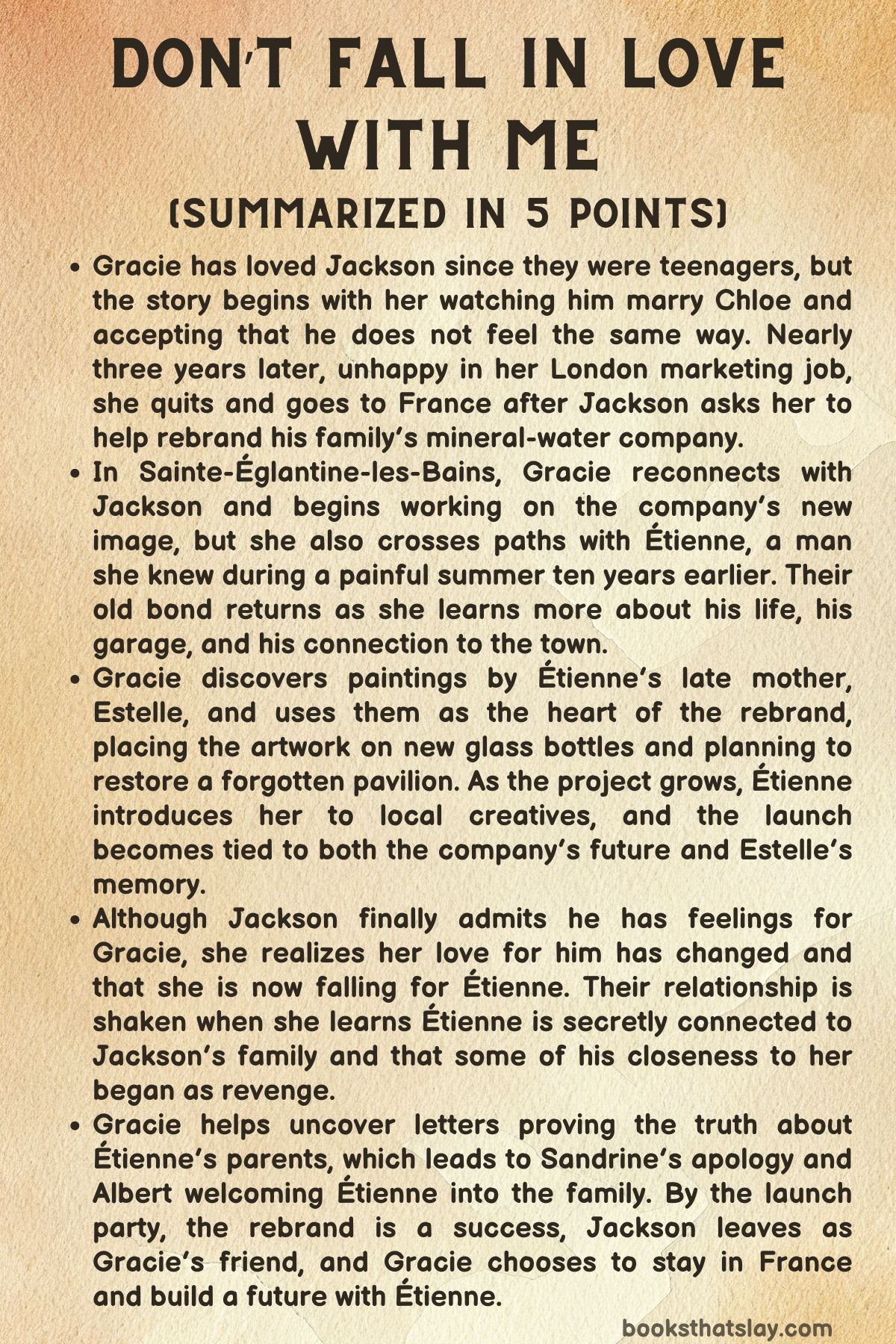
Summary
Gracie has loved Jackson for much of her life. Their history reaches back to their teenage years, when her feelings for him became part of the way she understood herself and her future.
Yet the story opens with a painful reminder that love is not always returned in the way a person hopes. Gracie watches Jackson marry Chloe, a woman who has the place in his life that Gracie once wanted for herself.
As she sits through the wedding, she is forced to accept what she has tried not to face: Jackson has chosen someone else, and her heart has no claim on him.
Nearly three years pass. Gracie is living in London and working in marketing, but her life is far from happy.
Her job is demanding, her boss expects too much, and even her birthday is swallowed by work. She is exhausted, undervalued, and stuck in a routine that leaves little room for joy.
Then Jackson contacts her unexpectedly. He wants advice about rebranding Eau de Sainte Églantine, his family’s French mineral-water company.
The company is based in Sainte-Églantine-les-Bains, a town that already holds personal meaning for Gracie because her grandmother, Mellie, lives nearby.
During their conversation, Gracie jokes that she could handle the rebrand herself. Jackson takes the idea seriously and encourages her to come to France for the summer.
At first, Gracie resists. She assumes Chloe will be there and does not want to put herself in a painful position.
Jackson then tells her that he and Chloe have separated and are divorcing. This changes everything.
Gracie, already unhappy with her job and longing for a different life, decides to take the risk. She quits her job and travels to Sainte-Églantine-les-Bains, where Jackson’s grandfather Albert owns a château and where the mineral-water business is rooted.
Once Gracie arrives, she and Jackson reconnect quickly. Their old ease returns, along with the tension that has always existed between them.
Gracie begins working on the rebrand, hoping to bring fresh energy to the company while respecting its history. She is also drawn back into the town itself, its beauty, its memories, and the people connected to her past.
One of those people is Étienne, a Frenchman she first met ten years earlier, when she was seventeen.
That earlier meeting happened during a difficult summer. Gracie had been hurt after seeing Jackson with Chloe and had run from the feelings she could not bear.
She came across a river house called Les Saules, where she was frightened by a wolf and injured her ankle. Étienne helped her, and the two became close during that summer.
Their bond was intense but brief. After his mother, Estelle, died from ALS, Étienne disappeared from Gracie’s life, leaving her with unanswered questions and memories she never fully resolved.
In the present, Étienne is no longer the young man Gracie remembers. He now owns Garage du Rallye, a local garage that Jackson’s mother, Sandrine, wants to buy as part of a spa expansion.
Étienne refuses to sell, creating tension between him and Jackson’s family. His anger toward them seems deeper than a business disagreement, though Gracie does not yet understand why.
As Gracie explores the town and studies the history of Eau de Sainte Églantine, she discovers that Estelle painted several images of Sainte Églantine. These artworks are scattered around the town, and one of them is hidden inside a boarded-up pavilion owned by Albert.
Gracie sees beauty and possibility in the paintings. They represent the town, its heritage, and a personal artistic legacy that has been neglected.
She develops an idea for the rebrand: Estelle’s artwork could be used on new glass bottles, and the pavilion could be restored as part of the company’s relaunch.
The idea brings together the past and the future. It also requires Étienne’s permission because Estelle was his mother.
Though he is reluctant, he eventually allows the project to move forward. Through him, Gracie meets local artists, photographers, designers, and craftspeople who help shape the rebrand.
The project becomes larger than a marketing assignment. It starts to feel like a way of honoring Estelle, restoring something beautiful to the town, and creating a new identity for the company that is honest and rooted in place.
While Gracie works closely with Jackson, her relationship with Étienne grows more complicated. At first, Étienne flirts with her partly to unsettle Jackson.
Gracie understands this, and in some ways she plays along because part of her wants Jackson to feel the jealousy and uncertainty she once felt because of him. Yet what begins as a game does not remain one.
Gracie and Étienne spend more time together. They visit Les Saules, search for Estelle’s paintings, attend parties at his garage, and share moments that are more honest than either of them expects.
Their connection becomes physical after they kayak through the Ardèche and are stranded overnight by the river. Étienne warns Gracie not to fall in love with him, making it clear that he is not offering easy promises.
But the warning does not stop their feelings from growing. Gracie finds herself drawn to his intensity, his pain, his humor, and the parts of himself he tries to protect.
Étienne is not simple or safe, but he is real with her in ways Jackson has often failed to be.
Jackson, meanwhile, begins to recognize what he may have lost. He admits that he has feelings for Gracie and thinks he might be in love with her.
For years, this is what Gracie wanted to hear. She imagined that if Jackson finally chose her, everything would fall into place.
But when the moment arrives, she realizes the truth has changed. She has loved Jackson for a long time, but she is no longer in love with him.
Her heart has moved toward Étienne, even though loving him may bring its own pain.
Soon Gracie learns the truth behind Étienne’s anger toward Jackson’s family. Étienne is the son of Sébastien, Sandrine’s late brother, and Estelle.
After Sébastien died in a car accident, Sandrine found Estelle and young Étienne at Les Saules. Instead of welcoming them or telling Albert that he had a grandson, Sandrine rejected them and kept their existence secret.
Étienne grew up carrying the wound of that rejection. His refusal to sell the garage and his hostility toward the family are tied to years of hurt, exclusion, and anger.
The revelation also changes how Gracie sees her relationship with him. Étienne admits that part of his involvement with her began as revenge against Jackson and his family.
Gracie is devastated. She feels used and betrayed, especially because her feelings for him have become real.
The discovery forces her to question whether Étienne’s tenderness was genuine or whether she was only a way for him to punish people who had hurt him.
Despite her pain, Gracie becomes part of uncovering the fuller truth. She helps Jackson search Château Angèle, where they find letters written by Sébastien and Estelle.
The letters prove that Étienne’s parents truly loved each other. They also give Étienne something he has needed for years: evidence that his existence came from love, not shame or accident.
When Gracie brings the letters to him, they help him understand his parents’ relationship in a new way.
The truth also forces Sandrine and the rest of the family to face what happened. Sandrine apologizes for her rejection and secrecy.
Jackson insists that Albert must be told immediately. When Albert learns about Étienne, he welcomes him as family.
This acceptance does not erase the past, but it gives Étienne a chance to begin healing. For the first time, he is not simply the hidden child of a painful history.
He is acknowledged as Sébastien’s son and Albert’s grandson.
As the launch party approaches, Gracie’s rebrand reaches completion. Estelle’s artwork is restored and celebrated.
The new glass bottles are ready, and the pavilion becomes part of the relaunch. The anniversary celebration for Eau de Sainte Églantine brings the town together, turning the company’s future into a tribute to its past.
What began as a job for Gracie becomes a turning point in her life.
By the end of Don’t Fall in Love with Me, Gracie has made her choice. She decides to stay in France, continue freelance work, and build a life that belongs to her rather than returning to the one that drained her in London.
Jackson returns to New York, no longer the man she is waiting for, but still someone who matters as a friend and colleague. Gracie and Étienne move forward together, not without scars, but with honesty and hope.
The story closes with Gracie no longer chasing an old dream of love. Instead, she chooses the future that has grown from truth, forgiveness, and the courage to begin again.
Characters
Gracie
Gracie is the emotional centre of Don’t Fall in Love with Me, and her character is shaped by longing, disappointment, growth, and self-discovery. At the beginning of the book, she is still carrying the pain of loving Jackson since her teenage years, even though he has chosen another woman.
Her presence at his wedding shows both her emotional loyalty and her quiet suffering, because she watches him marry Chloe while accepting that he does not return her love in the way she has always hoped. This early heartbreak makes Gracie appear vulnerable, but it also reveals her strength, because she does not collapse under the pain; instead, she continues with her life, even if that life has become exhausting and unfulfilling.
Gracie’s demanding marketing job in London shows how far she has pushed herself into a life of pressure and responsibility. She is successful and capable, but she is also emotionally drained, disconnected from joy, and unable to prioritize herself.
Her missed birthday celebration becomes an important sign of how little space she has left for happiness. When Jackson unexpectedly contacts her about the rebranding of his family’s mineral-water company, Gracie’s decision to go to France becomes more than a career move.
It becomes a chance to step away from a life that no longer nourishes her and return to a place connected with memory, love, and unfinished emotions.
In France, Gracie’s professional ability becomes one of her strongest qualities. She is creative, observant, and sensitive to the history of Sainte-Églantine-les-Bains.
Rather than treating the rebrand as a shallow business project, she finds meaning in Estelle’s paintings and understands how art, place, memory, and identity can come together. Her idea to use Estelle’s artwork on the bottles and restore the pavilion shows her instinct for emotional storytelling.
She does not simply promote a product; she helps restore a hidden legacy. This makes Gracie important not only romantically but also socially, because her work brings buried truths and forgotten beauty back into public life.
Gracie’s emotional journey is most powerful in the way her feelings change. For years, she believes Jackson is the great love of her life, but her return to France forces her to question whether she is still in love with him or only attached to the idea of him.
Her growing connection with Étienne challenges everything she thought she wanted. At first, she uses the flirtation partly to make Jackson jealous, which shows that she is not perfect and still carries hurt.
However, as her bond with Étienne deepens, she becomes more honest with herself. Her realization that she has loved Jackson for years but is no longer in love with him marks a major moment of maturity.
By the end of the book, Gracie has chosen herself, her future, and a love that belongs to who she is now rather than who she used to be.
Jackson
Jackson is a complicated figure because he is both the source of Gracie’s old heartbreak and an important part of her new beginning. For much of the book, he represents the love Gracie could never fully have.
His marriage to Chloe at the beginning places him emotionally out of reach, and Gracie’s pain at his wedding shows how deeply his choices have affected her. Yet Jackson is not presented as cruel.
He is someone who has made decisions, lived with them, and later finds himself facing the consequences of emotional confusion, separation, and regret.
When Jackson contacts Gracie after his separation from Chloe, he reopens an emotional door that Gracie had tried to close. His request for help with the family company may be professional, but it is also personal, because his invitation brings Gracie back into his world.
Jackson’s ability to recognize Gracie’s talent shows that he respects her intelligence and creativity. He trusts her with an important rebrand, and through this, he gives her the opportunity to rediscover her own confidence.
However, his presence also complicates her emotional life, because he appears just when she is vulnerable and still connected to the old dream of being loved by him.
Jackson’s jealousy over Étienne reveals that his feelings for Gracie are deeper than he has previously admitted. He is unsettled by the possibility that she may no longer be emotionally available to him.
This jealousy is significant because it reverses the emotional balance between them. For years, Gracie has been the one wanting him from a distance, but now Jackson becomes the one who must confront the possibility of losing her.
His admission that he might be in love with her comes late, and that lateness is central to his role in the story. He is not necessarily false in his feelings, but he reaches clarity after Gracie has begun to move beyond him.
Jackson also becomes important in the family conflict involving Étienne. When the truth about Sébastien, Estelle, and Étienne emerges, Jackson responds with a stronger sense of fairness than some members of the older generation initially showed.
His insistence that Albert must be told immediately reveals his moral growth and his unwillingness to continue hiding painful family truths. By the end, Jackson accepts that Gracie’s future is not with him.
His return to New York as her friend and colleague shows that he is able to let go with dignity. He becomes a figure of closure rather than romantic fulfillment.
Étienne
Étienne is one of the most emotionally intense and morally layered characters in the book. He first enters Gracie’s life when she is seventeen, during a moment of fear, injury, and emotional escape.
His help after the wolf incident creates an immediate sense of mystery and safety around him. Their youthful connection is tender, but it is interrupted by grief when his mother, Estelle, dies of ALS.
His disappearance from Gracie’s life leaves behind unanswered questions, making him a figure connected with both romance and unresolved pain.
As an adult, Étienne appears guarded, flirtatious, proud, and wounded. He owns Garage du Rallye and refuses to sell it to Sandrine, which immediately places him in opposition to Jackson’s family.
His resistance is not just about property; it is tied to identity, memory, and resentment. The garage becomes a symbol of independence and defiance.
Étienne does not want to be absorbed into the ambitions of a family that once rejected him and his mother. His hostility toward Jackson’s family may seem stubborn at first, but as the truth is revealed, it becomes clear that his anger is rooted in deep abandonment.
Étienne’s relationship with Gracie begins with elements of performance and revenge. He flirts with her partly to unsettle Jackson, and Gracie also participates because she wants Jackson to feel the jealousy she once endured.
This makes their early dynamic morally imperfect, but it also makes it realistic. Both characters are carrying old wounds and using attraction as a way to regain power.
However, the connection between them soon becomes more genuine. Their time at Les Saules, their exploration of the town’s paintings, their parties, kayaking, and the night by the river all reveal a bond that is physical, emotional, and rooted in shared memory.
The warning in the title Don’t Fall in Love with Me is most strongly connected to Étienne’s fear of emotional surrender. He warns Gracie not to fall in love with him because he knows he is damaged by grief, anger, and revenge.
His confession that part of his involvement with her began as revenge is painful because it makes Gracie question the sincerity of their relationship. Yet Étienne’s character is not defined only by this mistake.
His journey involves facing the truth of his parents’ love, accepting the letters Gracie brings him, and allowing himself to become part of the family history that was denied to him. By the end, Étienne begins to move from bitterness toward healing, making him one of the book’s most transformed characters.
Chloe
Chloe plays a quieter but important role because she represents the life Jackson chose instead of Gracie. At the beginning, Chloe is Jackson’s bride, and her wedding to him is the event that forces Gracie to confront the painful reality that Jackson belongs to someone else.
Chloe’s presence therefore shapes Gracie’s emotional state, even though she is not central to the later action in France. She is important because she stands at the boundary between Gracie’s old hope and her eventual need to let go.
Chloe’s separation from Jackson changes the emotional possibilities of the story. Once Jackson reveals that he and Chloe are divorcing, Gracie no longer has the same external reason to suppress her feelings for him.
However, Chloe’s absence is just as meaningful as her presence. The fact that Jackson’s marriage has failed does not automatically make him the right person for Gracie.
Through Chloe, the book shows that timing, desire, and availability are not enough to create lasting love. Jackson becomes available only after Gracie has started to become someone different.
Chloe also prevents the story from simplifying Gracie’s heartbreak into a simple rivalry. The focus is not on Chloe as an enemy but on what her marriage to Jackson reveals about Gracie’s emotional attachment.
Chloe’s role is therefore structural and emotional rather than deeply personal. She helps mark the difference between the past Gracie could not release and the future Gracie eventually chooses.
Sandrine
Sandrine is one of the most important figures in the family conflict, and her character is marked by ambition, denial, guilt, and eventual accountability. As Jackson’s mother, she is connected to the family business and to the plans for expansion in Sainte-Églantine-les-Bains.
Her desire to buy Étienne’s garage for a spa expansion shows her practical and business-minded nature, but it also places her in direct conflict with Étienne. At first, she appears to be focused on progress, development, and family interests, but beneath this lies a far more painful history.
Sandrine’s past rejection of Estelle and young Étienne is one of the most damaging actions in the book. After Sébastien’s death, she discovers their existence but chooses not to welcome them or tell Albert the truth.
This decision has lasting consequences. It denies Étienne his family, hides Estelle’s place in Sébastien’s life, and creates years of resentment.
Sandrine’s silence is not a small mistake; it shapes the emotional suffering of multiple characters. Her character therefore represents how fear, pride, or discomfort with scandal can lead people to bury the truth instead of facing it.
However, Sandrine is not portrayed only as a villain. Her later apology matters because it shows that she is capable of recognizing the harm she caused.
The apology cannot erase the past, but it becomes a necessary step toward healing. Sandrine’s role shows that family wounds are often created by silence as much as by direct cruelty.
Her journey is one of being forced to confront what she once hid and accept that the family’s future depends on honesty rather than control.
Albert
Albert is the older family figure whose château, company, and history are central to the story. He represents heritage, legacy, and the older generation’s connection to Sainte-Églantine-les-Bains.
His ownership of the boarded-up pavilion becomes important because Estelle’s hidden painting inside it inspires Gracie’s rebrand. Without Albert’s estate and the family business, much of the book’s emotional and professional conflict would not unfold in the same way.
Albert’s most important character moment comes when he learns the truth about Étienne. For years, he has been kept unaware that Sébastien had a son.
This makes Albert a victim of the family secret as well as a figure of authority within the family. His response is crucial because it determines whether the cycle of rejection will continue.
When he welcomes Étienne as family, he helps repair some of the damage caused by Sandrine’s silence. His acceptance gives Étienne something he has been denied for most of his life: recognition.
Albert’s character also adds warmth and emotional closure to the family storyline. He does not respond to the truth with denial or rejection.
Instead, he makes room for Étienne, allowing the family history to expand rather than remain falsely neat. Through Albert, the book suggests that healing is possible when truth is met with compassion.
His acceptance does not undo Estelle’s suffering or Étienne’s lost years, but it gives the future a more hopeful direction.
Estelle
Estelle is physically absent for most of the book, but her presence is deeply felt through memory, art, and the emotional lives of other characters. As Étienne’s mother and Sébastien’s lover, she is central to the hidden family history.
Her death from ALS adds tragedy to her character, but she is not remembered only through illness. She is also remembered as an artist whose paintings preserve her vision of Sainte-Églantine-les-Bains.
Estelle’s artwork becomes one of the most meaningful forces in the story. Her images around the town and inside the pavilion inspire Gracie’s rebrand, allowing Estelle’s creativity to become part of the public identity of the mineral-water company.
This is deeply significant because Estelle herself was once rejected and hidden from the family. Through Gracie’s work, Estelle’s art is restored, celebrated, and placed at the centre of the town’s renewed image.
Her voice, once silenced by secrecy and death, returns through colour, place, and design.
Estelle also represents love that was misunderstood or concealed. The letters found at Château Angèle prove that she and Sébastien truly loved each other.
This discovery changes the meaning of Étienne’s past because it confirms that he was not the product of a shameful or casual relationship, but of a real bond. Estelle’s character therefore gives emotional dignity to Étienne’s identity.
Though she is gone, her love, art, and suffering continue to shape the living characters and help bring hidden truths into the light.
Sébastien
Sébastien is another character whose influence is felt mainly through the past. As Sandrine’s late brother and Étienne’s father, he is central to the family secret that drives much of the emotional conflict.
His death in a car accident leaves behind grief, confusion, and unanswered questions. Because he dies before the truth can be openly acknowledged, others control the story of his life and relationships for many years.
The letters proving Sébastien’s love for Estelle are essential to understanding him. They show that his relationship with her was sincere and meaningful.
This matters because Étienne’s sense of rejection is partly built on the belief that his mother and he were unwanted or treated as shameful by Sébastien’s family. The letters restore Sébastien’s emotional truth and allow Étienne to see his parents’ relationship with new clarity.
Sébastien becomes more than a lost son or brother; he becomes a man who loved Estelle and left behind a child who deserved recognition.
Sébastien’s character also reveals how death can freeze a family in secrecy. Because he is no longer alive to speak for himself, Sandrine’s silence becomes even more powerful and damaging.
The discovery of his letters finally gives him a voice. Through him, the book explores how the past continues to affect the present until the truth is uncovered.
His role is quiet but vital, because his love for Estelle becomes the foundation for Étienne’s eventual acceptance into the family.
Mellie
Mellie, Gracie’s grandmother, gives the story a sense of rootedness and belonging. Her presence near Albert’s château connects Gracie to Sainte-Églantine-les-Bains not only through romance and work but also through family.
Mellie helps make France feel like more than a temporary escape. It becomes a place where Gracie has history, affection, and the possibility of a different future.
Mellie’s role is gentle but meaningful. She represents the kind of stable emotional connection Gracie needs after the exhaustion of her life in London and the uncertainty of her feelings for Jackson and Étienne.
While she does not drive the central romantic conflict, her presence supports Gracie’s transformation. She is part of the environment that allows Gracie to slow down, reconnect with herself, and imagine staying in France.
Mellie also contributes to the contrast between Gracie’s old life and her new one. London is associated with pressure, missed celebrations, and emotional fatigue, while Sainte-Églantine-les-Bains offers memory, creativity, family, and love.
Mellie’s presence strengthens this contrast. She helps anchor Gracie’s choice to remain in France, making that decision feel not impulsive but emotionally grounded.
Themes
Unrequited Love and Emotional Release
Gracie’s long attachment to Jackson shapes much of her emotional life, but the story does not treat first love as something that must always be fulfilled. In Don’t Fall in Love with Me, her feelings for Jackson begin as teenage devotion and grow into years of hope, hurt, and imagined possibility.
Watching him marry Chloe forces her to accept rejection, but the pain does not disappear because her love has become part of how she understands herself. When Jackson re-enters her life, Gracie is pulled back into old patterns, especially because he now seems available and interested.
However, her emotional journey shows that wanting someone for years is not the same as truly belonging with them. By the time Jackson admits his feelings, Gracie has changed.
She recognizes that her love for him was partly tied to memory, longing, and the ache of not being chosen. Her release from this attachment is powerful because it allows her to choose the present instead of chasing the past.
Identity, Belonging, and Starting Again
Gracie’s move to France becomes more than a break from her stressful London job; it becomes a chance to rebuild her sense of identity. In London, she is overworked, overlooked, and emotionally drained, missing personal milestones because her career consumes her.
France offers her space to reconnect with creativity, family history, and a slower way of living. Her work on the rebrand gives her professional confidence, but it also connects her to the town, its people, and its artistic heritage.
Through Estelle’s paintings, local collaborators, and the restoration of the pavilion, Gracie begins to feel useful in a way that is personal rather than purely corporate. Her decision to stay shows that belonging is not always found where life began or where ambition first led.
It can be created through meaningful work, emotional honesty, and chosen community. Gracie’s new life is not an escape from difficulty, but a conscious step toward a version of herself that feels freer and more whole.
Family Secrets, Rejection, and Healing
The hidden history surrounding Étienne’s parentage shows how silence can damage generations. Étienne’s anger is not simply bitterness; it comes from being denied recognition, family, and truth.
Sandrine’s rejection of Estelle and young Étienne creates a wound that affects his entire view of Jackson’s family. His refusal to sell the garage and his hostility toward them are rooted in the belief that they erased him from a life he had a right to know.
The discovery of Sébastien and Estelle’s letters changes the emotional direction of the story because written proof replaces rumor, shame, and misunderstanding. These letters reveal love where Étienne had only known abandonment.
Sandrine’s apology and Albert’s acceptance do not erase the damage, but they begin the process of repair. The theme shows that healing requires truth to be spoken clearly.
Forgiveness is not presented as instant or easy; it begins when people stop protecting old lies and finally acknowledge the pain they caused.
Love, Trust, and Emotional Risk
Gracie and Étienne’s relationship develops through attraction, playfulness, conflict, and vulnerability, making love feel uncertain rather than simple. Étienne’s warning that Gracie should not fall in love with him reflects his fear of closeness and his unresolved anger toward Jackson’s family.
At first, their connection is complicated by jealousy and revenge, because both of them use flirtation to provoke Jackson in different ways. Yet their bond grows beyond that initial game.
Shared experiences at the river house, through the town, and with the creative project allow Gracie to see the hurt beneath Étienne’s guarded personality. The betrayal she feels when she learns part of his interest in her was connected to revenge is significant because it tests whether their relationship has real emotional ground.
Their eventual future together depends not on perfect beginnings, but on honesty, accountability, and change. Love becomes meaningful because both characters must risk being hurt, admit uncomfortable truths, and choose each other without hiding behind the past.