Ghost Town Summary, Characters and Themes
Ghost Town by Tom Perrotta is a coming-of-age novel about grief, memory, class, race, and the stories people carry from childhood into adulthood. Set mostly in the working-class town of Creamwood, New Jersey, the book follows Jimmy Perrini during the summer after his mother’s death.
What begins as a boy’s attempt to understand loss becomes a darker account of isolation, desire, prejudice, and family secrets. Decades later, Jimmy returns as a successful writer and is forced to face the town, the people he lost, and the uncertain truth about a fire that changed his life.
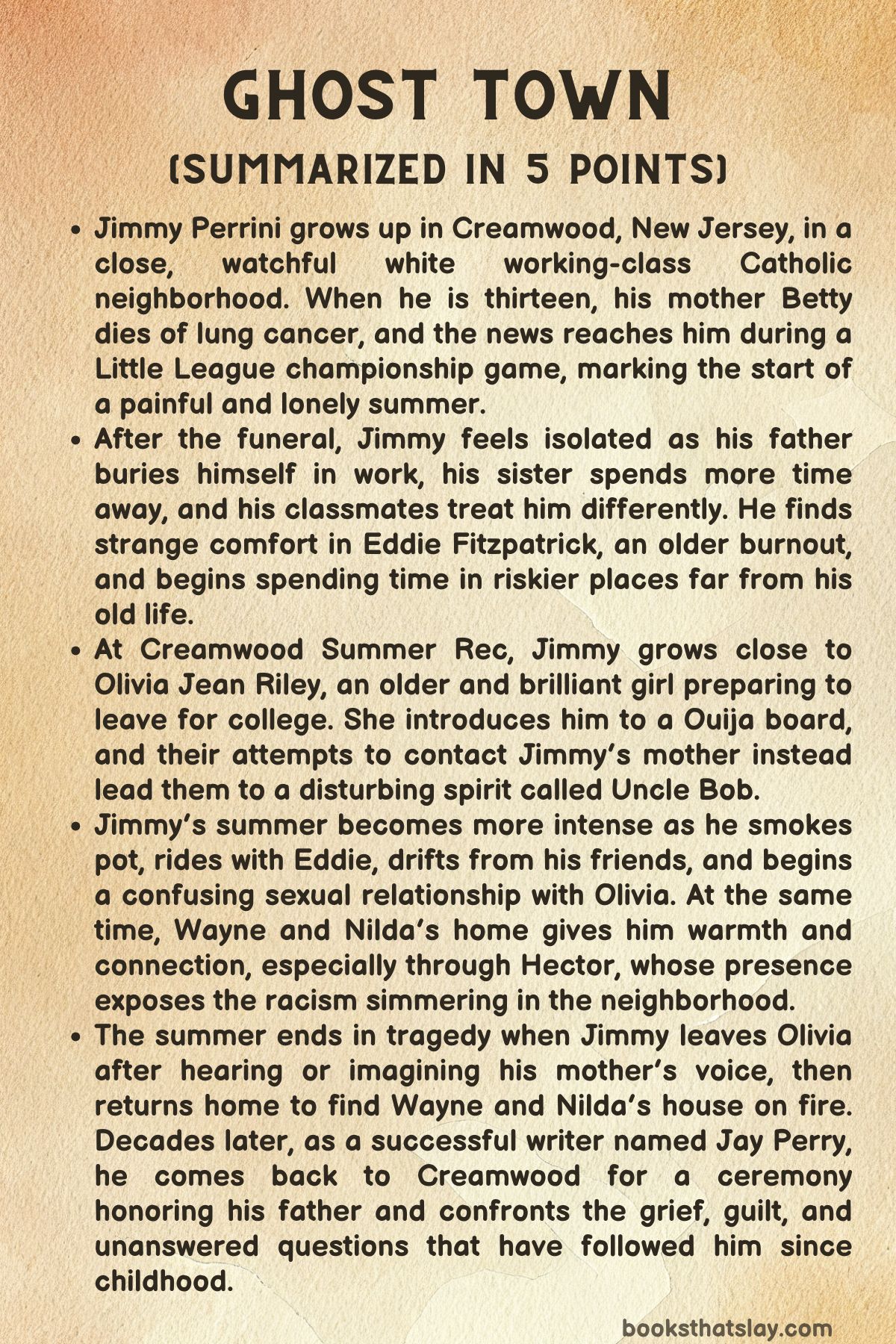
Summary
Jimmy Perrini grows up in Creamwood, New Jersey, a crowded, mostly white, working-class Catholic town where families live close together and privacy is almost impossible. Everyone seems to know everyone else’s business, and the community has strict ideas about class, race, religion, and proper behavior.
Jimmy’s family appears ordinary from the outside. His mother, Betty, is loving but seriously ill.
His father, Frank, is a hardworking man who keeps his emotions under control and tries to hold the household together. Jimmy’s older sister, Denise, is moving into her own teenage life, while Jimmy is still young enough to depend on the comfort and order his mother provides.
When Jimmy is thirteen, his mother dies of lung cancer. The family has not fully explained the seriousness of her illness to him, so the news reaches him with shocking force.
He is playing shortstop in a Little League championship game when his cousin Wayne comes to the field and tells him that his mother is gone. Wayne, who has recently moved next door with his wife Nilda, is very different from the adults Jimmy is used to.
He has long hair, a loose hippie style, and a relaxed manner that sets him apart in Creamwood. He takes Jimmy home from the game, marking the beginning of a strange and painful summer.
Jimmy finds the rituals after his mother’s death almost unbearable. At the wake, he hates seeing Betty’s body in the coffin, made up and still, as if the adults have turned her into someone he no longer recognizes.
He feels trapped by the funeral home, the relatives, and the steady pressure to behave properly. At one point, he slips outside, desperate to escape the atmosphere of mourning.
There he meets Eddie Fitzpatrick, an older neighborhood burnout with a beat-up car and a careless attitude. Eddie is not exactly a friend and not exactly a role model, but he offers Jimmy a way out of the suffocating world of grief and sympathy.
After the funeral, life at home changes completely. Frank throws himself into work, overtime, and projects around the house.
He seems determined to keep moving rather than talk about Betty or comfort his son. Denise spends more time away with friends.
Jimmy is left with long empty hours and the feeling that people at school and in the neighborhood are watching him as the boy whose mother died. He does not know how to speak about his loss, and he does not know what to do with the anger, sadness, and confusion inside him.
That summer, Jimmy begins helping at Creamwood Summer Rec, a local program for children. The counselors give him a yellow shirt with “COUNSELOR” printed on it, and the shirt makes him feel important.
For a while, the job gives him a role and a sense of purpose. At Summer Rec, he grows close to Olivia Jean Riley, a brilliant former valedictorian who is older than he is and preparing to leave for college.
Olivia is smart, bold, and mysterious to Jimmy. She treats him with attention and seriousness at a time when he feels overlooked by nearly everyone else.
Olivia introduces Jimmy to the Ouija board and suggests that it may allow him to contact his dead mother. Jimmy is both frightened and eager.
He badly wants some sign that Betty still exists somewhere and still knows him. He and Olivia secretly use the board in the Randowski house, where Olivia has access to a key.
But instead of Betty, they reach a spirit calling itself Uncle Bob. At first, the contact seems strange and almost like a game, but Jimmy later begins to connect Uncle Bob with the dead former owner of Eddie’s car, a man who murdered his fiancée and later killed himself in prison.
The supernatural possibility unsettles Jimmy, but it also fits the emotional chaos of his summer, when the boundary between memory, fear, and imagination feels thin.
As the summer continues, Jimmy drifts away from the safer parts of his old life. He rides around with Eddie in the Vega, smokes pot, and buys weed from Leonard at McDonald’s.
He becomes caught up with older boys whose world is rougher and more dangerous than his own. His friendships also begin to break down.
He feels betrayed by Greg, his old friend, because he believes Greg has taken Janie Randowski away from him. Jimmy’s anger does not stay private.
Eddie and Leonard step in and threaten Greg on Jimmy’s behalf, forcing Greg into a humiliating apology. Jimmy had not wanted things to go that far, but he is unable to stop the damage once others act in his name.
At the same time, Jimmy’s relationship with Olivia becomes more intense. She is older, more experienced, and on the edge of leaving Creamwood behind.
To Jimmy, she represents desire, escape, knowledge, and danger all at once. Their relationship becomes romantic and sexual, but Jimmy is still very young.
He is flattered by her attention and drawn to her confidence, yet he is also scared by the speed and seriousness of what is happening. His feelings for Olivia mix with his grief for his mother, his anger at his father, and his longing to be seen as more than a child.
Wayne and Nilda’s house becomes another place where Jimmy feels drawn in. Wayne’s relaxed manner and Nilda’s warmth give their home a freedom that contrasts with the tight rules of Creamwood.
When Nilda’s Black cousin Hector comes to stay with them, his presence unsettles Jimmy’s father and many people in the neighborhood. Creamwood’s racism is often expressed through suspicion, jokes, and hostility disguised as concern.
Hector, however, treats Jimmy with kindness. He talks to Jimmy about losing his own mother and understands something about grief that other adults do not say aloud.
He also helps Jimmy make an ashtray, a small act of attention that leaves a mark on him.
One evening, Wayne, Nilda, Hector, and Yvette take Jimmy out for Chinese food. The outing should be ordinary, but it becomes tense when Jimmy’s teacher, Mr. Kazmierski, confronts them with racist and anti-hippie hostility.
The scene reveals how narrow and aggressive Creamwood can be toward anyone who seems different. Jimmy begins to see more clearly that the town he has always known as home is also a place built on fear, judgment, and exclusion.
Near the end of the summer, Jimmy sneaks out to the Randowski house for a planned night with Olivia. They use the Ouija board again, and this time Olivia appears to contact her dead father.
The moment is charged with grief, belief, and performance, and Jimmy is unsure what is real. Later, as the night turns sexual, Jimmy hears or imagines his mother’s voice telling him to go home.
The voice breaks through his confusion. Instead of staying with Olivia, he leaves without saying goodbye and starts walking home.
On the way back, Eddie’s car speeds past him, adding to the sense that something has gone wrong. When Jimmy reaches Morgan Street, he sees that Wayne and Nilda’s house is burning.
The fire is horrifying and chaotic. Frank has climbed his own ladder into the burning house, trying to rescue people trapped inside.
In that moment, Jimmy’s father becomes both heroic and unreachable. Frank dies in the fire, and Hector dies too.
Wayne and Nilda survive, but they are crushed by the loss. Jimmy, who has already lost his mother, now loses his father in an event that will define the rest of his life.
Decades later, Jimmy has become Jay Perry, a successful writer and television creator. He returns to Creamwood because the town is naming a municipal complex after his father.
The town has changed since his childhood. It is more diverse now, and the old Creamwood exists partly as memory, partly as myth, and partly as something he may never have fully understood.
Jay tours the town and thinks back on the summer that shaped him. He begins to suspect that the fire at Wayne and Nilda’s house may not have been an accident.
It may have been racist arson, connected to the neighborhood’s hostility toward Hector, Wayne, Nilda, and the life they represented.
Jay’s return forces him to face the uncertainty of memory. He has built a career out of stories, but his own past remains unstable.
He cannot be sure what he saw, what he imagined, what people hid from him, or what he later reshaped in his mind. The town wants to honor Frank as a hero, and Jay does not reject that image, but he also knows the truth may be more complicated.
His father’s death cannot be separated from the fear and prejudice that surrounded Wayne and Nilda’s house that summer.
At a library event, Jay reads from a new work based on his last summer in Creamwood. As he reads, he sees or imagines figures from the past in the audience, including Uncle Bob and his mother.
The appearance of Uncle Bob suggests that the darker forces of memory, guilt, and violence have not entirely disappeared. But Jay turns his attention to his mother’s love rather than to fear.
He continues reading, choosing to stay with the story instead of running from it. In the end, Ghost Town presents Creamwood as both a real place and a haunted one, shaped by the dead, by secrets, and by the painful ways childhood survives inside adult life.
Characters
Jimmy Perrini / Jay Perry
Jimmy Perrini is the central character of Ghost Town, and his journey is shaped by grief, loneliness, guilt, desire, and memory. As a boy, Jimmy begins as an ordinary thirteen-year-old growing up in a tightly controlled working-class Catholic neighborhood, but his mother’s death tears away his sense of safety.
He is too young to fully understand loss, yet old enough to feel its humiliation, confusion, and permanence. His grief makes him feel exposed, as though everyone in Creamwood can see that he has been marked by tragedy.
Instead of receiving steady emotional support, he finds himself surrounded by people who are also retreating into their own forms of survival. This leaves Jimmy vulnerable to unusual attachments, dangerous choices, and fantasies of escape.
Jimmy’s character is especially complex because he is not simply innocent or rebellious; he is both. He wants comfort, but he also wants to be seen as older, tougher, and more independent than he really is.
His connection with Eddie gives him access to a darker adult world of cars, drugs, threats, and recklessness, while his relationship with Olivia pulls him into emotional and sexual experiences he is not mature enough to process. His interest in the Ouija board shows how desperate he is to cross the boundary between life and death, because ordinary mourning does not give him the answers he wants.
He wants his mother back, but he also fears what it would mean to actually hear from her.
As an adult, Jimmy becomes Jay Perry, a successful writer and television creator, but the name change does not free him from Creamwood. His return shows that the past remains unfinished inside him.
He has turned memory into art, yet he is still unsure what really happened and what he only imagined. His suspicion that the fire may have been racist arson rather than an accident reveals his adult awareness of the ugliness that his younger self only partly understood.
Jay’s final act of reading about that summer suggests that storytelling is his way of facing grief without being destroyed by it. He survives by transforming pain into narrative, but the book makes clear that survival is not the same as complete healing.
Betty Perrini
Betty Perrini, Jimmy’s mother, is physically absent for much of the story, but emotionally she dominates Jimmy’s inner life. Her death from lung cancer is the event that breaks the structure of the Perrini family and changes Jimmy’s understanding of the world.
To Jimmy, Betty represents love, comfort, and the lost stability of childhood. Because the family partly hides the seriousness of her illness from him, her death feels both expected and shocking, as though the adults around him have failed to prepare him for the truth.
This makes his grief even more confusing, because he must mourn not only his mother but also the illusion that his family was honest and secure.
Betty’s presence after death is complicated. Jimmy hates the artificial version of her body at the wake, because the made-up corpse feels like a betrayal of the living mother he remembers.
Later, when he tries to contact her through the Ouija board, his longing becomes mixed with fear and doubt. He wants proof that she still exists somewhere, but he is also frightened by the possibility that the dead may not return in comforting ways.
Near the end of the story, when Jimmy hears or imagines his mother’s voice telling him to go home, Betty becomes a moral and protective force. Whether supernatural or psychological, that voice shows how deeply her love remains inside him.
She is not merely a lost parent in the book; she becomes the emotional center around which Jimmy’s memory, guilt, and survival revolve.
Frank Perrini
Frank Perrini is Jimmy’s father, a working-class man who responds to grief through labor, silence, and duty. After Betty’s death, he does not know how to comfort his son directly, so he throws himself into overtime and house projects.
This makes him seem distant, but his distance is not simple coldness. Frank belongs to a world where men are expected to provide, endure, and fix practical things rather than speak openly about pain.
His love is real, but it is often trapped behind emotional restraint. As a result, Jimmy experiences him as both a father and a stranger.
Frank’s character also reflects the contradictions of Creamwood. He is a product of the neighborhood’s narrow racial and social assumptions, and he is unsettled by Hector’s presence next door.
This discomfort reveals the prejudice and fear built into the community. Yet Frank’s final act complicates any simple judgment of him.
When Wayne and Nilda’s house burns, Frank climbs into the fire to rescue people, risking and losing his life. His death transforms him from a flawed, grieving father into a public hero, but the adult Jimmy understands that heroism does not erase complexity.
Frank is brave, limited, loving, prejudiced, silent, and sacrificial all at once. The municipal complex named after him preserves a simplified version of his life, while Jimmy’s memory holds the harder truth.
Denise Perrini
Denise Perrini, Jimmy’s sister, represents another way of surviving family grief. After their mother’s death, Denise spends more time away from home and with friends, creating distance from the broken household.
To Jimmy, this may feel like abandonment, but Denise is also a young person trying to escape an atmosphere of sorrow that no one in the family knows how to discuss. Her absence matters because it deepens Jimmy’s isolation.
With his father working and Denise elsewhere, Jimmy is left to search for belonging in unsafe or unstable places.
Denise is not as central as Jimmy, Frank, or Betty, but her role is important because she shows how grief disperses a family rather than bringing it neatly together. She does not become Jimmy’s guide or substitute parent, and that absence is part of the emotional truth of the story.
The family members suffer separately, each retreating into a different pattern. Denise’s character helps reveal that the Perrini home after Betty’s death is not held together by shared mourning; it is quietly coming apart.
Wayne
Wayne is Jimmy’s cousin and one of the most important alternative adult figures in the book. With his long hair, hippie lifestyle, and unconventional household, Wayne stands apart from Creamwood’s conservative working-class culture.
He is the one who comes to the baseball field to tell Jimmy that his mother has died, placing him at the doorway between Jimmy’s ordinary childhood and his life after loss. Wayne’s presence is gentle but disruptive.
He offers Jimmy a different model of adulthood, one based less on rigid masculinity and neighborhood judgment and more on openness, warmth, and chosen community.
Wayne’s home becomes a refuge for Jimmy because it feels freer and more emotionally alive than his own house. Yet Wayne’s difference also makes him a target.
The neighborhood watches him, judges him, and treats his household as suspicious. His relationship with Nilda and his welcome toward Hector challenge Creamwood’s racial and social boundaries.
When the fire destroys his home and kills Frank and Hector, Wayne becomes a victim of the same hostility that has surrounded him all along. His character shows both the promise and vulnerability of living outside a community’s accepted rules.
Nilda
Nilda is Wayne’s wife, and she brings warmth, difference, and tension into Jimmy’s world. As part of Wayne’s household, she represents a more open and diverse way of living than the one Creamwood usually permits.
Her presence unsettles the neighborhood because she does not fit its narrow expectations, and through her, the story exposes the racism and suspicion that lie beneath the town’s surface. Nilda’s home is not just a physical space; it becomes a symbolic alternative to the rigid world Jimmy has inherited.
Nilda’s importance also comes from the atmosphere she helps create. Around her, Wayne, Hector, and others form a household that feels emotionally generous and socially mixed.
For Jimmy, who is lonely and grieving, that house offers a sense of welcome he badly needs. The tragedy of the fire is therefore not only the destruction of a building but also the destruction of a fragile possibility.
Nilda survives, but her survival is marked by devastation. Through her character, the story shows how communities punish those who seem different, especially when race, class, and countercultural identity are involved.
Olivia Jean Riley
Olivia Jean Riley is one of the most fascinating and troubling figures in Jimmy’s adolescence. She is brilliant, older, and on the edge of leaving Creamwood for college, which makes her seem to Jimmy like someone who already belongs to a larger world.
Her intelligence and confidence attract him, but they also create an imbalance between them. Olivia understands more than Jimmy does about desire, performance, secrecy, and escape.
To him, she is mysterious and powerful; to herself, she may also be lonely, restless, and eager to test the limits of the town before leaving it behind.
Olivia’s use of the Ouija board reveals her attraction to danger and hidden knowledge. She introduces Jimmy to the possibility of contacting the dead, but this is not a harmless game for him.
Because he is grieving his mother, the board touches his deepest wound. Olivia becomes connected to both his longing for the supernatural and his awakening sexuality, which makes their relationship emotionally overwhelming.
Their romantic and sexual involvement is not presented as simple love; it is confusing, unequal, intense, and shadowed by grief.
Olivia also carries her own pain, especially in relation to her dead father. When she tries to reach him, the Ouija board becomes a mirror of her own unresolved loss.
She and Jimmy are drawn together partly because both are haunted, but they do not experience haunting in the same way. Olivia is preparing to leave, while Jimmy is still trapped inside the town and inside his family’s tragedy.
Her character represents desire, danger, escape, and the seductive promise of adulthood, but she also exposes how unprepared Jimmy is for the emotional weight of what he is experiencing.
Eddie Fitzpatrick
Eddie Fitzpatrick is a dangerous but strangely comforting presence in Jimmy’s life. As an older burnout with an unlicensed car, Eddie exists on the margins of respectable Creamwood society.
He first appears to Jimmy as a way out of the unbearable rituals of mourning, offering escape when Jimmy flees the funeral home. Because Eddie does not treat Jimmy with the careful pity of adults, Jimmy finds relief in his company.
Eddie’s world is reckless, smoky, and lawless, but for a grieving boy who feels trapped and watched, that lawlessness feels like freedom.
At the same time, Eddie is not a safe guide. Through him, Jimmy enters a world of drugs, aimless driving, and intimidation.
Eddie’s influence encourages Jimmy to drift away from childhood friendships and toward a false idea of toughness. His car, possibly connected to the dead Uncle Bob, adds a sinister supernatural or psychological layer to his role.
Eddie becomes associated with possession, violence, and unresolved evil, whether literally or symbolically. He is a refuge, but he is also a warning.
His character shows how grief can make danger feel like companionship when ordinary sources of comfort have failed.
Uncle Bob
Uncle Bob is one of the darkest and most ambiguous presences in the story. He first appears through the Ouija board, not as the mother Jimmy hopes to contact, but as another dead figure intruding into the space of grief.
The possibility that Uncle Bob is connected to Eddie’s car and to a history of murder and suicide makes him a symbol of corrupted memory. Instead of giving Jimmy comfort, the supernatural opens a door to something violent and morally diseased.
Uncle Bob’s importance lies in the uncertainty surrounding him. He may be a real spirit, a projection of Jimmy’s fear, or a narrative form for the evil already present in the adult world.
His presence suggests that the past does not return in pure or comforting ways. The dead may bring love, as Betty does in Jimmy’s memory, but they may also bring guilt, violence, and contamination.
When the adult Jay seems to see Uncle Bob in the audience, the figure becomes part of the unresolved haunting of Creamwood itself. Uncle Bob represents the ugly underside of nostalgia, the part of the past that refuses to stay buried.
Hector
Hector is Nilda’s Black cousin, and his arrival exposes the racial tensions of Creamwood more clearly than almost any other character. To Jimmy’s father and the neighborhood, Hector’s presence is unsettling because he violates the town’s segregated expectations.
Yet to Jimmy, Hector is warm, patient, and humane. He talks to Jimmy about losing his own mother and helps him make an ashtray, giving him a form of attention and understanding that many of the adults in his own family cannot provide.
Hector’s kindness matters because it challenges the prejudices Jimmy has absorbed from his environment.
Hector’s role is also tragic because he becomes one of the victims of the fire. His death forces the adult Jimmy to reconsider the official story of the past.
If the fire was not accidental, then Hector was not merely caught in a tragedy; he may have been targeted by racist violence. This possibility changes the moral meaning of the story.
Hector is not only a kind figure in Jimmy’s memory; he becomes a measure of the town’s cruelty and denial. His character reveals how racism can be both openly expressed, as in Mr. Kazmierski’s hostility, and silently buried under public myths of accident and heroism.
Yvette
Yvette appears as part of the social world surrounding Wayne, Nilda, and Hector, and her presence helps expand Jimmy’s sense of life beyond his own family and neighborhood routines. When she joins the outing for Chinese food, she is part of a group that feels different from the watchful, judgmental environment of Creamwood.
For Jimmy, this group offers a glimpse of a broader, freer, more mixed world. Yvette’s role may be smaller than that of Wayne, Nilda, or Hector, but she contributes to the atmosphere of openness that makes their household so important to Jimmy.
Yvette also helps highlight the hostility of outsiders like Mr. Kazmierski. The restaurant scene becomes significant because the group’s simple act of being together in public provokes racist and anti-hippie aggression.
Through Yvette’s presence in that scene, the story shows how social difference becomes visible and vulnerable in public spaces. She is part of the community that Creamwood’s narrow worldview cannot comfortably accept.
Mr. Kazmierski
Mr. Kazmierski is Jimmy’s teacher, but he does not function as a wise or protective adult. Instead, he becomes a representative of the prejudice and authoritarian ugliness embedded in the community.
His confrontation with Wayne, Nilda, Hector, Yvette, and Jimmy at the Chinese restaurant exposes his racism and hostility toward countercultural difference. Because he is a teacher, his behavior is especially disturbing.
He is someone who should guide young people, yet he models contempt and social cruelty.
His character matters because he gives open voice to attitudes that other people in Creamwood may hide or express more quietly. He is not an isolated villain so much as an expression of the town’s moral atmosphere.
Through him, Jimmy witnesses how adults can use respectability as a cover for bigotry. Mr. Kazmierski helps the story move beyond private grief and into a broader critique of the community that shaped Jimmy’s childhood.
Greg
Greg is one of Jimmy’s old friends, and his relationship with Jimmy shows how grief and adolescence can distort loyalty. Jimmy believes Greg has stolen Janie Randowski from him, and this belief feeds his resentment.
In another kind of childhood, the conflict might have remained a small jealousy, but Jimmy’s emotional state makes everything feel larger and more humiliating. Greg becomes a target for feelings Jimmy cannot fully understand or control.
The most important moment involving Greg is the forced apology arranged by Leonard and Eddie. Jimmy never truly wants this kind of intimidation, but by associating with Eddie’s world, he allows violence and humiliation to enter his friendships.
Greg’s apology reveals Jimmy’s loss of innocence. He is no longer simply a wounded boy; he has become connected to actions that hurt others.
Greg’s character therefore helps expose the moral cost of Jimmy’s drift toward anger, resentment, and false toughness.
Janie Randowski
Janie Randowski is important less as a fully developed figure and more as a symbol of Jimmy’s adolescent longing and insecurity. Jimmy’s belief that Greg has taken her from him reveals how intensely he wants recognition, affection, and status at a time when he feels powerless in his family life.
Janie becomes part of the emotional triangle through which Jimmy experiences jealousy and betrayal. His feelings about her are shaped by immaturity, wounded pride, and the need to feel chosen.
Her family’s house also becomes significant because Olivia has a key to it, and it becomes the secret place where Jimmy and Olivia use the Ouija board and later move toward sexual intimacy. In this way, Janie’s world becomes connected to Jimmy’s fantasies, fears, and transgressions.
Janie herself may remain somewhat distant in the narrative, but her presence helps reveal the unstable emotional territory of Jimmy’s adolescence, where grief, desire, rivalry, and secrecy overlap.
Leonard
Leonard is part of the darker adolescent and young adult world into which Jimmy drifts after his mother’s death. As the person who sells weed at McDonald’s and joins Eddie in threatening Greg, Leonard represents the casual menace that surrounds Jimmy’s new life.
He is not emotionally close to Jimmy in the way Wayne or Hector is, but he influences the atmosphere of risk and intimidation that begins to replace Jimmy’s former childhood routines.
Leonard’s role is important because he shows how quickly Jimmy’s grief can be redirected into destructive behavior. Jimmy does not set out to become cruel, but through people like Leonard, his private resentment gains public consequences.
Leonard helps turn Jimmy’s jealousy toward Greg into an act of humiliation. His character represents peer pressure, masculine aggression, and the dangerous appeal of belonging to a tougher crowd.
Themes
Grief and the Loss of Childhood
Jimmy’s mother’s death forces him into an emotional world he is not prepared to understand. He is still a child, but the adults around him either hide the truth, stay busy, or expect him to keep functioning as if nothing permanent has happened.
The moment he learns of her death while playing baseball shows how suddenly ordinary childhood can be broken by tragedy. After the funeral, his grief becomes isolating because everyone seems to look at him differently, yet no one really knows how to help him.
His father works more, Denise spends time away from home, and Jimmy is left to make sense of pain through silence, avoidance, and risky friendships. His search for contact with his mother through the Ouija board shows that grief makes him desperate for proof that love has not disappeared.
In Ghost Town, childhood ends not through maturity, but through shock, loneliness, and the painful realization that death changes both family and identity.
Escape, Risk, and Emotional Confusion
Jimmy’s attraction to danger grows out of his need to escape a home filled with absence. Eddie’s car, late-night rides, smoking pot, and secret meetings all give him a temporary sense of freedom, but they also pull him further from safety and stability.
Eddie becomes important not because he is a good influence, but because he offers Jimmy a place where grief does not have to be explained. Jimmy’s choices are often reckless, yet they are also emotionally understandable because he is trying to feel powerful at a time when everything feels out of his control.
His relationship with Olivia adds another layer of confusion because it mixes desire, comfort, fear, and guilt. He wants closeness, but he does not fully understand the emotional consequences of what is happening.
The risky summer becomes a way for Jimmy to test boundaries, but each escape also reveals how vulnerable he really is.
Racism, Class, and Community Judgment
Creamwood presents itself as a close community, but its closeness often turns into surveillance, prejudice, and exclusion. The town’s working-class Catholic identity gives people a strong sense of belonging, yet that belonging depends on strict ideas about who is acceptable.
Hector’s arrival exposes the racism that has been present beneath everyday neighborly life. Jimmy’s father and others respond to Hector with suspicion not because of anything he has done, but because he challenges the racial boundaries the neighborhood has quietly protected.
The confrontation at the Chinese restaurant shows how quickly prejudice becomes public hostility when people feel their social order is being disturbed. Decades later, Jimmy’s suspicion that the fire may have been racist arson forces a darker reading of the past.
What once seemed like a tragic accident may also reveal the violence hidden inside a community that claimed to value family, loyalty, and respectability.
Memory, Guilt, and the Unfinished Past
The adult Jimmy’s return to Creamwood shows that the past is not fixed simply because time has passed. His memories of that summer remain full of gaps, doubts, and unanswered questions.
He is now successful and known by a different name, yet the boy he once was still shapes how he understands himself. The fire, his father’s death, Hector’s death, and his decision to leave Olivia all remain emotionally unresolved.
His suspicion about the cause of the fire suggests that memory is not only personal but also historical, because what a town chooses to remember or ignore affects how truth is understood. Seeing or imagining the dead during his reading shows that grief and guilt still live inside him, but the moment also allows him to focus on love rather than fear.
His act of reading becomes a way of facing the past, not solving it completely, but refusing to keep it buried.