In the Great Quiet Summary, Characters and Themes
In the Great Quiet by Laura Vogt is a historical novel about Minnie Hoopes, a young woman who enters the 1893 Oklahoma land run with one clear aim: to claim a piece of land that belongs to her alone. Set against the harsh beauty and violence of the prairie, the book follows Minnie as she faces fire, hunger, danger, guilt, love, and the burden of survival.
It is also a story about women, land, memory, and community, showing how independence can be both a fierce dream and a lonely road until trust begins to take root.
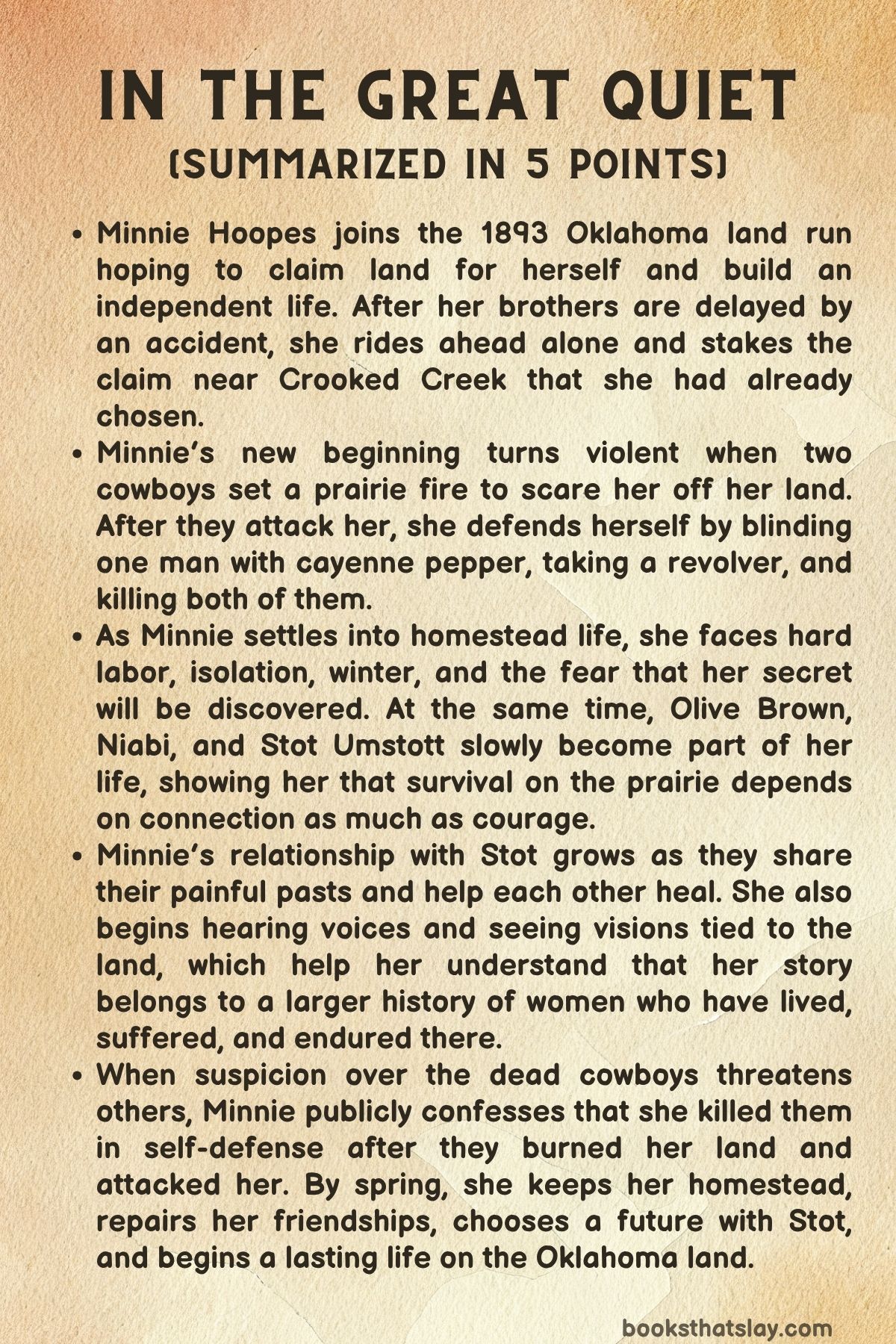
Summary
Minnie Hoopes enters the 1893 Oklahoma land run with a determination that sets her apart from many of the people around her. She is not only chasing opportunity; she is chasing ownership, privacy, and a chance to make a life that is not ruled by her father, her brothers, or the mistakes she left behind in Kansas.
When the cannon sounds at noon, the prairie erupts into motion. Riders, wagons, families, outlaws, hopeful settlers, and desperate people race across the open land, all trying to reach a claim before anyone else.
Minnie rides her horse Cricket hard, focused on the place she has already scouted near Crooked Creek.
Her brothers, Willie and Ezra, are supposed to be with her, but their buggy crashes in a creek during the run. The delay infuriates Minnie.
She knows that every minute matters, and she refuses to lose the land she has chosen because of them. Rather than wait, she leaves them behind and rides on alone.
Her choice shows the force of her ambition and also the stubborn isolation that will shape much of her early life on the claim.
Minnie reaches the land first and stakes it with her flag. For a brief moment, victory seems possible.
She begins making the required improvements, knowing that claiming the land is only the first step. She must prove that she can live on it, work it, and make it productive.
The prairie, however, does not give her much time to celebrate. A fire soon moves toward her claim, threatening everything she has just won.
Minnie realizes that the blaze is not an accident. Two cowboys have set it deliberately, hoping to force her away and take the land for themselves.
Instead of running, Minnie acts quickly. She starts a backfire and shelters with Cricket on ground that has already burned.
The plan saves her life and her claim, but the danger is not over. When the cowboys ride in afterward, they expect to find her defeated.
They attack her, and one of them tries to rape her while the other keeps her under threat with a gun. Minnie fights back with whatever she has.
She blinds one man with cayenne pepper, seizes a revolver, and kills both attackers.
The killings leave Minnie shaken, but they do not break her resolve. She understands that if the truth comes out in the wrong way, she could lose her claim, her freedom, or both.
Her mysterious neighbor, a gunfighter known as the Lawman, helps her hide the bodies. His real name is Stot Umstott, though he carries his own history like a sealed wound.
Minnie does not fully trust him at first, but his help binds them together in a secret that will later threaten them both.
Minnie files her claim and begins the hard work of homesteading. She meets her father and brothers for supplies, but she remains committed to proving that she can survive without depending on them.
Her days are filled with labor. She builds shelter, plants potatoes, cares for her horses, hunts for food, gathers what she needs, and prepares for winter.
The land is difficult, and solitude is often harsher than she expected, but Minnie clings to the idea that independence means living apart from everyone.
Even so, people begin to enter her life. Olive Brown, a nearby settler, arrives with her daughters and brings food, talk, advice, and a kind of neighborly warmth Minnie is not sure she wants.
Olive is practical, social, and persistent. She sees through some of Minnie’s defenses and offers friendship anyway.
Through Olive, Minnie begins to understand that survival on the prairie often depends on community, even for people who pride themselves on self-reliance.
Minnie also meets Niabi, an Osage woman whose presence broadens Minnie’s understanding of the land she has claimed. Niabi teaches her about healing, Osage life, and the cost of the land rush for Native people who already had histories, homes, and sacred ties to the place.
Minnie’s desire for ownership becomes more complicated as she learns that the land is not empty and never was. When Minnie and Stot trespass on Osage land while hunting, they could have faced hostility.
Instead, Niabi identifies Minnie as a friend, and she and Stot are welcomed for the night by Niabi and her husband, Wa-ah-zho. The experience challenges Minnie’s assumptions and deepens her connection to Niabi.
As winter settles over the prairie, Minnie’s relationships with Olive, Niabi, and Stot grow stronger, though she continues to resist needing anyone. At the same time, she begins hearing voices and seeing visions tied to the land.
These experiences frighten her. She worries that the loneliness, trauma, and harsh conditions may be damaging her mind.
Yet the visions continue, linking Minnie’s life with the lives of women from other times. The land seems to hold memory, and Minnie gradually senses that her story is only one part of something larger.
The secret of the dead cowboys grows more dangerous. Rumors spread, and Marshal Canton begins asking questions.
When the buried bodies are eventually found, Minnie lies, afraid that no one will believe she acted in self-defense. The truth of what happened is tied to violence, shame, and the fear of being judged by men who may care more about order and property than about what was done to her.
Her silence protects her for a time, but it also puts others at risk.
Stot becomes Minnie’s closest companion. Their bond develops through trouble rather than ease.
After Minnie finds him wounded near her shack, she drags him inside, removes a bullet, and nurses him back toward health. In the close quarters of her rough home, they argue, share food, work together, and reveal pieces of themselves they have kept hidden.
Stot tells Minnie that he was once a lawman, and that his wife and family were killed because of his conflict with the Dalton gang. His reputation as the Lawman is built on loss as much as skill.
Minnie, too, carries guilt from her past. She admits that before leaving Kansas, she betrayed her sister Magnolia by sleeping with Lark, Magnolia’s husband, the night before their wedding.
This confession shows the pain Minnie has tried to outrun. Her claim in Oklahoma is not only a new beginning; it is also an escape from a family wound she helped create.
With Stot, Minnie finds someone who understands shame, grief, and the need to keep moving even when the past will not stay buried.
Their closeness grows into love, but Minnie pulls away when she believes Stot intends to marry Clara, his brother’s widow. Rather than risk humiliation or dependence, she retreats behind anger and pride.
This misunderstanding nearly costs them the relationship they have slowly built. Minnie’s fear of being trapped or abandoned often makes her choose distance before anyone else can hurt her.
Meanwhile, the danger surrounding the dead cowboys worsens. Suspicion begins to touch the Browns, and their barn burns.
Minnie realizes that her secrecy is no longer only protecting herself. It is endangering people who showed her kindness.
This knowledge forces her to face the moral cost of silence. She finally tells Olive the truth.
Olive is hurt and angry, not only because Minnie killed the men, but because Minnie kept the truth from her while allowing danger to come near her family. Their friendship breaks under the weight of the confession.
Minnie then makes a public choice. She goes to Duke’s Saloon and sits before the Wild Bunch, Marshal Canton, and the gathered townspeople.
There, she admits that she killed the missing men. She explains that they burned her land and attacked her, and that she fought to save herself.
The scene is tense because Minnie’s fate depends on whether the men listening will accept her word and her right to defend herself. After questioning, Bitter Creek and the marshal accept that the killings were self-defense.
Still, Bitter Creek warns her to watch her back, reminding Minnie that being cleared does not mean being safe.
After this reckoning, Minnie confronts Stot and learns that he is not going to marry Clara. The misunderstanding falls away, and they choose each other openly.
Their relationship becomes part of Minnie’s new life, not as a surrender of independence but as a form of trust she has earned through pain and honesty.
Minnie also begins repairing her friendship with Olive. She helps Olive’s family and offers to teach the Brown girls, showing through action that she wants to belong to the community she once tried to avoid.
Her connection with Niabi continues to guide her as well. Through Niabi, Minnie comes to accept the voices and visions not as madness, but as signs that the land holds many lives, losses, and stories.
This acceptance changes her understanding of home. The land is not merely something she owns.
It is something she must listen to, respect, and live with.
By spring, Minnie has changed. She remains strong and stubborn, but she no longer believes that survival requires complete isolation.
She keeps her homestead, accepts friendship, loves Stot, and begins building a future rooted in both independence and community. Her claim becomes more than a piece of property.
It becomes a place where she can face her past, make amends, and grow into a fuller version of herself.
The story closes by revealing the long future that follows. Minnie Hoopes and James Solomon Umstott Tharp marry, remain on their Oklahoma land for forty-five years, and raise four children there.
After all the violence, fear, guilt, and loneliness of her beginning, Minnie’s life on the prairie becomes lasting proof of her endurance and her ability to make a home in a place marked by both beauty and sorrow.
Characters
Minnie Hoopes
Minnie Hoopes is the central figure of In the Great Quiet, and her character is shaped by fierce independence, guilt, survival, and gradual emotional transformation. She enters the story determined to claim land for herself, not as someone’s daughter, sister, wife, or dependent, but as a woman who wants ownership over her own future.
Her decision to leave her brothers behind after their buggy accident shows both her ambition and her impatience; she is not cruel, but she is driven by a need to prove that she can survive without waiting for men to help her. Minnie’s courage becomes most visible when she defends herself against the cowboys who burn her land and attack her.
Her violence is not presented as casual or simple; it comes from terror, necessity, and the instinct to protect both her body and her claim. Afterward, her secrecy reveals how frightened she is of losing everything she has fought for.
Minnie is also emotionally complex because her desire for solitude hides deep shame and loneliness. Her confession about betraying Magnolia with Lark shows that she is not only escaping the limits placed on women but also escaping her own past.
This guilt makes her guarded, especially in her relationships with Olive, Niabi, and Stot. She wants connection but fears judgment, dependence, and emotional exposure.
Over time, however, the harshness of homestead life teaches her that independence does not have to mean isolation. Her bond with Olive gives her a sense of neighborly belonging, her friendship with Niabi opens her to a deeper understanding of the land, and her love for Stot allows her to trust someone without surrendering herself.
By the end of the book, Minnie has grown from a woman determined to survive alone into someone who can build a life rooted in courage, truth, love, and community.
Stot Umstott
Stot Umstott, also known as the Lawman, is one of the most mysterious and wounded characters in the story. At first, he appears as a dangerous neighboring figure, a man connected to violence, secrecy, and the unsettled justice of the frontier.
His help in hiding the cowboys’ bodies makes him morally complicated from the beginning. He is not a purely lawful figure despite his title; instead, he exists in the gray space between justice, revenge, protection, and survival.
His past as a former lawman gives him authority, but the murder of his wife and family has left him emotionally broken and detached from ordinary life.
Stot’s relationship with Minnie reveals his gentler and more vulnerable side. When Minnie finds him wounded and cares for him, their dynamic shifts from wary alliance to emotional intimacy.
He is stubborn, guarded, and haunted, but he recognizes Minnie’s strength without trying to control it. Like Minnie, he carries a past marked by guilt and grief, which makes their connection feel less like rescue and more like recognition.
He understands what it means to live with violence and loss, and this allows him to accept parts of Minnie that others might condemn. His rumored connection to Clara creates tension because Minnie believes he may choose duty over love, but the truth allows them to reconcile.
By the end of the novel, Stot becomes not just Minnie’s companion but someone who helps her imagine a future in which love can exist alongside freedom.
Olive Brown
Olive Brown represents friendship, domestic strength, and the practical force of community. She enters Minnie’s life as a neighbor who brings food, conversation, gossip, and warmth, slowly challenging Minnie’s belief that she can live entirely alone.
Olive is not simply a cheerful side character; she is a woman trying to build stability in a harsh and dangerous place. Her kindness is active rather than sentimental.
She feeds, visits, supports, and includes Minnie, offering the kind of everyday care that makes survival possible on the frontier.
Olive’s importance becomes especially clear when Minnie’s secrecy begins to harm those around her. After the Browns are threatened and their barn burns, Olive’s anger is justified because she realizes Minnie has allowed danger to spread into her family’s life.
This moment gives Olive moral weight. She is compassionate, but she is not passive, and she does not excuse betrayal simply because she loves Minnie.
Their break shows that friendship in the book is not effortless; it requires honesty, accountability, and repair. When Minnie later tries to make amends and offers to teach Olive’s daughters, the friendship begins to heal.
Olive’s character shows that community is not just comfort but responsibility.
Niabi
Niabi is one of the most spiritually and culturally significant characters in the book. As an Osage woman, she connects Minnie to a broader understanding of the land, one that existed long before the settlers arrived to divide and claim it.
Niabi’s presence challenges the land-run idea that the prairie is empty or simply waiting to be owned. Through her, Minnie begins to see that the land has memory, history, and pain.
Niabi’s role is therefore not limited to friendship; she becomes a guide into a deeper moral and spiritual awareness.
Niabi is calm, perceptive, and generous, but her kindness does not erase the historical injustice surrounding her. When Minnie trespasses on Osage land, Niabi’s choice to identify her as a friend protects her, yet the scene also reminds the reader that Minnie’s survival is taking place within a larger story of Native dispossession.
Niabi helps Minnie understand healing, women’s experiences, and the voices connected to the land. She does not force Minnie into belief but helps her stop fearing what she does not understand.
By the end of the story, Niabi has helped Minnie accept that her life is part of a much larger pattern of women’s endurance across time.
Wa-ah-zho
Wa-ah-zho, Niabi’s husband, represents dignity, hospitality, and the quiet strength of Osage presence in the story. Although he does not occupy as much narrative space as Niabi, his role is important because he helps create a moment of welcome when Minnie and Stot enter Osage territory.
His acceptance of them for the night shows restraint and generosity, especially given the tensions surrounding land, trespass, and settlement. He is not presented as a figure who exists only to serve Minnie’s development; instead, he helps embody a world and a community that settlers have intruded upon.
Wa-ah-zho’s character also adds balance to the portrayal of the Osage household. Alongside Niabi, he shows a form of life rooted in relationship to land, custom, and mutual protection.
His presence reminds the reader that the land Minnie claims is not without history or belonging. Even in a brief role, Wa-ah-zho deepens the story’s moral landscape by making visible the people whose lives are affected by the land rush.
Willie Hoopes
Willie Hoopes, Minnie’s brother, helps reveal the family world Minnie is trying to move beyond. His buggy crash with Ezra delays their journey during the land run, creating the moment when Minnie chooses to separate herself from her brothers and pursue the claim alone.
Willie’s role shows the tension between family dependence and individual ambition. Minnie does not hate her brothers, but she refuses to let their mistake determine her future.
Through Willie, the story highlights how Minnie’s independence requires painful choices.
Willie also represents the ordinary male relatives who might have been expected to guide or protect Minnie in a frontier setting. Instead, his failure during the land run allows Minnie to step fully into her own agency.
He is not necessarily villainous or weak, but he is part of a family structure Minnie no longer wants to rely on. His character matters because Minnie’s break from him is one of the first signs that she intends to claim not only land but personal authority.
Ezra Hoopes
Ezra Hoopes, like Willie, functions as part of Minnie’s family background and as a contrast to her determination. His involvement in the buggy accident places him on the side of delay, dependence, and frustration, while Minnie becomes associated with speed, action, and self-reliance.
Ezra helps show that Minnie’s journey is not simply about land ownership; it is also about refusing to be slowed by the expectations and limitations of her family.
Ezra’s presence also makes Minnie’s choice more morally complicated. Leaving her brothers behind is not an easy or purely heroic action.
It reveals her impatience and ambition, but it also reveals how deeply she wants a life that is hers alone. Ezra therefore helps expose one of Minnie’s central conflicts: she wants freedom, but freedom often requires decisions that can appear selfish or harsh.
His character helps establish the emotional cost of Minnie’s independence.
Minnie’s Father
Minnie’s father represents the family structure that remains behind Minnie even as she tries to build a separate life. His appearance when Minnie meets him and her brothers for supplies suggests that Minnie has not completely severed herself from her family, even though she is determined to live independently.
He belongs to the practical world of provisions, family support, and social expectation. His role is quieter than Minnie’s or Stot’s, but he helps show that Minnie’s homesteading life does not begin in total isolation.
As a father figure, he also helps define the expectations Minnie resists. Minnie does not want her life to be arranged around male protection or approval.
Her interactions with him emphasize that she is stepping into a role usually reserved for men: claiming land, defending it, improving it, and building a future on it. His character therefore serves as a reminder of the world Minnie comes from and the boundaries she is determined to cross.
Cricket
Cricket, Minnie’s horse, is more than an animal companion; she is essential to Minnie’s survival, independence, and emotional endurance. During the land run, Cricket gives Minnie the speed and strength she needs to reach her claim before others.
In that sense, Cricket becomes part of Minnie’s agency. Minnie’s dream of land ownership depends not only on courage but also on her bond with the horse who carries her across the prairie.
Cricket also becomes a symbol of trust and companionship in Minnie’s loneliest moments. During the prairie fire, Minnie survives by sheltering with Cricket on burned ground, and the shared danger strengthens the sense that Cricket is part of Minnie’s homestead life rather than a mere possession.
Minnie’s care for her horses shows her tenderness, responsibility, and need for living connection even when she claims to want solitude. Cricket reflects the part of Minnie that can love fiercely without words.
Marshal Canton
Marshal Canton represents public law, suspicion, and the pressure of official judgment. When the missing cowboys become a matter of investigation, he becomes a threat to Minnie’s secrecy and security.
His questioning forces Minnie to confront the possibility that the violence she survived may still destroy her future. Canton is not simply an enemy; he represents a legal world that may not fully understand or protect a woman who defended herself on the frontier.
His role is important because it places Minnie’s private trauma into the public arena. As long as the killings remain hidden, Minnie can pretend that survival is enough.
Canton’s investigation proves that truth cannot stay buried without consequences. In the final public confession, his willingness to accept her self-defense helps resolve the immediate danger, but his presence throughout the story reminds the reader how fragile Minnie’s position is.
Her land, freedom, and reputation all depend on whether men in authority believe her.
Bitter Creek
Bitter Creek is a dangerous and influential figure connected to the violent world of outlaws, saloons, and frontier power. His presence during Minnie’s confession raises the stakes because she is not only speaking before legal authority but also before men who live by intimidation and reputation.
Bitter Creek listens to her account and accepts that she acted in self-defense, but his warning that she should watch her back keeps the moment from feeling completely safe.
Bitter Creek’s character represents the rough justice of the frontier, where survival often depends on how one’s story is received by powerful and dangerous people. He is not a comforting figure, but he is not presented as mindlessly cruel either.
His acceptance of Minnie’s explanation suggests that even violent men may recognize certain codes of self-defense. Still, his warning leaves a shadow over Minnie’s victory, reminding the reader that public truth does not erase danger.
The Two Cowboys
The two cowboys are the clearest human antagonists in Minnie’s early homestead life. They try to force her off her claim by setting a prairie fire, and when that fails, they attack her directly.
Their actions reveal the gendered violence beneath the land rush. They do not see Minnie as a legitimate claimant; they see her as someone who can be frightened, violated, and removed.
Their cruelty exposes how vulnerable a woman alone on the frontier can be, even when she has legally claimed land.
At the same time, the cowboys’ deaths create the central moral and legal crisis of the story. Minnie kills them in self-defense, but hiding their bodies turns survival into secrecy.
Their role continues even after they die because suspicion, gossip, and fear spread through the community. As characters, they represent both physical danger and the lasting consequences of violence.
Through them, the book shows that defending oneself may save a life while still leaving emotional, legal, and communal damage behind.
Magnolia
Magnolia, Minnie’s sister, is one of the most important absent figures in Minnie’s emotional life. Although she does not appear directly in the main action, her betrayal by Minnie shapes Minnie’s guilt and self-image.
Minnie’s confession that she slept with Lark, Magnolia’s husband, before their wedding reveals a wound that Minnie has carried with her into Oklahoma. Magnolia therefore represents the family bond Minnie has damaged and the moral failure she cannot easily escape.
Magnolia’s importance lies in how deeply she complicates Minnie. Without this backstory, Minnie might seem only brave, wronged, and independent.
With Magnolia, the reader sees that Minnie has also caused pain. Her guilt over her sister adds emotional depth to her desire for isolation.
Minnie is not only trying to survive the frontier; she is trying to live with herself. Magnolia’s character shows that some of Minnie’s hardest battles are not against outlaws or nature but against memory and shame.
Lark
Lark is a morally troubling figure because of his connection to Minnie’s betrayal of Magnolia. As Magnolia’s husband, he should represent loyalty and commitment, but his night with Minnie before the wedding reveals selfishness and emotional irresponsibility.
His role in the story is brief but damaging. He becomes part of the past that Minnie carries into her new life, a reminder that desire can create lasting harm.
Lark’s character also helps explain Minnie’s fear of intimacy. Her relationship with him was not simply a romantic mistake; it was a betrayal that injured her sister and stained Minnie’s sense of herself.
Because of Lark, Minnie’s later love for Stot is shadowed by fear, guilt, and uncertainty. Lark represents the destructive side of passion, while Stot eventually represents a love that can be honest, chosen, and healing.
Clara
Clara is important because of what Minnie believes she represents. As Stot’s brother’s widow, she appears to Minnie as a possible claim on Stot’s loyalty and future.
Minnie’s belief that Stot may marry Clara triggers her emotional withdrawal, revealing Minnie’s insecurity and fear of being abandoned or humiliated. Clara therefore functions less as a rival in action and more as a figure of misunderstanding, duty, and imagined loss.
Clara’s role also highlights the difference between assumption and truth. Minnie’s pain comes from what she thinks Stot intends to do, not from what he actually chooses.
Through Clara, the story explores how easily wounded people can protect themselves by retreating before they know the full truth. Once Minnie learns that Stot is not going to marry Clara, the path opens for reconciliation.
Clara’s character helps bring Minnie’s fear of love into the open.
Olive’s Daughters
Olive’s daughters represent innocence, continuity, and the future of the homestead community. They are part of the family life that Minnie initially keeps at a distance, but they eventually become connected to her healing and reintegration into community.
When Minnie offers to teach them, the gesture shows that she is no longer thinking only about her own survival. She is beginning to imagine herself as someone who can contribute to the lives of others.
The Brown girls also soften the emotional world of the story. Around them, the stakes are not only land, violence, and secrecy, but also education, care, and the next generation.
Their presence helps show why Minnie’s choices matter beyond herself. When danger reaches the Brown family, Minnie realizes that secrecy can harm innocent people.
Through Olive’s daughters, the novel gives Minnie a reason to repair what she has damaged and take responsibility within a community.
Duke
Duke is significant mainly through Duke’s Saloon, the public space where Minnie makes her confession. Although Duke himself is not developed as deeply as Minnie, Stot, Olive, or Niabi, his name is attached to a place of social judgment, masculine power, and frontier reputation.
The saloon becomes the setting where private truth becomes public knowledge. In that sense, Duke’s presence is tied to the wider town culture that watches, questions, and judges Minnie.
Duke’s role reminds the reader that community is not only made of friendship and neighborly care. It is also made of rumor, spectacle, and public opinion.
The saloon setting shows how Minnie must face not just the law but the eyes of the town. Duke’s character, even in a limited role, helps define the social world in which Minnie’s fate is debated.
James Solomon Umstott Tharp
James Solomon Umstott Tharp is the name connected to Stot’s future with Minnie, and it gives final shape to the man who has lived for much of the story under mystery and grief. The use of his fuller identity at the end of In the Great Quiet transforms him from the shadowy Lawman into a husband, settler, and partner in a long shared life.
This shift matters because names in the story often carry identity, history, and belonging. Stot’s fuller name suggests that he is no longer only defined by violence or loss.
As Minnie’s future husband, James Solomon Umstott Tharp represents the possibility of rebuilding after trauma. His marriage to Minnie and their long life on the land show that both characters move beyond mere survival.
He does not erase Minnie’s independence; instead, he becomes part of the future she chooses. His final identity completes his emotional journey from haunted gunfighter to a man capable of love, family, and rootedness.
Themes
Female Independence and Self-Ownership
Minnie’s journey in In the Great Quiet is driven by her fierce desire to own land, shape her future, and live according to her own will rather than accept the limits placed on women in her time. Her decision to enter the land run is not simply an adventure; it is an act of resistance against a world that expects women to depend on fathers, brothers, husbands, or communities for safety and status.
Minnie wants a homestead because land represents legal identity, personal freedom, and control over her life. Her determination becomes clearer when she refuses to abandon her claim even after violence, fear, hunger, isolation, and suspicion threaten her.
She performs labor often associated with men: riding, hunting, building, planting, defending herself, and negotiating public danger. Yet her independence is not shown as effortless strength.
It is costly, lonely, and sometimes dangerous. The story presents self-ownership as something Minnie must fight for physically, emotionally, and socially, while also learning that independence does not require complete isolation.
Violence, Survival, and Moral Burden
Violence enters Minnie’s life suddenly, but its effects remain long after the immediate danger has passed. When she kills the two cowboys, the act is necessary for survival, yet it leaves her carrying fear, secrecy, guilt, and the constant threat of exposure.
The killings are not treated as simple victory over evil men. Instead, they force Minnie into a moral struggle where protecting herself also means hiding the truth, risking the safety of others, and living under suspicion.
Her silence creates consequences beyond her own conscience, especially when people who care for her become endangered by the mystery surrounding the missing men. Survival in the story is therefore not only physical endurance; it also involves facing the emotional weight of what survival has required.
Minnie’s eventual confession becomes an important turning point because it shows her moving from private fear to public accountability. The theme suggests that self-defense may be justified, but secrecy can still damage the soul and the community around it.
Community as a Form of Strength
Minnie begins her homestead life believing that solitude will protect her. She wants distance from judgment, dependence, gossip, and emotional obligation.
However, the harshness of frontier life gradually shows that survival cannot depend only on personal toughness. Olive, Niabi, Stot, and others become part of a wider support system that Minnie does not initially know how to accept.
Community offers food, healing, protection, knowledge, companionship, and moral correction. Olive’s friendship gives Minnie a place in local life, while Niabi’s presence expands her understanding of the land and its older histories.
Stot becomes a partner not because he weakens Minnie’s independence, but because he meets her as someone who has also endured loss and danger. The story does not romanticize community as always easy or gentle.
It includes conflict, gossip, anger, betrayal, and misunderstanding. Still, Minnie’s growth depends on learning that needing others does not make her powerless.
Real strength comes when she allows trust to stand beside self-reliance.
Land, Memory, and Belonging
The land is more than a prize to be claimed; it carries memory, conflict, loss, and spiritual meaning. Minnie first sees her homestead as proof of ownership and independence, but her experiences slowly challenge the idea that land can be understood only through flags, filings, fences, and improvements.
The voices and visions she encounters connect her life to women from different times, suggesting that the ground holds stories older and larger than her own ambition. Niabi’s presence deepens this theme by reminding Minnie that the land rush is not only a story of opportunity for settlers, but also one of displacement and broken claims for Native people.
Minnie’s growing relationship with the land therefore becomes complicated. She loves it, works it, defends it, and builds a future there, yet she must also recognize that belonging cannot be created by possession alone.
True belonging requires humility, memory, responsibility, and an awareness of those who came before.