I Could Give You the Moon Summary, Characters and Themes
I Could Give You the Moon by Ann Liang is a romantic supernatural young adult story about fate, fear, family, and the messy ways people try to protect what they love. The book follows Chanel Cao, a rich and famous student whose polished life hides loneliness, pressure, and pain.
When she sees a moonlit vision of her future, she becomes convinced that the new boy at school, Ares Yin, will ruin her life. But Ares is carrying his own desperate mission, and as their paths keep crossing, both of them must decide whether the future is something to obey, escape, or change.
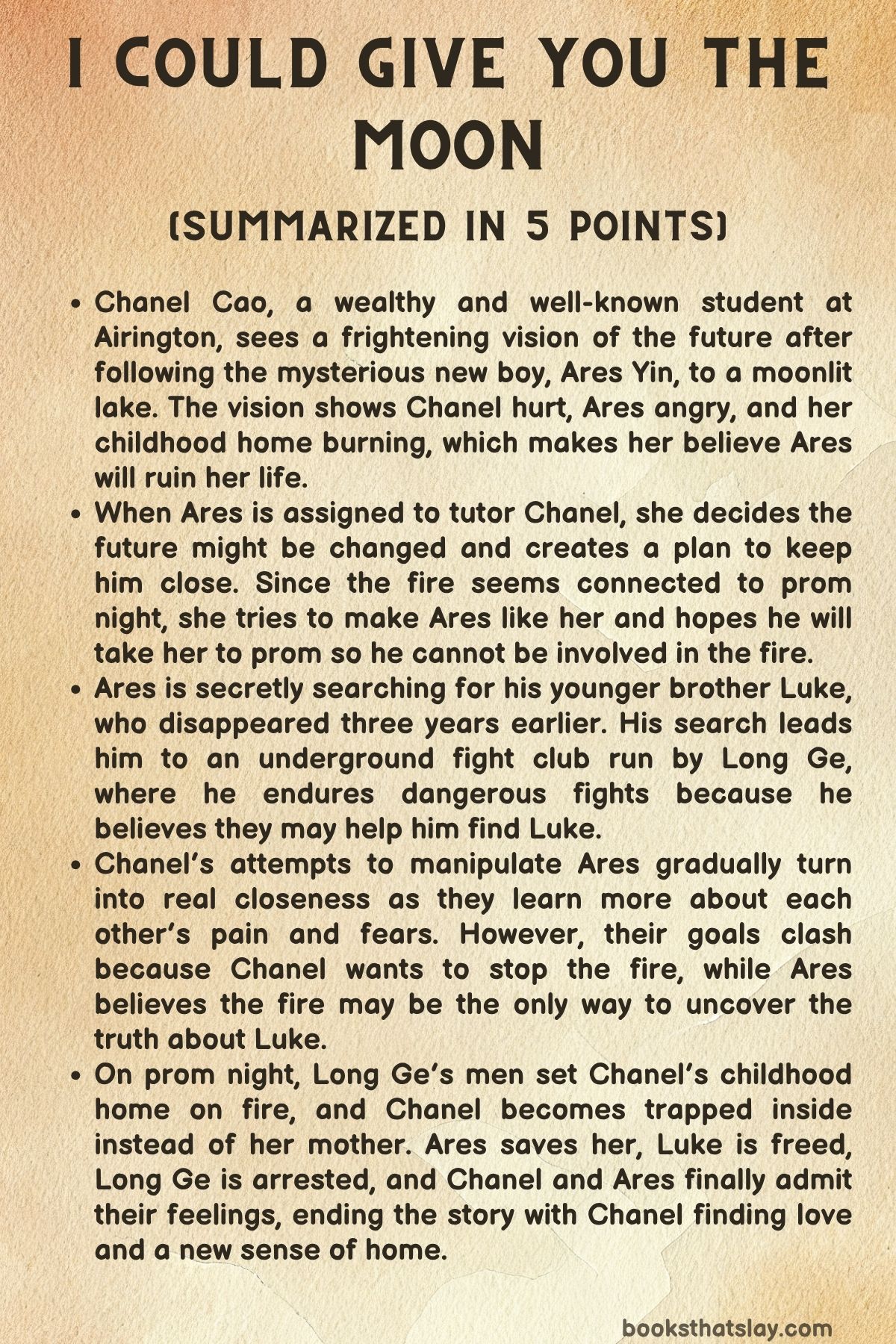
Summary
Chanel Cao is one of the most famous girls at Airington. She is wealthy, admired, and used to having doors open for her because of her name and status.
At the start of the story, she uses that power to help her friend Haili prove that Haili’s crush, Yaozu, is cheating. Chanel gets them into an exclusive hotel restaurant, where Yaozu is with another girl, and makes sure he is exposed in a very public and humiliating way.
The scene shows how confident and dramatic Chanel can be, but it also hints that she often uses performance and control to handle pain.
At the restaurant, Chanel notices Ares Yin, the quiet new boy at school. Unlike most people, he does not seem interested in her.
His indifference bothers her, partly because Chanel is used to being seen and partly because there is something strange about him. Later, outside the hotel, Chanel sees Ares behaving suspiciously and follows him to a park.
There, under the moonlight, they both see a vision in the lake. The vision shows Chanel with bruised wrists, Ares raging in an alley, and Chanel’s childhood home burning while a woman screams inside.
Chanel also sees Ares holding a lighter. She immediately believes that Ares is going to destroy her life.
The next day, the vision begins to feel less like a dream and more like a warning. Chanel’s math teacher assigns Ares to tutor her, forcing the two of them together.
Chanel does not want to trust him, but she also wants to prevent the future she saw. She turns to her friends Alice and Henry, who have dealt with strange supernatural events before.
They help her think through what the lake may have shown. Chanel decides that the future might not be fixed.
If the fire in the vision happens on prom night, and Ares is connected to it, then she needs to keep him away from the house. Since Ares has been nominated for prom king, she creates a plan: she will make him like her, get him to ask her to prom, and keep him by her side all night.
Ares has his own reason for paying attention to the vision. Three years earlier, his younger brother Luke disappeared.
Since then, Ares has been searching for him with almost no help and no clear answers. His life is shaped by guilt, grief, and the need to find Luke at any cost.
A thief named Sangui recognizes Luke’s photo and leads Ares toward a dangerous underground fight club called the Cave. The place is run by Long Ge, a powerful and cruel man who controls young fighters and other vulnerable people.
Ares believes Long Ge may be able to lead him to Luke, so he begins fighting there, even when the matches are brutal and risky. To Ares, the pain is worth it if it brings him closer to his brother.
As Chanel tries to win Ares over, her methods are not subtle. She asks someone to investigate him, pretends to need his help, stages situations where he has to care for her, and tries to push him into romantic moments.
She even arranges an injury so he will carry her and takes him shopping as part of her plan. She also posts hints online to make people think something may be happening between them.
Through all of this, she keeps steering their conversations toward prom, hoping he will eventually ask her.
Ares sees through many of Chanel’s tactics, and at first he resists her. Still, their time together changes both of them.
He tutors her, gives her his WeChat, cooks for her, carries her bags, and shows quiet concern when she is hurt or upset. Chanel learns that Ares boxes, that he is afraid of dogs, and that his search for Luke has taken over his life.
Ares, in turn, begins to see the real Chanel beneath her perfect public image. He learns about her loneliness, her difficult relationship with her mother Coco, her unhealthy relationship with food, and the damage caused by her father’s cheating.
Chanel may look powerful from the outside, but Ares sees that she often feels abandoned and unwanted.
Their connection grows because both of them are pretending to be harder than they are. Chanel uses beauty, fame, and manipulation as armor.
Ares uses silence, fighting, and anger as his. Neither of them wants to be vulnerable, yet they keep revealing pieces of themselves to each other.
Chanel’s original plan was to control Ares, but she begins to care about him for real. Ares, who is focused on Luke above everything else, also becomes protective of Chanel in ways he does not fully admit at first.
While Chanel is trying to understand Ares, she also investigates Long Ge. She discovers that Long Ge has been obsessed with her mother, Coco, for years.
Coco is a famous woman whose life has recently become unstable because her divorce from Chanel’s father has gone public. The scandal hurts Chanel’s image too, since her family’s problems are now being discussed by everyone.
Coco becomes vulnerable at exactly the wrong time, and Long Ge tries to use that vulnerability to pressure her into a contract.
This puts Chanel and Ares on opposite sides of the future they saw. Chanel wants to stop the fire because she believes it will destroy her home and hurt her mother.
Ares believes the fire may be the only path that leads him to Luke. For Chanel, preventing the vision means saving her family.
For Ares, allowing the vision to happen may mean saving his brother. Their goals clash badly.
Chanel asks Ares to go to prom with her, hoping he will choose her and stay away from the fire. Ares refuses because he cannot give up the only clue he has to Luke.
Chanel is hurt, and the rejection pushes her back into old habits. Instead of trusting him, she starts planning around him.
Chanel decides she has to keep both Coco and Ares away from the house on prom night. She believes that if she can move everyone into the right place, she can stop the vision from becoming real.
But Long Ge is also making plans. He pressures Ares with the one thing Ares cannot ignore: Luke.
Long Ge tells Ares that if he helps secure Coco’s contract through Chanel, Luke will appear. Ares is trapped by the possibility that his brother is finally within reach.
On prom night, Chanel puts her plan into motion and sends Coco away from the house. For a moment, it seems as if she may have outsmarted the future.
But Coco turns back because she forgot her sunglasses, and Chanel realizes the danger has not passed. She rushes home to stop what she believes is coming.
Instead of saving herself from the vision, she becomes part of it. Long Ge’s men set the house on fire, and Chanel gets trapped inside.
Outside, Ares is with Luke. The moment should be everything he wanted: his brother is alive and finally in front of him.
But then Ares realizes Chanel is inside the burning house. He is forced to choose between the brother he has spent years searching for and the girl he has come to love.
Ares runs into the fire to save Chanel. He reaches her, and they both survive, though Chanel is injured and left scarred.
The fire exposes Long Ge’s crimes. He is arrested, Luke is freed, and the other minors he exploited are rescued as well.
The terrible future Chanel feared does happen in some form, but it does not mean what she first thought. Ares was never the true danger.
He was part of the path that led to the truth, to Luke’s rescue, and to Chanel’s survival.
After the fire, both Chanel and Ares have to rebuild. Ares is reunited with Luke, but their relationship is not instantly healed.
Luke has been gone for years, and both brothers carry pain from that separation. Still, they begin trying to find their way back to each other.
Chanel also faces what has happened to her. Her old life has burned down in more than one sense.
The home she feared losing is gone, and so is the illusion that she can control everything through image, charm, and planning.
Chanel and Ares finally admit their feelings. Their relationship becomes more honest because it is no longer built on Chanel’s schemes or Ares’s secrecy.
Ares shows his love through quiet but meaningful gestures. He plans romantic dates, gives Chanel the altered red dress she once wanted, officially becomes her boyfriend, and surprises her with a celebration.
These moments give Chanel a different kind of safety from the one she tried to create through control.
By the end, Chanel is no longer the girl who believes fame and perfection can protect her. Ares is no longer only the boy chasing a lost brother through danger.
Both of them have been changed by loss, fear, and love. The story ends with Chanel happy with Ares and beginning to understand that home is not only a place.
After the fire, after the fear, and after everything she tried so hard to prevent, she finds a new sense of belonging with him.
Characters
The characters in I Could Give You the Moon are shaped by fear, longing, loyalty, manipulation, and the desire to change what seems inevitable. Each character plays a role in pushing the story toward its central conflict, where the future appears dangerous but human choices still matter.
Chanel Cao
As the central figure of I Could Give You the Moon, Chanel Cao is a wealthy, famous, and socially powerful student whose confidence often hides deep emotional insecurity. At the beginning of the book, she appears sharp, glamorous, and in control, using her celebrity status to enter exclusive spaces and publicly defend her friend Haili.
However, her actions also show that she is comfortable with spectacle, manipulation, and social pressure when she believes she has a reason to use them. Chanel’s first encounter with the moonlit vision changes her completely because it forces her to confront a future in which her home, her mother, and her own safety are threatened.
Her fear of Ares makes her suspicious and calculating, and her plan to make him like her begins less as romance and more as self-protection.
Chanel is one of the most emotionally layered characters in the book because her outward confidence contrasts strongly with her private pain. Her strained relationship with her mother, Coco, her father’s betrayal, and her eating issues reveal that her polished public image comes at a heavy personal cost.
She is used to being watched, judged, and expected to perform perfection, which makes her both defensive and lonely. Her attempts to control Ares, prom night, and even her mother’s movements show how terrified she is of losing the few things that still feel like home.
Yet Chanel is not only manipulative; she is also loyal, brave, and deeply loving. Her willingness to rush home when she realizes Coco may be in danger proves that beneath her image-conscious behavior is a daughter desperate to protect her mother.
Chanel’s development comes from learning that control is not the same as safety and that love cannot be created through strategy. Her relationship with Ares begins with suspicion, performance, and hidden motives, but it slowly becomes genuine because he sees the vulnerable parts of her that she usually hides.
By the end of the story, Chanel has survived physical danger, emotional humiliation, and the collapse of the life she once tried so hard to preserve. Her scars symbolize both trauma and survival.
She ends the story not as the untouchable celebrity girl she appeared to be at the start, but as someone who has learned that home can be rebuilt through trust, honesty, and chosen love.
Ares Yin
Ares Yin is introduced as mysterious, distant, and difficult to read, which makes him seem dangerous from Chanel’s point of view. Because Chanel sees him in the moonlit vision holding a lighter near the burning house, she immediately associates him with destruction.
However, as the story develops, Ares becomes one of the most sympathetic and morally complicated characters in the book. His guarded behavior is not cruelty but the result of grief, desperation, and years of searching for his missing younger brother, Luke.
He lives with the weight of uncertainty, and that pain shapes almost every choice he makes.
Ares’s greatest motivation is his loyalty to Luke. His involvement with Sangui, Long Ge, and the underground fight club shows how far he is willing to go when he believes there is even a small chance of finding his brother.
He enters brutal fights not because he enjoys violence, but because he sees suffering as a price he must pay for answers. This makes Ares both admirable and tragic.
He is protective and caring, but he is also willing to risk himself and others when Luke’s fate is involved. His conflict with Chanel becomes intense because both of them are trying to save someone they love, but their goals seem to oppose each other.
Ares’s softer side appears gradually through his interactions with Chanel. He tutors her, cooks for her, helps her, gives her his contact information, and becomes protective even when he knows she is not always honest with him.
His fear of dogs and his quiet acts of care make him more human, breaking the image of the cold, dangerous boy Chanel first imagines. By the end of the story, Ares proves that he is not the destroyer Chanel feared.
Instead, he becomes her rescuer, risking his life to save her from the fire. His reunion with Luke gives him the chance to begin healing, while his love for Chanel shows that he can build a future beyond guilt, grief, and survival.
Luke Yin
Luke Yin is physically absent for much of the story, but his presence drives many of the most important events. As Ares’s missing younger brother, Luke represents unresolved grief, hope, and the emotional wound that keeps Ares from living freely.
Even before he appears directly, Luke influences Ares’s decisions, pulling him into dangerous places and forcing him to trust questionable people. Ares’s love for Luke is so strong that it becomes both his greatest strength and his greatest vulnerability.
Luke’s disappearance also gives the story a darker emotional foundation. Through him, the book explores exploitation, power, and the way vulnerable young people can be trapped by dangerous adults.
His connection to Long Ge’s world reveals that the threat surrounding Chanel’s family is larger than one house fire or one vision. Luke is not simply a missing person to be found; he is part of a wider system of harm that must be exposed and destroyed.
His rescue therefore brings relief not only to Ares but also to the other exploited minors connected to Long Ge.
After being freed, Luke’s role shifts from mystery to healing. His relationship with Ares cannot instantly return to what it was before, because years of absence and trauma have changed them both.
Still, his survival gives Ares the chance to rebuild his life with less guilt and fear. Luke’s character is important because he represents the possibility of recovery after long suffering.
His return allows the story to move from dread and uncertainty toward restoration.
Coco
Coco, Chanel’s mother, is a glamorous but vulnerable figure whose life is shaped by public image, emotional disappointment, and predatory attention. As Chanel’s mother, she is closely tied to Chanel’s sense of home and identity.
Her divorce from Chanel’s father exposes her to public judgment and personal instability, making her a target for Long Ge’s obsession. Coco’s situation shows how fame and beauty can attract admiration but also control, pressure, and danger.
Coco’s relationship with Chanel is strained, but it is not empty of love. Chanel clearly feels neglected and hurt by her mother, especially because Coco’s choices and emotional distance have contributed to Chanel’s loneliness.
At the same time, Chanel’s desperate attempt to keep Coco away from the house on prom night proves that she loves her mother deeply. Their relationship is complicated because it contains resentment, protection, misunderstanding, and need all at once.
Coco may not always provide Chanel with the emotional safety she wants, but she remains one of the most important people in Chanel’s life.
Coco also functions as a symbol of what Chanel fears becoming: admired by many, desired by the wrong people, and trapped by the expectations of others. Long Ge’s obsession with Coco turns her into the center of a dangerous power struggle, but she is more than a victim.
Her presence reveals how women in the story are often judged, used, or controlled by men who claim to want them. Through Coco, the book deepens its themes of image, vulnerability, and the cost of being seen.
Long Ge
Long Ge is the main antagonist and one of the most threatening figures in the story. He operates through manipulation, violence, and control, using his power over desperate young people to get what he wants.
His underground fight club, the Cave, shows the cruelty of his world, where vulnerable minors are exploited and forced into danger. He is not just a personal enemy to Chanel and Ares; he represents a wider system of corruption and abuse.
Long Ge’s obsession with Coco makes him especially dangerous because his motives are personal as well as criminal. He does not simply want business control; he wants access to Coco and uses Chanel as a way to pressure her.
This makes him a deeply predatory character. His willingness to involve Chanel, Ares, Luke, and others in his schemes shows that he sees people as tools rather than human beings.
He understands emotional weakness and uses it against others, especially Ares’s love for Luke and Chanel’s love for her mother.
By forcing Ares to choose between helping him and finding Luke, Long Ge exposes the moral pressure at the center of the story. He creates situations where good people feel trapped into bad choices.
His eventual arrest is important because it brings justice not only for Chanel and Ares but also for the exploited minors under his control. Long Ge’s downfall allows the story to break the cycle of fear he created.
Haili
Haili is Chanel’s friend and one of the first characters whose personal problem reveals Chanel’s bold and protective nature. Haili’s suspicion that Yaozu is cheating on her sets the opening events in motion, and Chanel’s decision to help her shows that Chanel can be fiercely loyal to the people she cares about.
Haili may not dominate the larger supernatural and criminal plot, but her role is important because she helps establish Chanel’s social world and personality.
Haili also reflects the emotional concerns of the students around Chanel: romance, betrayal, reputation, and public humiliation. Her pain over Yaozu’s cheating becomes a smaller mirror of the larger betrayals in the book, especially the betrayal Chanel feels because of her father’s actions.
Through Haili, the story begins with a familiar teenage conflict before expanding into danger, visions, and life-threatening stakes.
As a supporting character, Haili helps show that Chanel is not simply selfish or image-obsessed. Chanel’s dramatic defense of Haili may be excessive, but it comes from real loyalty.
Haili’s presence therefore adds warmth and context to Chanel’s character, showing that Chanel’s sharpness can come from a desire to protect others as well as from pride.
Yaozu
Yaozu is a minor but useful character because his cheating introduces the book’s early focus on betrayal and public image. His behavior toward Haili presents him as dishonest and careless with other people’s feelings.
When Chanel exposes him at the restaurant, he becomes the first person in the story to experience her ability to control a social situation through confidence, status, and humiliation.
Although Yaozu does not play a major role in the central conflict, he helps establish the emotional atmosphere of the story. His betrayal of Haili connects to broader patterns of broken trust, especially Chanel’s pain over her father’s cheating.
In that sense, Yaozu is not only a cheating boyfriend but also an early sign that the world Chanel moves through is filled with appearances that hide uglier truths.
Yaozu’s character also gives readers an early view of Chanel’s strengths and flaws. She is brave enough to confront wrongdoing, but she also enjoys turning confrontation into performance.
Through Yaozu, the story introduces Chanel’s complicated relationship with justice, attention, and control.
Alice
Alice is one of Chanel’s friends and serves as a grounded source of support when Chanel tries to understand the supernatural vision. Because Alice has experience with unusual events, Chanel turns to her for help, which shows that Alice is trusted and capable of thinking beyond ordinary explanations.
Her role is important because she helps Chanel consider that the future may not be fixed.
Alice represents friendship, perspective, and practical reasoning. While Chanel reacts to the vision with panic and suspicion, Alice helps create space for interpretation.
Her presence reminds Chanel that fear should not be the only guide for action. Alice does not remove the danger, but she helps Chanel think strategically about whether the future can be changed.
As a supporting character, Alice also connects Chanel to a wider world beyond wealth, fame, and school status. She gives Chanel someone to confide in and helps balance the intensity of Chanel’s emotions.
Her importance lies less in dramatic action and more in emotional and intellectual support.
Henry
Henry, like Alice, is part of Chanel’s trusted circle and helps her process the supernatural elements of the story. His experience with unusual events makes him useful when Chanel needs advice about the moonlit vision.
He helps reinforce the idea that what Chanel has seen may be meaningful but not necessarily unavoidable.
Henry’s role is especially important because he supports the possibility of choice. The vision frightens Chanel into believing Ares will destroy her life, but Henry’s perspective helps open the door to a more complicated understanding of fate.
This matters because the story depends on the tension between prediction and free will. Henry helps Chanel see that the future may be influenced by human decisions.
Though Henry is not central to the romance or the fight against Long Ge, he contributes to the story’s emotional structure by being part of Chanel’s support system. He helps prevent Chanel from facing the mystery completely alone.
His presence shows that friendship can offer clarity when fear makes the future seem certain.
Sangui
Sangui is a thief who becomes a key link between Ares and the underground world connected to Luke. His recognition of Luke’s photo gives Ares hope after years of searching, but it also leads Ares into danger.
Sangui is important because he functions as a bridge between the ordinary world of school and the criminal world of Long Ge.
Sangui’s character carries moral ambiguity. He is not presented as purely heroic, since his connection to theft and dangerous circles makes him untrustworthy.
However, the information he gives Ares matters deeply. He helps move the story forward by guiding Ares toward the Cave, even though that path exposes Ares to violence and manipulation.
Through Sangui, the book shows how desperation can make people rely on uncertain sources. Ares is willing to follow him because Luke matters more than caution.
Sangui’s role therefore highlights Ares’s vulnerability and the dangerous choices that grief can create.
Themes
Fate, Choice, and the Fear of a Fixed Future
I Could Give You the Moon presents the future as something frightening because Chanel and Ares both see visions that seem impossible to escape. Chanel’s fear comes from believing that the images shown by the lake are warnings of a life already decided for her.
She sees pain, fire, and Ares’s possible involvement, so she tries to control every detail before the danger arrives. Her choices are not calm or honest at first; they are shaped by panic.
She manipulates situations, studies Ares, and treats prom night like a problem that can be solved through strategy. Ares responds to the future differently because he sees the fire as a possible path to Luke.
For him, changing the future feels like losing his brother again. The theme becomes powerful because neither character is fully right or fully wrong.
The future may offer clues, but it does not remove responsibility. In the end, their choices matter most when they stop trying to use the visions for personal control and begin acting out of love, courage, and sacrifice.
Loneliness Behind Privilege and Popularity
Chanel’s life appears perfect from the outside because she is rich, admired, famous, and socially powerful at school. Yet the story shows that status can hide deep emotional emptiness.
Her celebrity gives her access to exclusive spaces and influence over others, but it does not give her security. She is surrounded by friends, attention, and luxury, but she still feels unseen in the parts of her life that hurt most.
Her strained relationship with Coco, her father’s betrayal, and her eating issues reveal that privilege does not protect her from pain. In fact, her public image makes her suffering harder to express because she is expected to look polished and confident.
Chanel often uses performance as protection. She charms, plans, posts, and manages appearances because control feels safer than honesty.
Ares becomes important because he begins to see beyond her image. Through him, Chanel is slowly forced to face the difference between being watched and being understood.
The theme shows that emotional isolation can exist even in a life that looks enviable.
Love as Protection, Honesty, and Emotional Risk
The romance between Chanel and Ares begins with distrust, hidden motives, and fear, but it grows into something more honest because both characters gradually lower their defenses. Chanel first approaches Ares because she wants to prevent the fire, not because she fully trusts him.
Ares keeps his distance because he is carrying grief, guilt, and the desperate need to find Luke. Their early connection is therefore built on suspicion, but small acts of care begin to change the relationship.
Ares tutors Chanel, cooks for her, protects her, and notices her pain. Chanel, despite her manipulative plans, starts caring about Ares’s fear, his brother, and his loneliness.
Love in the story is not shown as instant trust or simple happiness. It requires both characters to risk being hurt and to stop treating each other as tools for their own goals.
Ares’s decision to save Chanel from the fire becomes a turning point because it proves that love is not only feeling, but action. Their relationship becomes meaningful when protection replaces suspicion and honesty replaces control.
Family, Loss, and the Search for Home
Family shapes both Chanel and Ares in painful ways. Ares’s life is marked by Luke’s disappearance, and his need to find his brother drives many of his choices.
His grief makes him willing to enter dangerous spaces and endure violence because he cannot accept a life where Luke remains lost. Chanel’s family pain is different but equally important.
Her father’s cheating damages her sense of trust, while Coco’s emotional distance leaves Chanel feeling unsupported at the very moment she needs comfort most. Both characters are searching for a form of home that is not simply a house or a family name.
The burning of Chanel’s childhood home becomes symbolic because it destroys a place tied to fear, secrets, and old wounds, but it also clears space for a new beginning. After the danger ends, Ares and Luke begin repairing their bond, while Chanel finds warmth and belonging with Ares.
The theme suggests that home is not only where someone comes from. It can also be rebuilt through loyalty, forgiveness, and chosen love.