How to Fake It in Society Summary, Characters and Themes
How to Fake It in Society by K.J. Charles is a historical romance about sudden wealth, social performance, deception, and the risk of trusting someone after years of disappointment. The story follows Titus Pilcrow, a practical London tradesman whose life changes overnight when a dying customer marries him to keep her fortune from a murderous nephew.
Thrown into high society, Titus meets Nicolas de La Motte, a charming French aristocrat with secrets of his own. Their connection grows through fashion, scandal, danger, and betrayal, leading both men to decide what kind of life they want and whether love can survive lies.
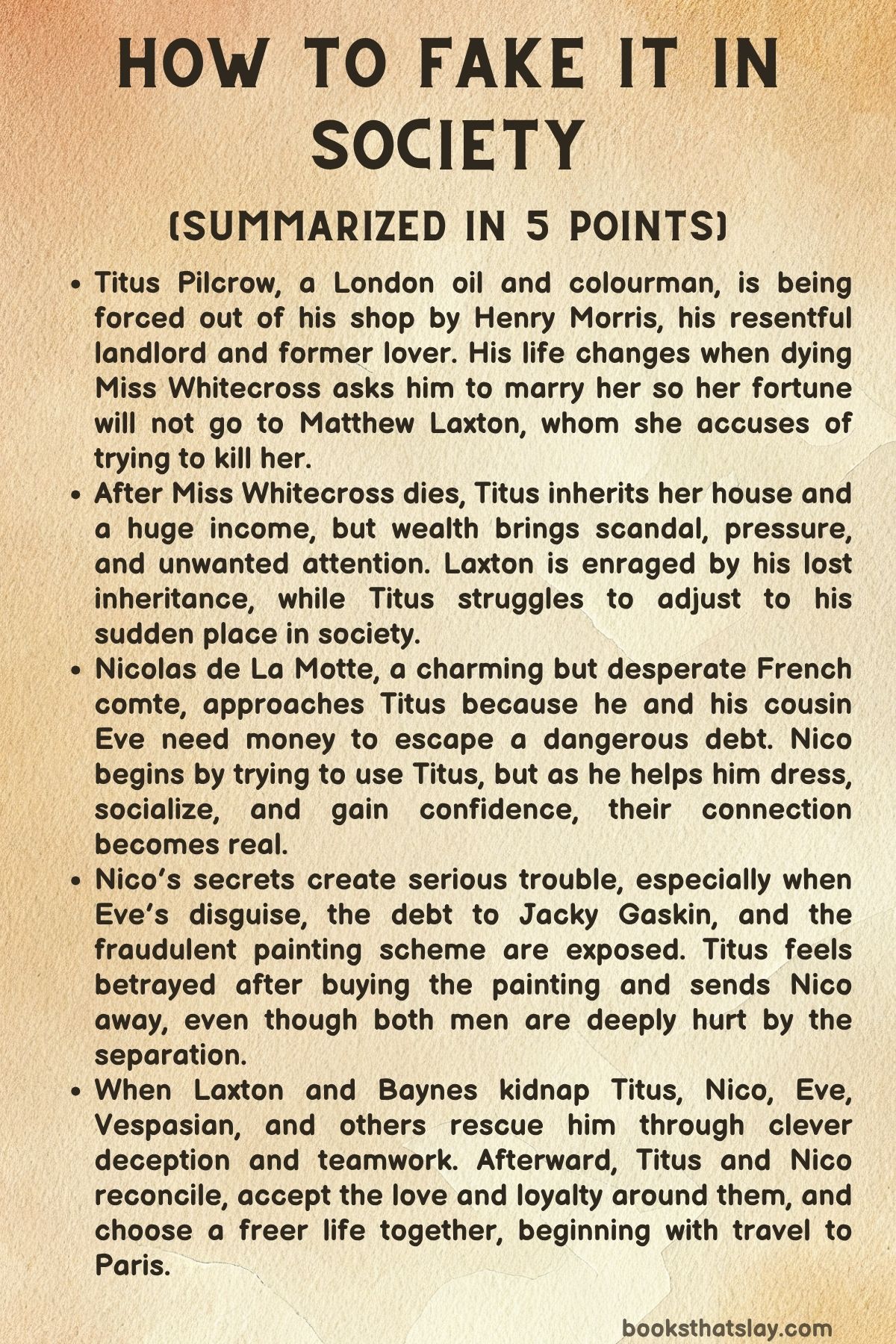
Summary
Titus Pilcrow lives a modest, careful life in London as an oil and colourman, running the shop that also serves as his home. His position is already precarious when Henry Morris, his landlord and former lover, informs him that he must leave unless he can pay a higher rent.
Titus understands the cruelty behind the demand. Henry is not acting from business necessity but from spite, punishing Titus for ending an unhappy affair.
Though the notice threatens everything Titus has built, he refuses to beg or flatter Henry. He accepts the loss with outward calm, even as he knows that losing the shop will mean losing his home, trade, and security.
Soon afterward, Titus visits Miss Whitecross, a wealthy customer, to deliver paints. He finds her gravely injured after a fall down the stairs.
Miss Whitecross tells him that the fall was no accident: her nephew, Matthew Laxton, tripped her in order to inherit her fortune. With little time left and no proof that would hold up in court, she decides on a drastic solution.
She asks Titus to marry her immediately so Laxton will receive nothing. Titus is shocked, but he believes her and agrees.
The marriage is arranged at once, and Miss Whitecross makes him her heir before dying.
Titus is suddenly transformed from a tradesman facing eviction into a rich widower with a house in Carey Street and a huge income. The change is bewildering rather than joyful.
Miss Whitecross’s lawyer, Carnaby, explains that Laxton will probably escape prosecution because there is not enough evidence, although the accusation may ruin his reputation. Laxton is enraged when he learns he has been disinherited.
Titus, meanwhile, finds himself surrounded by attention he never sought. Beggars, charities, social climbers, opportunists, distant relations, and gossip writers all descend on him.
His marriage to Miss Whitecross becomes a subject of scandal, and society treats him as both a curiosity and a prize.
At the same time, Nicolas de La Motte returns to London with plans that depend on Miss Whitecross’s money. Nico is a charming French comte with elegant manners, but beneath his polish he and his cousin Eve are nearly desperate.
Eve has borrowed money from Jacky Gaskin, a dangerous moneylender, and the debt has become urgent. Nico has also tried to raise funds from Chilcott Baynes, a collector, but that attempt has ended badly.
Nico had hoped to marry Miss Whitecross himself, so when he learns that Titus has inherited her fortune, he goes to see him.
At first, Nico’s visit is motivated by need. He hopes Titus may compensate him in some way, or perhaps buy a dubious painting with a supposed connection to Marie Antoinette and the Diamond Necklace scandal.
During the meeting, Laxton bursts in and attacks Titus. Nico steps in and throws him out, earning Titus’s gratitude.
Titus is impressed by Nico’s confidence and style, while Nico quickly realizes that Titus is lost in his new world and badly needs guidance. Nico offers to help him learn how to move through fashionable society.
Nico begins by taking Titus to tailors, bootmakers, glove sellers, and social events. He teaches him how clothing, manners, and confidence work as tools in a class-conscious world.
Titus, who has spent years being practical and self-contained, starts to understand that wealth has given him power, even if he does not yet know how to use it. Nico helps him handle intrusive visitors, false charities, entitled relatives, and men such as Henry, who assume they can shame or command him.
Under Nico’s influence, Titus starts to stand straighter in his new life.
Eve also becomes part of Titus’s household, though in disguise. She presents herself as Perreau, Nico’s former valet, allowing her and Nico to remain close to Titus while they try to solve their financial crisis.
Their deception is not harmless. Nico still hopes to sell Titus the questionable painting and use the money to settle Eve’s debt to Gaskin.
Yet his feelings begin to change. What starts as a scheme becomes complicated by affection.
Nico finds Titus honest, steady, clever, and far less foolish than society assumes. Titus, lonely and shaken by his sudden rise, is drawn to Nico’s warmth and skill.
Their friendship turns intimate, and Titus falls in love.
The relationship gives Titus pleasure and confidence, but danger grows around it. Titus’s brother Augustus appears and presses him for money, treating the inheritance as a family resource.
Another brother, Vespasian, comes back into Titus’s life after Nico secretly arranges contact between them. That act shows Nico’s capacity for kindness, but it is also another example of him taking control without telling Titus the truth.
Nico continues to conceal Eve’s identity, the debt to Gaskin, and the fraudulent nature of the painting scheme.
Gaskin’s patience runs out, and his pressure becomes more threatening. His men target Alma Thorpe, the housekeeper’s daughter, who is also Eve’s love interest.
The danger to Alma makes the situation impossible to ignore. Nico finally sells Titus the painting for two thousand pounds, intending to use the money to clear the debt.
Titus, however, realizes he has been deceived. Nico admits part of the truth, but the confession comes too late and is not complete enough to repair the damage.
Titus is hurt not only by the financial fraud but by the fact that Nico, the person he trusted most in his new life, treated him as someone to be managed and used. He sends Nico away.
Their separation is painful for both men. Titus later arranges to meet Nico and Eve so he can hear the full explanation.
Nico tells more of the truth, and Eve’s part in the deception becomes clearer. Titus understands the desperation that drove them, but understanding is not the same as trust.
He cannot simply forgive the lies because Nico loves him, and he rejects him again. For Titus, the issue is not just the money.
It is the pattern of people deciding what he should know, what he should do, and how much of the truth he deserves.
Before Titus can fully make sense of his future, Laxton and Baynes abduct him and take him to Laxton’s house. Their goal is to force him to surrender money, and they may intend to kill him once they have what they want.
Titus is in serious danger, trapped by men who see him as an obstacle between themselves and wealth. This crisis brings Nico, Eve, Vespasian, and others together in a rescue plan that relies on disguise, quick thinking, forged illness, intimidation, and theatrical misdirection.
They manipulate Baynes and Laxton’s fears, using threats and staged death to frighten and confuse them.
The rescue succeeds. Baynes and Laxton are tricked, shaken, and neutralized.
Enough of their crimes and intentions are exposed to prevent them from remaining a direct threat. Titus survives, and the people who came for him prove, through action, that he is no longer alone.
The ordeal also changes the way Titus sees Nico. The lies still matter, but Nico’s loyalty and courage are real too.
He risked himself to save Titus, and the rescue shows the difference between selfish manipulation and desperate, imperfect love.
In the aftermath, Titus and Nico reconcile. Titus does not pretend the deception was harmless, but he recognizes the fear, debt, and love behind Nico’s choices.
Nico, in turn, accepts that Titus is not a mark, a helpless innocent, or a man to be guided without consent. Their renewed relationship rests on greater honesty.
Eve and Alma are accepted together, and the Thorpes remain part of Titus’s household, creating a chosen family around him.
Titus decides he will no longer live timidly or allow other people to define his place. His fortune, once a source of fear and confusion, becomes a means of freedom.
He offers to settle Nico’s remaining debts, not as a man being tricked or used, but as someone choosing generosity with open eyes. He also proposes that he and Nico travel together, beginning with Paris.
Nico accepts. By the end of How to Fake It in Society, Titus has moved from insecurity and isolation into wealth, love, and self-command.
Nico has moved from deception toward trust. Together, they look ahead to a wider world and a life shaped by their own choices.
Characters
Titus Pilcrow
Titus Pilcrow is the central figure of How to Fake It in Society, and his character is built around a powerful contrast between outward plainness and inner strength. At the beginning of the book, he appears to be an ordinary London oil and colourman whose life is small, practical, and emotionally restrained.
He is not socially polished, wealthy, or powerful, and he has learned to endure humiliation quietly rather than expect kindness from others. His relationship with Henry Morris has left him wounded, and Henry’s attempt to punish him through the rent increase shows how vulnerable Titus is when the story begins.
Yet Titus’s refusal to beg also reveals his pride and dignity. He may be frightened of losing everything, but he does not collapse into helplessness.
Titus’s sudden inheritance changes his circumstances but not immediately his sense of himself. Wealth brings him attention, but it also exposes his loneliness, uncertainty, and lack of social confidence.
He is surrounded by people who want something from him, and because he has spent much of his life being overlooked or mistreated, he struggles to know who is sincere. This makes his attraction to Nico especially significant.
Nico offers him charm, companionship, and guidance, but he also teaches Titus to take up space in the world. Through Nico, Titus begins to imagine himself as someone who deserves pleasure, style, love, and authority.
What makes Titus especially compelling is that his gentleness is never the same as weakness. He is generous, but not foolish forever; trusting, but capable of deep hurt when betrayed.
When he realizes Nico has deceived him, his pain is intense because he has allowed himself to become emotionally open. His rejection of Nico is not cruelty but self-protection.
By the end of the story, Titus has become more active in his own life. He does not simply forgive because he is soft-hearted; he forgives because he has heard the truth, judged it, and chosen love without surrendering his self-respect.
His journey is one of emotional awakening, social confidence, and learning that kindness can exist alongside strength.
Nicolas de La Motte
Nicolas de La Motte, or Nico, is one of the most charming and morally complicated figures in the book. He enters the story as a desperate aristocrat trying to survive through wit, performance, and deception.
His title gives him glamour, but it does not give him security. Beneath his elegant manners and theatrical confidence is a man under pressure, responsible not only for himself but also for Eve, whose debt to Gaskin places them both in danger.
Nico’s charm is therefore both natural and defensive. He knows how to please, distract, flatter, and improvise because those skills have become tools of survival.
Nico’s relationship with Titus begins in manipulation but develops into genuine affection. At first, he sees Titus as a possible solution to his financial crisis, someone who might buy the questionable painting or provide access to wealth.
However, as he spends more time with Titus, his motives become increasingly conflicted. He enjoys transforming Titus’s appearance and social confidence, but he also begins to care about Titus’s happiness.
This tension between fraud and sincerity defines Nico’s character. He lies, but not because he is incapable of love; rather, he lies because fear, debt, and long habit have made honesty seem dangerous.
Nico’s greatest flaw is that he tries to manage reality through performance instead of trust. He hides Eve’s identity, conceals the debt, and sells Titus the painting even after their intimacy has become emotionally real.
His actions wound Titus because they make love feel like another part of the scheme. Yet Nico is not presented as heartless.
His guilt, desperation, and eventual willingness to face consequences show that he is capable of moral growth. By the end of the novel, he is forced to stop relying only on cleverness and admit the truth of his feelings.
His reconciliation with Titus works because he is no longer merely performing devotion; he is finally allowing himself to be known.
Eve de La Motte
Eve de La Motte is bold, resourceful, and deeply unconventional. As Nico’s cousin, she shares his instinct for disguise and improvisation, but her situation carries its own danger.
Her debt to Jacky Gaskin is one of the major forces driving the plot, and her choices create serious consequences for both herself and Nico. Yet Eve is not simply a reckless figure.
She is a woman trying to survive in a society that gives her limited freedom, and her disguise as Perreau shows both her courage and her refusal to accept the role expected of her.
Eve’s decision to enter Titus’s household disguised as a former valet reveals her intelligence and nerve. She is willing to cross boundaries of class, gender presentation, and respectability in order to stay close to the source of possible rescue.
Her disguise also gives her a kind of freedom that she might not otherwise possess. As Perreau, she observes, moves, and acts in ways that polite society would not allow Eve to do openly.
This makes her one of the most dynamic characters in the story, because she constantly challenges appearances.
Her love for Alma Thorpe adds emotional depth to her character. Eve’s feelings are not treated as a passing impulse but as part of her desire for a life that is honest and chosen.
She is capable of deceit, but she longs for a place where she does not have to hide. By the end of the book, Eve’s acceptance into Titus’s household suggests a broader idea of family.
She is not restored to conventional society; instead, she helps form a new household built around loyalty, truth, and chosen bonds.
Henry Morris
Henry Morris is a significant figure because he represents the emotional and social oppression from which Titus must free himself. As Titus’s landlord and former lover, Henry holds both practical and emotional power over him at the beginning of the story.
His decision to raise the rent is not simply a business matter; it is an act of punishment. Henry uses property and status as weapons because Titus has ended their unhappy affair.
This makes him a controlling and vindictive presence.
Henry’s importance lies in how he has shaped Titus’s sense of himself. Their past relationship appears to have been miserable, and Henry’s behavior suggests that Titus has been accustomed to being diminished.
Henry expects Titus to plead, submit, or remain trapped by fear. Titus’s refusal to do so is therefore one of the earliest signs of his hidden strength.
Even before he becomes wealthy, Titus shows that he will not give Henry the satisfaction of seeing him beg.
In the larger emotional structure of the story, Henry serves as a contrast to Nico. Both men have power over Titus at different points, and both are capable of hurting him.
However, Henry’s power is cold, possessive, and punitive, while Nico’s flawed behavior is mixed with real affection and eventual remorse. Henry belongs to the life Titus must leave behind: a life of secrecy, shame, and emotional smallness.
Overcoming Henry’s influence is part of Titus’s movement toward self-respect.
Miss Whitecross
Miss Whitecross is crucial to the book despite her brief direct presence. She is wealthy, sharp-minded, and determined to control the fate of her fortune even while dying.
Her accusation that Matthew Laxton tripped her down the stairs immediately gives the story a tone of danger, inheritance, and social corruption. She knows she may not be able to secure legal justice, so she chooses a dramatic personal solution: marrying Titus to prevent Laxton from inheriting.
Her decision to marry Titus reveals both desperation and judgment. She trusts him enough to make him the instrument of her revenge, and this suggests that she sees in him a decency others may overlook.
Titus is not chosen because he is grand or socially impressive, but because he is present, honest, and unlikely to be part of Laxton’s world of greed. In that sense, Miss Whitecross recognizes Titus’s moral worth before high society does.
Miss Whitecross also functions as the force that overturns the social order of the story. Through her final act, Titus is lifted from insecurity into wealth, while Laxton is denied the reward he expected.
Her death does not remove her influence; it continues through the inheritance, the scandal, and the danger that follows. She is a reminder that wealth can be both liberation and burden, and that a dying person’s final decision can reshape many lives.
Matthew Laxton
Matthew Laxton is one of the main antagonistic figures in the book. He is driven by greed, entitlement, and resentment, especially after Miss Whitecross’s fortune passes to Titus instead of him.
His alleged attack on his aunt establishes him as dangerous from the beginning, even if the lack of proof prevents immediate punishment. Laxton’s fury after being disinherited reveals the depth of his selfishness.
He believes the fortune should be his, and he treats Titus not as a person but as an obstacle.
Laxton’s violence is not limited to one act. His attack on Titus during Nico’s visit shows that he is impulsive and physically threatening.
Later, his involvement in Titus’s abduction makes clear that his greed has become criminal desperation. He is willing to use force to regain control over money he believes he deserves.
Unlike Nico, whose deception is tied to fear and survival, Laxton’s wrongdoing comes from entitlement. He feels cheated by justice because he never accepted that Miss Whitecross’s money was hers to give.
As a character, Laxton exposes the ugliness beneath respectable inheritance culture. He is connected to family, property, and social expectation, but he behaves with far less honor than the people society might dismiss or scandalize.
His defeat is important because it allows Titus to stop being merely the lucky inheritor and become someone who actively survives and resists those who would exploit him.
Carnaby
Carnaby, Miss Whitecross’s lawyer, is a practical and stabilizing figure in the book. He helps explain the legal consequences of Titus’s sudden inheritance and the difficulty of proving Laxton’s crime.
His role is not emotionally dramatic, but it is important because he represents the limits of formal justice. Miss Whitecross’s accusation carries moral weight, but without proof, the law cannot easily punish Laxton.
Carnaby’s presence therefore helps show the gap between knowing the truth and being able to prove it.
Carnaby also serves as a guide to Titus during the first stage of his transformation. Titus is overwhelmed by the money, the house, the attention, and the implications of Miss Whitecross’s final act.
Carnaby provides information and structure at a moment when Titus badly needs both. He does not solve Titus’s emotional problems, but he helps establish the new reality Titus must learn to inhabit.
His character is useful because he grounds the story in practical consequences. In a plot filled with disguise, fraud, romance, debt, and danger, Carnaby represents paperwork, inheritance, law, and procedure.
He reminds the reader that dramatic events still have legal and social frameworks around them, even when those frameworks are imperfect.
Jacky Gaskin
Jacky Gaskin is a threatening force in the story because he represents the brutal pressure of debt. He may not occupy the emotional center of the novel, but his influence is felt through Eve and Nico’s desperation.
As a dangerous moneylender, he turns financial obligation into physical fear. His impatience and willingness to threaten Alma Thorpe show that he does not merely want repayment; he wants control.
Gaskin’s role is important because he explains why Nico and Eve behave as recklessly as they do. Their schemes are not only about greed or luxury.
They are trying to escape someone who can harm them and the people close to them. This does not excuse their deception of Titus, but it complicates it.
Gaskin’s menace creates the pressure under which bad choices become easier to make.
He also broadens the social world of the book. The story is not only about fashionable society and inheritance; it also includes the dangerous economy beneath respectability.
Gaskin’s presence reminds the reader that money can trap people at every level, whether through rent, debt, inheritance, or social obligation.
Chilcott Baynes
Chilcott Baynes is another antagonistic figure, and his connection to art, collecting, and violence makes him especially unpleasant. Nico’s failed attempt to get money from him establishes Baynes as someone involved in the shady world surrounding valuable objects and questionable deals.
His later alliance with Laxton in Titus’s abduction confirms that he is not merely dishonest but actively dangerous.
Baynes represents greed disguised as refinement. As a collector, he is associated with taste, culture, and valuable art, but his behavior reveals corruption beneath that surface.
This makes him an effective contrast to Titus, whose original work with paints and materials is honest and practical. Baynes belongs to a world where beauty, money, and status become excuses for exploitation.
His role in the abduction raises the stakes of the story and helps bring the hidden crimes into the open. Through Baynes, the painting scheme and Laxton’s violence become connected.
He is part of the web of deceit that forces Nico, Eve, Vespasian, and others into action. His defeat helps restore safety, but it also exposes how dangerous polished society can be when greed is allowed to govern it.
Augustus Pilcrow
Augustus Pilcrow, Titus’s estranged brother, represents family as a source of pressure rather than comfort. When he appears after Titus’s inheritance, his interest is clearly tied to money.
Instead of approaching Titus with genuine affection or remorse, he pressures him for financial support. This makes him part of the wave of people who see Titus’s new wealth before they see Titus himself.
Augustus is important because he shows that Titus’s vulnerability does not come only from lovers, strangers, or criminals. It also comes from family history.
Titus has not been surrounded by reliable kinship, and Augustus’s arrival reinforces the sense that Titus has long been emotionally isolated. His brother’s behavior tests Titus’s ability to set boundaries in his new life.
Through Augustus, the book explores the uncomfortable question of obligation. Wealth can create expectations, especially from relatives who believe they have a claim simply because of blood.
Titus’s challenge is to decide what generosity means without allowing himself to be used. Augustus therefore contributes to Titus’s growth by forcing him to distinguish between kindness and submission.
Vespasian Pilcrow
Vespasian Pilcrow is a more hopeful figure in Titus’s family story. Unlike Augustus, his re-entry into Titus’s life becomes part of the movement toward repair and connection.
Nico’s secret arrangement of contact between Vespasian and Titus is complicated because it involves interference, but it also opens a door that Titus might not have opened alone. Vespasian’s presence suggests that not every tie from Titus’s past must remain painful.
Vespasian matters because he helps widen Titus’s world beyond romance. Titus’s transformation is not only about falling in love with Nico; it is also about gaining a fuller life, including family, household, friendship, and courage.
Vespasian becomes part of the group that helps rescue Titus, which proves that he is not merely a symbolic brother but someone willing to act when Titus is in danger.
His character helps soften the book’s treatment of family. Augustus shows the selfish side of kinship, while Vespasian suggests the possibility of renewed loyalty.
Through him, Titus’s past is not completely discarded. Some parts of it can be reclaimed and reshaped into something healthier.
Alma Thorpe
Alma Thorpe is a quietly important character whose role becomes more emotionally significant as the story develops. As the housekeeper’s daughter and Eve’s love interest, Alma connects the household world to the romantic and dangerous plots surrounding Nico and Eve.
She is not merely an observer; she becomes personally endangered when Gaskin’s men threaten her. This threat shows how the consequences of debt and deception spread beyond the people who created them.
Alma’s relationship with Eve adds tenderness and sincerity to a plot filled with disguise. Eve hides behind the identity of Perreau, but her feelings for Alma point toward a desire for truth.
Alma becomes part of the emotional reason Eve needs a safer and more honest life. Their bond also expands the story’s idea of love beyond the central romance between Titus and Nico.
Alma’s acceptance in Titus’s household at the end is significant. She and Eve are not pushed aside as a scandal or treated as impossible.
Instead, their relationship becomes part of the new domestic arrangement Titus chooses to protect. Alma therefore represents the possibility of belonging for people whose love does not fit conventional expectations.
Mrs. Thorpe
Mrs. Thorpe, as Titus’s housekeeper and Alma’s mother, represents the household stability that becomes increasingly important as Titus’s life changes. She belongs to the domestic sphere, but that does not make her insignificant.
The home Titus inherits is not only a property or symbol of wealth; it becomes a place where new loyalties are formed. Mrs. Thorpe is part of that foundation.
Her importance is also tied to Alma. When Alma is threatened, the danger becomes personal for the household, not just for Nico and Eve.
Mrs. Thorpe’s position reminds the reader that servants and dependents are affected by the schemes of those above or around them. In a world where wealthy and titled people often treat others as tools, the Thorpes help humanize the consequences of every decision.
By remaining part of Titus’s household, Mrs. Thorpe contributes to the story’s final sense of chosen community. Titus does not simply become rich and enter society alone.
He builds a household that includes people who have shared danger, loyalty, and truth. Mrs. Thorpe’s presence helps make that ending feel domestic, grounded, and emotionally secure.
Perreau
Perreau is not a separate person in the ordinary sense but the identity Eve uses while disguised as Nico’s former valet. Even so, the role of Perreau is important enough to analyze because it shapes how Eve moves through the story.
As Perreau, Eve gains access to Titus’s household and can stay near Nico while their plans unfold. The disguise is practical, but it is also symbolic.
It shows how much of society depends on clothing, manners, names, and assumptions.
The Perreau identity also reflects one of the book’s central interests: performance. Many characters are pretending in some way.
Titus must learn to perform confidence in society; Nico performs charm and aristocratic ease; Eve performs masculinity and servitude through Perreau. The disguise reveals that social identity can be surprisingly fragile.
People see what they expect to see, and Eve uses that expectation to survive.
At the same time, Perreau is connected to the harm caused by secrecy. The disguise helps Eve and Nico stay close to Titus, but it also deepens the deception that eventually wounds him.
Once the truth is revealed, Perreau becomes part of the larger question Titus must face: whether love can survive lies. The answer is not simple, but the exposure of the disguise helps move the story from performance toward honesty.
Themes
Class, Money, and Social Performance
In How to Fake It in Society, sudden wealth does not simply improve Titus’s life; it exposes how unstable and artificial social status can be. Before the inheritance, he is treated as disposable by Henry, who uses property and rent as tools of control.
Once Titus becomes rich, the same world that ignored him begins to pursue him with invitations, requests, gossip, and false respect. This shift shows that society often values money more than character.
Titus’s discomfort in fashionable spaces also reveals how class is performed through clothes, manners, connections, and confidence rather than moral worth. Nico’s guidance helps Titus understand the rules of elite life, but it also shows that those rules can be learned, copied, and used.
The theme becomes more complex because social performance is not always shallow; for Titus, learning to present himself differently becomes part of learning to protect himself. Wealth gives him power, but he must decide how to use it without becoming cruel or empty like the people who once dismissed him.
Trust, Deception, and Emotional Risk
Deception shapes nearly every major relationship, but the emotional centre of the story lies in how trust can be damaged and rebuilt. Nico begins by approaching Titus with hidden motives, hoping to solve his financial crisis through charm and manipulation.
Eve’s disguise, the false painting scheme, and the concealed debt all deepen the betrayal because Titus is not merely tricked in business; he is deceived by people he has allowed into his home and heart. Titus’s reaction is powerful because his pain comes from wounded trust, not simple anger over money.
He has already experienced exploitation from Henry and pressure from his brothers, so Nico’s lies confirm his fear that affection may always hide self-interest. Yet the story does not treat deception as a simple sign of evil.
Nico lies out of desperation, loyalty, fear, and survival, even though those reasons do not erase the harm. Reconciliation becomes possible only when truth is spoken fully and Titus is allowed to choose love without being manipulated into it.
Freedom from Control and Intimidation
Titus’s journey is marked by repeated attempts by others to control his choices, his money, his home, and his sense of self. Henry tries to punish him through eviction, assuming Titus will submit because he has fewer resources.
Laxton and Baynes later turn greed into physical violence, treating Titus’s inheritance as something they are entitled to seize. Even Augustus pressures him through family obligation, expecting wealth to make Titus available for use.
Against these forces, Titus slowly learns that politeness and endurance are not the same as safety. Nico’s influence helps him become firmer with intruders, false charities, social climbers, and relatives, but Titus’s growth is ultimately his own.
The rescue plot near the end turns this theme outward: control is defeated not through respectable legal order alone, but through courage, strategy, loyalty, and theatrical defiance. By the end, Titus no longer accepts a life shaped by other people’s demands.
His decision to travel and build a future with Nico signals emotional freedom as much as physical escape.
Chosen Family and Belonging
The story presents belonging as something built through loyalty, care, and acceptance rather than blood or social convention. Titus’s biological family is fractured and unreliable, especially when Augustus appears with demands rather than affection.
Vespasian’s return suggests that family ties can be repaired, but only when they are based on respect instead of entitlement. In contrast, Titus’s household gradually becomes a chosen family made up of people who protect one another despite class differences, secrets, and social risk.
Eve and Alma’s relationship is especially important because it expands the idea of home beyond traditional expectations. The Thorpes remain part of Titus’s life not as servants kept at a distance, but as people whose happiness matters to him.
Nico also longs for safety and belonging, though his fear and debt lead him into dishonesty before he can accept love honestly. The final sense of resolution comes not only from romance, but from the creation of a household where unconventional bonds are defended.
Belonging becomes an active choice, proven through protection, forgiveness, and shared future plans.