The Ascended Summary, Characters and Themes
The Ascended by Bree Grenwich and Parker Lennox is a dark fantasy romance about divine power, mortal suffering, rebellion, and the cost of becoming something greater than human. The story follows Thais Morvaren, a half-divine woman forced into deadly Trials after years of hiding her starlight abilities.
Alongside her twin brother Thatcher, she enters a brutal divine world ruled by gods who treat mortals as tools, threats, or entertainment. What begins as survival becomes a quest for revenge, truth, and power, shaped by forbidden love, political betrayal, and a war far older than Thais understands.
Summary
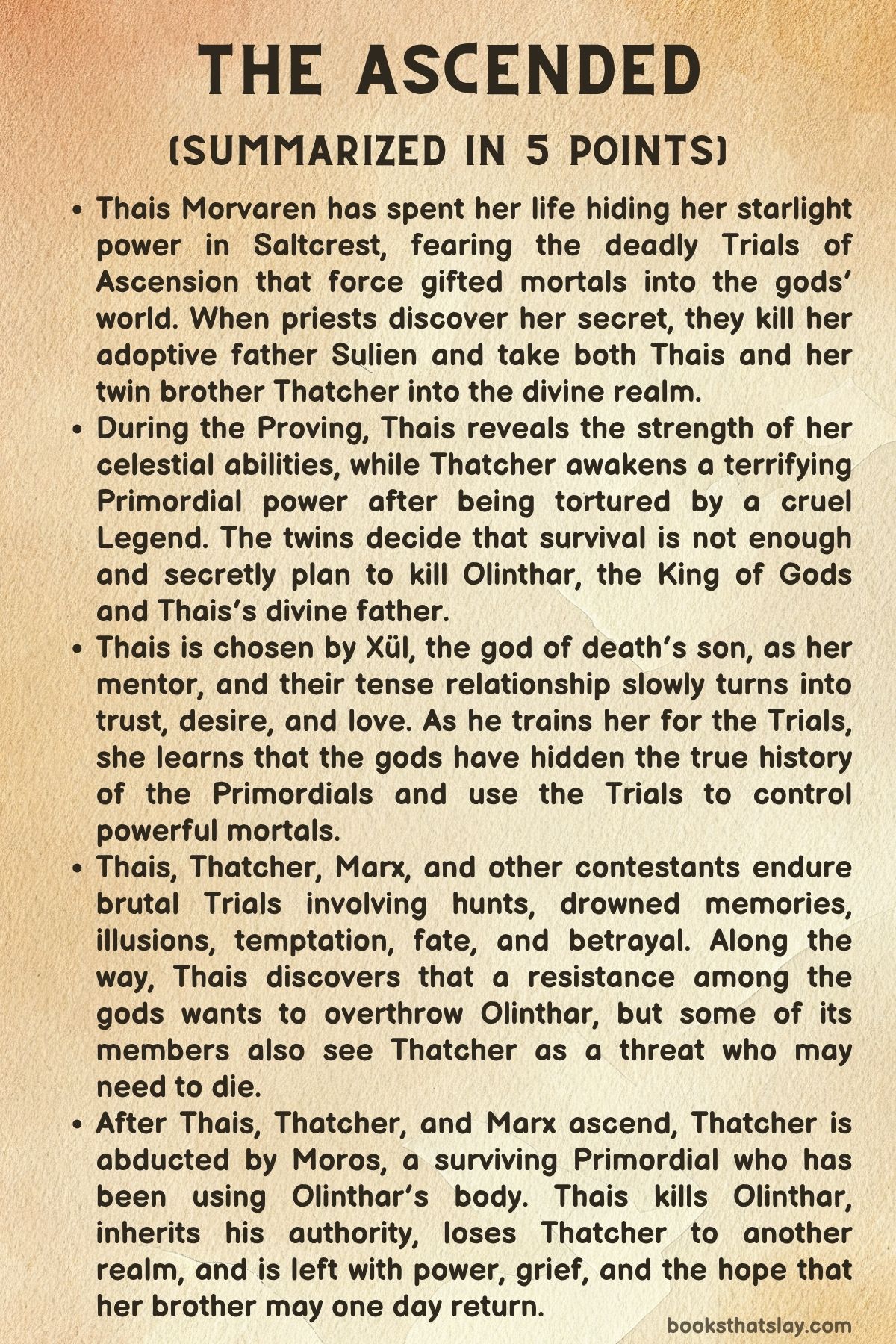
Thais Morvaren lives in the fishing village of Saltcrest with her twin brother Thatcher and their adoptive father Sulien. She has spent her life hiding a dangerous gift: she can create weapons and objects from starlight.
Her power comes from her divine father, Olinthar, King of Gods, who assaulted her mother. Thais’s mother died giving birth to her, and Sulien raised the twins with care, secrecy, and fear.
Every decade, Blessed Mortals are taken to compete in the Trials of Ascension, a deadly path that may turn a few survivors into lesser gods. Thais wants revenge against the gods, but Sulien has always begged her to keep her power hidden.
Her secret is exposed after she loses control during an intimate meeting with Marel, a young man who loves her and wants marriage. The altered sky attracts the attention of priests searching for Blessed Mortals.
When Marel is seized in her place, Thais reveals herself to save him. The priests bind her powers, take Thatcher too, and execute Sulien for hiding her.
His death breaks the fragile safety the twins once had and turns Thais’s anger into a purpose.
Thais wakes imprisoned and separated from Thatcher, but a Dreamweaver named Lyralei helps her prepare for the first display of power. Thais enters an arena before powerful Legends and reveals the scale of her starlight abilities.
The event quickly becomes a bloodbath, leaving only Thais and another contestant named Vance alive from her group. She asks that Thatcher be freed, but the gods instead test him.
Drakor, a cruel Legend, tortures Thatcher to awaken any hidden ability. Thatcher’s power erupts with terrifying force, and he makes Drakor implode.
The twins survive, but they are now even more interesting to the gods.
Locked together afterward, Thais and Thatcher grieve Sulien and discuss their next move. Thais decides that surviving is not enough.
She wants to kill Olinthar and avenge her mother, Sulien, and everyone destroyed by divine rule. Thatcher agrees to help, though he knows the plan may cost them their lives.
The surviving Blessed Mortals are then chosen by divine mentors. Thatcher is claimed by Chavore, Olinthar’s son and a Legend of War.
Thais is chosen by Xül, the son of Morthus, god of death, and Osythe, a mortal woman who became bound to him through love.
Xül brings Thais to Draknavor, the land of the dead. At first he is cold, dismissive, and unwilling to train her.
Thais refuses to be ignored. She explores his castle, learns of old divine wars, and discovers that Thatcher’s ability resembles the lost power of a Primordial.
This makes him far more dangerous than anyone realizes. Xül eventually begins training Thais through combat, endurance, alchemy, and emotional control.
He pushes her harshly, even creating a false image of Thatcher to force her to fight without hesitation. Thais hates his methods, but she grows stronger.
Meanwhile, Thatcher trains with Chavore in the Domain of War. His power lets him see and manipulate living systems, from organs to plants.
He decides to act obedient while gathering information for the plan against Olinthar. Chavore, though part of the divine order, proves less simple than Thatcher expected.
He lives under his father’s shadow and has his own resentments toward the system that shaped him.
Thais’s bond with Xül begins to change. She learns that he was mistreated by other gods because he was born of both mortal and divine worlds.
He spent his childhood judged as too much for mortals and not enough for gods. Xül discovers that Thais is Olinthar’s daughter after an alchemical reaction reveals her divine blood.
When she tells him the truth about her mother, he offers sympathy rather than condemnation. He also sees that Olinthar’s hypocrisy could become a weapon.
From that point, Xül becomes more determined to keep Thais alive.
The first Trial sends contestants into a forest where they must hunt sacred animals, only to become prey themselves. Thais, Thatcher, Marx, and Kyren work together.
Marx, a curse-bearing survivor with a brutal past, becomes Thais’s friend. Thais kills for the first time to protect her.
The Trial becomes an alchemical survival test as monsters chase them through the forest. Thais and Thatcher use Marx’s blood to protect their friends and hide their own half-divine nature, but that choice leaves their wards useless.
Thais nearly dies after luring monsters away, but Xül secretly saves her by hiding a protective ward on her.
The second Trial takes place underwater in the ruined city of Memorica. The contestants search for keys and witness the final memories of people drowned by Thalor, a god who destroyed the city after its priests misused divine knowledge.
The Trial forces them to face fear and confession. Marx admits she cursed her abusive family.
Kyren admits he ruined lives through illusion and fraud. Thais tries to hide her deepest secret, but the sirens sense her deception and torture her.
Thatcher destroys them to save her, causing the Archive to collapse. Olinthar later appears and praises the twins’ creative rule-breaking, but Thais becomes more certain that he must die.
As the Trials continue, Thais learns darker truths from Xül. The gods did not tell mortals the real history of the universe.
The Aesymar rose after the deaths of the Primordials and used the Trials to control, eliminate, or absorb powerful mortals who might challenge them. Thatcher’s Primordial power makes him either a weapon or a threat.
Thais also learns that Olinthar is secretly merging his realm with the Domain of War, upsetting the balance between divine powers.
Xül and Thais grow closer through training, argument, attraction, and shared loneliness. He introduces her to his family and the mortal village where his relatives live, letting her see the softer part of himself.
Their desire becomes harder to deny, especially after the third Trial, which disguises itself as a divine ball. Contestants are drugged, tempted with illusions, and burned alive if they surrender completely to desire.
Thais escapes an illusion of Xül, rescues Thatcher, and survives by jumping into empty space with Thatcher and Marx. Kyren dies after saving another contestant, a loss that deepens Thais’s grief and hardens the survivors.
Afterward, Xül and Thais admit their feelings. They understand that a relationship between a god and a mortal is forbidden, yet they eventually give in to their love.
Xül’s affection is real, but he is also trapped by politics. His father is part of a secret resistance against Olinthar, and that resistance plans to kill Thatcher before he can become too powerful.
Thais discovers the plot and confronts Xül in fury. Once restrained, she learns that Xül has argued for Thatcher’s life but has not told her everything.
She demands an audience with Morthus and convinces him that Thatcher is not their enemy. Morthus agrees to spare him if Thatcher joins the resistance, lives in Sundralis after ascending, and helps bring down Olinthar.
The final Trial concerns fate and destiny. Thais and Thatcher find that their lives are bound together in ways that are difficult to separate.
Thais sees a vision of another realm cut off from their universe, hinting that the world is larger and more broken than the gods admit. The Trial collapses, and the remaining contestants are allowed to proceed to the Forging.
Thatcher swears to help overthrow Olinthar but refuses to bind himself blindly to Morthus. Xül and Thais reconcile more fully, and Xül secretly binds his soul to hers through an ancient ritual, though he does not tell her.
During the Forging, Thais, Thatcher, Marx, and Vance stand before the gods as divine light burns away their mortality. Vance dies, but the others ascend.
Thais and Thatcher choose Sundralis, placing themselves close to Olinthar. Marx chooses Draknavor.
At first it seems like victory, but Thatcher suddenly disappears. Thais follows his trail into a hidden chamber and finds him bound before a dark force.
Olinthar’s body has been possessed by Moros, a surviving Primordial of corruption. Moros reveals that he sent the priests to Saltcrest because he wanted Thatcher’s power.
He also sent threats against Thais and manipulated earlier events to remove her.
Elysia, who serves Moros out of hunger for status and power, stabs Thais with a poisoned blade. Thais still fights, kills Elysia, and helps Thatcher battle Moros.
Together they force Moros out of Olinthar’s body, but Moros drags Thatcher into the abyss between realms. Olinthar, dying, taunts Thais by claiming he lives on in her.
She kills him with a blade of starlight, and his authority passes to her.
Morthus arrives and insists that he must take public credit for Olinthar’s death to protect Thais from divine politics. He also forces Xül to marry Nyvora to secure alliances, threatening Thais if Xül refuses.
Xül agrees, though his heart remains with Thais. Two weeks later, Thais avoids the wedding and returns to Saltcrest in disguise, watching villagers celebrate Olinthar’s death while she feels only emptiness.
Xül comes to her and promises that his love remains hers despite the marriage.
The story ends with a fragile hope. Heron, now the new god of Fate, tells Thais that Thatcher will return for seven seconds in thirty-six years.
Elsewhere, Thatcher and Moros fall into a prison made by another pantheon. Moros cannot take Thatcher’s power there, but he begins stealing his memories until Thatcher forgets Thais and even his own name.
A queen finds him and gives him a new one: Aether.
Characters
Thais Morvaren
Thais Morvaren is the emotional and moral center of The Ascended, a young woman shaped by secrecy, rage, loyalty, and an unwanted divine inheritance. Her life in Saltcrest teaches her restraint, but restraint never means submission.
She hides her starlight power because survival demands it, yet she carries a fierce desire to make the gods answer for what they have done to her family. Sulien’s death transforms that anger into a clear mission.
Thais begins as someone who wants to protect Thatcher above all else, but the Trials force her to expand her sense of responsibility. She learns that her suffering is part of a larger system that consumes powerful mortals, erases history, and rewards cruelty.
Her romance with Xül also tests her judgment, because love offers comfort while exposing her to danger and betrayal. Thais is not flawless; she can be reckless, emotionally driven, and slow to trust those who hide things from her.
Yet those traits also make her resistant to divine numbness. Even after killing, ascending, and inheriting terrible power, she fights to remember what mortality felt like.
Her strength lies not only in her celestial abilities but in her refusal to accept that power should require the death of compassion.
Thatcher Morvaren
Thatcher is Thais’s twin, her closest bond, and the character whose power changes the scale of the entire story. At first, he appears to be the more ordinary sibling because Thais is the one known to possess supernatural abilities.
His hidden Primordial power, however, makes him one of the most dangerous beings in the divine realm. Thatcher’s ability to perceive and manipulate living systems is frightening because it is precise, intimate, and absolute.
His killing of Drakor is both self-defense and a traumatic awakening. Afterward, he must live with the horror of what he can do.
Thatcher’s love for Thais defines many of his choices, but he is not merely an extension of her. His time with Chavore reveals his own intelligence, restraint, and capacity for strategic deception.
He understands the need to play the obedient student while hiding his hatred of Olinthar. His sympathy for Chavore complicates his hatred of the gods, showing that Thatcher can recognize pain even in those who belong to the system that destroyed his family.
His final fate is tragic because the story strips him of memory, identity, and connection, leaving him alive but severed from the person he was.
Xül
Xül is one of the most layered figures in The Ascended, standing between mortality and godhood, tenderness and brutality, duty and desire. As the son of Morthus and Osythe, he is both a symbol of forbidden union and a political problem for the gods.
His childhood wounds explain much of his guarded behavior. He learned early that vulnerability could be exploited, so he built a life around secrecy, knowledge, discipline, and control.
His training of Thais is harsh because he believes survival in Voldaris requires emotional armor. Yet his coldness is never complete.
He protects Thais in hidden ways, listens when she reveals Olinthar’s crime, and gradually allows her to see the parts of him that divine society never values. His love for her is genuine, but it is also marked by concealment.
He keeps the resistance’s plan from her and binds his soul to hers without her knowledge, choices that reveal both devotion and arrogance. Xül’s tragedy lies in being brave enough to love Thais but not free enough to choose her openly when politics closes around him.
He is neither savior nor villain; he is a damaged god trying to act with honor inside a world that punishes honest feeling.
Olinthar
Olinthar represents the bright face of tyranny in The Ascended. As King of Gods and Aesymar of Light and Order, he presents himself as lawful, noble, and divinely justified, yet his actions reveal corruption beneath that image.
His assault on Thais’s mother exposes the hypocrisy at the center of his rule: he enforces laws against divine and mortal unions while violating those same boundaries when it serves his desire. He treats Thatcher’s power as something to acquire, shape, and use.
His interest in the twins is never parental in any meaningful sense; it is political and strategic. The later revelation that Moros has possessed Olinthar complicates his role but does not erase his guilt.
Olinthar’s body becomes a vessel for an even older hunger, yet the cruelty, control, and entitlement associated with him remain central to the divine order he led. His final words to Thais are designed to poison her victory by making her feel permanently marked by him.
In that moment, he embodies the lasting damage abusers try to leave behind. Thais killing him is not simple freedom, but it is a necessary rejection of his claim over her body, blood, and future.
Moros
Moros is the ancient force behind much of the story’s hidden conflict. As a Primordial of corruption, he is not simply a villain who wants power; he is a being who survives by consuming memory, identity, and truth.
That makes him especially frightening in a book built around hidden histories and stolen agency. Moros’s possession of Olinthar allows him to rule from behind a divine mask, manipulating priests, Trials, assassinations, and alliances while others believe they are dealing with the King of Gods.
His interest in Thatcher is rooted in hunger and strategy. Thatcher’s Primordial ability offers Moros a new vessel and a way to expand beyond the limits that have contained him.
Moros also understands the value of narrative. He plans to frame Thatcher as a murderer and Thais as a casualty, turning the truth into a story that protects his ambition.
His final act of dragging Thatcher into the abyss continues this pattern. Even when he cannot absorb Thatcher’s power, he attacks memory itself, reducing Thatcher’s sense of self until he can be renamed and remade.
Sulien
Sulien is the moral foundation of Thais and Thatcher’s early lives. Though he is not their biological father, his love for them is practical, protective, and deeply real.
He raises them in Saltcrest, teaches Thais to hide her power, and understands better than they do how ruthless the divine system can be. His caution sometimes frustrates Thais, especially when he asks her to control her drinking and avoid drawing attention, but his fear comes from knowledge rather than weakness.
Sulien’s execution is one of the story’s defining wounds because it shows how the gods punish ordinary love and protection as crimes. His last words become a memory the twins carry into the Trials.
Sulien’s importance does not depend on power. He has no divine authority, no supernatural weapon, and no political influence, yet his love shapes the rebellion more than many gods understand.
Thais’s refusal to surrender her humanity is tied to him. Thatcher’s loyalty and grief are tied to him.
Sulien’s death gives the twins a reason to fight, but his life gives them something worth preserving.
Marx
Marx is a survivor whose hardness has been earned through pain. Born into a devout family that tortured her after her powers appeared, she learns early that fear often hides behind righteousness.
Her curse ability makes others view her as monstrous, and for a time she internalizes the danger she represents. The death of Finn, the man who loved her and tried to protect her, marks a turning point.
After losing him, Marx chooses to stop shrinking herself for a world that will hate her anyway. What makes her compelling is that she does not pretend innocence.
She admits to killing her abusive family and understands the horror of what she has done. Yet she is not cruel for pleasure.
Her friendship with Thais reveals loyalty, humor, and emotional intelligence. She recognizes Thais’s secrets without forcing confession and stands beside her when Xül and Aelix restrain her.
Marx’s choice to ascend and select Draknavor also shows her search for a place where darkness does not automatically mean evil. She becomes a mirror for Thais, asking whether godhood will make them forget fear, mortality, and mercy.
Chavore
Chavore begins as a figure Thais and Thatcher have every reason to distrust. As Olinthar’s son and a Legend of War, he appears to be a direct extension of the divine order they hate.
His mentorship of Thatcher, however, reveals a more conflicted person. Chavore is proud, powerful, and politically aware, but he is also emotionally shaped by Olinthar’s approval and manipulation.
His relationship with Elysia is arranged to suit Olinthar’s ideals of beauty, ambition, and usefulness, suggesting that even divine children can be treated as pieces in a larger game. Chavore’s memories being altered after the secret volcanic gathering shows how vulnerable he is within the system despite his status.
Thatcher’s response to him is important because it complicates revenge. He sees that Chavore is part of the structure that killed Sulien, but also sees a person damaged by that same structure.
Chavore’s gratitude when Xül saves Thatcher hints that rivalry among gods is not fixed beyond change. He represents the possibility that some insiders may become allies, not because they are innocent, but because they too have been used.
Morthus
Morthus is a revolutionary and a ruler, and the tension between those identities makes him morally difficult. As Aesymar of death and King of Draknavor, he understands the rot in the divine order and leads a resistance against Olinthar.
His love for Osythe and protection of Xül show that he can defy divine law for personal loyalty. He also believes gods should use power to protect mortals rather than exploit them, making his political vision far better than Olinthar’s rule.
Yet Morthus is ruthless in pursuit of that vision. His willingness to kill Thatcher before Thais argues him down reveals how easily rebellion can imitate the cruelty it opposes.
He thinks in terms of threats, alliances, and outcomes, even when those outcomes require sacrificing people. After Olinthar’s death, he forces Xül into marriage with Nyvora to strengthen political support, again choosing strategy over individual happiness.
Morthus is not evil, but he is dangerous because he can justify almost anything as necessary. He shows that opposing tyranny does not automatically make someone gentle, honest, or just.
Osythe
Osythe offers a quieter but vital counterpoint to the harsh politics of the divine realm. Once mortal and beloved by Morthus, she refused full divinity and instead accepted a life altered by his power.
Her presence proves that love between mortal and god can exist outside domination, even if the world around it labels such unions an abomination. Osythe is warm toward Thais and perceptive about Xül’s feelings, noticing what he cannot easily admit.
Her gardens and conversations provide a rare space where Thais can encounter tenderness within Draknavor. Yet Osythe is not merely decorative or passive.
She influences Morthus during the negotiation over Thatcher’s life, helping him see reason when strategy has narrowed his moral vision. She represents memory, patience, and emotional clarity in a world ruled by secrecy.
Through her, the story shows what Xül has inherited beyond power: the capacity to love deeply, even when that love carries risk.
Lyralei
Lyralei is one of the earliest signs that service to the gods does not always equal loyalty to their cruelty. As a Dreamweaver, she is part of the machinery that prepares Blessed Mortals for the Trials, yet she treats Thais with compassion from the beginning.
She restores Thais’s connection to Thatcher, advises her on how to survive the Proving, and later protects her during the illusion-based Trial by warning her about the dangerous drink. Lyralei understands the rules of the divine world well enough to move carefully within them.
Her kindness is not loud rebellion, but it matters. In a system built to isolate, terrify, and control contestants, she offers information, dignity, and small acts of protection.
She also complicates the idea of complicity. Lyralei serves a corrupt structure, but she uses her position to reduce harm where she can.
Her role suggests that resistance can take many forms, including quiet defiance from people who cannot yet openly challenge power.
Aelix
Aelix appears as a more approachable Legend, especially when compared with the openly cruel gods around him. His invitation to train survival skills with Marx and Thais helps prepare them for the first Trial, and he offers useful insight into Xül’s past.
Through him, Thais learns that Xül was mistreated by other divine children because of his mortal origins. Aelix’s friendliness, however, does not make him fully transparent.
He is tied to the resistance and participates in restraining Thais when she discovers the plan to kill Thatcher. This makes him a character of divided loyalties.
He can be kind, helpful, and even protective, but he still prioritizes the political goals of the rebellion when pressed. Aelix demonstrates that likable people can be involved in morally ugly decisions when they believe the larger cause demands it.
His character works best in the gray space between ally and handler.
Nyvora
Nyvora is outwardly cruel, proud, and dismissive, but her behavior is tied to insecurity and political pressure. As a goddess connected to fauna and the daughter of Davina, she has status, yet she is still trapped by expectation.
Her desire to marry Xül is partly strategic, a way to escape her mother’s influence and secure a stronger position. She resents Thais because Thais has what Nyvora cannot command: Xül’s genuine attention.
Her earlier attack on Xül when they were children reveals a long history of cruelty, and her later comments to Thais show how she uses humiliation as defense. Still, Nyvora is not simply a romantic obstacle.
She reflects the emotional damage caused by a society where marriage, beauty, lineage, and power are tools of survival. Her wedding to Xül becomes a political act rather than a union of love, showing how divine privilege can still function as a cage.
Elysia
Elysia is a character defined by ambition sharpened into betrayal. At first, she appears as Chavore’s polished paramour, someone who praises Olinthar and fits neatly into the role arranged for her.
Her beauty and ambition make her useful to Olinthar’s plans, but usefulness is not the same as fulfillment. Elysia feels overlooked, and Moros exploits that hunger.
Her decision to serve him reveals a desire not merely to survive divine politics but to rise above those who failed to recognize her worth. When she stabs Thais, the act is personal, political, and opportunistic.
She chooses the promise of greater power over loyalty, love, or moral restraint. Her death at Thais’s hands closes the path she chose, but it also highlights one of the story’s recurring dangers: people who feel unseen may become easy prey for forces that promise importance at any cost.
Kyren
Kyren is introduced as a contestant with illusion-based abilities, and his role grows through cooperation, confession, and sacrifice. He joins Thais, Thatcher, and Marx during the forest Trial and proves useful through his ability to disguise and protect the group.
In the underwater Trial, he admits that he once used illusions to manipulate business success for his parents, destroying lives through fraud. This confession gives him moral weight because he is not presented as innocent.
He has harmed others, and he knows it. Yet his later actions show a desire to be better than his worst choice.
During the third Trial, Kyren saves a contestant trapped by an illusion of his dead wife, only to be killed by the man he rescues. His death is cruel because it comes from compassion, not failure.
Kyren’s arc shows that redemption in this world is possible but not guaranteed to be rewarded.
Marel
Marel belongs to the life Thais might have had if she were ordinary, but their relationship is built on imbalance. He loves her and wants marriage, while she feels guilt because she cannot return that love with the same certainty.
Their encounter on the cliff accidentally exposes her power, setting the main conflict in motion. Marel is not malicious; he is simply unaware of the full danger surrounding Thais.
When the priests seize him, Thais reveals herself to save him, proving that she still values his life even if she does not love him as he wants. Marel’s importance lies in what he represents: the impossibility of Thais remaining in Saltcrest as if secrecy could last forever.
He is tied to her last moments of ordinary intimacy before the divine world claims her.
Heron
Heron is a seer hidden away by Vorinar because blindness would have made him vulnerable to the Trials. His existence reveals another hypocrisy in the divine order: powerful gods can hide their own children from the dangers imposed on other mortals.
Heron is gentle but unsettling because he sees possible futures that others cannot bear. His warning that Thatcher’s thread ends with the Trials gives Thais a new urgency, while his reminder that fate can change keeps despair from becoming final.
After Moros’s actions lead to Vorinar’s death, Heron becomes the new god of Fate. His later vision of Thatcher’s brief return gives Thais the first real hope after her brother’s disappearance.
Heron’s role is small but important because he turns fate from a fixed sentence into a fragile opening.
Vance
Vance is one of the few contestants to survive the early slaughter alongside Thais, which marks him as capable, but he remains less developed than the central survivors. His endurance through the Trials shows that the competition does not only test power; it also rewards adaptability, luck, and a willingness to keep moving through terror.
His death during the Forging is significant because it proves that even reaching the final stage does not guarantee victory. The divine process remains deadly until the last moment.
Vance’s role reinforces the brutality of Ascension. He survives what kills many others, only to be consumed at the threshold of godhood.
Themes
Power as Control, Survival, and Corruption
Power in The Ascended is never neutral. For the gods, power has become a system of ownership: they claim mortal lives, write laws for others, hide history, and decide which gifted people may live.
The Trials are presented as an honor, but they function as a filter that either destroys dangerous mortals or reshapes them into servants of the divine order. Thais and Thatcher expose the fear beneath that system.
Their abilities are not merely gifts; they are threats to rulers who depend on the belief that their authority is natural. Olinthar’s rule shows power at its most hypocritical, using light and order as symbols while concealing violence, assault, and manipulation.
Moros shows another version of power, one rooted in consumption: he steals bodies, memories, futures, and names. By contrast, Thais’s growing power is tied to resistance, but the book refuses to make that simple.
As she kills, ascends, and inherits authority, she must ask whether power can be used without becoming like those she hates. The tension lies in the need to gain strength without surrendering conscience.
The Cost of Vengeance
Thais’s desire for revenge begins as a clear moral response to unforgivable harm. Olinthar’s violence destroyed her mother, the priests murdered Sulien, and the divine order treats mortal suffering as acceptable damage.
Her anger is justified, and the story does not ask the reader to dismiss it. Yet the pursuit of vengeance keeps demanding more from her.
She must kill, lie, form alliances with dangerous gods, and risk Thatcher’s life as well as her own. Revenge gives her direction after grief, but it cannot give her peace.
Even when Olinthar dies by her hand, the victory is hollow because Thatcher is gone, Xül is forced into a political marriage, and Thais inherits a power she never asked for. The book uses this outcome to show that vengeance may end a tyrant without repairing the damage he caused.
Thais’s final state is not triumph but survival after a terrible exchange. Her revenge matters because it rejects Olinthar’s control, but it also leaves her facing the harder task of living with loss, authority, and memory.
Love Under Systems of Fear
Love appears throughout the story, but it is rarely safe. Sulien’s love for the twins leads to his execution.
Thais’s love for Thatcher becomes both her greatest strength and her most vulnerable point. Xül’s love for Thais gives him courage, yet it also places both of them in danger because divine law and political duty forbid their union.
Even Morthus and Osythe, whose bond proves that mortal-divine love can be real, live inside the consequences of defying a system that sees such relationships as disorder. The story repeatedly asks what love can survive when power turns people into risks, tools, or liabilities.
Xül and Thais are drawn to each other because each sees past the role the world has assigned to the other. She sees the wounded man beneath the god of death, and he sees the fierce, frightened woman beneath the weapon the gods want to shape.
Still, love does not erase secrecy. Xül hides the resistance’s plan and binds himself to Thais without telling her, proving that devotion can coexist with control.
The book treats love as powerful, but not pure enough to escape consequences.
Memory, Identity, and the Fear of Forgetting
Memory is one of the story’s deepest concerns. The gods maintain power partly by controlling what mortals know about the past.
The true history of the Primordials, the Sundering, and the purpose of the Trials has been hidden so that mortals will not question divine rule. On a personal level, memory keeps characters human.
Thais clings to Saltcrest, Sulien, Thatcher, and Xül during the Forging so that godhood will not erase who she has been. Marx’s question about whether they will forget what it felt like to be mortal captures the fear that ascension may bring emotional death as well as power.
Moros makes this fear literal. He does not only attack bodies; he consumes memory until identity collapses.
Thatcher’s ending is devastating because he survives physically while losing the memories that made him Thatcher. When Queen Andrid renames him Aether, the new name signals both rescue and erasure.
Against that loss, Thais’s promise to remember becomes an act of resistance. To remember pain, love, fear, and injustice is to resist becoming another distant god.