Sweet Oblivion Summary, Characters and Themes
Sweet Oblivion by Bella Matthews is a contemporary romance centered on survival, trust, chosen family, and a love that begins under impossible circumstances. The novel follows Delaney Rousseau, a woman shaped by violence and betrayal, and Ryker Beneventi, a professional football player whose protective instincts place him at the center of a public scandal.
What begins as a fake marriage meant to save Ryker’s career and freedom slowly becomes a real partnership built on patience, honesty, and emotional safety. The story combines romantic tension, family bonds, trauma recovery, suspense, and the quiet power of being loved without conditions. It’s the 4th book of the Love and Legacy Series.
Summary
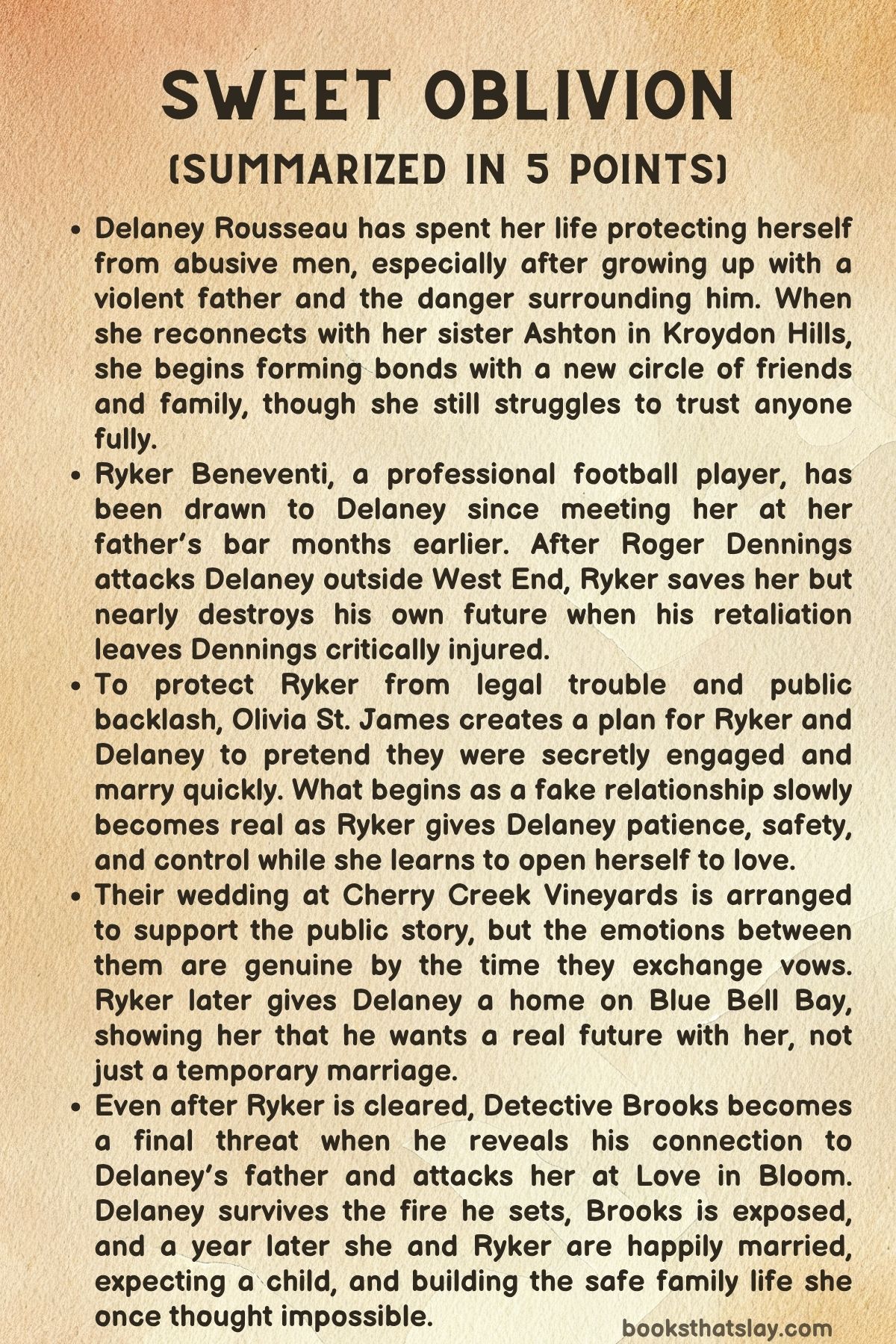
Delaney Rousseau has spent most of her life believing that safety is something she must create for herself. Her childhood taught her that danger does not always come from strangers.
Sometimes it lives inside a home, wears the face of a parent, and uses love as a weapon. Her father was abusive, cruel, and deeply connected to dangerous men, and Delaney learned early that trusting the wrong person could cost her everything.
Because of him, she grew into a guarded woman who kept her distance, relied on herself, and never expected anyone to rescue her.
Her life begins to change when she moves to Kroydon Hills and reconnects with her sister Ashton. Through Ashton, she becomes connected to a close circle of friends and powerful families, including the Kingstons, Sinclairs, and Beneventis.
This world is different from the one Delaney has known. It is full of loyalty, protection, wealth, and fierce family bonds.
Yet even as she becomes part of it, she remains careful. She does not easily believe that people can stay, care, or protect without wanting something in return.
Ryker Beneventi, a professional football player for the Philadelphia Kings, has already crossed paths with Delaney before her arrival in Kroydon Hills. Months earlier, when she worked at her father’s bar, Ryker noticed her and was immediately drawn to her.
He spent the spring trying to convince her to go out with him, but Delaney refused him again and again. Her refusal was not because she felt nothing.
It was because she knew her father. When her father noticed Ryker’s interest and realized that Ryker came from an influential family, Delaney disappeared from the bar to protect Ryker from being used or manipulated.
Months later, Delaney reappears in Ryker’s life through Ashton and Jamie. Although the attraction between them still exists, both of them act as if nothing is happening.
Ryker watches her, cares more than he admits, and struggles with her distance. Delaney, meanwhile, is drawn to him but afraid of what wanting him could mean.
She has spent so long avoiding vulnerability that accepting kindness feels as dangerous as any threat.
After a Philadelphia Kings game, Ryker and his friend Hendrix go to West End to celebrate a win. Delaney is also there, and Ryker cannot stop watching her from across the bar.
The evening takes a dark turn when Roger Dennings, a player from the opposing team, begins crowding and harassing Delaney. Ryker intervenes when Dennings refuses to back off.
Dennings mocks Ryker’s hearing loss and accuses him of playing dirty, but Delaney refuses to let the insult pass. She stands up for Ryker and fires back at Dennings.
Humiliated and angry, Dennings leaves after Ryker threatens him.
Ryker still does not trust the situation, so he offers Delaney a ride home. Before they can leave, Delaney goes to the restroom.
On her way back, Dennings attacks her. He drags her outside, chokes her, beats her, and attempts to sexually assault her.
When Ryker realizes she has been gone too long, he searches for her and finds Dennings attacking her outside the bar. The sight destroys his control.
Ryker knocks Dennings off Delaney and sees her unconscious, injured, and bleeding. Rage takes over, and he beats Dennings badly until Hendrix pulls him away.
Delaney is taken away by ambulance. When the EMTs say only family can ride with her, Ryker lies and says he is her husband.
The lie is impulsive, but it comes from his refusal to leave her alone after what she has suffered. At the hospital, Delaney is treated for severe bruising, head trauma, cracked ribs, and other injuries.
Ryker remains at her side, shaken by what happened and consumed by guilt that he did not protect her sooner.
Ryker’s cousin, Olivia St. James, arrives at the hospital. As a lawyer, she immediately takes control of the situation and prevents the police from questioning Ryker and Delaney without representation.
She soon reveals that Dennings is in critical condition and has coded twice. Videos of Ryker beating Dennings and claiming to be Delaney’s husband have already spread online.
The story could easily be twisted into a violent football rivalry instead of a man defending a woman from assault.
Olivia proposes a risky solution. Ryker and Delaney should claim they were secretly engaged and marry quickly.
If they are married, Olivia can present Ryker’s actions as the defense of his future wife rather than an attack on an opposing player. Delaney agrees because she believes Ryker saved her life and wants to save him in return.
The fake engagement becomes a public strategy, but it also forces both of them into emotional closeness neither expected.
Ryker takes Delaney home to her apartment above Love in Bloom, where he meets her pet potbellied pig, Tori, whose full name is The Notorious P.I.G. Delaney’s apartment matters deeply to her because it is the first home that truly feels like hers. She does not want to leave it, even after the attack.
Ryker respects that and stays with her there, moving into her space because it is where she feels safest. This decision becomes one of the first signs that he understands her needs instead of trying to control them.
Ashton and Jamie arrive the next morning, and Delaney tells Ashton what happened, including the plan to marry Ryker. Ryker’s parents and Olivia also come, and the families begin preparing the public engagement and wedding.
Ryker’s mother, Lenny, enthusiastically helps plan a large wedding at Cherry Creek Vineyards. The event includes a custom gown by Everly Wilder Designs, a cake by Lexie, and flowers from Love in Bloom.
What begins as a legal and public relations move becomes something surrounded by warmth, family, and unexpected tenderness.
During the wedding preparations, Delaney grows closer to the women around her, including Ashton, Kaleigh, Dillan, and Lexie. They support her through dress fittings, cake tastings, games, and vulnerable conversations.
Their acceptance helps Delaney experience friendship and sisterhood in a way she has rarely allowed herself to trust. At the same time, she and Ryker begin asking each other questions every day so their relationship will seem believable.
The questions start as part of the act, but they become a way for them to know each other honestly.
Their physical relationship also develops slowly. Delaney admits that she has never been intimate with anyone because of her past and her fear of trusting someone with her body.
Ryker responds with patience instead of pressure. He promises that she will always have control and that nothing will happen unless she wants it.
His restraint becomes one of the foundations of their bond. He does not treat her trauma as something to fix quickly.
He makes space for her choices, her fear, and her desire.
The situation becomes more dangerous when Dennings dies from his injuries. Ryker now faces the possibility of charges, league consequences, and a media storm.
Olivia continues to manage the legal and public narrative, but Detective Brooks becomes a serious concern. He questions Delaney harshly, implies that her account is too convenient, and seems unusually determined to blame Ryker.
His behavior raises suspicion, and Olivia begins investigating him while keeping Ryker and Delaney’s public love story under control.
Ryker and Delaney marry at Cherry Creek Vineyards in a public ceremony designed to support Olivia’s strategy. Yet the wedding does not feel entirely fake.
Ryker kisses Delaney before the ceremony even properly begins, and his words during the celebrations make it clear that his feelings are real. Delaney, too, begins to understand that what she has with Ryker is no longer only an agreement.
At the reception, they stop pretending with each other and accept that their marriage has become real in the ways that matter most.
They spend their wedding night together at a bed and breakfast Ryker has rented out. Afterward, he takes Delaney to a restored farmhouse he bought on Blue Bell Bay.
He tells her it is their home now and invites her to design the landscaping, honoring an old dream she once had of becoming a landscape architect. The gesture shows that Ryker sees not only the woman she is now but also the dreams she buried in order to survive.
The district attorney eventually decides not to press charges against Ryker, but the danger does not end there. Detective Brooks confronts Delaney again, furious that Ryker has been cleared.
Later, while Delaney is at her old apartment collecting pots and pans to cook dinner for Ryker, Brooks breaks in. He reveals the truth about his connection to Delaney’s father.
He worked with her father for years, covered up his crimes, and even killed Delaney’s mother at her father’s request. He also tells Delaney that her father once offered her as collateral if he could not repay his debts.
Brooks attacks Delaney, kicks Tori, and sets fire to the shop. Ryker sees Brooks leaving Love in Bloom and notices the fire.
He rushes inside and finds Delaney unconscious in the smoke-filled apartment with Tori beside her. He carries them out, but Delaney has no pulse.
Ryker and Hendrix perform CPR until she begins breathing again. She is rushed to the hospital and treated for smoke inhalation, carbon monoxide poisoning, a concussion, and a head wound.
When Delaney wakes, Ryker tells her Brooks has been caught and connected to both the fire and her father’s crimes. The truth brings pain, but it also frees her from years of unanswered questions and hidden danger.
Delaney finally tells Ryker she loves him, and he tells her she is his life. Their love has survived violence, fear, public scrutiny, and the ghosts of her past.
A year later, Delaney and Ryker are happily married and living in their home on Blue Bell Bay. Delaney has become part of Ryker’s family traditions, including Sunday dinners and book club.
She chooses not to pursue landscape architecture professionally, though she still loves gardening. Instead, she enrolls in a psychology and counseling program because she wants to help abuse victims.
Her past no longer defines only her pain; it shapes the work she wants to do for others.
At a family dinner, Delaney tells Ryker she is pregnant. The news represents the beginning of the future they have dreamed about: a life filled with love, children, grandchildren, and the security Delaney once believed she would never have.
Ryker promises to love her forever, in this life and the next. Their story ends with Delaney surrounded by family, safety, and a love that proves she was never meant to survive alone.
Characters
Delaney Rousseau
Delaney Rousseau is the emotional center of the book, shaped by a past full of abuse, fear, and betrayal. She grew up with a father who turned home into a place of danger, and that background explains her guarded nature.
Delaney does not begin as someone who trusts easily or expects kindness to last. Her instinct is to protect others by removing herself from their lives, which is why she disappears from Ryker when she realizes her father might exploit his connection to power.
This choice shows her selflessness, but it also reveals how deeply she believes she must handle danger alone. Throughout Sweet Oblivion, Delaney’s growth comes from learning that accepting protection is not weakness.
Her relationship with Ryker helps her reclaim agency over her body, her choices, and her future. Her bond with Ashton and the women around her also gives her a new understanding of family.
By the end, Delaney has transformed from a woman living in survival mode into someone who can love openly, build a home, and turn her trauma into a desire to help other abuse victims.
Ryker Beneventi
Ryker Beneventi is protective, loyal, intense, and deeply patient. As a professional football player, he is physically powerful and publicly visible, but his most important qualities are emotional rather than athletic.
He sees Delaney before she is ready to be seen, and even when she keeps him at a distance, he does not treat her fear as rejection he must conquer. His violent reaction to Dennings comes from rage and terror, but the story also shows that Ryker’s protectiveness is not limited to physical defense.
His true strength appears in the quieter moments: staying with Delaney at the hospital, moving into her apartment because she feels safe there, respecting her control over intimacy, and offering her a home that honors her old dreams. Ryker’s hearing loss also becomes part of how others underestimate or attack him, but he refuses to be defined by it.
In the book, he represents a form of love that is steady, fierce, and careful. His journey is not about learning to love Delaney, because he does that early, but about proving that his love can be trusted.
Ashton
Ashton is Delaney’s sister and one of the most important bridges between Delaney’s painful past and her safer present. Her relationship with Delaney carries the emotional weight of family history, separation, and reconnection.
Ashton gives Delaney a link to belonging in Kroydon Hills, and through her, Delaney gains access to a larger circle of friends and relatives who eventually become her chosen family. Ashton’s role is not simply to support the romance; she helps remind Delaney that she still has blood family worth trusting.
When Delaney tells Ashton about the attack and the marriage plan, the moment reflects their growing honesty and renewed sisterly closeness. Ashton gives Delaney a safe place to be vulnerable, and that matters because Delaney has spent so much of her life hiding pain.
Her presence in the novel shows how healing is strengthened when survivors are not forced to rebuild alone. Ashton also represents continuity, proving that Delaney’s past did not destroy every bond that mattered.
Olivia St. James
Olivia St. James is one of the most strategic and commanding figures in the story. As Ryker’s cousin and a lawyer, she enters during a crisis and immediately understands the legal, public, and emotional stakes of the situation.
Her plan for Ryker and Delaney to present themselves as secretly engaged and quickly marry is bold, but it is not careless. Olivia recognizes how the media, the league, and the legal system might twist the truth, and she acts before that can happen.
Her intelligence lies in seeing not only what is true, but what will be believed by the public. In Sweet Oblivion, Olivia functions as both protector and tactician.
She prevents the police from pushing Delaney and Ryker into damaging statements, investigates Detective Brooks, and controls the narrative around the couple. Although her methods are practical and sometimes aggressive, they come from loyalty.
Olivia’s character shows how power and preparation can become forms of care when used to defend people who are vulnerable.
Detective Brooks
Detective Brooks is one of the most dangerous characters in the novel because his threat is hidden behind authority. At first, he appears to be an investigator who doubts Delaney and wants to hold Ryker responsible, but his behavior slowly reveals something more corrupt.
He questions Delaney with cruelty and suspicion, not because he seeks justice, but because he is protecting secrets of his own. His connection to Delaney’s father exposes the depth of his corruption.
Brooks worked with her father, covered up crimes, and killed Delaney’s mother at her father’s request. This makes him a figure of institutional betrayal.
He is not just another villain from Delaney’s past; he is proof that the systems meant to protect people can be controlled by predators. His final attack on Delaney and the fire at Love in Bloom show his desperation and brutality.
Brooks’s role in the book sharpens the suspense and forces Delaney to face the truth behind some of the darkest parts of her history.
Roger Dennings
Roger Dennings is the immediate physical threat who sets the central crisis in motion. His harassment of Delaney at West End shows his entitlement, aggression, and need to dominate.
When Ryker intervenes, Dennings does not simply back away; he escalates, mocks Ryker’s hearing loss, and later attacks Delaney in a brutal act of violence. Dennings represents the kind of man Delaney has spent her life trying to avoid: cruel, predatory, and enraged when challenged.
His death after Ryker’s beating complicates the story because it turns an act of defense into a legal and public danger. Dennings is not given moral complexity, but he has a major effect on the lives of the central characters.
Through him, the novel examines how quickly violence against women can become a public argument about reputation, motive, and blame. His actions force Ryker and Delaney into a fake marriage, but they also reveal the depth of Ryker’s devotion and Delaney’s courage.
Lenny Beneventi
Lenny Beneventi brings warmth, energy, and family acceptance into the story. As Ryker’s mother, she responds to Delaney not with suspicion or distance, but with open enthusiasm.
Her involvement in planning the wedding could have felt overwhelming, yet it also gives Delaney something she has rarely experienced: a maternal presence who wants joy for her without cruelty attached. Lenny’s excitement over the wedding, the gown, the venue, and the details helps turn a strategic arrangement into an event surrounded by affection.
She represents the Beneventi family’s habit of absorbing people into their circle and loving them loudly. For Delaney, who grew up with fear instead of comfort, Lenny’s warmth becomes part of her healing.
Lenny also helps show why Ryker loves the way he does. He comes from a family that protects fiercely, celebrates fully, and treats loyalty as action.
Her character adds softness to a story filled with danger.
Hendrix
Hendrix is Ryker’s friend and an important supporting presence during some of the story’s most intense moments. At West End, he is there when Ryker discovers Delaney being attacked and has to pull Ryker away from Dennings before the violence goes even further.
Later, during the fire, Hendrix helps Ryker perform CPR on Delaney until she begins breathing again. His role is built on loyalty, steadiness, and quick action under pressure.
Hendrix does not dominate the novel, but he matters because he is one of the people Ryker can rely on when everything is falling apart. He also serves as a witness to Ryker’s love for Delaney, seeing firsthand how far Ryker will go to save her.
In a story where chosen family and friendship are essential, Hendrix represents the dependable friend who shows up in the worst moments and does what needs to be done.
Tori
Tori, Delaney’s potbellied pig whose full name is The Notorious P.I.G., adds humor, tenderness, and emotional texture to the book. She is more than a quirky pet.
Tori is part of Delaney’s sense of home, comfort, and independence. When Ryker meets Tori at Delaney’s apartment, it marks his entrance into Delaney’s private world.
Accepting Tori is also part of accepting Delaney fully, including the unusual and vulnerable pieces of her life. Tori’s presence during Brooks’s attack and the fire makes her especially meaningful.
She stays beside Delaney in danger, and Ryker saves both of them from the smoke-filled apartment. Tori reflects Delaney’s need for companionship that feels safe and uncomplicated.
In a novel filled with trauma and threat, Tori brings moments of lightness while also reinforcing the importance of home, loyalty, and being loved exactly as one is.
Themes
Healing Through Safety and Choice
Delaney’s healing is not presented as instant recovery or as something love magically completes. Her progress depends on safety, patience, and the right to choose what happens to her own body and life.
Ryker’s importance lies not only in saving her from physical danger, but in respecting her boundaries afterward. He stays close without trapping her, protects her without making decisions for her, and allows her to define the pace of their intimacy.
This is especially important because Delaney’s past has taught her that control can be taken away without warning. Every time Ryker gives that control back to her, he helps rebuild something violence damaged.
The same pattern appears in her friendships and family bonds. Ashton, Lenny, Kaleigh, Dillan, and Lexie do not demand that Delaney become comfortable immediately.
They offer presence, support, and normal moments of joy. In Sweet Oblivion, healing is shown as a gradual return to selfhood.
Delaney does not erase her past; she learns that her past no longer gets to decide the limits of her future.
Love as Protection Without Possession
Ryker’s love for Delaney is fierce, but the story makes a clear difference between protection and possession. His instinct is to defend her, and at times that instinct becomes physically explosive, especially when he finds Dennings attacking her.
Yet the emotional core of his relationship with Delaney is not control. He does not use her vulnerability as a reason to dominate her choices.
Instead, he listens when she says her apartment feels safe, honors her attachment to her home, and adjusts himself around her needs. His protection becomes meaningful because it is paired with restraint.
Delaney has known men who use power to frighten, own, and exploit. Ryker offers the opposite kind of strength.
He has the ability to overpower, but he chooses tenderness when it matters most. The fake marriage setup could have easily created pressure or obligation, but Ryker repeatedly shows Delaney that she is not trapped with him.
Love in the story becomes a shelter, not a cage, and that distinction is essential to why Delaney learns to trust him.
Chosen Family and Belonging
Family in the novel is not limited to blood, and blood itself is not treated as automatically safe. Delaney’s father represents the worst betrayal of family, while Ashton represents the possibility of repairing family bonds that were damaged by the past.
Around Delaney, the Kingston, Sinclair, and Beneventi circles create a larger model of belonging. These people show up, organize, protect, tease, celebrate, and absorb Delaney into their traditions until she begins to believe she has a place among them.
The wedding preparations are especially important because they turn a legal strategy into an experience filled with care. Dress fittings, flowers, cake, games, and Sunday dinners become more than background details.
They are proof that ordinary rituals can help someone feel claimed in a loving way. For a woman who grew up without dependable safety, being included is transformative.
The book uses chosen family to show that belonging is built through repeated acts of loyalty. Delaney does not simply marry Ryker; she gains a network of people who refuse to let her stand alone.
Escaping the Past and Reclaiming the Future
Delaney’s past follows her through fear, trauma, her father’s crimes, Brooks’s corruption, and the danger surrounding men who once had power over her life. The story does not pretend that leaving an abusive environment automatically ends its effects.
Even after Delaney moves to Kroydon Hills, the consequences of her father’s choices continue to reach her. Brooks’s confession exposes how deeply her life was shaped by secrets and violence, including the truth about her mother’s death and the horrifying fact that her father once treated her as collateral.
Yet the novel’s direction is not only about survival. It is about reclaiming the future piece by piece.
The farmhouse on Blue Bell Bay symbolizes a life Delaney gets to design for herself. Her decision to study psychology and counseling shows that she is no longer only responding to what was done to her; she is choosing what to do with what she survived.
Pregnancy at the end expands that future even further, marking family, hope, and continuity. Delaney escapes the past not by forgetting it, but by refusing to let it own the rest of her life.