The Counting Game Summary, Characters and Themes
The Counting Game by Sinead Nolan is a dark mystery set in a small Irish coastal village where childhood fear, family trauma, and local legend blur together after a young girl disappears in the forest. The book follows Jack Kellough, a frightened nine-year-old whose sister Saoirse vanishes during a game, and Dr Freya Hemmings, the therapist brought in to help him speak about what he saw.
As the investigation grows, old disappearances, buried guilt, and village secrets begin to surface. The story is about survival, memory, blame, and the damage caused when grief is allowed to harden into obsession.
Summary
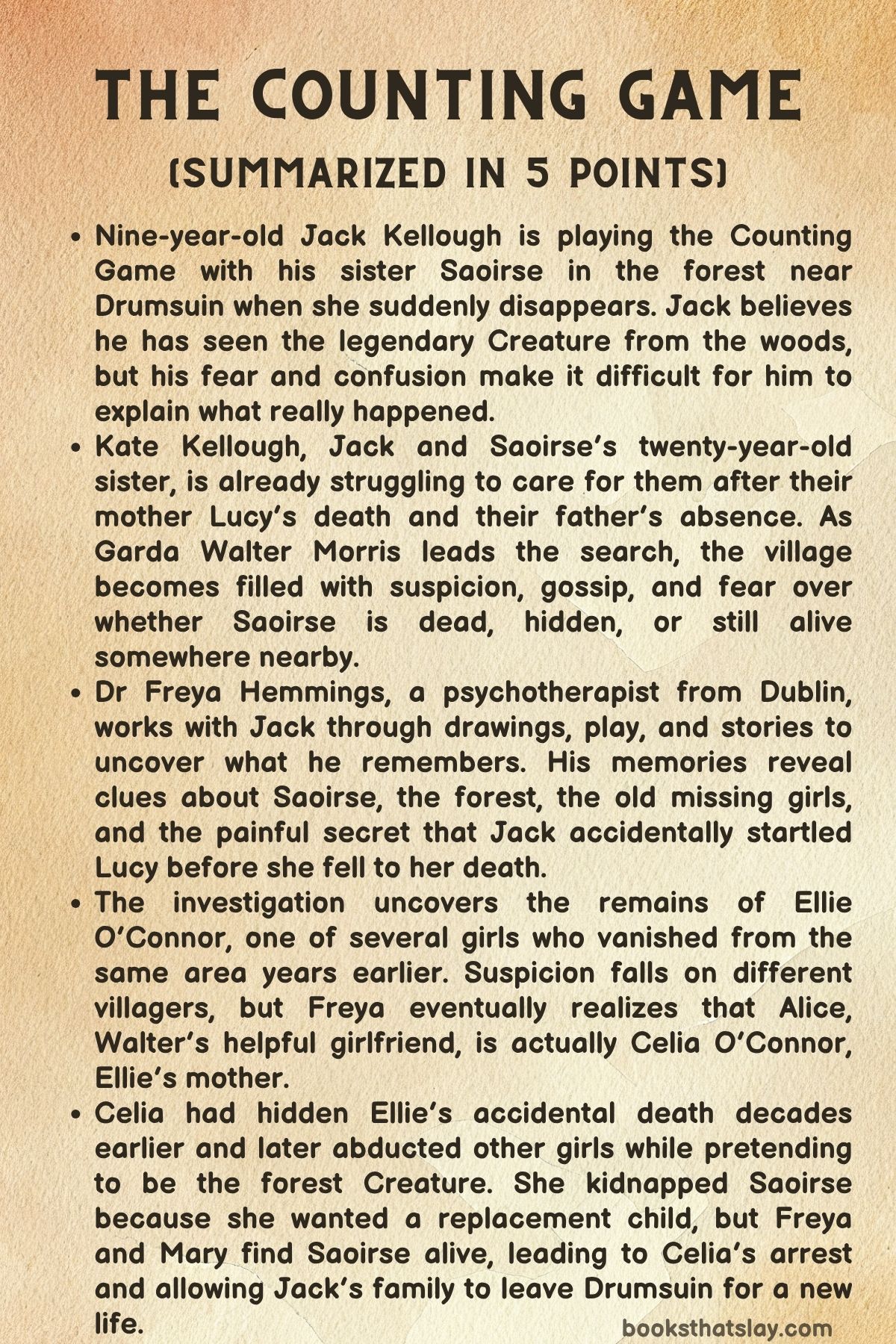
Nine-year-old Jack Kellough is playing the Counting Game in the forest near Drumsuin, a coastal village in southwest Ireland, with his thirteen-year-old sister Saoirse when the afternoon turns into a nightmare. The game is simple: Jack counts while Saoirse hides.
Yet this time the forest feels different to him. It seems hostile, watchful, and full of unseen danger.
Jack has grown up with stories about the woods, especially tales of a dark Creature said to haunt the trees, and in his frightened imagination the old legends become real. While he is counting, he hears a terrible scream in the distance.
He feels that something has broken between him and Saoirse, as if their usual bond has been cut. Then he sees what he believes is the Creature, a huge dark figure moving through the forest.
Panic takes over. Jack runs, calls for Saoirse, and searches in confusion, but he cannot find her.
Eventually he wanders out onto a road, where a man finds him and takes him home. Jack is terrified of making the situation worse and begs the man not to tell his older sister Kate.
Because of this, Saoirse’s disappearance is not reported until the next morning. By then precious time has been lost, and the village is already shifting from ordinary life into fear.
Kate Kellough is only twenty, but she has become the main caretaker for Jack and Saoirse after the death of their mother, Lucy, six months earlier. Their father, Cahill, is mostly absent in Dublin, and the children have been living inside a damaged family system held together by Kate’s exhausted determination.
Saoirse’s disappearance exposes how fragile everything already was. Garda Walter Morris begins investigating the case, but Jack is unable to give a clear account of what happened.
He believes the forest has rules, that the Counting Game is dangerous if spoken about wrongly, and that the Creature may return if he tells too much. His silence is not defiance; it is terror mixed with guilt and confusion.
The search for Saoirse quickly grows. Gardaí, volunteers, dogs, helicopters, and water-search teams comb the area.
Drumsuin becomes consumed by suspicion and rumor. Everyone wants answers, but each answer seems to lead toward another fear.
Some villagers believe the forest itself has taken Saoirse, while others think a human predator must be involved. The case becomes even harder because Jack’s account is fragmented.
He remembers sensations, images, and pieces of fear more clearly than facts.
Dr Freya Hemmings, a psychotherapist from Dublin, is brought in to help Jack recover what he knows without harming him further. Freya is skilled with children, but this case affects her deeply because of her own loss.
Years earlier, her little daughter Violet drowned while Freya was briefly away from her. Since then, Freya has lived with sorrow and self-blame.
Working with Jack forces her close to the kind of pain she has tried to manage privately. Even so, she approaches him with patience.
Through play, drawing, sand-tray work, and storytelling, she gives him ways to speak without forcing him into direct confession.
Jack slowly reveals important details. He and Saoirse often played the Counting Game.
He sees or dreams of a girl named Ellie in the forest. He is afraid of Father Maguire.
He believes the Creature took Saoirse. His drawings become key because they show places, figures, and events he cannot yet explain in ordinary language.
To the adults, the pictures are possible clues. To Jack, they are pieces of a world where the dead, the missing, and the imagined all seem to exist side by side.
Several suspects come under attention. Father Maguire seems suspicious because Saoirse disliked visiting his house, but he explains that he provided meals for disadvantaged children and that a housekeeper was present.
Mr Fitzgerald, the butcher and Lucy’s former lover, is unsettling and had contact with the family, but he later has an alibi through a woman he was secretly seeing. Fergal Duffy, a neighboring farmer, had frightened the children away from his land and has a connection to an earlier missing girl, Maeve Murphy, but he too has an alibi.
Saoirse’s young boyfriend Paddy Lyons and his brother also become relevant after Paddy’s brother admits he saw Saoirse on the day she vanished with a woman who looked like Freya.
The history of the forest becomes central to the investigation. Saoirse is not the first girl to vanish near Drumsuin.
Ellie O’Connor disappeared in 1975, Ashling McGill in 1981, and Maeve Murphy in 1988. Local stories connect these disappearances to the old Magdalene Laundry, the Hollowing Place, and the Creature.
These legends have shaped the village’s fears for years, giving people a supernatural explanation for crimes they could not solve. During the search for Saoirse, Gardaí discover a child’s remains and a cardigan in the forest.
The body is not Saoirse’s, but Ellie O’Connor’s. Ellie has been missing for twenty years, and Jack’s drawings and dreams of her make the discovery feel deeply unsettling.
At the same time, the story of the Kellough family’s past begins to emerge. Lucy, the children’s mother, was unstable, drank heavily, and did not always take her medication.
She brought men into the house and often failed to protect her children from emotional chaos. Saoirse, though still young, often acted like an adult, protecting Jack and managing problems that should never have been hers.
Lucy taught the children the Counting Game and told them it could protect them from the forest. What seemed like a childhood game was tied to fear, superstition, and the family’s damaged inner life.
The truth about Lucy’s death is especially painful. On the day she died, she took Jack and Saoirse into the forest near the cliffs.
Lucy stood too close to the edge. Jack tried to get her attention, startled her, and she fell.
Her death was an accident, but Jack has carried the belief that he caused it. Saoirse knew what happened and helped him keep it secret.
Kate later hides Saoirse’s diary because it contains the truth. This hidden guilt has shaped Jack’s silence.
His fear about Saoirse’s disappearance is mixed with his fear that the past will return and destroy what remains of the family.
The investigation changes dramatically when a local woman hears Saoirse’s voice through a baby monitor signal. Saoirse says she has been taken by a woman and cannot see the woman’s face.
This proves she may still be alive and nearby, possibly communicating through a walkie-talkie. Hope returns, but so does urgency.
Around the same time, Kate breaks under the pressure and attempts suicide. In the hospital, Freya presses her about the hidden diary.
Kate admits she had argued bitterly with Saoirse before the disappearance and told her to go live with their father. She also admits that she followed Saoirse and Jack briefly and saw a dark-haired woman near Fergal’s car.
Freya begins to suspect Alice, a helpful volunteer who is also Walter Morris’s girlfriend. Alice has been present almost everywhere: at searches, at the Kellough house, near the Garda station, and in newspaper photographs.
At first she seems kind and supportive, but Freya notices too many coincidences. She finds matching handwriting between a note left on her car and a shopping list from Alice’s house.
Alice had worked at Freya’s hotel and could have entered her room. She likely stole Jack’s therapy notes, planted misleading clues, placed Walter’s glove near Saoirse’s locket, and forged a letter to make Walter believe Freya was romantically interested in him.
With the help of hotel owner Mary, Freya breaks into Alice’s house. Inside, she finds signs of a strange private world built around loss and fantasy: toys, old photographs, and a bedroom shrine to Ellie O’Connor.
Freya realizes that Alice is actually Celia O’Connor, Ellie’s mother. In Celia’s wardrobe she finds a costume made to resemble the forest Creature, created from leaves, feathers, and branches.
She also finds travel tickets for one adult and one child to France. Celia catches Freya and confesses the truth.
Ellie accidentally drowned in 1975 while Celia’s son was supposed to watch her. Celia and her husband panicked, hid Ellie’s body, and pretended she had been kidnapped.
After Celia’s husband left with their son, Celia returned to Drumsuin again and again, trapped inside her grief. Wearing the Creature costume, she abducted Ashling and Maeve, claiming she was saving them.
When they tried to escape, she killed them. Celia’s love for Ellie had become twisted into a need to replace her.
She first wanted Jack because she believed he needed a new mother, but Saoirse always protected him. When Saoirse was finally alone, Celia drugged her, hid her in a secret treehouse, and later moved her to the attic of her own house using Walter’s car while he was distracted.
Her plan was to flee to France with Saoirse and begin again as her mother.
Celia attacks Freya and locks her in a closet, but Mary arrives and knocks Celia unconscious. Walter also arrives after discovering Alice’s real identity through her dropped driving licence.
Freya hears movement above and climbs into the attic, where she finds Saoirse tied, gagged, dehydrated, and terrified, but alive. Saoirse is rescued and taken to hospital.
Celia is arrested and confesses to the truth about Ellie, Ashling, and Maeve. The old missing-girl cases are finally solved, and the legend of the Creature is exposed as the mask of a human crime.
Freya is praised as a hero, though the case leaves her shaken. She decides to return to longer-term therapy work with children, recognizing how much patience and care damaged children need.
Before leaving Drumsuin, she has one final session with Jack. He gives her Saoirse’s diary and reveals the truth about Lucy’s fall.
Freya helps him understand that it was an accident and that he does not have to spend his life blaming himself. This does not erase what happened, but it gives him a way to begin healing.
Two months later, Jack, Saoirse, Kate, and Aunt Bronagh prepare to leave Drumsuin for Dublin, where they will live closer to Cahill and try to rebuild their lives. Before they go, they visit the graveyard and say goodbye to Lucy and to the forest that has held so much fear for them.
Jack briefly sees a huge dark figure among the trees, though he is unsure whether it is real or imagined. Then the family drives away, laughing about Jack finally getting his first trip to McDonald’s.
Behind them, Drumsuin and its forest fade into the distance, still haunted by memory, but no longer holding them captive.
Characters
Jack Kellough
Jack Kellough is the emotional center of the book and the character through whom fear, guilt, and childhood imagination are most powerfully expressed. In The Counting Game, he is not simply a witness to Saoirse’s disappearance; he is a child carrying several layers of trauma at once.
His terror of the forest, his belief in the Creature, and his silence after Saoirse vanishes all come from a mind trying to survive things too large for him to understand. Jack’s guilt over Lucy’s accidental death shapes almost every part of his behavior.
He believes that speaking the wrong truth can destroy people, because in his experience truth is tied to punishment, loss, and shame. His drawings and play sessions show that he understands more than he can say aloud.
By the end of the story, Jack begins to move from magical fear toward emotional honesty. His final recognition that Lucy’s death was an accident gives him a chance to live as a child again rather than as a secret keeper.
Saoirse Kellough
Saoirse Kellough’s role in The Counting Game is defined by protection, endurance, and the unfair burden of growing up too soon. At thirteen, she has already taken on responsibilities that belong to adults.
She protects Jack from their mother’s instability, helps him cope with fear, and keeps the truth about Lucy’s fall because she knows he cannot bear it. Saoirse can be sharp, secretive, and rebellious, but those qualities come from pressure rather than cruelty.
She is a young girl trying to create space for herself while still guarding her little brother. Her relationship with Jack is one of the strongest emotional bonds in the story, and her disappearance matters not only as a crime but as the removal of Jack’s safest person.
Her survival shows her strength, yet the book does not treat her as untouched by what happened. She is brave, but she is also a child who has been harmed by family chaos, adult failure, and Celia’s obsession.
Kate Kellough
Kate Kellough is a young woman forced into a parental role before she has had time to build a life of her own. At twenty, she is expected to hold the household together after Lucy’s death, care for Jack and Saoirse, manage public judgment, and deal with a missing-child investigation.
Her harsh argument with Saoirse before the disappearance becomes a source of terrible guilt, especially because she told Saoirse to go live with their father. Kate’s attempted suicide shows how close she is to collapse beneath grief, responsibility, and self-blame.
She is not a perfect guardian, but the book presents her as someone overwhelmed rather than uncaring. Kate’s decision to hide Saoirse’s diary is morally complicated because it protects Jack while also concealing the truth.
Her character shows how trauma can distort judgment, especially when a young person is asked to become the adult everyone else failed to be.
Dr Freya Hemmings
Dr Freya Hemmings is both an investigator of Jack’s inner world and a woman facing her own unresolved grief. Her daughter Violet’s drowning has left her with a deep wound that makes Jack’s case painful for her, but it also gives her unusual sensitivity toward a child who cannot speak plainly about trauma.
Freya’s methods are patient and careful. She does not force Jack into direct answers, instead allowing him to communicate through play, drawings, stories, and symbols.
This makes her one of the few adults who truly listens to him. Her personal history also makes her vulnerable.
The case echoes her own loss, and Celia’s crimes force her to confront what grief can become when it is not faced honestly. Freya’s courage is not just physical, though she does risk herself to find Saoirse.
Her deeper courage lies in continuing to care for wounded children despite knowing how easily children can be lost.
Celia O’Connor / Alice
Celia O’Connor, who hides behind the identity of Alice, is the book’s most damaged and dangerous figure. Her grief over Ellie’s accidental death becomes the root of decades of deception, abduction, and murder.
Instead of admitting the truth when Ellie drowned, Celia and her husband hid the body and created a false kidnapping story. That first lie allowed Celia to turn loss into fantasy.
Over time, she began returning to Drumsuin as the Creature, using village legend as a disguise for her crimes. Celia’s desire to “rescue” children is not love in any healthy sense; it is possession.
She projects her need for Ellie onto other children and destroys them when they resist the role she has assigned them. Her public identity as Alice makes her especially frightening because she hides in plain sight as a helpful volunteer and caring partner.
She shows how grief, denial, and obsession can become monstrous when cut loose from truth and responsibility.
Garda Walter Morris
Garda Walter Morris is a figure caught between professional duty and personal blindness. As the investigator handling Saoirse’s disappearance, he tries to follow the evidence and manage a frightened village, but his relationship with Alice leaves him exposed to manipulation.
Celia uses his trust, his car, and his emotional vulnerability to mislead the investigation and move Saoirse. Walter is not portrayed as malicious, but he is flawed because he does not see the danger closest to him.
His role shows how personal attachments can distort judgment, even in people who are trying to do their jobs. When he discovers Alice’s true identity, he becomes part of the rescue, but the damage has already shown how effectively Celia used ordinary trust as cover.
Walter’s character adds a quieter kind of tragedy to the book: the pain of realizing that someone loved and trusted was never the person they claimed to be.
Lucy Kellough
Lucy Kellough is dead before the main events unfold, but her presence shapes the entire story. She is remembered through the damage she left behind: unstable behavior, drinking, inconsistent medication, unsafe relationships, and emotional unpredictability.
Yet the book does not reduce her to a villain. Lucy appears as a deeply troubled woman whose illness and choices harmed her children, especially Saoirse and Jack.
Teaching them the Counting Game gave them a ritual for dealing with fear, but it also tied that fear to the forest and to the belief that danger had rules they had to obey. Her accidental death becomes the secret at the heart of Jack’s guilt and Saoirse’s silence.
Lucy’s character matters because she shows how parental instability can continue affecting children even after the parent is gone. Her death does not end the family’s pain; it changes its shape.
Father Maguire
Father Maguire functions as one of the early figures of suspicion, partly because Saoirse disliked visiting his house and partly because the village’s fear makes every adult man near the children seem questionable. His presence in the story reflects the way communities often search for familiar patterns when a child disappears.
Because he is a priest and because the setting carries a history of institutional secrecy, suspicion naturally gathers around him. However, his explanation about hosting meals for disadvantaged children with a housekeeper present shifts attention away from him.
His role is important because it shows how fear can make people reinterpret ordinary or unclear behavior as evidence of guilt. At the same time, the unease around him adds to the book’s atmosphere of mistrust, where authority figures are no longer automatically seen as safe.
Mr Fitzgerald
Mr Fitzgerald is unsettling because of his connection to Lucy and his presence around the Kellough family. As Lucy’s former lover and a man whose behavior seems creepy, he becomes a believable suspect during the investigation.
His character adds to the sense that the children’s home life was exposed to adults who should not have had access to them. Even though he eventually gains an alibi through a woman he was secretly seeing, his role is not meaningless.
He represents the messy adult world surrounding Jack, Saoirse, and Kate, a world full of secrets, affairs, and uncomfortable half-truths. The suspicion around him shows how Lucy’s choices left the children vulnerable to gossip and possible danger.
He may not be responsible for Saoirse’s abduction, but his presence helps explain why the family never felt fully safe.
Fergal Duffy
Fergal Duffy is another suspect whose significance comes from fear, proximity, and the unresolved history of the forest. As a neighboring farmer who scared the children away from his land and had a connection to Maeve Murphy, he naturally attracts attention.
His behavior makes him appear threatening, and his association with a previous missing girl gives the investigation a darker edge. Yet like several other suspects, he eventually has an alibi.
His role shows how an unsolved past can attach suspicion to people for years, whether or not they are guilty. Fergal’s presence also reinforces the importance of land, boundaries, and local memory in the story.
The forest is not just a physical place but a space where old fears collect, and Fergal becomes one of the people shaped by that atmosphere of suspicion.
Mary
Mary, the hotel owner, becomes a crucial ally to Freya at the moment when suspicion turns toward Alice. She is practical, brave, and willing to act when the official investigation has not yet caught up with the truth.
Her decision to help Freya break into Alice’s house is risky, but it becomes essential to finding Saoirse. Mary’s courage is especially clear when she arrives in time to stop Celia from doing further harm.
She is not one of the central wounded figures in the story, but her role matters because she represents ordinary decency and decisive action. In a village full of gossip, fear, and secrets, Mary stands out as someone who chooses loyalty and intervention over caution.
Her presence helps balance the darker parts of the book by showing that community can harm, but it can also save.
Aunt Bronagh
Aunt Bronagh represents the possibility of stability after chaos. She is not as central to the investigation as Freya, Jack, Saoirse, or Kate, but her role becomes important in the aftermath.
By preparing to leave Drumsuin with the Kellough children and Kate, she helps create a practical path forward. Her presence suggests that healing will not happen simply because Celia has been caught.
The family still needs support, distance, and a safer structure. Bronagh’s role is quiet but necessary because she helps move the surviving family out of the place where so much damage occurred.
She stands for the ordinary care that must follow dramatic rescue: housing, protection, routine, and the chance to begin again.
Themes
Childhood Fear and the Power of Imagination
Jack’s fear is shaped by more than ordinary nervousness; it grows from family trauma, village legend, and the way children try to explain danger when adults fail to make the world safe. The forest becomes terrifying because Jack has been taught to see it as a place with rules, punishments, and hidden beings.
The Counting Game gives him a structure for fear, but it also traps him inside magical thinking. When Saoirse disappears, Jack does not simply think a person has taken her.
He believes the Creature may have claimed her because that explanation matches the stories, images, and emotional language available to him. The Counting Game shows how childhood imagination can be protective and dangerous at the same time.
Jack’s drawings and stories help him communicate what he cannot say directly, yet his belief in the Creature also delays his ability to explain what happened. The book treats a child’s imagination seriously, not as nonsense, but as a coded language created under pressure.
Jack’s inner world becomes a map of truth, fear, guilt, and memory.
Grief Turned Into Possession
Celia’s character shows how grief can become destructive when it is built on denial rather than truth. Ellie’s death is an accident, but Celia’s refusal to face it honestly creates the conditions for every later crime.
By hiding Ellie’s body and pretending she was kidnapped, Celia turns loss into a false story she can keep living inside. Over the years, that story becomes more important to her than the lives of real children.
She abducts Ashling, Maeve, and Saoirse because she is not truly seeing them as themselves. She sees them as replacements, chances to repair the unbearable absence left by Ellie.
Her language of rescue is deeply distorted because it allows her to imagine herself as loving while she is actually imprisoning and harming children. The theme is powerful because the book does not present grief as automatically noble.
Grief can create sympathy, but it can also become selfish when a person refuses responsibility. Celia’s tragedy is that she once lost a child; her evil lies in deciding that her loss gave her the right to take other people’s children.
The Burden of Secrets
Secrets shape nearly every part of the story, and they rarely protect people in the way the characters hope they will. Jack and Saoirse keep the truth about Lucy’s fall because Jack cannot bear to be blamed and Saoirse wants to protect him.
Kate hides Saoirse’s diary because she believes the truth will damage the family further. Celia hides Ellie’s death and builds an entire false identity around that lie.
Even smaller secrets, such as affairs, hidden relationships, and private guilt, create confusion during the investigation. The book shows that secrets may begin as acts of fear, love, or survival, but over time they often become heavy and dangerous.
Jack’s secret traps him in guilt. Kate’s secret increases her isolation.
Celia’s secret becomes the foundation for murder. Truth in the story is painful, but it is also necessary.
When hidden facts finally come into the open, they do not erase suffering, yet they stop the cycle of false explanations. The solved cases of Ellie, Ashling, and Maeve matter because their families and the village can finally stop living under rumor and legend.
Failed Adults and Children Forced to Survive
Many of the children in the story suffer because adults fail to protect them. Jack and Saoirse grow up with Lucy’s instability, Cahill’s absence, and Kate’s overburdened care.
Saoirse becomes a protector long before she should have to, managing Jack’s fear and shielding him from adult problems. Jack learns to move through life by obeying rituals and hiding truths.
Ellie dies because she is not properly watched, and the adults respond not with honesty but with concealment. Ashling and Maeve are taken by a woman who convinces herself she is saving children while actually destroying them.
This pattern gives the book a sharp view of childhood vulnerability. Children are repeatedly asked to survive the consequences of adult weakness, illness, shame, selfishness, and denial.
Yet the story also offers a contrast through Freya and Mary, adults who do act with care and courage. Freya listens to Jack in a way few others can, and Mary helps when action is needed.
The theme gains strength because it does not suggest that all adults fail, only that children pay the highest price when adults do.