The Caretaker by Marcus Kliewer Summary, Characters and Themes
The Caretaker by Marcus Kliewer is a supernatural horror novel about grief, poverty, belief, and the terrible cost of ignoring impossible rules. The story follows Macy Mullins, a struggling young woman who accepts a strangely well-paid house-sitting job at a secluded property called Brooksview Heights.
What first appears to be the eccentric routine of a dead man soon reveals itself as a dangerous ritual system holding back something inhuman. The book uses haunted-house suspense, psychological fear, and family trauma to create a story where every small mistake can invite a larger horror.
Summary
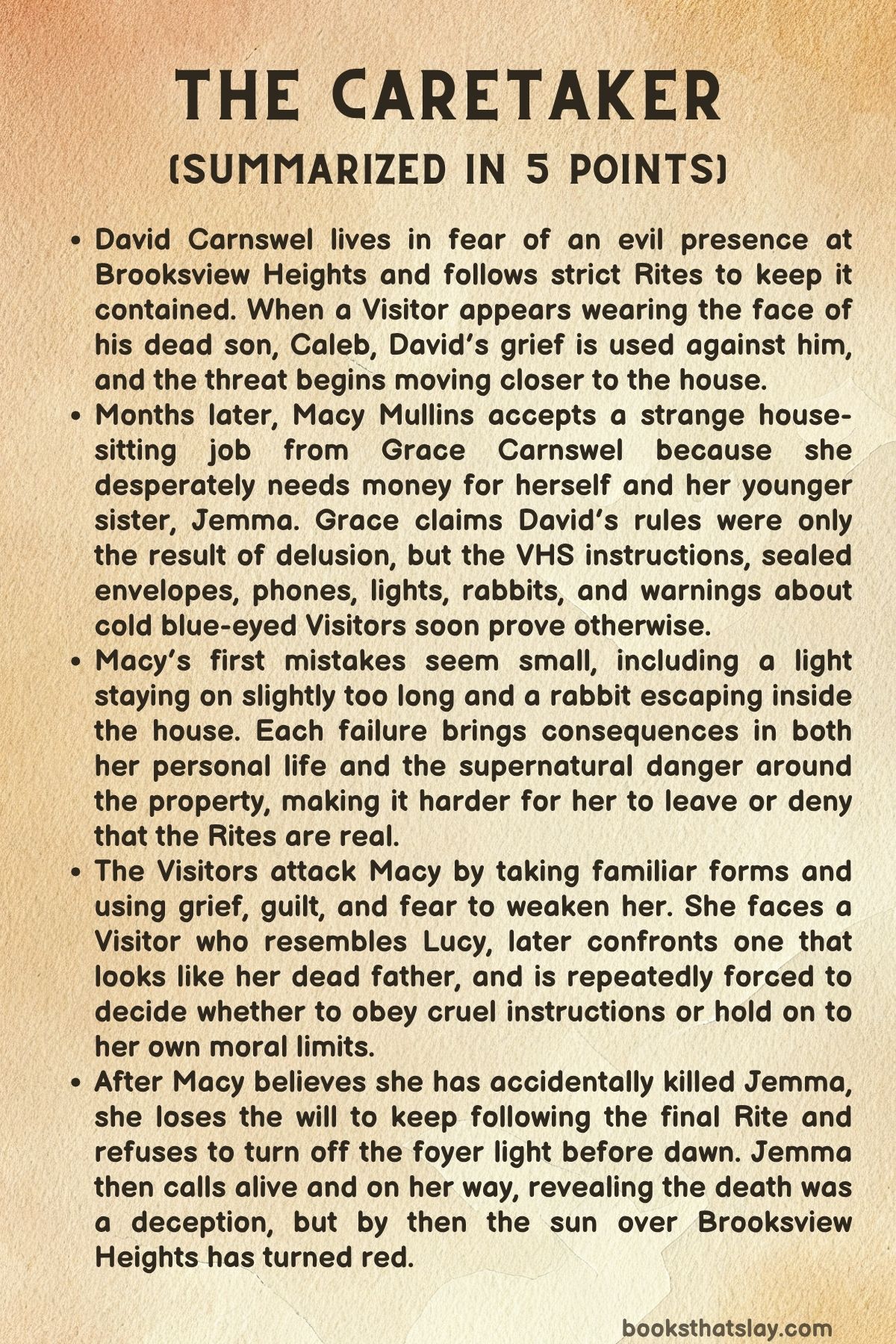
David Carnswel lives with his wife, Grace, in a remote house at 5637 Brooksview Heights. By the time the story begins, David has become consumed by a set of strange rules he calls the Rites.
He believes these actions are not superstition but a defense against an evil presence tied to the land around the house. Grace sees his behavior as the result of mental decline and grief, yet David treats the rituals as a matter of survival for everyone, not just for himself and his wife.
One night, David notices muddy footprints leading away from his front door and into the woods. He follows them because he believes the trail marks a breach in the protective order of the property.
In the woods, he finds a Visitor, a supernatural figure with cold blue eyes that wears the appearance of Caleb, David’s dead son. The creature does not merely copy Caleb’s face; it uses Caleb’s voice, David’s loss, and David’s guilt to weaken him.
David tries to calm it and guide it back, but the Visitor turns his pain against him and runs toward the house. As David chases it, many more Visitors in yellow ponchos emerge from the woods, all racing toward his home.
Months later, Macy Mullins is living in Salem, Oregon, under heavy financial pressure. She is unemployed, in debt, and responsible for her younger sister, Jemma, after their father died by driving into a river.
Macy is desperate for money and stability, so when she sees a Craigslist ad for a caretaker needed for an elderly husband, she decides to apply. The job is located at Brooksview Heights, far from her normal life, but the promised pay is high enough that she cannot easily ignore it.
Macy takes a long bus trip to the house, expecting an interview for elder care. Instead, she meets Grace Carnswel, who admits the ad was misleading.
David has been dead for three months, and Grace does not need anyone to care for him. She needs someone to stay in the house while she travels to Florida to visit family.
Macy is immediately suspicious, but Grace offers nine thousand dollars for one weekend, with three thousand paid in advance. The amount is life-changing for Macy and Jemma, at least in the short term.
Against her better judgment, Macy accepts.
Grace gives Macy a VHS tape recorded by David before his death. Macy and Jemma watch it together at home, and the tape lays out the Rites Macy must follow during her stay.
David explains that the house must be kept tidy. All lights on the main and second floors must be off between 3:00 and 4:00 a.m., and no light can remain on for longer than three minutes.
If rabbits appear inside the house, they must be caught within ten minutes and released outside. If that time limit is missed, Macy must follow instructions in a sealed envelope.
If anyone with cold blue eyes knocks between 6:00 p.m. and 6:00 a.m., she must hide and never let them enter.
Rotary phones around the house may ring with new instructions, and those instructions overrule every other rule. David also warns that the property line is marked by rope, that the caretaker cannot simply quit once the job begins, and that failure could cause a blood-red sun to rise, allowing the force on the property to spread outward.
Jemma begs Macy not to take the job, sensing that the money cannot be worth the danger. Macy, however, feels trapped by practical needs.
She returns to Brooksview Heights, where Grace gives her a tour of the house and points out the phones, envelopes, cameras, basement, and the family cat, Brownie. Grace continues to frame David’s beliefs as delusions, though she admits she still follows his routines because she promised him she would.
Once Grace leaves, Macy begins noticing things that do not feel normal. Lights switch on by themselves, a strange symbol appears near the property boundary, and rabbits move around outside the house.
Macy walks to Windfall Bluff, a nearby lookout, and meets Lucy, a nervous red-haired woman who once cleaned and house-sat for the Carnswels. Lucy tells Macy that David fired her after she slept through the witching hour and failed to keep the lights off.
Lucy also speaks about Zee, her missing best friend, whose absence still troubles her. The meeting gives Macy a hint that the house has harmed others before her, but it does not yet give her a full understanding of what she has agreed to face.
That night, Macy tries to obey the light Rite. She patrols the house between 3:00 and 4:00 a.m., making sure the lights remain off.
Later, when she reviews the Ring camera footage, she realizes that a storage-room light came on behind her and stayed on for three minutes and seven seconds. The failure is tiny in ordinary terms, but David’s instructions treat it as serious.
Macy opens the “In Case of Lights” envelope and learns that the consequence will be a moderate personal setback and an increased chance of rabbits.
The punishment arrives through Macy’s ordinary life. Greg, her father’s insurance broker, calls to say the long-delayed life-insurance payout for Macy and Jemma may be denied because the company believes their father’s death may have been self-inflicted.
During the call, Greg accidentally reveals that Macy’s father had attempted suicide before Macy was born. The news damages Macy’s understanding of her father and makes the money she needs feel even farther away.
Soon after, a brown rabbit appears inside the house.
Macy chases the rabbit but fails to catch it within ten minutes. When she opens the “In Case of Rabbits” envelope, she finds an instruction that horrifies her: she must burn the rabbit alive in the fireplace.
If she refuses, she will face worse consequences, including a devastating personal setback and a much higher chance of Visitors. Macy cannot bring herself to do it.
She tries to abandon the job and leave the property in an Uber, but as the car drives away, she is overcome by visions, sickness, and dread. She realizes the Rites may be real and returns to the house.
The phone rings, and a terrified young man gives Macy new instructions. At midnight, she must follow footprints into the woods, find the Visitor, calm it, keep it from leaving the property, and run back to the house if it begins weeping or saying strange things.
Macy obeys and finds a Visitor who looks like Lucy. The creature hears Zee calling from the woods and begins to break down.
Macy tries to soothe it, but the Visitor starts sobbing, then turns blank and says she knows Macy. Macy runs back toward the house as the Lucy-Visitor and many other yellow-ponchoed figures chase her.
Macy tackles Lucy on the stairs, but the creature escapes her, smashes her face with a boot, and gets inside.
When Macy wakes, the situation has worsened. Visitors now surround the property, cutting off escape.
Another phone call gives her a new set of Rites. She must stay inside, keep her heart rate under 150, keep all lights on, keep fallen pictures upright, avoid opening the study, and ignore the intruder if it remains contained.
The house becomes a place of constant pressure, with Macy forced to manage details while something inside uses her fear against her. It torments her with the sound of Jemma dying, forcing Macy to fight panic and obey rules that are almost impossible to maintain.
Eventually, the study door opens. A new phone call warns Macy not to look at the Visitor for more than three seconds, not to let it touch her, and to think gentle thoughts because it can hear her mind.
The creature hunts her through the house. Macy hides, arms herself with a knife, retreats to the basement, and finally fights the Visitor in darkness.
She wounds its ankle, escapes its grasp, and then stabs it again and again until it stops moving. Morning comes, and the sun rises white rather than red, suggesting Macy has survived that stage of the ordeal.
The next day, another caller tells Macy to mow the lawn. She repairs David’s mower, cuts the grass, and receives the final payment.
The money proves that the job’s rewards are real, but so are its costs. A white rabbit then appears, and this time Macy tries to follow the brutal instruction and burn it.
Before she can complete the Rite, Jemma calls and distracts her. The rabbit escapes into the basement, and Macy misses the five-minute limit.
A Visitor arrives at the front door, wearing the face and voice of Macy’s dead father. Jemma hears him over the phone and begs Macy to hide.
Macy opens the emergency envelope, which leads her to a red-lit room in the basement containing the same TV and VCR from the strange VHS glitches. A new tape from David explains that because Macy failed to burn the white rabbit, a Visitor has taken the form of someone she lost.
If it finds her, she must kill it. If she survives until morning, she must turn off the foyer light within three minutes to prevent the red sun.
The Dad-Visitor breaks in, and Macy hides in the basement room. When the door bursts open, Macy swings the VCR at the figure, believing she is defending herself.
Instead, she discovers that the person she struck is Jemma. Jemma falls, hits her head, and dies.
Macy tries to convince herself this is another trick, but the body has Jemma’s hazel eyes. The apparent death destroys Macy’s will to keep obeying the Rites.
As dawn approaches, the foyer light switches on. Macy knows she is supposed to turn it off, but she refuses.
She leaves the house and walks to Windfall Bluff, intending to jump. At first, the sun rises white, and then Jemma calls.
She is alive, still on her way to the property, and has called 911. Macy realizes the dead Jemma in the basement was another deception.
But the realization comes too late. As Jemma speaks over the phone, the white sun above Brooksview Heights turns red.
Characters
Macy Mullins
Macy Mullins is the emotional center of The Caretaker, and her role is shaped by desperation long before the supernatural danger fully reveals itself. She is not drawn to Brooksview Heights by curiosity or arrogance; she accepts the job because money has trapped her.
Her unemployment, debt, and responsibility for Jemma make her vulnerable to Grace’s offer, even when the situation clearly feels wrong. Macy’s choices often come from a mix of fear, love, guilt, and survival instinct.
She wants to protect Jemma, but the very job she takes for Jemma’s sake places both sisters in greater danger. Her moral limits are tested most clearly through the rabbits.
Macy can follow strange household rules and endure fear, but burning a living creature crosses a line she cannot easily accept. This refusal makes her sympathetic, but it also creates consequences the story treats as severe.
Macy is brave, but not invincible. She panics, misjudges, delays, and sometimes acts too late.
Her final refusal to turn off the foyer light comes from emotional collapse rather than ignorance. After believing she has killed Jemma, Macy loses faith in the value of survival itself.
Her tragedy lies in how the entity uses her best qualities, especially her love for her sister and grief for her father, as weapons against her.
Jemma Mullins
Jemma Mullins represents Macy’s strongest reason for accepting the job and her deepest emotional vulnerability. Although she is younger, Jemma often sees the danger more clearly than Macy does.
She urges Macy not to go to Brooksview Heights, not because she understands the full supernatural threat, but because she recognizes that the offer is too strange and too generous to be safe. Jemma’s relationship with Macy is built on dependence, affection, and fear of further loss.
Since their father’s death, the sisters have become each other’s remaining family, which gives Jemma a powerful place in Macy’s decisions. Jemma is not physically present for much of the ordeal, yet her voice and imagined suffering dominate Macy’s fear.
The entity understands that Macy can withstand pain directed at herself more easily than harm aimed at Jemma. That is why the sounds of Jemma dying and the false vision of her death are so effective.
Jemma also functions as the final measure of reality. When Macy thinks she has killed her, the world becomes unbearable.
When the real Jemma calls, Macy learns the truth, but the damage has already been done. Jemma’s importance comes less from action and more from emotional force; she is the person Macy is trying to save, and the person the horror uses to break her.
David Carnswel
David Carnswel is one of the book’s most unsettling figures because he stands between madness and truth. To Grace and others, he appears to have been a grieving man whose mind broke after terrible loss.
His obsession with Rites, envelopes, phones, lights, rabbits, Visitors, and the red sun looks like paranoia. Yet the events Macy experiences prove that David understood far more than anyone wanted to believe.
David’s tragedy is that being right does not make him stable, happy, or successful. He knows enough to create a system of defense, but not enough to defeat the force permanently.
His recorded tapes show a man trying to prepare strangers for horrors that sound absurd until they happen. He is controlling and frightening, but also desperate.
His rules are cruel at times, especially when they demand violence against rabbits, and the story never makes him simple to admire. Still, his warnings are often accurate.
The Visitor who appears as Caleb reveals how deeply David’s grief has been exploited. His dead son’s image becomes a weapon, suggesting that David’s knowledge of the Rites was earned through suffering.
David is both a failed protector and a necessary guide, a man whose legacy saves Macy more than once while also trapping her inside a system that offers no mercy.
Grace Carnswel
Grace Carnswel is a complicated character because she stands at the doorway between denial and belief. She presents herself as practical, calm, and tired of David’s obsessions, yet she continues to honor his routines because she promised him she would.
This makes her difficult to judge. On one hand, she misleads Macy through the job advertisement and fails to fully explain what the caretaker position may involve.
On the other hand, Grace may genuinely believe that David’s rituals are the remnants of illness rather than proof of a real threat. Her offer of nine thousand dollars suggests she understands the job is not normal, even if she refuses to state the danger plainly.
Grace’s grief over David and Caleb seems to have hardened into avoidance. She does not want to live inside David’s terror, but she also cannot fully abandon it.
Her decision to bring Macy into the house shows moral weakness, since she transfers risk onto someone poor enough to accept. Grace is not a traditional villain, but her choices make the horror possible for Macy.
She shows how denial can become a form of harm. By refusing to name the danger honestly, she leaves Macy to discover the truth only after the job has already begun.
The Visitors
The Visitors are the clearest supernatural threat in The Caretaker, but they are frightening because they are not merely monsters with cold blue eyes. They imitate the dead, the missing, and the emotionally important.
Their power comes from recognition. A Visitor does not need to be stronger than its victim at first; it only needs to look and sound like someone the victim longs for, failed, or could not save.
The Caleb-Visitor attacks David through fatherly grief. The Lucy-Visitor draws on Lucy’s lost bond with Zee.
The Dad-Visitor uses Macy’s unresolved pain over her father’s death. These forms show that the entity understands human memory and guilt with terrible precision.
The Visitors also behave according to rules that are not fully explained, which makes them even more disturbing. They can be held back, redirected, or contained, but never made harmless.
Their yellow ponchos give them a strange shared identity, turning individual grief into a crowd of threats. They are both physical and psychological dangers.
They chase, break in, injure, and kill, but their real strength lies in making people doubt what they see and what they love. Through them, the story turns mourning into a battlefield where trust itself becomes unsafe.
Lucy
Lucy is a warning figure for Macy, showing that Brooksview Heights has damaged people before her arrival. She once worked for the Carnswels, cleaning and house-sitting, but David fired her after she slept through the required hour and failed to keep the lights off.
Her nervousness suggests she has not fully recovered from what happened there. Lucy’s story about Zee, her lost best friend, gives her a private grief that mirrors the losses carried by David and Macy.
When a Visitor takes Lucy’s form in the woods, that grief becomes part of the supernatural threat. The creature responds to Zee’s voice, begins to cry, and then turns blank before pursuing Macy.
This makes Lucy more than a side character; she becomes proof that the house’s power feeds on unfinished sorrow. The real Lucy’s fear also confirms that David’s routines were not simply eccentric habits.
She knows enough to be afraid, but not enough to protect Macy completely. Her presence at Windfall Bluff expands the world beyond the Carnswel house, implying that the property’s influence has touched a wider circle of people.
Lucy’s role is brief, but she deepens the sense that Brooksview Heights leaves survivors behind who cannot explain themselves without sounding unstable.
Caleb Carnswel
Caleb Carnswel is physically absent from the main events, but his death shapes the emotional foundation of the Carnswel family. He is most important through the form the Visitor takes when confronting David.
By appearing as Caleb, the entity shows that David’s grief is one of the main openings through which it can reach him. Caleb represents the wound David cannot close and the loss Grace cannot fully face.
His memory helps explain why David became so fixated on rules, warnings, and containment. Whether David’s obsession began before or after Caleb’s death, the Visitor’s use of Caleb’s image makes clear that fatherly guilt has become central to David’s fear.
Caleb also helps establish one of the story’s main patterns: the dead are not allowed to remain peacefully dead. Their faces can return as traps.
Their voices can be copied. Their memory can be used to guide the living into danger.
Caleb’s role is therefore symbolic as well as personal. He represents love turned into leverage.
Through him, the book shows that grief is not only painful because someone is gone; it is painful because the desire to see that person again can make people vulnerable to deception.
Macy and Jemma’s Father
Macy and Jemma’s father is another absent character whose influence remains powerful throughout the story. His death by driving into a river has already left Macy with grief, confusion, and responsibility.
She has had to become Jemma’s protector while also dealing with money problems made worse by uncertainty around the life-insurance payout. The later revelation that he may have died by suicide, and that he had attempted suicide before Macy was born, changes Macy’s understanding of him.
It suggests he carried pain she did not fully know, and it complicates her mourning with questions she cannot answer. The Dad-Visitor uses this unresolved grief with cruel accuracy.
By appearing at the door in his form and speaking in his voice, the supernatural force targets Macy’s longing for explanation and reunion. Her father’s role is tied to the story’s concern with what families hide from each other.
Macy thought she knew the basic facts of his death, but the call from Greg opens a deeper uncertainty. That uncertainty leaves her exposed.
Her father is not present as a living guide, yet his memory shapes her decisions, her fears, and the form of one of the story’s most painful deceptions.
Greg
Greg, the insurance broker, has a small but important role because he brings the consequences of the house into Macy’s ordinary life. After Macy fails the light Rite, the punishment arrives not as an immediate monster attack but as a financial and emotional blow.
Greg tells Macy that the insurance payout may be denied because her father’s death may have been self-inflicted. This threatens Macy and Jemma’s future and makes Macy’s decision to take the caretaker money feel even more necessary.
Greg also accidentally reveals the earlier suicide attempt, giving Macy painful information at the worst possible time. He is not malicious, but his call becomes part of the house’s machinery of punishment.
Through him, the book shows that the Rites do not only affect what happens inside Brooksview Heights. Their consequences can reach into paperwork, money, family history, and memory.
Greg’s role also grounds the horror in real-world fear. Macy is not only afraid of Visitors; she is afraid of debt, denied claims, unemployment, and failing her sister.
Greg represents the ordinary systems that can hurt people without intending to, and his call makes Macy more emotionally exposed to the supernatural threat that follows.
Zee
Zee never appears directly as an active character, but her absence is central to Lucy’s fear and to the scene in the woods. She is Lucy’s lost best friend, and that loss gives the Visitor wearing Lucy’s face something to respond to.
When the sound of Zee calling comes from the woods, the Lucy-Visitor begins to break down, showing that the Visitors are tied to emotional histories even when they are not truly the people they resemble. Zee’s role helps expand the pattern of grief beyond Macy and David.
The property has not only harmed the Carnswels; it has also touched Lucy’s life and possibly destroyed or consumed someone close to her. Zee functions as a missing piece, a sign that Brooksview Heights leaves gaps in people’s lives that cannot be repaired.
Her absence also makes the woods feel populated by voices and memories rather than just trees and darkness. In that sense, Zee is part of the story’s atmosphere of unresolved loss.
She gives Lucy depth, and she gives the Visitor scene a sharper emotional edge, because the creature’s reaction suggests that the entity can imitate not only bodies but also the wounds connected to those bodies.
Brownie
Brownie, the Carnswels’ cat, has a quieter role than the human characters, but the cat helps make the house feel lived-in and uneasy. In a story ruled by strange instructions, sealed envelopes, cameras, phones, and supernatural threats, Brownie is part of the ordinary domestic world that still exists inside the Carnswel home.
That contrast matters. The house is not an abandoned ruin; it is a place where people lived, made promises, kept pets, and tried to maintain routines.
Brownie also adds to Macy’s sense that she has been given real responsibilities rather than only symbolic ones. She is not simply facing a haunted property; she is caring for a home with living details.
Animals in the story carry special weight because rabbits become part of the Rites and force Macy into moral crisis. Brownie’s presence differs from the rabbits because the cat is not presented as an omen or required sacrifice, but as a reminder of normal care.
In that way, Brownie quietly sharpens the horror around the rabbits. The story places ordinary affection for animals beside instructions that demand cruelty, making Macy’s choices feel more disturbing and more human.
Themes
Grief as a Point of Vulnerability
Grief in The Caretaker is not treated as a private sadness that stays inside the mind. It becomes an opening through which danger can enter.
The Visitors do not choose random disguises. They take forms connected to loss: Caleb for David, Macy’s father for Macy, and Lucy’s appearance in a scene charged by Zee’s absence.
These forms are effective because grief creates a desire to see, hear, or understand the dead and missing one more time. The horror grows from that desire.
David knows the Caleb-Visitor is not truly his son, yet the creature can still wound him because it speaks through a face he loves. Macy knows the Dad-Visitor is dangerous, but the sound of her father’s voice carries emotional force that simple reason cannot erase.
The book shows that mourning can make people doubt their own judgment, especially when guilt remains unresolved. The cruelest part of the supernatural threat is not that it kills, but that it makes love unsafe.
A familiar face becomes a trap, a voice becomes a weapon, and the need for closure becomes the path toward harm.
Poverty, Desperation, and Risk
Macy does not accept the caretaker job because she is reckless by nature. She accepts it because her life has narrowed around financial pressure.
The nine thousand dollars Grace offers is suspiciously high, but Macy’s debt, unemployment, and responsibility for Jemma make the risk seem almost practical. This theme gives the horror a social edge.
Macy’s poverty does not merely create background stress; it places her directly in danger. Grace can transfer the burden of the house to Macy because Macy needs money badly enough to ignore warning signs.
The story understands that desperation changes how choices look. A wealthy person might walk away from the strange advertisement, the misleading interview, and the bizarre VHS instructions.
Macy cannot walk away so easily because the money promises rent, security, and a future for her sister. Even after the job becomes terrifying, the financial stakes remain present through the insurance problem and the final payment.
The book suggests that danger often reaches those with the fewest options first. Macy’s courage is real, but it is shaped by an unfair situation in which survival requires accepting risks that should never have been offered to her.
Rules, Control, and the Fear of Small Mistakes
The Rites turn ordinary household actions into matters of life and death. Lights, rabbits, picture frames, doors, heart rate, lawn care, and phone calls all become part of a system that Macy must obey under extreme pressure.
The fear comes partly from the rules themselves, but even more from their precision. A light staying on for three minutes and seven seconds is enough to trigger punishment.
A missed ten-minute limit changes the course of the weekend. A five-minute failure with the white rabbit invites a Visitor wearing Macy’s father’s face.
This creates a world where small mistakes are not small at all. Macy is forced to live in a state of constant measurement, watching time, space, and behavior while fear makes accuracy harder.
The Rites also raise a deeper question about control. David’s system appears to offer protection, but it never offers freedom.
Following the rules may delay disaster, yet the caretaker remains trapped inside a game whose full purpose is hidden. The story uses this structure to show how terrifying life becomes when survival depends on perfect obedience to instructions that are incomplete, cruel, and always changing.
Deception, Perception, and Emotional Manipulation
The horror depends on Macy’s inability to trust what she sees and hears. The Visitors copy familiar people, the VHS tapes reveal information only after failures, voices come through phones with urgent instructions, and the house creates sounds that mimic Jemma’s suffering.
By the final act, deception has become so powerful that Macy strikes what appears to be an intruder and believes she has killed her sister. The later phone call from the real Jemma proves that Macy has been tricked, but the truth arrives too late to repair her decision.
This theme is especially effective because the supernatural force does not rely only on visual illusion. It understands timing, guilt, love, and panic.
It knows when to sound like Jemma, when to look like Macy’s father, and when to push Macy toward despair. The story also shows how fear weakens perception.
Macy is not foolish for being deceived; she is exhausted, injured, isolated, and under impossible pressure. Her mind is being attacked as much as her body.
The red sun at the end marks more than a failed Rite. It marks the victory of manipulation over trust, hope, and clear judgment.