The Bloody and the Damned Summary, Characters and Themes
The Bloody and the Damned by Becca Coffindaffer is a dark science-fantasy story set on Trinity, a brutal metal world where survival depends on rationed water, naphtha, class power, and the dangerous gifts of saints. At its center is Valene Bruinn, a protective older sibling who secretly lives as the Butcher, a feared assassin with the ability to phase through space.
The novel follows Val through betrayal, family loss, hidden history, divine fraud, and a final choice that reshapes an entire world. It is a story about violence, devotion, exploitation, and the cost of saving the people one loves.
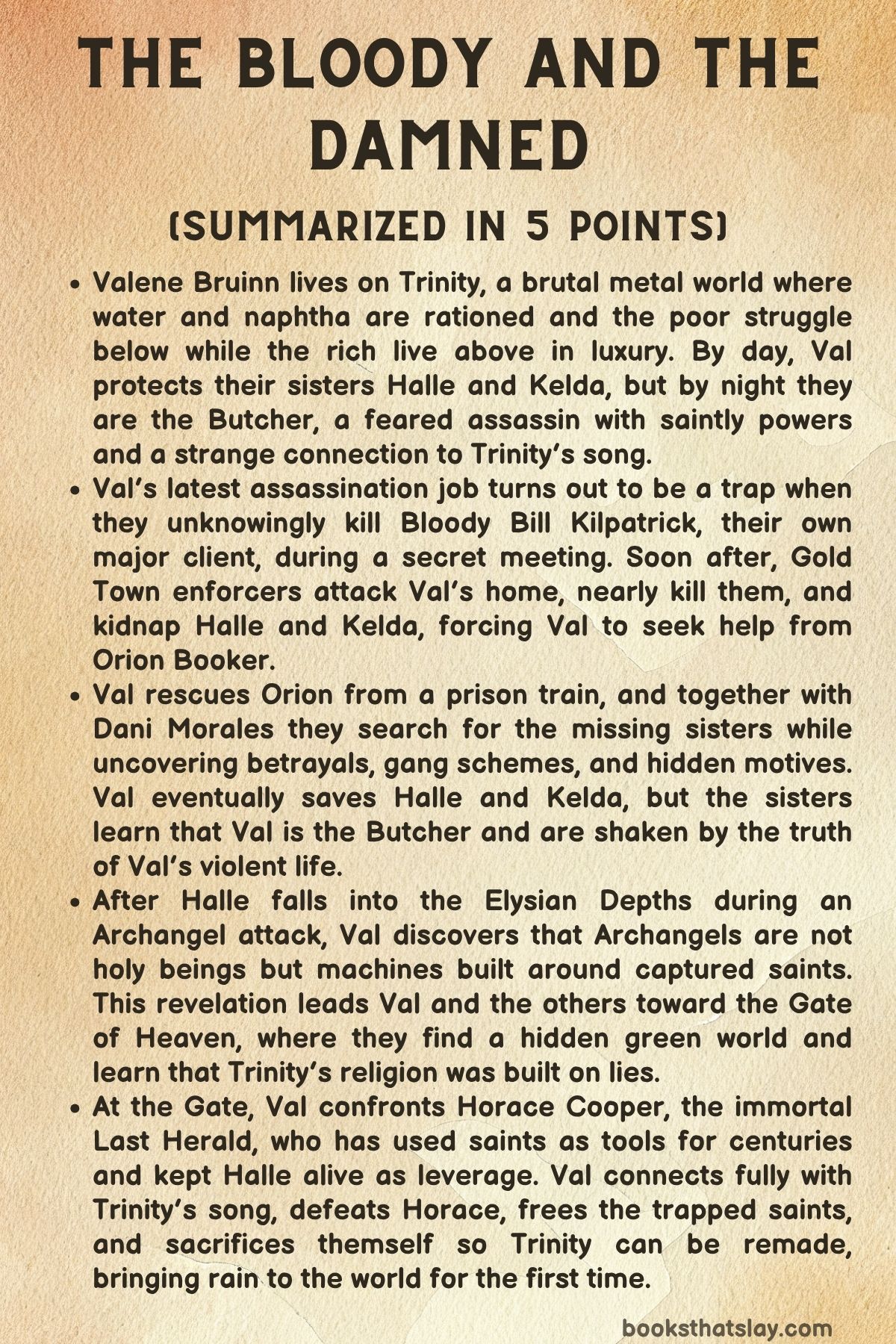
Summary
Valene Bruinn lives on Trinity, a harsh metal world divided by wealth, scarcity, and fear. The rich live above the dust in skyliner ships and floating homesteads, while those below struggle for water, fuel, and safety.
Val’s public life is centered on protecting their younger sisters, Halle and Kelda, but their secret life is far more dangerous. By night, Val is the Butcher, an assassin feared across Covenant because of their saintly ability to phase through space.
Val also hears the song of Trinity, a strange living call that no one around them fully understands.
Val’s latest job comes through Dani Morales, their handler. The assignment seems direct: board an airship, kill Gold Town Gang defectors named Eteri and Karolyi, and recover stolen water for the crime boss Bloody Bill Kilpatrick.
Val carries out the first part of the mission with lethal precision, but once they reach the cargo hold, they discover the job was not what they were told. Instead of stolen water, the hold contains a secret meeting of masked figures: preachers, wardens, barons, and gang leaders.
Because the witnesses have seen Val use their power, Val decides none of them can live. They kill everyone in the room, only to remove one mask afterward and discover that one of the dead men is Bloody Bill himself.
Someone has tricked the Butcher into murdering their own most important client.
Val destroys the airship to hide the evidence and returns home shaken by the betrayal. On the way, they see news that Orion Booker, their childhood friend and former love, has been arrested as the Skywayman and is being sent to the Ninth Circle prison.
Val also witnesses a strange blue-white flare rising from the distant Depths. The flare makes Trinity’s song louder and more painful, as if the world itself is trying to call to them.
When Val reaches home, Halle and Kelda are safe, but the peace does not last. Halle is angry about Val’s secrecy and broken promises, while Kelda wants more freedom than Val is willing to give.
Val tries to bury their fear in moonshine, but the night only grows worse.
Gold Town enforcers attack the apartment. Vasya Paley, known as the Gold Town Hammer, nearly kills Val, while other gang members abduct Halle and Kelda.
Vasya detonates a device that destroys the apartment, but Val phases away and survives with serious wounds. After using emergency supplies and dangerous elixirs to recover enough to move, Val tries to contact Dani, but Dani does not appear.
With no handler, no home, and their sisters missing, Val goes to the chapel and sees their mother, who has become a prophet claimed by the Heraldic Ministry. She is white-eyed, humming, and no longer the parent Val once knew.
With Gold Town hunting them and Dani gone, Val decides that the only person capable of helping is Orion.
Val attacks the prison train carrying Orion and kills wardens to reach him. Orion, however, is not as helpless as expected.
He reveals that he had allowed himself to be captured so he could steal Ministry information from High Warden Clarence. He has already freed himself from his restraints and taken a red crystal and a telegram.
Val tells him Halle and Kelda have been kidnapped, and Orion agrees to help, though he demands a future favor in exchange. His brother Atlas, a preacher, arrives with automaton mounts and helps them escape.
As they return toward Covenant, another blue-white flare erupts from the Copper Plains, and Val feels its force more intensely than before.
Orion leads Val to the Old Clock Tower, a Gold Town stronghold, where they find Dani alive. Val quickly realizes the truth: Dani arranged the false job that led to Kilpatrick’s death.
Dani admits that she set Val up to kill him, though she insists she never intended for Halle and Kelda to be taken. Val wants to kill her, but Dani still knows too much to waste.
Val, Orion, and Dani begin forcing information out of Gold Town members and learn that the sisters may have been taken to South Parish.
Their search brings them to the Gentleman’s Rack, a Gold Town gambling den. Orion creates a distraction, Dani cuts the naphtha power, and Val moves through the building, killing their way toward the vault.
Val expects to find Halle and Kelda there, but the vault does not hold the girls. Instead, Orion finds the Aaldenberg knot, a legendary puzzle box he had been hunting.
Val is furious, believing Orion used the rescue mission to advance his own goals. Then Val finds Halle’s copper hairpin and realizes the sisters escaped through the vents.
Val tracks Halle and Kelda to the roof, where Rough Rory Rhodes and other Gold Towners are holding them hostage. Rory exposes Val’s identity as the Butcher in front of the sisters, forcing them to confront the truth about the person who raised and protected them.
Val tells the girls to close their eyes and kills the attackers. Halle and Kelda survive, but they are horrified by what they have seen and hurt by Val’s lies.
At the same time, chapel bells begin ringing because Val’s saintly power has been exposed. Another huge flare erupts from the Crater, cutting power and sending skyliner ships falling from the sky.
Val, Halle, Kelda, Orion, Dani, Atlas, and Atlas’s partner Liren flee Covenant together.
The group reaches Concord, but danger follows them. An Archangel finds them, and Val fights it, only to be seized.
Halle attacks the Archangel to save Val and is thrown aside, falling into the Elysian Depths. Val is overcome with rage and destroys the Archangel.
Inside it, they find a human body: Sorcha Tannith, a saint who had been taken years earlier. The discovery changes everything.
Liren examines Sorcha’s remains and confirms that Archangels are not holy machines but constructs built around captured saints. Val grieves Halle, but Kelda still needs them, so they keep moving.
Orion opens the Aaldenberg knot with help from Val’s humming of Trinity’s song. Inside are a preserved flower, a living creature named Ember, and a message from Samuel Covenant: “Proof of life.
There are answers at the gate.” The message points them toward the Gate of Heaven, the place saints are said to go when taken by divine forces. Val decides they must go there, both for answers and for revenge.
The journey across the Copper Plains is dangerous, with Archangels pursuing them. At the Gate, Val, Orion, and Dani enter through an aqueduct and discover a hidden green world filled with water, soil, flowers, and old machinery.
This place reveals the truth behind Trinity’s religion. The Heralds were not divine beings.
They were the thirteen founders of the Herald Power Company. Their naphtha experiments transformed Trinity into metal, erased history, created the aqueduct system, and allowed Horace Cooper to present himself as the Last Herald.
Saints were not chosen by the Ministry or created for worship. They were made by Trinity itself, but Horace captured them and used their power by trapping them inside Archangels.
Val fights through Archangels and reaches the inner part of the Gate, where they find Gabriel Cirillo, a saint taken as a child, still alive but imprisoned. Horace Cooper appears and reveals himself as the immortal Last Herald.
He argues that saints must return their power to Trinity and tries to force Val to surrender. He also reveals that Halle is alive.
Archangels saved her from the Depths and brought her to him so he could use her as leverage. Val refuses to bargain with him.
They trap Halle safely behind a door and attack Horace.
Horace is almost impossible to kill. He is filled with naphtha instead of blood, and his Herald-angels overwhelm Val.
Near defeat, Val reaches the pool of Trinity’s light and enters it. Inside the song, Val understands that Trinity is alive and has been trying to reach saints for centuries.
The voices of the captured saints are part of that song. Val returns transformed, able to command lightning, move with greater force, and connect to all the saints trapped by Horace.
With this new power, Val destroys the Herald-angels, frees Gabriel, rescues Halle, Orion, and Dani, and phases them all to safety. Val then kills Horace, reducing him to golden dust.
But the victory demands a final sacrifice. Trinity’s song calls Val back, and Val understands what must happen.
They say goodbye to Kelda, Halle, Orion, Dani, Atlas, and Liren. After embracing their sisters one last time, Val returns to the Gate and gives themself to Trinity.
The Gate collapses, Trinity is remade, and the sky changes. Val becomes something new with the living world they have finally heard clearly.
For the first time, rain falls on Trinity, marking both an ending and the beginning of a transformed future.
Characters
Valene Bruinn
Valene Bruinn is the central force of The Bloody and the Damned, a character shaped by survival, secrecy, violence, and fierce family devotion. As the Butcher, Val has built a life around killing, partly because their saintly power makes them uniquely capable of it and partly because the world around them has left very few safe choices.
Their ability to phase through space gives them terrifying power, but the book never treats that power as simple freedom. It isolates Val, makes them feared, and turns them into a weapon for people who manipulate them.
At home, Val is not the Butcher but Halle and Kelda’s protector, a role they cling to with desperate intensity. Their tragedy lies in the fact that the life they built to protect their sisters is the very life that endangers them.
Val’s emotional journey is driven by guilt: guilt over the people they have killed, guilt over lying to Halle and Kelda, guilt over failing to stop Halle’s fall, and guilt over surviving when others suffer. Yet Val is not defined only by brutality.
Their connection to Trinity’s song reveals a deeper sensitivity beneath their guarded exterior. By the end, Val becomes more than an assassin or even a saint.
Their final sacrifice turns protection into transformation, changing their love for their sisters into an act that renews the whole world.
Halle Bruinn
Halle Bruinn represents the emotional cost of Val’s secrets. She is old enough to recognize that Val is hiding something, and her anger comes from years of being protected without being trusted.
Halle loves Val, but she does not want a life built on half-truths, unexplained absences, and broken promises. Her reaction to discovering that Val is the Butcher is one of the book’s most important emotional breaks because it forces Val to face how their hidden life has damaged the family bond they were trying to preserve.
Halle is also brave in her own right. When the Archangel seizes Val, Halle acts without hesitation, attacking a monstrous force to save the person she loves.
Her fall into the Depths becomes one of Val’s deepest wounds, but her later survival also gives Horace a way to test Val’s limits. Halle’s role is not simply that of a rescued sister.
She is a moral witness. Through her pain, the story asks whether protection still counts as love when it denies someone truth and choice.
Kelda Bruinn
Kelda Bruinn is the youngest of the Bruinn sisters, and her presence gives Val’s mission its tenderest purpose. She wants more freedom and independence, but her youth also makes her vulnerable in a world where children can be used as leverage.
Kelda’s relationship with Val is shaped by dependence, affection, and frustration. She wants to be safe, but she also wants to live rather than exist inside Val’s fear.
After the sisters are kidnapped, Kelda becomes one of the reasons Val refuses to stop moving, even after injury, betrayal, and grief. When Halle is believed dead, Kelda’s survival keeps Val from collapsing completely.
She also carries the future that Val wants to protect. The final goodbye between Val and the sisters matters because Kelda must go on in the remade world without the person who had always tried to shield her from harm.
In that sense, Kelda embodies both innocence and continuation.
Orion Booker
Orion Booker is Val’s childhood friend, former love, and one of the few people who can challenge them without being destroyed by their defenses. As the Skywayman, Orion is clever, theatrical, and deeply committed to his own mission against the systems controlling Trinity.
His decision to let himself be captured shows how willing he is to risk himself for knowledge. Yet he is not purely noble.
His pursuit of the Aaldenberg knot during the rescue effort makes Val feel used, and that tension reveals the uneasy balance between trust and self-interest in their relationship. Orion’s connection to Val is layered with old affection, shared history, disappointment, and unfinished longing.
He understands parts of Val that others do not, but he also withholds his own motives when it suits him. His best quality is his belief that the truth matters, even when it is dangerous.
Through Orion, the book explores how love can survive anger, distance, and competing loyalties without becoming simple or easy.
Dani Morales
Dani Morales is one of the most morally complicated figures in the book. As Val’s handler, she understands the criminal networks of Covenant and knows how to move through danger with calculation.
Her betrayal is devastating because it is practical rather than impulsive. She arranges the false job that causes Val to kill Bloody Bill Kilpatrick, changing Val’s life in a single night.
Dani insists she never wanted Halle and Kelda kidnapped, but her excuse does not erase the consequences of her choice. She is useful, intelligent, and often necessary, which makes Val’s anger toward her more difficult to act on.
Dani survives because she has information, and the story keeps forcing Val to work beside someone they have every reason to hate. Her character shows how survival in Trinity often demands compromise, but it also asks where compromise becomes unforgivable.
Dani is not redeemed by simple apology; instead, she remains a person whose help and harm cannot be separated cleanly.
Atlas Booker
Atlas Booker, Orion’s brother, brings a different kind of strength into the group. As a preacher, he is connected to the religious structure of Trinity, but he does not function as a blind servant of the Ministry’s lies.
He rescues Val and Orion with automaton mounts and becomes part of the escape from Covenant, showing both courage and loyalty. Atlas also gives the group a steadier presence amid chaos.
Unlike Orion, who often operates through secrets and daring plans, Atlas feels more grounded. His relationship with Liren adds warmth and humanity to the group’s journey, even as the world around them becomes more dangerous.
Atlas’s role is important because he complicates the portrayal of faith. Not every religious figure is corrupt, but the institutions built around faith have been deeply corrupted.
Atlas stands near that divide.
Liren
Liren is Atlas’s partner and one of the group’s most rational, observant figures. Their importance becomes clear after Val destroys the Archangel and Sorcha Tannith’s body is found inside.
Liren examines Sorcha and confirms the horrifying truth that saints have been trapped within Archangels. This discovery changes the meaning of the Ministry’s power and exposes the violence hidden beneath divine language.
Liren’s role is quieter than Val’s or Orion’s, but their knowledge gives the group a way to understand what they are seeing. They help turn horror into evidence.
In a story full of assassins, gang leaders, saints, and false gods, Liren represents careful attention and the need to look directly at the body of truth rather than accept the stories told by authority.
Vasya Paley
Vasya Paley, the Gold Town Hammer, is a direct embodiment of gang violence. His attack on Val’s apartment marks the point where Val’s hidden life fully invades their home.
Vasya is not simply an obstacle in a fight; he represents the reach of Gold Town power and the way criminal punishment spreads beyond its intended target. By nearly killing Val and helping set the sisters’ abduction in motion, he exposes the weakness in Val’s belief that they can separate assassination from family.
His brutality is personal because it happens inside the space Val thought of as home. Even though he is not one of the story’s most emotionally layered characters, his impact is enormous.
He turns Val’s fear into reality.
Rough Rory Rhodes
Rough Rory Rhodes functions as a cruel public revealer. By holding Halle and Kelda hostage and exposing Val as the Butcher in front of them, Rory does more than threaten their lives.
He destroys the last barrier between Val’s two identities. His actions force a confrontation Val had avoided for years, making the sisters see the violence that paid for their safety.
Rory’s role is brief but important because he understands that shame can be used as a weapon. He attacks Val not only through physical danger but through truth delivered at the worst possible moment.
His death saves the sisters, but the emotional damage he causes remains.
Bloody Bill Kilpatrick
Bloody Bill Kilpatrick is powerful even in death. As Val’s main client and a major crime boss, he represents the criminal hierarchy that has helped sustain Val’s life as the Butcher.
His murder is the first major trap in The Bloody and the Damned, and it destabilizes everything around Val. Kilpatrick’s death matters because it proves Val can be used, even with all their skill and caution.
The revelation that Val has unknowingly killed him exposes how little control they truly have over the jobs they accept. He is less emotionally central than others, but his death begins the chain of betrayal, retaliation, and discovery that drives the story forward.
Eteri and Karolyi
Eteri and Karolyi are the supposed targets of Val’s airship mission. They are described as Gold Town Gang defectors, and their deaths at first seem to confirm the job Val has been given.
Their function in the book is tied to misdirection. Val believes they are carrying stolen water, but they are part of a setup designed to bring Val to a hidden meeting and make them kill people they did not intend to target.
As characters, they are not deeply developed, but they matter because their presence helps create the illusion of a routine assassination. Through them, the story shows how easily Val’s professional certainty can be turned against them.
Val’s Mother
Val’s mother is one of the book’s most unsettling figures because she shows what the Heraldic Ministry can do to a person. When Val sees her in the chapel, she is no longer simply a mother.
She has become a prophet, white-eyed and humming, claimed by a religious system that uses bodies and voices for its own purposes. Her transformation mirrors the larger exploitation of saints and believers across Trinity.
For Val, seeing her like this deepens the sense that family can be taken in many ways: by gangs, by poverty, by religion, by power, and by forces that call themselves holy. She also reflects a possible fate that Val fears, one in which a person’s gifts and identity are consumed by something larger and crueler.
Sorcha Tannith
Sorcha Tannith is a dead saint whose body is discovered inside an Archangel. Her character carries immense symbolic weight.
Though she is no longer alive when Val finds her, her body becomes evidence of one of the story’s central horrors. Saints who were believed to have been taken to a divine destiny were instead imprisoned inside machines and used as power sources.
Sorcha turns myth into proof. Her funeral rites matter because they restore dignity to someone who had been turned into a hidden engine of violence.
Through Sorcha, the story gives a face to the many stolen saints whose voices are trapped in Trinity’s song.
Gabriel Cirillo
Gabriel Cirillo is a saint taken as a child and kept alive inside the Gate. His survival reveals the long cruelty of Horace Cooper’s system.
Gabriel is not just a victim of the past; he is living proof that the false divine order has been feeding on saints for years. His imprisonment shows the personal cost of the Ministry’s mythology.
Children with gifts were not honored, protected, or elevated. They were captured and used.
Gabriel’s rescue becomes one of the clearest signs that Val’s final fight is not only about revenge or family, but about freeing all those whom Trinity had been trying to reach.
Horace Cooper
Horace Cooper is the central villain, the immortal Last Herald who built a religion out of corporate crime, erased history, and turned saints into tools. His power comes from both physical unnaturalness and ideological control.
Filled with naphtha instead of blood, he is almost impossible to kill, but his more frightening strength is his ability to make exploitation look sacred. He claims saints must give their power back to Trinity, yet he has spent centuries imprisoning them and using their abilities for domination.
Horace represents the fusion of industry, religion, and authoritarian control. His defeat is not simply the death of one man.
It is the collapse of a false history. When Val reduces him to golden dust, the book rejects his version of divinity and restores Trinity’s voice to the saints he tried to silence.
Samuel Covenant
Samuel Covenant is important because of the message hidden inside the Aaldenberg knot. His words, “Proof of life.
There are answers at the gate,” direct Val and the others toward the truth. Although he is not physically central in the action, his message becomes a bridge between lost history and present discovery.
The preserved flower, Ember, and the note all suggest that the official story of Trinity is incomplete and that life still exists where it was believed impossible. Samuel’s role is that of a hidden witness, someone whose trace helps break open the world’s greatest lie.
Ember
Ember, the living creature found inside the Aaldenberg knot, is small but meaningful. In a metal world defined by scarcity, machinery, and artificial systems of survival, the existence of a living animal is astonishing.
Ember proves that life has endured beneath the lies. Alongside the preserved flower, Ember points toward the hidden green world at the Gate and prepares the characters to understand that Trinity was not always what it has become.
Ember’s presence gives physical form to hope, not as an abstract idea, but as something breathing, fragile, and real.
High Warden Clarence
High Warden Clarence matters because Orion uses his capture to steal Ministry information from him. Clarence represents the prison and enforcement side of the system that keeps Trinity controlled.
His role shows that the Ministry’s authority is not maintained only by preaching and myth, but also by wardens, trains, confinement, and punishment. Even though he is not explored as deeply as the major characters, his position helps reveal how many institutions serve the same lie.
The prison train sequence also proves Orion’s resourcefulness and shows how information can be as valuable as weapons.
Themes
Power Built on Scarcity
Scarcity controls nearly every part of life on Trinity. Water and naphtha are rationed, and that rationing determines who lives in comfort and who struggles in dust below.
The wealthy remain physically above the poor in skyliner ships and floating homesteads, making class division visible in the world’s geography. This scarcity is not only natural hardship; it is political control.
When people depend on powerful groups for water, fuel, work, and safety, they become easier to manipulate. Gangs, wardens, barons, and religious authorities all benefit from a world where ordinary people are desperate.
Val’s life as an assassin is tied to this structure because violence becomes a form of employment in a society where survival has already been made brutal. The later discovery of a hidden green world with water and soil makes the injustice sharper.
Trinity’s people have been taught to accept deprivation while proof of abundance is hidden behind myth and machinery. The theme shows that scarcity can be manufactured, protected, and justified by those who profit from it.
Family, Protection, and the Damage Caused by Secrecy
Val’s love for Halle and Kelda is the emotional center of the story, but that love is complicated by secrecy and control. Val believes that hiding their identity as the Butcher is necessary to keep the sisters safe.
In practical terms, this makes sense: Val’s enemies are dangerous, and knowledge can be deadly. Yet the book shows that secrecy also creates distance.
Halle feels betrayed not only because Val has killed, but because Val has denied her the truth about the life supporting their household. Protection becomes painful when it removes trust.
Kelda’s desire for freedom adds another layer, showing that safety without agency can feel like confinement. When Rory exposes Val’s identity, the revelation hurts because it comes through violence rather than honesty.
Val’s final sacrifice changes the meaning of protection. Instead of guarding their sisters through lies and bloodshed, Val gives them a transformed world where they may have a chance at a life beyond fear.
The theme asks whether love can truly protect others if it refuses to let them know what they are being protected from.
False Divinity and Institutional Control
The religion surrounding the Heralds depends on distance, mystery, and obedience. Saints are treated as sacred figures, Archangels are presented as divine agents, and the Gate of Heaven is imagined as a holy destination.
The truth destroys that entire structure. The Heralds were founders of the Herald Power Company, not gods, and their experiments reshaped Trinity while erasing the past.
Horace Cooper’s survival as the Last Herald is built on controlling both history and belief. By turning captured saints into Archangels, he transforms living people into religious machinery, then uses the image of holiness to hide what has been done to them.
This is one of the strongest themes in The Bloody and the Damned because it shows how institutions can make cruelty appear righteous. Language becomes a weapon.
Words like saint, prophet, Herald, and Heaven are used to make exploitation feel inevitable or sacred. Val’s discovery of the truth breaks that spell.
Once the divine story is revealed as a system of theft, imprisonment, and historical manipulation, rebellion becomes not only political but spiritual.
Identity, Violence, and Transformation
Val’s identity is divided between sibling, assassin, saint, and listener to Trinity’s song. For much of the story, they believe these roles cannot exist together peacefully.
As the Butcher, Val is feared and efficient, but that name also traps them inside the worst things they have done. As Halle and Kelda’s protector, Val wants to be loving, reliable, and necessary, yet their violent life keeps poisoning that role.
As a saint, Val has power they do not fully understand, and the world around them is eager to define that power for its own purposes. The story’s movement is not about Val becoming innocent.
They cannot undo the deaths they caused. Instead, their transformation comes through recognition and choice.
By entering Trinity’s song, Val finally understands that their gift is not a curse created for killing and not a resource for Horace to harvest. It is part of a living world reaching out through stolen voices.
Val’s final act does not erase their violence, but it redirects their power toward liberation, repair, and renewal. Their ending suggests that identity is not fixed by the names others give us, even names earned through blood.