The Girl Upstairs Summary, Characters and Themes
The Girl Upstairs by Jessica R. Patch is a psychological suspense novel about buried trauma, hidden crimes, and the dangerous cost of silence. The story follows Gwen McDaniel, a former homicide detective trying to rebuild her life with her husband in a cliffside house in Cold Harbor, Maine.
What begins as a fragile fresh start becomes a confrontation with strange visions, missing girls, old murders, and secrets protected for decades. The novel uses the haunted-house atmosphere not only for fear, but also as a way to explore memory, grief, manipulation, and the long reach of violence.
Summary
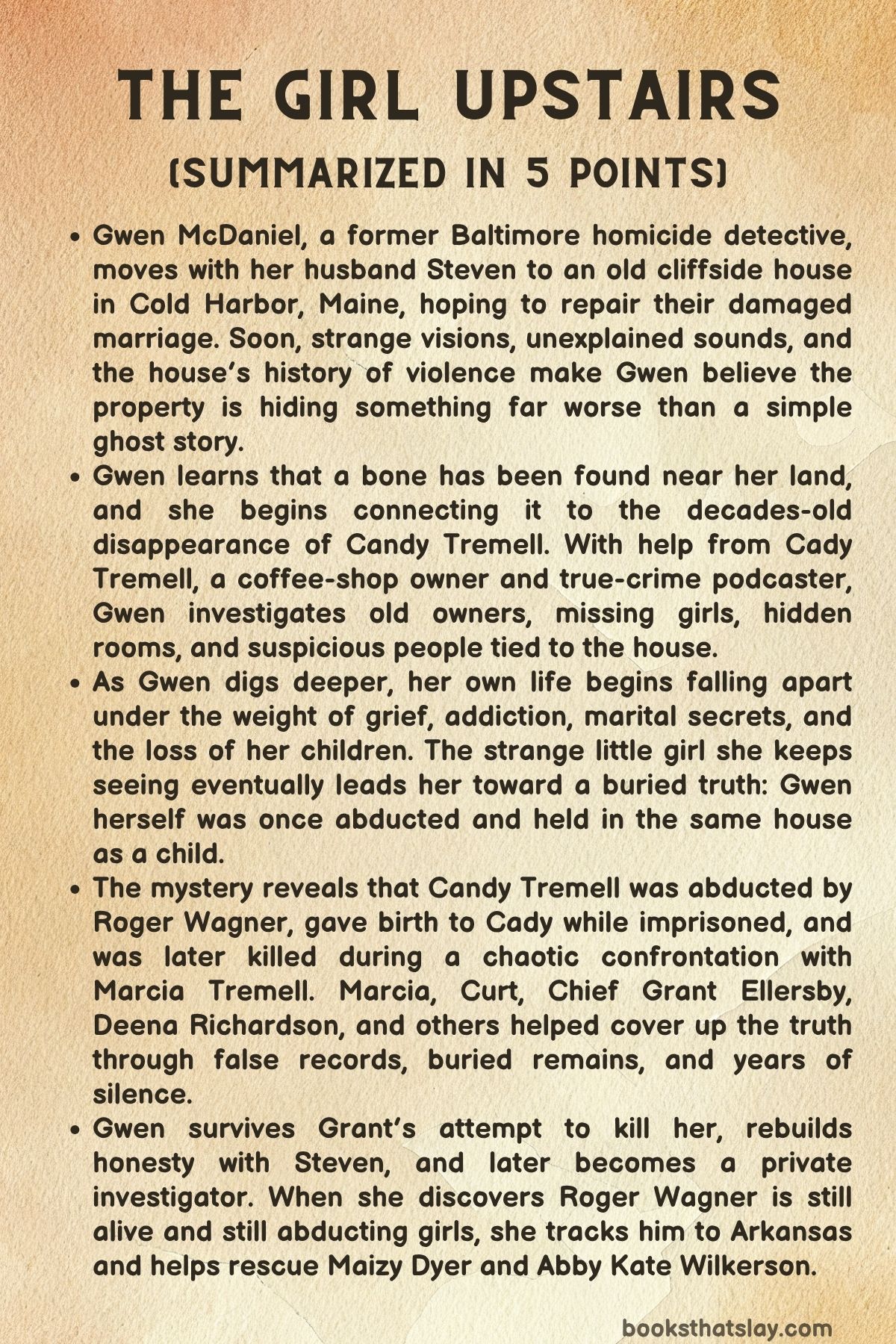
The Girl Upstairs begins with Gwen McDaniel and her husband, Steven, moving from Baltimore to Cold Harbor, Maine, after their marriage and careers have been damaged by grief, addiction, betrayal, and loss. Gwen was once a homicide detective, while Steven had a respected medical career before their lives fell apart.
Their new home, an old house on Darkwater Road overlooking the harbor, is supposed to give them a chance to repair what remains of their relationship. Yet from the moment Gwen enters the house, she senses that something is deeply wrong.
The realtor, Teresa, eventually admits that the house has a grim reputation. In 1974, Thomas Barkley allegedly murdered his wife, Gina, and daughter, Lizzie, before killing himself.
This history unsettles Gwen, but the disturbing events inside the house quickly become more personal than local rumor. Gwen sees a little girl, hears strange sounds, notices a fireplace that appears to blaze and then turns cold, and later hears baby cries, chains, and old music coming from the attic.
Steven insists that grief, anxiety, and trauma are affecting her judgment. Gwen, however, feels that the house is trying to reveal something.
Soon after the move, a bone is discovered in the woods near Gwen’s property. Chief Grant Ellersby claims it is only an animal bone, but a hunter named Wilt Dinner disagrees.
Gwen’s instincts as a former detective awaken, and she begins looking into the discovery despite Steven’s concern. She befriends Cady Tremell, the owner of Black Capped Coffee, who is preparing a true-crime podcast.
Cady has her own reason for caring about missing-person cases: her older sister, Candy, vanished thirty years earlier when she was thirteen. Candy was never found, and the wound of that disappearance still shapes Cady’s life.
Gwen begins to suspect that the bone may be connected to Candy. Steven warns her to stop investigating because their past in Baltimore could expose them to further damage.
Their marriage is already fragile, and Gwen’s fixation on the house and the missing girl only increases the strain between them. Still, Gwen cannot ignore what she sees and hears.
As renovations continue, the disturbances grow worse. The attic record player plays “Beautiful Dreamer” by itself.
Lights flash from Dr. Adrian Rivera’s house across the harbor. Gwen sees a child jumping rope and discovers the words “I AM NOT CRAZY” carved again and again into the attic floor under old carpet.
The novel also follows a girl named Lily Ann in separate sections. She is abducted by a man pretending to be a park ranger.
He convinces her that her parents are dead, traps her in hidden spaces, and forces her to accept him first as “Daddy” and later as “Husband.” These sections reveal a history of captivity, control, and psychological abuse. At first, Lily Ann’s story appears separate from Gwen’s investigation, but it gradually becomes clear that it is tied to the house and to the crimes hidden there.
Gwen and Cady research the property’s past. They learn about Roger Wagner, his wife Ann, and their daughter Lily Ann, who was said to have run away.
They also look into old fires, missing girls, rumors involving the Barkleys, Rebekah Howler, property records, and the people who once had connections to the house. Gwen visits Dr. Adrian Rivera, who has Alzheimer’s, and questions his nurse, Kristin White.
Adrian’s confused comments about a girl, a dock fire, and the house suggest that he knows more than he can clearly explain. Deena Richardson, a Welcome Wagon visitor and retired real-estate agent, also reacts nervously when Gwen asks questions.
Not long afterward, Deena is found dead on a hiking trail, supposedly after a fall. Gwen believes she was killed to keep her quiet.
The danger around Gwen increases. Her shed burns, her car’s lug nuts are loosened, objects in the house are moved, and lights appear in the woods at night.
She begins to think someone is removing remains from the property before she can prove anything. Steven sees her behavior as reckless and obsessive.
He wants her to choose their marriage over the mystery, but Gwen feels unable to stop. Their personal secrets begin to surface.
Gwen suspects Steven of cheating with Teresa after discovering hidden texts, while Steven confronts Gwen about the damage she caused in Baltimore. After miscarriages and the stillbirth of their daughter, Gwen became addicted to pain pills, stole Steven’s prescription pads, forged his signature, and helped destroy his career.
Another painful truth is revealed: the baby Gwen carries and cares for, Tara Gwen, is not alive. She is a realistic doll Gwen uses to cope with loss.
For a short time, Gwen tries to step away from the investigation in order to save her marriage. But Cady finds Lily Ann Cartwright in Florida, and the search becomes impossible to ignore.
Gwen and Cady travel to meet her. Lily Ann confirms that her father, Roger Wagner, was a predator who abused young girls, controlled people, and made them question their own sanity.
She also reveals that the house had hidden rooms. Gwen returns to Cold Harbor convinced that Roger may have abducted Candy Tremell and kept her somewhere inside the house.
Gwen’s suspicions widen. She begins to think that Cady’s mother, Marcia Tremell, Cady’s father Curt, Chief Grant Ellersby, Deena Richardson, attorney Pat Dunham, Adrian Rivera, and others may have helped hide something terrible decades earlier.
On Halloween, Gwen follows more clues. Brad Langston, the previous owner, reveals that Deena was his great-aunt and had helped arrange the property so it would remain connected to the family.
Gwen realizes that the sale records and ownership history have been manipulated to hide the truth.
After visiting Cady and Adrian, Gwen is drugged by tea from Kristin. Chief Ellersby meets her at the dock and attempts to make her death look like an accident.
During the confrontation, Gwen’s buried memories return. She realizes that she herself was once a ten-year-old abducted child kept in Roger Wagner’s house and called “Dolly.” The little girl she believed she was seeing was not a ghost in the ordinary sense, but a memory of herself.
The words “I AM NOT CRAZY” were carved by Gwen when she was a child, a desperate attempt to hold on to reality while Roger tried to break her mind.
Steven and Cady rescue Gwen. Meanwhile, Cady has confronted Marcia after DNA evidence proves that Cady is actually Candy Tremell’s biological daughter.
Marcia confesses the truth. Candy was abducted by Roger and held in the hidden basement, where she gave birth to Cady, whom she named Tara.
Marcia found Candy after years of searching and shot Roger when he returned. In the chaos, Candy, deeply traumatized and conditioned by Roger’s abuse, attacked Marcia for killing the man she had been forced to call “Husband.” Marcia killed Candy during the struggle.
Instead of reporting the truth, Marcia called Curt, who called Grant. A group of adults covered up the crime.
They buried Candy and Roger, cleaned the house, concealed evidence with carpet, arranged false papers so Cady could be raised as Marcia and Curt’s adopted daughter, and helped manipulate property records. Deena later tried to protect the secret but panicked when Gwen began asking questions, so Marcia killed her too.
Grant was not the original killer, but he protected the cover-up, moved remains, manipulated Gwen, and ordered Kristin to drug her.
Gwen also learns that Grant had once returned her anonymously to her parents after her captivity in Roger’s house. Her childhood trauma had been buried so deeply that she did not remember it until the house forced the memories back into the open.
She then shares another long-hidden secret with Steven: when she was sixteen, a married man preyed on her, and she gave birth to a daughter named Tara, whom she placed for adoption. Steven chooses not to abandon her.
They agree that if their marriage is to survive, it must be rebuilt without lies.
Eight months later, Gwen and Steven remain in the renovated Darkwater Road house. Cady’s podcast about the case becomes a major success.
Gwen has found her adult daughter, Laken, and now has a granddaughter, Nora. Curt and Marcia have been sentenced, but Gwen continues investigating because Roger’s grave has never been found.
The final revelation confirms her fear: Roger survived being shot and has continued abducting girls.
Now working as a private investigator, Gwen tracks Roger to Arkansas. With police, she raids his house and rescues two girls, Maizy Dyer and Abby Kate Wilkerson.
Maizy is reunited with her parents, and Gwen is able to give another family the kind of rescue and closure that had once been denied to her. The ending brings Gwen’s trauma, detective instincts, and need for justice together, showing her no longer as a woman controlled by buried memories, but as someone who can face the past and save others from the darkness that once consumed her.
Characters
Gwen McDaniel
Gwen McDaniel is the emotional and investigative center of The Girl Upstairs, and much of the book is shaped by her struggle to separate reality from trauma. As a former homicide detective, she has trained instincts, a sharp eye for patterns, and a deep need to uncover truth even when others dismiss her.
Yet Gwen is also severely wounded by personal loss, addiction, shame, and buried childhood abuse. Her move to Cold Harbor is meant to be a new beginning, but the house forces her to confront memories she had locked away for decades.
What makes Gwen compelling is that she is both unreliable and right. Her visions, fears, and strange experiences are filtered through grief and trauma, but they also point toward real crimes.
Her care for the doll Tara Gwen reveals the depth of her unresolved mourning, while her eventual honesty with Steven shows her desire to stop surviving through denial. By the end, Gwen becomes someone who turns pain into action, using her own rescue story to help save other girls.
Steven McDaniel
Steven McDaniel is a man caught between love, exhaustion, resentment, and guilt. His marriage to Gwen has been battered by miscarriages, stillbirth, addiction, professional ruin, and years of secrets neither of them fully knows how to discuss.
At first, Steven often appears dismissive because he insists that Gwen’s experiences in the house are products of anxiety or grief. Yet his skepticism is not simple cruelty.
He has watched Gwen spiral before, and he fears that the investigation will destroy what little stability they have left. Steven also carries his own anger because Gwen’s forged prescriptions cost him the career and reputation he valued.
His hidden texts with Teresa add ambiguity to his role, making him seem emotionally distant and possibly unfaithful. However, Steven’s decision to rescue Gwen, hear the full truth, and remain with her gives him a redemptive arc.
He represents the difficult work of rebuilding trust after damage that cannot be erased.
Cady Tremell
Cady Tremell is both Gwen’s ally and one of the book’s most personally affected figures. As the owner of Black Capped Coffee and an aspiring true-crime podcaster, she has curiosity, drive, and a strong emotional reason for wanting answers about the past.
Her missing sister Candy has shaped her family history, and her podcast becomes more than a project; it is a way to give voice to a wound that has never healed. Cady’s friendship with Gwen is important because it gives Gwen someone who believes her instincts instead of dismissing them.
At the same time, Cady is not just a helper in Gwen’s story. The truth that she is Candy’s biological daughter overturns her entire identity.
She learns that the woman she believed was her mother raised her after helping hide the death of her real mother. Cady’s arc is about truth replacing a carefully built family lie, and her success as a podcaster shows her reclaiming the story that was stolen from Candy and from herself.
Roger Wagner
Roger Wagner is the central predator behind the horrors of The Girl Upstairs. He is not merely a criminal who abducts girls; he is a manipulator who destroys their sense of reality and identity.
Through Lily Ann’s sections and Gwen’s recovered memories, Roger is shown as someone who uses lies, isolation, false affection, and forced family roles to control his victims. His insistence on being called “Daddy” and later “Husband” shows how he twists language into a tool of imprisonment.
He makes his victims doubt what they know, depend on him, and accept the world he creates inside hidden rooms. Roger’s evil also spreads beyond his direct victims because the people who cover up his crimes become part of the harm.
The final revelation that he survived and continued abducting girls makes him a lasting threat rather than a closed piece of history. His capture by Gwen gives the story its clearest act of justice.
Candy Tremell
Candy Tremell is the absent presence whose disappearance drives much of the mystery. Though she vanished as a young teenager, the truth of her life after abduction reveals the devastating effects of prolonged captivity and conditioning.
Roger traps her in the hidden basement, abuses her, and forces her into a false relationship in which she gives birth to Cady, whom she names Tara. Candy’s attack on Marcia after Roger is shot is not presented as simple violence but as the tragic result of psychological imprisonment.
Roger has reshaped her survival instincts so completely that she reacts against the person trying to free her. Candy’s death is then buried beneath a second crime: the cover-up that denies her public truth, justice, and identity as Cady’s mother.
She is central to the novel’s emotional weight because her story shows how a missing girl can be reduced to rumor by the people who would rather protect themselves than face what happened.
Marcia Tremell
Marcia Tremell is one of the most morally conflicted characters in the story. Her search for Candy suggests a mother driven by love and desperation, and her discovery of Candy in Roger’s captivity is horrifying.
Yet Marcia’s choices after that moment turn her grief into a long chain of lies and violence. She shoots Roger, kills Candy during the struggle, and then joins the cover-up rather than expose the truth.
Her decision to raise Cady as her adopted daughter adds another layer of complexity. On one level, she gives Candy’s child a home.
On another, she builds that home on deception, hiding Cady’s real identity and the truth of her mother’s death. Marcia’s later murder of Deena proves that her secrecy has become self-protection rather than love.
She is not written as a simple villain, but her fear and possessiveness cause lasting harm. Her confession reveals how one terrible moment can become decades of corruption when truth is avoided.
Curt Tremell
Curt Tremell plays a quieter but important role in the cover-up. As Marcia’s husband and Cady’s presumed father, he benefits from the false version of family history created after Candy’s death.
His involvement shows how silence can be active even when a person is not the main force behind a crime. Curt helps preserve the lie, allowing Cady to grow up without knowing who she really is and allowing Candy’s fate to remain hidden.
His role also reflects the broader social failure around Roger Wagner’s crimes. Rather than bringing the authorities fully into the truth, he turns to Grant and helps bury the evidence.
Curt’s sentencing at the end confirms that the book does not treat passive cooperation as innocence. He may not be as forceful as Marcia or as predatory as Roger, but he participates in a system of concealment that denies justice to Candy, Gwen, Cady, and other victims.
Chief Grant Ellersby
Chief Grant Ellersby represents institutional betrayal. As police chief, he should stand for investigation, protection, and truth, but he instead uses his authority to block Gwen, mislabel evidence, move remains, and protect the old cover-up.
His insistence that the discovered bone is an animal femur is one of the earliest signs that he is managing the case rather than solving it. Grant is especially dangerous because he appears controlled and official, making his lies harder to challenge.
His past decision to return Gwen anonymously to her parents complicates him, but it does not redeem him. That act may have saved her life, yet it also kept Roger’s crimes hidden and allowed more harm to follow.
When Grant tries to kill Gwen and stage her death as an accident, his corruption becomes undeniable. He is a reminder that buried crimes often survive because people with power decide reputation matters more than victims.
Lily Ann Cartwright
Lily Ann Cartwright is a survivor whose testimony helps Gwen understand the house’s true history. Her childhood with Roger Wagner exposes the pattern behind his abuse: abduction, lies, isolation, forced dependence, and hidden spaces.
Lily Ann’s claim that Roger made people feel crazy directly reflects Gwen’s own experiences in the house. She becomes a living witness to the kind of control Gwen is only beginning to remember.
Lily Ann’s importance lies not only in what happened to her, but in how her survival gives shape to the investigation. Her story proves that the house was not simply associated with old tragedy; it was designed and used as a place of captivity.
By speaking about Roger’s manipulation, she helps Gwen trust her own instincts. Lily Ann stands as evidence that survival does not always look neat or complete, but it can still become a source of truth.
Deena Richardson
Deena Richardson begins as the friendly Welcome Wagon woman and retired real-estate agent, but her nervousness hints that she knows more than she says. Her connection to the house’s ownership history makes her a key figure in how the property’s secrets were preserved.
Deena helped keep the house tied to people who could manage or conceal its past, and she becomes frightened when Gwen’s questions threaten to expose the arrangement. Her death on the hiking trail shows how dangerous the truth has become.
Deena is not innocent, but she is also not the mastermind. She represents the people who help maintain a lie for years, perhaps telling themselves that silence is safer than confession.
Her panic near the end suggests that guilt and fear have been living under the surface for a long time. Her murder by Marcia shows how secrets can turn even former allies into threats.
Dr. Adrian Rivera
Dr. Adrian Rivera is a fragile witness to the past. His Alzheimer’s makes his memories incomplete and difficult to interpret, but his scattered comments about the dock fire, a girl, and the house offer important clues.
Adrian’s condition creates tension because he may know the truth, yet he cannot always communicate it in a clear or reliable way. His presence also shows how time affects justice.
Decades have passed, witnesses have aged, records have been altered, and memory itself has weakened. Even so, pieces of truth remain inside him.
Gwen’s conversations with Adrian are important because they reinforce her belief that the official story is false. He is a character shaped by decline, but not without purpose.
His confused words help point Gwen toward the hidden crimes that others worked so hard to erase.
Kristin White
Kristin White, Adrian Rivera’s nurse, appears at first to be a caretaker on the edge of the mystery, but her later actions reveal her involvement in the effort to control Gwen. By drugging Gwen through the tea, Kristin becomes part of Grant’s attempt to silence her.
Her role shows how the cover-up depends not only on the original conspirators but also on later cooperation from people willing to obey, assist, or look away. Kristin’s betrayal is chilling because it comes through an act associated with comfort and care.
A nurse’s position carries trust, and she violates that trust by helping place Gwen in danger. While she is not as deeply developed as Marcia, Grant, or Roger, Kristin serves an important function in the story: she shows that corruption spreads through ordinary roles when people choose loyalty to power over basic human responsibility.
Teresa
Teresa, the realtor, introduces Gwen and Steven to the Darkwater Road house while also carrying knowledge of its violent reputation. Her revelation about the 1974 murder-suicide gives Gwen an early explanation for the house’s darkness, though that explanation is incomplete and misleading.
Teresa also becomes a source of tension in Gwen and Steven’s marriage because Gwen suspects Steven may be cheating with her. Whether Teresa is a direct danger or not, she contributes to Gwen’s sense of instability.
Her presence forces Gwen to confront the fear that Steven has emotionally turned away from her. As a character, Teresa works less as a central player in the crime and more as a pressure point.
She is tied to the house’s sale, the past that was packaged for new buyers, and the distrust already weakening Gwen and Steven’s relationship.
Brad Langston
Brad Langston is important because he helps Gwen understand that the house’s ownership history has been managed rather than accidental. As the former owner, he reveals that Deena was his great-aunt and that she arranged for the property to remain within a certain circle.
This information confirms Gwen’s suspicion that the house sale records were manipulated. Brad is not one of the emotional anchors of the novel, but his role is practical and revealing.
He helps expose the machinery behind the cover-up: not only bodies and memories were hidden, but deeds, ownership, and access to the property were also controlled. His connection to Deena shows how family ties helped preserve silence.
Through Brad, the house becomes more than a setting. It becomes evidence of a long-running effort to control who could find the truth.
Thomas, Gina, and Lizzie Barkley
Thomas, Gina, and Lizzie Barkley belong to the house’s official horror story. The tale that Thomas murdered his wife and daughter before killing himself gives the property its haunted reputation and offers an early explanation for Gwen’s experiences.
Their story matters because it shows how one public tragedy can distract from another hidden one. The Barkley murder-suicide becomes part of the house’s legend, but it also helps obscure the deeper crimes connected to Roger Wagner, Candy, Lily Ann, and Gwen.
Gina and Lizzie, especially, function as reminders of how women and children are often remembered through the violence done to them. Thomas’s alleged act casts a long shadow over the house, but as Gwen investigates, she learns that the official past is only a surface layer.
The Barkleys are part of the misdirection that allows the real history to remain buried.
Pat Dunham
Pat Dunham is a supporting figure connected to the legal and property-related side of the old secrets. As an attorney linked to the people Gwen suspects, Pat represents the formal structures that can be used to protect lies.
Crimes in the novel are not hidden only through threats or violence; they are also concealed through paperwork, false records, altered ownership trails, and carefully maintained public stories. Pat’s importance lies in that connection.
The character helps show that the cover-up is not a single emotional decision made in panic, but a sustained effort involving practical knowledge and social authority. Even without occupying the center of the narrative, Pat belongs to the network that kept Candy’s fate hidden and made the Darkwater Road house harder to understand from the outside.
Tara Gwen
Tara Gwen, the realistic doll Gwen carries and cares for, is not a living character, but she is essential to understanding Gwen’s grief. The doll represents Gwen’s unresolved mourning for her stillborn daughter and her inability to fully accept the loss.
Gwen’s treatment of Tara Gwen may seem strange or unsettling to others, but it reflects the emotional survival method she has built after repeated trauma. The doll also connects to Gwen’s larger pattern of buried pain.
Just as she cannot initially remember her childhood captivity, she also cannot process motherhood, loss, and guilt in a straightforward way. Tara Gwen becomes a physical sign of the private world Gwen has created to keep functioning.
When the truth is revealed, the doll’s meaning expands, connecting Gwen’s grief over her baby to her hidden past and to the daughter she gave up as a teenager.
Laken
Laken is Gwen’s adult daughter, born when Gwen was sixteen after she was preyed upon by a married man and later placed for adoption. Her existence is one of Gwen’s deepest secrets, and revealing it to Steven marks a major step toward honesty.
Laken represents a part of Gwen’s life that she has carried with shame, grief, and silence. Finding her gives Gwen a form of restoration that does not erase the past but changes its meaning.
Laken’s presence near the end shows that Gwen’s life is not defined only by loss. She has family beyond what trauma took from her, and she can begin to build relationships based on truth rather than concealment.
Laken also connects Gwen to Nora, giving her a new role as a grandmother and suggesting a future that is larger than survival.
Nora
Nora, Gwen’s granddaughter, appears near the end as a sign of renewal. While she is not central to the mystery, her presence matters emotionally because she gives Gwen a living connection to the family she once believed she had lost or forfeited.
Nora represents continuity after years of death, secrecy, and broken motherhood. For Gwen, becoming part of Nora’s life offers a gentler future, one that contrasts with the haunted rooms, missing girls, and buried bones that dominated her return to Cold Harbor.
Nora’s role is small, but symbolically strong. She shows that truth can create new bonds as well as expose old wounds.
Through Nora, the story allows Gwen to move beyond being only a victim, detective, wife, or grieving mother. She becomes part of a family line that can continue without being ruled by silence.
Maizy Dyer
Maizy Dyer is one of the girls Gwen rescues after tracking Roger Wagner to Arkansas. Her rescue brings Gwen’s arc full circle.
Gwen was once a stolen child returned without truth or justice, but as an adult private investigator, she can now give another child and family the rescue she needed. Maizy’s reunion with her parents is one of the clearest signs that Gwen’s pain has been transformed into purpose.
Maizy also proves that Roger’s violence did not end with the old crimes in Cold Harbor. His survival means more girls were harmed, and Gwen’s pursuit of him prevents that pattern from continuing.
Though Maizy appears late, she is vital to the ending because she gives the story a living example of justice in action.
Abby Kate Wilkerson
Abby Kate Wilkerson, rescued alongside Maizy, represents the broader number of victims affected by Roger Wagner’s continued crimes. Her presence prevents the final rescue from feeling like a single isolated case.
Roger’s pattern has continued across time and place, and Abby Kate’s survival shows the urgency of Gwen’s work after the Cold Harbor revelations. Like Maizy, Abby Kate is not developed in the same depth as Gwen, Cady, or Candy, but she matters because she shows what is at stake beyond Gwen’s personal healing.
Saving Abby Kate means stopping the cycle before another girl disappears into secrecy, false names, and forced dependence. Her rescue confirms that Gwen’s investigation has moved from solving the past to actively protecting the future.
Themes
Trauma and the Return of Buried Memory
Trauma in The Girl Upstairs is shown as something that can hide for years while still shaping every choice, fear, and reaction. Gwen does not begin the book knowing that she was once one of Roger Wagner’s victims, yet her body and mind respond to the house long before her conscious memory catches up.
The little girl she sees, the sounds she hears, and the terror she feels are not meaningless signs of instability; they are pieces of a past she was forced to forget in order to survive. This treatment of memory is powerful because it refuses to make trauma simple.
Gwen’s grief over her stillborn daughter, her addiction, her doll, and her distrust of herself all connect to a deeper history of being controlled and silenced as a child. The carved words “I AM NOT CRAZY” become one of the clearest expressions of this theme.
They show a child fighting to preserve truth against an abuser who wants to replace reality with his own rules. When Gwen finally remembers, healing does not arrive instantly, but she gains the ability to name what happened and act from truth rather than fear.
The Damage Caused by Silence
Silence protects the guilty far more often than it protects the wounded. The old cover-up surrounding Candy, Roger, and the hidden rooms survives because several people decide that exposing the truth would be too costly.
Marcia, Curt, Grant, Deena, and others each contribute to a false version of history, and their silence becomes a second crime layered over the first. Candy loses not only her life but also her identity as Cady’s mother.
Cady grows up inside a lie. Gwen lives without knowing the source of her nightmares.
Other girls remain vulnerable because Roger is never publicly exposed or confirmed dead. The book shows that silence is rarely passive.
It requires maintenance through false records, staged explanations, intimidation, and eventually murder. Deena’s death proves that once people choose concealment, they may commit further harm to preserve it.
This theme also affects Gwen and Steven’s marriage. Their relationship suffers because both carry secrets and resentments they have not fully faced.
The novel argues that truth may be painful, but silence allows pain to spread across families, institutions, and generations.
Gaslighting, Control, and the Theft of Reality
Roger Wagner’s abuse depends not only on physical captivity but on mental domination. He lies to his victims, renames them, invents family roles, and forces them to depend on him.
By making girls call him “Daddy” or “Husband,” he turns language into a prison. His goal is not simply to hide them from the world but to make them doubt that any other world still exists.
This theme appears again in Gwen’s adult life when people around her dismiss her fears as grief, instability, or obsession. Steven’s doubt comes from fear and exhaustion, while Grant’s dismissal is calculated, but both leave Gwen questioning herself.
The house becomes a place where reality is constantly contested. Are the sounds supernatural, psychological, or evidence of crime?
Is Gwen remembering, imagining, or detecting? The answer is often all of these at once.
The book uses this uncertainty to show how control works: when a person’s confidence in their own perception is damaged, they become easier to silence. Gwen’s recovery begins when she trusts the evidence of her own mind and refuses to accept the version of reality handed to her by others.
Justice as Rescue, Not Just Punishment
Justice in the novel is not limited to arrests, confessions, or prison sentences. Those outcomes matter, especially when Curt and Marcia are sentenced and Grant’s corruption is exposed, but the deeper form of justice is rescue.
Gwen’s final work as a private investigator shows this clearly. After learning that Roger survived, she does not stop at solving the historical mystery.
She follows the threat into the present and helps save Maizy Dyer and Abby Kate Wilkerson. This act matters because Gwen was once a child who needed rescue, truth, and protection.
She was returned home, but without the full story, and that incomplete rescue left her with buried trauma and unanswered questions. By saving other girls, Gwen gives them a chance at a different future.
The theme also applies to Cady, who receives the truth about her mother and her own identity. Justice becomes the restoration of names, histories, relationships, and choices stolen by violence.
Punishment addresses the guilty, but rescue centers the victims. The ending suggests that real justice must do both: confront the predator and bring the lost back into the light.