The Missing Ones Summary, Characters and Themes
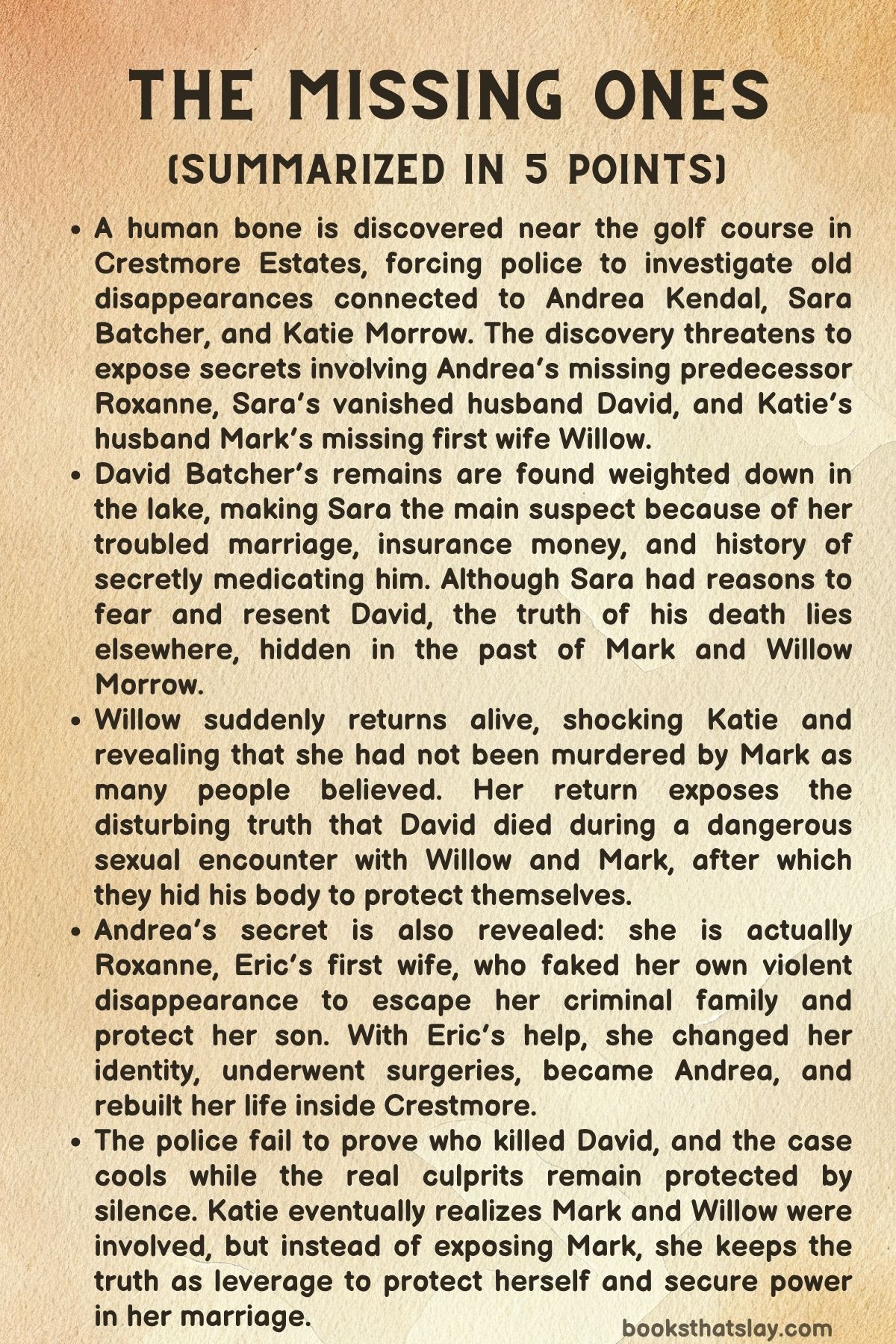
The Missing Ones by A.R. Torre is a domestic thriller set inside Crestmore Estates, a wealthy gated community where polished homes and controlled lives hide old crimes. The story begins when a human bone is discovered near the golf course, forcing police to reopen buried questions about three disappearances.
Andrea Kendal fears the return of her husband’s missing first wife, Sara Batcher faces suspicion over her vanished husband, and Katie Morrow begins doubting everything she knows about Mark’s former marriage. The novel builds its tension through secrets, false identities, marital control, and the dangerous choices people make to protect themselves.
Summary
The story begins in Crestmore Estates, an exclusive gated neighborhood built around a golf course, where privacy, money, and reputation matter almost as much as safety. That carefully managed world is disturbed when a dog finds a human bone near the course.
Soon police, forensic vans, search dogs, and divers fill the area, and the residents are forced to watch as the secrets under their lawns and ponds begin to surface. The discovery especially affects three women whose homes border the golf course: Andrea Kendal, Sara Batcher, and Katie Morrow.
Each of them is tied to an old disappearance, and each has reason to fear what the police might uncover.
Andrea Kendal lives with her husband Eric and their sons, Cameron and Ryder. Five years earlier, Eric’s first wife, Roxanne, vanished after an apparent bloody attack, and many people believed Eric was responsible.
Roxanne’s uncle Tony, a police officer, and her mother Patrizia never accepted that Roxanne simply disappeared. Patrizia in particular has always blamed Eric and believes he escaped justice.
When the bone is found near the course, Andrea immediately worries that the old Roxanne case will come back into focus. Eric tries to reassure her that the search has nothing to do with them, but Andrea knows their life is built on secrets.
Sara Batcher has a different reason to panic. Her husband David disappeared about five years earlier, and she had him legally declared dead so she could collect his life insurance.
She never had a body or a funeral, and she has lived with suspicion ever since. Many people thought she might have killed him, driven him away, or known more than she admitted.
Sara also carries private guilt because she had been secretly dosing David with lorazepam during their marriage. David was addicted to Vicodin, unstable, angry, unfaithful, and increasingly hard to manage.
Sara tells herself she used the drug to calm him and protect herself, not to murder him, but she knows the truth will look terrible if the police connect her to his death.
Katie Morrow’s fear begins at home. She finds a woman’s thong hidden in one of Mark’s old suits, and the discovery shakes her trust in her husband.
Mark’s first wife, Willow, also disappeared years earlier, and many neighbors believed Mark had killed her. Katie has tried to build a stable marriage with him, but the old stories have always lingered around them.
When police ask to search the pond behind the Morrow house, Katie grows even more uneasy. Mark allows the search but insists on being there.
The officers find nothing in the pond, yet their interest in Willow and Mark’s reaction make Katie wonder whether the neighborhood rumors may have some truth.
The investigation soon becomes more focused when the police find additional remains in the lake near hole six, close to Andrea and Eric’s house. The skeleton is identified as male, and it becomes clear that the body was weighted down with kettlebells before being dumped in the water.
The remains are eventually confirmed as David Batcher’s. That confirmation puts Sara under heavy pressure.
The detectives know she had a difficult marriage, had access to medication, collected insurance money, and had years to hide what happened. Sara tries to explain David’s addiction, his gambling debts, his affairs, and the professional trouble connected to a medical lawsuit over a failed heart valve, but every explanation seems to circle back to her.
Sara’s affair with Police Chief Joel Stanton gives her some inside information for a time, but even Joel cannot fully protect her. He warns her that she is the most obvious suspect because she had motive and opportunity.
Sara is frightened by how easily her old actions can be reshaped into a murder case. She did not know where David’s body was, but she cannot deny that she drugged him or that his disappearance improved her life financially and emotionally.
The absence of stronger suspects keeps police attention fixed on her, even as the real story remains hidden elsewhere in Crestmore.
The most shocking disruption occurs when Willow Morrow suddenly returns alive. Katie is stunned because Willow had been presumed dead by almost everyone in the community.
Willow walks back into Mark’s life as if she still has a claim on his house, his attention, and his body. She drinks, provokes Katie, comments on her old marriage, and fills the home with tension.
Mark’s reaction hurts Katie even more than Willow’s behavior. Instead of treating Willow like a closed part of his past, Mark collapses emotionally when he sees her.
He kneels, cries, and seems overwhelmed by her return. Katie realizes that Mark never truly let Willow go.
Willow explains that Mark called her after the body was found. Her return is not random.
She has come because David’s body has resurfaced, and the old crime that bound her to Mark may finally be exposed. Through the truth about Willow and Mark’s past, the story reveals what happened on the night David died.
Their marriage had been violent, sexual, and based on domination, punishment, control, and humiliation. Willow often controlled Mark, sometimes physically confining him, and their relationship was driven by extreme dependency.
On May 5, 2021, after keeping Mark locked in a cage for hours, Willow told him to bring home a “pet” for the night.
Mark and Willow went to a bar called the Onyx, where they met David Batcher. David was reckless, flirtatious, and willing to go home with them for sex.
At the Morrow house, Willow gave him a benzodiazepine, and the three drank together. In the basement, David suggested using electrical shock clamps.
Willow attached them to him and activated the device while he was handcuffed to the bed. David suffered a fatal cardiac event and died.
Although the death was not planned as a murder, Mark and Willow knew the scene would destroy them. David had been drugged, restrained, and electrocuted in their basement.
They believed no one would accept it as an accident.
Instead of calling the police, Mark convinced Willow they had to hide the body. They left David in the basement overnight and then prepared him for disposal.
They dressed him, weighted his body with kettlebells, transported him by golf cart through the course, and dumped him in the lake near hole six. For years, the lake kept their secret.
Yet David’s death ruined Willow and Mark’s marriage. Willow could not continue living with the body between them, and Mark became increasingly desperate and dependent.
Eventually Willow arranged a divorce settlement, drugged Mark, left the papers behind, and disappeared by choice. She escaped her old life and lived off-grid, letting Crestmore believe she was dead.
Another major truth concerns Andrea. She is not simply Eric’s second wife.
Andrea is Roxanne. Years earlier, Roxanne came from a powerful criminal family and became pregnant with Eric’s child.
She and Eric believed her father would try to control their son and shape him into the heir of the family’s criminal world. To protect the baby, they created a plan to make Roxanne vanish.
Roxanne staged a bloody attack at Treveley Park using stored blood, abandoned her car and belongings, and escaped with help from her friend Kisi. Later, she underwent extensive surgeries and rebuilt herself as Andrea Kendal.
After giving birth to Cameron, she returned to Eric under her new identity, and Ryder was later born into the protected life they had built.
In the present, the police investigation fails to reach the full truth. Sara remains the easiest suspect because her marriage to David was troubled and her history of drugging him is damaging.
Still, the police cannot prove she killed him or connect her directly to the body in the lake. Katie eventually pieces together the truth about Mark and Willow.
A photograph of the kettlebells used to weigh down David’s body matches the incomplete set she once cataloged from Mark’s old workout equipment. She understands that Mark and Willow were involved in David’s death and disposal.
Yet Katie does not go to the police. Willow has warned her that Mark needs control and discipline because of his dependency, and Katie begins to see that knowledge can become power.
Months later, Katie gives birth to a daughter, Chloe, and remains with Mark. Instead of exposing him, she keeps the truth as leverage, protecting herself in case Willow returns or Mark stops being the husband she wants.
Characters
The character work in The Missing Ones is built around people who hide behind wealth, marriage, beauty, and fear. Most of the central figures are not innocent in a simple sense, but they are also not all guilty in the same way.
Their choices are shaped by control, survival, social pressure, desire, and the need to protect a version of life that cannot survive public truth.
Andrea Kendal / Roxanne
Andrea Kendal is one of the most carefully constructed characters in the book because her entire present life is an invention. To the outside world, she is Eric’s second wife, a polished Crestmore mother with two sons and a place in the community.
In reality, she is Roxanne, the missing first wife whose disappearance has haunted Eric for years. Her greatest defining trait is not weakness but discipline.
She survives by controlling her face, her history, her body, and the story other people believe about her. Her decision to become Andrea is extreme, but it comes from a protective instinct.
She wants to keep her son away from the criminal world of her own family, especially from a father who might treat the child as an heir rather than a person. Her secrecy makes her morally complicated because she allows others to suffer under false assumptions, including Eric, who remains suspected by many.
Yet Andrea’s actions also show how far she is willing to go to save her children from a dangerous legacy. She is both victim and architect, a woman who escapes one form of control by building a new life based on deception.
Eric Kendal
Eric Kendal is presented as a man living under the weight of a crime he did not commit, while also helping maintain a lie that makes him look guilty. His love for Roxanne, later Andrea, pushes him into a risky plan that costs him his reputation and leaves him permanently vulnerable to suspicion.
Eric’s calm reassurances in the present do not erase the fact that his life is fragile. One reopened investigation, one suspicious detective, or one angry relative could destroy everything he and Andrea built.
His role in the story shows a quieter kind of loyalty. He is not the loudest or most active figure, but he accepts years of judgment in order to protect his wife and children.
At the same time, Eric is not entirely innocent in a moral sense. He helps fake a death, misleads police, and allows Roxanne’s family to live with confusion and anger.
His devotion is real, but it requires him to choose private family safety over legal truth.
Sara Batcher
Sara Batcher is one of the most vulnerable and suspicious figures in the novel because the facts around her look damning even when they do not tell the whole story. She was trapped in a miserable marriage with David, a man whose addiction, affairs, debts, and instability made daily life exhausting and frightening.
Her decision to dose him with lorazepam is deeply troubling, even if she frames it as a desperate attempt to manage his behavior rather than an effort to kill him. Sara becomes a study in how partial guilt can make innocence almost impossible to prove.
She did not dispose of David’s body, yet her secrets create the exact image detectives expect from a murderer. Her life insurance claim, her lack of grief in the expected form, and her affair with Joel Stanton make her seem calculating.
Underneath that appearance, Sara is a woman who has lived for years without closure and then finds herself trapped by the worst possible interpretation of her own actions. She represents the danger of hidden wrongdoing, because even a lesser secret can make someone look capable of a greater crime.
David Batcher
David Batcher’s presence in the book is mostly felt through memory, investigation, and the consequences of his final night. He is not portrayed as a harmless victim in his personal life.
He is addicted to pills, unfaithful, reckless, financially unstable, and professionally compromised. His behavior makes life difficult for Sara and helps explain why so many people believe she may have wanted him gone.
Yet the story does not suggest that his flaws make his death acceptable. David’s final choices, especially his willingness to go home with Mark and Willow and participate in a dangerous sexual encounter, place him in the path of disaster.
His death is accidental in one sense, but it is also the result of a chain of careless, selfish, and secretive decisions by several people. As a character, David functions as both victim and catalyst.
His disappearance exposes the rotten foundations of several marriages and forces Crestmore to confront the fact that respectability can hide violence, addiction, and fear.
Katie Morrow
Katie Morrow begins as a woman trying to believe in the version of marriage she has chosen. She knows Mark’s past is shadowed by Willow’s disappearance, but she has built a life with him anyway.
Her discovery of the thong in his old suit and the police search behind her home awaken doubts that she can no longer dismiss. Katie’s emotional journey is shaped by humiliation, fear, jealousy, and calculation.
Willow’s return forces her to see that Mark’s first marriage was not truly over, at least not in his mind. Katie is wounded by Mark’s reaction because it reveals a bond deeper and more disturbing than she expected.
Yet Katie is not passive. By the end, she understands enough to know Mark and Willow were connected to David’s death, and she makes a deliberate choice not to expose him.
Her silence is not simple loyalty. It becomes strategy.
She keeps the truth as a form of protection and power, especially after Chloe’s birth. Katie changes from insecure second wife into someone who understands the rules of control inside her own marriage.
Mark Morrow
Mark Morrow is one of the most dangerous characters in The Missing Ones because his neediness is tied to control, secrecy, and moral weakness. His relationship with Willow reveals a man who depends on domination games and emotional extremes to feel whole.
He is not simply a victim of Willow’s intensity, even though she often controls and humiliates him. When David dies, Mark is the one who argues for concealment, and that choice turns an accidental death into a long-running crime.
His panic is practical, but it is also self-protective. He would rather erase David than face the consequences of what happened in his basement.
Mark’s reaction to Willow’s return shows that he has never escaped her influence. His breakdown in front of Katie exposes how much of his current marriage rests on unfinished obsession.
By the end, Mark remains free not because he is innocent but because the women around him choose silence for their own reasons. He is a figure of dependency disguised as authority, and that makes him especially unstable.
Willow Morrow
Willow Morrow is bold, destructive, theatrical, and deeply unsettling. Her return changes the entire direction of the story because she proves that one of Crestmore’s famous disappearances was never a murder at all.
Willow left because she wanted escape, not because Mark killed her. Yet her freedom is stained by David’s death and by her role in covering it up.
Her marriage to Mark was built around extreme power games, and she understood his needs better than anyone. That knowledge gives her control over him even after years away.
When she comes back, she treats Katie almost like an intruder in a house and life she still partly owns. Willow is not remorseful in a clean or open way, but she is not untouched by the past.
David’s death helped break her marriage and pushed her into disappearance. Her warning to Katie about Mark is both cruel and useful.
She knows Mark’s hunger for control and discipline, and she understands that Katie will need power if she wants to survive that marriage. Willow is less a conventional villain than a chaotic truth-bearer whose honesty arrives wrapped in manipulation.
Patrizia
Patrizia is driven by grief, anger, and certainty. As Roxanne’s mother, she believes Eric killed her daughter and escaped punishment.
Her confrontations with Andrea show a woman who has converted loss into accusation because accusation gives her something to hold onto. She is painful to watch because the reader eventually understands that her grief is based on a false event, yet the pain itself is real.
Patrizia was deceived by her own daughter’s staged death, and that deception leaves her mourning someone who is still alive. Her role adds emotional cost to Andrea and Eric’s plan.
Their escape protects their children, but it also wounds Patrizia and keeps her trapped in rage. She is not simply an obstacle for Andrea; she is one of the people harmed by a lie that was created for understandable reasons.
Tony
Tony, Roxanne’s uncle and a police officer, represents the pressure of unfinished justice. He has a personal connection to Roxanne and a professional interest in suspicion, which makes him a threat to Andrea and Eric’s hidden life.
Tony’s belief that Eric may have killed Roxanne keeps the old case alive even when others might have accepted uncertainty. His position gives Patrizia’s anger a sharper edge because he is not only a grieving relative but someone connected to law enforcement.
In the story, Tony shows how family loyalty can keep suspicion active for years. He also reminds the reader that Andrea’s false death did not happen in isolation.
It created a circle of people who still search for answers, blame the wrong man, and remain unable to move forward.
Joel Stanton
Police Chief Joel Stanton is important because his relationship with Sara blurs the line between investigation and intimacy. His affair with her gives Sara access to information and temporary reassurance, but it also increases the sense that her life is full of compromised choices.
Joel understands that Sara is in danger legally, and his warnings make the investigation feel more serious. He cannot simply remove suspicion from her, even if he cares about her or wants to help.
His role shows the limits of personal influence when a case begins to form around evidence, motive, and public pressure. Joel also reflects the moral mess surrounding Sara.
She is not only a suspected widow but a woman whose private life with the police chief can be used to make her look even more manipulative.
Cameron, Ryder, and Chloe
The children in the story represent the futures that the adults are trying to protect, control, or possess. Cameron is the reason Roxanne becomes Andrea.
His existence threatens to pull her back into her criminal family’s world, and the fear that he will be claimed as an heir drives the entire identity scheme. Ryder represents the second life Andrea and Eric are able to build after the disappearance, a child born into the safety created by the lie.
Chloe, Katie and Mark’s daughter, carries a different kind of meaning. Her birth helps anchor Katie’s decision to stay and use the truth about Mark as protection.
These children do not control the plot directly, but they shape the adults’ choices. They show that many of the story’s lies are justified as acts of protection, even when they create new harm.
Themes
Marriage as Control
Marriage in The Missing Ones is less about romance than power, leverage, dependency, and survival. Andrea and Eric’s marriage is built on loyalty, but it also depends on an enormous shared lie.
Sara and David’s marriage is damaged by addiction, resentment, fear, and secret medication. Katie and Mark’s marriage appears stable from the outside, yet it becomes clear that Katie does not fully understand the emotional and sexual history that shaped him.
Mark and Willow’s relationship is the clearest example of marriage as control because their bond is built on domination, submission, punishment, and psychological dependency. The story repeatedly shows that a legal relationship can become a closed room where outsiders see only the surface.
Inside that room, spouses hide drugs, affairs, fear, bodies, false identities, and private rules. The marriages are not all the same, but each one contains an imbalance of knowledge.
The person who knows more holds power. By the end, Katie’s decision to keep Mark’s secret proves that control can shift without justice being served.
Marriage becomes a battlefield where truth is not always revealed; sometimes it is stored for later use.
The Cost of Disappearance
Disappearance offers several characters a way out, but the book shows that vanishing never creates a clean ending. Roxanne disappears to protect her child and rebuilds herself as Andrea, but her mother and uncle are left with grief, suspicion, and rage.
Willow disappears to escape Mark and the aftermath of David’s death, but her absence leaves behind rumors, fear, and a second wife living under the shadow of a possible murder. David disappears because Mark and Willow hide his body, and his absence traps Sara in years of suspicion without closure.
In each case, disappearance transfers suffering from one person to another. The missing person may gain safety, freedom, or concealment, but those left behind build their lives around unanswered questions.
The theme is powerful because the story does not treat disappearance as only physical absence. It becomes social damage, legal uncertainty, emotional imprisonment, and moral debt.
People vanish from Crestmore, but their empty spaces remain active. They shape marriages, police work, gossip, money, and fear long after the original event.
Wealth, Privacy, and Hidden Violence
Crestmore Estates is designed to look secure, elegant, and controlled, but that polished setting makes the violence feel more disturbing. The gates, golf course, ponds, luxury homes, and social codes create an illusion that danger belongs somewhere else.
Yet the community contains drug addiction, marital cruelty, criminal family ties, sexual coercion, insurance suspicion, and a body weighted down in a lake. Wealth gives the residents tools to manage appearances.
They can hire lawyers, control access, hide behind property lines, and rely on the assumption that respectable people are less likely to be monstrous. The police presence breaks that illusion by turning private lawns and water features into possible crime scenes.
Still, even after the search, much remains hidden. The story suggests that privilege does not erase violence; it can make violence easier to disguise.
Crestmore’s beauty becomes part of the cover. Its orderliness helps people believe that the worst acts must be exceptions, when in reality the community’s calm depends on silence.
The golf course is not just scenery. It is the place where secrets are buried, moved, and eventually exposed only in fragments.
Truth as Leverage Instead of Justice
The novel repeatedly separates knowing the truth from doing the right thing with it. Andrea and Eric know what happened to Roxanne, but they preserve the lie because exposure would endanger their family.
Mark and Willow know how David died, but they hide the body to protect themselves from punishment. Katie discovers enough to understand Mark’s guilt, yet she chooses not to report him because the knowledge gives her security inside the marriage.
Even Sara’s situation depends on partial truth. She did drug David, but she did not kill or dispose of him, and the difference between those truths matters even when the police cannot see it clearly.
This theme gives the story its sharp moral tension. Truth does not automatically cleanse anything.
It can be used as a shield, a weapon, a bargaining chip, or a private insurance policy. Justice depends on disclosure, but most characters prefer survival.
By the end, several people know enough to change the outcome, yet silence wins because silence serves their interests. The result is unsettling because the mystery is answered for the reader, but not fully corrected inside the world of the story.