Our Beautiful Mess Summary, Characters and Themes
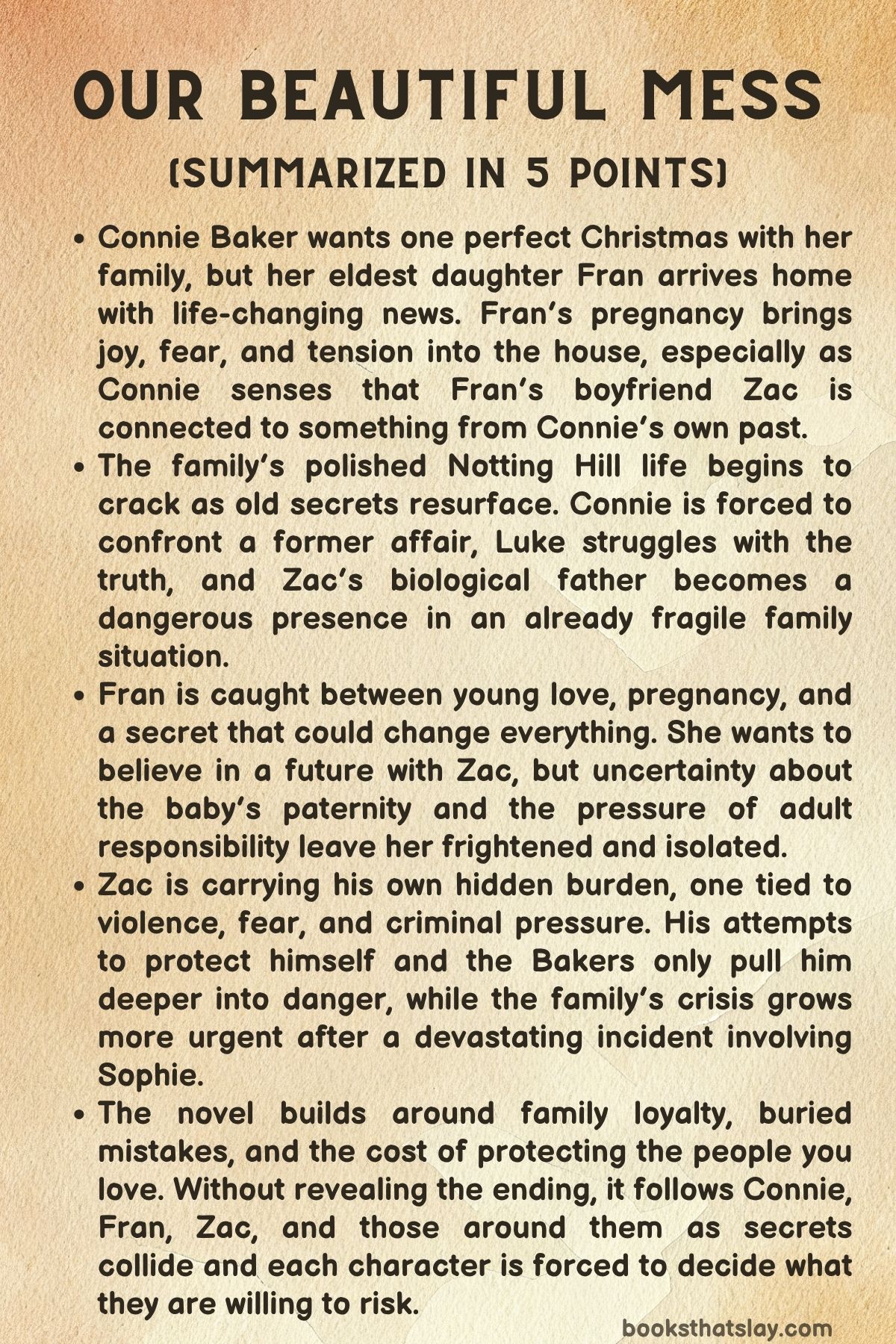
Our Beautiful Mess by Adele Parks is a domestic suspense novel about family loyalty, buried secrets and the damage caused by choices people believe they have left behind. The story centres on Connie Baker, whose carefully arranged family life is shaken when her eldest daughter, Fran, returns home pregnant with her boyfriend, Zac.
What should be a difficult but manageable family crisis soon exposes an old affair, a dangerous criminal network, and a chain of betrayals that threaten everyone Connie loves. The novel mixes family drama with crime tension, asking how far parents will go to protect their children.
Summary
The story begins in a warehouse, where Connie Baker is being held at gunpoint by a calm and practised man. He speaks with terrifying precision about how quickly a bullet can kill her and accuses her of cheating or lying over money she owes.
Connie tries to think clearly and buy herself time, but before she can find a way out, he shoots her. As she falls, terrified and bleeding, her thoughts turn to blood, motherhood and her children.
The novel then moves back eleven days to Christmas Eve. Connie is at home in Notting Hill with her younger daughters, Sophie and Flora, decorating the Christmas tree.
She wants everything to be perfect. Her daughters are less impressed by the family rituals, but Connie clings to the idea of a warm, beautiful Christmas.
Her eldest daughter, Fran, is coming home from university and bringing her boyfriend, Zac, to meet the family for the first time.
Fran arrives with Zac, who feels nervous in the Bakers’ elegant home. Connie greets them lovingly, but her excitement turns to shock when she sees Fran without her coat and immediately realises she is pregnant.
Fran confirms it, and Zac says they are both happy about becoming parents. Connie is shaken.
Fran is only twenty-one and still at university, and Connie cannot hide her fear about what this will mean for her daughter’s future. The family tries to treat the news as something to celebrate, but Connie struggles to respond with genuine happiness.
Fran explains that the pregnancy was not planned. Because she has endometriosis, she had believed she might have difficulty conceiving, so the baby feels like a rare chance she may not get again.
She and Zac had reconnected after a period apart, their relationship had become intense, and she had decided she wanted the child despite the uncertainty.
That evening, the family visits friends and then the younger group goes to the pub. Connie returns home with her husband, Luke, and her parents.
She and Luke discuss the pregnancy and agree they must support Fran if they do not want to push her away. Connie also admits that Zac reminds her of someone from her past, though she lies about exactly who.
Later, from the window, she sees two threatening men following the younger group home. One of them bumps into Zac, but nothing obvious happens.
At the pub, Fran senses that Connie is behaving oddly. She tells Flora, Sophie and Auriol that she does not want an abortion or adoption.
Meanwhile, Zac is hiding his own fear. The men who approached him are connected to a violent criminal network.
They have slipped a package into his pocket and injured his hand with a knife when he resisted. They know where he is, and he understands that he is not free of them.
On Christmas Day, Connie confides in her best friend Lucy that Zac reminds her of John Harding, the man Connie had an affair with early in her marriage. Lucy sees the resemblance but thinks Connie is overreacting.
Connie then questions Zac about his family. He reveals that his biological father was a one-night stand named John Harding.
Connie is horrified. Fran’s boyfriend, and the father of her unborn child, is connected to the man from Connie’s past.
After Christmas, Zac pushes for both families to meet: Fran’s parents, his mother Clare, his stepfather Neil, his sister Celeste, and his newly discovered biological father, John. Fran wants to delay, but Zac insists.
He wants John to see him taking responsibility in a way John never did. He also thinks John might be able to help financially.
Connie, meanwhile, finally tells Luke that Zac’s father is John Harding. Luke is devastated and furious, seeing John as a direct threat to their family.
Connie insists the affair is old history and that Fran must never know, but she still hides the fact that John had reappeared years later and flirted with her again.
Zac’s private danger grows clearer. During a placement year in London, he had met a man named Rob in a pub.
After they left together, Rob was brutally attacked in an alley. Zac tried to help briefly but ran.
When he was about to call the police, threats arrived from Rob’s phone, warning him to stay silent. Zac later saw that Rob had died.
Frightened and manipulated by the gang, he lied to the police and said he had seen nothing. The criminals then used photos to make him look guilty and forced him into delivering drugs.
He thought he had escaped by leaving London, but Fran’s visit to her family brings him back within their reach.
When Zac’s family arrives at the Bakers’ house, the atmosphere is strained. Clare, Neil and Celeste arrive first, then John.
Connie, Luke and John are all shocked to face one another again. John slowly realises that Zac’s pregnant girlfriend is Connie and Luke’s daughter.
During lunch, he speaks tensely with Connie, calling her by an old nickname and asking how often she has thought of him. He says Zac and Fran’s relationship cannot continue and even suggests Fran may have trapped Zac.
Connie nearly exposes their past in anger but manages to cover it.
Lucy arrives and helps ease the tension by taking everyone for a walk. Later, Zac makes another drug delivery at a party and finds Sophie there, drunk and vulnerable.
When a man tries to force himself on her, Zac intervenes by claiming a connection to Bear, the gang leader. He gets Sophie home safely, leaving both of them aware that they have seen something they should not have seen.
Fran becomes increasingly overwhelmed by her pregnancy. She feels distant from her friends, whose concerns seem younger and lighter than hers.
She misses being able to confide in Connie, but Connie has become too strange and guarded. Zac proposes with a Tiffany ring, telling Fran he loves her and the baby.
Fran is moved but panics because she is hiding a terrible secret. She cannot answer before Zac receives a message and leaves.
Connie later finds Fran upset with the ring still in its box. Fran admits the baby might not be Zac’s because she slept with another man around the same time.
Connie urges her to tell Zac or arrange a paternity test after the birth. Then Fran reveals that the other man was John Harding.
She had not known John was Zac’s biological father. Zac had arranged for them to meet at a bar but failed to appear, and Fran, hurt and confused, slept with John, thinking he was only a stranger who reminded her of Zac.
Connie is horrified. Because John and Zac share DNA, even a test may not give a simple answer.
Connie meets John at his hotel bar and asks him to disappear from Zac’s life. She argues that if Zac learns his biological father slept with Fran and may be the baby’s father, it will destroy him.
John is devastated because Zac is his only child and he has only just found him. Their argument is interrupted by a call from Luke: Sophie is in hospital after taking drugs at a New Year’s Eve party.
She is unconscious, and doctors warn that she may suffer brain damage, paralysis or death. Police report that a lethal batch of drugs is moving through private parties.
Zac realises Sophie’s overdose may be connected to the same gang forcing him to deliver drugs. He is crushed by guilt but too afraid of Bear to contact the police.
When he receives another delivery order, he collects a large package of tablets and throws it into the Thames instead of delivering it. For a moment he feels relief, but then despair takes over as he thinks of the people already harmed.
John learns Zac is in danger and searches for him through the night. Fran receives a photo from Zac’s phone showing him badly beaten.
The kidnappers demand money. John wants to go to the police, but Fran refuses because the message warns against it.
Soon after, Fran is abducted in the street, bound, gagged and drugged.
At the hospital, Sophie begins to wake, giving the family hope. John then arrives at Connie and Luke’s house and reveals that Fran and Zac have been taken.
In the chaos, Luke also learns that John slept with Fran and may be the baby’s father. The police become involved, but when the kidnappers demand £35,000 and send a location, Connie decides to take cash and gold herself.
In the warehouse, Fran wakes beside Zac, who is tied up and badly injured. Zac confesses that he was forced into drug deliveries after witnessing a murder and being framed.
Bear arrives and decides to kill everyone to erase evidence. Connie enters with the ransom, while John appears to run away but actually circles round and calls the police.
As Bear prepares to kill, John creates a distraction with the money bag. Shots are fired.
Bear turns on his own men, and John is hit while protecting Connie. The police arrive as John lies bleeding in Connie’s arms, having helped save Fran and Zac.
Characters
Connie Baker
Connie is the emotional centre of Our Beautiful Mess, a mother whose need to protect her family is both loving and dangerously controlling. She wants Christmas, motherhood and marriage to look stable, polished and happy, but the story quickly reveals that her life is built on buried panic and old secrets.
Her reaction to Fran’s pregnancy is not simply disappointment; it is fear, because Zac’s resemblance to John Harding drags her past into the present. Connie’s affair with John has never fully disappeared from her conscience, and when she learns that Zac is John’s son, her instinct is to contain the truth rather than face it openly.
This makes her both sympathetic and flawed. She loves Fran deeply, but her fear of exposure sometimes matters almost as much as her daughter’s pain.
Connie’s character is shaped by contradiction. She is warm, devoted and capable of immense courage, yet she also lies, avoids difficult conversations and tries to manage everyone else’s choices.
Her desire to keep Fran from losing Zac, Luke from being destroyed and the family from collapsing leads her into morally complicated decisions. She knows that honesty might be necessary, but she repeatedly chooses delay, partly because she has spent years pretending the past is harmless.
By the end of the story, Connie’s bravery becomes undeniable. Her decision to take the ransom money to the warehouse shows the fierce, almost reckless force of maternal love.
She is not heroic because she is perfect; she is heroic because, despite all her mistakes, she walks directly into danger for her daughter.
Fran Baker
Fran is one of the most emotionally vulnerable characters in the book because she stands at the point where youth, love, guilt and motherhood collide. At twenty-one, she is still trying to understand herself, but pregnancy forces her into adult decisions before she feels ready.
Her choice to keep the baby is presented as both hopeful and frightening. Because of her endometriosis, the pregnancy feels to her like a rare chance at motherhood, but it also traps her inside a life she has not planned.
Fran wants to believe that love can make everything manageable, especially with Zac, yet she knows that the truth about John could destroy that hope.
Fran’s most painful conflict comes from her secrecy. She loves Zac, but she cannot confess that John Harding may be the baby’s father, especially after discovering that John is Zac’s biological father.
Her silence is not casual dishonesty; it comes from shame, terror and a desperate wish to preserve the future she imagines with Zac. At the same time, her secrecy causes her to become isolated from Connie, Auriol and even Zac.
She no longer fits easily into the carefree world of university friendships, shopping trips and gossip. Her kidnapping pushes her from emotional crisis into physical danger, and in the warehouse her relationship with Zac becomes stripped down to fear, confession and survival.
Fran represents the confusion of growing up too quickly and discovering that one mistake can become tied to many other people’s lives.
Zac
Zac is one of the most tragic and morally complex figures in the novel. At first, he appears to be the nervous boyfriend entering a wealthy, intimidating family home, but beneath that awkwardness is a young man trapped by fear, guilt and criminal coercion.
His involvement with Bear’s gang begins not because he is cruel or greedy, but because he is lonely, frightened and caught in a violent situation he does not understand how to escape. His decision to run when Rob is attacked becomes the defining wound in his conscience.
From that point onward, Zac sees himself as cowardly and guilty, even though the gang deliberately manipulates and terrifies him.
Zac’s love for Fran is genuine, but he is carrying secrets that make a stable future almost impossible. His proposal is moving because he wants to take responsibility, yet it is also heartbreaking because he does not know the full truth about Fran and John.
His longing for John’s acknowledgement shows how deeply abandonment has shaped him. He wants his biological father to witness him becoming a better man than John was, but this desire exposes him to even more pain.
When Sophie overdoses, Zac’s guilt becomes unbearable because he believes the drugs he delivered may have helped destroy Fran’s family. Throwing the package into the Thames is his first clear act of rebellion against the gang, but it also leads to his abduction.
Zac’s character is defined by the struggle between fear and conscience, and his suffering makes him one of the story’s most emotionally charged characters.
John Harding
John Harding is a disruptive figure whose arrival turns hidden history into present disaster. He is charming, selfish, careless and emotionally dangerous, especially because he has a way of making other people feel unsettled around him.
For Connie, he represents temptation, shame and unfinished guilt. For Zac, he represents the missing father whose absence has shaped a lifetime of insecurity.
For Fran, he becomes the man connected to one of her most devastating secrets. John’s power in the book comes from the fact that he is not merely a villain; he is a person whose selfishness has long consequences.
John initially appears arrogant and emotionally irresponsible. His failure to remember Clare humiliates her, and his private comments to Connie about Fran and the pregnancy are cold and cruel.
He thinks in terms of inconvenience, reputation and escape rather than emotional responsibility. Yet the story gradually complicates him.
Once he understands Zac’s danger, he becomes determined to find and help him. His horror at Fran’s abduction and his eventual decision to call the police show that he is capable of real concern, even if it arrives late.
His final act in the warehouse, protecting Connie and helping save Fran and Zac, gives him a form of redemption. John remains deeply flawed, but his ending suggests that even a selfish man can choose courage when finally forced to face the damage he has caused.
Luke Baker
Luke is Connie’s husband and Fran’s father, and his role is defined by loyalty, shock and wounded trust. He represents the family stability that Connie has tried so hard to preserve.
When he learns that Zac’s father is John Harding, Luke immediately understands that the past has not stayed buried. His anger is not only jealousy; it is the pain of realizing that Connie has kept emotional danger close to their family without fully telling him the truth.
Luke’s reaction shows how deeply betrayal can echo through a marriage, even years after the original event.
Despite his fury, Luke remains fundamentally devoted to his family. When Sophie is hospitalized and Fran is abducted, his personal hurt becomes secondary to the need to protect his daughters.
He is a practical and emotionally grounded presence, though he is not untouched by fear. His love for Connie is strained by revelation after revelation, but the crisis forces him to focus on survival rather than pride.
Luke’s character adds moral weight to the story because he shows the cost of secrets on the innocent partner. He is not perfect or endlessly forgiving, but he is decent, protective and deeply invested in the family he thought he understood.
Sophie Baker
Sophie is one of Connie and Luke’s younger daughters, and her character brings the dangers surrounding the older characters into sharper focus. At first, she appears as a cynical, unimpressed teenager who resists Connie’s idealized version of family Christmas.
Her presence helps show the difference between Connie’s fantasy of domestic perfection and the more complicated reality of her daughters’ lives. Sophie is young, curious and vulnerable, and her trip to the party reveals how easily teenage rebellion can turn into real danger.
Her overdose becomes one of the story’s major emotional turning points. Until then, Zac’s connection to the drug network feels like his private nightmare, but Sophie’s collapse shows that his secret world has reached directly into the Baker family.
Her unconscious body in hospital forces everyone to confront mortality, guilt and helplessness. Sophie is not explored as deeply as Connie, Fran or Zac, but her role is crucial because she embodies innocence caught in the consequences of adult secrecy and criminal violence.
Her small sign of recovery gives the family hope at a moment when everything else seems to be falling apart.
Flora Baker
Flora, another of Connie and Luke’s daughters, acts as part of the younger family circle that surrounds Fran. She is observant, direct and emotionally present, especially when Fran tries to discuss the pregnancy with her sisters and Auriol.
Flora helps reveal how Fran’s announcement affects the whole household, not just Connie and Luke. Through Flora, the story shows the mixture of curiosity, loyalty and immaturity that can exist between siblings when one of them suddenly crosses into adulthood.
Flora’s role is quieter than Sophie’s or Fran’s, but she is important because she gives the family a sense of ordinary life before the crisis fully takes over. She belongs to the world of Christmas, sibling conversation and family routine, which makes the later violence feel even more shocking.
Flora also helps highlight Fran’s isolation. Even when Fran is surrounded by sisters, friends and family, there are truths she cannot say aloud.
Flora therefore functions as part of the emotional background that shows what Fran risks losing if her secrets come out.
Lucy
Lucy is Connie’s best friend and one of the few people who knows enough of Connie’s past to understand the danger of John Harding’s return. She is practical, loyal and perceptive, often seeing the situation more clearly than Connie wants to.
When Connie confesses that Zac reminds her of John, Lucy initially tries to calm her, but she does not dismiss Connie’s fear once the truth becomes undeniable. Her presence gives Connie a place to speak honestly, even when Connie is still hiding things from Luke and Fran.
Lucy also functions as a stabilizing force during social chaos. Her arrival during the disastrous family meeting helps rescue the gathering from total exposure, and her warning to Connie shows that she understands how fragile the situation has become.
Later, her willingness to bring cash and gold for the ransom shows that her loyalty is not merely conversational; she acts when Connie’s family is in danger. Lucy is not central to the main triangle of Connie, Fran and Zac, but she is essential as a witness, adviser and emergency support.
She represents friendship that survives discomfort and crisis.
Clare
Clare is Zac’s mother, and her character carries the quiet pain of having raised a child without the support of his biological father. Her presence at the Bakers’ house shows the dignity and discomfort of a woman who has had to build a family around absence.
When John fails to remember her, the humiliation is sharp because it confirms how little emotional weight he has given to something that shaped her life and Zac’s identity. Clare’s pain is not loud, but it is significant.
Clare also contrasts strongly with John. While John drifts in and out of responsibility, Clare has stayed.
She may not know the full truth about Zac’s criminal entanglement, but her life has been defined by the practical realities that John avoided. Her role helps the reader understand why Zac’s longing for John is so complicated.
Zac is not lacking love entirely; he has Clare and Neil. Yet the absence of his biological father still matters to him.
Clare’s character shows that abandonment harms more than the abandoned child. It also wounds the parent left behind to explain, compensate and endure.
Neil
Neil is Zac’s stepfather and father figure, a steadier presence than John. Although he is not explored in great depth, he is important because he represents the difference between biology and responsibility.
Zac may be drawn toward John because of blood and unanswered questions, but Neil appears to be the man who has actually occupied the fatherly role in Zac’s life. His presence complicates Zac’s desire for John because it shows that Zac’s emotional hunger is not simply about needing a parent; it is about needing recognition from the person who rejected him before birth.
Neil’s quiet importance lies in his contrast with the chaos John brings. He belongs to the family Zac already has, while John belongs to the fantasy of explanation and completion.
The story suggests that dependable love can be overlooked when a person is chasing the approval of someone absent. Neil therefore stands for stable, earned parenthood, even though the plot gives more dramatic attention to John’s return.
Celeste
Celeste is Zac’s sister and part of the family he brings into the Bakers’ world. Her role is relatively small, but she helps establish that Zac does not exist only as Fran’s boyfriend or John’s abandoned son.
He comes from a family system with its own tensions, loyalties and history. Celeste’s presence at the meeting between the families adds to the social awkwardness and emotional pressure of the scene.
As a character, Celeste also helps widen the consequences of Zac’s choices. His danger is not isolated; it threatens to affect everyone connected to him.
She represents the ordinary family life that sits beside the extraordinary secrets of the plot. Even when she is not central to the action, her inclusion reminds the reader that Zac’s identity is divided between the family that raised him, the biological father he has only just found and the new family he may be creating with Fran.
Auriol
Auriol is Fran’s best friend, and her main function is to show how dramatically Fran’s life has changed. Auriol still belongs to the world Fran might have expected to inhabit at twenty-one: crushes, shopping, gossip and ordinary social drama.
Fran, meanwhile, is thinking about pregnancy, paternity, childcare, exams, money and whether her relationship can survive the truth. The distance between them is painful because it is not caused by cruelty.
It happens because Fran has entered a reality Auriol cannot fully understand.
Auriol’s presence makes Fran’s isolation more visible. Fran misses the simplicity of friendship, but she can no longer comfortably share everything.
Even a shopping trip becomes overwhelming because baby equipment reminds Fran of how unprepared she is. Auriol therefore represents the life Fran is leaving behind: youthful, social and comparatively uncomplicated.
Through her, the story captures the loneliness that can come when one person is forced into adulthood faster than her friends.
Blythe
Blythe appears as part of Fran’s social circle during the Selfridges trip. Although she is a minor character, her presence helps create the contrast between ordinary young adulthood and Fran’s private crisis.
The shopping environment, the friends and the casual atmosphere all emphasize how strange and frightening pregnancy feels to Fran at this stage of her life. Blythe belongs to the normal world Fran is physically present in but emotionally separated from.
Blythe’s importance is therefore atmospheric rather than plot-driving. She helps show that Fran is surrounded by people but still alone with the heaviest truths.
The gap between what Fran’s friends can see and what Fran is actually carrying inside herself is one of the quieter emotional tensions of Our Beautiful Mess.
Rose
Rose is one of the family friends connected to Connie and Luke’s Christmas traditions. Her role is small, but she helps establish the social world Connie wants to maintain.
Visiting Rose and Craig is part of the rhythm of family celebration, the kind of familiar ritual Connie associates with stability and happiness. In that sense, Rose belongs to the polished surface of Connie’s life before the deeper secrets break through.
Rose’s presence also highlights Connie’s emotional exhaustion. Connie is surrounded by friends, family and festive routines, yet she cannot relax into them because Fran’s pregnancy and Zac’s resemblance to John have already unsettled her.
Rose functions as part of the ordinary social setting that makes Connie’s private panic more noticeable. The contrast between public celebration and private dread is central to the book’s emotional tension.
Craig
Craig, like Rose, is a supporting figure within the Bakers’ social circle. He helps create the sense of a comfortable, established community around Connie and Luke.
This matters because the story depends on the collapse of apparent security. The Bakers are not isolated people living on the margins; they are surrounded by friends, traditions and respectable domestic life.
Craig’s presence contributes to that world.
Although Craig does not shape the central conflict directly, he helps show what Connie is afraid of losing. Her family’s life is not only private; it is socially visible.
The more secrets emerge, the more fragile that respectable world becomes. Craig’s role is minor, but he is part of the background against which the family’s hidden chaos becomes more dramatic.
Bear
Bear is the story’s most direct embodiment of criminal violence. Unlike John, whose harm comes through selfishness and emotional irresponsibility, Bear is openly dangerous.
He controls Zac through fear, threats and coercion, and his network turns ordinary parties into places of death and exploitation. Bear’s power lies in his calm brutality.
He treats people as disposable and sees murder as a practical solution when events become inconvenient.
As an antagonist, Bear raises the stakes from family drama to life-and-death danger. He is not interested in Connie’s past, Fran’s pregnancy or Zac’s emotional wounds except where they affect his money and control.
This makes him terrifying because he strips the situation of sentiment. In the warehouse, his willingness to kill hostages and even his own men reveals the full extent of his ruthlessness.
Bear represents the outside violence that collides with the Bakers’ private secrets, proving that hidden mistakes can become deadly when they intersect with people who have no conscience.
Rob
Rob is a crucial figure even though he dies before becoming a fully developed presence in the story. His attack and death are the event that traps Zac in Bear’s criminal world.
Rob’s importance lies in what he awakens in Zac: fear, guilt and a sense of moral failure. Zac’s brief attempt to help, followed by his decision to run, becomes the moment he cannot forgive himself for.
Rob also represents the human cost of the drug network before Sophie’s overdose brings that cost into the Baker family. His death shows that Bear’s world has always been lethal.
For Zac, Rob is not just a victim; he is the proof of Zac’s cowardice in his own mind. The gang weaponizes this guilt by making Zac look implicated and forcing him into deliveries.
Rob’s character therefore matters less as an individual personality and more as the moral wound at the centre of Zac’s fear.
DI Elizabeth Gianella
DI Elizabeth Gianella represents law, procedure and rational authority during the kidnapping crisis. Her arrival changes the situation from private panic to official investigation.
She questions Connie, Luke and John about the ransom, the van, Zac’s drug debt and the men who had been seen near the house. Her role is important because she brings order to a situation driven by fear, secrecy and emotional impulse.
Gianella also contrasts with Connie. Connie wants to act immediately and personally because she is a mother in terror; Gianella advises against paying the ransom and tries to manage the danger through police strategy.
This tension shows the difference between institutional caution and parental desperation. Although Connie ultimately goes against police advice, Gianella’s presence reminds the reader that the crisis is not only a family nightmare but also a criminal case.
She grounds the final act of Our Beautiful Mess in the reality of investigation and consequence.
Asti
Asti, the family dog, is a small but meaningful presence. Zac uses walking Asti as an excuse to sneak out at night, which makes the dog part of the contrast between domestic innocence and hidden danger.
In Connie’s home, Asti belongs to the ordinary rhythms of family life, but Zac’s secret use of that routine shows how deeply deception has entered the household.
Asti’s role is minor, yet symbolically useful. The dog represents the safe, familiar home Connie thinks she is protecting.
When Zac uses Asti as cover for meeting criminals, the story shows that danger has already crossed the threshold. Even the most ordinary parts of family life have become entangled with secrets.
Themes
Secrets and the Damage They Cause
Secrets create much of the emotional pressure in Our Beautiful Mess, because nearly every major crisis grows worse when characters hide the truth. Connie’s old affair with John is not simply a private mistake from the past; it becomes dangerous because it has never been fully faced.
Her silence leaves Luke unprepared, makes Fran’s relationship with Zac far more painful, and turns an already difficult pregnancy into a family emergency filled with fear and suspicion. Fran also carries a secret about the baby’s possible father, and her silence comes from shame, confusion and the desire to protect her relationship.
Zac’s secret is different but equally destructive: his criminal involvement is forced on him through fear, yet by hiding it, he allows the danger to move closer to Fran, Sophie and the whole family. The novel shows that secrets may begin as attempts to avoid pain, but they often delay honesty until the truth arrives in a harsher, more damaging form.
Family Love Under Pressure
Family love is shown not as calm or perfect, but as tested, frightened and sometimes painfully imperfect. Connie wants to protect her daughters and create a stable home, yet her love often becomes controlling because she is terrified of losing them.
Fran’s pregnancy forces the family to adjust quickly from celebration to practical concern, and Connie must learn that support cannot mean taking over Fran’s choices. Luke’s anger over Connie’s past is intense, but when Fran and Zac are kidnapped, his pain has to exist alongside urgent parental fear.
The family’s love is also visible at Sophie’s hospital bedside, where panic, guilt and hope gather around her fragile recovery. In Our Beautiful Mess, family is not presented as a place without betrayal or conflict.
Instead, it becomes a place where people are wounded by one another, yet still keep returning to protect, forgive and survive together when the danger becomes real.
Responsibility and Moral Courage
Responsibility is explored through characters who must decide whether to protect themselves or do what is right. Zac begins as a young man trapped by fear, guilt and criminal pressure.
His first failure is running away after witnessing violence, and that act shapes everything that follows. Yet his later decision to throw the drugs into the river shows a desperate attempt to stop further harm, even though it places him in greater danger.
Connie also faces moral responsibility when she must decide how much truth to reveal and how far she will go to save her daughter. John is perhaps the clearest example of a flawed person trying to act better too late.
He has been selfish, careless and damaging, yet in the final crisis he chooses action over self-preservation. The theme suggests that responsibility is not about being innocent from the beginning.
It is about what people do once they understand the cost of their choices.
Motherhood, Fear and Protection
Motherhood is presented as powerful, anxious and complicated. Connie’s identity is deeply tied to protecting her daughters, and Fran’s pregnancy forces her to confront the painful truth that her children’s lives can no longer be fully managed by her.
She wants to guide Fran, but Fran is entering motherhood herself and needs space to make decisions, even uncertain ones. Fran’s feelings about the baby are also mixed with fear, hope and confusion.
Her endometriosis makes the pregnancy feel precious, while the uncertainty around paternity makes it frightening. The theme becomes darker through Sophie’s overdose, because Connie’s fear shifts from emotional concern to the possibility of physical loss.
Blood, birth, injury and survival all connect motherhood to vulnerability. Protection is shown as instinctive, but not always simple.
Mothers cannot prevent every danger, truth or mistake; they can only stand close enough to help when the consequences arrive.