The Thorn Queen Summary, Characters and Themes
The Thorn Queen by Sasha Peyton Smith, the sequel to The Rose Bargain, is a fantasy romance about power, survival, sisterhood, and the cost of ruling across two worlds. The story follows Ivy Benton after her forced marriage to King Bram, a faerie ruler whose charm hides brutality and obsession.
With Prince Emmett trapped in the Otherworld and her sister Lydia missing, Ivy must pretend obedience while searching for a way to break Bram’s control. The novel builds its conflict around court politics, faerie bargains, emotional manipulation, and the bond between sisters, leading to a battle not only for love, but for the future of England and the Otherworld.
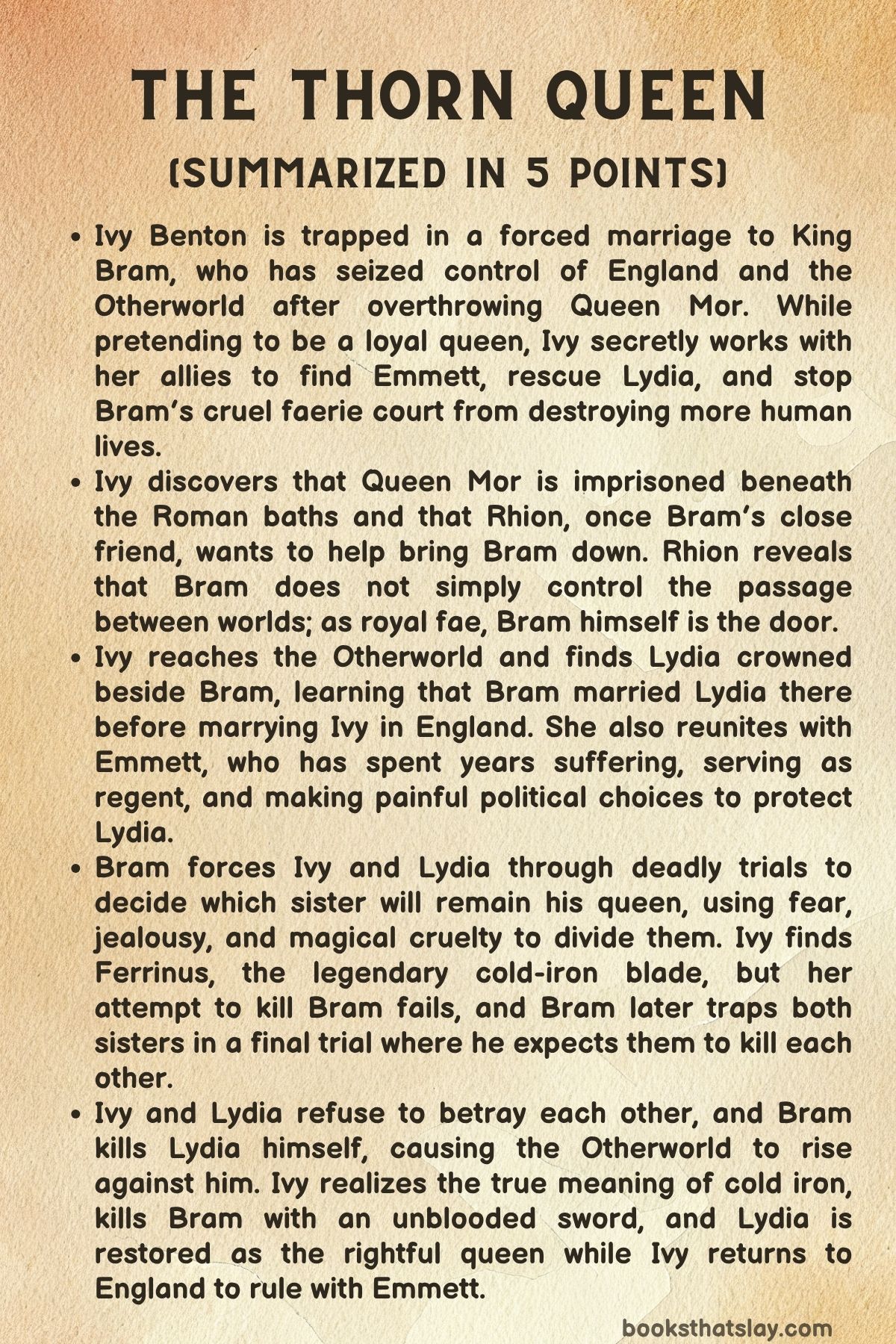
Summary
Prince Emmett De Vere begins the story trapped in the Otherworld, imprisoned after the disaster of Ivy Benton’s wedding day. He has been beaten, starved, and left in a dungeon, but he has not given up.
With only a silver pin from his boutonniere, he tries to work his way free and escape through the stairs. His attempt fails when a guard catches him, throws him back down, and knocks him unconscious.
As his strength fades, Emmett thinks only of Ivy. He believes he has failed her, and that belief haunts him even more than the pain of captivity.
Four months later, Ivy’s life has become a nightmare disguised as royalty. Bram has overthrown Queen Mor, broken the old bargain system, and taken control of both England and the Otherworld.
He has made Ivy his queen, but she has no real authority. Bram’s court treats her as a decorative wife, and his fae followers turn Bath into a place of violence and magical cruelty.
Humans are tortured for amusement, faeries hold bloody revels, and Bram allows terror to become part of his reign. Ivy must act like a loyal wife while secretly planning resistance.
Her grief is sharpened by uncertainty. Emmett has vanished, and so has Lydia, Ivy’s sister.
Ivy does not know whether either of them is alive. She searches for any way to reach the Otherworld, but Bram controls the door between realms, and his guards watch her closely.
Ivy’s real support comes from a small group of allies, including her ladies-in-waiting Faith, Marion, Olive, and Emmy, as well as Lottie, Ben, Eduart, and other members of a quiet rebel circle. Together they try to survive Bram’s court while looking for a weakness in his rule.
Ivy first tries to gain information through Aurelia Vallen, a frightened faerie wife who may know how the fae pass between worlds. Aurelia seems close to revealing something useful, but Bram’s guards drag her away before she can speak clearly.
That same night, Ivy sees faeries tormenting humans in public. A young girl is forced to wear a deer mask and become prey in a cruel hunt.
The next morning, Ivy finds the girl dead outside the Royal Crescent. Soon afterward, Ivy’s elderly friend Ethel comes to Bath hoping for a faerie bargain, only to be killed when faeries make her fly straight into tree branches.
These deaths harden Ivy’s will. She can no longer think only of saving Emmett and Lydia; she must stop Bram before his rule destroys more lives.
A clue comes through Olive, whose strange behavior draws Ivy’s attention. Rhion, Bram’s closest friend, hints that Olive has been secretly leaving every morning.
Ivy follows her to the Roman baths and discovers a hidden chamber where Queen Mor is being held prisoner. Olive has been enchanted by Bram to care for Mor without remembering her actions.
Rhion catches Ivy and her friends, but instead of exposing them immediately, he reveals his own hatred for Bram’s reign. Rhion once loved Lydia during her time in the Otherworld, and he wants Bram removed from power.
He also explains the truth about Bram’s ability: Bram does not merely open the door between realms. As royal fae, he is the door itself.
Ivy and Rhion create a dangerous plan based on faerie hunger for human emotion. Since faeries can feed on intense feeling, Ivy uses her love for Emmett and her hatred for Bram to overwhelm Bram enough to make him open the way.
She crosses into the Otherworld, expecting to find Emmett and Lydia as prisoners. Instead, she is pulled into a faerie revel and finds Lydia crowned as queen beside a man Ivy first mistakes for Emmett.
Lydia then reveals the truth: the man is Bram. Before marrying Ivy in England, Bram married Lydia in the Otherworld.
Lydia’s bargain with Mor had taken her there, stripped away much of her memory, and left her vulnerable to Bram’s influence. Bram later married Ivy because he needed an English marriage to break Mor’s bargains and complete his seizure of power.
When Emmett appears, the reunion Ivy imagined does not happen. Bram has convinced him that Ivy died on their wedding night, and Emmett believes the woman before him might be a faerie trick.
Ivy proves herself to Lydia first, but Emmett continues to resist until Ivy pours water over herself to prove she is not a selkie. Only then does he accept that she is real.
Their reunion is filled with relief, pain, and the weight of lost time. For Ivy, four months have passed.
For Emmett, two years have gone by in the Otherworld. He was first imprisoned, then forced into a ruthless political role as regent beside Lydia.
To protect Lydia, he even entered a political marriage with Lady Thalia, a cruel and ambitious faerie noblewoman.
Bram returns and turns the sisters’ conflict into entertainment. He announces trials to decide which Benton sister will remain his queen.
The first trial sends Ivy and Lydia into the woods to hunt a unicorn. Ivy cannot bring herself to kill the creature, but Lydia does, believing that victory may protect Ivy and others from Bram’s wrath.
The trial shows the difference between the sisters’ burdens: Ivy still resists cruelty directly, while Lydia has learned to make terrible choices in order to survive.
Ivy later rescues Faith and Marion from the dungeons and finds Mor imprisoned again. With Rhion, Emmett, Lydia, Faith, and Marion, she searches for Ferrinus, the legendary cold-iron blade Bram used to kill his father.
Their path takes them across a magical bridge, into a cottage haunted by Redcaps, and finally to the Isern Caves. Inside the caves, Ivy endures visions of Emmett and Lydia’s years of suffering without her.
These visions test her guilt, love, and fear, but she holds on. By lasting the longest inside the caves, Ivy wins the second trial and gains Ferrinus.
Rhion urges the group to act before Bram regains control of the situation. Their plan is to use Ferrinus to force Bram to abdicate.
But Bram discovers Ivy and Emmett’s renewed relationship by disguising himself as Emmett and entering Ivy’s bedchamber. With their plan exposed, Ivy and Emmett attempt a backup strategy.
They try to force Mor to take Emmett back to England and lock the door between worlds. Ivy secretly expects Mor to betray her and hopes to use that betrayal to get close enough to Bram with Ferrinus.
The plan works only in part. Mor takes Emmett to England, then drags Ivy back to the Otherworld and hands her to Bram.
Ivy stabs Bram in the heart with Ferrinus, believing she has finally ended him. But the blade fails.
Bram heals, and Ivy is thrown into the dungeon. Starving, wounded, and nearly out of hope, Ivy realizes something crucial: as Bram’s wife, she is part of the royal family.
That may mean she can open the door herself. She manages to create a portal to Kensington Palace, and Emmett leaps through to save her, but the escape does not succeed.
Bram captures Ivy, Emmett, and Rhion, then prepares his final trial in a coliseum.
For the final trial, Ivy and Lydia are dressed alike and armed. Lydia carries the unicorn horn, while Ivy holds Ferrinus.
Bram wants the sisters to kill each other while magic whispers their worst jealousies and resentments into their minds. The trial is designed to break their bond and prove that love can be twisted into rivalry.
Both sisters resist. Lydia tries to sacrifice herself, but Ivy refuses to let her.
They choose each other over Bram’s game, denying him the ending he wants. Furious, Bram uses Ferrinus to kill Lydia himself.
Lydia’s death awakens the Otherworld. The coliseum cracks open, water floods through it, trees burst from the ground, and vines seize Bram against a massive trunk.
Ivy realizes that Lydia was the true queen loved by the land. Duddon, a small folk creature, returns Ivy’s old sword from the unicorn trial.
Ivy then understands the real meaning of cold iron. It is not only unforged iron; it is a blade that has never been blooded.
She drives the sword into Bram’s chest and kills him. Mor disappears, possibly consumed by the land or transformed into bloodred lux flowers.
The Otherworld then restores Lydia to life and marks her as its rightful queen.
Lydia takes the throne and changes the future of the Otherworld. She bans the torture of humans, protects the small folk, limits the door to England to controlled diplomacy, and begins trials for cruel courtiers such as Thalia.
Ivy, Emmett, Faith, and Marion return to England, where political resistance still waits. Parliament considers replacing Ivy with a distant male heir, but Emmett publicly defends her as the rightful queen.
Ivy accepts the crown with Emmett beside her. Years later, they are happily married with children, ruling a changed England while Lydia reigns in the Otherworld.
Ivy’s youngest daughter becomes fascinated by faerie stories, asking again and again to hear the tale of the faerie king.
Characters
Ivy Benton
Ivy Benton is the emotional and political center of The Thorn Queen, a heroine shaped by captivity, grief, responsibility, and stubborn hope. At the start, she is trapped in a royal marriage that gives her a crown but no power.
Bram uses her position as queen to legitimize his rule while denying her any meaningful authority, yet Ivy learns to operate inside that restriction. Her strength is not loud or effortless; it comes from patience, observation, and the ability to keep acting even when she is frightened.
She performs obedience while building a rebellion in private, and this double life shows how much she understands the danger around her. Ivy’s compassion is one of her defining traits.
The deaths of the hunted girl and Ethel do not remain distant horrors to her; they become personal reasons to fight Bram’s rule. Her love for Emmett is powerful, but the book does not reduce her motivation to romance.
She wants to save him, but she also wants to end a system that treats human lives as toys. Her growth becomes clearest when she realizes that she may have power through her own royal connection, not only through Bram or Emmett.
By the end, Ivy is not simply rescued or restored; she claims her place as queen through courage, moral clarity, and a refusal to let cruelty define either England or the Otherworld.
Prince Emmett De Vere
Prince Emmett De Vere is a character marked by endurance, guilt, and a deep conflict between love and survival. His imprisonment in the Otherworld shows his vulnerability from the beginning.
He is not presented as an untouchable romantic hero; he is starved, beaten, broken down, and forced to live with the belief that he failed Ivy. When he later refuses to believe Ivy is real, that reaction is painful but understandable within the story.
Bram has manipulated him with grief, and the Otherworld has taught him to distrust appearances. Emmett’s two lost years have changed him.
He has been pushed into a political life beside Lydia and forced into choices that Ivy could not have imagined, including a political marriage to Thalia. These decisions make him more complicated, because his loyalty to Ivy exists alongside the compromises he made to protect Lydia and survive court life.
His love remains sincere, but it is no longer simple. Emmett’s public defense of Ivy in England is important because it shows that he respects her authority, not just their romance.
He does not try to take the crown from her or stand above her. Instead, he supports her right to rule, proving that his devotion is tied to trust, partnership, and recognition of her strength.
King Bram
King Bram is the main force of corruption in the novel, combining charm, political intelligence, magical power, and extreme cruelty. He is dangerous because he understands people’s emotions well enough to use them against them.
His marriages to Lydia and Ivy are not acts of love, but tools of conquest. He marries Lydia in the Otherworld, manipulates her weakened memory, and then marries Ivy in England to break Mor’s bargains and secure wider control.
Bram’s rule shows what happens when power is separated from responsibility. He encourages faerie violence, allows humans to be tortured for amusement, and treats the suffering of others as proof of his dominance.
His final trial reveals his deepest ugliness: he does not only want obedience, he wants love and loyalty to become poisoned. By forcing Ivy and Lydia to confront jealousy, resentment, and fear, he tries to prove that their bond can be destroyed.
His failure comes from misunderstanding the strength of the people he manipulates. Bram can feed on emotion and command fear, but he cannot create the kind of loyalty Lydia inspires in the land or the kind of love Ivy and Lydia choose in the coliseum.
His death by an unblooded blade is fitting because it defeats not only his body, but also the violent logic on which his reign depends.
Lydia Benton
Lydia Benton is one of the most tragic and powerful figures in the book, a sister whose suffering transforms her into the true queen of the Otherworld. Her disappearance first makes her seem like a lost victim, but her story is far more complicated.
She has lived in the Otherworld under Bram’s influence, lost much of her memory, and been made queen beside him before Ivy ever arrives. Lydia’s choices can appear harsh, especially when she kills the unicorn during the first trial, but those choices come from the brutal lessons she has learned.
She believes that survival sometimes requires moral compromise, and that winning Bram’s games may protect others from worse harm. Her relationship with Ivy is marked by pain, guilt, jealousy, and love.
Bram tries to exploit every wound between them, but Lydia’s core loyalty remains. In the final trial, her willingness to sacrifice herself shows that beneath the crown, manipulation, and survival instincts, she still loves Ivy more than she fears death.
The land’s response to Lydia’s murder reveals her true nature. She is not queen because Bram chose her, but because the Otherworld itself recognizes her.
Her restored life and later rule allow her to turn suffering into reform, protection, and justice.
Queen Mor
Queen Mor is a fallen ruler whose presence complicates the moral landscape of the story. Before Bram’s rise, she controlled the bargain system, and although Bram’s reign is more openly violent, Mor is not simply a benevolent alternative.
Her bargains have caused harm, and her methods are shaped by old faerie power rather than human mercy. Still, her imprisonment by Bram shows how completely he has overturned the previous order.
Mor becomes both a source of information and a dangerous uncertainty. Ivy cannot fully trust her, yet Mor remains useful because she understands the deeper laws of the Otherworld and the door between realms.
Her betrayal of Ivy confirms that she serves her own interests first, even when those interests overlap with resistance against Bram. Mor’s disappearance after Bram’s defeat leaves her fate uncertain, which suits her role in the novel.
She represents an older, colder kind of faerie rule that cannot simply return once Bram is dead. The future belongs neither to Bram’s sadism nor Mor’s bargain-bound control, but to Lydia’s new vision.
Mor’s possible transformation into bloodred lux flowers suggests that the land itself absorbs or replaces the old powers that failed it.
Rhion
Rhion begins as a suspicious figure because of his closeness to Bram, but he becomes one of the story’s most important allies. His position near Bram allows him to understand the king’s power, weaknesses, and political habits, making his help essential to Ivy’s rebellion.
Rhion’s change is not based on convenience alone. He has seen what Bram has become and hates the cruelty spreading through both courts.
His love for Lydia gives his resistance a personal urgency, but it does not make him reckless or sentimental. He often acts with caution, and his knowledge of faerie politics helps Ivy survive situations she could not navigate alone.
Rhion’s explanation that Bram is the door is one of the key turning points in the book because it changes Ivy’s understanding of the conflict. Bram is not merely guarding access to the Otherworld; his own body and royal nature are part of the barrier.
Rhion also carries guilt, especially because he remained close to Bram for so long, but he tries to answer that guilt through action. By standing with Ivy, Emmett, and Lydia, he becomes a bridge between faerie society and the future Lydia later builds.
Faith
Faith is one of Ivy’s most trusted ladies-in-waiting and represents the quiet courage of the human allies who resist Bram from within his court. She is not protected by magical power or royal status in the way the central rulers are, yet she chooses loyalty even when the cost is imprisonment, torture, or death.
Faith’s importance lies in her steadiness. She helps Ivy maintain a sense of purpose when Bram’s court is designed to isolate and frighten her.
Her presence also reminds the reader that Ivy’s rebellion is not a solitary act. It depends on women who share information, protect one another, and keep moving even when their roles are underestimated.
When Faith is imprisoned in the Otherworld, Ivy’s effort to rescue her shows how deeply Ivy values those who stand with her. Faith’s suffering is part of the larger human cost of Bram’s rule, but she is not only a victim.
She is a participant in resistance, and her survival allows her to return to England as part of the group that helps carry the memory of what happened into the new reign.
Marion
Marion, like Faith, is part of the loyal circle that gives Ivy strength during her forced marriage. Her role may not be as politically central as Ivy’s or Lydia’s, but she matters because the rebellion depends on trust at the personal level.
In a court where everyone may be watched, enchanted, or threatened, a dependable companion becomes a form of protection. Marion’s loyalty is tested when she is taken into the dungeons, and her rescue becomes one of Ivy’s urgent goals in the Otherworld.
Through Marion, the book shows that royal conflict affects ordinary attendants and friends as much as queens and princes. She is drawn into danger not because she seeks power, but because she stands beside someone who is trying to stop a tyrant.
Marion also helps humanize Ivy’s position. Ivy is not only a queen making strategic choices; she is a friend who refuses to abandon the people who trusted her.
Marion’s survival and return to England help show that the fight against Bram is not only about restoring crowns, but about saving the human bonds his reign tries to crush.
Olive
Olive’s role is tied closely to enchantment, secrecy, and the hidden damage Bram causes inside his own household. Her strange morning absences first seem suspicious, but Ivy’s investigation reveals that Olive has been magically compelled to care for the imprisoned Queen Mor without remembering it.
This makes Olive an example of how Bram’s power violates not only bodies, but also minds. He uses enchantment to turn a lady-in-waiting into a tool, stripping her of consent and memory.
Olive’s situation also gives Ivy the path toward discovering Mor’s prison, making her unwilling role important to the rebellion’s progress. As a character, Olive reflects the vulnerability of humans living under faerie rule.
Even those close to Ivy are not safe from manipulation. Her lack of memory does not make her weak; rather, it shows how thoroughly Bram’s court depends on hidden abuse.
Once the truth is uncovered, Olive’s experience adds urgency to Ivy’s mission. Bram’s reign cannot be treated as a political inconvenience or a bad marriage.
It is a system built on control, and Olive’s enchantment reveals how intimate and invasive that control can be.
Emmy
Emmy belongs to Ivy’s group of ladies-in-waiting and helps create the sense of a small human community inside a hostile faerie court. Her role supports one of the book’s central emotional realities: Ivy survives because she is not entirely alone.
In a palace ruled by fear, even small acts of loyalty matter. Emmy’s presence among Ivy’s attendants shows that resistance does not always begin with weapons or public defiance.
It often begins with listening, helping, keeping secrets, and remaining loyal when obedience to power would be safer. She also helps contrast the warmth of Ivy’s circle with the cruelty of Bram’s court.
The faeries surrounding Bram enjoy humiliation and pain, while Ivy’s ladies try to preserve dignity and care. Emmy may not drive the main political twists, but she contributes to the human foundation of the rebellion.
Her character helps show how Ivy’s queenship is different from Bram’s rule. Ivy draws people toward her through trust and protection, while Bram commands through fear.
Emmy’s loyalty is one of the many small signs that Ivy already possesses the moral qualities of a true ruler before the crown is secure.
Aurelia Vallen
Aurelia Vallen is a nervous faerie wife whose brief appearance carries real significance. Ivy approaches her because Aurelia may know how faeries travel between England and the Otherworld, making her a potential source of information that could help rescue Emmett and Lydia.
Aurelia’s fear reveals that even faeries are not fully safe under Bram’s reign. Although his court appears to favor faerie power over human life, Bram’s rule also traps and intimidates those within faerie society.
Aurelia’s removal by the guards before she can explain the truth shows how tightly Bram controls knowledge. He understands that information about the door between realms could threaten him, and he prevents even small conversations from continuing when they might weaken his power.
Aurelia functions as a reminder that tyranny creates silence. People do not need to openly oppose Bram to become targets; simply knowing something dangerous is enough.
Her interrupted conversation also pushes Ivy toward other paths, eventually leading her to Rhion and the truth that Bram himself is the door. Aurelia’s fear makes the court feel more unstable and shows how Bram’s power rests on constant surveillance.
Ethel
Ethel is an elderly human friend whose death becomes one of Ivy’s emotional turning points. She comes to Bath hoping for a faerie bargain, which shows how humans can still be drawn toward faerie magic despite its danger.
Her hope is painfully ordinary: she wants something from a world that promises miracles, not realizing how cruel Bram’s court has become. When faeries make her fly into tree branches and kill her, the scene exposes the sadism that now passes for entertainment.
Ethel’s death matters because Ivy knows her. This is not anonymous suffering in the distance; it is personal, immediate, and impossible to excuse.
Through Ethel, the book shows how Bram’s reign preys especially on human vulnerability. Old age, hope, desperation, and trust are all turned into weaknesses that faeries exploit.
Ivy’s grief over Ethel hardens into resolve, making her resistance less private and more political. Saving Emmett and Lydia remains central, but Ethel’s death helps Ivy see that every delay costs more human lives.
Ethel becomes one of the people Ivy carries with her into the fight.
Lady Thalia
Lady Thalia is a cruel faerie noblewoman whose political marriage to Emmett creates tension, jealousy, and pain. She represents the brutal social order Emmett was forced to navigate during Ivy’s absence.
His marriage to her is not a romantic betrayal in the simple sense; it is a survival arrangement tied to protecting Lydia and maintaining a position in a dangerous court. Still, Thalia’s presence wounds Ivy because it forces her to confront everything that happened while she was trapped in England.
Thalia herself benefits from the harshness of faerie politics. She is ambitious, unkind, and aligned with a court culture that treats power as permission to dominate others.
Her cruelty makes her one of the figures Lydia must later judge when she becomes queen. Thalia also helps show how Bram’s rule is supported by courtiers who enjoy or profit from abuse.
He is the central tyrant, but he does not act alone. His court contains many people willing to preserve their status through fear.
Thalia’s later trial under Lydia’s new rule signals that justice must reach beyond Bram to the society that allowed him to flourish.
Duddon
Duddon, a small folk creature, has a quiet but crucial role near the end of the story. His return of Ivy’s old sword becomes the key to Bram’s defeat, because Ivy finally understands the true meaning of cold iron.
Duddon’s importance is not based on royal blood, beauty, or court rank. Instead, he represents the small folk whom Lydia later chooses to protect.
His action shows that the future of the Otherworld depends not only on queens and princes, but also on the beings who have been ignored, threatened, or dismissed by the powerful. By helping Ivy at the decisive moment, Duddon proves that justice can come from those Bram and his court would consider insignificant.
His role also connects to Lydia’s legitimacy. The land and its overlooked people respond to the kind of rule she represents, not to Bram’s violence.
Duddon’s gift allows Ivy to kill Bram with a blade that has not been blooded, turning an object from an earlier trial into the true weapon of liberation. His presence gives the ending a wider moral scope: the Otherworld is saved not only by royal courage, but by the loyalty of those finally seen and valued.
Lottie, Ben, and Eduart
Lottie, Ben, and Eduart are part of Ivy’s rebel circle in England, and together they show that resistance to Bram stretches beyond the queen’s private rooms. Their support helps Ivy function in a world where public institutions have been compromised and faerie violence has become part of daily life.
They are not as central to the faerie court drama as Ivy, Emmett, Lydia, or Rhion, but their role matters because they help form the human network behind the rebellion. In The Thorn Queen, political survival depends on relationships that Bram cannot fully see or control.
Lottie, Ben, and Eduart contribute to that hidden structure of loyalty. They also reflect the broader stakes in England.
Bram’s rule is not only a family tragedy or a romantic obstacle; it affects common people, servants, citizens, and anyone exposed to faerie cruelty. Their presence helps make Ivy’s queenship feel connected to human responsibility.
She is not fighting for a crown in isolation, but for a country full of people who need protection from a king who treats them as disposable.
Themes
Power Without Mercy Becomes Monstrous
Bram’s reign shows how power becomes destructive when it is separated from duty, restraint, and care. He gains control over England and the Otherworld not to protect either realm, but to satisfy his need for dominance.
His court’s treatment of humans reveals the moral sickness of his rule: people are hunted, enchanted, tortured, and killed for amusement. The crown becomes a mask for cruelty, and magic becomes a tool for turning fear into entertainment.
Bram’s marriages also show his view of power. He does not love Lydia or Ivy as people; he uses them as legal and magical instruments to secure authority.
Against this, the story offers a different model of rule through Ivy and Lydia. Ivy’s authority grows from empathy and responsibility, while Lydia’s restored queenship is confirmed by the land itself.
When Lydia takes the throne, her first acts are protective and corrective: she bans human torture, safeguards the small folk, controls passage between realms, and begins trials for abusive courtiers. The Thorn Queen argues that true rule is not proven by conquest, but by the willingness to protect the vulnerable and answer for harm.
Sisterhood as Resistance
Ivy and Lydia’s bond is tested by distance, manipulation, jealousy, and trauma, yet it becomes the force Bram cannot defeat. He tries to turn the sisters against each other by placing them in competition for the title of queen, forcing them into trials, and using magic to whisper their worst resentments into their minds.
His strategy depends on the belief that pain will make love collapse into rivalry. For a time, the sisters are divided by different experiences.
Ivy has been trapped in England as Bram’s powerless wife, while Lydia has spent years in the Otherworld under his influence. Lydia’s choices, especially killing the unicorn, reveal how much survival has changed her.
Ivy struggles to understand those choices, and Lydia carries guilt for what she has become. Yet their final refusal to kill one another destroys Bram’s game.
Lydia’s attempted sacrifice and Ivy’s refusal to accept it prove that their relationship is stronger than the roles Bram assigns them. Their sisterhood becomes political as well as emotional.
By choosing each other, they reject a system built on possession, competition, and control.
Survival, Compromise, and Moral Injury
Many characters in the novel survive by making choices that leave wounds behind. Emmett’s political marriage to Thalia, Lydia’s role as Bram’s queen, Olive’s enchanted service to Mor, and Ivy’s performance as Bram’s loyal wife all show different forms of compromise under coercion.
The story does not treat survival as clean or easy. Emmett remains loyal to Ivy, but his years in the Otherworld force him into actions that hurt her when she learns the truth.
Lydia kills the unicorn not because she is heartless, but because she has learned that Bram’s world punishes innocence. Ivy herself manipulates Bram’s hunger for emotion and later expects Mor’s betrayal as part of her plan, showing how resistance can require morally uncomfortable tactics.
These choices create moral injury: characters survive, but they do not emerge untouched. The book’s strength lies in showing that trauma does not always make people noble in simple ways.
Sometimes it makes them guarded, harsh, guilty, or suspicious. Healing begins only when characters are allowed to tell the truth about what happened and stop pretending that survival under tyranny was the same as consent.
The Land Chooses the Worthy Ruler
The Otherworld is not just a setting; it responds to the moral condition of its rulers. Bram controls the court through fear, but he never truly earns the loyalty of the land.
His power depends on violence, spectacle, and bloodshed, yet the land remains waiting for a ruler who protects rather than consumes. Lydia’s death reveals this hidden judgment.
When Bram kills her, the coliseum breaks apart, water floods in, trees rise, and vines seize him. Nature itself rejects him.
This moment changes the meaning of queenship. Lydia is not the true queen because Bram married her or because courtiers crowned her.
She is queen because the Otherworld recognizes something in her that Bram lacks: a capacity for sacrifice, protection, and renewal. Ivy’s discovery about cold iron deepens this idea.
Bram can only be killed by a blade that has not been blooded, which makes his defeat depend on an object outside his violent logic. The land’s restoration of Lydia confirms that rightful rule is tied to relationship rather than domination.
A ruler must belong to the world they govern, and that belonging is earned through care.