You’ll Miss Me When I’m Gone Summary, Characters and Themes
You’ll Miss Me When I’m Gone by A.R. Torre is a domestic suspense story about a woman whose desperate attempt to repair her marriage exposes the much darker truth beneath it. Rachel Redden stages her own disappearance because she wants her husband, Jake, to feel needed again, but her carefully planned scare uncovers his affair with her best friend and his plan to have her murdered for money.
The story turns a marriage-repair stunt into a survival story, built around betrayal, greed, emotional blindness, and the moment Rachel realizes that saving herself matters more than saving her marriage. It’s the 3rd story in the Deadly Ambition series.
Summary
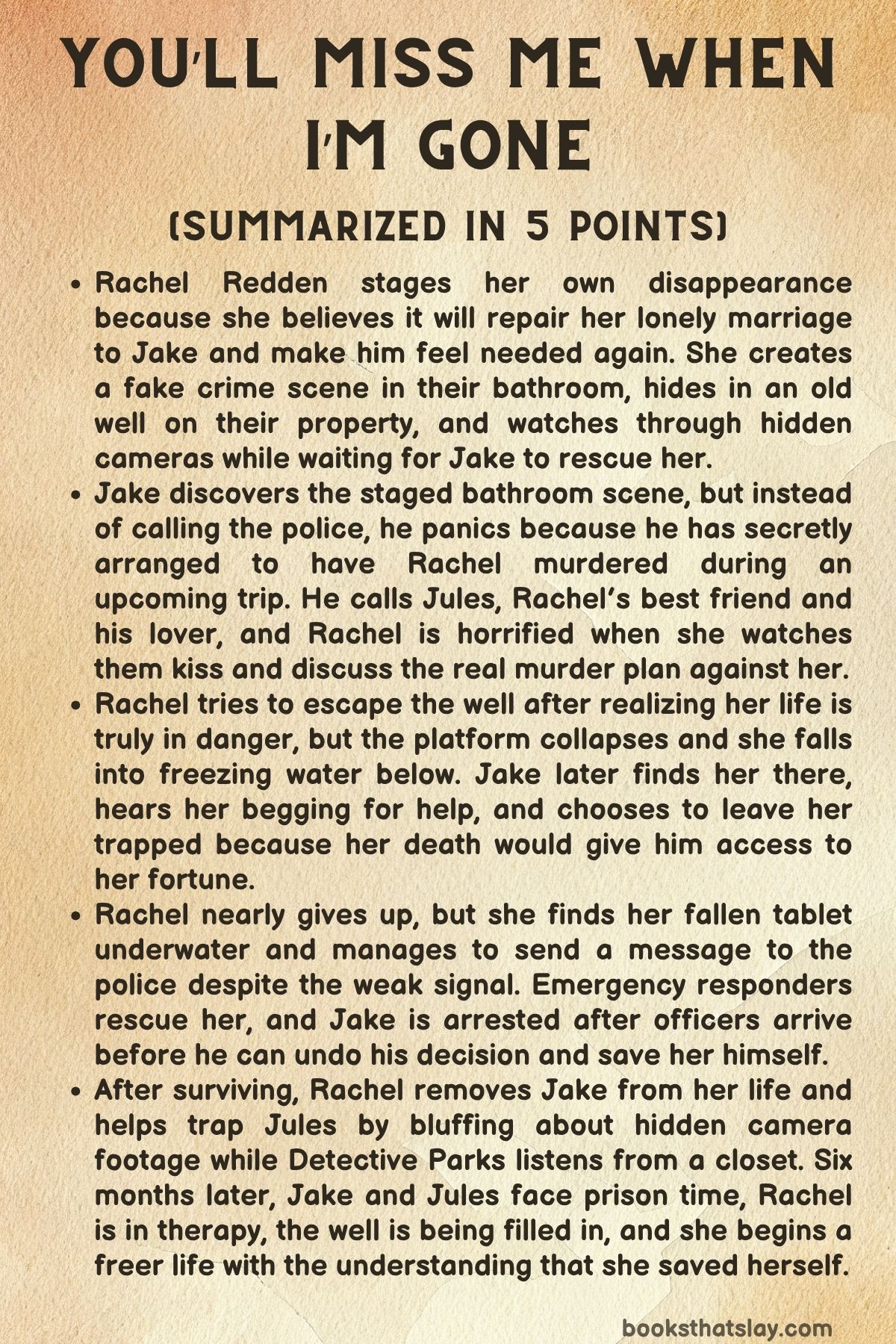
Rachel Redden begins her day with a plan that is both theatrical and deeply sad. She believes her marriage to Jake has become cold because he no longer feels useful beside her.
Rachel has a trust fund, a large house, and financial independence, while Jake depends on her money and carries resentment because of it. After reading a self-help book about troubled marriages, Rachel becomes convinced that Jake’s pride has been damaged by his dependence on her.
She decides that if she can create a crisis, he will be forced into the role of rescuer, and the emotional shock will remind him that he loves her.
Her solution is to fake her own disappearance. Rachel prepares the bathroom to look as though she has been attacked.
She leaves blood, a broken mirror, scattered cosmetics, a dropped earring, and her abandoned phone. Every detail is meant to frighten Jake without truly harming anyone.
She hides in an old well on their property and sets up hidden cameras so she can watch Jake discover the scene and follow the clues. Rachel expects panic, concern, and eventually a rescue.
In her mind, this is not just a prank; it is a desperate attempt to bring back intimacy and importance in a marriage that has become lonely.
When Jake comes home, he finds the bathroom in ruins. He notices the blood, the cracked mirror, the phone, and the general disorder, all of which feel wrong because Rachel is normally precise and controlled.
For a moment, his alarm seems real. But instead of calling the police, Jake hesitates.
His fear is not simply for Rachel’s safety. He has already arranged for Rachel to be killed during a planned trip to Palm Springs.
The staged crime scene makes him wonder whether the hired killer acted too early or whether the murder plan has somehow gone out of control.
Jake calls Jules, Rachel’s closest friend, who is also his lover. Jules is with her husband, Sam, when Jake contacts her, but she quickly understands the danger.
She tells Jake not to call the police and comes to the house. Her reaction reveals that she is not an innocent outsider.
She knows about Jake’s plan and is involved in the betrayal. Rachel watches everything from the well, still hoping the scare will become a turning point in her marriage.
Instead, she sees Jake and Jules kiss. The truth becomes even more painful when Jules sexually services Jake in the bathroom while Rachel watches through the camera feed, surrounded by the fake evidence she created.
Rachel is crushed, humiliated, and furious. She had suspected Jake might be unfaithful, but she never imagined Jules would be the person betraying her.
The emotional wound deepens when she hears Jake and Jules discuss the murder plot. Jake says the plan was supposed to happen during the Palm Springs trip, not at the house.
Rachel finally understands that her staged disappearance has uncovered a real plan to kill her. The reason is money.
Because of their prenuptial agreement, Jake cannot gain control of Rachel’s fortune through divorce, but her death would give him access to what he wants.
Rachel decides she has to escape the well and confront them, but her situation suddenly becomes dangerous in a way she never intended. She had arranged the hiding place as part of the fake rescue, planning for Jake to find her and save her.
But when she tries to climb out, the platform and metal grate shift beneath her. Her tablet falls, and she loses her grip on the slick handholds.
She drops into the freezing water below. The staged emergency becomes real.
Rachel is now trapped deep underground, soaked, cold, injured by the shock of the fall, and cut off from the device that allowed her to watch the house.
Aboveground, Jake tries to understand what has happened. He calls hospitals and pretends to be a worried husband, but no one has admitted Rachel.
His thoughts show how much resentment he carries. He blames Rachel for the failure of the garage she financed for him, feeling that her advice, questions, and presence made him look weak.
His pride has curdled into anger. He also has gambling debts and badly needs money.
His affair with Jules is not only sexual; it is also tied to their shared plan to remove Rachel and profit from her death. Jake hopes that if someone else has already kidnapped or killed Rachel, he might avoid paying the hit man connected to his poker circle.
Rachel’s planned clue eventually reaches Jake. An ancient coin arrives at the house, a delivery she arranged after telling him about the well earlier.
She intended the coin to remind him of the well and guide him toward her hiding place. The plan works in a literal sense: Jake goes to the well and hears Rachel calling from below.
Rachel begs him to get a rope and call emergency services. For one fragile moment, she hopes he might still save her.
Instead, Jake looks down at her and chooses cruelty. He throws the coin into the well and says he made a wish.
He tells her it would be easier for everyone if she stays there. He promises her body will be found later, covers the well, and leaves her to die.
Rachel is left in darkness, surrounded by freezing water and the knowledge that her husband has chosen her death. Her strength begins to fail.
She is exhausted, terrified, and losing hope. At one point, she lets herself sink beneath the surface, but underwater she touches something hard.
It is the tablet. She grabs it and rises again.
Against the odds, the device still functions. The signal is weak, but she manages to load a police contact page and send a message through a chat box.
The message reaches help. Police and emergency responders come to the property and pull her from the well.
Meanwhile, Jake begins to regret leaving Rachel behind. After drinking and sitting with memories of their marriage, he starts to think that perhaps Rachel does not deserve to die.
He decides he should rescue her, but his change of heart comes too late. When he opens the door, police officers are there.
Rachel has already been saved. She is cold, wet, furious, and alive near an ambulance.
Jake is taken in for questioning, and the false disappearance has become an attempted murder investigation.
After the rescue, Rachel begins removing Jake from her life. She clears his belongings out of the house and prepares to remodel the bathroom where her fake scene exposed real betrayal.
Jake negotiates a plea deal and expects prison time. Rachel then turns her attention to Jules.
She invites Jules over under the excuse of choosing bathroom materials. During the visit, Rachel claims she had hidden cameras throughout the house and says she saw Jules with Jake and heard the murder discussions.
Rachel is bluffing because she does not actually have a recording, but Jules panics. She tries to deny involvement, then blames Jake and claims the murder plan was his idea.
Rachel keeps pushing until Jules reveals enough. Detective Parks, hidden in the closet and listening, steps out and arrests her.
Six months later, Rachel is rebuilding herself. Jules has accepted a plea deal for eighteen months, while her husband has filed for divorce and frozen their accounts.
Jake faces a longer sentence of seven to ten years. Rachel understands the bitter irony of what happened.
She created an elaborate rescue fantasy because she believed her marriage could be fixed if Jake felt needed, but she survived only because she saved herself. The well is going to be filled in, and Rachel plans to plant a memorial garden above it for the version of herself who emotionally died there.
She is in therapy and learning that not everything broken deserves repair. She has also begun seeing Marcus, a contractor who treats her with ease and kindness.
When he arrives with chili for dinner, Rachel recognizes that she is no longer trying to please a man who resented her existence. For the first time in months, she feels free.
Characters
Rachel Redden
Rachel is the central figure of You’ll Miss Me When I’m Gone, and her journey begins with a mistake born from loneliness rather than malice. She is wealthy, organized, and emotionally starved, with a marriage that has left her feeling unseen despite all the material comfort around her.
Her decision to stage her own disappearance shows how deeply she has internalized the belief that she must manage Jake’s feelings and repair his pride. At first, Rachel appears controlling and naïve because she designs an elaborate emotional test instead of facing the marriage honestly.
Yet the story gradually reveals that her real flaw is not cruelty but desperation. Once she discovers Jake and Jules’s affair and their murder plan, Rachel’s fantasy collapses.
Her survival in the well becomes a physical version of her emotional awakening. By the end, she is no longer trying to be rescued by a man who hates her.
She becomes sharper, calmer, and more self-protective, using intelligence and restraint to expose Jules and reclaim her life.
Jake Redden
Jake is Rachel’s husband, and he represents wounded pride turned into entitlement. He feels emasculated by Rachel’s wealth and by his own dependence on her, but instead of confronting his failures, he blames her for them.
The failed garage becomes one of his central excuses, allowing him to recast himself as a victim of Rachel’s support rather than a man responsible for his own choices. His gambling debts reveal a reckless and selfish side, while his affair with Jules shows his need for admiration without accountability.
Jake’s most disturbing moment comes at the well, where he has the chance to save Rachel but chooses to leave her there. That decision strips away any remaining illusion that he is merely weak or confused.
He is capable of calculating cruelty when his comfort and financial future are at stake. His brief regret later does not redeem him; it only shows that his conscience wakes up after the damage is done.
Jules
Jules is one of the most personal sources of betrayal in the story because she is not just Jake’s lover but Rachel’s closest friend. Her role makes the danger feel intimate rather than distant.
She enters the house already aware that Rachel’s disappearance may be connected to the murder plan, and her first instinct is not concern for Rachel but damage control. Jules’s relationship with Jake is built on secrecy, greed, and shared contempt for Rachel, though she later tries to present herself as someone who was only pretending to cooperate.
Her panic during Rachel’s trap reveals her weakness under pressure. Jules is manipulative, but she is not as controlled as she thinks.
When Rachel claims to have proof, Jules quickly shifts from denial to self-preservation, blaming Jake and exposing her own guilt. In You’ll Miss Me When I’m Gone, Jules functions as a reminder that betrayal is often most devastating when it comes from someone trusted enough to be invited inside every part of one’s life.
Detective Parks
Detective Parks becomes important in the later part of the story as the representative of law, patience, and controlled strategy. Rather than rushing the case only through suspicion, Parks helps Rachel create a situation where Jules can reveal herself.
His hidden presence during Rachel’s confrontation with Jules allows the truth to emerge through Jules’s own fear and contradictions. Parks does not dominate the story, but his role matters because he validates Rachel’s experience after Jake and Jules have tried to make her disposable.
He also gives Rachel’s intelligence room to operate. The closet trap works because Parks trusts the possibility that Rachel can draw Jules out.
His presence brings structure to a situation that began as emotional chaos, turning Rachel’s private nightmare into a legal case with consequences.
Marcus
Marcus appears later as a sign of Rachel’s changed life rather than as the source of her recovery. He is a contractor, and his kindness, humor, and ordinary warmth contrast sharply with Jake’s resentment.
Marcus does not arrive as a savior, and that is important. Rachel’s survival and emotional renewal are already underway before romance becomes possible again.
His presence suggests that companionship can exist without manipulation, fear, or the need to prove one’s usefulness. When he brings chili for dinner, the gesture is simple, domestic, and gentle, which makes it meaningful after the violence of Rachel’s marriage.
Marcus represents a future Rachel can choose without losing herself inside someone else’s needs.
Sam
Sam, Jules’s husband, remains mostly at the edge of the story, but his position adds another layer to Jules’s betrayal. He is another person deceived by the affair and the murder plot, and his later decision to file for divorce and freeze accounts shows that Jules’s actions damage more than Rachel alone.
Sam’s presence also highlights how carefully Jules has been maintaining a false life. She is not simply betraying a friend; she is betraying her own marriage while helping plan another woman’s death.
Though Sam is not explored as deeply as Rachel or Jake, his reaction after the truth comes out shows the wider collapse caused by Jules’s choices.
Themes
The Danger of Trying to Fix What Should Be Left Behind
Rachel begins from the belief that her marriage can be repaired if she finds the right emotional lever. She does not first ask whether Jake deserves that effort or whether his resentment has already become something dangerous.
Her fake disappearance is extreme, but it grows from a common emotional pattern: taking responsibility for another person’s bitterness. Rachel thinks Jake feels useless because she has too much money and too much control, so she tries to create a situation where he can feel needed.
The tragedy is that she is solving the wrong problem. Jake does not need a chance to rescue her; Rachel needs to recognize that his anger is not love in disguise.
You’ll Miss Me When I’m Gone uses the well as a brutal metaphor for this realization. Rachel literally falls into the trap she created to save the marriage, and she escapes only when she stops waiting for Jake.
The theme becomes clear through her final understanding: some broken things are not noble projects. Some are warnings.
Betrayal Inside Intimate Relationships
The betrayals in the story hurt because they come from the two people Rachel should have been able to trust most. Jake’s betrayal is marital, financial, emotional, and physical.
He does not merely cheat on Rachel; he plans to benefit from her death. Jules’s betrayal cuts differently because friendship requires a form of chosen loyalty.
Rachel lets Jules close to her life, only to learn that Jules has been using that closeness against her. The bathroom scene intensifies this theme because Rachel watches her private humiliation unfold inside her own home, in the same space she staged as a symbol of danger.
What she imagined as a performance becomes a window into the truth. The story shows that betrayal is not only the act itself but the rewriting of reality around it.
Jake and Jules speak about Rachel as a problem, an obstacle, and a financial solution, proving they have emotionally erased her long before they try to remove her physically.
Money, Power, and Resentment
Rachel’s trust fund shapes the marriage in ways she does not fully understand at first. She sees her money as security and support, while Jake experiences it as humiliation.
Instead of being honest about his insecurity, he turns it into a grievance. The failed garage is especially important because Rachel’s financial help should have been an opportunity, but Jake remembers it as evidence that she made him feel small.
His debts and greed make that resentment deadly. The prenuptial agreement blocks him from gaining her wealth through divorce, so he begins to see murder as a path to freedom and money.
The story shows how financial imbalance can become poisonous when one person refuses accountability. Rachel’s wealth does not make her cruel, and Jake’s dependence does not make him powerless in a moral sense.
His choices are still his own. His resentment becomes dangerous because he treats Rachel’s resources as something he deserves while treating Rachel herself as disposable.
Self-Rescue and Reclaiming Identity
Rachel’s survival depends on the moment she stops imagining Jake as her rescuer. At the start, her plan is built around his reaction.
She wants him to panic, search, save her, and become emotionally connected to her again. After he leaves her in the well, that fantasy dies completely.
The rescue that follows is not romantic or symbolic in the way she intended; it is practical, painful, and self-directed. She finds the tablet, fights through fear and exhaustion, and gets help herself.
This shift continues after the physical danger ends. Rachel clears Jake’s belongings, works with Detective Parks, tricks Jules into revealing the truth, enters therapy, and begins building a life that is not organized around Jake’s approval.
The memorial garden over the filled well captures this transformation. It honors the version of Rachel who was lost, but it also marks the place where a stronger version began.
Her freedom comes not from being chosen, but from choosing herself.