Dead Weight Summary, Characters and Themes
Dead Weight by Hildur Knútsdóttir is a dark psychological novel about loneliness, coercive control, hidden relationships, and the unsettling ways ordinary routines can coexist with violence.
At its center is Unnur, a highly organized Reykjavík business analyst whose private fascination with disposing of bodies unexpectedly becomes useful when she befriends Ásta, a young woman trapped in an abusive relationship. What begins with a stray cat gradually develops into an intense friendship, a desperate act of resistance, and a carefully planned cover-up. The book combines bleak humor with social criticism while examining whether destruction can sometimes clear the way for freedom, companionship, and renewal.
Summary
Unnur is a thirty-three-year-old business analyst living alone in a spotless Reykjavík apartment. She is disciplined, observant, professionally ambitious, and privately fascinated by the practical problem of disposing of a human body, an idea she has considered during sleepless nights for years.
Her mental exercises involve comparing burial, fire, water, dismemberment, and other methods of concealment. These thoughts calm her because they transform death into a problem that can be solved through preparation, organization, and patience.
Unnur’s carefully controlled life is disrupted when she returns from a business trip and discovers a black-and-white cat sleeping on her white sofa. Although she initially puts the animal outside, the cat repeatedly finds its way back into the apartment.
Holding the warm, purring animal awakens Unnur’s longing for affection. Her emotional life is dominated by Jói, an older married man who gives her limited attention while promising that their hidden relationship is meaningful.
Jói often calls only when his wife and children are absent. Unnur accepts the secrecy because she believes he will eventually leave his unhappy marriage, although he has never invited her to his home or given her any concrete reason to expect change.
At work, Unnur prepares for an important meeting with the company director, Þorvard. Her manager, Tumi, is seriously ill, and she suspects that the company may need someone to assume his responsibilities.
Unnur carefully develops marketing ideas but plans to present them as spontaneous thoughts. She understands that powerful men are often praised for immediate opinions, while women must prepare extensively and then conceal that preparation to appear naturally brilliant.
The meeting goes well, and Þorvard records several of her suggestions. Unnur hopes this indicates that she is being considered for promotion, but she must wait for a decision.
Meanwhile, the cat continues entering her apartment. A social-media post reveals that the animal is named Io and belongs to Ásta Ólafardóttir, who arrives breathless and emotional after Unnur contacts her.
Ásta’s open affection for Io makes Unnur uncomfortable because it is so different from her own guarded behavior. Ásta cries, holds Unnur’s hands, offers a reward, and repeatedly thanks her before taking Io home.
The connection appears to have ended until Unnur comes home and discovers Io on her bed beside a bloodstain. Io has returned to give birth to a single black kitten on Unnur’s carefully arranged bedspread.
Ásta is shocked that Io was pregnant and hurt that the cat chose Unnur’s apartment rather than her own home. She insists that moving Io and the newborn could be dangerous, so Unnur reluctantly agrees to care for them temporarily.
Ásta establishes a precise visiting schedule and asks Unnur to communicate through text rather than telephone. During one visit, she explains that Io may have left because she felt insecure after Ásta’s boyfriend, Ragnar, moved into the apartment.
Ásta describes Ragnar as the person who rescued her from childhood neglect. Her mother suffered from serious emotional problems and eventually died by suicide, leaving Ásta dependent on Ragnar from a very young age.
Their relationship began when Ásta was thirteen and Ragnar was seventeen. He fed her when she was hungry, protected her when no one else did, and later provided her with a home.
Unnur recognizes that gratitude and dependence have made it difficult for Ásta to examine the relationship honestly. Ásta regards Ragnar as her protector, even though her descriptions suggest that his support has always been connected to power and control.
As the women spend more time together, they begin discussing their romantic lives. Unnur claims that Jói is a pilot living abroad and presents their limited contact as a healthy long-distance arrangement that protects her independence.
Ásta questions whether freedom has any value when there is no one available to share ordinary life. Her questions unsettle Unnur because they expose how little she truly knows about Jói’s home, marriage, and intentions.
Their conversation is interrupted when Ragnar arrives unexpectedly. Ásta becomes visibly terrified, while Io arches her back and moves protectively toward her kitten.
Ragnar acts polite, but he studies Unnur’s apartment, crushes her hand during a handshake, and makes it clear that he expects Ásta to leave immediately. His presence transforms Ásta from an expressive young woman into someone tense, obedient, and frightened.
Ásta later admits that Ragnar installed a tracking application on her phone without properly informing her. She defends the surveillance as practical assistance because she is supposedly forgetful, but Unnur identifies it as controlling behavior.
When Unnur challenges her, Ásta responds by criticizing Unnur’s relationship with Jói. The argument hurts them both because each woman is protecting a relationship built on secrecy, inequality, and emotional dependence.
Ragnar later visits Unnur alone and tries to persuade her to surrender Io and the kitten. He claims that Ásta is mentally unstable and suggests that the cats worsen her condition.
His story creates uncertainty because Ásta has appeared exhausted, injured, and emotionally distressed. However, Ragnar’s behavior soon exposes his true nature.
He enters Unnur’s bedroom without permission, removes the newborn kitten from Io, and remarks that the animal’s skull and bones could easily be crushed in one hand. When Unnur orders him to leave, he corners her against a wall and insults her before finally departing.
Unnur tells Jói about the incident, expecting reassurance. Instead, he minimizes the threat, wonders whether Ragnar was misunderstood, and makes Unnur doubt her own judgment.
Jói’s reaction reflects his inability to understand physical vulnerability. As a large, socially secure man, he does not recognize how terrifying Ragnar’s actions were for a woman trapped alone with him.
Ásta soon arrives with bruises, nausea, and visible pain. She claims that she fell, but Unnur no longer believes her explanations.
During this visit, Ásta asks whether Jói is married. Unnur admits the truth, and Ásta calmly questions whether the familiar story of an unhappy marriage is believable.
Ásta also describes the theory of a hidden planet whose gravity influences the solar system despite remaining unseen. This idea becomes a metaphor for the concealed forces governing both women’s lives.
Ragnar suddenly enters through the unlocked door. He shoves Unnur onto the bed, grabs Ásta by the hair, and drags her screaming from the apartment.
Unnur calls the police. Officers speak to Ásta and Ragnar at their home, but both insist that nothing is wrong, leaving the authorities with little ability to intervene.
The police explain that Ásta must choose to leave. Unnur is forced to confront the painful limits of outside assistance when a victim remains frightened, dependent, and unwilling to accuse her abuser.
Unnur later visits Ásta’s apartment and demands proof that she is alive. Ásta appears bruised and frightened but mechanically states that she is fine while Ragnar watches.
After Ragnar closes the door, Unnur calls through a basement window and reminds Ásta that Io misses her. Ragnar returns, insults Unnur, and threatens to call the police.
Unnur turns to Jói for comfort, but he refuses to speak because he is with his family. Returning home, she checks the social-media account of Jói’s wife through a false identity.
She discovers that Jói’s wife is pregnant. The photographs document fertility treatments, miscarriages, hormone injections, grief, a sonogram, and Jói’s affectionate participation throughout the process.
The evidence destroys Jói’s claim that his marriage has been emotionally and physically dead for years. Unnur suffers a panic attack and vomits after realizing that the future she imagined was based on deliberate deception.
Despite her emotional collapse, Unnur attends work the next morning. Þorvard informs her that Tumi has aggressive cancer and will be absent for an extended period.
Unnur is offered the position of acting marketing manager with a twenty-percent raise. Þorvard praises her judgment but also mentions pressure to improve gender representation, leaving her uncertain whether the promotion reflects merit, convenience, or corporate appearance.
That evening, Jói comes to Unnur’s apartment and tries to persuade her that nothing between them has changed. When he refuses to leave, she threatens to contact his wife, which immediately forces him to retreat.
Soon afterward, Ásta arrives without a coat, bleeding and badly injured. Unnur brings her inside, wraps her in a blanket, and begins making tea.
Ragnar breaks through the front door before the water boils. He throws Ásta down, kicks her, and repeatedly punches her while she tries to protect herself.
Unnur initially freezes, but then she takes a heavy clay statue from a shelf and strikes Ragnar on the back of the head. The blow stops the assault but does not kill him.
Ásta takes the statue and approaches Ragnar as he attempts to rise. She strikes him in the face and continues hitting him until his skull is destroyed and he is unquestionably dead.
The killing begins as protection but continues as the release of years of terror, humiliation, dependence, and rage. Unnur does not stop Ásta or call the police.
Instead, she finishes making tea. The domestic action creates a pause in which both women recognize the seriousness of what has happened.
Ásta initially assumes they will report the death as self-defense. Unnur examines the corpse and concludes that the physical evidence would make the explanation difficult to believe because Ásta continued striking Ragnar after he was incapacitated.
Unnur decides that they must conceal the death. Her years of private planning immediately give her control over the situation.
They drag Ragnar’s body into the bathroom and begin cleaning the living room. Unnur focuses on removing blood from the floor and sofa before it dries, treating the apartment as a scene that must be restored to normal.
She gathers garbage bags, suitcases, gloves, a saw, hedge clippers, and other supplies from the building’s storage areas. The tools are ordinary household objects, but Unnur converts them into instruments of concealment.
The women place Ragnar’s naked body in the bathtub. Unnur cuts his throat, wrists, and legs in an effort to drain the blood before dismemberment.
Ásta becomes nauseated and vomits, while Unnur remains calm. Ásta’s violence came from fear and accumulated rage, whereas Unnur experiences the aftermath as a difficult but manageable project.
They begin sawing through Ragnar’s limbs. After struggling with joints and tendons, Unnur learns that cutting directly through bone is faster.
The task takes hours. Unnur develops a steady rhythm, removes Ragnar’s head, and arranges the bagged body parts inside two suitcases with the same precision she once used when packing luggage for Jói.
They clean the bathroom with bleach, wash themselves, package their stained clothing, and return the borrowed tools. Shortly after two in the morning, they wheel the suitcases to Unnur’s car as though leaving for a journey.
The next stage involves creating the appearance that Ragnar left voluntarily. Ásta retrieves his wallet, keys, phone, and vehicle while leaving her own phone behind so its location data will not expose her movements.
Ásta drives Ragnar’s Toyota while Unnur follows in her Honda. They travel toward the coastal village of Garður, where Ásta throws Ragnar’s phone into the sea.
They leave his wallet and keys inside the abandoned car, allowing investigators to imagine that he disappeared near the coast. The women then collect heavy rocks and place them in Unnur’s trunk.
Unnur drives toward the Krýsuvík geothermal area, a location she has remembered since childhood. Her father once explained that the scalding, sulfurous mud could destroy a body.
That conversation occurred shortly before her father disappeared without explanation. His absence may have inspired Unnur’s lifelong fascination with bodies that continue to exist somewhere even after a person has vanished from ordinary life.
At the hot spring, Unnur and Ásta place rocks in the suitcases and bags to make them sink. They carry the first suitcase across unstable ground and throw it into the bubbling mud.
After a tense moment, the suitcase disappears beneath the surface. They repeat the process with the remaining suitcase and the bag containing their stained clothing.
Once the evidence is gone, Ásta breaks down. She admits that she loved Ragnar despite everything he did to her.
Ragnar had controlled, threatened, and injured her, but he had also fed and sheltered her when she was a neglected child. His death does not erase the emotional dependence and complicated history that shaped most of her life.
Unnur comforts her without judgment. She understands that freedom from abuse does not immediately remove grief, memory, or attachment.
Before separating, Unnur gives Ásta a detailed timeline to follow. Ásta must wait before reporting Ragnar missing, contact people who might supposedly know his location, and emphasize the disappearance of his vehicle.
The women agree not to communicate for several months. Ásta is devastated that she cannot visit Io and the kitten, but Unnur promises to care for them.
Unnur returns to her apartment, makes herself presentable, and goes to work without sleeping. Maintaining her routine becomes another part of the cover-up.
When police later visit, Unnur claims she has not seen Ragnar since her earlier confrontation at his home. One officer notices the bloodstain on her white sofa, but his colleague jokingly identifies it as menstrual blood, and the embarrassed man accepts the explanation.
News reports eventually announce that Ragnar’s abandoned vehicle has been found. Police state that there is no evidence of criminal activity and suspend the active search.
Unnur experiences relief rather than guilt. She believes that when forced to choose between Ragnar’s survival and Ásta’s, they made the correct decision.
As the months pass, the black kitten grows into an energetic presence in her apartment. Unnur names him Gestur, meaning guest, because he entered her life unexpectedly and became welcome.
Io and Gestur transform the sterile apartment into a home. Unnur no longer cares when Gestur scratches the sofa because physical perfection has become less important than companionship.
She ends her relationship with Jói and gradually accepts that he never filled her loneliness. She had attached her hopes to an unavailable man because waiting allowed her to avoid the risks of building a real shared life.
Jói’s wife gives birth, and Unnur directs her anger toward him rather than toward the woman he deceived. Her understanding of responsibility becomes clearer as she releases the fantasy that his wife was her enemy.
Unnur reconsiders Ásta’s hidden-planet theory. A destructive force may cause catastrophe, but destruction can also create conditions in which new life becomes possible.
Ragnar’s death, Jói’s betrayal, and the collapse of Unnur’s former identity have caused irreversible damage. Yet these events have also freed Unnur and Ásta from relationships that restricted their lives.
Months after their separation, someone knocks on Unnur’s door. Io runs toward it, and Unnur finds Ásta standing outside.
Ásta looks tired but smiles as she asks whether “we” may come inside. She opens her coat and reveals that she is pregnant.
Unnur welcomes Ásta and embraces her. Dead Weight ends with an opening door, the return of friendship, and the possibility that Unnur, Ásta, Io, Gestur, and the unborn child may form a chosen family built from the ruins of their former lives.
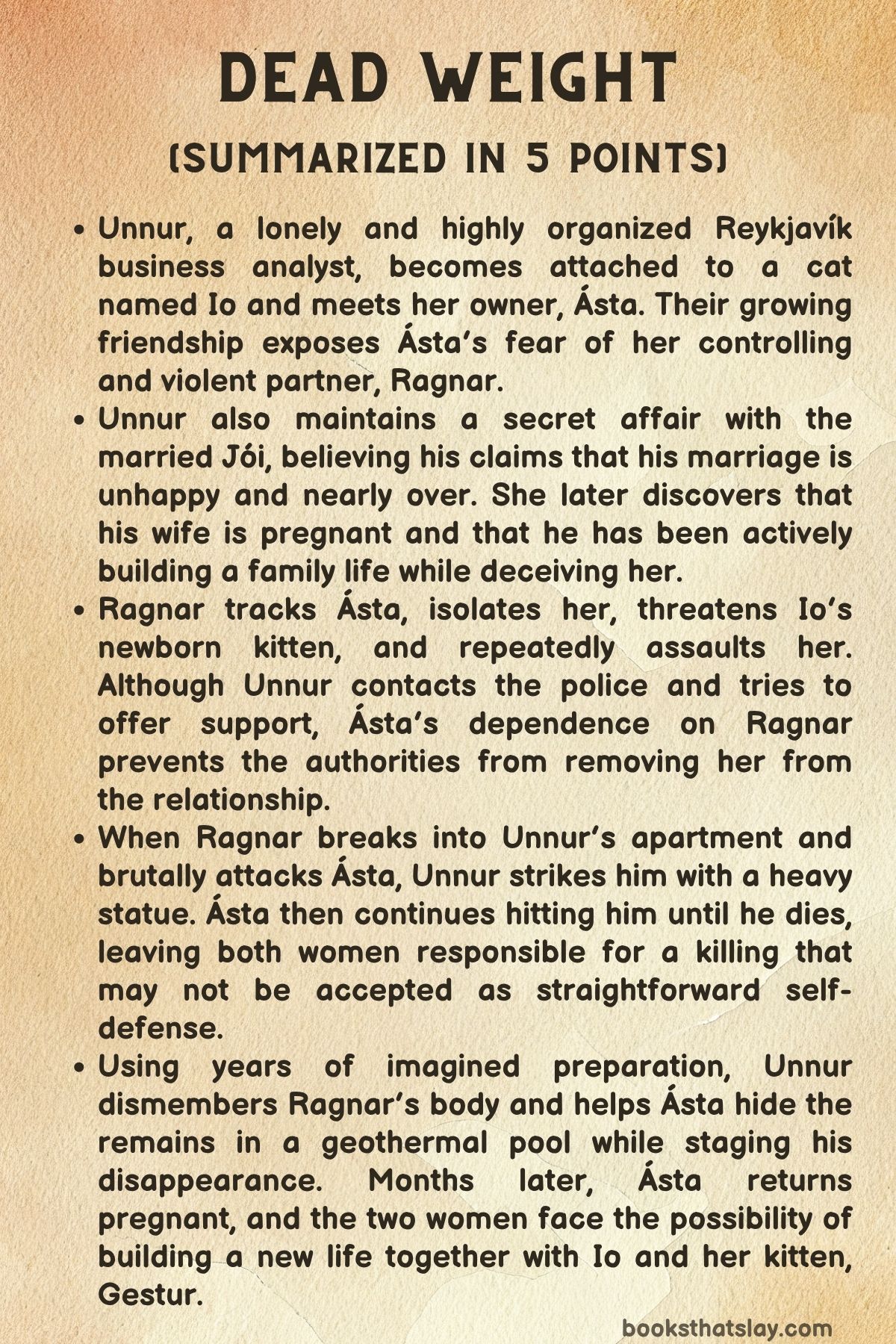
Characters
Unnur
At the center of Dead Weight, Unnur is a highly intelligent, controlled, and emotionally isolated woman whose professional competence contrasts sharply with her unusual private imagination. Her habit of planning how to dispose of a body initially appears to be a harmless mental exercise, but it reveals her instinct to convert fear, violence, and disorder into practical questions.
Unnur’s apartment reflects her inner life before she meets Ásta. It is clean, expensive, carefully arranged, and almost entirely protected from unpredictability, yet it provides little warmth or companionship.
Her relationship with Jói demonstrates how deeply loneliness influences her choices. Although she considers herself rational and independent, she accepts years of secrecy, canceled plans, restricted communication, and vague promises because partial affection seems preferable to complete isolation.
Unnur is skilled at constructing explanations that protect her from painful truths. She interprets Jói’s refusal to leave his family as responsibility, treats his emotional absence as respect for her independence, and imagines that patience will eventually transform deception into commitment.
Her professional life also requires performance and self-control. She understands workplace sexism, prepares extensively, and deliberately disguises her preparation so that male managers will interpret her ideas as natural instinct rather than disciplined work.
The friendship with Ásta gradually forces Unnur beyond observation and into moral involvement. At first, she hesitates to interfere because she cannot determine whether Ragnar is dangerous or whether she is misreading the situation.
Once she witnesses Ragnar dragging Ásta by the hair, uncertainty disappears. Unnur’s frustration with the police, Jói’s dismissive response, and Ásta’s inability to seek help convince her that conventional systems may not protect someone trapped by coercion.
Striking Ragnar is an act of immediate defense, but organizing the concealment of his body reveals something more complicated. Unnur is not horrified by the physical reality of death, and she experiences unusual calm while cutting, cleaning, packing, and transporting the remains.
Her emotional detachment can be disturbing, but it is also the quality that saves Ásta from arrest and possible retaliation. The novel refuses to define her composure as either purely monstrous or purely admirable.
Unnur changes most clearly through her relationship with Io and Gestur. The animals introduce disorder into her perfect home, but they also give her physical affection, responsibility, and uncomplicated companionship.
By the end, Unnur no longer values spotless furniture above emotional connection. She rejects Jói, accepts the damage within her apartment and herself, and opens her door to Ásta without demanding certainty about what the future will bring.
Ásta Ólafardóttir
Within Dead Weight, Ásta is both a survivor of prolonged abuse and a woman whose emotional attachment to her abuser cannot be reduced to weakness. Her life with Ragnar began during childhood, when hunger, neglect, grief, and dependence made his attention feel like rescue.
Ásta’s mother was unable to care for her consistently and later died by suicide. Ragnar entered this instability as the person who fed Ásta, protected her, and eventually gave her somewhere to live.
Because Ragnar’s control developed alongside acts of care, Ásta finds it difficult to separate love from dependence. She believes that questioning him would mean denying the person who helped her survive when no one else did.
Ásta’s openness distinguishes her from Unnur. She cries without hiding, touches people affectionately, expresses love for Io freely, and asks direct questions that expose the emotional weaknesses in Unnur’s relationship with Jói.
This openness, however, disappears whenever Ragnar is present. His arrival changes her posture, voice, facial expression, and ability to make independent decisions.
Ásta repeatedly minimizes her injuries and explains Ragnar’s surveillance as concern. Her defenses demonstrate how coercive control alters a person’s interpretation of reality by making domination seem necessary, ordinary, or deserved.
Her connection with Io becomes a quiet form of resistance. Io rejects Ragnar, escapes from his home, and chooses Unnur’s apartment as a safe place to give birth, reflecting dangers that Ásta is not yet able to admit.
When Ásta finally runs to Unnur after a severe assault, she makes an important choice toward survival. Ragnar’s violent arrival prevents her from leaving through legal or peaceful means, and his attack creates the confrontation she has spent years trying to avoid.
Ásta’s killing of Ragnar contains fear, self-defense, rage, and revenge. The repeated blows express emotions that she could not safely communicate while he controlled her.
Her actions do not bring immediate peace. After disposing of the body, Ásta cries because she still loves Ragnar and mourns the person who once represented safety, even though that safety became a method of imprisonment.
Her pregnancy at the end is deliberately complex. It represents renewal and a future beyond Ragnar, but it may also carry reminders of him, leaving Ásta to build a life in which survival, grief, freedom, and memory exist together.
Ragnar
Ragnar is the novel’s clearest embodiment of coercive control. He presents himself as Ásta’s protector while gradually restricting her movements, communications, relationships, and ability to understand her own experiences.
His early assistance to Ásta gives him lasting emotional power. Because he cared for her during childhood neglect, he expects gratitude to justify permanent access to her body, choices, location, and future.
Ragnar’s abuse is not limited to physical violence. He monitors Ásta’s phone, follows her movements, isolates her from Io and Unnur, enters private spaces without permission, and portrays Ásta as mentally unstable whenever he needs to undermine her credibility.
His visit to Unnur reveals how he uses intimidation while preserving deniability. The remark about crushing the kitten can be presented as an observation, yet his posture, tone, and actions make the threat unmistakable.
Ragnar also attempts to recruit Unnur into his version of reality. By describing himself as a tired caregiver and Ásta as dangerous to herself, he tries to transform his domination into sacrifice.
His violence eventually becomes impossible to conceal. Dragging Ásta by the hair and later beating her on Unnur’s floor demonstrate that his authority depends on physical terror when manipulation fails.
Ragnar’s death occurs because he assumes that neither woman is capable of resisting him effectively. His disbelief after Unnur strikes him shows how completely he has mistaken fear for permanent obedience.
Even after his body disappears, his influence remains. Ásta continues loving and grieving him, proving that the destruction of an abuser does not automatically destroy the psychological structure created by years of dependence.
Jói
Jói is emotionally less violent than Ragnar, but he also benefits from secrecy, inequality, and a woman’s willingness to doubt herself. He gives Unnur enough attention to sustain hope without making sacrifices that would disrupt his comfortable life.
His relationship with Unnur begins with concealment. He sleeps with her before revealing that he is married and later persuades her that his marriage is effectively over.
Jói repeatedly claims that he remains with his wife for financial obligations and the well-being of his children. These explanations allow him to appear responsible while continuing an affair that serves his needs.
He controls the terms of communication. He calls when convenient, disappears when he is with his family, and speaks to Unnur like a stranger whenever someone nearby might hear him.
Jói’s refusal to take Ragnar’s threat seriously is especially revealing. Rather than trusting Unnur’s account, he searches for an interpretation that requires no emotional involvement or action from him.
The pregnancy photographs expose the depth of his deception. His active participation in fertility treatments and public affection toward his wife contradict everything he told Unnur about the marriage.
When confronted, Jói insists that the pregnancy changes nothing between them. His statement reveals his selfish expectation that Unnur should absorb humiliation and continue providing emotional and sexual companionship without demanding honesty.
Unnur’s final rejection of him is an important act of self-respect. By threatening to contact his wife, she identifies the one consequence he truly fears and breaks the secrecy that gave him power.
Io
Io is not merely a pet but an active force connecting Unnur and Ásta. Her repeated arrival in Unnur’s apartment creates the circumstances through which the two women meet and gradually recognize the hidden dangers in each other’s lives.
Io appears to understand Ragnar before Unnur does. She freezes, arches her back, protects her kitten, and moves the newborn farther from the door after Ragnar enters the apartment.
Her decision to give birth in Unnur’s bed suggests that she recognizes Unnur’s home as safer than Ásta’s. The choice challenges Unnur’s belief that emotional distance and perfect order are forms of security.
Io also reflects Ásta’s instincts. Both flee Ragnar’s home, return to Unnur, and seek shelter there, although Io acts on danger before Ásta can consciously admit it.
For Unnur, Io offers affection without secrecy or manipulation. Her warmth, physical presence, and dependence begin softening the emotional defenses that Jói’s limited attention never truly penetrated.
Io’s movement toward the door at the end recalls the night Ásta escaped Ragnar. She becomes a guardian of the household and a signal that someone important has returned.
Gestur
Gestur begins life as the fragile kitten Ragnar threatens to crush, making him an immediate symbol of vulnerability. His survival contrasts with Ragnar’s desire to control or destroy anything that competes for Ásta’s affection.
His name means guest, but the word gradually becomes inaccurate because he is no longer temporary. He belongs in Unnur’s apartment and becomes part of the home she did not realize she wanted.
Gestur introduces noise, scratches, movement, and unpredictability into Unnur’s controlled environment. Instead of resenting the disruption, she learns to value the living creature above the appearance of her furniture.
His growth marks the passage of time after Ragnar’s disappearance. As he develops from a helpless newborn into an energetic cat, Unnur also develops from someone waiting for Jói into someone capable of creating an independent life.
Gestur represents a form of dependence that does not become exploitation. He needs Unnur’s care, but that need encourages tenderness rather than power.
Þorvard
Þorvard represents the professional structures Unnur must navigate. He recognizes her ability and promotes her, but his behavior also demonstrates how workplace praise can be shaped by gender politics and unequal expectations.
Unnur prepares carefully for their meetings because she knows that competence alone may not be enough. She must make studied ideas appear effortless to match the style of confidence rewarded in senior men.
Þorvard praises her instincts even though her successful proposals are the result of extensive preparation. His language unintentionally confirms Unnur’s belief that workplaces often celebrate performance more readily than labor.
His comment about improving gender balance weakens what should have been a clear professional victory. It leaves Unnur wondering whether the promotion reflects genuine confidence in her or a need to satisfy external pressure.
Þorvard is not presented as openly cruel. His significance lies in showing how ordinary institutional habits can leave capable women questioning whether their achievements truly belong to them.
Tumi
Tumi remains largely absent because of illness, yet his condition creates the professional opening Unnur has been waiting for. His aggressive cancer turns another person’s suffering into the opportunity through which her career advances.
Unnur does not cause his illness or celebrate it, but the situation creates an uncomfortable connection between success and loss. She receives increased authority because someone else has become physically unable to perform the role.
Tumi’s uncertain future also prevents Unnur’s position from feeling completely secure. She is acting manager rather than unquestioned successor, meaning that even her promotion contains an element of waiting.
His illness parallels other forms of hidden damage in the story. Serious realities may exist beneath ordinary appearances long before other people recognize their severity.
Jói’s Wife
Jói’s wife is initially present only through Unnur’s imagination and social-media surveillance. Unnur views her as an obstacle, a financially dependent spouse, and the person preventing Jói from beginning his supposedly authentic life.
The pregnancy post changes that interpretation. The photographs reveal a woman who has endured fertility treatments, miscarriages, grief, medical intervention, and repeated disappointment with Jói beside her.
She is not the cold, distant figure described by her husband. She is an unsuspecting participant in a marriage whose private reality Jói has distorted for Unnur.
Unnur’s eventual refusal to direct her hatred toward the wife marks significant moral growth. She recognizes that both women were deceived, even though only one knew the other existed.
The wife’s lack of direct involvement strengthens her importance. She remains unaware that her public happiness destroys Unnur’s private fantasy simply by revealing the truth.
Unnur’s Father
Unnur’s father is absent from the main events, but his unexplained disappearance has shaped her relationship with death, uncertainty, and concealment. His body was never found, leaving Unnur with the knowledge that physical remains can exist somewhere without ever being recovered.
Shortly before disappearing, he told Unnur that a geothermal pool could destroy a body. Whether he meant the comment as ordinary geological information or something more disturbing remains unresolved.
Unnur’s later choice of Krýsuvík connects Ragnar’s disposal to the mystery surrounding her father. She returns to the place associated with one of her last clear memories of him and uses his knowledge to create another disappearance.
His absence may explain why Unnur finds uncertainty more distressing than death itself. A body can be handled, moved, cut, hidden, or destroyed, while disappearance leaves endless unanswered questions.
Unnur’s Mother
Unnur’s mother appears mainly through memory, but her reaction to her husband’s disappearance raises important questions. Unnur remembers watching her face and wondering whether grief might have existed beside relief.
The possibility suggests that Unnur’s father may not have been entirely safe or loving. However, Unnur chooses not to ask because the answer could permanently change her understanding of her family.
Her mother’s silence parallels Ásta’s inability to speak openly about Ragnar. Both women may have lived beside truths that were easier to endure when left unnamed.
This uncertainty also influences Unnur’s decision to protect Ásta. She may be responding not only to her friend’s immediate danger but also to questions about her mother that she never had the courage to confront.
The Police Officers
The police officers demonstrate both the necessity and the limitations of institutional intervention. They listen to Unnur, visit Ásta’s home, and acknowledge that calling for help was correct.
However, they cannot remove Ásta when she denies the abuse. Their dependence on her cooperation leaves Ragnar free to continue controlling her.
The policewoman understands the pattern and responds with sympathy, but procedural awareness does not become physical protection. The officers must leave for another assignment while Unnur remains convinced that Ásta is in danger.
Their later investigation into Ragnar’s disappearance creates a different kind of threat. The same system that could not prevent his violence might punish the women for the extreme method through which they ended it.
The accidental dismissal of the bloodstain as menstrual blood shows how assumptions can shape investigations. A moment of embarrassment and casual humor allows crucial evidence to remain unnoticed.
Themes
Coercive Control and the Distortion of Love
In Dead Weight, abuse develops through emotional debt, surveillance, isolation, fear, and the gradual destruction of personal independence. Ragnar does not rely solely on physical force; he maintains control by presenting himself as the person who rescued Ásta when she was a neglected and hungry child.
Because his early care was real, Ásta cannot easily separate gratitude from obligation. She interprets his tracking application as assistance, his jealousy as sensitivity, and his domination as protection.
The relationship shows how coercion can alter a victim’s understanding of love. Ásta believes that leaving Ragnar would mean betraying the person who kept her alive, even after he becomes the greatest danger to her survival.
Jói’s behavior offers a quieter parallel. He does not physically assault Unnur, but he controls access, information, timing, and expectations while allowing her to build a future around promises he does not intend to fulfill.
Both women defend relationships that provide occasional comfort while demanding secrecy and self-denial. Their intelligence does not protect them because emotional dependence operates through hope, fear, history, and loneliness rather than simple logic.
The book therefore treats freedom as more than physical escape. Ragnar’s death removes his immediate power, but Ásta still loves and mourns him, while Unnur must consciously dismantle the beliefs that kept her waiting for Jói.
Female Friendship as Recognition and Rescue
Unnur and Ásta do not begin as people naturally suited to friendship. Unnur is controlled, private, and uncomfortable with emotion, while Ásta is physically affectionate, expressive, and willing to ask personal questions.
Their differences gradually become strengths. Ásta recognizes that Unnur’s supposed independence conceals loneliness, and Unnur recognizes that Ásta’s supposed devotion conceals fear.
Io provides the first bridge between them, but their friendship grows through repeated acts of attention. They notice changes in each other’s expressions, injuries, silences, excuses, and emotional defenses.
Neither woman rescues the other through perfect understanding. Unnur initially hesitates to intervene, while Ásta exposes painful truths about Jói that Unnur does not want to hear.
Their relationship becomes transformative because they continue looking at realities the other tries to hide. Friendship functions as a form of witness that makes denial more difficult.
When Ragnar attacks, Unnur acts because Ásta’s life has become more important than her own safety and moral certainty. Later, Ásta trusts Unnur’s plan even while frightened by what they have done.
Their forced separation shows the cost of survival, but the final reunion confirms that their bond exists beyond the crime. The possibility of a chosen family emerges from mutual recognition rather than romance, obligation, or biological connection.
Order, Domesticity, and Violence
Unnur’s domestic habits are initially methods of maintaining emotional control. Her clean apartment, white sofa, carefully arranged possessions, and precise routines protect her from the disorder of loneliness and uncertainty.
After Ragnar’s death, the same habits become essential to concealment. Cleaning blood, washing fabric with cold water, organizing tools, packing suitcases, and restoring the apartment are treated as extensions of ordinary household work.
This connection creates much of the novel’s dark humor and discomfort. Tea is prepared immediately before and after violence, while luggage associated with travel becomes a container for dismembered remains.
The boundary between respectable domestic life and brutality becomes unexpectedly thin. Unnur does not enter a completely foreign psychological state when she hides Ragnar’s body; she applies familiar skills to an extreme situation.
Her attention to the bloodstained sofa also reveals how trauma can be processed through manageable details. The furniture matters because it is easier to consider cleaning fabric than to confront the full meaning of death.
Over time, Unnur’s relationship with domestic space changes. Io and Gestur scratch furniture, create noise, leave fur, and interrupt routines, but they also transform the apartment into a home.
The movement from sterile order toward living disorder reflects Unnur’s emotional development. She learns that safety cannot be created through perfect surfaces alone and that a meaningful home must allow vulnerability, damage, affection, and change.
Destruction, Release, and Renewal
The hidden-planet metaphor gives catastrophe a meaning beyond simple ruin. A destructive force can end an established world, but the space created by that ending may allow new forms of life to emerge.
Ragnar’s death is horrifying, illegal, and morally complicated, yet it ends a pattern of violence that institutions were unable to stop. Ásta survives because the structure controlling her life is destroyed rather than carefully repaired.
Unnur experiences a related collapse when she discovers Jói’s wife is pregnant. The photographs destroy the story she has repeated for years, forcing her to accept that Jói has built his family life while using her as a hidden source of attention.
These losses initially appear to leave emptiness. Ásta loses the person who served as both protector and abuser, while Unnur loses the future around which she organized her emotional life.
The months that follow reveal that emptiness can become space. Unnur forms a home with Io and Gestur, directs her anger toward the person who deceived her, and stops waiting for a man who refuses to choose her.
Ásta’s return while pregnant develops this idea further. New life does not erase violence, guilt, grief, or memory, but it proves that survival can produce possibilities that were unimaginable within the old structure.
Releasing dead weight therefore means more than removing a dangerous person. It means abandoning relationships, fantasies, habits, and identities that once provided security but have become obstacles to living freely.