Five by Ilona Bannister Summary, Characters and Themes
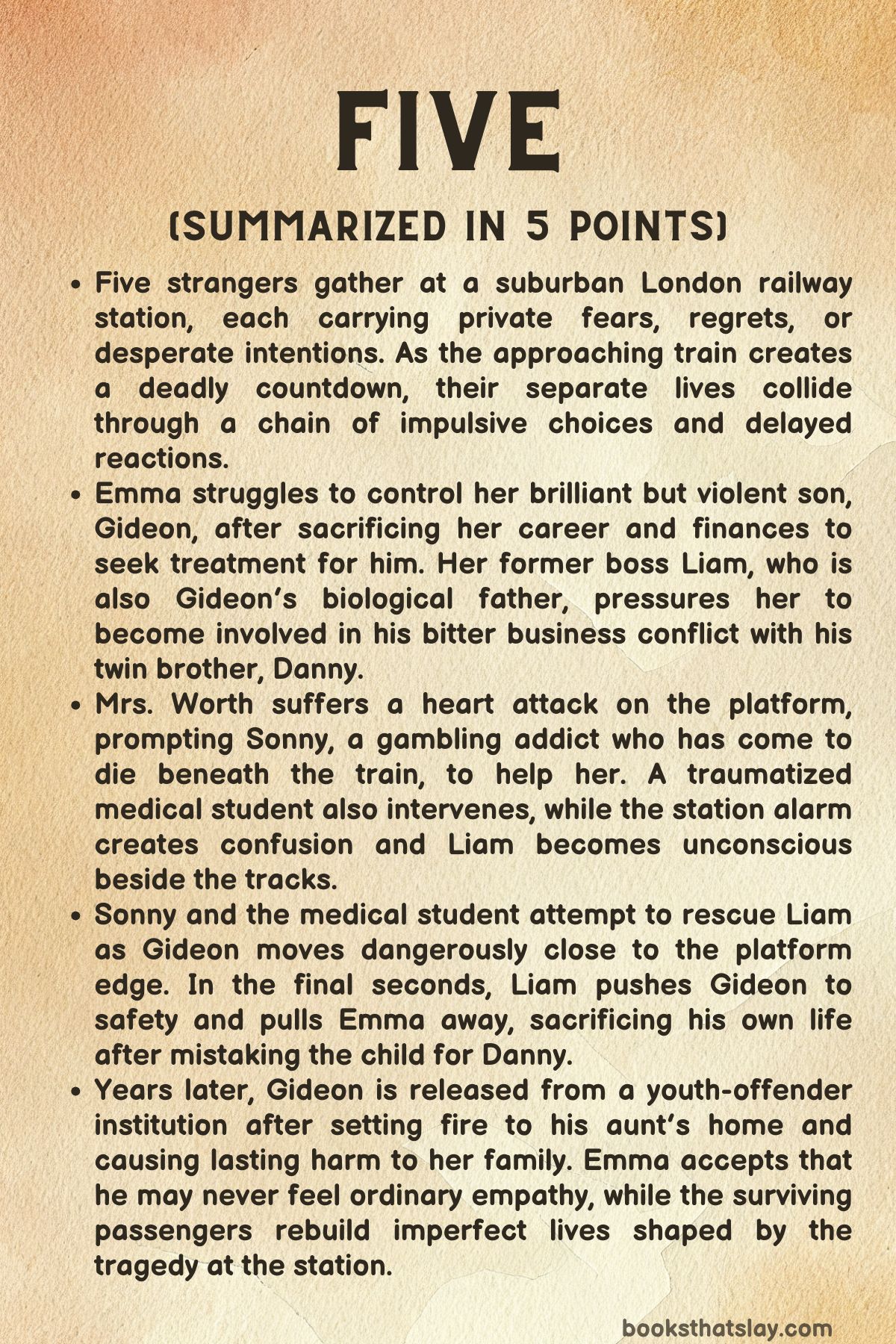
Five by Ilona Bannister is a psychological suspense novel built around a few terrifying minutes at a suburban London railway station. Five strangers arrive carrying private grief, guilt, fear, and desperation, unaware that one of them will not leave alive.
The story moves between the approaching train and the personal histories that brought these people to the platform. By showing how their choices collide within seconds, the novel examines responsibility, parenthood, addiction, trauma, judgment, and the uncertain boundary between selfishness and sacrifice.
Summary
Shortly after seven in the morning, five people stand at a suburban London station as the 7:06 train approaches. The narrator immediately warns that one of them will die, turning every movement, hesitation, and decision into a possible cause of the coming tragedy.
Emma waits with her six-year-old son, Gideon, who runs dangerously close to the platform edge. For one disturbing instant, Emma does not react, but Liam, a wealthy businessman nearby, catches the child and pulls him back.
Liam is not a stranger to them. He is Gideon’s biological father, Emma’s former boss, and a man who has recently been using her financial desperation to involve her in a damaging dispute with his estranged twin brother, Danny.
Other passengers watch the incident with varying degrees of concern. Mrs. Worth, a severe retired forensic pathologist travelling to her daughter-in-law’s funeral, quickly judges Emma’s parenting and Gideon’s behaviour.
Sonny, a fashionable young man burdened by gambling debts, has come to the station intending to end his life beneath the approaching train. A medical student, exhausted from working nights as a caregiver and haunted by memories of war, is also present.
Two additional commuters are identified by the narrator through their habits rather than their names. Bad Back is an indecisive man who invents physical excuses to avoid responsibility, while To Do List is a highly organized woman who believes that following procedures can keep disorder under control.
Gideon knocks Emma’s phone onto the tracks. The phone contains information connected to Emma’s dealings with Liam and Danny, and losing it could destroy her chance of obtaining the money needed to send Gideon to a therapeutic boarding school.
Emma jumps down to retrieve it. Liam follows, takes the phone, and refuses to return it immediately, while Gideon jumps onto his back and bites him.
The danger at the station reflects the danger already dominating Emma’s life. She was once a highly successful finance executive who took pride in defeating competitors, intimidating colleagues, and using secrets as weapons within a sexist professional environment.
Emma approached motherhood with the same competitive attitude. Resentful of her infertile sister Anne and convinced that becoming a mother would prove her superiority, she asked Liam to father a child while surrendering all parental rights.
Gideon’s premature and traumatic birth unexpectedly awakened intense emotions in Emma. However, as he grew, he displayed extraordinary intelligence alongside sleeplessness, manipulation, violent outbursts, cruelty, and an apparent inability to feel empathy.
Nannies left, specialists failed to offer useful solutions, and Emma abandoned her career to supervise him. She sold most of her possessions and spent nearly everything seeking treatment, even after Gideon attacked her with a stiletto and created dangerous traps around their home.
Emma remained committed to protecting him, partly from maternal devotion and partly from guilt. She knew that she had conceived him to satisfy her pride and feared that her motives had helped create the destructive bond between them.
Liam had recently offered Emma financial help, but only in exchange for influencing Danny. The brothers had built D-Tech, a successful assistive-technology company, but their relationship collapsed after Liam attacked Danny’s partner, Brendon, during their wedding.
Danny, who has cerebral palsy, had authorized financial transfers that Liam believed were evidence of exploitation. Liam saw himself as Danny’s lifelong protector and could not accept that his brother was capable of choosing his own partner and controlling his own money.
Danny threatened to expose Liam publicly unless he surrendered his share of the company. Liam recruited Emma as an intermediary, knowing that she urgently needed money for Gideon’s school.
During a meeting at Emma’s home, Liam refused to sign the required documents. Instead, he pressured Emma to persuade Danny to enter a risky investment and offered to take control of Emma’s life and Gideon’s care.
When Liam saw Emma’s injuries and Gideon’s disturbing locked bedroom, he threatened to contact the authorities and remove the child. Emma responded by threatening scandal and exposure, leaving both adults treating Gideon as leverage in a much larger conflict.
Back at the station, the train is delayed, but the extra time does not create safety. Mrs. Worth falls and begins experiencing severe chest pain after Gideon knocks into her during the struggle over Emma’s phone.
Although Sonny has come to die, he instinctively kneels beside Mrs. Worth. His immediate concern for her interrupts his suicide plan and reveals that his desire for death exists beside an equally powerful impulse to help others.
The medical student joins him. His professional training guides him, but the station alarm soon awakens memories of air raids, wounded friends, and a person he once failed to save during the war.
To Do List discovers that the ticket office is empty and presses the station’s emergency alarm. She assumes that this action will summon help or stop the train, but the siren only creates further confusion.
Liam returns to the tracks to retrieve his keys. While trying to climb out without accepting assistance, he strikes his head beneath the platform and collapses unconscious in a recessed space beside the rails.
No one initially notices him. Mrs. Worth’s condition worsens, Sonny remains beside her, and the medical student struggles to remain focused while the alarm intensifies his traumatic memories.
Bad Back receives a message informing him that his wife is leaving him. Even as the emergency develops, he refuses to assist anyone and invents a back injury to justify his inaction.
When To Do List twists her ankle and falls on the stairs, she demands that Bad Back do something. He finally looks over the platform edge and discovers Liam lying unconscious below.
Sonny immediately jumps onto the tracks and reaches Liam. His motives are confused because saving Liam may give him a reason to live, while remaining beside him may allow both men to die together.
The medical student follows Emma’s instructions and climbs down to help. Together, he and Sonny raise Liam toward the platform while Emma uses Liam’s phone to speak with emergency services about Mrs. Worth.
Liam regains partial consciousness but is confused by his head injury. He lashes out and accidentally strikes To Do List in the face, leaving her physically injured and emotionally overwhelmed by the failure of her carefully ordered worldview.
The medical student climbs back toward safety, but Sonny moves into the centre of the track. Having completed the rescue, he appears ready to continue with his original intention.
Mrs. Worth recognizes what Sonny is doing. Although she is close to losing consciousness, she orders Emma to help him and repeats the warning that there is a man on the tracks.
Gideon, meanwhile, becomes absorbed in walking along the platform edge. He moves closer to Liam while the approaching train becomes visible and its warning sounds grow louder.
The train driver sees Sonny and applies the emergency brake, but the distance is too short for the train to stop before reaching the people on the tracks. The driver repeatedly sounds the horn as everyone on the platform begins acting at once.
Emma grabs Gideon while reaching toward Liam. For a brief moment, the three appear like a family, despite years of secrecy, resentment, manipulation, and fear.
Gideon kicks and struggles until Emma releases him. Liam, disoriented by the head injury, looks at Gideon and believes that he is seeing Danny as a child.
Gideon steps beyond the safety line, and Liam reaches for him. Emma moves toward both of them as Bad Back finally abandons his excuses and attempts to help.
The medical student jumps back onto the tracks and pulls Sonny toward the recess beneath the platform. Sonny’s shoulder is dislocated during the rescue, but both men escape the direct path of the train.
The final seconds are presented through a countdown. Each person is described through conflicting identities: Emma is both a mother and a woman near collapse, Gideon is both a child and a source of danger, Liam is both controlling and protective, Sonny is both an addict and a rescuer, and the medical student is both a caregiver and a traumatized refugee.
Emma screams Gideon’s name as the train reaches them. The novel initially withholds the identity of the dead person, leaving open the possibility that any one of the five has been killed.
Nearly ten years later, Emma collects teenage Gideon from a youth-offender institution. He has been confined after setting fire to Anne and Ollie’s house while the family slept.
Anne, Ollie, and their daughter Louise survived, but the consequences were devastating. Their dog died, Anne miscarried, Ollie was severely burned while protecting Louise, and the family moved away to escape Gideon.
Emma and Gideon visit the abandoned site of the burned house. Gideon explains that he was not consciously trying to murder anyone; he simply did not consider the people inside when he started the fire.
He admits that he does not experience feelings in the way others seem to. His main reason for avoiding future crimes is not remorse but his determination never to return to prison.
Emma accepts this practical motive because she understands that demanding emotions Gideon cannot produce will not protect anyone. She also accepts responsibility for conceiving him out of resentment and treating motherhood as another competition to win.
Their conversation returns to the railway station. Gideon remembers trying to push someone during the confusion and being pushed back, but he cannot clearly identify who acted or what happened.
Emma continues telling him that she was saving him and that another man rescued them. However, her uncertainty and secrecy suggest that she may know more about the final seconds than she has ever admitted.
Emma explains that love is not always an emotion. For her, love is a repeated action and a decision to protect someone, even when that person cannot return the same devotion.
She tells Gideon that she would jump in front of a train for him. Gideon replies honestly that he would not do the same for her, and the brutal truth unexpectedly allows them to share a rare moment of laughter.
The full aftermath of the station disaster reveals that Emma and Gideon survived. Mrs. Worth suffered cardiac arrest but was revived, while the medical student successfully pulled Sonny into the platform recess.
Sonny eventually admitted the truth about his gambling addiction and suicide attempt. He rebuilt an imperfect life with Valentina, another recovering gambler, and they became parents to a son.
Mrs. Worth visited her son Nicholas and accepted responsibility for their estrangement. Instead of protecting herself through distance and criticism, she began allowing herself to participate in the lives of Nicholas and her grandsons.
To Do List responded to the trauma by beginning an affair, abandoning the strict structure through which she had previously controlled her life. Bad Back’s last-second rescue of Emma and Gideon temporarily repaired his marriage, although the injuries he suffered led to painkiller addiction.
The person killed by the train was Liam. In the final moment, he pulled Emma back and pushed Gideon away from the train, sacrificing himself to save them.
Because of his concussion, Liam believed Gideon was Danny. His final act was directed toward the brother he had loved and protected since childhood, even though that protective love had become possessive and destructive.
After Liam’s death, Danny entered the investment Liam had warned against, gave Emma employment, and paid for Gideon’s therapeutic school. The investment later collapsed because of fraud, contributing to the instability that preceded Gideon’s arson and imprisonment.
As an adult, Gideon finds Danny and reconnects with him. Their meeting brings together two survivors whose lives were permanently shaped by Liam’s decisions, failures, devotion, and death.
The commuters eventually continue their journeys, and another train approaches the station. The ordinary movement of the railway resumes, indifferent to the tragedy that transformed everyone who survived it.
Characters
Emma
Emma is the emotional centre of Five, although she is never presented as a simple victim or an idealized mother. Her intelligence, competitiveness, cruelty, shame, devotion, and exhaustion exist together, making her actions difficult to judge through a single moral standard.
Before Gideon’s birth, Emma builds her identity around control. She survives a hostile workplace by becoming more strategic and intimidating than the men who underestimate her, and she begins to treat vulnerability as a weakness that other people will exploit.
Her decision to become a mother grows partly from rivalry and resentment. She wants to prove that she can possess what Anne cannot, and she approaches conception as a transaction in which Liam provides the necessary biological role without gaining emotional or legal authority.
Gideon’s birth destroys Emma’s belief that she can control every consequence. Her love for him is real, but it develops beside fear, regret, physical danger, financial collapse, and the knowledge that she chose motherhood for selfish reasons.
Emma repeatedly protects Gideon even when he hurts her. This protection can be understood as devotion, guilt, denial, or a refusal to admit that she cannot save him through sacrifice alone.
At the station, Emma’s behaviour remains morally uncertain. Her momentary hesitation when Gideon approaches the edge and her secrecy about the final collision suggest that exhaustion has brought her close to imagining freedom from him.
However, Emma does not abandon Gideon after Liam’s death or his later crimes. She continues defining love as an action rather than a feeling, accepting that her son may never love her in the same way.
Her final conversation with Gideon shows a form of honesty that neither possesses earlier. Emma stops demanding emotional reassurance and accepts the limited, practical relationship available to them, even though that acceptance cannot undo the harm already caused.
Gideon
Gideon is a highly intelligent child whose behaviour creates fear in nearly every adult around him. He is calculating, violent, curious, emotionally detached, and capable of using other people’s weaknesses without appearing to understand the suffering he causes.
The novel avoids offering a simple explanation for Gideon. His behaviour may arise from neurological differences, psychological disturbance, Emma’s unstable parenting, inherited traits, or a combination of factors that no specialist has been able to define.
His cruelty is often presented through actions rather than emotional declarations. He bites Liam, attacks Emma, sets traps, pushes physical boundaries, and later starts a fire without considering the people sleeping inside the house.
Gideon’s lack of empathy does not mean he is unable to understand rules or consequences. As a teenager, he recognizes that returning to prison would be intolerable and therefore develops a practical reason to avoid further offences.
This distinction is central to his character. Gideon may not feel guilt in the expected way, but he can still choose restraint when self-interest and clear consequences give him a reason to do so.
His relationship with Emma is marked by dependence without conventional affection. He accepts her continued presence and honesty, but he refuses to pretend that he would make the same sacrifices for her.
Gideon also represents the limits of parental love. Emma’s devotion can keep him alive and pursue treatment, but it cannot manufacture empathy, erase responsibility, or guarantee that others will remain safe.
By reconnecting with Danny as an adult, Gideon moves toward a part of his history that Emma has never fully explained. He becomes the surviving link between Liam’s private failures, Danny’s grief, and the family relationship that was lost at the station.
Liam
Liam is both the victim of the central tragedy and one of the book’s most controlling figures. In Five, his final sacrifice does not erase the damage he caused, but it prevents him from being reduced to a selfish villain.
His relationship with Danny shapes his entire identity. Because Danny has cerebral palsy, Liam becomes his defender from childhood and begins believing that his own purpose is to rescue people who appear vulnerable.
What begins as brotherly protection gradually becomes possession. Liam cannot accept that Danny can make independent financial, romantic, or professional decisions, particularly when those choices reduce Liam’s importance.
His attack on Brendon exposes the violence beneath his saviour identity. Liam claims to be protecting Danny from exploitation, but his actions reveal jealousy, wounded pride, prejudice, and a refusal to respect his brother’s autonomy.
The same pattern appears in Liam’s relationships with women. He is attracted to people he believes he can rescue, but once they become independent, he feels rejected and seeks another situation in which he can appear essential.
Emma fascinates Liam because she initially refuses to need him. After Gideon’s birth and Emma’s collapse, Liam finally sees an opportunity to enter her life as the provider and protector she once rejected.
His offer to care for Emma and Gideon is therefore not entirely generous. It is tied to control, business pressure, threats, and his desire to occupy the central role in their lives.
Yet Liam’s instinct to save others is genuine as well as destructive. His first response to Gideon’s danger is to help, and his final action is to push the child to safety even though doing so places him directly in the train’s path.
His concussion causes him to mistake Gideon for Danny, but this confusion reveals the deepest source of his behaviour. Liam dies attempting to protect the brother around whom he built his entire sense of worth.
Mrs. Worth
Mrs. Worth, whose first name is Matilda, is a brilliant retired forensic pathologist shaped by a childhood in which death became the only available language of intimacy. Her severity is not natural coldness alone but a defence learned from a father incapable of expressing ordinary affection.
Gerald teaches Matilda anatomy by dissecting animals on their kitchen table. She is horrified by his increasing cruelty, yet she also understands that these lessons are his distorted way of sharing knowledge and attention.
Matilda transforms this disturbing education into professional achievement. As a forensic pathologist, she can interpret damaged bodies with precision, but she remains unable to communicate tenderness to the living.
Her relationship with Nicholas reveals the cost of this limitation. She loves him deeply, yet she expresses that love through criticism, practicality, and withdrawal rather than warmth.
Livvie’s emotional openness threatens Mrs. Worth because it exposes everything she cannot provide. Her contempt for Livvie’s personality and dog becomes a defence against jealousy, insecurity, and fear of being replaced.
Her years of estrangement are presented as another misguided form of love. Mrs. Worth convinces herself that staying away is a gift to Nicholas, although this decision also protects her from apologizing and risking rejection.
At the station, her professional awareness allows her to recognize both her cardiac emergency and Sonny’s suicidal intention. Even while dying, she continues observing others and demanding action.
Surviving the heart attack gives Mrs. Worth an opportunity to change. By accepting responsibility and returning to Nicholas, she begins learning that love requires presence, humility, and a willingness to endure emotional discomfort.
Sonny
Sonny arrives at the station intending to die, but nearly every action he takes reveals a strong instinct toward life and human connection. His tragedy comes from believing that addiction has erased the generous person his parents raised.
As a child, Sonny is energetic, impulsive, creative, and difficult for schools to manage. His parents interpret these traits with love, while institutions often treat them as evidence of failure.
His father’s sudden death leaves Luna devastated, and Sonny becomes both the reason she continues living and the person she fiercely protects. Her defence gives him confidence, but it sometimes prevents him from fully accepting responsibility for his choices.
Gambling initially provides relief from the constant movement of his mind. The concentration required by online betting creates temporary calm, but that relief soon develops into secrecy, debt, damaged relationships, and repeated relapse.
Luna’s inheritance conditions are intended to protect him after her death. Sonny briefly meets those conditions, completes his education, and begins rebuilding his life, but his relationship with Valentina gives both recovering gamblers access to temptation.
By the morning at the station, Sonny has lost money, trust, his treasured watch, and his belief in change. He treats suicide as a final escape from a cycle he assumes will continue forever.
Mrs. Worth’s collapse interrupts that certainty. Sonny helps her, jumps onto the tracks to reach Liam, and calls for assistance even though these acts conflict with his plan to die.
His rescue does not instantly cure his addiction or despair. Instead, it gives him the chance to confess, seek help, reconnect with Valentina, and build a future that remains imperfect but possible.
The Medical Student
The medical student is an unnamed refugee whose professional identity has been formed by exposure to war. He studies medicine and works nights as a caregiver, carrying physical exhaustion alongside memories of violence and loss.
The station alarm triggers a trauma response because it resembles the sounds of wartime danger. For a moment, the platform disappears beneath memories of air raids and a wounded friend he could not save.
Mrs. Worth’s suffering draws him back into the present. His ability to act despite fear demonstrates that courage does not require the absence of trauma.
He helps stabilize Mrs. Worth, climbs onto the tracks, assists in lifting Liam, and later saves Sonny by pulling him into the recessed area. These actions place him in direct physical danger, yet he continues because his medical instincts are joined by a deeply personal need not to fail another person.
The character also challenges the labels placed upon him. Other commuters might see a foreign student or night worker, but the crisis reveals a trained, compassionate, and decisive man whose actions save several lives.
His encounter with Mrs. Worth creates an important contrast. She possesses professional authority without emotional openness, while he combines limited status with active compassion and personal courage.
Danny
Danny is Liam’s twin brother and the person around whom Liam constructs his protector identity. His cerebral palsy affects his physical life, but it does not prevent him from becoming intelligent, professionally successful, financially capable, or emotionally independent.
The brothers build D-Tech by combining their talents. Liam handles many physical and public aspects of the business, while Danny contributes the ideas and knowledge that help turn their work into a major company.
Conflict arises because Liam never fully updates his image of Danny. He continues treating him as the vulnerable child who required defence, even after Danny has become an adult capable of choosing a partner and controlling his money.
Danny’s relationship with Brendon offers equality rather than rescue. Liam interprets this relationship as manipulation because accepting its legitimacy would force him to surrender his central role in Danny’s life.
Danny’s decision to remove Liam from the company is harsh but understandable. Public exposure and financial pressure become the only tools available to stop Liam’s interference.
After Liam’s death, Danny helps Emma and Gideon. His support reflects loyalty to his brother’s child, grief over their damaged relationship, and perhaps guilt that reconciliation never occurred.
His decision to enter the investment Liam opposed has severe consequences. The collapse demonstrates that Liam’s warnings were not entirely wrong, even though his methods and motives were deeply flawed.
Anne
Anne is Emma’s sister and an important source of Emma’s jealousy, guilt, and self-judgment. Her infertility becomes something Emma uses privately as a measure of superiority when deciding to have a child.
Emma expects motherhood to establish a permanent victory over Anne. Instead, Gideon’s behaviour leaves Emma isolated, while Anne’s comparatively stable family life becomes another reminder of what Emma cannot control.
Anne often dismisses Emma’s descriptions of Gideon’s violence. This response may reflect disbelief, resentment of Emma’s dramatic history, or an inability to imagine that a young child could be genuinely dangerous.
The fire turns the sisters’ conflict into irreversible tragedy. Anne survives but loses her pregnancy, her dog, her home, and the security of believing that her family is safe around Gideon.
Her role shows how private rivalry can shape decisions with consequences far beyond the original resentment. Emma’s attempt to defeat Anne through motherhood eventually places Anne’s entire family in danger.
Ollie
Ollie is Anne’s husband and one of the people most severely harmed by Gideon’s later violence. During the house fire, he protects Louise and suffers serious burns.
His actions establish him as a devoted father willing to accept physical injury to save his child. This sacrifice also parallels Liam’s death, as both men respond to immediate danger by placing a child’s life before their own safety.
Ollie’s injuries make the consequences of Gideon’s emotional detachment impossible to minimize. The fire is not merely a disturbing experiment or impulsive act; it permanently damages the bodies, relationships, and future of an entire family.
Louise
Louise is Anne and Ollie’s daughter and Gideon’s cousin. She survives the fire because Ollie protects her, but the event forces her family to leave their home and relocate.
Although she has little direct control over the plot, Louise represents the innocent people placed at risk by Emma’s decisions and Gideon’s actions. Her presence prevents the conflict from remaining a private struggle between mother and son.
The threat to Louise also emphasizes the difference between explanation and excuse. Gideon’s inability to consider others may help explain the fire, but it cannot remove the danger he poses to children who depend on adults for protection.
Nicholas
Nicholas is Mrs. Worth’s son and the person most affected by her emotional limitations. He grows up with a mother who provides practical care but struggles to offer reassurance, affection, or apology.
His marriage to Livvie creates a family atmosphere very different from the one Mrs. Worth understands. Livvie’s warmth and spontaneity expose the absence of those qualities in Nicholas’s childhood.
Nicholas’s estrangement from his mother follows years of criticism and the conflict over Horatio. By remaining apart, he protects his wife and children from Mrs. Worth’s hostility, though the separation also leaves unresolved grief on both sides.
Sending the funeral information after Livvie’s death is a restrained act of inclusion. It gives Mrs. Worth a chance to return without guaranteeing forgiveness.
Livvie
Livvie is Nicholas’s wife and the emotional opposite of Mrs. Worth. She is warm, expressive, playful, and comfortable showing affection, qualities Mrs. Worth dismisses partly because she envies them.
Her relationship with Horatio becomes a symbolic point of conflict. Mrs. Worth treats the dog as evidence of Livvie’s frivolity, while Livvie’s affection for him demonstrates her ability to love openly and without embarrassment.
The dispute following the apparent accident deepens the family division. Mrs. Worth’s inability to apologize sincerely confirms Livvie’s belief that distance is necessary.
Livvie’s death from cancer forces Mrs. Worth to confront grief that cannot be reduced to anatomy or professional understanding. Her absence creates the possibility of reconciliation between Nicholas and his mother, but it also ensures that Mrs. Worth can never repair their own relationship.
Luna
Luna is Sonny’s fierce and devoted mother. She recognizes his intelligence and creativity even when schools and other adults focus on his impulsiveness and academic difficulties.
After Graham’s death, Luna’s bond with Sonny becomes even stronger. Caring for him gives her a reason to continue, while her constant defence teaches Sonny that he is worthy of love.
However, Luna’s protection sometimes prevents Sonny from facing responsibility. By challenging every judgment against him, she may unintentionally strengthen his habit of seeing failure as something imposed from outside.
Her response to his gambling debt is firm without becoming rejecting. The inheritance trust she creates shows that she understands love must include boundaries, conditions, and protection from destructive impulses.
Even after her death, Sonny imagines her voice during the crisis. The memory of her refusal to call either of them failures becomes one of the forces leading him away from suicide.
Graham
Graham is Sonny’s joyful Scottish father, whose warmth helps create the secure childhood Sonny remembers. His sudden death in a cycling accident becomes the first major rupture in Sonny’s family life.
Graham’s absence changes the balance between Luna and Sonny. Without him, their relationship becomes more intense, protective, and emotionally dependent.
His death also creates a lasting association between love and sudden loss. Sonny’s later fear that stability will always collapse may be partly rooted in losing a loving parent without warning.
Valentina
Valentina is a recovering gambler who understands Sonny’s addiction because she shares it. Their relationship begins with mutual recognition, attraction, and the hope that two damaged people can support each other.
The same similarity that creates intimacy also creates danger. Both conceal aspects of their addiction, and their access to money contributes to relapse rather than recovery.
Valentina eventually leaves Sonny when the relationship becomes destructive. Her departure intensifies his despair, but it also prevents their connection from becoming an excuse for continued self-destruction.
Their later reunion is not presented as a magical solution. Building a family with their son requires honesty, responsibility, and acceptance that recovery remains an ongoing process.
Doreen
Doreen is Liam and Danny’s formidable mother. Her strength shapes both sons, encouraging ambition, resilience, and a deep sense of family loyalty.
She raises Liam to see himself as Danny’s protector, whether intentionally or through the practical realities of their childhood. That role becomes so central that Liam later cannot distinguish support from control.
Doreen’s influence helps explain why the brothers remain emotionally bound even after their professional and personal relationship collapses. The loyalty she encouraged survives inside Liam until his final moment.
Brendon
Brendon is Danny’s partner and represents the independent adult life Liam refuses to respect. His relationship with Danny is based on equality rather than the assumption that disability makes Danny incapable of judgment.
Liam views Brendon through suspicion and hostility. Financial transfers become evidence of exploitation in Liam’s mind, even though Danny authorized them willingly.
The attack at their wedding reveals the danger of paternalistic prejudice. Liam claims to be protecting Danny, but his violence humiliates his brother and denies the legitimacy of Danny and Brendon’s relationship.
Brendon’s presence forces Liam to confront the possibility that Danny no longer needs him in the same way. Liam responds not by adapting but by trying to destroy the relationship that threatens his identity.
Gerald
Gerald is Mrs. Worth’s father, a traumatized former wartime surgeon whose inability to express affection shapes Matilda’s entire life. After his wife’s death, he raises his daughter alone while carrying emotional damage he cannot communicate.
His anatomy lessons begin as a strange attempt to share knowledge. As he starts deliberately killing animals, however, education becomes cruelty and his bond with Matilda becomes frightening.
Gerald teaches his daughter to understand bodies while leaving her unable to understand ordinary tenderness. His legacy continues through her professional success, emotional severity, and harsh language toward Nicholas and Livvie.
To Do List
To Do List is defined by organization, schedules, and the belief that proper procedure can control unexpected situations. She presses the emergency alarm because it appears to be the correct institutional response.
When the alarm fails to produce help, her confidence begins to collapse. Her injury, Liam’s accidental blow, and the approaching train expose the limits of planning in a crisis governed by human unpredictability.
Her later affair suggests a rejection of the rigid order that once structured her life. Rather than processing the trauma through reflection, she moves toward impulsive behaviour that contradicts her former identity.
Bad Back
Bad Back initially represents passive selfishness. He invents pain to avoid helping others, even as the danger at the station becomes increasingly obvious.
The message that his wife is leaving him deepens his self-absorption. He focuses on his own rejection while people nearby face death.
However, he eventually discovers Liam, raises the alarm, and participates in saving Emma and Gideon. This final action does not erase his earlier cowardice, but it proves that people can behave differently when hesitation gives way to immediate necessity.
His injuries temporarily restore his marriage by allowing him to become the heroic figure he failed to be at first. The resulting painkiller addiction complicates that redemption, showing that a courageous act can lead to another form of personal collapse.
The Train Driver
The train driver has almost no power over the catastrophe despite controlling the machine at its centre. By the time Sonny is visible on the tracks, the physical distance makes stopping impossible.
The driver sounds warnings and applies the emergency brake, fully aware that the train may still strike someone. This perspective shows how strangers can be forced to carry responsibility and trauma for situations they did not create.
The driver also represents the impersonal movement of ordinary systems. The railway follows its route and schedule even as private lives collapse in front of it.
Themes
The Uncertain Meaning of Love
Love appears through protection, control, sacrifice, honesty, jealousy, and endurance, making it impossible to define through emotion alone. Emma loves Gideon fiercely, yet that love began with selfish motives and sometimes prevents her from fully confronting the danger he presents.
Liam loves Danny, but his devotion becomes possessive because he cannot respect Danny’s independence. His final sacrifice proves the sincerity of his attachment while also revealing that genuine love can coexist with harmful behaviour.
Mrs. Worth loves Nicholas but communicates through criticism and absence. Luna loves Sonny through fierce defence and later through financial restrictions designed to protect him after her death.
In Five, love is judged most clearly through actions, yet actions remain morally complicated. Emma continues supporting Gideon without receiving affection, Liam dies saving a child he mistakes for his brother, and the medical student risks his life for strangers.
The novel therefore separates love from sentimental reassurance. A person may love deeply and still cause damage, while someone who feels emotionally detached may be capable of following rules that protect others.
Emma’s final definition of love as something one does rather than something one feels reflects this complexity. It allows her to accept Gideon honestly, but it also raises the question of whether endless sacrifice remains loving when other people are placed at risk.
Responsibility, Guilt, and Moral Choice
Nearly every character attempts to explain harmful behaviour through circumstances. Emma points toward exhaustion and Gideon’s condition, Liam claims that he is protecting Danny, Sonny sees addiction as a cycle he cannot escape, and Bad Back invents physical pain to excuse inaction.
The story repeatedly distinguishes explanation from innocence. Trauma, illness, addiction, disability, grief, and fear influence behaviour, but they do not remove every possibility of choice.
Sonny’s actions at the station show this distinction clearly. He arrives intending to die, yet he chooses to help Mrs. Worth and Liam before returning to the tracks.
The medical student is overwhelmed by traumatic memories but continues acting. Mrs. Worth recognizes that her childhood shaped her emotional severity, yet her reconciliation only begins when she accepts responsibility rather than treating her past as a complete excuse.
Emma’s guilt is more complicated because she assumes responsibility for both her own actions and Gideon’s nature. Her remorse is justified in relation to her competitive motives and denial, but she cannot be held responsible for every aspect of her son’s emotional development.
Gideon’s admission that he does not feel ordinary guilt creates the hardest moral question. The novel suggests that responsibility may still be built through consequences, boundaries, and practical choices, even when remorse is absent.
Labels and Hidden Identities
The commuters initially understand one another through quick judgments. Emma appears to be a careless mother, Gideon looks like a badly behaved child, Sonny resembles a stylish young professional, and the medical student may be seen only as a tired foreign worker.
The narrative gradually reveals the histories concealed beneath these surfaces. Each label contains part of the truth but fails to represent the whole person.
Mrs. Worth calls Gideon a psychopath, while Emma sees a frightened and difficult child she must protect. Liam is both a controlling businessman and a man capable of sacrificing himself without hesitation.
Sonny describes himself as a failure because of his addiction, but his actions reveal courage, compassion, and a strong instinct to preserve life. The medical student carries the identities of refugee, caregiver, survivor, and rescuer at the same time.
The countdown strengthens this idea by assigning contradictory descriptions to the people in danger. Mother and lunatic, child and threat, saviour and abuser, addict and helper can exist within the same human being.
The theme does not argue that judgment is always wrong. Some labels identify real danger, but no label alone is sufficient for understanding responsibility, motivation, or the possibility of change.
Chance, Timing, and the Consequences of Small Decisions
The entire tragedy depends on seconds. A delayed train, a dropped phone, an empty ticket office, an emergency alarm, lost keys, a twisted ankle, and a moment of hesitation combine to determine who lives and who dies.
No single action appears powerful enough to cause the disaster. Together, however, these ordinary decisions create a situation in which several people stand within inches of death.
The train delay seems at first to offer safety. Instead, the revised arrival time disrupts expectations and contributes to the confusion that places Liam, Sonny, Gideon, and the medical student near the tracks together.
Chance also determines which qualities emerge from each character. Bad Back’s cowardice is interrupted by the discovery of Liam, Sonny’s suicide plan is interrupted by Mrs. Worth’s collapse, and the medical student’s traumatic paralysis is interrupted by a patient who needs him.
Liam’s concussion produces the fatal misunderstanding through which Gideon becomes Danny in his mind. That error leads to a genuine act of sacrifice, turning confusion into the final expression of his lifelong devotion.
The arrival of another train at the end reinforces the indifference of time and machinery. Individual lives are permanently altered, yet the station continues operating, reminding readers that catastrophe can exist beside the ordinary routines of everyone who passes without knowing what occurred.