The Reservation Summary, Characters and Themes | Rebecca Kauffman
The Reservation by Rebecca Kauffman is a workplace mystery set inside Aunt Orsa’s restaurant on what should be a landmark night for the business. A famous-author booking, a second major dinner, and a missing supply of costly steaks turn an ordinary shift into a test of loyalty, pride, and suspicion.
The story uses the pressure of restaurant service to reveal the private lives of the people behind the kitchen doors: their grudges, secrets, ambitions, and quiet acts of care. It is less about a theft alone than about how quickly a close workplace can become divided when fear and judgment take over.
Summary
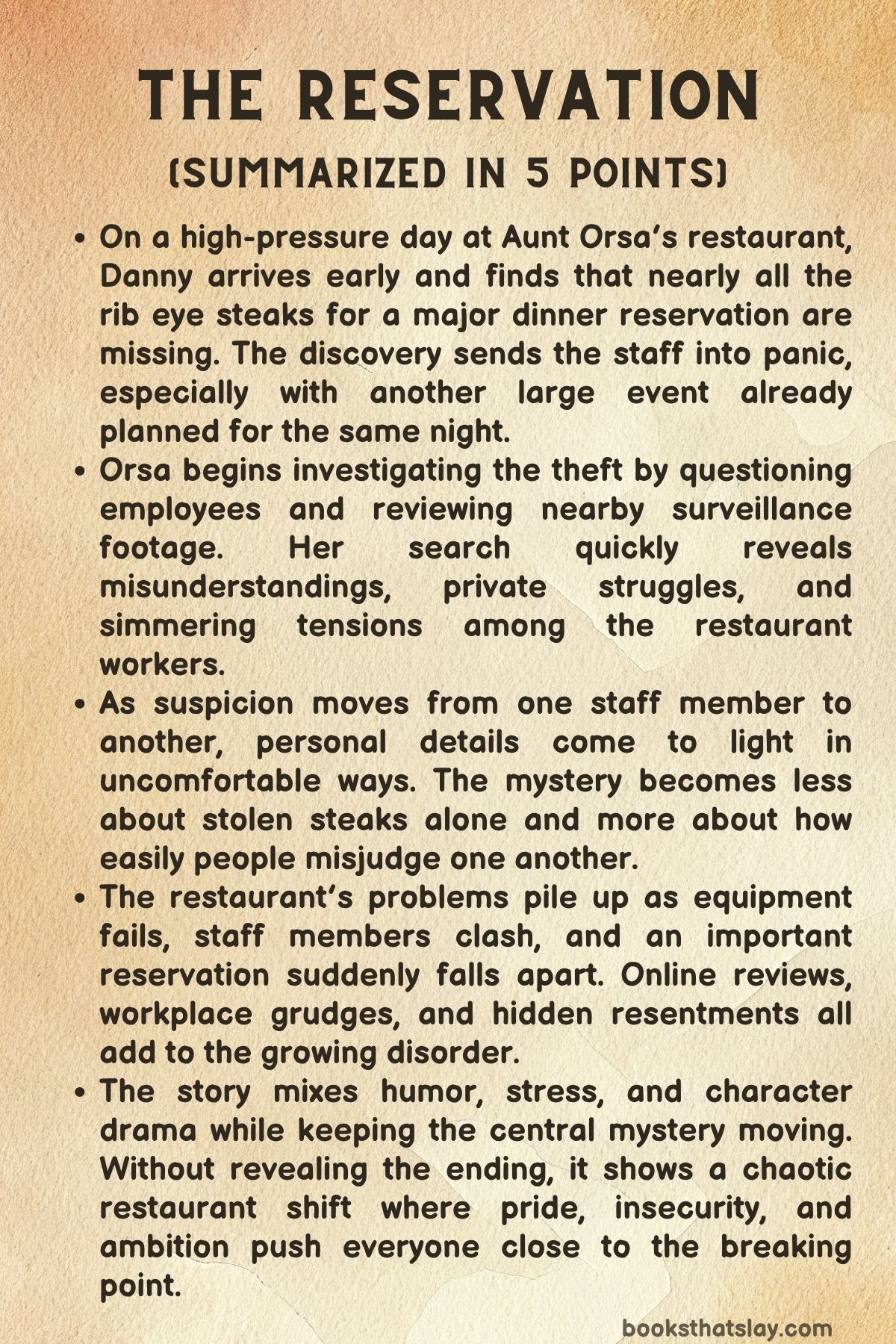
The Reservation centers on a single chaotic day at Aunt Orsa’s restaurant, where the staff is preparing for a high-profile dinner that has everyone tense before the doors even open. The day matters because the restaurant is expecting a reservation connected to John Grisham and a university group, an event the staff has nicknamed “Grisham Day.” For Orsa, the owner, it is the kind of evening that can bring prestige, attention, and validation.
For the kitchen and service staff, it means pressure, scrutiny, and the need to make every detail look effortless.
Danny, Orsa’s nephew and the restaurant’s operations assistant, arrives early to begin his usual inspection. He expects to find the kitchen ready for the demanding shift ahead, but instead he discovers a serious problem: twenty-two expensive rib eye steaks are missing from the walk-in cooler.
Only two remain. The loss is not just costly; it threatens the restaurant’s ability to serve two major groups that evening, including a large pharmaceutical dinner.
Danny searches the restaurant again, hoping there has been some mistake, but the steaks are truly gone. He calls Orsa, who reacts with panic and anger.
The missing steaks immediately turn the restaurant into a place of suspicion. Orsa comes in determined to find out who stole them, and the staff members become possible suspects in her mind.
Danny, meanwhile, is distracted by Jane, the Mennonite pastry chef he quietly admires. He notices that Jane has hidden ordinary clothes in her locker and wonders whether this secret has any connection to the theft.
The truth is more private and much less criminal: Jane has brought the clothes because she has a doctor’s appointment and does not want her usual Mennonite appearance to define how she is seen outside work.
Orsa begins searching for evidence. She obtains surveillance footage from the parking lot of a neighboring Wells Fargo, hoping it will show who may have carried the steaks out.
The footage does not solve everything, but it helps her narrow the suspect list to people who left with bags large enough to carry the missing meat. The main names become Glen, Shannon, Willis, and Julia.
This apparent evidence sharpens the tension, even though it rests on incomplete assumptions.
As Orsa questions the staff, the restaurant’s deeper problems come into view. Shannon becomes one of the main targets because she has been seen with a cooler in her locker.
Chef Oz has already suspected that she may have been stealing food. But when the truth comes out, it is embarrassing for everyone who judged her: Shannon uses the cooler to store breast milk while she works.
The accusation exposes how little the people around her understand her daily life and how quickly they turn private necessity into evidence of wrongdoing.
Shannon’s anger is not only about being accused of theft. She is frustrated by the way Orsa runs the restaurant and by the limits placed on her role.
She feels trapped in the back of house and resents never being allowed into the front, where she believes she could do more. Orsa’s questioning also brings up complaints about Shannon’s desserts and work habits, making the interrogation feel less like a fair search for the truth and more like a pile-on.
Oz defends Shannon partly because he knows her history and cares about her family, including her brother, who is in prison. The scene reveals loyalty, resentment, class tension, and the emotional cost of working under someone who often confuses authority with insight.
Glen is also questioned, and his own sadness and instability become part of the day’s emotional pressure. He is dealing with personal pain after a breakup, and his behavior makes him seem vulnerable rather than guilty.
The investigation keeps widening, but the more Orsa pushes, the more she uncovers personal struggles instead of clear answers.
Away from the restaurant, Jane leaves with Edgar, the prep cook, who drives her to her appointment. During the trip, Jane learns that Edgar has been lying about having a girlfriend.
The truth is that his life is much harder and lonelier than he has let on. He works another job at a poultry plant and sometimes sleeps in his car.
This revelation changes how Jane sees him. It also broadens the story beyond the missing steaks, showing how many staff members are carrying hidden burdens while trying to function through long shifts and low wages.
Back at Aunt Orsa’s, the evening grows worse. The dishwasher breaks at exactly the wrong time.
Willis, the dishwasher, is told he will have to hand-wash everything during an extremely busy service. Instead of accepting the impossible workload, he quits.
His departure adds another crisis to a night already strained by missing food, tense staff, and Orsa’s desperate need for control.
Then the celebrated Grisham reservation cancels. This is a major blow.
Orsa first wonders whether Julia may have invented the reservation or somehow staged the theft. Larry, however, suggests they call the number in the reservation system.
When Orsa does, she learns that the reservation was real. The group canceled because they had read a series of recent terrible online reviews of the restaurant.
The bad reviews open a new line of suspicion. Rhea studies them and begins to think they are fake.
They seem less like honest customer complaints and more like a deliberate attack, possibly aimed at Shannon. The staff starts to consider whether someone has been trying to damage both the restaurant and specific coworkers.
Attention turns to Byron, a server and aspiring writer who has made himself disliked by turning the lives of people around him into material. He has written about Jane, upsetting her, and he has posted an altered photo of Julia.
He watches people, collects details, and uses them in ways that feel invasive and cruel.
Darius, the bartender, reveals that Byron may have a grudge against Shannon. This makes the fake reviews look more personal.
The staff then rethinks the original assumption about how the steaks disappeared. Orsa has been focused on people leaving with bags, but Julia points out something important: Byron often dumps his own trash into kitchen trash bins so someone else will take it out.
This means the steaks may not have left in a personal bag at all. They may have been hidden in kitchen trash, allowing Byron to frame back-of-house workers, especially Shannon.
Once this possibility becomes clear, Byron flees. His reaction strengthens the case against him.
The restaurant has spent much of the day accusing the wrong people, and now the pattern begins to make sense. The fake reviews, the missing steaks, and the attempt to direct blame toward Shannon all seem connected to Byron’s need for attention, control, and material for his own writing.
He appears to have created disorder not simply to steal food but to manipulate the people around him and turn their lives into drama.
Even then, confusion remains. Larry later finds mangled steak in the broken dishwasher disposal, and Orsa briefly falls back into suspecting Shannon.
Her instinct to accuse the person already under suspicion shows how hard it is for her to let go of her assumptions. But the evidence points more strongly toward Byron, especially after Julia’s explanation about the trash and Byron’s escape.
The mystery is mostly resolved, though not with the clean satisfaction of a formal confession. Instead, the staff is left with the damage: mistrust, embarrassment, anger, and a clearer understanding of how easily a workplace can become hostile when people are not seen fairly.
After the disastrous shift, the restaurant settles into a strange quiet. Darius serves a late bar guest who may actually be John Grisham.
The famous visitor, if it is him, has come without fanfare after the official reservation has been canceled. He orders wine and a brûlée.
Glen prepares the dessert with care, and the moment becomes unexpectedly graceful after a night of mistakes and suspicion.
Darius tells the guest Glen’s sad childhood story, not realizing the man may be the writer everyone had been waiting for. This creates a final irony: the restaurant lost its grand public chance to impress John Grisham, yet may have served him privately after all.
Instead of a polished performance, he witnesses something smaller and more human: a weary bartender, a damaged staff, and one carefully made dessert.
By the end, Aunt Orsa’s restaurant has survived the night, but not unchanged. The missing steaks expose far more than a theft.
They reveal Orsa’s habit of judging too quickly, the staff’s hidden struggles, Byron’s manipulative behavior, and the fragile trust that holds a workplace together. The story closes not with complete peace, but with a brief pause in the chaos, centered on the simple perfection of a brûlée made well despite everything that has gone wrong.
Characters
Danny
Danny is the character who first brings the central problem of The Reservation into motion. As the operations assistant at Aunt Orsa’s restaurant, he is responsible, observant, and deeply aware of how much depends on the smooth running of the business.
His early arrival and careful inspection show that he takes his role seriously, even though he is not the owner or the chef. Danny’s discovery of the missing rib eyes immediately places him in the position of problem-solver, and his reaction suggests a mixture of panic, loyalty, and practical thinking.
He does not ignore the problem or try to hide it; instead, he checks the restaurant and contacts Orsa, showing that he understands the seriousness of the situation.
Danny’s feelings for Jane add a more personal layer to his character. His interest in her causes him to notice details that might otherwise seem unrelated, such as the regular clothes hidden in her locker.
This moment shows that Danny can be emotionally distracted and that his judgment is not completely separate from his private feelings. However, the discovery also reveals the book’s larger pattern: characters are often misread because others observe only fragments of their lives.
Danny’s suspicion about Jane does not come from malice, but it still shows how easily concern, attraction, and uncertainty can become mixed together.
As a character, Danny represents the anxious middle ground of the restaurant world. He is not as powerful as Orsa, not as artistically central as the kitchen staff, and not as visibly dramatic as Byron or Shannon, but he is deeply connected to the restaurant’s daily functioning.
Through him, the book shows how one small discovery can expose a much larger network of secrets, pressures, and misunderstandings. Danny’s role is important because he begins the mystery, but he also reflects the nervous loyalty of someone trying to hold a chaotic workplace together.
Aunt Orsa
Aunt Orsa is one of the most forceful and complicated figures in the book. As the owner of the restaurant, she carries the pressure of reputation, money, staffing, and customer expectations.
Her panic over the missing steaks is understandable because the restaurant is facing not just one important dinner but multiple high-stakes events. At the same time, her response reveals her tendency to assume, accuse, and control.
She wants answers quickly, and that urgency causes her to treat her employees less like people and more like possible threats to the business.
Orsa’s investigation shows both her strength and her weakness. She is determined, practical, and willing to act; she gets surveillance footage, questions staff members, and tries to narrow the list of suspects.
However, her methods reveal a lack of trust. She often interprets people’s private struggles as signs of guilt, and this creates emotional damage among the staff.
Her suspicion of Shannon is especially revealing because it exposes how Orsa can confuse workplace complaints, personal frustration, and actual evidence. She wants to protect the restaurant, but she does not always protect the dignity of the people who keep it running.
Orsa’s character is important because she represents authority under pressure. She is not simply cruel or unreasonable; she is frightened, responsible, and desperate to prevent disaster.
Yet the book makes it clear that leadership based on suspicion can deepen existing tensions. By the end, Orsa has been forced to confront the fact that her assumptions have led her in the wrong direction more than once.
Her character shows how easily a leader can mistake control for wisdom, especially when fear takes over.
Jane
Jane is a quiet but emotionally significant character whose presence brings tenderness, secrecy, and misunderstanding into the story. As the Mennonite pastry chef, she stands somewhat apart from the rest of the restaurant staff.
Her hidden regular clothes create suspicion at first, but the truth behind them is private and vulnerable rather than criminal. This detail shows that Jane, like many characters in the book, has an inner life that others do not fully understand.
She is not involved in the theft, but the assumptions made about her reveal how quickly people can turn privacy into suspicion.
Jane’s relationship with Danny is also important because it shows how she is viewed through the eyes of someone who is infatuated with her. Danny notices her carefully, but his attention is not the same as understanding.
Jane’s decision to leave with Edgar for her appointment moves her away from Danny’s imagined version of her and places her in a more real, independent space. She is not simply an object of Danny’s affection; she has her own needs, anxieties, and choices.
Her journey with Edgar adds depth to her character because it exposes her to another person’s hidden hardship. When she learns that Edgar has lied about having a girlfriend and is actually struggling with a second job and unstable living conditions, Jane becomes part of a quieter emotional thread in the story.
Her character helps show that behind the restaurant’s chaos are people carrying private burdens. Jane’s role in The Reservation is not centered on loud conflict but on the delicate gap between what others assume and what is actually true.
Edgar
Edgar is one of the more quietly sympathetic characters in the book. As a prep cook, he occupies a practical and often overlooked position in the restaurant, but his personal life reveals a great deal about economic pressure and pride.
His lie about having a girlfriend suggests embarrassment and a desire to appear more secure or socially normal than he actually feels. The truth that he works a second job at a poultry plant and sometimes sleeps in his car makes him a figure of hardship, endurance, and concealed vulnerability.
Edgar’s decision to drive Jane to her appointment shows kindness and reliability. He is not presented as someone trying to draw attention to himself or demand sympathy.
Instead, he helps Jane while carrying his own difficult reality. This contrast makes him morally grounded in a way that stands apart from the more manipulative or suspicious behavior happening at the restaurant.
His lie is not meant to harm others; it is a shield against shame.
Through Edgar, the book explores how working people often hide the most painful parts of their lives in order to keep functioning. He is not part of the central act of sabotage, yet his story matters because it widens the emotional world of the restaurant.
Edgar reminds the reader that not every secret is evidence of wrongdoing. Some secrets are forms of survival.
Glen
Glen is a character shaped by sadness, insecurity, and the need for dignity. He becomes one of the people suspected because the surveillance footage suggests he may have had a bag large enough to carry the missing steaks.
However, like several others, Glen’s suspicious appearance does not necessarily reflect guilt. His personal troubles, including his breakup and emotional pain, make him vulnerable to being misunderstood.
He is one of the characters whose private suffering becomes entangled with the investigation.
Glen’s importance grows near the end, when he carefully prepares the brûlée for the late guest who may be John Grisham. This moment gives him a kind of quiet redemption.
After a night of accusations, cancellations, broken equipment, and workplace humiliation, Glen’s careful preparation of a perfect dessert becomes a small act of grace. It shows that beneath his sadness, he still has pride in his work and the ability to create something beautiful.
Darius’s telling of Glen’s childhood story also makes Glen feel exposed, even if he may not immediately realize the significance of the moment. His pain becomes material for someone else’s conversation, possibly even for a famous writer.
This connects him to one of the book’s major concerns: the ethics of using other people’s lives as stories. Glen is not just a troubled employee; he is a person whose sorrow has weight, and the book treats that sorrow as meaningful.
Shannon
Shannon is one of the most emotionally charged and unfairly judged characters in the story. She becomes a major suspect because of assumptions made about her behavior, her anger, and the cooler in her locker.
Chef Oz initially thinks she may be stealing food, but the truth is that the cooler is used for breast milk she pumps during shifts. This revelation is one of the clearest examples of the book’s concern with misinterpretation.
What others read as suspicious is actually connected to motherhood, labor, and the difficulty of managing private responsibilities in an unsympathetic workplace.
Shannon’s anger is not random. It comes from accumulated frustration, especially over being denied opportunities in the front of house and being treated as someone untrustworthy or less valuable.
Her response to Orsa’s questioning shows that she has reached a breaking point. She is tired of being reduced to complaints, mistakes, or suspicion.
Her anger gives her character intensity, but it also reveals the emotional cost of being repeatedly underestimated.
The smear campaign against Shannon makes her even more central to the moral conflict of The Reservation. The fake reviews appear to target her and damage her reputation, suggesting that she has been deliberately framed or attacked.
Shannon becomes a figure through whom the book explores workplace bias, resentment, and the danger of easy blame. She is not perfect, but the story makes clear that imperfection is not the same as guilt.
Her character asks the reader to look beyond anger and see the wounded dignity beneath it.
Willis
Willis, the dishwasher, is a smaller but still important character because he represents the limits of endurance in a demanding workplace. His role is physically exhausting and often thankless, but it becomes especially crucial when the dishwasher breaks during an already chaotic shift.
When he learns he will have to hand-wash everything on such a busy night, he quits. This decision may seem abrupt, but it also reveals how much pressure has been placed on workers whose labor is usually invisible until something goes wrong.
Willis’s departure adds to the collapse of order in the restaurant. The missing steaks are already a crisis, the major reservation has become uncertain, and staff members are turning against one another.
When Willis quits, the practical machinery of the restaurant breaks down even further. His action shows that chaos is not only caused by mystery or sabotage; it is also caused by exhaustion and the failure to support essential workers.
As a character, Willis embodies refusal. He does not stay to absorb unlimited pressure simply because the restaurant needs him.
His quitting becomes a blunt reminder that every workplace depends on people who can choose to walk away. Though he is not deeply explored, his role is meaningful because he exposes the fragility of the restaurant’s structure.
Julia
Julia is one of the most observant and useful characters in solving the mystery. At first, Orsa suspects that Julia may have faked the reservation or been involved in the steak theft, but this suspicion once again reflects the book’s pattern of misplaced assumptions.
Julia ultimately provides a key piece of information about Byron’s habit of dumping his own trash into the kitchen bins so others will carry it out. This detail helps shift the investigation away from the back-of-house workers and toward Byron.
Julia’s character is important because she notices patterns in behavior that others overlook. Her knowledge of Byron’s habits becomes more valuable than the initial surveillance footage because it explains how the steaks could have been moved without fitting the obvious suspect list.
She shows that truth in the book often comes from ordinary workplace knowledge rather than dramatic confession. People who pay attention to routines may understand more than those who rely only on authority or suspicion.
Julia is also connected to Byron’s cruelty through the altered photo he posted of her. This makes her one of the people harmed by his habit of turning coworkers into material for his own purposes.
Her role is therefore both practical and moral. She helps reveal how Byron operates, and she also stands as one of the victims of his invasive, self-serving behavior.
Chef Oz
Chef Oz is a character defined by loyalty, authority in the kitchen, and imperfect judgment. He initially suspects Shannon because of the cooler in her locker, but the truth about the breast milk forces a reassessment.
This moment shows that Oz, like Orsa, is capable of making assumptions based on incomplete information. However, his loyalty to Shannon because of her imprisoned brother gives his character emotional complexity.
He is not simply suspicious or harsh; he has personal reasons for caring about her and protecting her.
Oz’s position in the kitchen places him between management pressure and staff hardship. He must care about discipline, food, and performance, but he also understands the people working under him more intimately than Orsa does.
His assumptions about Shannon are damaging, yet his loyalty suggests that he is not indifferent. This contradiction makes him realistic.
He can be protective and unfair at the same time.
Chef Oz helps reveal the complicated emotional bonds within the restaurant. The kitchen is not just a workplace; it is a place of alliances, resentments, histories, and hidden obligations.
Through Oz, the book shows that loyalty does not always prevent misunderstanding. Sometimes people can care about someone and still misread them.
Larry
Larry functions as one of the more reasonable and stabilizing characters in the story. While Orsa becomes increasingly suspicious and reactive, Larry suggests a practical step: calling the number in the reservation system to verify whether the Grisham party was real.
This suggestion is simple, but it changes the direction of the investigation. Instead of continuing to build theories from panic, Larry encourages direct confirmation.
His role shows the importance of calm thinking during crisis. The restaurant is full of people making assumptions, reacting emotionally, or protecting themselves.
Larry’s contribution is valuable because he cuts through speculation and points toward evidence. His practicality helps reveal that the reservation was genuine and that the cancellation was caused by terrible online reviews rather than a fake booking.
Larry may not dominate the story emotionally, but he matters because he represents steadiness. In a book full of suspicion and escalation, his grounded response prevents the mystery from becoming even more distorted.
He shows that sometimes the most useful person in a crisis is not the loudest or most powerful one, but the one who asks the obvious question others have missed.
Rhea
Rhea is an intelligent and perceptive character whose attention to the online reviews helps uncover another layer of the sabotage. When she studies the reviews and suspects they are fake, she shifts the focus from the missing steaks alone to a broader campaign of damage.
Her insight suggests that the restaurant’s disaster is not merely a theft but part of a deliberate attempt to create chaos and harm specific people, especially Shannon.
Rhea’s character is important because she understands reputation in a modern sense. The cancellation of the major reservation shows that online reviews can have real consequences for a restaurant.
By recognizing the possibility of a smear campaign, Rhea reveals how public judgment can be manipulated. Her thinking expands the mystery beyond the physical space of the kitchen and into the digital world, where damage can be done anonymously.
Rhea also helps balance the emotional chaos of the staff. While others are reacting through anger, fear, or defensiveness, she analyzes patterns.
Her role is not only to provide information but to show another form of intelligence: careful reading. She helps expose the hidden structure behind events that first appear random.
Byron
Byron is the most destructive and morally troubling character in the book. As a server and aspiring writer, he is connected to one of the story’s central ethical questions: what happens when someone treats other people’s lives as material without respect for their humanity?
He is disliked for writing about Jane and for posting an altered photo of Julia, both of which show his willingness to use, distort, or expose coworkers for his own purposes. His artistic ambition is not presented as noble; instead, it becomes selfish, invasive, and cruel.
Byron’s likely role in the steak theft and fake reviews makes him the main source of sabotage. The theory that he hid the steaks in kitchen trash so others would carry them out reveals planning and manipulation.
It also suggests that he understood how suspicion would fall on back-of-house workers, especially Shannon. This makes his actions especially ugly because he exploits existing workplace tensions and prejudices.
He does not merely cause trouble; he weaponizes the restaurant’s mistrust.
His flight when the staff begins to understand the truth strongly suggests guilt. Byron’s character represents the danger of cleverness without empathy.
He wants stories, drama, and perhaps revenge, but he does not seem to care about the real harm done to people’s jobs, reputations, and emotional lives. Through Byron, the book criticizes the kind of writer or observer who consumes other people’s pain without responsibility.
Darius
Darius, the bartender, is a socially aware and revealing character. He helps expose Byron’s possible grudge against Shannon, which moves the staff closer to understanding the motive behind the fake reviews and the chaos of the night.
As a bartender, he occupies a position where he hears, observes, and connects people’s stories. His knowledge is not formal authority, but it is socially powerful.
Darius’s most important scene comes near the end, when he serves the late bar guest who may actually be John Grisham. His conversation with the guest, especially his telling of Glen’s sad childhood story, is layered with irony.
Darius does not realize the guest may be the famous writer, which makes the moment feel quietly comic but also morally uneasy. After a story full of concern about people using other people’s lives as material, Darius unknowingly offers Glen’s pain to someone who may turn it into fiction.
Darius is not malicious in the way Byron is, but his character shows that storytelling can be complicated even when it is casual. He reveals information, interprets people, and passes along personal details.
His role suggests that everyone in the restaurant participates, in some way, in turning life into stories. The difference lies in whether those stories are told with care, selfishness, or blindness.
Themes
Assumption and Misjudgment
In The Reservation, suspicion spreads faster than evidence. Orsa begins with a real crisis, but her investigation is shaped by guesses about the people around her.
Jane’s hidden clothes, Shannon’s cooler, Glen’s emotional state, and Julia’s possible connection to the canceled reservation all become reasons for doubt before the truth is understood. This shows how easily people are reduced to appearances, habits, or rumors.
Shannon’s situation is especially painful because her cooler, first treated as possible proof of theft, is actually tied to motherhood and the private pressure of pumping breast milk during work. The theme becomes sharper because the missing steaks are not just a mystery; they expose how little the staff truly understands one another.
Instead of creating clarity, Orsa’s questioning often deepens resentment. The story suggests that judgment made under stress can damage trust, especially in a workplace where people already feel unseen, undervalued, or misunderstood.
Workplace Pressure and Hidden Struggles
The restaurant becomes a place where every employee is carrying more than the job requires. Danny is anxious about responsibility, Orsa is desperate to protect the business, Jane is managing private medical concerns, Edgar is hiding financial hardship, Shannon is balancing motherhood with work, and Glen is weighed down by personal sadness.
These struggles are not presented as separate from the restaurant’s crisis; they shape how each person reacts when pressure rises. The missing steaks, broken dishwasher, canceled reservation, and bad reviews create a chain of problems, but the deeper tension comes from workers who are already close to exhaustion.
Willis quitting when the dishwasher breaks shows how one added burden can push someone past the limit. The restaurant depends on teamwork, yet the staff members often lack the time, safety, or respect needed to explain themselves.
The theme reveals how service work can demand calm performance while hiding the private strain of the people making that performance possible.
Resentment, Exploitation, and the Use of Other People’s Lives
Byron’s behavior reveals a darker form of selfishness: he treats coworkers as material rather than as people. His writing, altered image of Julia, possible fake reviews, and attempt to frame others all suggest a pattern of using private lives for attention, control, or creative gain.
The damage he causes is not only practical, though the restaurant suffers badly from the missing steaks and damaged reputation. The greater harm is emotional.
Jane, Shannon, Julia, and others become vulnerable because their personal details can be twisted or exposed. This theme shows how storytelling can become cruel when it ignores consent and dignity.
Byron wants drama, but the people around him must live with the consequences. His actions also turn existing workplace tensions into weapons.
Because some employees are already misunderstood or marginalized, it becomes easier for suspicion to fall on them. The story warns against turning real people into tools for ambition, amusement, or revenge.
Chaos, Grace, and Small Moments of Meaning
Even after the ruined shift, the broken equipment, the accusations, and the canceled event, the ending allows a quieter kind of resolution. The possible arrival of John Grisham matters less as a celebrity twist than as a reminder that meaning can appear without announcement.
The staff has spent the day preparing for a grand public moment, only for that moment to collapse. Yet something modest and sincere still happens at the bar: Darius serves the guest, Glen prepares a careful dessert, and the restaurant briefly regains a sense of purpose.
In The Reservation, chaos does not fully disappear, and the mystery is only mostly resolved, but the final dessert creates a small space of order. Glen’s careful work matters because it is done with attention despite sadness and disaster.
The theme suggests that dignity can survive failure. A difficult day may not end perfectly, but one act of care can still restore a little beauty.