Rolls and Rivalry Summary, Characters and Themes
Rolls and Rivalry by Kristy Boyce is a young adult romantic comedy about marching band, old friendships, fierce competition, family expectations, and learning how to lead without controlling others.
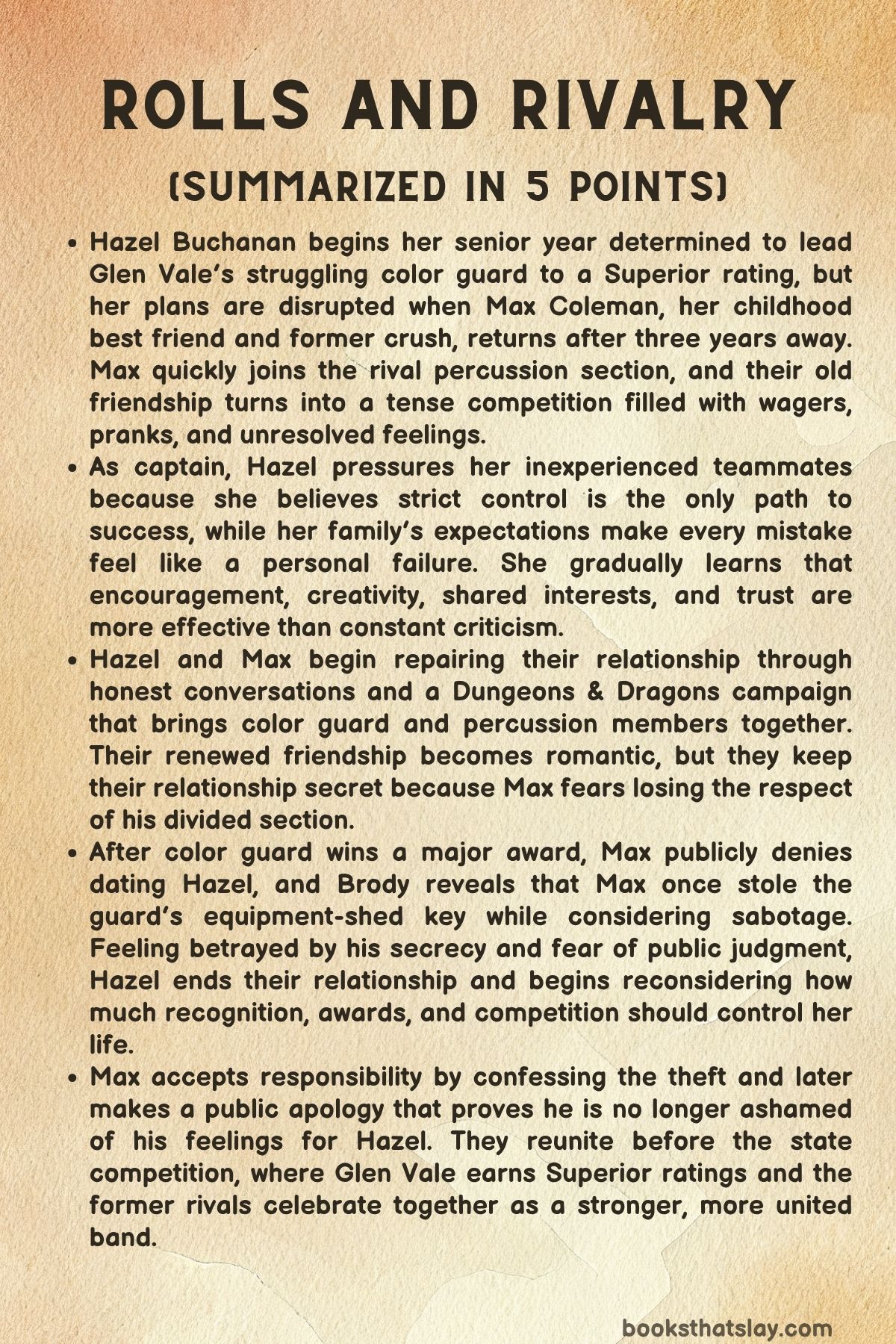
Hazel Buchanan begins her senior year determined to transform Glen Vale High School’s struggling color guard and earn the recognition she has chased for years. Her plans become complicated when Max Coleman, her childhood best friend and former crush, unexpectedly returns after a long absence. Their revived rivalry soon extends from band competitions to Dungeons & Dragons sessions, personal wagers, leadership battles, and unresolved romantic feelings. It’s the 3rd book of the Gaming and Romance series.
Summary
Hazel Buchanan begins her final band camp carrying the pressure of leading Glen Vale High School’s inexperienced color guard. She desperately wants the section to earn a Superior rating and prove that its members deserve the same respect as the musicians.
Her carefully imagined senior season changes when Max Coleman returns after three years away. Max was once Hazel’s closest friend, gaming companion, and first crush, but he now behaves as though their shared past means very little.
Max quickly becomes popular within the percussion section because of his musical talent, confidence, humor, and willingness to participate in its competitive culture. Hazel warns him about Brody, the arrogant percussion leader who has spent years belittling color guard, but Max accuses her of trying to control his new friendships.
The argument leaves Hazel hurt and confused. She had expected Max to return as the boy who understood her interests and laughed at her jokes, yet he seems determined to keep her at a distance.
Hazel is also struggling with her responsibilities as captain. Most of her guard members are inexperienced, their director Faith cannot attend every rehearsal, and Hazel believes their only chance of success is constant discipline.
Her parents unintentionally increase the pressure. Hazel’s mother was an accomplished Glen Vale musician and repeatedly predicts that Hazel will win the senior Most Valuable Member award, while her father’s history with marching band makes success seem like a family tradition she must continue.
The rivalry between color guard and percussion grows through pranks, wagers, and public challenges. Hazel defeats Max and Brody during a marching competition, winning Popsicles for her section, but Max delivers them unfrozen and argues that he technically fulfilled the agreement.
Color guard retaliates by creating a mocking version of percussion’s treasured chant. Although the exchange strengthens the guard members’ loyalty to one another, it also makes the conflict between the two sections increasingly personal.
Hazel’s first major success as captain occurs during a sectional dinner at her house. When conversation becomes awkward, she helps everyone create Dungeons & Dragons characters, and the guard members begin bonding through shared jokes, drawings, and imaginary identities.
Li, an enthusiastic freshman, tells Hazel that she should be a wizard because she is wise and capable of helping the guard create magic. The compliment makes Hazel realize that her teammates may value her for more than her ability to demand better performances.
The rivalry becomes more serious after percussion fills water balloons with vinegar and humiliates the guard during rehearsal. When Brody insults Li and calls the entire section useless, Hazel declares that color guard will win a best-in-show award before percussion does.
The resulting wager carries an unpleasant punishment. If percussion wins first, color guard must clean the men’s stadium restrooms, but if color guard wins, percussion must learn and publicly perform the guard’s choreography.
Many guard members resent Hazel for accepting such a dangerous bet, but Li thanks her for defending them. Hazel now feels responsible not only for their competition scores but also for proving that color guard deserves dignity.
During the Family March, Hazel notices Max standing alone because neither parent has attended. His loneliness awakens her sympathy, but his defensive reaction prevents her family from approaching him.
Their relationship begins improving when Max and his mother attend a Sunday Dungeons & Dragons gathering at Hazel’s house. While their parents play downstairs, Hazel and Max return to their old routine of teasing, competing, and recalling childhood memories.
After losing a trampoline wager, Max reveals that his parents have separated. He and his mother now live in a small apartment, and the emotional and financial strain has changed his life.
Hazel begins to understand why Max has become defensive and desperate to belong. His behavior still frustrates her, but she can no longer view him as simply cruel or arrogant.
Max later explains that Hazel’s mother helped his mother recognize how controlling her marriage had become. Because Max believed Hazel knew private information about his family, he resented her apparently perfect home and blamed her family for influencing his parents’ separation.
Hazel tells him that she knew nothing and admits that her own family life is not as effortless as it appears. Her mother’s expectations often make her feel watched, judged, and unable to decide what success should mean for herself.
Max apologizes for blaming her, and the two agree to try rebuilding their friendship. Hazel invites him into a new Dungeons & Dragons campaign with Nova and Li, while Max brings Felix, a quieter percussion player.
Their first session succeeds because the players cooperate instead of carrying their band hostility into the game. Max revives Axolotl, a ridiculous dragonborn fighter he and Hazel invented as children, showing that their shared memories mattered to him even during their years apart.
The campaign becomes neutral ground where guard and percussion members can create relationships outside their school identities. Li and Felix, who independently create elf druids, become especially close as their characters develop a connected history.
Marching competitions are less successful. Glen Vale performs poorly at its first regional event, while Oak Grove defeats both color guard and percussion.
At the next competition, rain turns the field into mud, Hazel falls, and color guard receives an even lower rating. Hazel begins questioning whether her strict leadership is helping anyone.
Her opinion of Max changes further when she overhears him confronting Brody for bullying younger percussion members. Max eventually challenges Brody’s authority and is appointed percussion section leader, choosing responsibility over the safety of remaining popular.
Hazel and Max celebrate his promotion through another wager that leads to an ice cream outing. Their increasingly personal conversations reveal that both use competition as a way to request attention without admitting their emotional needs.
Max explains that percussion became an escape from his parents’ conflict. Hazel admits that she chose color guard partly to establish an identity separate from her family’s musical accomplishments, only to find that her mother transferred those expectations to her new activity.
Max advises Hazel to build her section through enjoyment and shared interests instead of fear. She begins moving rehearsals into spaces with mirrors, allowing members to recognize their own mistakes, and connecting warm-up activities to their Dungeons & Dragons characters.
The new approach improves morale and synchronization. Hazel starts becoming the kind of captain who helps others take ownership of the group rather than treating every mistake as a personal failure.
Her growth is not immediate or complete. During the Dungeons & Dragons campaign, she becomes upset when Li and Felix pursue a storyline she has not prepared, and she tries to force them back toward her original plans.
Max recognizes her panic and invents a break so she can recover without being embarrassed. Although Hazel later repeats the mistake and frustrates the players, she eventually admits that she confused leadership with control.
A trip with Max to buy gaming miniatures gives Hazel the courage to discuss her failure. Max encourages her to apologize, listen to her friends, and adapt the campaign rather than treating one difficult session as proof that she is incapable.
At the county fair, Hazel apologizes to Li and Felix and promises to make their characters’ homeland central to the adventure. Li forgives her and confesses that she has developed feelings for Felix.
Hazel’s friendship with Max continues turning romantic. Their teasing, private jokes, shared nachos, music, gaming trips, and emotional conversations restore the closeness they had as children while creating something more mature.
Max eventually takes Hazel to a nature preserve and leads her onto an elevated net suspended among the trees. There, they admit that their feelings never completely disappeared during their time apart.
Max tells Hazel that he has been trying to win her over since returning, despite repeatedly damaging his own chances. Hazel confesses that he first won her affection when they were twelve, and they finally kiss.
They decide to keep the relationship secret because both sections remain divided. Hazel believes privacy will give them time to understand their feelings, while Max worries that Brody and the percussion members will question his authority if they learn he is dating the color guard captain.
The secrecy soon creates tension. Hazel would eventually choose Max over band recognition, but Max’s repeated insistence that percussion must come first makes her wonder whether he values their relationship equally.
Hazel’s final regional competition becomes the turning point for the guard. Before performing, she angrily confronts Faith for being absent and leaving her with too much responsibility.
Faith reveals that no other director was available and that Glen Vale would have eliminated color guard entirely if she had refused the position. Hazel realizes that Faith accepted an imperfect arrangement because she wanted the students to have a season at all.
Hazel apologizes and enters the competition with a more generous understanding of leadership. Glen Vale delivers its strongest performance, color guard wins Best Overall Auxiliary, and the entire band finally earns the Superior rating required for state.
Max enthusiastically celebrates Hazel’s victory even though percussion loses their wager. Encouraged, Hazel suggests revealing their relationship, but when his teammates approach, Max publicly denies that they are dating.
Brody then exposes another betrayal. Max has possessed the equipment-shed key Hazel believed she had lost because he stole it during band camp while considering a plan to sabotage the guard.
Max insists that he abandoned the plan and kept the secret because he feared losing Hazel. She responds that his silence, his public denial, and his concern about percussion have already destroyed her trust.
Hazel ends the relationship and cancels the next gaming session. Even while heartbroken, she begins breaking down the feud by inviting Felix and Niko to join color guard members for pizza, allowing the younger students to speak as ordinary friends rather than enemies.
At the band awards ceremony, Li wins Most Valuable Freshman and Nova wins the senior award. Hazel is sincerely happy for Nova because she recognizes how much her loyal friend has contributed over four years.
Max admits the key theft to the band director and accepts the consequences, even though the confession could remove him from the state performance. His decision clears Hazel’s name and demonstrates that he is finally taking responsibility without demanding forgiveness.
Hazel also confronts her mother after mistakenly believing that losing the senior award means she has failed the family. Her mother is horrified to learn how seriously Hazel interpreted her constant predictions and promises that Hazel’s happiness matters more than any trophy.
Their honest conversation allows Hazel to explain how pressure damaged her enjoyment of the season. Her mother apologizes, and Hazel begins viewing her as a loving but imperfect person rather than an impossible standard she must match.
On Balloon Day, the guard members honor Hazel with a plaque and thank her for creating a real team. Their recognition means more to her than the official award because it reflects the influence she had on people rather than her position in a ranking.
Max then makes a public apology through a special performance. The musicians play “I Want You to Want Me,” percussion performs color guard choreography, and the students form symbols connected to Hazel and Max’s shared memories.
In front of everyone, Max calls Hazel his favorite person and best friend. By openly admitting his love, he rejects the secrecy that caused their breakup and proves that he is willing to stand beside her regardless of his section’s opinion.
Hazel forgives him after seeing that his apology includes accountability, effort, and public honesty. They reunite and kiss before the cheering band.
At the state competition, Hazel performs without obsessing over every possible mistake. She understands that no rating can erase the friendships, confidence, and sense of belonging she gained during the season.
Glen Vale earns Superior ratings in every major category. Color guard and percussion celebrate together, while Hazel begins considering a future that includes college, winter guard, continued gaming, and a relationship with Max built on trust rather than rivalry.
Characters
Hazel Buchanan
Hazel is the central character of Rolls and Rivalry, and her development is closely connected to her changing definition of success. At first, she believes that achievement requires total preparation, strict discipline, constant correction, and personal responsibility for every outcome.
Her desire to earn recognition is understandable because color guard has long been treated as less legitimate than percussion and the rest of the band. However, this desire also causes her to view ordinary mistakes as threats to her value as a captain.
Hazel’s perfectionism appears in both marching band and Dungeons & Dragons. She prepares detailed plans, assumes that good leadership means preventing uncertainty, and becomes frustrated when other people make choices she cannot predict.
Her greatest strength is her willingness to reflect after failure. Once she recognizes that her behavior has silenced Li, frustrated Felix, and weakened guard morale, she apologizes and changes her methods rather than defending herself indefinitely.
Hazel is fiercely protective of people who are dismissed by others. Her impulsive wager with percussion is reckless, but it begins when Brody humiliates Li and treats color guard as worthless.
Her romantic relationship with Max also tests her self-respect. Although she loves him, she refuses to accept a relationship in which he acknowledges her privately and denies her publicly.
By the conclusion, Hazel has stopped measuring her worth through trophies, awards, and perfect performances. She values the community she helped build, the honesty she established with her mother, and the confidence to enjoy an experience without controlling its result.
Max Coleman
Max is the second major figure in Rolls and Rivalry, serving as Hazel’s rival, childhood friend, romantic interest, and leadership counterpart. His confidence and humor initially make him appear secure, but much of his behavior is shaped by instability at home.
The separation of his parents leaves Max angry, displaced, and uncertain about where he belongs. He responds by trying to make himself valuable to percussion, believing that popularity and talent can protect him from another rejection.
His early treatment of Hazel is unfair because he blames her for information she never possessed. His decision to steal the equipment-shed key also reveals how far he is initially willing to go to earn acceptance from a group.
Max nevertheless demonstrates a strong capacity for change. He confronts Brody’s bullying, accepts responsibility as section leader, supports Felix and Niko, and begins choosing his principles over his desire to fit in.
He is especially helpful when Hazel becomes overwhelmed. Rather than taking control of her campaign or publicly exposing her struggle, he gives her room to recover and later offers honest advice.
His greatest failure occurs when he publicly denies their relationship. Although fear explains his reaction, it does not excuse his willingness to protect his authority at Hazel’s expense.
Max’s confession to Sire and public apology show that he has learned accountability. He stops hiding behind charm, accepts consequences that may cost him recognition, and openly declares that Hazel matters more than his reputation.
Nova
Nova is Hazel’s most reliable friend and one of the emotional foundations of the color guard. She supports Hazel’s goals without treating her as incapable of making mistakes.
Her loyalty is steady rather than passive. When Hazel keeps her relationship with Max secret, Nova questions whether the arrangement is fair and forces Hazel to consider concerns she has been avoiding.
Nova also represents a quieter form of leadership. She has spent years contributing to the band without receiving the same attention as Hazel, Max, or Brody, yet she remains dependable and generous.
Her senior MVM victory demonstrates that valuable service is not always loud or competitive. Hazel’s happiness for Nova confirms that she has become capable of celebrating another person’s recognition without interpreting it as her own defeat.
Li
Li begins as a cheerful freshman who brings creativity, emotional openness, and trust to the color guard. Her belief in Hazel often remains strong even when older members question their captain’s decisions.
She is one of the first people to recognize Hazel’s ability to inspire others. By describing Hazel as a wizard who helps the guard create magic, Li gives her a form of appreciation that is based on guidance rather than awards.
Li’s artistic talent strengthens both the guard and the gaming group. Her character portraits preserve their shared experiences and reveal how carefully she observes the people around her.
Her conflict with Hazel during the campaign is important because Li refuses to accept being limited to a supporting role. She wants Ellywich to possess her own goals, choices, and importance rather than existing only to heal others.
Li’s willingness to forgive Hazel follows a sincere apology and meaningful change. Her friendship and eventual romance with Felix also help prove that the feud between guard and percussion is learned behavior rather than an unavoidable division.
Felix
Felix is a quiet percussion member whose kindness contrasts sharply with Brody’s aggression. He is frequently placed in an uncomfortable position because he belongs to a section that treats hostility as part of its identity.
Through Dungeons & Dragons, Felix gains the freedom to cooperate with Li without worrying about their opposing groups. Their connected characters allow their friendship to grow naturally.
Felix is also perceptive enough to challenge Hazel when her campaign becomes unfair. His criticism is not cruel; it reflects his desire for a game in which information, agency, and participation are shared.
His developing relationship with Li symbolizes the possibility of a healthier band culture. Together, they represent younger students who can inherit Glen Vale without continuing its old resentment.
Faith
Faith is the color guard director whose cheerful encouragement initially frustrates Hazel. Because she attends irregularly and avoids harsh criticism, Hazel assumes that Faith is unwilling to take the group’s problems seriously.
The truth reveals a more complicated reality. Faith accepted the position despite knowing that she could not provide ideal support because the school would otherwise have eliminated color guard.
Her approach emphasizes confidence, enjoyment, and emotional safety. Although it lacks some of the structure Hazel needs, it provides an important correction to Hazel’s belief that fear and pressure are necessary for improvement.
Faith’s imperfections make her a useful adult figure. She is neither a perfect mentor nor a careless one, but someone trying to preserve an opportunity under difficult circumstances.
Brody
Brody represents the destructive side of competition. His resentment began when Hazel defeated him for the freshman MVM award, and he has spent years attempting to undermine the legitimacy of color guard.
He maintains authority by humiliating weaker students, encouraging pranks, and treating cruelty as proof of loyalty. His behavior damages percussion internally as much as it harms the guard.
Brody’s hostility is rooted in insecurity. Rather than accepting that Hazel deserved recognition, he transforms one loss into a lasting grievance and builds his identity around proving that her section is inferior.
His removal from leadership shows that talent or seniority cannot justify abuse. By the end, his refusal to cooperate isolates him while younger percussion members begin forming healthier relationships.
Sire
Sire is Glen Vale’s band director and the adult responsible for managing the entire marching program. He recognizes Hazel’s authority by giving her the equipment-shed key and regularly observes her development as captain.
His disappointment after the key disappears increases Hazel’s shame, but he does not reduce her identity to that mistake. Later, he notices the guard’s improvement and acknowledges Hazel’s work.
Sire also replaces Brody with Max when it becomes clear that percussion requires different leadership. His decision suggests that he values responsibility and group welfare more than tradition.
When Max confesses the key theft, Sire imposes serious consequences without ignoring the importance of his honesty. He therefore acts as an authority figure who expects accountability while leaving room for growth.
Hazel’s Mother
Hazel’s mother is loving, energetic, accomplished, and unintentionally overwhelming. Her own positive memories of Glen Vale cause her to assume that Hazel will find happiness through the same achievements.
She repeatedly predicts awards and Superior ratings because she believes she is expressing confidence. Hazel instead hears these predictions as conditions she must satisfy to deserve approval.
Her mistake is not a lack of love but a failure to recognize the effect of her language. She also becomes so involved in managing family responsibilities that she misses the awards ceremony whose importance she had repeatedly emphasized.
The confrontation with Hazel allows her to understand the pressure she created. Her apology is meaningful because she does not defend her intentions as more important than Hazel’s experience.
Hazel’s Father
Hazel’s father is supportive and enthusiastic about marching band, though he plays a less forceful role than her mother. His background with Ohio State’s marching band contributes to the family culture surrounding musical achievement.
He often participates in the family’s excitement without noticing how intimidating that history can feel to Hazel. However, he does not appear to demand specific awards or treat her mistakes as personal disappointments.
His presence at performances and willingness to celebrate Hazel show genuine affection. He also helps explain misunderstandings, including the reason Hazel’s mother misses the awards ceremony.
Melanie Coleman
Melanie is Max’s mother and an important influence on the emotional conflict between the families. Her decision to leave a controlling marriage creates instability, but it also begins a healthier life for herself and Max.
She confides in Hazel’s mother because she needs perspective and support. Max initially interprets this relationship as interference, while Hazel gradually understands that the adults were responding to serious problems he could not yet see clearly.
Melanie’s limited finances and emotional exhaustion explain several moments that Max experiences as abandonment. Her situation also helps Hazel understand that his confident school persona hides uncertainty at home.
Kelsey
Kelsey is Hazel’s younger sister and part of the Buchanan family’s enthusiastic involvement in band activities. She joins the Family March and quickly notices Max’s attractiveness.
Although her role is minor, she adds humor and helps reveal Hazel’s jealousy before Hazel is ready to admit that her crush has returned. Kelsey also reflects the relaxed family closeness that Max observes from the outside.
Niko
Niko is one of the younger percussion members affected by Brody’s bullying. Max’s decision to defend students such as Niko becomes a major reason he challenges Brody for leadership.
Niko later joins guard members for pizza, helping reduce the hostility between sections. His participation demonstrates that many percussion students are not personally committed to the feud and welcome the chance to interact without Brody’s influence.
Callie
Callie is one of the guard members who becomes more engaged after Hazel introduces the Dungeons & Dragons character activity. Her creation of Puff, a purple dragonborn, shows how an informal shared interest can awaken enthusiasm that strict rehearsal has failed to produce.
She contributes to the section’s growing identity and confirms that Hazel’s teammates respond best when they are invited to be imaginative. Her participation helps turn the guard from a collection of reluctant performers into a community.
Yori
Yori creates Oof, an orc barbarian capable of flattening anyone who irritates her. The humorous character allows her personality to become more visible within the group.
Like Callie, Yori demonstrates the importance of giving team members space to contribute in their own ways. Her growing investment supports Hazel’s realization that unity develops through shared enjoyment rather than constant commands.
Keira
Keira is the guard member who accidentally retrieves the wrong flag during the first regional competition. The highly visible mistake becomes one of the moments Hazel interprets as proof that she has failed as captain.
Keira is not presented as careless or malicious. Her mistake represents the ordinary unpredictability of live performance and the danger of treating one error as a judgment on an entire person or team.
Themes
Leadership Through Trust
Leadership changes from a form of control into a practice of listening, adaptation, and shared responsibility throughout Rolls and Rivalry. Hazel begins her senior season believing that a successful captain must anticipate every problem, correct every weakness, and prevent her team from making visible mistakes.
This belief makes her hardworking, but it also causes her to distrust the people she leads. She speaks as though guard members will fail unless she maintains constant pressure, and she treats unexpected choices during Dungeons & Dragons as attacks on her preparation.
Her strongest progress occurs when she gives other people ownership. Mirrors allow guard members to identify their own mistakes, music choices create personal investment, and fantasy characters help them express identities beyond their positions on the field.
Max’s leadership follows a related path. He initially seeks acceptance by participating in percussion’s cruel culture, but he becomes worthy of authority only when he protects younger members and challenges Brody.
Faith adds another perspective by showing that leadership may involve accepting an imperfect responsibility so that others do not lose an opportunity entirely. The characters eventually learn that leaders are not valuable because they prevent every failure; they are valuable because they create conditions in which people feel respected, capable, and willing to improve together.
Competition, Recognition, and Self-Worth
Competition provides energy, humor, and motivation, but it becomes harmful when characters use victory as proof of personal value. Hazel and Max communicate through wagers because competition feels safer than openly expressing affection, fear, jealousy, or vulnerability.
Their bets often create enjoyable moments, yet the larger contests surrounding band awards become emotionally dangerous. Hazel believes that earning MVM and a Superior rating will confirm that she deserves her captaincy, while Max believes percussion success can compensate for his father’s rejection.
Brody represents the most destructive outcome of this mindset. He cannot accept losing the freshman award to Hazel, so he spends years attacking her section in an attempt to rewrite that defeat.
Hazel’s development requires separating recognition from worth. Nova’s MVM victory initially threatens the legacy Hazel believes she must continue, but Hazel recognizes that her friend deserves the award and that leadership cannot be fully measured by voting.
The plaque from her guard members matters more because it acknowledges the relationships she built. By the state competition, Hazel can still desire a Superior rating without allowing it to determine whether the season was meaningful.
The story does not reject competition completely. Instead, it suggests that rivalry becomes healthy only when winning does not require humiliation, secrecy, betrayal, or the belief that another person’s success reduces one’s own importance.
Belonging and the Courage to Be Known
Max’s actions are strongly shaped by his need to belong after his family and school life are disrupted. Entering an established percussion section gives him a ready-made identity, but maintaining that acceptance initially requires him to tolerate behavior he knows is wrong.
His fear of exclusion explains why he defends Brody, participates in pranks, considers sabotage, and later denies his relationship with Hazel. In each case, he protects his place in the group by hiding a more honest part of himself.
Hazel experiences a different version of the same problem. She is surrounded by family and friends, yet she hides her anxiety because everyone expects her to be capable, organized, and successful.
Dungeons & Dragons provides a setting where characters can belong without obeying the social divisions of marching band. Li and Felix become friends because the game allows them to see one another as creative individuals rather than representatives of rival sections.
True belonging eventually requires openness. Max becomes a better leader when he rejects Brody’s approval, and Hazel becomes more secure when she admits her mistakes to Li, Felix, Faith, and her mother.
Their romance succeeds only after Max is willing to acknowledge it publicly. The book presents belonging not as acceptance purchased through performance, but as connection built when people reveal their mistakes, loyalties, interests, and emotions without pretending to be someone safer.
Family Expectations and Personal Identity
Hazel’s family genuinely loves her, but its enthusiasm makes it difficult for her to distinguish support from expectation. Her mother’s history as a successful Glen Vale musician creates a standard Hazel believes she must reproduce.
Color guard originally offers Hazel a way to establish an identity separate from her parents’ musical achievements. However, her mother quickly transforms that choice into another achievement project by predicting awards and measuring the season through ratings.
Hazel internalizes these comments so deeply that she apologizes after Nova wins MVM. She assumes that failing to continue her mother’s record means failing the family itself.
Max faces family pressure in a harsher form. His father’s controlling behavior and emotional withdrawal teach him to connect love with obedience and approval with performance.
When his father refuses to attend important competitions, Max responds by trying to make percussion successful enough that the rejection will no longer hurt. This makes him vulnerable to repeating the same pattern within his section, where belonging appears conditional on loyalty.
Both characters improve when they stop taking responsibility for their parents’ choices. Hazel’s mother clarifies that she wants Hazel to be happy rather than identical to her, while Hazel assures Max that supporting Melanie was right and that his father’s absence is not his fault.
Their growth depends on accepting that family history can influence identity without dictating it. They can value inherited traditions while choosing their own definitions of success, loyalty, and happiness.