Storm Breaker Summary, Characters and Themes
Storm Breaker by Nisha J. Tuli is a dystopian fantasy romance set in a future New Manhattan rebuilt above a climate-ravaged world. Society is controlled by four powerful Houses that determine a person’s education, career, relationships, and social value.
At the center of the novel is Poet Graves, the daughter of an influential political leader who is secretly immune to the deadly electrical energy known as Spark. Her struggle to choose her own future leads her into dangerous academy trials, forbidden attraction, government conspiracies, and discoveries that challenge everything she has been taught about civilization, outsiders, and herself.
Summary
Poet Graves spends her final night before attending Amery Academy at a party hosted by Knox Arden, her unfaithful and possessive fiancé. Their engagement was arranged by their fathers to preserve an alliance between two influential House Fiama families, leaving Poet trapped in a relationship that serves political ambition rather than love.
As an Empire Storm gathers over New Manhattan, Poet secretly longs for the electrical force known as Spark. During the party, Bethany Fawkes is struck and killed, while Poet returns home and deliberately allows the lightning to strike her through her bedroom window.
The Spark causes intense pain followed by overwhelming pleasure, confirming that Poet is a Keeper who can survive direct exposure. Because unregistered Keepers are considered unstable and are captured or killed, Poet has concealed her ability since childhood.
Poet leaves for Amery hoping to train for the Storm Guard and honor her late brother Raine. Her abusive father, Grady Graves, has forbidden this path and expects her to marry Knox within three years, but Poet secretly plans to enter cadet training before he can stop her.
At Amery, students are divided according to the four ruling Houses and must survive dangerous initiation trials to earn their positions in Society. Poet also meets Rook Athira, a tall, tattooed outsider from the Wastes whose arrival shocks students raised to believe Solitudes are uncivilized enemies.
Knox immediately targets Rook with insults and slurs. When Rook nearly chokes him during a confrontation, Poet intervenes, and Rook unexpectedly obeys her.
Poet’s first initiation requires her to fight a condemned prisoner to the death. The trial was designed by Grady, who expects his daughter to prove that she values Fiama’s authority over an individual life.
Poet refuses to kill the man and chooses to attempt House Aria’s trial instead. She fights masked attackers, climbs to Amery’s roof during a storm, and jumps from the building before discovering that the real target is a net hidden below.
She survives, but her decision brands her a traitor among Fiama students. Grady visits the academy, threatens her, and warns that the Arden family may replace her with Winter Jenkins as Knox’s future wife.
Rather than retreat, Poet secretly registers for Storm Guard cadet training. Her determination is strengthened when she sees Rook’s name on the list, although she remains suspicious of him because Solitudes were blamed for Raine’s death.
Poet soon learns that Trinity, her closest friend, was severely injured during her own Fiama initiation. Trinity tried to kill the prisoner but failed, leaving her required to pass two more tests or lose her place in Society.
Rook helps carry Trinity to the medical wing, challenging Poet’s assumptions about him. When Poet later finds her belongings destroyed and the word “TRAITOR” painted across her dormitory wall, a cog student named Domino offers her a safe bed without expecting anything in return.
Poet and Rook are paired in biology class, where their hostility gradually becomes attraction. He proves intelligent, observant, and more considerate than the students who claim to be civilized, while Poet begins questioning the prejudices she inherited.
As Poet’s need for Spark grows unbearable, she secretly leaves the city and travels to a hidden location near the Wastes. She absorbs a lightning strike but senses that someone may have witnessed her survival.
On her way back, Poet becomes trapped in a subway disaster after a fight sends several people onto the tracks. Rook pulls her from the crowd and stays with her after the victims are killed by an oncoming train.
General Nyxia Sol later warns Poet that Keeper cases are increasing and that anyone concealing an infected person will face severe punishment. Sol also argues that Poet must marry Knox to maintain political stability, making her responsible for controlling the behavior of the man who mistreats her.
Poet begins Storm Guard training, where candidates are tested for resistance to electrical currents. She hides her complete immunity by imitating the suffering of ordinary cadets, while Dr Eze appears to notice the truth and quietly protects her.
Knox confronts Poet after training and grabs her hard enough to bruise her. Rook intervenes, shows Poet how to escape the hold, and forces Knox to apologize.
Poet’s second initiation presents her with two captives. She is told she can save either an accused criminal or a captured Keeper, while the other must die.
Poet first rescues the criminal from an electrified cage. Instead of accepting the result, she returns for the Keeper, saves her from a platform suspended above iron spikes, and carries her across the finish line before time expires.
Because the rules never expressly prohibited saving both people, Poet passes the trial and may choose between Fiama and Aria. She rejects her father’s plans, ends her expected future with Knox, and pledges herself to House Aria.
Her decision separates her from her family, former friends, and political protection. Sariah, Poet’s mother, reacts with fear because she knows Grady’s anger may become violent, but she initially offers little direct support.
Trinity also changes Houses and joins Aria’s Extinguisher unit, believing that hunting Keepers protects Society. Her new role creates a painful division between the friends, since Trinity has unknowingly joined the organization that would capture Poet.
Poet settles into Aria with Domino and Journey, but many students distrust her. Rook challenges her for approaching him only after her privileged friends reject her, forcing Poet to recognize that she has sometimes treated him as an exception rather than confronting her prejudice honestly.
During a Storm Guard simulation, Poet is struck by real Spark. Rook pulls her into the shadows and removes the visible energy from her skin, revealing that he already knows her secret.
Poet then sees Spark in Rook’s hair and realizes that he is also immune. He admits that he followed her beyond the walls and witnessed her absorbing the storm.
Poet finally rejects Knox’s offer to return to Fiama and formally ends their engagement. She tells him that his cheating, humiliation, and attempts to control her have destroyed the love she once felt for him.
Poet and Rook begin meeting secretly during storms. When they hold hands and absorb Spark together, the usual pain and mental confusion disappear, suggesting that their abilities are connected in a way neither understands.
Rook describes his family in the Wastes and admits that life beyond New Manhattan is harsh but far more organized than Society claims. Poet shares her fears about becoming a monster, and Rook insists that an ability she never chose does not define her morality.
During Aria’s pledging ceremony, Grady publicly disowns Poet. She confronts him about his abuse, his refusal to support her ambitions, and his attempt to use her marriage as a political instrument.
Afterward, Rook comforts Poet, and their attraction leads to a passionate kiss. Their relationship grows stronger even though Rook continues hiding important information about his past and his purpose at Amery.
Scion Surreal Beaufort accepts Poet into Aria but openly warns that she will be watched and may not survive. The threat soon becomes real when hostile Aria students destroy Poet’s childhood teddy bear, attack her, and push her down a staircase.
Rook finds Poet, carefully repairs the bear, and offers her a bed in his private basement room. Living together gives Poet the first environment in which she feels safe enough to leave her possessions visible and exist without apologizing for herself.
Their bond deepens through shared reading, quiet companionship, physical attraction, and secret storm meetings. Yet fear of surveillance repeatedly forces Rook to distance himself, making Poet feel abandoned even when his intention is to protect her.
A visit to the Tempestade training facility exposes further corruption. Scientists test Spark-resistant equipment by deliberately sacrificing Hollow prisoners, showing that New Manhattan’s technological progress is built upon lives its leaders consider disposable.
At Sogno, Knox explains that he mistreated Poet because he felt powerless under his father and feared that she was superior to him. Poet accepts that his insecurity is real but refuses to treat it as an excuse, finally releasing herself from any obligation to forgive him.
Trinity sees Poet dancing and kissing Rook and responds with disgust. Her growing loyalty to E-squad makes it increasingly difficult for her to view Poet outside the beliefs taught by the Extinguishers.
During the year-end cadet exam, a new blood-testing device fails to identify either Poet or Rook as Keepers. Rook admits that Keepers are common in the Wastes and suggests that he and Poet may belong to a different category that is resistant to madness.
Poet believes government records may reveal the truth. She recruits Edward, Trinity’s former boyfriend and a skilled technology student, to help her enter the Citadel’s restricted security system during the graduation masquerade.
To gain access, Poet and Rook break into her parents’ penthouse and steal Grady’s Shield credential. They are discovered by Sariah, whose bruised throat reveals that Grady has punished her for Poet’s rebellion.
Sariah admits that she remained with Grady because Society wives possess little independent money or protection. She apologizes for failing Poet, expresses pride in her courage, and encourages her to hold on to anyone willing to fight for her.
Soon afterward, Poet meets Greta, the daughter of the nanny who helped conceal her Keeper abilities. Greta reveals that Grady murdered her mother after learning she knew Poet’s secret.
Greta also claims that Grady has always known Poet is a Keeper and that Raine was connected to the same mystery. Poet enters the masquerade determined to investigate her brother’s death as well as the truth about her own condition.
At the ceremony, Lieutenant Dire drags Trinity before the gathered Houses and forces her to identify the Keeper she witnessed during the cadet exam. Under pressure, Trinity names Poet.
A Blood Storm strikes at the same moment, allowing Poet to escape. Rather than flee immediately, she continues with the break-in because the Shield’s records may be her only chance to prove that she is not dangerous.
Edward enters the restricted office with her and begins hacking the archives. Surveillance footage reveals that Rook was present when Solitudes supposedly killed Raine.
The recording also shows Raine surviving a direct Spark strike. General Sol arrives, kills the Guard who witnessed his immunity, removes the visible sparks from Raine’s body, and orders him carried away alive.
The official account of Raine’s death was therefore a lie. Before Poet can learn what happened afterward, a Circle Guard discovers her and Edward.
Rook arrives and defeats the Guard with combat skills far beyond those he displayed during training. He admits that he was present during the attack but insists that he planned to tell Poet the truth.
Poet no longer knows whether their relationship was genuine, but she has no time to demand a complete explanation. Rook leads her across the Citadel roof while General Sol orders the Guards to capture them alive.
They jump to Amery and attempt to escape through the academy. Knox tries to hand Poet over to the Extinguishers, but Jackson and Sal eventually turn against the officers and help her flee.
Knox then attacks Poet with a knife. Instead of submitting, Poet fights back and knocks him aside, but an Extinguisher stunner leaves her conscious and completely paralyzed.
Rook carries her through underground passages and admits that he entered New Manhattan under orders from unnamed superiors. He insists that his feelings and the person Poet has come to know are real, even though he concealed his mission.
Poet chooses to trust him enough to leave the city. Rook uses his compass to open a hidden exit and collapses the passage behind them, cutting off their pursuers.
Outside the walls, Poet sees open land, trees, rocks, and a world far different from the wasteland described by Society. Rook is badly injured, so Poet stitches his wound and refuses to let him die before answering her questions.
Before they can travel farther, armed fighters surround them. A formidable woman announces that Commander Fisher Sterling has ordered the arrest of Rook Athira and Poet.
Poet has escaped her father, the Houses, and the Shield, but she remains far from free. Rook’s true assignment, Raine’s fate, General Sol’s secrets, and the real nature of their abilities remain unresolved as they enter the political world hidden beyond New Manhattan.
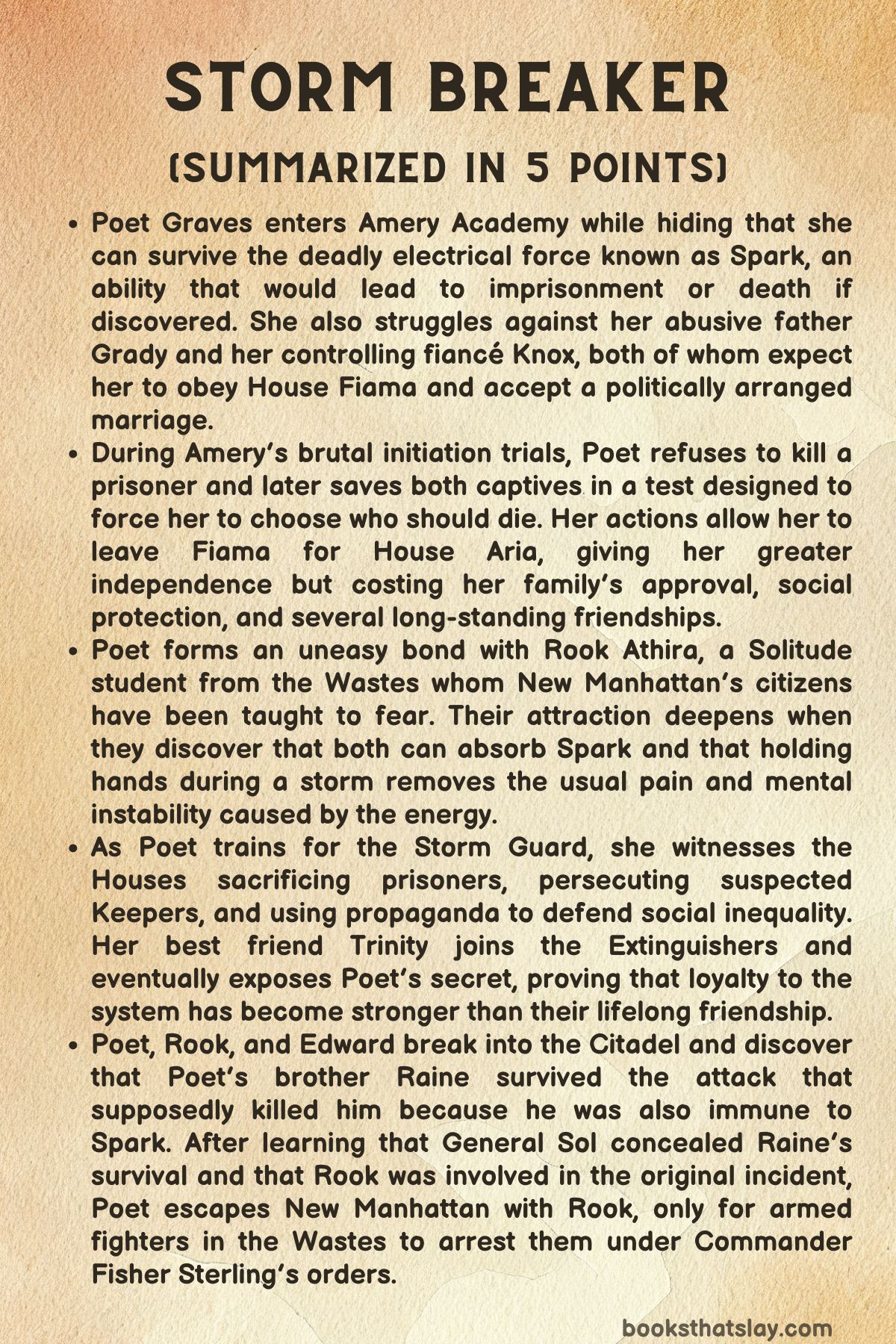
Characters
Poet Graves
Poet Graves is the central character of Storm Breaker, and her development is defined by the gradual replacement of obedience with self-determination. At the beginning, she understands that her engagement, education, House allegiance, and future have been chosen for her, yet years of abuse have taught her to resist mostly through private thoughts and small acts of secrecy.
Her refusal to kill during the Fiama initiation becomes the first public expression of her moral independence. By saving both captives during the later trial, she moves beyond rejecting one cruel command and openly challenges the assumption that power must depend on sacrifice.
Poet is both privileged and oppressed. Her family name gives her wealth, education, and political importance, but it also turns her into property whose marriage and behavior are treated as public resources.
Her hidden Keeper identity adds another layer to this conflict because the same Society that protects her social position would imprison or kill her for what she is. Her dependence on Spark carries pleasure, shame, fear, and possible danger, making her power feel as much like an addiction as a gift.
Poet’s growth is not presented as immediate perfection. She carries prejudices against Solitudes, fails to recognize some of her class assumptions, and sometimes relies on the authority attached to her family even while condemning it.
What distinguishes her is her growing willingness to examine those contradictions. By the ending, she has lost nearly every institution that once defined her, but she has gained the ability to make choices based upon conscience rather than fear.
Rook Athira
Rook Athira enters Storm Breaker as an outsider whom New Manhattan has already judged before he speaks. His physical confidence, unusual clothing, scars, tattoos, and combat skills make him appear dangerous, yet his intelligence and restraint repeatedly contradict Society’s claims about Solitudes.
He is protective without initially treating Poet as helpless. When Knox grabs her, Rook demonstrates how she can free herself instead of merely rescuing her, showing that he wants her to recognize her own strength.
His care for Poet often appears through quiet actions rather than declarations. Carrying Trinity to treatment, repairing Teddy, sharing his room, easing Poet’s fear of enclosed spaces, and caring for her after the stunner reveal patience beneath his defensive manner.
Rook nevertheless remains morally complicated because his relationship with Poet develops while he conceals his mission and his involvement in Raine’s disappearance. His affection appears genuine, but sincerity does not erase the damage caused by withholding information that directly concerns Poet’s family.
His identity is divided between the young man who misses his family and the operative sent into hostile territory. This tension explains his caution, but it also raises difficult questions about whether love built around partial truth can survive complete revelation.
Knox Arden
Knox Arden is shaped by entitlement, insecurity, and an obsessive need to appear powerful. His engagement to Poet gives him social status, but he responds to his fear of inadequacy by cheating, humiliating her, and treating her ambitions as threats.
He occasionally displays traces of the boy who once comforted Poet during her father’s violence. These memories explain why Poet once loved him and why ending the engagement requires more than simply recognizing his cruelty.
Knox eventually admits that he mistreated Poet because their fathers made him feel powerless and because he feared she was stronger and more capable. This explanation gives context to his behavior without excusing it, since he repeatedly chooses to transfer his pain onto someone with less freedom.
His final attack confirms that control matters to him more than Poet’s safety. When persuasion, guilt, political pressure, and emotional appeals fail, he turns to violence because he cannot accept that she has the right to leave him.
Grady Graves
Grady Graves represents private abuse protected by public authority. As House Fiama’s scion, he presents himself as a defender of order, yet inside his family he relies on intimidation, violence, threats, and financial control.
He views Poet primarily as an instrument for securing his alliance with the Arden family. Her marriage, loyalty, appearance, and education matter to him only when they support his political position.
Grady’s initiation test reveals his belief that compassion is weakness. By forcing Poet to choose who must die, he attempts to shape her into someone who accepts his definition of leadership.
The revelation that he knew Poet was a Keeper makes his conduct even more disturbing. He protects his own daughter’s secret while supporting a system that destroys others like her, and he murders the nanny whose knowledge threatens his control.
Grady is not merely an abusive father separated from the larger government. His behavior demonstrates how the House system rewards people who treat domination as responsibility and cruelty as necessary discipline.
Sariah Graves
Sariah Graves initially appears passive because she witnesses Grady’s abuse without stopping it. Her silence wounds Poet deeply, especially when she repeats Grady’s demands instead of asking whether her daughter is safe.
Her later revelations show that this passivity developed through years of financial dependence, isolation, fear, and physical violence. Society gives wives like Sariah status only through their husbands, leaving her with few realistic ways to escape while protecting her children.
Understanding her circumstances does not remove her responsibility. Sariah sometimes uses guilt to pressure Poet and focuses on the damage caused to Grady rather than the harm he has inflicted.
Her confrontation with Poet marks a significant change because she finally admits her failure and expresses pride in the courage she could not find for herself. The bruises on her throat also force Poet to see that leaving an abuser can be morally necessary while still endangering those who remain behind.
Trinity Jenkins
Trinity begins as Poet’s closest friend and one of the few people who provides genuine emotional security. Their shared memories, affection, and childhood loyalty make her eventual betrayal especially painful.
Her failed initiation exposes how thoroughly Society has shaped her sense of worth. She would rather die than lose her status because she cannot imagine an identity that exists outside her House.
Joining E-squad gives Trinity a new purpose, community, and source of authority. She convinces herself that Extinguishers protect Keepers from their own instability, allowing her to participate in persecution while believing she is serving the greater good.
Her betrayal of Poet is not caused by a lack of history between them. It results from choosing institutional belonging over personal knowledge, since she reports the friend she has loved for years after accepting the government’s claim that Keepers are dangerous.
Trinity functions as Poet’s opposite. Poet gradually questions the rules that once defined her, while Trinity responds to fear by embracing those rules more completely.
Edward
Edward is introduced through his loving relationship with Trinity and his warm place within Poet’s social circle. He is gentle, intelligent, and far less interested in House politics than many of the privileged students around him.
Trinity’s decision to end their relationship leaves him directionless and angry. His initial wish that Grady could force her back reveals how grief can tempt even decent people to mistake control for restoration.
Helping Poet enter the Citadel gives Edward a purpose beyond mourning. His technical skill, curiosity, and loyalty allow him to participate in exposing the Shield’s lies despite the personal danger.
His willingness to support Poet after learning that she is a Keeper shows that he trusts his knowledge of her character over official propaganda. This choice makes him one of the few people who responds to the truth without treating her as either a monster or a political tool.
Domino Parsons
Domino Parsons is a cog student whose kindness becomes essential when Poet’s privileged community rejects her. She offers Poet a bed after the dormitory attack without asking for political advantage or social repayment.
Her friendship challenges Poet’s class assumptions. When Poet nearly questions why someone of Domino’s status would help her, Domino refuses to accept the insult and establishes that their relationship must be based on equality.
Domino is compassionate without being weak. Her strong performance in Storm Guard training proves that the social categories used to define cogs are not measures of courage, intelligence, or ability.
She also helps create Poet’s chosen family. Her teasing, loyalty, and ordinary companionship provide relief from the fear and calculation surrounding Poet’s relationships with her parents, Knox, Trinity, and Rook.
Journey
Journey represents the desire to be seen within a system that treats lower-status people as background figures. She is fascinated by Poet because Poet’s choices attract public attention, while Journey has spent much of her life feeling socially invisible.
Her curiosity is energetic but sometimes careless. Questions about Rook’s family and Solitude customs reveal that prejudice can appear through fascination as well as hostility.
Unlike many characters, Journey is capable of participating in a friendship that crosses class and House boundaries. Her imperfections make her useful because she shows that rejecting formal hatred does not automatically remove every learned assumption.
Together with Domino, she offers Poet companionship based less on inherited obligation and more on shared experience. Their friendship becomes evidence that a new community can be created even inside a deeply divided institution.
General Nyxia Sol
General Sol is one of the novel’s most powerful and mysterious figures. Publicly, she is celebrated as the only acknowledged Keeper, a military protector, and the person who converts deadly storms into energy for New Manhattan.
Her speeches transform fear into obedience. By presenting hierarchy as humanity’s only defense against collapse, she encourages citizens to interpret surveillance, social inequality, and disappearance as necessary protections.
Sol’s private actions contradict her public image. The footage of Raine’s survival shows her killing a witness, concealing his Keeper identity, and arranging his secret removal.
She may belong to the same category as Poet and Rook, meaning she possesses knowledge that could undermine the government’s claims about Keeper madness. Her decision to preserve the lie suggests that her authority depends upon controlling who is allowed to possess power and who must be classified as diseased.
Raine Graves
Raine is absent from most of the present-day action, yet his memory influences nearly every major decision Poet makes. She wants to join the Storm Guard to honor him, while her hatred of Solitudes originates in the official account of his death.
Poet remembers Raine as loving, protective, and willing to defend her against Grady. Henry’s grief and Molly’s memories further establish him as someone who gave Poet safety within a violent family.
The Citadel footage transforms Raine from a dead hero into a central mystery. His survival of a Spark strike proves that he was a Keeper, while General Sol’s intervention suggests that his disappearance was planned rather than accidental.
Raine’s hidden identity may explain why Grady protected Poet’s secret and why her nanny was killed. His unresolved fate also connects Poet’s family history to the wider political conflict between New Manhattan and the Wastes.
Henry
Henry serves as a link between Poet’s memories of Raine and her developing life in the Storm Guard. His grief has not disappeared, but he has learned to carry it without allowing it to end his future.
As an instructor, he recognizes Poet’s ability and adapts training around her injuries rather than dismissing her. His support offers a healthier version of authority based on guidance rather than control.
Henry also helps Poet separate love for Raine from loyalty to Fiama. By insisting that Raine would have been proud of her independence, he frees her from the belief that changing Houses betrays her brother.
His warnings suggest that he may know more than he openly states. Whether or not he suspects her Keeper identity, his offer of protection makes him one of the few adults who places Poet’s safety above politics.
Molly Arden
Molly Arden provides a compassionate adult perspective that neither excuses Poet’s family nor reduces complicated relationships to simple categories. She understands why Poet once loved Knox because she remembers the gentler boy he used to be.
She also explains the economic and social traps that kept Sariah with Grady. This information helps Poet understand her mother’s fear without pretending that years of silence caused no harm.
Although Poet’s decision damages the Arden alliance and threatens Knox’s future, Molly refuses to pressure her into marriage. Her advice that Poet choose the life that is right for her directly opposes the demands made by both fathers.
Molly’s presence proves that parental love does not require ownership. She can grieve the collapse of her family’s plans while still respecting Poet’s right to refuse them.
Scion Surreal Beaufort
Surreal Beaufort embodies cruelty hidden beneath elegance and discipline. Her refined appearance and controlled speech make her authority seem respectable, even when she openly threatens those beneath her.
She treats Domino’s cog background with condescension and Rook’s Solitude identity as an entertaining political curiosity. Poet interests her because the daughter of Fiama’s scion can be used either as a symbol of Aria’s power or as an expendable target.
Beaufort’s leadership shows that changing Houses does not automatically free Poet from oppression. Aria may offer an escape from Grady and Knox, but its control over health, Extinguishers, and population management supports another form of institutional violence.
Her willingness to overlook attacks against Poet demonstrates how leaders maintain plausible innocence while encouraging harm. She does not need to issue a direct order when students already understand what behavior will please her.
Dr Eze
Dr Eze occupies an uncertain but potentially important position within the Storm Guard program. She participates in resistance testing that could expose Keepers, yet she appears to recognize Poet’s immunity and chooses not to report it.
Her subtle expressions and private reassurance suggest that she knows more about Spark sensitivity than official teaching permits. She may understand that Poet’s biology does not match the supposedly infected Keepers hunted by the Extinguishers.
Her conduct presents a quiet form of resistance. Unlike Poet, she works within the institution and protects through careful omissions rather than open rebellion.
The limits of her knowledge remain unclear, but her behavior suggests that not every person connected to the government accepts its claims. She may eventually become a source of medical evidence capable of challenging the Shield’s classification system.
Dr Perez
Dr Perez is one of the most consistently compassionate adults at Amery. She treats Trinity’s infection without judging her failure and later examines Poet with concern that extends beyond the immediate injury.
When she notices evidence of old fractures, she gently offers Poet the opportunity to report the abuse. Her approach respects Poet’s control over her own disclosure, even though the surrounding system offers little reliable protection.
Dr Perez’s refusal to admit Rook at first shows that she is not free from institutional prejudice. However, her medical care is guided more by human need than House loyalty, distinguishing her from officials who treat suffering as evidence of weakness.
Dean Withers
Dean Withers presents herself as the guardian of Amery’s rules, but her decisions are shaped by status, donations, and fear of powerful families. Her familiarity with Grady and discomfort around Sariah also suggest a personal closeness that compromises her impartiality.
She attempts to block Poet’s Storm Guard training because Grady expects a different future for his daughter. Poet defeats this resistance by appealing to Withers’s financial interests, exposing how easily institutional principles bend when money is involved.
Withers is less openly violent than Grady or Beaufort, yet her opportunism helps their power continue. She protects the academy’s relationship with influential patrons rather than the freedom or safety of its students.
Greta
Greta is the living consequence of Grady’s decision to protect Poet by destroying someone else. Her mother helped conceal Poet’s Keeper identity and was murdered when that knowledge became dangerous.
Greta’s anger toward Poet is unfair in one sense because Poet was a child who had no control over the murder. At the same time, her resentment exposes how privilege can shelter one innocent person by transferring suffering to another.
Her revelation destroys Poet’s belief that Grady simply failed to recognize her condition. It shows that his cruelty, secrecy, and political authority have shaped Poet’s life from the beginning.
Greta also connects Poet to a hidden network of Keepers among the Hollows. Her existence suggests that the people erased by Society may possess knowledge essential to understanding the storms and the Shield’s lies.
Lacey Turner
Lacey initially appears as one of Poet’s hostile roommates and may have participated in the destruction of her belongings. Her later capture reveals that she may have been hiding the same fear that controls Poet’s life.
When the Extinguishers seize her, Lacey’s social rank offers no protection. Her disappearance shows how quickly Society erases individuals once they are classified as infected.
Poet’s relief that the officers did not come for her immediately becomes guilt. Through Lacey, she realizes that disliking someone does not make their persecution acceptable and that hidden Keepers may exist throughout every House.
Stevie and Devon
Stevie and Devon administer the initiations that determine whether students retain social value. They do not appear personally sadistic at every moment, but they accept deadly trials as normal and enforce them without questioning the system’s authority.
Their reactions to Poet’s decision to save both captives reveal the limits of institutional imagination. The possibility of preserving both lives confuses them because the test was designed around obedience to a forced choice.
Stevie later offers Poet entry into Aria but warns that trust will not come automatically. She therefore represents both an alternative to Fiama and a reminder that joining a rival House does not erase suspicion or hierarchy.
Winter Jenkins
Winter Jenkins begins as Poet’s social rival and possible replacement in the Arden marriage alliance. Her hostility is shaped partly by personal resentment and partly by a system that encourages young women to compete for political value.
She participates in the social rejection of Poet after the Aria trial, yet she is also affected by Lacey’s disappearance. Her grief suggests that loyalty and vulnerability continue beneath her polished cruelty.
Winter demonstrates how privileged students can become both enforcers and victims of the same system. She attacks Poet to protect her own position, but she remains subject to family expectations and Extinguisher authority.
Jackson and Sal
Jackson and Sal initially support Knox and benefit from their association with his status. Jackson nevertheless shows more genuine concern for Poet than Knox does, particularly when her ambitions and safety are threatened.
During the final escape, both men turn against the Extinguishers and help Poet and Rook. Their decision does not erase their earlier complicity, but it shows that loyalty to a friend can eventually overcome loyalty to House authority.
Their change also isolates Knox. While Knox becomes more violent as his control collapses, Jackson and Sal recognize that handing Poet over would cross a moral boundary they are unwilling to accept.
Themes
Freedom, Control, and the Right to Choose
Nearly every institution in the story attempts to determine Poet’s identity before she can define it herself. Her father chooses her education, Knox assumes ownership of her future, General Sol presents marriage as civic duty, and the Houses demand loyalty through trials that threaten death or social exile.
Poet’s movement toward freedom begins with refusal. She will not kill a prisoner, abandon Trinity, surrender Storm Guard training, or remain engaged to a man who humiliates her.
These refusals gradually become active choices. Saving both captives, joining Aria, confronting Grady, loving Rook, and leaving New Manhattan require her to create alternatives rather than accept the limited options offered by authority.
Freedom is never presented as painless. Poet loses wealth, family approval, friendships, security, and the familiar world she once understood.
Her escape into the Wastes does not immediately give her control because another armed faction arrests her. The ending therefore distinguishes freedom from simple movement: leaving one system of control does not guarantee that another will not replace it.
The central achievement of Poet’s journey is her growing belief that consequences do not make a choice invalid. Even when others suffer or reject her, she begins accepting that obedience cannot be the price of belonging.
Propaganda, Prejudice, and Manufactured Enemies
New Manhattan maintains order by teaching citizens to fear anyone beyond its accepted categories. Solitudes are described as savage, Hollows are treated as disposable, cogs are considered socially inferior, and Keepers are classified as diseased threats.
Rook’s presence exposes the weakness of these claims. He is educated, strategic, loyal to his family, capable of tenderness, and connected to an organized society outside the city.
Poet’s prejudice does not disappear as soon as she becomes attracted to him. She must repeatedly confront the assumptions hidden in her language, suspicions, and expectations.
The treatment of Keepers follows the same pattern. Government reports connect them to brutal killings, while blood tests, secret research, and General Sol’s actions suggest that officials deliberately conceal important biological differences.
By controlling information, the Shield can decide which deaths count as tragedies and which people may be sacrificed. Amery students receive public memorials, while Hollows killed in the subway or laboratories are ignored.
Storm Breaker shows that prejudice is not maintained only through personal hatred. It survives through education, selective mourning, scientific language, political speeches, and institutions that make unequal treatment appear reasonable.
Abuse, Complicity, and Cycles of Power
Grady’s violence establishes a pattern that appears repeatedly across families, romantic relationships, Houses, and government institutions. He calls control protection, uses fear to secure obedience, and teaches Poet that resistance will harm everyone around her.
Knox repeats many of these behaviors. Although he was once kind, his insecurity leads him to monitor Poet, bruise her, restrict her friendships, dismiss her ambitions, and attack her when she refuses to return.
Sariah and Trinity show different forms of complicity. Sariah remains silent because she is financially trapped and terrified, while Trinity embraces E-squad because institutional approval protects her from shame and exclusion.
Neither woman begins with a desire to harm Poet. Their fear nevertheless helps violent systems continue.
The novel refuses to treat victimhood as automatic innocence. Knox suffers under his father but chooses to abuse Poet, while Trinity’s fear of losing status does not remove her responsibility for reporting her friend.
Breaking the cycle requires more than recognizing that another person has been hurt. Poet must stop excusing harmful behavior, refuse to manage Knox’s emotions, challenge her mother’s silence, and resist becoming the ruthless heir Grady wants.
Identity, Belonging, and Chosen Family
Poet begins with an identity constructed from inherited labels: Fiama daughter, scion’s heir, Raine’s sister, Trinity’s friend, and Knox’s future wife. When she leaves Fiama, these labels collapse faster than she can replace them.
Her loneliness reveals how completely belonging has been tied to obedience. Friends withdraw to protect their reputations, her father disowns her, her mother stops answering, and Trinity chooses E-squad.
Domino, Journey, Henry, Edward, and Rook gradually offer a different form of connection. Their relationships with Poet develop through shared risks, honest disagreement, practical care, and respect for decisions they may not fully understand.
Rook becomes especially important because he sees both Poet’s privilege and her suffering. He does not require her to hide Teddy, minimize her fear, surrender her ambition, or deny her Keeper identity.
Chosen family does not mean perfect trust. Rook conceals his mission, Edward briefly wishes to control Trinity, Journey asks offensive questions, and Poet carries assumptions that hurt others.
What separates these bonds from the relationships imposed by the Houses is the possibility of accountability and change. Belonging becomes meaningful when people remain connected without demanding ownership, silence, or unquestioning loyalty.