Gold by Raven Kennedy Summary, Characters and Themes
Gold by Raven Kennedy continues Auren’s journey as she confronts revelations about her past, her identity, and the forces that seek to shape her destiny. The story explores her separation from Slade, her discovery of hidden heritage, and the weight of expectations placed on her by a divided world.
Kennedy blends fantasy, power struggles, and personal growth, portraying characters caught between vengeance, survival, and loyalty. With kingdoms under siege, betrayals unfolding, and bonds tested across realms, the novel expands both the scope of its conflict and the depth of its characters, weaving together resilience, legacy, and the search for belonging. It is the 5th book in the Plated Prisoner series.
Summary
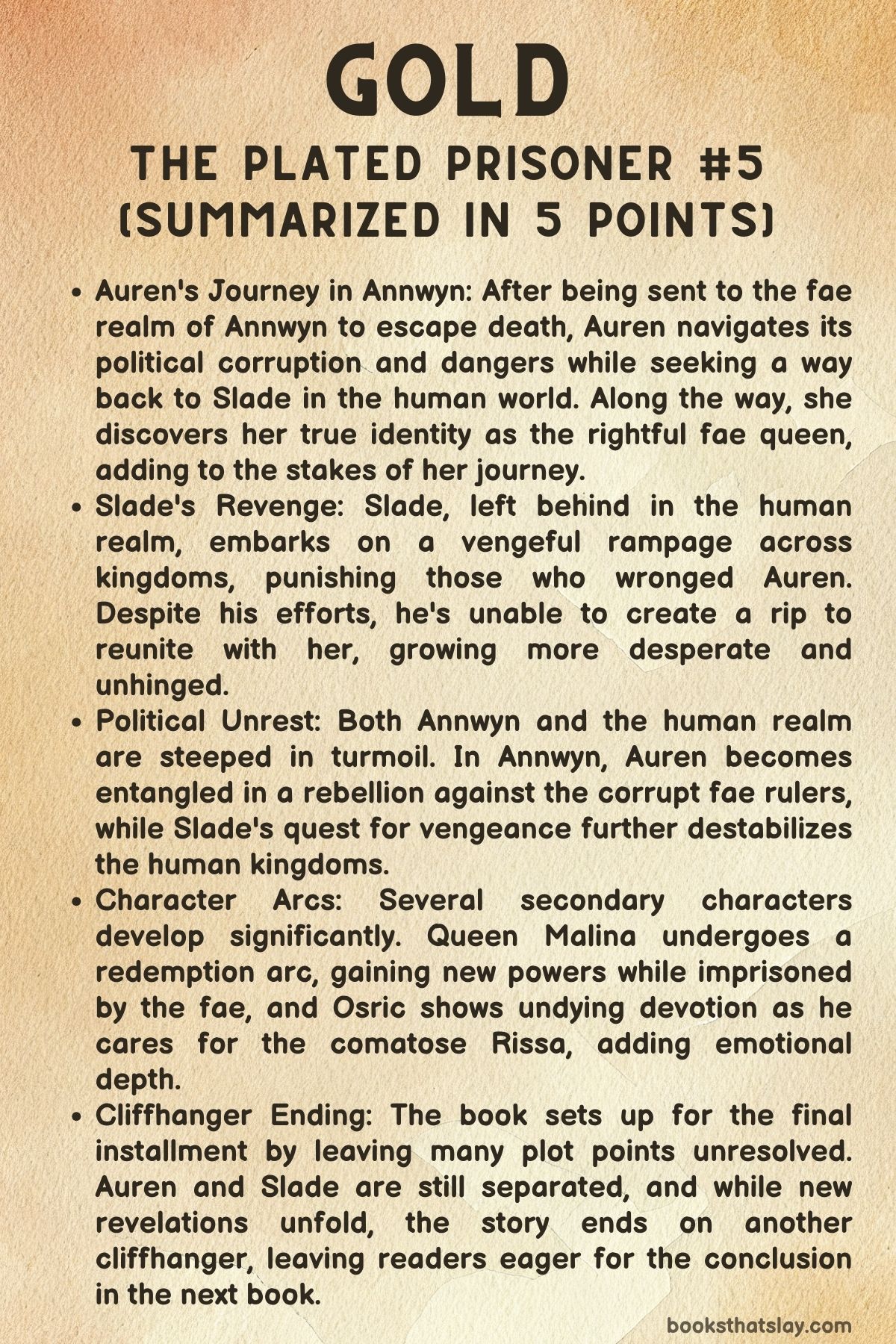
The story begins with Auren being torn from Slade through a rip in the sky, falling into a void where she is stripped of her senses. Memories from her childhood flicker through her mind as she struggles against the darkness.
Slade’s voice reaches her, urging her to “fly” and promising he will find her again. Summoning her golden power, she halts her fall and instead soars, guided by starshine into a new sky.
There, she discovers her golden ribbons restored—an important part of her identity that had once been torn from her. Though not fully responsive, their return signifies her regaining a part of herself.
Exhausted, she lands in a field of glowing flowers, where onlookers whisper in awe, calling her “gold.” An old woman approaches, addressing her as Lyäri Ulvêre, declaring that she has finally come home.
Meanwhile, Slade rages over Auren’s disappearance. Unable to open another rip to reach her, his fury erupts upon Third Kingdom.
He blames Queen Kaila for her capture and storms Gallenreef Castle. With his deadly power, he rots guards, castle walls, and corpses in his wake.
He takes Kaila’s brother Manu as leverage, sparing him but leaving the castle in ruins. Though consumed by grief, his vengeance cannot fill the emptiness of losing Auren.
Elsewhere, Queen Malina faces her own turmoil. Tricked by fae twins into giving her blood, she had unknowingly restored the bridge between Orea and Annwyn, allowing fae armies to invade.
Imprisoned in Cauval Castle, she struggles with the uncontrollable ice magic now coursing through her. An assassin confronts her, blaming her for the invasion and challenging her to take responsibility.
Though her fear and anger clash with unexpected attraction to him, Malina realizes his accusations hold truth, and she must decide how to act.
Auren wakes in Geisel, Annwyn, cared for by Estelia, a healer who restores her wounds. Hidden in an attic, she learns that fae loyalists revere her as the “lost gilded girl.” An elder named Nenet reveals she is the last heir of the Turley line, descended from Saira Turley, the legendary girl who once united realms.
Auren, long haunted by memories of Saira’s story, struggles to accept this revelation. Nenet insists she is the “last-birthed Turley,” a figure of prophecy who can restore balance.
While the loyalists view her as their salvation, Auren resists being forced into destiny. Her only desire is to find Slade.
Nenet recalls the fall of Bryol, a ruined city from Auren’s childhood, confirming that her parents were killed there and that she had been declared dead. The Carrick monarchy, which usurped the Turleys, has since spread propaganda, taxes, and oppression.
To many fae, the Turley name is forgotten or hated, while to loyalists, her survival means hope. Torn between grief and disbelief, Auren insists on returning to the flower field where she landed, hoping Slade might find her.
Smuggled back, she witnesses villagers worshipping her arrival as a blessing, leaving feathers in reverence. Wick, leader of a Turley-loyalist rebellion, urges her to join their revolution against the Carricks.
Auren refuses, unwilling to be used as a symbol, though Nenet gifts her a pin with the rebellion’s bird emblem.
Slade, on the other hand, devastates Derfort, dismantling the flesh trade that once enslaved Auren. His wrath destroys the city’s criminal empire, though it offers him little solace.
His power grows as his rage deepens, but the void left by Auren remains unfilled.
Malina meanwhile discovers her ice magic can be wielded against King Tyec Carrick’s cruelty. Though humiliated by him, she learns to challenge his dominance, using her newfound strength to resist.
With the assassin’s reluctant help, she escapes her captivity, resolved to warn her kingdom and redeem her failures.
Back in Annwyn, Auren begins to build bonds with Emonie, a Vulmi woman whose playful spirit and survival skills offer companionship. Their friendship grows as they share laughter and trust in a safehouse.
Later, the Vulmin rebels lead Auren to Bryol, her childhood home, now reduced to ruins. Overcome by grief, she mourns her parents and past.
Yet from the rubble, she uses her power to grow a magnificent golden tree, transforming destruction into resilience. The Vulmin kneel beside her in solidarity, and the villagers celebrate her return, pledging loyalty to her.
Though reluctant, she feels her influence growing.
The rebels urge her to join a rescue mission for enslaved Oreans, and she accepts, stepping into active resistance. At the same time, Malina and the assassin Dommik journey to Highbell.
There, she confronts Queen Kaila, who has seized power and mocks Malina’s claims. Kaila imprisons her in the infamous gilded cage once used for Midas’s pet, seeking to secure her own rule.
Malina is left betrayed and humiliated, forced to reckon with Kaila’s deception and her own fall from power.
As war spreads, Highbell is destroyed by fae invasion. Malina awakens amidst devastation but finds survivors in the forest.
Though filled with guilt, she accepts their gratitude and renews her role as queen, vowing to protect them. Slade receives word of the massacre and learns that the fae bridge is restored.
Though it brings horror, it also sparks hope that he may reach Annwyn to find Auren. Torn between his duty as king and his devotion to her, he agrees to rally Orea’s kingdoms against the fae before leaving.
Slade unites fractured kingdoms by forcing Kaila to swear allegiance, despite his hatred for her. Though pragmatic, his priority remains Auren.
At the same time, Auren faces Slade’s father, Stanton Cull, a ruthless figure known as the Breaker. In a brutal fight, Auren’s bond with Slade manifests fully as their powers merge, confirming them as soul-bound.
Though empowered, she and her allies are betrayed and delivered into King Carrick’s hands. Surrounded by his forces, she fights desperately, but a fae named Una invades her mind, tearing her consciousness apart.
Captured and broken, Auren’s fate—and that of Orea—hangs in peril as the kingdoms brace for annihilation.
Characters
Auren
Auren emerges as the central figure in Gold, caught between her past and a destiny she never sought. Her journey begins with deep loss—ripped away from Slade and stripped of her senses, she is forced to rediscover not only her powers but also her sense of self.
Her golden ribbons, once taken from her, are symbolic of her fractured identity, and their gradual return reflects her own resilience and reclamation of agency. Through her experiences in Annwyn, Auren is confronted with revelations about her true heritage as a Turley, the last heir of a fallen line.
This discovery reshapes her perception of herself from a broken survivor to a symbol of hope. Yet, her humanity remains at the forefront; she resists being used as a pawn in others’ schemes and clings to her desire for autonomy, even as loyalists and rebels project their hopes onto her.
Her compassion, grief, and determination make her a character defined not by prophecy, but by choice, as she struggles between her longing for Slade and the heavy burden of leadership.
Slade
Slade’s arc in Gold is marked by raw power and rawer emotion. Torn from Auren, he channels his anguish into devastating acts of vengeance across kingdoms.
His rot magic becomes both weapon and outlet for his despair, leaving destruction in his wake. Yet beneath the ferocity lies an undeniable devotion—his bond with Auren transcends distance, manifesting as both magical connection and emotional tether.
His interactions with enemies like Queen Kaila and her brother reveal a strategic mind sharpened by rage, but also a man willing to use cruelty to secure alliances when necessary. Despite his duty as a ruler, his singular focus remains Auren, making him a paradox: a king fighting to defend his realm, and a lover desperate to reclaim his other half.
His character embodies both destructive fury and unyielding loyalty, torn between the personal and the political.
Queen Malina Colier
Malina stands as one of the most conflicted and evolving characters. Initially consumed by guilt for her betrayal, manipulated by the fae, and burdened by her newfound ice magic, she teeters between self-preservation and responsibility.
Her dynamic with the assassin Dommik forces her to confront uncomfortable truths about her actions and motivations. Though proud and often defensive, she gradually learns the weight of leadership not as entitlement but as sacrifice.
The fall of Highbell forces her transformation into a true queen—one who embraces survival as resistance and vows to protect what remains of her people. Her character captures the complexity of redemption, showing both vulnerability and growing strength, as she learns to wield her power with conviction rather than fear.
Queen Kaila
Kaila embodies political opportunism and manipulation. While Slade views her as complicit in Auren’s capture, she reveals her true nature in her dealings with Malina—mocking, dismissive, and cruelly pragmatic.
Her willingness to manipulate public opinion, claim power through deceit, and exploit the vulnerable, such as Mist, paints her as a ruler obsessed with control and appearances rather than justice. Even when forced into alliance by Slade, her motivations remain selfish, tethered not to duty but to personal gain and familial loyalty.
Kaila’s character highlights the darker side of leadership, where ambition and survival outweigh compassion.
Nenet
Nenet serves as a guide and grounding presence in Auren’s journey of rediscovery. As the bearer of truth about the Turley lineage, she represents both the weight of history and the voice of faith in prophecy.
Her reverence for Auren is not blind worship but rooted in knowledge of the past and hope for the future. Through her, Auren comes to understand not only her ancestry but also the political fractures of Annwyn.
Nenet’s character adds depth to the themes of legacy, loss, and the power of memory, making her both mentor and anchor for Auren in a world that demands too much of her too quickly.
Emonie
Emonie offers warmth, levity, and genuine companionship to Auren at a time when she is surrounded by expectations and burdens. Playful, daring, and skilled with glamour magic, she balances Auren’s grief with laughter and trust.
Her daring history with the Stone Swords and her resourcefulness as a Vulmi make her more than comic relief—she is both ally and mirror, someone who demonstrates resilience and freedom in her own way. Their friendship provides Auren with grounding humanity amidst prophecy and rebellion, highlighting the power of bonds formed in shared struggle.
Wick
As leader of the Vulmin rebellion, Wick embodies conviction and the fire of resistance. His belief in Auren as a symbol of hope positions him both as ally and pressure, pushing her to accept a role she resists.
Though his intentions align with liberation, his insistence clashes with Auren’s need for autonomy, reflecting the tension between personal choice and collective expectation. Wick’s leadership demonstrates the sacrifices of rebellion, and his dynamic with Auren raises questions about agency, destiny, and the costs of being seen as a savior.
Dommik
Dommik, the assassin who shadows Malina, is a figure of both danger and reluctant care. His blunt accusations force Malina to confront her selfishness, and his unwavering practicality challenges her idealism.
Though cold and brutal in execution, he provides her with the harsh truths she needs to grow, making him a catalyst for her transformation. His presence complicates Malina’s emotional world, blending distrust, attraction, and reluctant partnership.
Dommik represents the gray morality of survival—merciless in action, but ultimately a protector in his own way.
Stanton Cull
Cull, Slade’s father, is a force of cruelty and power. His brutal ability to snap bones makes him a terrifying antagonist, embodying the destructive extremes of magic.
Yet his recognition of Auren as “päyur,” his son’s fated pair, connects him inextricably to her fate. He represents not only a physical threat but also a haunting shadow of Slade’s lineage—the embodiment of what power without restraint becomes.
His confrontation with Auren is pivotal, as it forces her to embrace her bond with Slade and the true depth of her power.
Themes
Identity and Self-Discovery
A central concern throughout Gold is Auren’s struggle with identity. At first, she resists the notion that she is Lyäri Ulvêre, the lost heir of the Turley bloodline, because her sense of self has long been shaped by captivity, survival, and the stigma of being Midas’s gilded pet.
Her denial reflects the weight of trauma that taught her to distrust labels and expectations. Yet, the return of her golden ribbons, the villagers’ reverence, and the revelations about her past all force her to confront a lineage she never asked for but cannot deny.
The ruins of Bryol intensify this journey: walking through the remnants of her childhood home, mourning the loss of her parents, and creating a golden tree in their honor symbolize both grief and reclamation. Auren begins to accept that her past, her heritage, and her magic are inseparable from who she is becoming.
This theme highlights the difficult process of redefining oneself when old scars and external pressures clash with an emerging inner strength. The narrative treats identity not as a static possession but as something constantly reshaped by history, community, and choice.
Power and Responsibility
Power in Gold is portrayed as both gift and burden. Auren’s gold is beautiful and awe-inspiring, yet she struggles with control and fears exploitation by others.
The loyalty of rebels and villagers illustrates how power attracts expectation, demanding leadership even when she feels unprepared. In contrast, Slade embodies destructive force when consumed by grief, his rot magic leaving kingdoms devastated as an expression of inner torment.
Malina’s newfound ice powers highlight another dimension: raw strength that emerges in moments of desperation but demands discipline and purpose. The Carrick monarchy, by comparison, wields institutional power—built on fear, propaganda, and oppression.
Through these parallels, the book explores the moral tension between using power for vengeance, for self-preservation, or for the collective good. Characters are repeatedly confronted with the question of whether their abilities will define them as destroyers, protectors, or reluctant symbols.
Legacy and Destiny
The shadow of legacy is ever-present, particularly in how Auren is tied to Saira Turley and the myths surrounding her. The loyalists see her as the living embodiment of prophecy, a figure who must restore balance between Annwyn and Orea.
Yet Auren herself resists being reduced to destiny, yearning only to reunite with Slade. Her story captures the tension between inherited roles and personal choice.
Similarly, Malina is forced to carry the legacy of her crown even after betrayal and imprisonment, realizing that her people’s survival depends on her willingness to embrace her title despite her guilt and failures. Slade, too, is trapped by his father’s legacy of cruelty, as Stanton Cull’s appearance forces him and Auren to confront what inheritance means for their bond.
Destiny in this narrative is not an inescapable script but a field of pressure, where characters must decide whether to embody, resist, or redefine the roles imposed on them by history and myth.
Love, Loss, and Devotion
At its heart, Gold is driven by love—romantic, familial, and communal—and the grief that arises from its absence. Auren’s bond with Slade is tested by distance, each moment of separation deepening her fear and longing.
His vengeance across kingdoms becomes a testament to his inability to live without her, while their eventual recognition as soul-bonded reveals love as both vulnerability and empowerment. Auren’s grief for her parents and her childhood home expands this theme, connecting personal love to the broader losses inflicted by tyranny and war.
Malina’s dynamic with Dommik adds another layer, as her reluctant reliance on him forces her to navigate trust, resentment, and unexpected warmth in the shadow of betrayal. Across the story, devotion becomes the most powerful motivator—sometimes destructive, sometimes redemptive—showing that love, in all its forms, drives individuals to confront impossible odds.
War, Betrayal, and Resistance
Conflict shapes nearly every thread of the novel. Slade’s warpath, the fae invasion, and the fractured kingdoms all portray a world defined by betrayal and bloodshed.
Malina’s betrayal by the fae twins, Kaila’s manipulation and imprisonment of her, and Brennur’s treachery in delivering Auren into Carrick’s hands show how deception erodes trust and reshapes alliances. Yet, alongside betrayal, there is resistance.
The Vulmin rebels, the survivors of Bryol, and even the traumatized villagers of Highbell all embody resilience, refusing to submit to tyranny. Auren’s golden tree in the ruins of Bryol is the most poignant expression of this theme: even from ashes, resistance can bloom, rooted in memory and defiance.
The novel makes clear that while betrayal fractures bonds, it also sparks the courage to resist and to build something stronger from ruin.