The Daisy Chain Flower Shop Summary, Characters and Themes
The Daisy Chain Flower Shop by Laurie Gilmore is a small-town romance about inherited expectations, damaging gossip and the courage required to love after disappointment.
Daisy Scott runs her family’s flower shop in Dream Harbor, but her livelihood is threatened when residents begin claiming that her wedding arrangements are cursed. A spontaneous lie turns the shy architect Elliot Parker into her fake boyfriend, giving both of them a chance to repair their public images. As their staged affection becomes genuine, Daisy must decide whether her painful past deserves control over her future. The novel combines romance, family history, community humor and personal renewal. It’s the 6th book in the Dream Harbor series by the author.
Summary
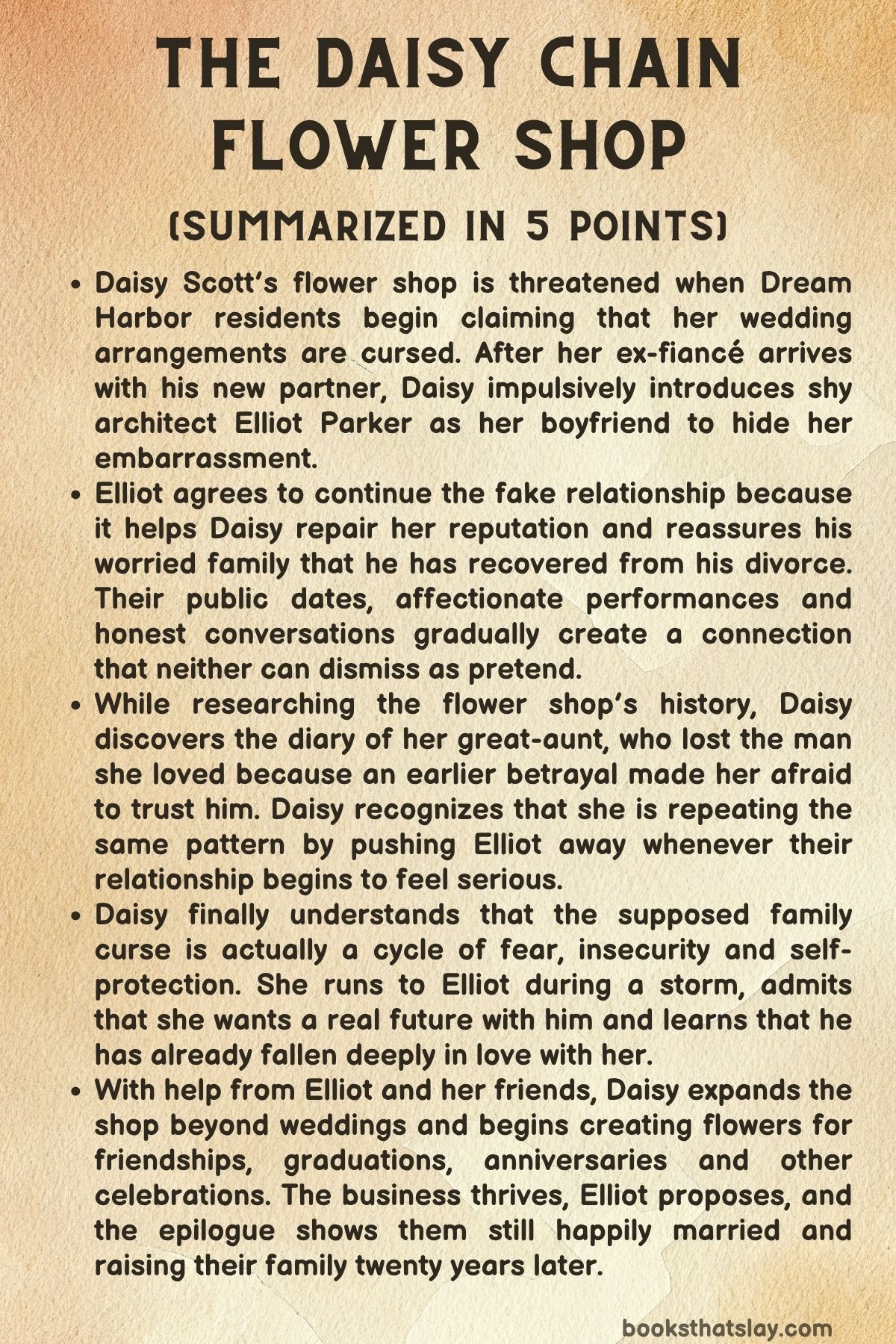
Daisy Scott has inherited the Daisy Chain Flower Shop from generations of women in her family, all of whom share the name Daisy. After returning to Dream Harbor following the collapse of her engagement, she becomes the focus of an increasingly harmful local rumor.
Several couples whose weddings featured Daisy’s flowers have separated, encouraging townspeople to believe that her arrangements carry a romantic curse. Wedding bookings disappear, customers begin avoiding the store for other celebrations and Daisy faces the possibility of losing the family business.
Her distress intensifies when her former fiancé, David, arrives with his new fiancée, Hailey. David explains that they are considering Dream Harbor as a wedding location but casually assures Daisy that they will hire someone else to provide the flowers.
Humiliated by David’s pity and still hurt by his rejection, Daisy claims that she has also moved on. When Elliot Parker enters the shop, she impulsively introduces the quiet architect as her boyfriend.
Elliot has been avoiding Daisy because he has developed a serious crush on her. Having endured a painful divorce from his wife, Leigh, he has promised himself that he will remain emotionally guarded, but he immediately recognizes Daisy’s embarrassment and supports her lie.
He holds Daisy’s hand, claims they have been dating and invents details whenever their stories fail to match. Once David and Hailey leave, Daisy apologizes, but Elliot responds with patience and understanding rather than judgment.
Their conversation reveals that both have been deeply wounded by partners who failed to choose them fully. Daisy married her high-school sweetheart, Matthew, when she was eighteen, but that marriage lasted only a year, while her later engagement to David ended after she invested years in believing he represented a mature second chance.
Elliot was married to Leigh for five years before she left him. The divorce caused him to withdraw from work and depend heavily on his mother and brother, Caleb, until he eventually moved to Dream Harbor to rebuild his independence.
The fake relationship might have ended after the encounter with David, but Iris, Daisy’s friend and employee, suggests extending it. She believes a convincing romance could prove that Daisy is not cursed and persuade the town to trust her flowers again.
At nearly the same time, Elliot tells his concerned mother that he is dating Daisy. His mother has come to Dream Harbor because she fears he remains isolated and emotionally fragile, so Elliot begins to see how the arrangement could help both of them.
The situation becomes public during a town meeting about the Beltane festival. Residents question whether Daisy should make the flower crowns because the celebration is associated with love and fertility, and their cruel comments leave her visibly shaken.
Elliot unexpectedly stands before the town and announces that he and Daisy have been dating for a month. He declares that both Daisy and her flowers are perfect, giving her enough public support to retain the festival commission.
Although Daisy is initially angry that Elliot acted without consulting her, she realizes that an immediate breakup would strengthen the curse rumor. They formally agree to continue pretending until her business improves and Elliot’s family believes he has recovered.
They establish a shared history, rules for physical affection and personal details that will make the performance believable. Their conversations about books, families, pets and childhood experiences quickly create an intimacy neither expected.
Daisy explains that the flower shop has passed through women named Daisy, including her grandmother June and her mother May. Although the tradition links her to her family, she has often resented being treated as childish because of her floral name and the cheerful expectations attached to it.
Elliot understands what it means to be misjudged. His shyness has made him nearly invisible within Dream Harbor, and his family’s concern sometimes causes him to feel incapable rather than supported.
The pair begin appearing together around town. Elliot proposes that the renovated Dream Harbor inn purchase regular flower arrangements from Daisy, providing her with desperately needed income, while Daisy convinces his mother and Caleb that Elliot has become socially active and emotionally stable.
Their attraction becomes increasingly difficult to dismiss. A staged encounter at the Cinnamon Bun Bookstore turns physically intense when Daisy runs her hands through Elliot’s hair and he removes her hair tie, leaving both of them visibly affected.
A beach picnic brings them even closer. They discuss loneliness, divorce and the pain of living in places filled with memories of former partners, and Elliot nearly kisses Daisy before an interruption reminds them that their arrangement supposedly has boundaries.
Meanwhile, Elliot’s interest in local history leads them to old photographs of the flower shop. One image contains a deeply unhappy woman who looks remarkably like Daisy, and June identifies her as Daisy’s great-aunt.
A second photograph shows Great-Aunt Daisy smiling at a man who looks strikingly like Elliot. After briefly fearing that they could be related, Daisy and Elliot investigate their families and learn that the man was Nathan, a distant relative of Elliot’s great-grandfather, while Great-Aunt Daisy never had children.
The discovery forces Daisy and Elliot to acknowledge that their sexual attraction is mutual. Daisy proposes a casual physical relationship, arguing that neither of them wants emotional commitment, but Elliot refuses because he knows he cannot separate intimacy from love.
When Daisy assumes that he is rejecting her because he does not desire her, Elliot proves otherwise through an intense encounter. However, he refuses to kiss her on the mouth or continue further because those actions would carry emotional meaning for him.
Daisy believes Elliot may be repeating his old tendency to attach himself to the first woman who chooses him. Elliot disagrees but accepts friendship because he does not want to pressure her.
At Beltane, Daisy appears in a dark purple dress, sells hundreds of flower crowns and begins reclaiming the town’s respect. When David and Hailey appear, Elliot kisses her publicly, but the kiss immediately becomes more than a performance.
The arrival of Matthew, Daisy’s first husband, makes the situation even more uncomfortable. Elliot firmly defends Daisy, describing her former partners as part of her past and declaring that she is extraordinary.
Elliot’s mother also attends the festival and quickly bonds with Daisy. Seeing Elliot surrounded by friends and enjoying life reassures her that he has recovered, meaning the fake relationship has accomplished its purpose for him.
That evening, Daisy and Elliot dance beside the bonfires, share passionate kisses and struggle to resist the connection between them. Elliot becomes drunk, so Daisy takes him home and allows him to sleep in her bed without taking advantage of his condition.
The next morning, Daisy suggests that they remain platonic friends. Elliot is hurt but respects her decision, and they agree to continue the public relationship only until she receives another wedding booking.
Their emotional distance proves painful. Daisy buries herself in family photographs and discovers Great-Aunt Daisy’s diary hidden inside an old flower-shop ledger.
The diary describes Nathan repeatedly visiting the shop, buying unnecessary flowers and patiently pursuing Great-Aunt Daisy. She initially rejects him because a former lover named William abandoned her, leaving her convinced that trusting another man would lead to the same result.
Daisy sees uncomfortable similarities between her ancestor’s behavior and her own treatment of Elliot. Iris points out that Elliot resembles neither Matthew nor David because he provides patience, security and affection without forcing Daisy to chase his approval.
Daisy apologizes to Elliot for avoiding him, and they begin spending time together again without clearly defining their relationship. Elliot adopts a small golden puppy named Goldie, and caring for her gives Daisy a glimpse of the domestic life she has secretly wanted.
While reading the diary together, Daisy notices that Elliot has kept her hair tie around his wrist since their bookstore date. He admits that he wanted to keep something belonging to her close to him, and they finally share a deliberate, passionate kiss.
Daisy soon discovers that David’s future wedding no longer affects her emotionally. Watching happy couples and imagining flowers, a shared home and Goldie sleeping nearby helps her understand that the future she lost with David might still be possible with someone better suited to her.
The final diary entries reveal the consequences of Great-Aunt Daisy’s fear. Nathan proposes and tries to build a future with her, but she refuses to trust him, causing him to believe that she will never commit.
Nathan eventually marries another woman, who later leaves him, while Great-Aunt Daisy spends the rest of her life alone. She concludes that no supernatural force ruined her happiness; she created the outcome she feared by allowing William’s betrayal to determine every later decision.
Modern Daisy recognizes that she is close to making the same mistake. During a violent storm, she runs to Elliot’s house and tells him that she refuses to let old pain control her any longer.
Daisy and Elliot confess that they want one another completely. Their physical intimacy is built on reassurance, consent and honest communication, allowing Daisy to feel cherished while helping Elliot overcome the insecurity left by his marriage.
The following morning, Daisy tells Elliot that she wants a genuine relationship. Elliot admits that he is already deeply in love with her, and Daisy realizes that she loves him as well.
Although their romance is secure, the shop still needs a new business strategy. Elliot encourages Daisy to stop measuring her professional worth through weddings or through the success of their relationship.
He suggests that flowers can mark graduations, anniversaries, friendships, birthdays, new babies and other meaningful moments. To separate Daisy’s reputation from her romantic status, they jokingly announce a fake breakup while continuing their real relationship privately.
With help from Iris and Kira, Daisy expands the shop’s social-media presence and gathers testimonials from former clients. The divorced women do not blame Daisy’s flowers for their failed marriages; instead, they remember the arrangements as sources of beauty during otherwise painful experiences.
Daisy develops subscriptions, friendship bouquets and arrangements for celebrations unrelated to marriage. Her campaign encouraging people to nominate deserving friends becomes popular online and transforms the shop into a business celebrating every form of love.
Ten months later, Daisy has gradually moved into Elliot’s renovated home, shares responsibility for Goldie and enjoys a thriving business. Elliot asks whether she will accept a wedding-flower commission for their own wedding and proposes.
Daisy accepts, choosing marriage without believing that love must be perfect or guaranteed to be worthwhile. Twenty years later, she and Elliot remain together, raising their children James and Maggie in Dream Harbor.
As their eldest child prepares to graduate, Daisy reflects on Elliot’s steadiness, affection and patience. Their marriage, home and family prove that the true cycle was never a magical curse but a pattern of fear that could be broken through trust, honesty and the decision to accept happiness.
Characters
Daisy Scott
Daisy Scott is the romantic and emotional center of The Daisy Chain Flower Shop. She is creative, hardworking and fiercely protective of the business inherited from the women in her family, yet her confidence has been damaged by two major romantic failures and the judgment of her community.
Her first marriage to Matthew and later engagement to David have convinced her that her own choices cannot be trusted. Rather than viewing those relationships as individual disappointments, she begins to interpret them as evidence that lasting love may be unavailable to her.
Daisy’s defensiveness often appears as sarcasm, impatience or rigid independence. Her black clothing, resistance to her floral name and discomfort with cheerful expectations all reflect her desire to control how others perceive her.
The rumor surrounding her flowers attacks both her personal and professional identities. Because the shop represents her family history, losing customers feels like more than financial failure; it feels like proof that she has disappointed generations of women who protected the business before her.
Her fake relationship with Elliot initially serves as a shield against humiliation. Over time, however, his consistency forces her to distinguish between a dependable partner and the men who made her feel insecure, unwanted or responsible for their shortcomings.
Daisy’s greatest conflict is not deciding whether Elliot is trustworthy but accepting that a trustworthy man cannot guarantee she will never experience pain. Her growth occurs when she understands that courage in love does not come from certainty; it comes from choosing not to let previous injuries make every future decision.
Her relationship with Great-Aunt Daisy’s diary gives her a historical reflection of her own behavior. She criticizes her ancestor for rejecting Nathan while gradually realizing that she is pushing Elliot away for almost identical reasons.
Running through the storm represents Daisy’s refusal to remain passive inside an inherited pattern. By the conclusion, she has reclaimed bright clothing, expanded the shop beyond weddings and created a life based on friendship, family, creativity and mutual commitment.
Elliot Parker
Elliot Parker is gentle, intelligent and deeply observant, but his quiet manner conceals serious emotional wounds. His divorce from Leigh left him afraid that his devotion makes him vulnerable and that being abandoned proves he was never sufficiently interesting, confident or desirable.
He moves to Dream Harbor partly to escape reminders of his marriage and partly to prove that he can function without his family’s protection. His determination to appear independent occasionally causes him to reject useful support, particularly from Caleb.
Elliot’s decision to help Daisy against David immediately establishes his empathy. He understands the humiliation of facing a former partner who appears to have moved on, so he enters the performance without mocking Daisy or demanding anything in return.
Unlike Daisy’s previous partners, Elliot does not create uncertainty to maintain power. He listens carefully, notices emotional changes and repeatedly places Daisy’s safety above his own desires.
His refusal of casual sex is especially important because it demonstrates self-knowledge rather than rejection. Elliot recognizes that physical intimacy would deepen his attachment, and he refuses to pretend that his emotions can be separated from his actions.
His shyness does not make him weak. He defends Daisy before the town, confronts her former partners, repairs his relationship with Caleb and accepts the possibility that Daisy may never return his love.
Elliot’s professional role also reflects his personality. As an architect restoring the old inn, he respects existing foundations while imagining how damaged or mismatched structures can become functional again.
The same patience guides his relationship with Daisy. He does not demand that she forget her history; he helps her build a future in which that history remains present without controlling the entire design.
Great-Aunt Daisy
Great-Aunt Daisy serves as a historical counterpart to modern Daisy and gives The Daisy Chain Flower Shop its deeper examination of inherited fear. Her photographs initially present her as a mysterious, unhappy woman whose resemblance to Daisy suggests more than a shared family name.
Her diary reveals that she was once capable of humor, desire and hope. Nathan’s visits awaken feelings she believed had disappeared after William’s betrayal, but she treats every happy moment as a warning rather than an opportunity.
Great-Aunt Daisy mistakes vigilance for wisdom. She believes that expecting abandonment will protect her, yet her suspicion prevents her from recognizing that Nathan is offering a different kind of relationship.
Her tragedy is not simply that Nathan marries someone else. It is that she understands too late how actively she participated in creating the loneliness she feared.
By writing that she cursed herself, she gives the modern Daisy the insight needed to reject supernatural explanations. Her life demonstrates how family stories can preserve pain, but her honesty also allows a later generation to make a different choice.
Nathan
Nathan is the man whose resemblance to Elliot first creates anxiety and later clarifies the connection between the two love stories. Through Great-Aunt Daisy’s diary, he appears affectionate, persistent and genuinely committed to building a life with her.
His habit of purchasing excessive flowers and declaring daisies his favorite reflects an effort to communicate devotion through actions. He sees warmth and beauty beneath Great-Aunt Daisy’s guarded behavior and refuses to judge her for having loved William.
Nathan is not completely faultless. When his patience turns into pressure, he frames commitment as an immediate choice and threatens to find someone else, increasing the fear already controlling her.
His later marriage demonstrates that he also tries to escape uncertainty instead of patiently resolving it. The failure of that marriage suggests that hurried decisions made in response to rejection can be as damaging as decisions based on fear.
Nathan’s role strengthens the contrast between past and present. Elliot learns from the old story that love requires patience, while Daisy learns that endless hesitation can become a decision of its own.
Iris
Iris is Daisy’s loyal friend, employee and practical adviser. Her humor brings lightness to difficult situations, but her significance extends beyond encouraging the fake-dating arrangement.
As a new mother experiencing exhaustion and postpartum distress, Iris represents a form of love that is meaningful without being effortless. Her struggles challenge idealized assumptions that a happy marriage or wanted baby eliminates loneliness, fear or loss of identity.
Daisy’s willingness to support Iris reveals her capacity for care even when her own life is unstable. In return, Iris gives Daisy direct advice and refuses to accept the evasions Daisy uses to disguise her feelings for Elliot.
Iris understands that emotional risk cannot be removed through rules. Her own relationship with Archer began with an attempt to keep intimacy uncomplicated, giving her personal knowledge of how quickly desire can reveal deeper attachment.
May Scott
May is Daisy’s mother and one of the women responsible for preserving the family shop. Her crystals, astrological beliefs and prosperity rituals initially frustrate Daisy because they appear to reinforce the town’s superstitious thinking.
However, May’s behavior is motivated by concern rather than foolishness. She recognizes the financial danger facing the business and tries to offer help through the language and practices she understands.
Her immediate warmth toward Elliot reveals strong instincts about people. She notices that he treats Daisy with respect and takes an interest in her beliefs, creating a contrast with David’s inability to connect with Daisy’s family.
May also represents the expectations attached to the Scott women. Her involvement can make Daisy feel watched, but it reminds her that independence does not require rejecting the family members who built the foundation she now controls.
June Scott
June, Daisy’s grandmother, combines family warmth with sharp commercial judgment. She preserves photographs and documents from the flower shop, allowing Daisy to discover the history of Great-Aunt Daisy and Nathan.
Although June appears gentle, she understands that public perception can determine whether a small business survives. Her advice that Daisy should use the fake romance to challenge the curse rumor shows that she is willing to be strategic rather than sentimental.
June also warns Daisy not to become so absorbed in the past that she ignores the future. This observation proves important because the diary is valuable only when Daisy uses it to change her own actions instead of treating history as a destiny she must repeat.
Her pride in Daisy helps restore the confidence that public mockery has weakened. She represents family tradition as a source of knowledge and strength rather than an obligation that limits personal freedom.
David
David is Daisy’s former fiancé and the immediate cause of the fake relationship. His arrival with Hailey exposes how much emotional influence he still holds over Daisy at the beginning of the story.
He is not openly cruel, but his tactless reassurance that he will use another florist reveals a lack of emotional awareness. He treats Daisy with pity while failing to understand that his pity is another form of humiliation.
Daisy once believed David represented security after the failure of her first marriage. His rejection therefore damages not only her feelings but also her belief that she had become wiser and more capable of choosing a partner.
As Daisy grows closer to Elliot, David loses his importance. Her eventual indifference to his wedding demonstrates that healing is not achieved by defeating or impressing an ex-partner but by no longer organizing one’s life around that person’s judgment.
Hailey
Hailey is David’s new fiancée and initially represents the future Daisy expected to have. Her presence intensifies Daisy’s jealousy because she appears to have received the commitment David once promised Daisy.
The story does not portray Hailey as responsible for Daisy’s pain. She is largely an uncomfortable reminder of the life Daisy lost rather than an active rival.
This distinction supports Daisy’s development. Once Daisy stops viewing David’s choices as a measure of her own worth, Hailey also stops functioning as a symbol of replacement or personal defeat.
Matthew
Matthew is Daisy’s high-school sweetheart and first husband. Their decision to marry at eighteen reflects youth, hope and limited understanding of the responsibilities required by a lasting partnership.
The marriage ends after only a year, but its emotional consequences remain with Daisy. It becomes the first piece of evidence in her belief that she repeatedly chooses the wrong men.
Matthew’s cheerful appearance at Beltane is painful because he treats their shared past more casually than Daisy can. His presence beside David forces Daisy to confront the public image of herself as a woman with multiple failed relationships.
Elliot’s defense helps her see that former partners are experiences, not permanent definitions. Matthew’s role is therefore less about his present personality and more about the shame Daisy has attached to an early mistake.
Leigh
Leigh is Elliot’s former wife and the source of many of his insecurities. Because she was the first woman who chose him romantically, Elliot built much of his adult identity around their relationship.
Her departure leaves him emotionally overwhelmed and professionally withdrawn. Losing both Leigh and their dog makes the divorce feel like the destruction of an entire home rather than the end of a single relationship.
Although Leigh never appears directly, Elliot’s memories show how abandonment can reshape a person’s expectations. He fears that loving deeply will always leave him dependent and exposed.
Daisy initially assumes that Elliot’s feelings for her repeat his attachment to Leigh. Elliot’s growth requires him to explain that his love for Daisy is based on who she is, not merely on relief at being chosen again.
Caleb Parker
Caleb is Elliot’s confident, protective brother and former business partner. His support during Elliot’s breakdown was necessary, but his continued concern contributes to Elliot’s belief that his family sees him as permanently fragile.
Elliot leaves their shared renovation business partly because he needs to prove he can succeed independently. His silence and resentment damage the relationship, even though Caleb’s protectiveness comes from love rather than disrespect.
The crisis at the Dream Harbor inn forces Elliot to ask Caleb for professional help. Instead of disguising his need, Elliot apologizes for abandoning their partnership and acknowledges Caleb’s skill.
Their reconciliation demonstrates that accepting help does not erase personal growth. Caleb’s attraction to Vivienne also introduces the possibility that the confident brother may have his own emotional lessons to learn.
Mrs. Parker
Elliot’s mother is loving, attentive and intensely concerned about her son’s recovery. She visits Dream Harbor because she suspects that his claims of independence conceal continued isolation.
Her concern sometimes becomes overprotective, particularly when she monitors his eating, social life and emotional state. However, her behavior is grounded in the memory of how severely the divorce affected him.
Meeting Daisy reassures her because she sees Elliot participating in the community and forming meaningful connections. Her easy bond with Daisy also gives Elliot a vision of romantic love existing comfortably beside family relationships rather than replacing them.
Jack
Jack is Elliot’s friend at the Dream Harbor inn and one of the first people to learn that the romance is fake. He immediately recognizes that Elliot’s feelings are real, even while Elliot continues denying them.
His teasing provides humor, but his friendship also gives Elliot a safe place to discuss fear and vulnerability. Their conversations reveal that both men use caution to protect themselves from possible rejection.
Jack’s developing relationship with Gabe mirrors the central romance on a smaller scale. By eventually accepting the label of boyfriend, Jack demonstrates another form of courage in choosing openness over emotional self-protection.
Gabe
Gabe is the inn’s handyman and gardener, as well as Jack’s romantic interest. His presence encourages Jack to confront feelings he might otherwise keep hidden.
Although Gabe receives less direct attention than the central characters, his relationship contributes to the novel’s broad view of love. His eventual partnership with Jack reinforces the idea that emotional happiness becomes possible when people stop treating vulnerability as a weakness.
Kira
Kira supports Daisy both personally and professionally. She offers to reject David’s wedding booking because she understands how uncomfortable the situation could be for Daisy.
More importantly, Kira helps redesign the shop’s social-media presence and develops the campaign that changes its public identity. Her work allows Daisy’s talent to reach people beyond Dream Harbor.
Kira demonstrates that friendship can directly alter a person’s future. She does not merely reassure Daisy emotionally; she provides practical skills that help transform the struggling shop into a successful business.
Goldie
Goldie, the small golden puppy adopted by Elliot, symbolizes his willingness to form attachments again. After losing his dog in the divorce, taking responsibility for another animal requires him to accept the possibility of future grief.
Her immediate comfort around Daisy also strengthens the domestic bond between Daisy and Elliot. Their shared care for Goldie allows them to experience partnership before they formally admit that they want a life together.
Goldie frequently interrupts intense romantic moments, adding humor while reminding the couple that intimacy includes ordinary responsibilities. By the end, she belongs to both of them and represents the home they have consciously created.
The Dream Harbor Community
The residents of Dream Harbor function collectively as both antagonists and supporters. Their fascination with Mayor Kelly’s dreams and the supposed curse creates the rumor that threatens Daisy’s livelihood.
The community’s behavior shows how gossip can become economically and emotionally destructive even when individuals treat it as harmless entertainment. Repeated jokes and casual suspicion gradually isolate Daisy and turn private disappointment into public identity.
However, the town is also capable of loyalty, celebration and change. Friends promote Daisy’s work, customers respond to her new business model and the community eventually becomes distracted from the curse.
Dream Harbor is therefore not simply cruel or comforting. It represents the complicated reality of small communities, where belonging provides support but also exposes individuals to intense scrutiny.
Themes
Fear as a Self-Created Curse
The supposed curse in The Daisy Chain Flower Shop begins as a supernatural explanation for several failed marriages, but its deeper meaning lies in the behavior fear produces. Daisy’s wedding clients did not separate because of flowers, and Daisy’s own relationships did not fail because her family inherited bad romantic luck.
The actual danger comes from allowing painful experiences to become fixed predictions. Great-Aunt Daisy expects Nathan to abandon her because William once did, so she interprets commitment as a threat and repeatedly tests the man who wants to remain beside her.
Modern Daisy follows the same pattern with Elliot. She labels their affection fake, proposes intimacy without commitment and avoids him when their connection becomes emotionally serious, believing that distance will save her from another rejection.
Both women try to prevent suffering by refusing uncertainty, but their caution produces loneliness and confusion. Great-Aunt Daisy understands too late that she created the outcome she feared, while modern Daisy receives the opportunity to learn from that realization.
Breaking the curse therefore requires no ritual or magical intervention. Daisy defeats it by recognizing that the past can inform her choices without dictating them and by accepting that emotional safety cannot exist without some willingness to trust.
Love After Emotional Damage
Daisy and Elliot enter their arrangement believing that previous relationships have made them unsuitable for new commitment. Daisy distrusts her judgment, while Elliot fears that his emotional intensity makes him dependent and easy to abandon.
Their romance does not erase these wounds immediately. Their growing affection often activates the very fears they are trying to overcome, causing Daisy to withdraw and Elliot to question whether his feelings are genuine or merely a response to being chosen.
What distinguishes their relationship is the way they communicate through uncertainty. Elliot respects Daisy’s limits even when they hurt him, while Daisy gradually learns to express desire, fear and love without disguising them as jokes or practical arrangements.
Their physical relationship also reflects emotional repair. Elliot asks questions, listens to Daisy’s responses and admits his lack of experience, allowing intimacy to become an act of trust rather than performance.
The novel presents healing as something that happens within an honest relationship, not something that must be completed before love begins. Daisy and Elliot do not become flawless before choosing each other; they create a healthier partnership by acknowledging the damage they carry and refusing to use it as a weapon.
Identity Beyond Romantic Success
The curse rumor connects Daisy’s worth as a florist to her ability to maintain a successful relationship. When her engagement fails and former clients divorce, the town assumes that her personal history reveals something defective about her flowers.
Daisy initially accepts part of this logic. She uses Elliot as evidence that she is romantically successful, hoping public affection will restore the shop’s reputation.
Elliot eventually challenges the idea that her professional future should depend on whether she has a boyfriend. Their fake public breakup allows Daisy to separate the business from her relationship and prove that the shop deserves support because of her talent.
The testimonials from divorced clients strengthen this realization. The women remember Daisy’s flowers as beautiful parts of painful days, showing that art can retain value even when the occasion surrounding it does not end happily.
By expanding into friendship bouquets, graduations, anniversaries and other celebrations, Daisy redefines both the shop and herself. She is no longer a florist whose success depends on idealized weddings but a creator who helps people recognize love in its many forms.
Her eventual marriage becomes meaningful because it is a personal choice, not proof that she has defeated public judgment. Romantic happiness becomes one part of her identity rather than the standard by which every achievement is measured.
Inheritance, Family History and Personal Choice
Daisy inherits more than a shop and a name. She receives a family identity filled with expectations, stories, unresolved pain and the responsibility of preserving something that existed long before her birth.
At first, inheritance feels restrictive. Daisy dislikes the sweetness associated with her name, resents being treated as unserious and worries that the shop’s failure would make her responsible for ending a multigenerational legacy.
The discovery of Great-Aunt Daisy’s diary changes the meaning of that legacy. Family history becomes a source of instruction, but the similarity between the two women does not require them to share the same ending.
June’s warning about becoming trapped in the past captures the distinction between learning from history and surrendering to it. Daisy must understand her ancestor’s choices without treating them as commands.
May, June and Great-Aunt Daisy each contribute something different to Daisy’s development. May represents protective belief, June offers practical wisdom and Great-Aunt Daisy provides a written confession that exposes the cost of fear.
Daisy ultimately preserves the family legacy by changing it. She expands the business, introduces new forms of celebration and passes forward a story in which inherited pain can be acknowledged without being repeated.
Her future with Elliot, their children and the thriving shop demonstrates that honoring one’s family does not require copying earlier lives. The strongest inheritance is the freedom to understand the past and still choose a different future.