The Fine Art of Lying Summary, Characters and Themes
The Fine Art of Lying by Alexandra Andrews is a psychological suspense novel set within New York’s secretive, money-driven art world. It follows Clare Bast, a former art-history scholar whose marriage, motherhood, and abandoned ambitions have left her feeling disconnected from her former identity.
An affair with a charismatic art dealer briefly restores Clare’s confidence, but his sudden murder places her at the center of a criminal investigation involving a missing masterpiece, international money, forgery, blackmail, and institutional corruption. The novel examines how lies can imprison people, protect them, and sometimes become weapons against those who control the truth.
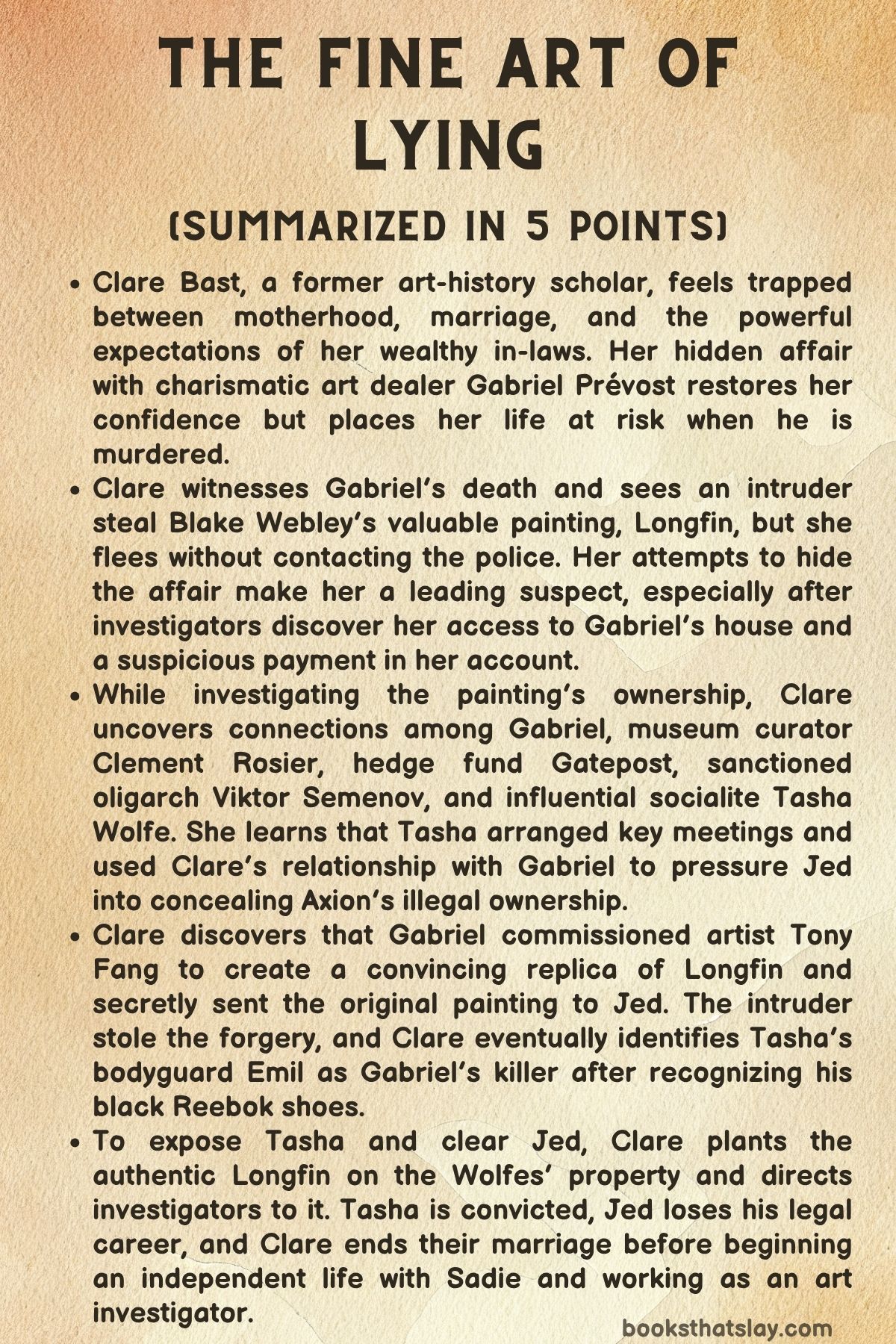
Summary
Clare Bast stands naked beside the body of Gabriel Prévost, watching his blood spread across the floor. Her thoughts retreat into art history as she struggles to decide whether she should call the police or erase every trace of her presence and escape.
Her husband, Jed, and their three-year-old daughter, Sadie, are sleeping at home, unaware that Clare has been conducting an affair. Calling the authorities would reveal everything, threaten her marriage, and expose her to the powerful Bast family, so she wipes the room, gathers her possessions, and leaves Gabriel behind.
Two months earlier, Clare is living in a privileged but emotionally restrictive world. She loves Sadie deeply, yet motherhood has consumed the academic, intellectual, and independent parts of her personality.
Jed appears warm and devoted, but he often makes decisions without considering the practical burdens they create for Clare. His purchase of a rabbit for Sadie reflects this pattern, since he enjoys presenting the gift while Clare expects to handle its care.
The Bast family’s wealth intensifies Clare’s sense of powerlessness. Jed’s mother, Dorothy, interferes with Sadie’s upbringing, judges Clare’s background, and treats her abandoned dissertation as proof that she has failed to fulfil her potential.
At a party hosted by hedge-fund manager Alec Wolfe and his wife, Tasha, Clare meets Gabriel, a French art dealer. Their conversation about contemporary art immediately restores a sense of intellectual excitement that Clare has not experienced for years.
Tasha encourages their connection and later takes Clare to Gabriel’s gallery. There Clare discusses her unfinished dissertation on painter Blake Webley and learns that Gabriel possesses Webley’s important painting Longfin, recently sold by the Museum of Contemporary Art.
Gabriel invites Clare to see the painting in his home. She initially refuses, but she returns the next day and experiences the work in private, away from museum crowds and academic expectations.
Standing before Longfin, Clare and Gabriel surrender to their attraction. Their sexual encounter becomes an act of rebellion against the cautious, dutiful identity Clare has adopted within her marriage.
Clare is initially overwhelmed by guilt, but the affair also makes her feel alert, desired, and intellectually alive. She remembers how her difficult pregnancy, Sadie’s premature birth, her mother’s death, and Dorothy’s interference gradually separated her from her academic ambitions.
Gabriel and Clare continue meeting while pretending that she may work for him as an art consultant. Clare begins living two separate lives: an attentive wife and mother uptown, and an adventurous lover connected to the art world downtown.
Their relationship extends beyond physical desire. Gabriel understands Clare’s connection to art, while Clare recognizes his dissatisfaction with the increasingly commercial nature of his profession.
During a visit to the Whitney Museum, Clare once again experiences the emotional response to art that disappeared after Sadie’s birth. However, she loses track of time and arrives late to collect Sadie, allowing Dorothy to recognize that Clare’s new activities may threaten the family’s control.
Dorothy eventually confronts Clare and reveals that she knows about Gabriel. She threatens to use the Bast family’s money, legal connections, and records of Clare’s postpartum anxiety to help Jed obtain custody of Sadie.
Terrified, Clare prepares to end the affair. Before she can explain the threat, Gabriel independently tells her that they should stop seeing each other because she has far more to lose than he does.
Clare returns to her family but cannot suppress the identity Gabriel helped revive. After meeting former graduate-school friends at the Hotel Chelsea, she attends the anniversary celebration of Gabriel’s gallery and reunites with him.
They return to his house, where Clare notices that Longfin is still hanging on the wall. While she is upstairs, an intruder enters the building, and Clare hides beneath the bed.
She sees only the intruder’s black Reebok shoes. Gabriel confronts him downstairs, a gun is fired, and the intruder removes Longfin before leaving.
Clare finds Gabriel dying but chooses not to summon help. She fears the affair will become public, Dorothy will take Sadie, and her entire domestic life will be destroyed.
Returning home, Clare invents a precise arrival time and acts as though nothing happened. When news of Gabriel’s death appears the following morning, she performs shock while accepting Jed’s sincere comfort.
Detectives Pam Breznick and Greg Nguyen soon question Clare. Jed, acting as her protective lawyer, restricts the interview, but the detectives later approach Clare alone and reveal that Beatriz Barros, Gabriel’s former wife, told them about the affair.
Clare admits the relationship but denies being at Gabriel’s house during the murder. Because the door showed no forced entry and Clare knew the security code, she becomes an obvious suspect.
Remembering that the intruder took Longfin, Clare realizes the painting may provide an alternative motive. She cannot reveal this knowledge, however, because only someone present during the killing could know the work had been removed.
Clare begins investigating privately. Gabriel’s business partner, Michael Kline, tells her that the gallery has no record of the painting’s final buyer, even though Gabriel claimed he was holding it temporarily for a client.
At Gabriel’s memorial, Clare questions museum curator Clement Rosier, Tasha, Michael, and Beatriz. She learns that the museum received eighteen million dollars for Longfin, but the identity of the buyer was concealed.
An art investigator named Elise Vargas then approaches Clare. Elise has been hired to locate Longfin and already knows about Clare’s affair, her scholarly interest in Webley, and the police investigation.
Clare refuses to tell Elise that she witnessed the theft. Her situation becomes more dangerous when she discovers an unexplained fifty-thousand-dollar payment from Kallsten Holdings, a Cyprus-based shell company.
The transfer makes Clare appear financially connected to the missing painting. Her access to Gabriel’s home, her expertise in Webley, and her affair now support a convincing theory that she participated in theft or murder.
Clare eventually confesses the full story of the murder night to Elise. Elise reveals that Gabriel’s estate is missing eighteen million dollars and that records show he borrowed money to purchase Longfin without ever receiving repayment from a buyer.
Kallsten is linked to Axion, a major investor in Gatepost, Alec Wolfe’s hedge fund. Clare begins to suspect that powerful financial interests selected her as a convenient scapegoat.
As Clare prepares to confess everything to Jed, she notices that he knows a phrase Gabriel used inaccurately to describe Webley’s work. She also learns that Jed secretly visited the family’s East Hampton property.
Searching Jed’s phone, Clare finds documents concerning Axion. She then travels to East Hampton and discovers Longfin hidden in a shipping crate inside a neglected closet.
Believing that Jed may have killed Gabriel or participated in the theft, Clare removes the painting and hides it at her friend Mina’s apartment. When she returns home, she finds Jed being arrested.
Clare finally confronts him and admits the affair. Jed denies killing Gabriel and explains that Axion is secretly owned by Viktor Semenov, Tasha’s Russian godfather and a sanctioned oligarch.
Jed had discovered the ownership during a compliance review at Gatepost. Reporting Viktor could have frozen hundreds of millions of dollars and destroyed Alec’s fund.
Tasha had threatened Jed by suggesting that Clare and Gabriel were involved in Axion’s purchase of Longfin. By connecting Clare to Gabriel and the painting, she could make Clare appear involved in financial crime and pressure Jed into abandoning the sanctions investigation.
Jed claims Longfin was delivered to him before Gabriel’s murder, and a building log later supports his account. Clare remains confused because she personally saw another Longfin removed from Gabriel’s wall.
Emails obtained by Elise reveal that Tasha arranged Gabriel’s connection to Axion, encouraged him to offer Clare employment, promoted Clare as a Webley expert, and shaped the museum’s decision to sell Longfin. She had identified what each person desired and quietly placed them where they could serve her interests.
Jed admits that he visited Gabriel after Tasha’s threat. He warned Gabriel that Axion belonged to Viktor and demanded that he end the affair.
Gabriel reacted angrily upon realizing that Tasha had manipulated both of them. He deleted his Axion-related files and soon ended his relationship with Clare in an attempt to protect her.
Clare then visits artist Tony Fang and discovers that Gabriel commissioned him to produce a replica of Longfin. Tony believed the copy would never be sold as authentic, but he did not know Gabriel’s complete plan.
Clare compares the two paintings and concludes that the work delivered to Jed was the original. The painting removed by the intruder was Tony’s forgery.
Gabriel had apparently agreed to participate in an arranged theft and insurance scheme while secretly preventing Viktor from receiving the real masterpiece. He placed the forgery on his wall and sent the original to Jed, who understood Axion’s hidden ownership.
The intruder was supposed to remove the painting, but Gabriel’s presence led to violence. His death was therefore an unintended result of a planned crime rather than a purely romantic confrontation.
Clare confronts Tasha and accuses her of orchestrating the transaction, manipulating the affair, and arranging the theft. During the confrontation, Tasha’s bodyguard Emil enters wearing black Reebok shoes.
Clare immediately recognizes him as the intruder who shot Gabriel. Her reaction alerts Tasha and Emil that she witnessed more than she has admitted.
The police refuse to accept Clare’s accusation because she still will not reveal that she was hiding beneath Gabriel’s bed. Understanding that the full story is too complicated to prove quickly, Clare decides to create visible evidence.
She removes the original canvas from its stretcher, hides it beneath the bedding in Noodle’s cage, and transports it to the Wolfes’ Southampton property. She plants it in a shed and anonymously directs Elise and the police to its location.
The discovery of the authentic Longfin on Wolfe property gives investigators a direct connection among Tasha, Emil, the stolen work, and Gabriel’s murder. Clare has adopted Tasha’s method by guiding others toward a conclusion through carefully positioned information.
Clare also informs Viktor that the painting delivered through Tasha’s arrangement was a forgery. Tasha is left facing both criminal investigation and the anger of the oligarch she failed.
Emil eventually cooperates with prosecutors, and his testimony helps convict Tasha of theft and manslaughter. Jed’s murder charge is dropped, though his decision to conceal the sanctions problem results in professional punishment and disbarment.
Jed hopes that surviving the crisis will allow him and Clare to repair their marriage. Clare refuses, recognizing that she has spent years adapting herself to his family, ambitions, preferred lifestyle, and desire for more children.
One year later, Clare and Sadie live independently in South Harlem. Clare and Jed are divorced but continue to share responsibility for their daughter.
The authentic Longfin is donated to the Metropolitan Museum of Art, where it remains available to the public. Clare leaves her doctoral program and begins working with Elise as an art investigator, combining her scholarship with the instincts and confidence developed during the case.
Clare accepts responsibility for her decisions without allowing guilt to define her permanently. She no longer sees herself as a passive wife, failed scholar, or victim of manipulation, but as someone capable of recognizing danger, shaping her own future, and claiming ownership of her identity.
Characters
Clare Bast
Clare is the central character and the emotional foundation of The Fine Art of Lying. She begins as an intelligent but dissatisfied woman whose identity has been narrowed by marriage, motherhood, grief, and the expectations of her wealthy in-laws.
Her love for Sadie is unquestionable, but motherhood has required sacrifices that no one around her fully acknowledges. Because she feels ashamed of resenting those sacrifices, she hides her frustration beneath the appearance of a capable and contented mother.
Clare’s abandoned dissertation represents more than an unfinished academic project. It symbolizes a former self who believed that knowledge, professional recognition, and art could provide an independent life.
Her affair with Gabriel is morally damaging, but it also reveals needs that have remained unspoken for years. She wants intellectual recognition, physical freedom, unpredictability, and the right to exist outside her roles as Jed’s wife and Sadie’s mother.
Clare’s decision to leave Gabriel without calling the police is her defining moral failure. It is motivated by fear rather than cruelty, yet it creates a chain of lies that places both her and Jed in danger.
Her investigative growth is gradual and convincing. Initially, she reacts to threats and attempts to preserve appearances, but she eventually learns to gather information, interpret motives, challenge powerful people, and create strategies of her own.
Clare is not presented as purely innocent or heroic. She repeatedly withholds evidence, manipulates friends, hides a priceless painting, and plants evidence, but the book allows these actions to emerge from a combination of self-preservation, guilt, intelligence, and increasing determination.
Her final decision to leave Jed demonstrates that solving the murder is not enough. Clare must also reject the larger structure that taught her to accept dependence, conceal dissatisfaction, and organize her future around other people’s desires.
Jed Bast
Jed initially appears to be an affectionate husband, responsible father, and principled lawyer. His warmth is genuine, but his optimism often prevents him from recognizing the emotional consequences of his decisions.
He assumes that Clare will eventually want more children, accept his family’s lifestyle, and continue adapting to the future he imagines. These assumptions reveal a form of control that is gentler than Dorothy’s but still limits Clare’s autonomy.
Jed’s decision to buy Sadie a rabbit illustrates his personality. He values the beauty of the gesture while leaving Clare to manage its practical consequences, reflecting how he often confuses good intentions with genuine partnership.
His secrecy concerning his failure to become a partner at his father’s firm shows that Clare is not the only dishonest spouse. Jed hides humiliation because he wants to preserve the image of effortless competence that has shaped his position within the Bast family.
His discovery of Viktor Semenov’s control of Axion creates his central ethical test. Although he understands the legal duty to report the sanctioned owner, he allows Tasha’s threats and his fear for Gatepost to silence him.
Jed claims that he acted to protect Clare, but career ambition and financial self-interest also influence him. His compromise exposes the gap between his stated moral standards and his actual behaviour when those standards become costly.
His anger over Clare’s affair is justified, yet his desire to restore the marriage too quickly shows that he does not fully understand the dissatisfaction that existed before Gabriel. Jed sees forgiveness as a way to resume their shared life, while Clare recognizes that the structure of that life must change.
By the end, Jed is neither a villain nor an innocent victim. He loses his profession and marriage because he allowed fear, privilege, and self-protection to override legal responsibility and emotional honesty.
Sadie Bast
Sadie is Clare and Jed’s young daughter, and her presence shapes nearly every major decision Clare makes. Clare’s fear of losing her explains why Dorothy’s threat is so effective and why Clare initially values secrecy above justice.
Sadie also represents the tenderness within Clare’s experience of motherhood. Their pancake mornings, games, conversations, and shared routines show that Clare’s frustration with maternal expectations does not weaken her love for her child.
Her insistence on naming the rabbit Noodle reveals a small but meaningful independence. Clare quietly encourages this resistance because she wants Sadie to develop an identity that cannot be controlled by Dorothy or the Bast family’s standards.
Sadie remains largely protected from the adult conspiracy, yet she absorbs its emotional effects. She notices Clare’s distress, Jed’s absence, the family’s tension, and the sudden changes in her living arrangements.
Clare’s final separation from Jed is partly intended to create a healthier example for Sadie. She wants her daughter to understand that love does not require surrendering personal ambition, identity, or choice.
Gabriel Prévost
Gabriel is a charismatic art dealer whose relationship with Clare begins the central crisis. He recognizes her intelligence immediately and responds to her as a scholar and individual rather than primarily as a wife or mother.
His attraction to Clare is genuine, but he is also connected to Tasha’s financial plan before the affair begins. This creates uncertainty about the degree to which his professional attention was initially encouraged by hidden motives.
Gabriel’s conversations with Clare reveal his frustration with the contemporary art market. He once viewed dealing as a creative activity through which talent could be discovered and cultural value shaped, but he has become tired of secrecy, speculation, and commercial pressure.
He is not entirely honest with Clare. He conceals the true financial circumstances surrounding Longfin and appears willing to participate in an insurance scheme involving Axion and a staged theft.
His decision to commission a replica, however, suggests an attempt to resist Tasha and Viktor. By sending the original to Jed, Gabriel creates a safeguard that may expose the scheme and prevent a sanctioned oligarch from secretly obtaining the work.
Gabriel’s decision to end the affair after Jed’s warning demonstrates concern for Clare. He realizes that Tasha has used their relationship as leverage and attempts to remove Clare from danger without explaining the full conspiracy.
His death transforms him from Clare’s lover into a difficult moral absence. She mourns the man who revived her connection to art while gradually confronting the fact that he was also secretive, compromised, and willing to participate in deception.
Tasha Wolfe
Tasha is the primary architect of the conspiracy and the most skilled manipulator in The Fine Art of Lying. She rarely commands people openly; instead, she identifies their desires and creates circumstances in which they choose the actions she needs.
She understands Clare’s hunger for professional recognition and introduces her to Gabriel. She recognizes Gabriel’s attraction to profitable deals, Clement’s institutional ambitions, Jed’s fear for his family, and Alec’s dependence on Axion’s money.
Tasha’s apparent generosity makes her especially dangerous. She presents introductions, professional opportunities, museum connections, and social access as acts of friendship while quietly turning each favour into leverage.
Her connection to Viktor Semenov reveals the larger purpose behind her actions. She arranges the purchase of Longfin for a sanctioned oligarch and uses Clare’s visible involvement with Gabriel to discourage Jed from reporting Axion’s hidden ownership.
Tasha maintains distance from direct criminal conduct. She allows Gabriel to manage the painting, Emil to carry out the theft, Clement to propose the museum sale, and Jed to silence himself.
Her language remains carefully deniable even when Clare confronts her. She offers alternative explanations, assigns responsibility to others, and portrays every outcome as the independent choice of another person.
Tasha’s eventual defeat occurs because Clare adopts a similar understanding of narrative and incentive. By planting Longfin on Wolfe property and informing Viktor about the forgery, Clare destroys the network of trust that protected Tasha.
Dorothy Bast
Dorothy is Jed’s controlling mother and an embodiment of inherited privilege. She believes that wealth, connections, and family reputation give her the right to supervise Clare’s marriage and influence Sadie’s upbringing.
Her behaviour is often disguised as concern. She changes Sadie’s clothes, interferes with school arrangements, criticizes Clare’s professional failures, and expects gratitude for advantages the Bast family has provided.
Dorothy’s threat to use Clare’s postpartum anxiety in a custody battle is particularly cruel. She understands that Clare’s greatest vulnerability is the possibility of losing Sadie and uses that fear to enforce obedience.
She also reflects the exclusionary nature of the Bast family. After Jed’s arrest, she removes Clare from discussions and treats her as an outsider despite previously insisting that Clare behave as a loyal wife.
Dorothy’s resentment arises partly because Clare does not fully admire the life she has married into. Clare benefits from the family’s resources but continues to see their limitations, making her difficult for Dorothy to control through gratitude alone.
Elise Vargas
Elise is an independent investigator specializing in art and antiquities. She operates within a world where collectors, insurers, dealers, and estates often require information that cannot be obtained through ordinary police procedures.
Her relationship with Clare begins as a cautious exchange. Elise knows important facts about Gabriel’s estate but refuses to provide them until Clare stops concealing what happened during the murder.
Elise values truth as a form of leverage rather than as an abstract moral duty. This initially unsettles Clare, but it also teaches her how investigations are conducted within systems built on secrecy.
Unlike Tasha, Elise uses information without pretending that manipulation is friendship. Her directness makes her a demanding but ultimately reliable ally.
Elise recognizes Clare’s intelligence and later gives her a professional opportunity. Their partnership allows Clare to transform the academic knowledge she once considered wasted into practical expertise and financial independence.
Maggie
Maggie is Clare’s closest and most dependable friend. As an investigative journalist, she brings both emotional loyalty and practical curiosity to Clare’s crisis.
She repeatedly urges Clare to tell Jed, seek legal protection, and stop relying on increasingly dangerous lies. Her advice provides a moral counterweight to Clare’s instinct for secrecy.
When Maggie comes to New York, she creates the first environment in which Clare can describe the affair, the murder, the painting, the shell company, and Jed’s arrest without being threatened or judged. Her presence demonstrates the value of friendship based on honesty rather than status or obligation.
Maggie cannot solve Clare’s problems, but she prevents isolation from controlling Clare completely. She represents the personal support Clare neglected when she withdrew into marriage and motherhood.
Beatriz Barros
Beatriz is Gabriel’s former wife and an accomplished Brazilian artist. Although their marriage ended, she and Gabriel remained emotionally close and continued to regard one another as family.
Her willingness to tell the detectives about Clare’s affair makes her appear threatening from Clare’s perspective. However, Beatriz is motivated by the desire to help uncover the truth about Gabriel’s death rather than by romantic jealousy.
She complicates Clare’s understanding of Gabriel because she knew many details about his life but apparently knew nothing about Longfin. This suggests that Gabriel concealed his most dangerous financial activities even from those closest to him.
Her eventual donation of the authentic painting to the Metropolitan Museum restores Longfin to public view. The decision honours Gabriel while rejecting the private ownership and hidden financial structures that contributed to his death.
Clement Rosier
Clement is a curator at the Museum of Contemporary Art who oversees the deaccession of Longfin. He defends the sale as a way to diversify the museum’s collection and fund the acquisition of contemporary works.
His hostility toward Clare initially makes him seem corrupt. He dismisses her expertise, insults her academic status, and resists questions that could expose the museum to scandal.
Clare eventually shows him that Tasha guided his decision through suggestions about funding, career advancement, and institutional priorities. Clement believed he was exercising independent judgment when he was actually serving a hidden financial plan.
His character demonstrates that manipulation does not always require direct bribery or orders. Ambition, insecurity, and professional ideology can guide a person toward a desired action while preserving the illusion of independence.
Emil
Emil is the Wolfe family’s bodyguard and the person who physically carries out the planned theft. His black Reebok shoes become the only detail Clare can remember clearly from beneath Gabriel’s bed.
He represents the direct violence that powerful people delegate to employees. Tasha creates the plan and protects herself through careful language, while Emil enters the house, removes the painting, and fires the fatal shot.
His decision to cooperate with prosecutors eventually provides the testimony needed to convict Tasha. Once the network protecting him collapses, his loyalty is replaced by self-preservation.
Alec Wolfe
Alec is Tasha’s husband and the head of Gatepost, the hedge fund employing Jed. His business depends heavily on Axion’s investment, making Viktor’s hidden ownership a threat to the firm’s survival.
Although Tasha directs most of the conspiracy, Alec benefits from Jed’s silence. His willingness to protect the fund places financial stability above legal compliance.
Alec remains less visible than Tasha because she handles the social influence and personal manipulation surrounding the scheme. His position nevertheless illustrates how respectable financial institutions can depend upon concealed money and compromised decision-making.
Viktor Semenov
Viktor is a sanctioned Russian oligarch who secretly controls Axion. Although he remains physically distant from most events, his wealth motivates the museum sale, Gatepost’s silence, and Tasha’s manipulation.
Longfin is valuable to him not simply as art but as a private asset that can be acquired through hidden financial structures. His use of shell companies and intermediaries allows him to operate while avoiding direct public connection to the transaction.
Clare’s decision to tell Viktor that Tasha delivered a forgery changes the balance of power. Tasha’s authority depends partly on satisfying him, and her failure places her under pressure from the very person she was trying to serve.
Michael Kline
Michael is Gabriel’s business partner and the executor of his estate. He initially appears unable or unwilling to explain Gabriel’s private acquisition of Longfin.
His decision to hire Elise shows that he recognizes serious irregularities in the estate. Gabriel borrowed eighteen million dollars for the painting, yet there is no documented buyer, repayment, or completed transfer.
Michael’s limited knowledge demonstrates the secrecy Gabriel maintained even within his professional partnership. It also confirms that Gabriel’s private dealings had moved beyond the ordinary operations of the gallery.
Tony Fang
Tony is an artist associated with Gabriel’s gallery. His memorial remarks reveal both loyalty to Gabriel and resentment toward the commercial demands surrounding their professional relationship.
He agrees to reproduce Longfin because Gabriel assures him that the copy will not be sold or used to deceive a collector. Tony believes he is assisting with a private or conceptual project rather than committing fraud.
His incomplete studies provide the physical evidence that confirms the existence of two paintings. Without Tony’s admission, Clare could not reconcile the original found in East Hampton with the work removed during Gabriel’s murder.
Tony’s role raises questions about artistic authorship and responsibility. He creates the object used in the crime but lacks knowledge of the full scheme, placing him between innocent craftsman and unwilling participant.
Detective Pam Breznick
Breznick is the more forceful of the two detectives investigating Gabriel’s death. She recognizes that Clare is withholding information and steadily increases pressure on her.
From Breznick’s perspective, Clare’s behaviour is highly suspicious. Clare has a secret affair, access to Gabriel’s home, knowledge of the missing painting, unexplained money, and a changing account of events.
Breznick’s skepticism is therefore reasonable, even when it frustrates Clare. The case becomes difficult because Clare offers important facts only when forced, making each new revelation appear like a calculated attempt to redirect suspicion.
Her refusal to accept unsupported accusations against Emil shows the limits of intuition within criminal investigation. Clare knows the truth, but Breznick requires evidence that can survive legal scrutiny.
Greg Nguyen
Nguyen works alongside Breznick and participates in the questioning of Clare and Jed. He is less individually developed, but his presence reinforces the pressure surrounding the investigation.
His reactions to the Bast household, including being startled by Noodle, occasionally interrupt the tension. Nevertheless, he remains part of a team that correctly recognizes significant inconsistencies in Clare’s story.
Mina
Mina is Clare’s friend and another mother within her social circle. Her pregnancy prompts Clare to express the resentment, exhaustion, and loss of identity hidden beneath the expected performance of cheerful motherhood.
Mina is uncomfortable with Clare’s honesty, which shows how difficult it is for mothers in their environment to discuss dissatisfaction without appearing unstable or ungrateful. Even so, she assists Clare by collecting Sadie and later storing the crate containing Longfin without demanding explanations.
Her trust makes her vulnerable to Clare’s deception. Mina represents the innocent people drawn into the crisis because Clare repeatedly depends on others without telling them what risks they are carrying.
Lauren Bast
Lauren is Jed’s sister and a comfortable member of the wealthy Bast family. Her accidental encounter with Clare and Gabriel contributes to Dorothy’s discovery of the affair.
She does not display Dorothy’s overt aggression, but she participates in the family culture that makes Clare feel observed and evaluated. Her conversations about property, money, and social status reinforce the environment Clare finds restrictive.
Abe Bast
Abe is Jed’s father and a recently retired lawyer. He appears passive and somewhat directionless after leaving professional life.
His limited role contrasts with Dorothy’s authority. Although the Bast family’s status is partly associated with his legal career, Dorothy is the person who actively manages relationships, reputation, and control.
Grant
Grant is Lauren’s venture-capitalist husband. His presence expands the portrait of the Bast family’s affluent social and professional world.
He contributes to conversations centred on expensive homes, investments, and status. Although he has little direct role in the crime, he helps establish the environment in which financial achievement is treated as a natural measure of personal worth.
Cassandra and Lev
Cassandra and Lev are Clare’s former graduate-school friends. Meeting them reminds Clare of the academic and cultural community she abandoned after becoming a mother.
Their conversation about exhibitions, research, curators, and professional gossip restores Clare’s awareness of how isolated she has become. They also lead her toward Gabriel’s gallery celebration, indirectly placing her on the path back to his house.
They are not responsible for Clare’s decision, but their presence reminds her of the identity she wants to reclaim. The encounter shows how nostalgia can become a powerful justification for risk.
Noodle
Noodle is Sadie’s rabbit and an unusual but meaningful presence throughout the story. The animal begins as another responsibility created by Jed’s grand gesture and left for Clare to manage.
Noodle’s escapes and noises interrupt tense moments, introducing disorder into carefully controlled domestic spaces. The rabbit later becomes central to Clare’s plan when she hides the authentic Longfin beneath the cage bedding.
This transformation gives Noodle symbolic importance. What first represents Clare’s invisible domestic labour eventually becomes the means by which she transports and protects a multimillion-dollar artwork.
Themes
Identity, Motherhood, and Personal Autonomy
Clare’s crisis begins long before the affair or murder because her individual identity has gradually been replaced by a collection of roles defined by other people. She is expected to be Jed’s grateful wife, Sadie’s endlessly patient mother, Dorothy’s compliant daughter-in-law, and a socially polished member of the Bast family.
Motherhood gives Clare profound love, but it also exposes the unequal expectations placed on women. Jed can imagine more children as part of a desirable future, while Clare understands that pregnancy, physical danger, daily care, emotional vigilance, and professional sacrifice will fall primarily upon her.
Her abandoned dissertation becomes evidence of this imbalance. The people around Clare speak about finishing it as though the problem is poor discipline, rarely acknowledging the trauma of Sadie’s birth, Clare’s grief after losing her mother, or the constant demands of childcare.
Gabriel’s attention awakens a version of Clare who exists outside domestic usefulness. He listens to her ideas, shares her interest in art, desires her physically, and treats her intellectual passion as something valuable rather than unfinished.
Yet Clare’s eventual independence does not come from choosing Gabriel over Jed. It comes from recognizing that neither man should determine the shape of her life.
By the end of The Fine Art of Lying, Clare accepts motherhood without allowing it to erase her ambitions. Her divorce, new home, investigative career, and shared parenting arrangement show her creating an identity in which love for Sadie and personal autonomy can exist together.
Lies, Manipulation, and the Construction of Truth
Lying appears in many forms, ranging from impulsive concealment to carefully engineered systems of control. Clare lies about the affair, her presence at Gabriel’s house, the missing painting, the unexplained payment, and her actions after Jed’s arrest.
Each lie appears to solve an immediate problem, but it also creates the conditions for another. Leaving the murder scene forces Clare to invent a timeline, deny the affair, hide evidence, investigate privately, deceive friends, and manipulate the police.
Jed’s dishonesty is less dramatic but equally important. He hides his professional failure, conceals his visit to Gabriel, and abandons his legal duty to report Viktor’s ownership of Axion.
Tasha operates on a more advanced level because she rarely makes direct false statements. She creates selective impressions, arranges meetings, provides opportunities, and encourages people to interpret her actions as friendship or professional support.
Her strength comes from allowing others to believe they are acting independently. Clare chooses Gabriel, Clement chooses to sell Longfin, Jed chooses silence, and Emil carries out the theft, while Tasha remains outside the visible chain of responsibility.
The novel also shows that truth must be made persuasive, not merely known. Clare knows Emil killed Gabriel, but her concealed presence makes her accusation appear unreliable.
She ultimately defeats Tasha by creating a simpler narrative that investigators can follow. Planting Longfin on Wolfe property is deceptive, yet it exposes a larger truth that ordinary testimony could not prove.
Art, Authenticity, and Ownership
Longfin functions as artwork, financial asset, evidence, weapon, and symbol of authenticity. Clare initially values it as a public cultural object whose significance should be experienced rather than privately possessed.
Its sale by the museum raises questions about whether institutions have the right to remove important works from public access. Clement defends the decision through institutional priorities, but the transaction allows secret wealth to determine who may see and control the painting.
The existence of Tony’s replica complicates the relationship between appearance and authenticity. The copy resembles Webley’s original closely enough to deceive the intruder, yet Clare senses that it lacks the physical and emotional force she associates with the genuine work.
Her response suggests that authenticity cannot be reduced entirely to visual similarity or market certification. History, material presence, artistic intention, and personal perception all contribute to an artwork’s meaning.
Gabriel’s use of the forgery is morally uncertain. He participates in a planned deception but also protects the original from Viktor and creates a form of resistance against Tasha’s financial arrangement.
The painting’s final donation to the Metropolitan Museum resolves its journey by returning it to public view. Instead of remaining hidden in an oligarch’s collection, stored as evidence, or controlled by private wealth, Longfin becomes available to anyone who wishes to experience it.
Clare’s career change follows the same movement from theory to direct engagement. She no longer studies art solely through academic language but works within the practical conflicts surrounding authenticity, ownership, theft, and cultural value.
Wealth, Class, and Institutional Power
The Bast and Wolfe families inhabit environments where money provides more than comfort. Wealth creates access to schools, museums, lawyers, judges, property, financial networks, and social authority.
Dorothy’s threat is credible because she possesses the resources to reshape the legal story of Clare’s motherhood. Clare understands that personal love for Sadie may offer little protection against a family able to hire stronger lawyers and present private struggles as evidence of instability.
Tasha exercises power through similar networks. As a museum trustee, hedge-fund spouse, social figure, and goddaughter of Viktor, she can connect people who would never recognize that they are participating in the same plan.
Institutions that appear respectable become vulnerable to private influence. MoCA’s deaccession is guided by a trustee’s hidden interests, Gatepost depends on concealed oligarch money, and international shell companies prevent investigators from identifying ownership.
Even Jed’s legal principles weaken under financial pressure. Reporting Viktor could destroy Gatepost, damage his career, and expose Clare, so he chooses silence despite understanding the law.
Clare’s outsider status allows her to recognize aspects of this system that its beneficiaries treat as normal. She has access to privilege through marriage but never feels fully secure within it, making her both dependent on and suspicious of the world around her.
Her eventual victory does not eliminate structural inequality, but it shows how knowledge can disrupt it. By tracing relationships, understanding incentives, and controlling the placement of Longfin, Clare turns an object desired by the powerful into evidence capable of exposing them.